

Obstetrics and Gynaecology · Jaipur Hospital
D&C (Dilation and Curettage) in Jaipur
When you face unexpected bleeding or pregnancy loss, Jaipur Hospital offers careful evaluation, clear answers, and a straightforward care plan.
- Serving Jaipur since 1991 (35 years)
- NABH accredited
- 24×7 emergency & ICU
- Cashless: RGHS, MAA Yojana, CGHS + 22 insurers
- Procedure time
- 15 to 30 minutes
- Anaesthesia
- Short General or IV Sedation
- Recovery
- 1 to 2 days for routine work
- Price
- ₹15,000 to ₹45,000typical range in India; ask us for an estimate
Worry and unexpected bleeding
Heavy bleeding and difficult questions
Unexpected bleeding or a sudden pregnancy loss brings physical discomfort and emotional strain. You may wonder what is happening inside your body and whether you need a procedure.
-
Prolonged bleeding
Bleeding and cramping that continue longer or heavier than a typical menstrual period.
-
Incomplete tissue clearance
Uncertainty over whether pregnancy tissue has cleared completely after an early loss.
-
Need for diagnosis
Abnormal uterine bleeding that requires tissue sampling to evaluate the underlying cause.
After the 10th week of pregnancy, there is a higher risk of an incomplete miscarriage.
Why Jaipur Hospital
You may feel worried about physical pain, hospital time away from home, and the cost of unexpected care.
Your care plan
Your first steps with us
- 1 Consult your gynaecologist in our OPD
- 2 Review diagnostic scans and blood tests
- 3 Discuss your procedure and anaesthesia options
- 4 Rest during daycare stay before discharge
how the operation is done
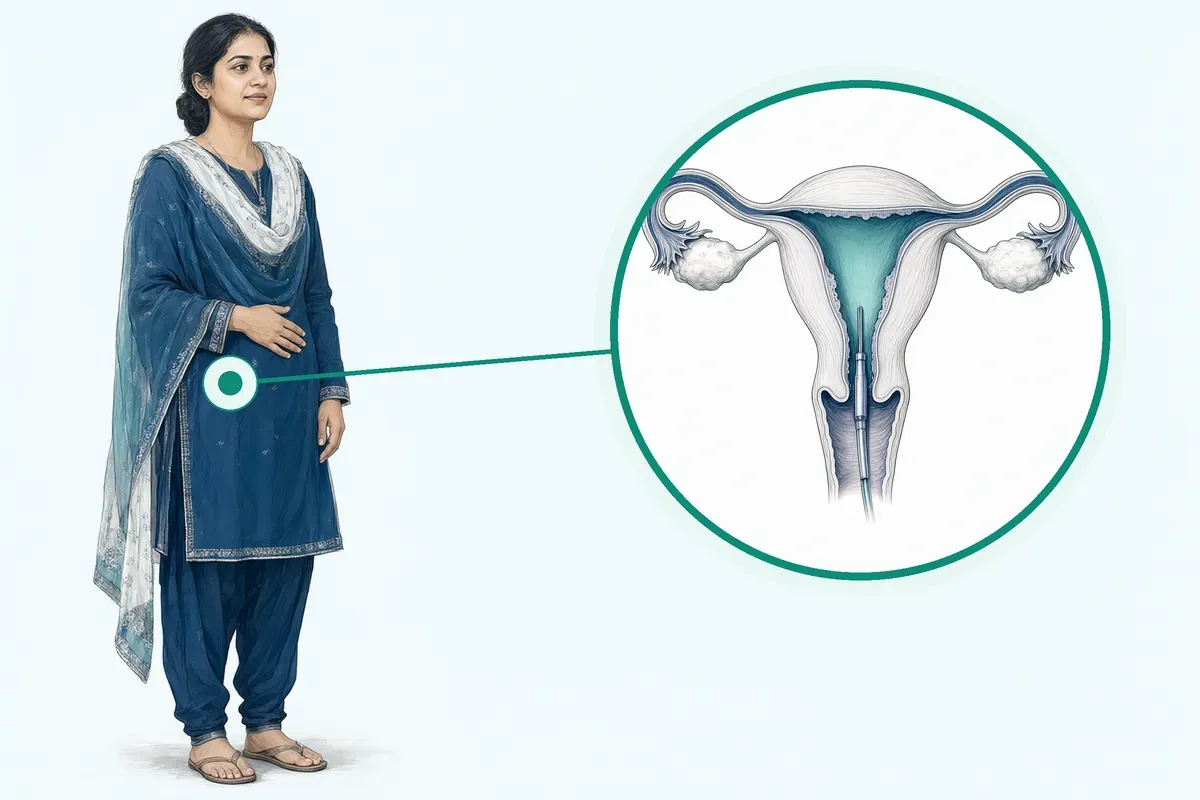
A D&C is a minor procedure to clear uterine tissue or sample the uterine lining, typically completed in 15 to 30 minutes under anaesthesia.
-
Sharp Curettage
Your surgeon will discuss using a traditional metal curette to remove uterine tissue.
-
Suction Curettage (MVA/EVA)
Your surgeon will discuss vacuum aspiration to remove tissue with less physical trauma.
-
Hysteroscopic D&C
Your surgeon will discuss using a small visual camera to guide tissue or polyp removal.
-
Medical Management (Misoprostol)
Your surgeon will discuss non-surgical tablet options to help the uterus expel retained tissue.
Why patients trust us
- 1991 Serving Jaipur for 35 years
- NABH Accredited hospital
- 3 Obstetrics and Gynaecology consultants
- 24×7 Emergency, ICU and ambulance
- 25 Cashless schemes and insurers
clinical research on D&C and recovery
-
1 to 2 days
Most women resume regular activities one or two days after having a D&C.
-
Within a week
When tissue samples are sent for laboratory analysis, results are typically available within seven days.
-
0.03-0.6%
In clinical trials, severe adverse events requiring blood transfusion were uncommon.
If it is left untreated
Leaving retained tissue untreated can lead to prolonged bleeding and pelvic infection. It removes any leftover tissue to prevent heavy bleeding and infection.
life after treatment
Most women recover quickly and return to their regular daily routine within a few days.
-
Prompt return home
A daycare stay of 4 to 6 hours usually allows you to return home the same day.
-
Quick daily routine resumption
Most people return to routine work within one to two days after the procedure.
-
Clear diagnostic answers
Laboratory evaluation provides your doctor with tissue reports to plan any further care.

Frequently asked questions
Questions patients ask about d&c (dilation and curettage)
What is miscarriage management?
In short
Miscarriage management at Jaipur Hospital means the medical and surgical care offered when a pregnancy ends on its own before twenty weeks. The aim is to remove any remaining tissue from the uterus, control bleeding, and prevent infection. Options include waiting for the tissue to pass naturally, using medicines to help the uterus empty, or a minor procedure called dilation and curettage (D&C). Your gynaecologist will discuss which approach suits your situation.
In detail
Evidence shows that up to fifty percent of people who miscarry do not need a D&C because the tissue passes on its own. If the pregnancy is before ten weeks, a natural miscarriage is most likely.
After ten weeks the chance of an incomplete miscarriage rises, and a D&C may be needed to ensure the uterus is empty. Medical management with misoprostol causes uterine contractions to expel tissue.
A D&C is the most predictable treatment for early pregnancy loss and is also used to diagnose abnormal bleeding.
The procedure takes fifteen to thirty minutes under short general anaesthesia or IV sedation, and you usually go home the same day after four to six hours of observation.
A common belief
Many people think surgery is always needed.
What actually happens
In fact, up to half of miscarriages complete on their own, especially before ten weeks. Medicine can help the rest. D&C is reserved for when tissue remains or bleeding is heavy.
Your next step at Jaipur Hospital
If you have had a miscarriage or are bleeding in early pregnancy, contact the gynaecology OPD at Jaipur Hospital. The doctor will confirm the diagnosis with an ultrasound and blood tests, then explain each option.
Recovery after a D&C is usually one to two days for routine work, with light spotting for up to a month. A follow-up visit is typically scheduled within two weeks.
Which specialist should I see for miscarriage management?
In short
You should see a gynaecologist at Jaipur Hospital for miscarriage management. The hospital's Department of Gynaecology handles early pregnancy loss, abnormal uterine bleeding, and the surgical procedure called dilation and curettage (D&C). A gynaecologist is trained to diagnose the cause of bleeding, perform ultrasound scans, prescribe medical management, and carry out D&C under short general anaesthesia or IV sedation in the modular operation theatre.
In detail
Evidence confirms that a D&C is a minor surgical procedure used to remove tissue from the uterus and is the most predictable treatment for early pregnancy loss.
The procedure takes fifteen to thirty minutes and is done as daycare with a four to six hour stay. The gynaecologist will also send any removed tissue to the in-house pathology laboratory to check for abnormal cells, polyps, or cancer.
If you have an active pelvic infection, a bleeding disorder, uncontrolled diabetes or hypertension, or a known allergy to anaesthesia, the gynaecologist will assess whether D&C is safe or if medical management is preferred. The department works closely with the anaesthesia and critical care team for safe sedation.
A common belief
Some people think a general physician can manage this.
What actually happens
But only a gynaecologist can do the uterine procedure, interpret the pathology, and handle complications like heavy bleeding or infection. The anaesthesia team supports the sedation.
Your next step at Jaipur Hospital
Visit the gynaecology OPD at Jaipur Hospital during working hours or the 24×7 emergency department if bleeding is heavy. Bring any previous ultrasound reports and a list of medicines you take. The doctor will examine you, order blood tests and a fresh ultrasound, and discuss the options.
What treatment options are available for miscarriage management?
In short
Three main options are available: expectant management (waiting for natural passage), medical management with tablets such as misoprostol with or without mifepristone, and surgical management (D&C) under short general anaesthesia or IV sedation. Jaipur Hospital provides all three.
In detail
Expectant management avoids medicines and surgery; most women pass the tissue within a few hours to a couple of weeks. Medical management uses misoprostol to cause contractions; adding mifepristone beforehand increases the success rate and lowers the chance of needing surgery later.
Surgical management (D&C) takes 15 to 30 minutes, uses a curette or suction device, and is the most predictable way to empty the uterus. The gynaecologist will explain the pros and cons of each based on your gestation, bleeding, and preference.
A common belief
Many people think D&C is the only sure way, but studies show medical management with mifepristone plus misoprostol works well and avoids surgery for most women.
What actually happens
Expectant management is also safe if bleeding is not heavy.
Your next step at Jaipur Hospital
After the ultrasound and blood tests, the doctor will discuss which option suits you. If you choose D&C, you will need to fast for a few hours and arrange an attendant to take you home. Recovery is usually one to two days.
What can I safely do at home to manage symptoms before D&C treatment?
In short
Before a D&C at Jaipur Hospital, you can manage mild cramping with a warm compress on the lower abdomen and rest. Use sanitary pads for bleeding; do not use tampons or menstrual cups. Avoid vaginal douching or inserting anything into the vagina.
In detail
Evidence shows that during miscarriage, bleeding and cramping are heavier than a normal period, and tissue may pass as large clots or grey-white material. Light spotting can continue for four to six weeks.
Over-the-counter pain relief such as paracetamol may help, but avoid aspirin or other blood thinners unless your surgeon advises otherwise. Stay hydrated and monitor pad usage. Dangerous bleeding means soaking more than two large pads in an hour for two hours or more.
Chills, fever, severe pain, or foul-smelling discharge suggest infection and need immediate emergency care. Do not take misoprostol or any medication to induce passage without a prescription. Your surgeon may advise stopping certain medicines, especially blood thinners, a few days before the scheduled procedure.
A common belief
Some people try herbal remedies or borrow misoprostol tablets to speed things up.
What actually happens
That can cause uncontrolled bleeding or infection. Heavy bleeding — soaking two large pads an hour for two hours — or fever and severe pain are danger signs. Go to the emergency department immediately if they happen. Waiting for a scheduled D&C is usually safe if you follow these precautions.
Your next step at Jaipur Hospital
Keep a record of bleeding pattern and pain level to share at your consultation. Arrange for an attendant to stay with you and drive you home after the procedure, as sedation is used. Fasting instructions will be given if anaesthesia is planned.
How does the term "pregnancy loss" relate to miscarriage management?
In short
"Pregnancy loss" is the broad medical term for any non-viable pregnancy before 20 weeks, including miscarriage. At Jaipur Hospital, management options — expectant, medical, or surgical D&C — are offered based on the type and timing of the loss, your health, and your preference.
In detail
Evidence shows that up to 50 percent of people who miscarry do not need a D&C because the tissue passes naturally. For early loss, suction curettage is standard; hysteroscopic D&C is used when visual guidance helps.
Medical management with misoprostol, sometimes preceded by mifepristone, clears the uterus in about 97 percent of cases in studies. The term "pregnancy loss" simply groups these situations so the care team can discuss all evidence-based choices with you.
- Medical management with misoprostol, sometimes preceded by mifepristone, clears the uterus in about 97 percent of cases in studies.
A common belief
The term itself does not dictate treatment.
What actually happens
Many women pass tissue naturally. Others choose tablets or a short D&C. The surgeon explains each route — expectant, medical, or surgical — so you can pick what feels right for you.
Your next step at Jaipur Hospital
Your surgeon will confirm the diagnosis with ultrasound and blood tests, then explain each option's typical recovery of one to two days and price range of ₹15,000 to ₹45,000 for surgical management. You decide together which path fits your situation.
How will the diagnosis of miscarriage be confirmed and a viable pregnancy assessed?
In short
At Jaipur Hospital, the diagnosis is confirmed by transvaginal ultrasound and serial beta-hCG blood tests. The ultrasound checks for a gestational sac, yolk sac, foetal pole and cardiac activity. If the sac is above a certain size with no heartbeat, or if hormone levels do not rise appropriately, a non-viable pregnancy is diagnosed. Your gynaecologist will explain the findings clearly.
In detail
Guidelines from ACOG and RCOG recommend combining imaging with hormone trends rather than relying on a single test. A transvaginal scan gives the clearest view in early pregnancy.
If the mean sac diameter is 25 mm or more with no embryo, or the embryo measures 7 mm or more with no cardiac activity, the diagnosis is certain.
When findings are borderline, a repeat scan after 7 to 10 days and a second beta-hCG at 48 hours are used. A rise of less than 53% in 48 hours suggests non-viability. This stepwise approach avoids unnecessary intervention while ensuring safety.
A common belief
A single scan or one blood test is not enough.
What actually happens
Early findings can look unclear, so guidelines require a repeat scan after a week or a second hormone check before confirming the diagnosis.
Your next step at Jaipur Hospital
You will usually have the first scan and blood test on the same OPD visit. If a repeat scan is needed, it is scheduled within a week. Results are discussed at the follow-up, and a management plan is agreed with you. Bring any previous reports. To book a consultation at Jaipur Hospital, call 0141-2551500 or visit the OPD on Tonk Road.
How could this condition or its treatment affect future pregnancy?
In short
At Jaipur Hospital, a single miscarriage or a D&C rarely causes long-term fertility problems. Large studies show a modest association between prior surgical uterine evacuation and a slightly higher risk of preterm birth in the next pregnancy, with odds ratios around 1.19 to 1.52. Asherman's syndrome — scar tissue inside the uterus — is a rare complication of D&C that can alter menstrual flow and implantation. The risk rises with multiple procedures or infection. Our gynaecologists use atraumatic techniques and limit instrumentation to protect the endometrium.
In detail
The evidence comes from population-based cohorts comparing women with and without prior surgical evacuation. The absolute increase in preterm birth remains small. Asherman's syndrome is reported in a minority of cases, more frequently when sharp curettage is used aggressively or when infection supervenes.
Suction curettage and hysteroscopic guidance are associated with less endometrial trauma. Medical management with misoprostol avoids intrauterine instruments entirely. Most women resume normal cycles within two to three months and conceive without difficulty. A preconception evaluation can identify any cavity abnormality before you try again.
A common belief
Many women worry that one procedure ruins their fertility.
What actually happens
The data shows most women go on to have healthy babies. The risks are real but low, and careful technique makes them even lower.
Your next step at Jaipur Hospital
After your recovery, wait for two to three normal periods before attempting conception. If you have irregular bleeding, scanty periods, or difficulty conceiving, a hysteroscopic assessment may be offered. To plan your next steps with our gynaecology team, book a consultation at Jaipur Hospital by calling 0141-2551500.
Which symptoms or changes should prompt me to seek medical advice?
In short
Seek medical advice if you have heavy bleeding that soaks more than two large pads in an hour for two hours or more, severe abdominal pain not relieved by simple painkillers, fever or chills, foul-smelling vaginal discharge, or dizziness and fainting. Jaipur Hospital provides 24-hour emergency care for these symptoms.
In detail
Heavy bleeding can mean the uterus has not emptied completely, which may lead to anaemia or need for urgent D&C. Severe pain may indicate infection or an ectopic pregnancy, which is a medical emergency.
Fever and chills suggest infection such as endometritis, especially after a miscarriage or procedure. Foul discharge also points to infection. Dizziness or fainting can signal significant blood loss. Evidence shows dangerous bleeding and infection are rare but need immediate care.
If you have had a recent miscarriage or D&C, watch for these signs during the first week.
Light spotting and mild cramping are common for up to a month after D&C and up to six weeks after miscarriage, but anything heavier or worsening should be checked.
A common belief
Some bleeding and cramping is normal for weeks after a miscarriage.
What actually happens
But many women mistake heavy bleeding for a heavy period. If you are changing pads every 30 minutes or have fever, it is not normal. Infection and heavy blood loss can become serious quickly.
Your next step at Jaipur Hospital
If any of these symptoms appear, go to the emergency department at Jaipur Hospital or call the ambulance service. Bring an attendant.
The team will assess vital signs, do an ultrasound and blood tests, and start treatment such as antibiotics, IV fluids or surgical evacuation if needed. Do not wait if bleeding is heavy or you feel unwell.
What will the doctor ask and check at the first visit for miscarriage management?
In short
At the first visit to Jaipur Hospital, the gynaecologist will take a detailed history and do a focused examination. The doctor will ask about your last menstrual period, the amount and duration of bleeding, any pain, previous pregnancies, past surgeries, current medicines (especially blood thinners), allergies, and any chronic conditions like diabetes or hypertension. A general and abdominal examination will be followed by a gentle pelvic examination to check the cervix and uterus size.
In detail
Evidence outlines that a thorough consultation, medical history review, and physical examination are standard before any D&C. The doctor looks for signs of anaemia, infection, or cervical opening. Vital signs are recorded.
If you are pregnant, an ultrasound will confirm whether the pregnancy is viable, its location, and how much tissue remains. Blood tests typically include haemoglobin, blood group, and clotting profile to ensure you are fit for anaesthesia if a D&C is needed. The doctor will also ask about your preference for waiting, medical management, or surgery, and explain each option.
A common belief
Patients often expect only a scan.
What actually happens
But the history and examination are just as important to decide if you need a D&C, medicine, or can wait safely. Blood tests check for anaemia and clotting before any anaesthesia.
Your next step at Jaipur Hospital
Bring your previous scan reports, blood test results, and a list of all medicines. Wear comfortable clothing. The visit takes about thirty minutes.
If a D&C is planned, you will be advised to fast for a few hours beforehand and to arrange someone to take you home.
Can miscarriage management improve without a procedure or operation?
In short
Yes, miscarriage management can improve without a procedure at Jaipur Hospital. Evidence shows that up to fifty percent of people who miscarry do not need a D&C because the pregnancy tissue passes on its own. If the pregnancy is before ten weeks, a natural miscarriage is most likely. Medical management with misoprostol tablets can also help the uterus expel the tissue without surgery. The gynaecologist will advise whether waiting or medicine is safe for you based on the ultrasound and your bleeding.
In detail
In studies, most women pass the tissue within forty-eight hours after taking medication for miscarriage. With expectant management, most pass the tissue within two to four hours after cramping and bleeding start.
However, after ten weeks the risk of incomplete miscarriage rises, meaning some tissue may remain and cause heavy bleeding or infection.
If the tissue does not pass completely, or if bleeding becomes heavy (soaking more than two large pads an hour for two hours), a D&C may then be needed.
The doctor will monitor you with repeat ultrasounds and blood tests to ensure the uterus is empty. An antibiotic is prescribed after D&C to prevent infection.
A common belief
People often rush to surgery out of fear.
What actually happens
But waiting or medicine is safe for many women. The key is close follow-up with scans to be sure the uterus is empty. Surgery is kept for when tissue remains or bleeding is heavy.
Your next step at Jaipur Hospital
If you prefer to avoid surgery, tell the gynaecologist at your first visit. The doctor will check the ultrasound: if the uterus is already empty or the pregnancy is very early, waiting or medicine may be appropriate.
You will be given a clear plan for pain relief, what bleeding to expect, and when to come back for a follow-up scan.
FAQ library
Questions and answers about d&c (dilation and curettage)
When you contact us
Consult our gynaecology team in Jaipur
Reach out to our OPD team to schedule your consultation and discuss your care options.
- A consultation with a gynaecologist in the OPD
- Your scans and reports reviewed, with tests done in-house if you need them (laboratory, X-ray and imaging)
- Your options explained in plain words, including whether you need surgery at all
- A cost estimate before you decide
- Help with cashless treatment under RGHS, MAA Yojana, CGHS and empanelled insurers and TPAs
- Follow-up visits after your treatment
Overview
D&C (Dilation and Curettage): what to know
What is D&C and why is it performed
- Procedure
- Widens cervix and removes uterine tissue
- After miscarriage
- Clears leftover tissue to prevent bleeding and infection
- Diagnostic use
- Samples lining to check for abnormal cells or polyps
- Daycare stay
- 4 to 6 hours at Jaipur Hospital
Dilation and curettage, often called a D&C, is a minor surgical procedure healthcare providers use to remove tissue from a person's uterus. In early pregnancy loss, a D&C is a surgical procedure and represents the most predictable treatment. During this procedure, your gynaecologist gently widens the cervix and passes a small tool into the uterus to clear tissue.
A D&C is commonly used after an early miscarriage or abortion to clear leftover tissue. Removing this tissue helps protect your health by preventing heavy bleeding and infection. A D&C may also serve as an option to end a pregnancy in the first trimester, up to about 13 weeks of pregnancy.
Beyond pregnancy-related care, your provider may recommend a D&C to investigate unexpected uterine bleeding. It allows your medical team to sample the uterine lining and check for abnormal endometrial cells, polyps, or signs of uterine cancer.
At Jaipur Hospital, a D&C is typically performed as a daycare procedure. Patients usually stay in the hospital for 4 to 6 hours before going home with an attendant.
Symptoms after miscarriage and warning signs that need urgent care
- Heavy bleeding Soaks more than two large pads in an hour for 2 hours or more
- Chills, severe pain, or high fever After treatment
- Any unexpected symptom That causes you concern
After a miscarriage, you will experience bleeding and cramping that are heavier than a regular menstrual period. The passing tissue may look like large blood clots, or it may appear white or grey. The tissue does not look like a baby. If you undergo a D&C, it is common to experience some bleeding and intense cramping during the procedure.
Most women have cramping and bleeding that subside over time, but certain symptoms require immediate medical attention. Dangerous bleeding and serious infection are rare risks of miscarriage treatments, but they can occur.
You must seek urgent care at an emergency department if you experience any of these warning signs:
- Bleeding that soaks through more than two large pads in an hour for 2 hours or more.
- Chills, severe pain, or high fever after treatment.
- Any unexpected symptom that causes you concern.
Jaipur Hospital operates a 24×7 emergency department and ambulance service for urgent evaluation.
Causes of incomplete miscarriage and risk factors
- Most likely pass on its own Miscarriage before 10 weeks
- Up to 50% People not needing surgical D&C
- 9.4% versus 8.6% Preterm birth after surgical evacuation
When a pregnancy ends unexpectedly, the body does not always clear all tissue naturally. If a miscarriage occurs before 10 weeks of pregnancy, it will most likely pass on its own without intervention. Up to 50% of people who miscarry do not need a surgical D&C procedure.
After the 10th week of pregnancy, there is a higher risk of having an incomplete miscarriage where tissue stays inside the womb. In that situation, you may need a D&C procedure to make sure your uterus is completely empty.
Medical conditions and prior surgical history also influence risks during and after uterine care. In rare cases after a miscarriage D&C, bands of scar tissue known as Asherman's syndrome can form inside the uterus. This scarring can alter menstrual flow and cause future infertility.
In five studies of 124,133 women, surgical uterine evacuation was associated with a higher risk of preterm birth in later pregnancies compared to controls (9.4% versus 8.6%).
Your clinical team evaluates specific health factors before scheduling a D&C. Active pelvic or uterine infections, bleeding disorders, severe uterine abnormalities like fibroids, and uncontrolled conditions like high blood pressure or diabetes can increase procedural risks.
How abnormal bleeding and miscarriage are diagnosed
- OPD consultation Review health history, medicines, allergies
- Ultrasound scan Detect retained tissue or structural issues
- Pathology if done Lab examines tissue for abnormal cells
Diagnosing whether you need a D&C begins with a detailed medical consultation and physical examination at the OPD. Your medical team reviews your full health background, current medications, previous surgeries, and drug allergies.
Diagnostic tests are routinely conducted to assess your physical health and evaluate the uterus.
Routine blood tests check for:
- Anaemia
- Blood clotting concerns
- General stability
Ultrasound imaging studies are performed to inspect the inside of the uterus and detect retained pregnancy tissue or structural abnormalities.
Ultrasound examinations may also be scheduled two weeks after tissue passes to verify that the uterus has cleared completely.
When a D&C is performed for diagnostic reasons, your provider collects a sample of endometrial cells and sends it directly to a pathology laboratory. Pathologists examine the tissue under a microscope to identify whether the cells are normal, benign polyps, or cancerous tissue. At Jaipur Hospital, testing is coordinated through our in-house diagnostic laboratory and imaging facilities.
Non-surgical options and when a D&C is advised
Not every miscarriage requires a surgical procedure. In expectant management, you wait for tissue to pass naturally. During expectant management, most women pass the tissue within 2 to 4 hours after cramping and bleeding begin. Cramping usually stops within a day after the tissue passes.
If tissue takes too long to pass on its own, your doctor may recommend medical management using tablets. Misoprostol is a prostaglandin analogue that causes the uterus to contract and expel pregnancy tissue. Studies show that taking mifepristone before misoprostol reduces the need for surgery in missed miscarriage compared to misoprostol alone.
In a clinical trial of 711 women across 28 hospitals, combining mifepristone with misoprostol resulted in 17% of women needing surgical intervention, compared to 25% in the placebo group. Most women pass the tissue within 48 hours of taking medication.
When non-surgical approaches are unsuitable, or if bleeding is too heavy, your surgeon will advise a procedure. Surgical options include traditional sharp curettage using a metal curette, suction curettage (MVA/EVA) which uses gentle vacuum aspiration, or hysteroscopic D&C for visual inspection. Your surgeon will discuss which technique suits your personal health condition.
At Jaipur Hospital, a D&C typically takes 15 to 30 minutes under short general anaesthesia or IV sedation. Recovery for routine work usually takes 1 to 2 days, and patients can obtain medicines from our in-house chemist.
Preparing for your D&C procedure
Do
- Bring a family attendant Needed to drive you home after sedation
- Tell your doctor all medicines Including supplements and over-the-counter drugs
- Follow fasting instructions Stop eating and drinking as told
- Bring medical records and ID Government identity card and insurance cards
Avoid
- Stop medicines on your own Never stop or change any medicine without guidance
Preparation for a D&C is an important step that helps make sure the procedure goes smoothly. Before the procedure, you will have a consultation with your healthcare provider in our OPD. Your provider will conduct a physical examination to check your overall health and look for any issues that could affect treatment.
A full medical history review will also take place, including previous surgeries, known allergies, and all medicines you currently take.
Your doctor may order routine blood tests to evaluate your overall health and check for anaemia or blood clotting issues. In some cases, imaging studies like an ultrasound are done to assess the condition of your uterus and identify any structural concerns before your procedure.
Tell your doctor about every prescription, over-the-counter medicine, and supplement you take. Patients may be advised to stop taking certain medications, especially blood thinners, a few days before the procedure. Never stop or change any medicine on your own; your surgeon will give you specific guidance based on your health history.
Fasting is typically required for a set period before the procedure, especially because sedation or general anaesthesia will be used. You will need to stop eating and drinking according to the timing given to you during your pre-procedure visit.
Plan to bring a family attendant with you on the day of the procedure. Because sedation or anaesthesia is used, you will need someone to drive you home and assist you once you are discharged. You should also bring your previous medical records, government identity card, and any relevant insurance or scheme cards.
How the D&C procedure is performed
- Check-in and preparation Change into gown, vital signs recorded, consent confirmed
- Cervix widened with dilating rods Smooth, graduated rods used
- Tissue removed with chosen technique Sharp curettage, suction curettage, or hysteroscopic D&C
On the day of your procedure, you will arrive at Jaipur Hospital and complete your check-in. You may be asked to change into a hospital gown, and our nursing team will record your vital signs. Your healthcare provider will review the procedure with you, confirm your consent, and answer any questions you have.
Anaesthesia is given to keep you comfortable throughout the procedure. Some ob-gyns perform D&Cs in an operating room under general anaesthesia, which means you are asleep. Other times, ob-gyns offer sedation, where you remain awake but comfortable. In some settings, providers perform the procedure in an examination room using an injection of medicine to numb the specific pelvic area.
At Jaipur Hospital, anaesthesia is usually short general anaesthesia or IV sedation. Once the anaesthesia takes effect, you are positioned on an examination table similar to a routine gynaecological exam.
Your surgeon will gently widen the opening of your cervix using a series of smooth, graduated dilating rods. Next, your doctor passes a small surgical tool through the cervix and into your uterus to remove tissue. In traditional sharp curettage, a curette, which is a thin, spoon-shaped instrument, is inserted to gently scrape the uterine lining.
In suction curettage, also called vacuum aspiration, gentle suction removes tissue with less trauma, which is common for early loss. In hysteroscopic D&C, a tiny lighted camera provides visual guidance to find and remove polyps or retained pregnancy tissue. Medical management with misoprostol is a non-surgical alternative where medication causes the uterus to contract and pass tissue. Your surgeon will advise which option suits your condition.
Your vital signs are monitored continuously while our surgical team completes the procedure. Once the curettage is done, your surgeon removes the surgical instruments and checks carefully for any excessive bleeding.
A D&C is typically completed in 15 to 30 minutes. Most patients are admitted under daycare and stay in the hospital for 4 to 6 hours before going home.
Risks and possible complications of a D&C
- Bleeding and infection
- Rare but possible with any miscarriage treatment
- Asherman's syndrome
- Scar tissue inside uterus can affect periods and fertility
- Preterm birth risk
- Slightly higher in later pregnancies after surgical evacuation
- Conditions that increase risk
- Infection, bleeding disorders, fibroids, uncontrolled diabetes or BP
A D&C is a safe, routine procedure, but like any surgical procedure, it carries some medical risks. Dangerous bleeding and infection can happen with all treatments for miscarriage, but these problems are rare. Most other surgical complications are also rare, and most patients do not require additional follow-up appointments after a D&C.
In studies tracking complications from medical abortion regimens, severe adverse events were uncommon, with blood transfusions occurring in 0.03% to 0.6% of patients and hospitalisations occurring in 0.04% to 0.9%. Across clinical trials, 0.3% of evaluable subjects were hospitalised. Studies also show that rates of surgical evacuation for reasons other than ongoing pregnancy range from 1.8% to 4.2%.
In rare cases, having a D&C after a miscarriage can lead to Asherman's syndrome. This condition occurs when bands of scar tissue, called adhesions, form inside your uterus. Asherman's syndrome can alter your monthly menstrual flow and cause difficulty conceiving in the future.
Researchers have also studied subsequent pregnancy outcomes after uterine evacuation. In one study of 124,133 women across five research papers, having a history of uterine evacuation for either induced termination or spontaneous miscarriage was associated with an increased risk of preterm birth in future pregnancies (5.7% compared to 5.0% in control groups).
In women with a prior surgical miscarriage management, the rate of preterm birth in a later pregnancy was 9.4% compared to 8.6% in women without that history. In women with prior surgical termination, the rate was 5.4% compared to 4.4% in controls. Women with prior medical termination had similar rates of preterm birth to controls (28.2% versus 29.5%).
Certain health conditions make a D&C unsuitable or require careful management. A D&C is not typically performed during an ongoing, viable pregnancy unless there is a specific medical emergency, such as an incomplete miscarriage. Having an active pelvic or uterine infection can worsen if a D&C is performed.
Bleeding disorders or taking blood thinners can raise the chance of excessive bleeding. Large fibroids or severe uterine scarring can complicate the procedure. Other reasons to postpone or adjust care include severe allergic reactions to anaesthesia, uncontrolled medical conditions like diabetes or high blood pressure, recent pelvic surgery, or when a patient is unable to give informed consent.
Recovery and aftercare: the first days and weeks
After your procedure, you will rest in our recovery area for a few hours while the effects of your anaesthesia wear off. Most patients experience little discomfort after a D&C. Recovery typically takes 1 to 2 days before you can return to routine work.
Most people can return to their normal daily activities within 1 to 2 days, or within 5 days or fewer.
An antibiotic is prescribed by your doctor to prevent infection after a D&C. You can pick this up from our in-house chemist before you go home. To keep your risk of infection low, do not place anything into your vagina for 1 week after your D&C.
Light spotting or light bleeding can last for up to a month after a D&C. When miscarriage is managed with medication or expectant watching, light bleeding or spotting can go on for 4 to 6 weeks.
Most people have their first regular period around 2 weeks after their light bleeding ends, which is usually about 2 to 3 months after passing tissue or having a D&C. Your next period may arrive earlier or later than usual because it takes time for your uterine lining to rebuild.
If you had a D&C following a miscarriage, speak with your surgeon about when it is safe to try for pregnancy again. In some cases, your doctor will advise waiting for at least two or three menstrual cycles before trying to conceive.
If tissue removed during your D&C was sent to our diagnostic laboratory for pathology analysis, results are usually ready within a week. You will usually have a follow-up visit with your doctor within 2 weeks. In some cases, your doctor may perform an ultrasound exam 2 weeks after tissue passes to confirm that your uterus is completely empty.
Contact our emergency department or return to the hospital immediately if you notice warning signs. Heavy bleeding that soaks through more than two large sanitary pads in an hour for 2 hours or more is dangerous and requires urgent medical attention.
You should also seek immediate care if you develop chills, severe pelvic pain, or any other troubling symptoms after your treatment.
Results and treatment outcomes in clinical studies
A D&C is a reliable procedure that removes remaining tissue from your uterus after a miscarriage, which helps prevent prolonged bleeding and infection. A D&C can also help your doctor identify the cause of abnormal bleeding or detect abnormal endometrial cells that may indicate uterine cancer.
The removed tissue is examined in a pathology laboratory to check for normal tissue, polyps, or abnormal cell changes. A D&C is recognised by ob-gyns as the most predictable treatment method for early pregnancy loss.
Not every patient who experiences a miscarriage requires surgical care. Up to 50% of people who miscarry do not need a D&C procedure. If a miscarriage happens before 10 weeks of pregnancy, it will most likely pass naturally on its own. However, after 10 weeks of pregnancy, there is a higher chance of an incomplete miscarriage. In that situation, a D&C procedure may be needed to make sure your uterus is completely cleared.
Clinical studies have compared medical management and surgical evacuation across large patient groups. In a large clinical trial involving 711 women across 28 UK hospitals, researchers evaluated medication treatment for missed miscarriage.
In that trial, women who received mifepristone followed by misoprostol were less likely to retain pregnancy tissue after 7 days (17%, or 59 out of 348 women) compared to women who received a placebo followed by misoprostol (24%, or 82 out of 348 women).
In the same study, 17% of women (62 out of 355) in the combination medication group eventually required surgical intervention to complete their miscarriage, compared to 25% of women (87 out of 353) in the placebo group. Combining mifepristone and misoprostol was more effective than misoprostol alone in managing missed miscarriage and reduced the need for miscarriage surgery.
Across multiple studies of medication regimens, the overall success rate of mifepristone followed by misoprostol was 96.7%. Overall treatment failure occurred in 4.8% of participants, and an ongoing pregnancy continued in 0.8% to 1.1% of patients. Research also shows that when tissue passes naturally, most women pass the tissue within 2 to 4 hours after cramping and bleeding start.
When taking medication for a miscarriage, most women pass the tissue within 48 hours. If it takes too long for tissue to pass on its own, your doctor may suggest medication or a D&C to safely complete the process.
Cost of a D&C and insurance coverage in Jaipur
The cost of a D&C procedure in India typically falls between ₹15,000 and ₹45,000 at Jaipur Hospital. Across hospitals in India, published average costs for a D&C procedure range between ₹20,000 and ₹50,000.
Your final bill depends on specific medical factors. These include:
- The type of anaesthesia chosen by your anaesthetist
- Whether your procedure is diagnostic or therapeutic
- The exact surgical technique used
- Whether ultrasound guidance is required during the procedure
- Whether removed tissue is sent to our laboratory for tissue biopsy and histopathology
You can ask us for an estimate based on your recommended treatment plan during your OPD consultation.
Jaipur Hospital accepts government health schemes, including:
- Rajasthan Government Health Scheme (RGHS)
- Mukhyamantri Ayushman Arogya Yojana (MAA Yojana)
- Central Government Health Scheme (CGHS)
We also work with a wide panel of private health insurance companies and Third Party Administrators (TPAs) to assist you with cashless hospitalisation and reimbursement claims. Please speak with our billing team during your visit to verify your scheme or policy coverage.