

Orthopaedics · Jaipur Hospital
Knee Replacement in Jaipur
Knee pain limiting daily life? Get clear assessment and a treatment plan at Jaipur Hospital.
- Serving Jaipur since 1991 (35 years)
- NABH accredited
- 24×7 emergency & ICU
- Cashless: RGHS, MAA Yojana, CGHS + 22 insurers
- Operation time
- 1.5 to 2.5 hours
- Anaesthesia
- Spinal or epidural anaesthesia
- Recovery
- Walk with aid in 1 to 2 daysdesk work in 4 to 6 weeks
- Price
- ₹1,80,000 to ₹3,50,000typical range in India; ask us for an estimate
Knee pain stops you
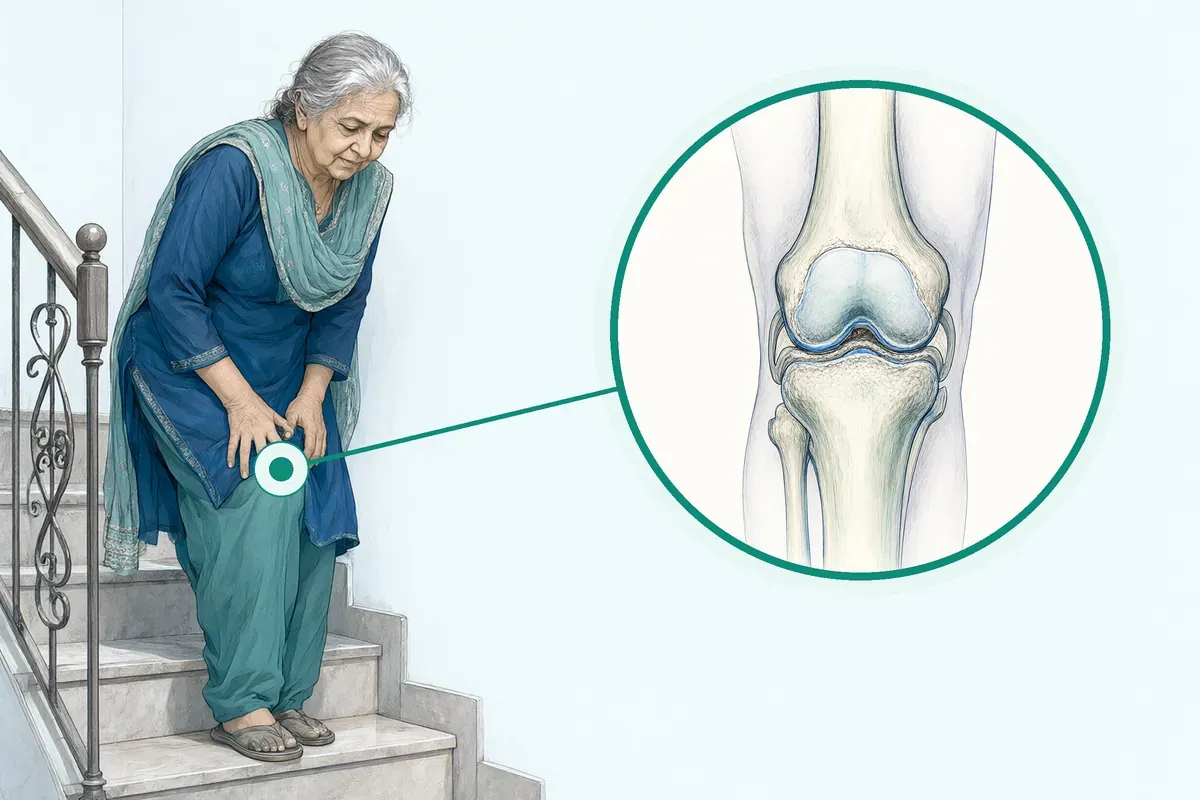
Severe knee pain makes walking, stairs, and sleep difficult
Arthritis or injury wears down the joint. Pain persists despite medicines, therapy, or injections. Simple tasks become hard. You may avoid activities you once enjoyed.
-
Pain at rest
Aching knee even when sitting or lying down disturbs sleep and comfort.
-
Stiffness limits movement
Cannot bend or straighten the knee fully; getting up from a chair is hard.
-
Medicines no longer help
Painkillers and injections give only short relief or cause side effects.
-
Daily tasks suffer
Walking to the market, climbing stairs, or using the toilet becomes a struggle.
Knee osteoarthritis is a leading cause of chronic pain and disability worldwide.
Why Jaipur Hospital
You worry that surgery means months off work, high costs, and whether you will walk normally again.
Your care plan
Your first steps with us
- 1 Book an OPD consultation with an orthopaedic surgeon
- 2 Get scans and tests done in-house
- 3 Review surgery options and receive a cost estimate
- 4 Have surgery and follow the guided recovery plan
How the operation is done
The surgeon removes damaged bone and cartilage and fits a metal and plastic implant. Spinal or epidural anaesthesia is used. The procedure usually takes 1.5 to 2.5 hours.
-
Total Knee Replacement (TKR)
Replaces all three knee compartments; common for widespread arthritis.
-
Partial Knee Replacement (UKR)
Resurfaces only the damaged compartment; preserves healthy bone and ligaments.
-
Computer-Navigated TKR
Uses navigation to improve implant alignment accuracy during surgery.
-
Robotic-Assisted TKR
Robotic arm assists with precise bone cuts based on a pre-operative plan.
Why patients trust us
- 1991 Serving Jaipur for 35 years
- NABH Accredited hospital
- 5 Orthopaedics consultants
- 24×7 Emergency, ICU and ambulance
- 25 Cashless schemes and insurers
What research shows about knee replacement
-
10 to 15 years
Almost everyone who has a knee replacement has improved knee function for at least 10 to 15 years.
-
about 25 years
Most knee replacements last for about 25 years before needing revision.
-
most people
Most people who have a knee replacement have reduced pain, increased mobility, and improved quality of life.
If it is left untreated
Untreated severe arthritis leads to worsening pain, joint deformity, muscle weakness, and loss of independence. Falls risk increases. Quality of life declines steadily.
Life after treatment
Most people return to daily activities with less pain and better movement over several months.
-
Walk without aid
Most people walk independently within weeks and return to desk work in 4 to 6 weeks.
-
Sleep better
Night pain usually settles as the joint heals, allowing restful sleep.
-
Resume light activities
Many patients return to walking, household tasks, and social outings they had avoided.
-
Long-lasting relief
The new joint typically functions well for 15 to 25 years for most patients.

Frequently asked questions
Questions patients ask about knee replacement
Which problems are assessed under knee replacement?
In short
At Jaipur Hospital, knee replacement is considered for severe knee arthritis or joint damage that limits daily activities. The surgical team evaluates advanced osteoarthritis, post-traumatic arthritis after a fracture, and other conditions that destroy the joint surfaces. Assessment focuses on pain severity, loss of movement, and how much the knee problem affects your quality of life.
In detail
Knee arthritis is the most common condition leading to knee replacement, and post-traumatic arthritis after breaking a bone in the knee joint may also be a reason.
The orthopaedic team reviews your history, examines the knee for swelling, deformity, and range of motion, and orders weight-bearing X-rays to see joint space loss and bone changes. In studies, persons with advanced symptoms and structural damage are candidates for total joint replacement.
The decision rests on whether non-surgical measures have failed and whether the joint damage is severe enough to warrant surgery.
A common belief
Many people think any knee pain qualifies.
What actually happens
In reality, the surgeon looks for advanced structural damage on X-rays and symptoms that have not improved with medicines, physiotherapy, or weight loss.
Your next step at Jaipur Hospital
You will attend the Orthopaedics OPD for a detailed clinical assessment and imaging. Bring any previous X-rays, MRI reports, and a list of medicines. The surgeon will explain whether total or partial replacement suits your pattern of arthritis.
How will the doctor decide which tests I need for knee replacement?
In short
At Jaipur Hospital, the surgeon decides tests based on your age, medical history, and the complexity of your knee problem. Standard tests include weight-bearing X-rays of both knees, blood counts, kidney and liver function, blood sugar, coagulation profile, and an ECG. Additional imaging like CT or MRI is ordered only if X-rays are unclear or deformity is complex.
In detail
The surgeon uses clinical examination and X-rays to grade arthritis severity and plan implant size. If you have other illnesses such as diabetes, heart disease, or are on blood thinners, extra cardiac or physician clearance may be needed.
The anaesthesia team assesses fitness for spinal or epidural anaesthesia. The goal is to ensure you are safe for surgery and to choose the right technique — total, partial, computer-navigated, or robotic-assisted — based on bone quality and alignment.
A common belief
Some patients assume they need an MRI or CT scan routinely.
What actually happens
These are only needed when X-rays do not give enough detail for surgical planning.
Your next step at Jaipur Hospital
All tests are done in-house at the hospital's diagnostic laboratory and radiology department. Results are usually available within a day. The surgeon reviews them and confirms the surgical plan. If any value is abnormal, a physician opinion is sought before proceeding.
How soon should I expect improvement after knee replacement treatment?
In short
After knee replacement at Jaipur Hospital, you usually start walking with an aid within one to two days. Most people can resume desk work in four to six weeks. Recovery after knee replacement usually takes around a year, with steady improvement in pain, movement, and daily function over that period.
In detail
In studies, most people who have a knee replacement have reduced pain, increased ability to move and use their knee, and an improved quality of life. Most people find their daily life improves after a knee replacement.
The operation takes 1.5 to 2.5 hours under spinal or epidural anaesthesia. Hospital stay is typically three to five nights. Physiotherapy begins early and continues at home to regain strength and range of motion.
A common belief
A common belief is that you are back to normal in a few weeks, but the tissues and muscles need months to heal fully.
What actually happens
Pushing too hard too soon can cause swelling and setbacks.
Your next step at Jaipur Hospital
Plan for an attendant to help at home for the first one to two weeks. Follow the physiotherapy schedule and attend outpatient reviews as advised. Gradual return to light activities occurs over six to twelve weeks.
How do I know whether I am ready for joint replacement?
In short
You may be ready for knee replacement when severe knee pain, stiffness, and swelling do not get better after trying other treatments and make it hard to move or use your knee. At Jaipur Hospital, the surgeon assesses your symptoms, examination, imaging, and how much the knee limits your daily life to decide if the time is right.
In detail
Healthcare providers might recommend knee replacement if you have severe symptoms that make it hard to move or use your knee. Persons with advanced symptoms and structural damage are candidates for total joint replacement.
Knee arthritis is the most common condition leading to surgery, and post-traumatic arthritis after a fracture can also be a reason. Patient expectations prior to surgery and the degree of improvement in knee function and pain relief following surgery are key factors affecting satisfaction.
The surgeon will discuss whether non-surgical options have been exhausted and whether your goals align with what the operation can achieve.
A common belief
Many people focus only on X-ray findings, but the decision depends more on how much the knee affects your life.
What actually happens
Unrealistic expectations about the speed or extent of recovery can lead to dissatisfaction.
Your next step at Jaipur Hospital
If knee pain limits walking, stairs, sleep, or basic self-care despite medication, physiotherapy, and walking aids, book a consultation at Jaipur Hospital.
The surgeon will review your case, explain the typical price range of ₹1,80,000 to ₹3,50,000, and help you decide if you are ready for joint replacement.
How can I decide whether to seek advice about total knee replacement?
In short
Consider total knee replacement advice when knee pain, stiffness, and swelling limit daily activities despite other treatments. Jaipur Hospital evaluates each patient individually. Your surgeon will confirm if you meet typical criteria.
In detail
Total knee replacement replaces all three knee compartments. It is usually recommended for advanced arthritis affecting multiple compartments. Evidence shows healthcare providers suggest it when severe symptoms make it hard to move or use the knee.
Typical signs include pain at rest, night pain, difficulty walking short distances, climbing stairs, or rising from a chair. Non-surgical options like weight loss, exercise, medicines, and injections are tried first. Obesity and previous knee injury increase arthritis risk.
The decision balances symptom severity, joint damage on X-ray, and impact on quality of life. Most people who have a knee replacement have reduced pain, increased ability to move, and improved quality of life. About twenty percent of patients report dissatisfaction, often linked to expectations and degree of improvement.
A common belief
Many people wait until pain is unbearable, but earlier evaluation helps plan better.
What actually happens
Others expect surgery to fix everything perfectly; studies show about twenty percent of patients remain dissatisfied, often because expectations were not discussed. The decision depends on your symptoms, X-ray findings, and how much your life is affected.
Your next step at Jaipur Hospital
If knee pain limits your independence despite other treatments, schedule an assessment. Bring recent X-rays and a list of tried treatments. The surgeon will examine your knee, review imaging, and discuss whether total knee replacement is appropriate.
How will knee replacement treatment affect my walking, movement, or independence?
In short
Most people walk with an aid within one to two days after knee replacement and return to desk work in four to six weeks. At Jaipur Hospital, the care team guides you through a structured rehabilitation programme. Long-term, the majority experience reduced pain and improved mobility.
In detail
Evidence shows that most people find daily life improves after knee replacement, with reduced pain and increased ability to move and use the knee. Recovery is gradual: you start with a walker or crutches, progress to a stick, and then walk unaided as strength returns.
Physiotherapy is essential to regain range of motion and muscle control. Some patients have ongoing stiffness or difficulty bending the knee fully, and a small number feel instability when standing or walking.
Implants typically last at least 10 to 15 years, so a younger patient may need revision surgery later in life. Your commitment to the exercise programme strongly influences the final outcome.
A common belief
Some expect instant normal walking.
What actually happens
In reality, it takes months of consistent exercise to rebuild strength and balance. Skipping physiotherapy often leads to stiffness and a limp.
Your next step at Jaipur Hospital
Follow the physiotherapy plan, keep follow-up appointments, and report any new pain or swelling.
Which symptoms should prompt me to see a specialist?
In short
At Jaipur Hospital, you should see a specialist when knee pain, stiffness, and swelling do not get better after trying other treatments. These symptoms suggest the joint may be worn enough to consider knee replacement. Difficulty walking, climbing stairs, or getting up from a chair are common reasons people seek an orthopaedic opinion.
In detail
Knee pain, stiffness and swelling that don't get better after trying other treatments can be signs a knee replacement may be right for you. Healthcare providers might recommend knee replacement if you have severe symptoms that make it hard to move or use your knee.
In studies, being overweight, obesity, female gender, and previous knee injury are the main factors associated with onset of knee pain. Obesity in particular needs to be a major target for prevention of development of knee pain.
The surgeon will ask how long you have had symptoms, what treatments you have tried, and how much they affect your daily routine.
A common belief
People often wait until they cannot walk at all.
What actually happens
Earlier evaluation helps preserve muscle strength and makes recovery easier if surgery becomes necessary.
Your next step at Jaipur Hospital
Make an OPD appointment if pain limits your walking distance, disturbs sleep, or makes you dependent on painkillers. Bring old X-rays and a list of medicines.
The surgeon will examine your knee, order fresh weight-bearing X-rays, and discuss whether non-surgical care can still help or if it is time to plan surgery.
How will the results change my care plan?
In short
At Jaipur Hospital, test results directly shape your surgical plan and safety measures. Abnormal blood values may delay surgery until corrected. Heart or lung findings can change the anaesthesia technique or require a cardiology opinion. Imaging details decide between total or partial replacement and whether computer navigation or robotic assistance is preferred for complex alignment.
In detail
If blood tests show anaemia or high sugar, the surgeon may optimise these first to lower infection and healing risks. ECG changes may need a cardiologist's clearance before spinal or epidural anaesthesia.
X-ray findings of single-compartment arthritis may allow a partial knee replacement, preserving more bone. Severe deformity or bone loss on imaging may lead the surgeon to choose computer-navigated or robotic-assisted total knee replacement for better implant positioning. In studies, alignment accuracy affects long-term implant survival. The multidisciplinary team reviews all results together to finalise the approach.
A common belief
Patients often think the implant choice is fixed.
What actually happens
In reality, imaging may show only one compartment is worn, allowing a smaller partial replacement. Or severe deformity may need navigated cuts for better longevity.
Your next step at Jaipur Hospital
You will discuss the finalised plan at a pre-admission visit. The surgeon explains the chosen technique, expected hospital stay of 3 to 5 nights, and rehabilitation timeline. Insurance pre-authorisation for RGHS, CGHS, MAA Yojana, or private TPAs is processed with the estimate.
What should I do if symptoms persist or worsen after knee replacement?
In short
If you notice throbbing or cramping pain in your leg, a high temperature, oozing or pus from the wound, or redness, tenderness and swelling that is not getting better, contact your surgeon straight away. Jaipur Hospital provides 24-hour emergency cover for any urgent concerns after your operation.
In detail
Most people who have a knee replacement have no complications. If there are any, they are usually minor and can be treated. Blood clots or DVT are possible after surgery; if a clot causes pain or swelling, anticoagulant medicines can help.
A clot that travels to the lungs is serious and needs immediate treatment. Wound infection is usually treated with antibiotics, but deep infection may need further surgery. Nerve or vessel damage during surgery is not common and often heals or is repaired. Ongoing pain, stiffness or instability should be reported to your surgeon for assessment.
A common belief
Some patients ignore a warm, swollen calf thinking it is normal swelling.
What actually happens
That can be a blood clot. Others wait days with a fever, hoping antibiotics at home will work. Early reporting turns a major problem into a minor one.
Your next step at Jaipur Hospital
Keep the emergency numbers handy. Do not wait if you develop sudden shortness of breath, chest pain, or a hot, swollen calf. Attend all scheduled follow-ups so the team can spot problems early. If anything feels wrong, call the hospital or visit the emergency department.
Which non-surgical treatments are still reasonable for me before knee replacement?
In short
Before knee replacement at Jaipur Hospital, reasonable non-surgical treatments include weight management, physiotherapy and strengthening exercises, walking aids, pain medication such as paracetamol or NSAIDs, and activity modification. The surgeon will review which options you have tried and whether any remain suitable for your situation.
In detail
In studies, diet and exercise together reduced pain and improved function more than either alone. Weight loss of around 10 kg in the diet plus exercise group lowered knee compressive forces and inflammatory markers.
Overweight and obesity are major risk factors for knee pain onset, with 24.6% of new knee pain cases related to being overweight or obese. Previous knee injury is another strong risk factor. Medication strategies typically start with paracetamol or NSAIDs before considering stronger options. These measures can delay or reduce the need for surgery in some patients.
- Overweight and obesity are major risk factors for knee pain onset, with 24.6% of new knee pain cases related to being overweight or obese.
Your next step at Jaipur Hospital
Discuss your current treatment plan with the surgeon at your consultation. If you have not completed a structured physiotherapy programme or weight management plan, these may be recommended before surgery.
FAQ library
Questions and answers about knee replacement
When you contact us
Get your knee assessed today
Contact Jaipur Hospital for an OPD consultation, in-house tests, clear options, a cost estimate, and cashless insurance help.
- A consultation with an orthopaedic surgeon in the OPD
- Your scans and reports reviewed, with tests done in-house if you need them (laboratory, X-ray and imaging)
- Your options explained in plain words, including whether you need surgery at all
- A cost estimate before you decide
- Help with cashless treatment under RGHS, MAA Yojana, CGHS and empanelled insurers and TPAs
- Follow-up visits after your treatment
Overview
Knee Replacement: what to know
What knee arthritis is and how it develops
Knee arthritis is the most common condition that causes people to need knee replacement surgery. The knee joint has smooth cartilage that lets the bones glide over each other. When this cartilage wears away, the bones rub together. This causes pain, stiffness and swelling. The condition is called osteoarthritis.
It has biomechanical and inflammatory origins and is made worse by excess body weight. Over time the joint space narrows and the bone may change shape. This makes everyday movements such as walking, climbing stairs or getting out of a chair difficult. Knee replacement surgery (knee arthroplasty) is surgery to replace all or some of your knee joint. It is a common and safe procedure.
Symptoms and warning signs that need same-day care
- Cannot put weight on the leg
- Knee very hot and red
- High fever
Typical symptoms include knee pain, stiffness and swelling that do not get better after trying other treatments. You may find it hard to walk, climb stairs or even get out of bed. Pain may be present at rest and can disturb sleep. The knee may feel unstable or give way.
If you suddenly cannot put weight on the leg, the knee becomes very hot and red, or you develop a high fever, contact your doctor or go to the emergency department the same day. These can be signs of a joint infection or a blood clot that needs urgent treatment.
Causes and who is at higher risk
- about twice the odds Overweight odds
- roughly triples the odds Previous injury odds
- about 25 percent New pain linked to weight
- about 5 percent New pain linked to injury
The main cause is wear-and-tear osteoarthritis. In some people, post-traumatic arthritis develops after a fracture or serious ligament injury in the knee. Being overweight or obese is a strong risk factor. In studies, overweight people had about twice the odds of new knee pain, and obesity raised the odds further. Previous knee injury roughly triples the odds.
Women have higher rates than men. Age is also a factor; prevalence rises after 50. In one large analysis, about 25 percent of new knee pain cases were linked to being overweight or obese, and about 5 percent to a previous knee injury. Hand osteoarthritis and smoking were not significant risk factors in the same data.
How knee arthritis is diagnosed: examination and tests
Your orthopaedic surgeon will ask about your pain, how far you can walk, and what treatments you have already tried. They will examine the knee for swelling, tenderness, range of movement and stability. Weight-bearing X-rays are the standard test. They show narrowing of the joint space, bone spurs and changes in bone shape.
In some cases an MRI may be ordered to look at the cartilage and ligaments more closely. Blood tests are sometimes done to rule out inflammatory arthritis such as rheumatoid arthritis. The diagnosis is based on your symptoms, the examination and the imaging findings together.
Non-surgical treatment options and when knee replacement is advised
Do
- Weight loss if overweight
- Low-impact exercise and physiotherapy
- Pain relief medicines (paracetamol or NSAIDs)
- Knee injections (corticosteroid or hyaluronic acid)
- Walking aids such as a stick
Before surgery, doctors usually recommend non-surgical measures.
These include:
- Weight loss if you are overweight
- Low-impact exercise and physiotherapy to strengthen the muscles around the knee
- Pain relief medicines such as paracetamol or NSAIDs
- Knee injections (corticosteroid or hyaluronic acid)
Walking aids such as a stick can offload the joint. In one trial, a combined diet and exercise programme gave better pain relief and function than either alone. Surgery is considered when these measures no longer control pain or allow you to do daily activities.
A healthcare provider might recommend knee replacement if you have severe symptoms that make it hard to move or use your knee. Persons with advanced symptoms and structural damage are candidates for total joint replacement. Total joint replacement effectively relieves pain in such cases. Most people find their daily life improves after a knee replacement.
Preparing for knee replacement surgery
Do
- Comfortable loose clothing
- Flat non-slip shoes
- Walking aid you already use
- Regular medicines in original packets
- Insurance or scheme cards
Before your operation, you will attend a pre-admission check at Jaipur Hospital. The team will run blood tests, a chest X-ray and an ECG to confirm you are fit for anaesthesia. Your surgeon will ask about every medicine and supplement you take, including over-the-counter painkillers and herbal products.
Some medicines, especially blood thinners, may need to be stopped several days before surgery. You will be told when to stop eating and drinking, usually 12 hours before the procedure.
Bring:
- Comfortable loose clothing
- Flat non-slip shoes
- Any walking aid you already use
- Your regular medicines in their original packets
- Your insurance or scheme cards
An attendant should plan to stay with you during the hospital stay.
How knee replacement surgery is done
On the day of surgery you will be taken to a modular operation theatre. Spinal or epidural anaesthesia is given so you are numb from the waist down and remain awake or lightly sedated. The operation usually takes 1.5 to 2.5 hours.
Your surgeon will remove the damaged cartilage and bone and fit an artificial joint made of metal and plastic. There are several technique options. Total knee replacement replaces all three compartments of the knee. Partial knee replacement is suitable only when arthritis affects a single compartment, preserving healthy bone and ligaments.
Computer-navigated total knee replacement uses tracking sensors to improve implant alignment accuracy. Robotic-assisted total knee replacement uses a robotic arm to guide precise bone cuts. Your surgeon will advise which option suits your knee anatomy and the extent of damage. After the implants are fixed, the wound is closed and a dressing is applied.
You are then moved to the recovery room where the team monitors you for a few hours until the anaesthesia wears off.
Risks and possible complications of knee replacement
Most people who have a knee replacement have no complications. If complications occur, they are usually minor and can be treated. Pain after surgery is expected, especially in the first few weeks, and is managed with a combination of prescription pain medication, NSAIDs if safe for you, and paracetamol.
Blood clots or deep vein thrombosis are possible because blood flow and clotting change after surgery. This is often not serious, but if a clot causes pain or swelling, anticoagulant medicines are given. A clot that travels to the lungs is a pulmonary embolism and can cause serious complications.
There is a small chance the wound could become infected; this is usually treated with antibiotics, but if infection spreads deep into the joint, further surgery may be needed. During surgery, a blood vessel, nerve or ligament around the knee could be damaged, though this is not common and can be repaired or heals afterwards.
Some people have ongoing stiffness, difficulty bending the knee, or persistent pain. In time, the implant may wear or loosen, and a revision replacement might be needed, but this is not common. The risk of complications depends on your age and general health. To reduce the risk of blood clots, your doctor may suggest compression stockings or anticoagulant medicines.
Recovery and aftercare after knee replacement
- Hospital stay 3 to 5 nights
- Start walking Within 1 to 2 days with a frame or crutches
- Desk work 4 to 6 weeks
- Manual work 3 months or more
- Full recovery Up to a year
You will usually stay in hospital for 3 to 5 nights. Most people start walking with a frame or crutches within 1 to 2 days. Physiotherapy begins the day after surgery and continues at home. You will be given a customised exercise plan to restore movement and strength.
Pain and swelling are managed with regular medication, ice packs and leg elevation. Keep the wound clean and dry; stitches or clips are removed after about 10 to 14 days. Desk work can often be resumed in 4 to 6 weeks, while heavier manual work may take 3 months or more.
Driving is usually allowed once you can bend your knee enough to control the car safely and are no longer taking strong painkillers. Full recovery can take up to a year, but you will gradually return to usual activities as you heal.
Contact the hospital or your surgeon promptly if you develop increasing redness, heat or discharge from the wound, a fever above 38°C, sudden increase in pain not relieved by medication, calf swelling or tenderness, shortness of breath or chest pain.
Results of knee replacement surgery
Knee replacement is a safe and effective procedure that relieves long-term pain and helps you regain mobility. In studies, most people have reduced pain, increased ability to move and use their knee, and an improved quality of life. If you have been avoiding activities you used to enjoy, you may be able to return to them once your knee heals.
Total joint replacement effectively relieves pain. Implants are durable: almost everyone who has a knee replacement has improved knee function for at least 10 to 15 years, and most knee replacements last for about 25 years. Revision surgery is sometimes needed later in life but this is not common.
Cost and insurance for knee replacement in Jaipur
- ₹1,80,000 to ₹3,50,000 Single knee replacement
- ₹4,00,000 to ₹7,00,000 Bilateral knee replacement
The typical price range for a single knee replacement in India is ₹1,80,000 to ₹3,50,000.
The final cost depends on:
- The type of implant chosen
- Whether a total or partial replacement is done
- The use of computer navigation or robotic assistance
- The length of hospital stay
- Any additional medical conditions that need management
A bilateral knee replacement, where both knees are replaced, typically ranges from ₹4,00,000 to ₹7,00,000.
Jaipur Hospital is empanelled under:
- RGHS
- MAA Yojana
- CGHS
- A panel of private insurers and TPAs
If you are covered under one of these schemes, the hospital will help you with the pre-authorisation process. The in-house pharmacy and diagnostic laboratory mean medicines and tests are available on site. For a personalised estimate, please contact the hospital admissions desk.