

General & Laparoscopic Surgery · Jaipur Hospital
Gallbladder Stone Surgery in Jaipur
Recurring upper abdominal pain? We assess your scans, explain options, and plan safe gallbladder removal.
- Serving Jaipur since 1991 (35 years)
- NABH accredited
- 24×7 emergency & ICU
- Cashless: RGHS, MAA Yojana, CGHS + 22 insurers
- Operation time
- 45 to 90 minutes
- Anaesthesia
- General anaesthesia
- Recovery
- Desk work in 1 to 2 weeksfull activity in about 4 weeks
- Price
- ₹45,000 to ₹1,10,000typical range in India; ask us for an estimate
Gallstone pain disrupts daily life
Pain after meals, fear of the next attack
Gallstones can cause sudden, severe pain in the upper right abdomen, often after fatty food. Attacks may come with nausea, fever, or jaundice. Many people delay care, hoping the pain will pass, but stones that cause symptoms do not go away on their own.
-
Unpredictable attacks
Pain can wake you at night or strike after a meal, making work and family plans uncertain.
-
Risk of complications
A stone can block the bile duct, leading to infection, pancreatitis, or jaundice needing urgent care.
-
Home remedies can harm
Flushes or herbal mixes may push a stone into the bile duct, turning a routine case into an emergency.
-
Medicines rarely work
Bile acid tablets only dissolve tiny cholesterol stones over years, and stones usually return after stopping.
Symptomatic gallstones do not resolve without treatment and carry a 1 to 3 percent yearly risk of serious complications.
Why Jaipur Hospital
You worry the next attack will land you in the emergency department at night, far from home, with no plan and a mounting bill.
Your care plan
Your first steps with us
- 1 Call or visit OPD for surgeon consultation and scan review
- 2 Complete pre-operative tests at our in-house lab and imaging centre
- 3 Undergo laparoscopic gallbladder removal with an overnight stay
- 4 Attend follow-up visits for wound check and diet guidance
How the operation is done
Under general anaesthesia, the surgeon makes three to four small cuts, inserts a camera and instruments, clips the duct and artery, and removes the gallbladder with stones inside. The procedure usually takes 45 to 90 minutes.
-
Laparoscopic cholecystectomy
Gallbladder removed through 3 to 4 small cuts; typical stay one night, desk work in 1 to 2 weeks.
-
Open cholecystectomy
Used when keyhole surgery is not safe; sometimes a planned switch during the operation for your safety.
-
Early surgery for acute cholecystitis
Surgery within days of an attack when you are fit, to avoid repeated admissions and complications.
Why patients trust us
- 1991 Serving Jaipur for 35 years
- NABH Accredited hospital
- 3 General & Laparoscopic Surgery consultants
- 24×7 Emergency, ICU and ambulance
- 25 Cashless schemes and insurers
What research shows about this treatment
-
1 to 2 weeks
Most people return to desk work within one to two weeks after laparoscopic surgery.
-
about 9 in 10
Around 80 percent of people with gallstone symptoms eventually need surgery; most do well after removal.
-
0.3 to 0.5 percent
Major bile duct injury occurs in roughly 3 to 5 per 1,000 laparoscopic cases in large studies.
If it is left untreated
Without treatment, symptomatic gallstones can lead to repeated pain attacks, bile duct blockage with jaundice, gallbladder infection (cholecystitis), or pancreatitis. These complications often need emergency admission and more complex procedures.
Life after treatment
Most people return to normal eating and activities within a few weeks. The gallbladder is not essential, and bile flows directly from the liver to the intestine.
-
Normal diet returns
Most people resume a regular, healthy diet after a short adjustment period of a few weeks.
-
Low recurrence risk
Removing the gallbladder greatly reduces the chance of new gallstones forming.
-
Fewer emergencies
Planned surgery avoids the stress and risk of repeated emergency department visits for pain.
-
Small scars fade
Three to four tiny marks usually become barely visible over time.
Frequently asked questions
Questions patients ask about gallbladder stone surgery
What does gallbladder stone surgery involve?
In short
Gallbladder stone surgery at Jaipur Hospital is usually a laparoscopic cholecystectomy. The surgeon removes the gallbladder through three or four small cuts, each under one centimetre, using a tiny camera and instruments. The operation takes 45 to 90 minutes under general anaesthesia. Most patients stay one night, and some go home the same day.
In detail
The procedure starts with general anaesthesia and a breathing tube. Carbon dioxide gas is put into the abdomen to make space. A 4K camera goes through one cut near the belly button. Long instruments go through the other cuts.
The surgeon clips the cystic duct and artery, frees the gallbladder, and takes it out through one cut. The clips stay in place permanently.
If the gallbladder is very inflamed or scarred, or if the surgeon cannot see safely, the operation may switch to open surgery with a larger cut. This is not a complication; it is a safety decision. Special X-rays during surgery can check for stones in the bile duct.
A common belief
Many people think the stones are just taken out and the gallbladder is left.
What actually happens
That is not done because stones come back. Also, some believe keyhole surgery is always possible. If the gallbladder is badly inflamed or there is scar tissue, the surgeon will switch to open surgery for safety.
Your next step at Jaipur Hospital
You will need blood tests and an anaesthesia check before surgery. You must not eat or drink for eight hours before the operation. Bring an attendant to take you home. After discharge, rest for three to five days. Avoid heavy lifting for about four weeks.
Desk work usually resumes in one to two weeks. You will see your surgeon for a follow-up in two to three weeks.
Which tests and scans do I need before gallbladder stone surgery?
In short
Before gallbladder stone surgery at Jaipur Hospital, you typically need an abdominal ultrasound, basic blood tests (CBC, clotting profile, liver function tests), and an anaesthesia assessment. Additional scans like MRCP or ERCP are needed only if bile duct stones are suspected.
In detail
Ultrasound is the first-line imaging to confirm stones, gallbladder wall thickening, and bile duct diameter. Blood tests check for infection (raised white cells, CRP), liver function, and clotting ability.
If the bile duct is dilated or liver enzymes are abnormal, an MRCP or ERCP may be ordered to look for stones in the common bile duct. A HIDA scan is rarely needed if ultrasound is unclear.
The anaesthesia team reviews your medical history, medicines, and may request an ECG or chest X-ray based on age and comorbidities. Fasting for 8 hours is required before surgery.
A common belief
Patients often ask about CT scans or MRIs.
What actually happens
These are not routine. They are only used if the ultrasound suggests a bile duct stone or another problem. Your surgeon will tell you exactly what you need.
Your next step at Jaipur Hospital
Get an ultrasound and basic blood work done before your surgical consultation. If you have recent reports, bring them.
How painful is laparoscopic gallbladder removal and the early recovery?
In short
Laparoscopic gallbladder removal at Jaipur Hospital uses general anaesthesia so you feel nothing during the operation. After surgery most patients describe the discomfort as mild to moderate. Shoulder tip pain from the gas used during surgery is common but usually settles within 24 to 48 hours. The small cuts on the abdomen are sore for a few days and regular pain tablets control it well.
In detail
The operation is done through three or four cuts each under one centimetre. Carbon dioxide gas creates space inside the abdomen and this gas irritates the diaphragm causing referred pain to the shoulder.
Studies show laparoscopic cholecystectomy causes less pain than open surgery and most people need only simple pain relief such as paracetamol or ibuprofen. Nausea from anaesthesia can occur but usually passes within a day. Your surgical team will give you a pain plan before you leave hospital.
A common belief
Many people expect severe pain because they think of open surgery with a large cut.
What actually happens
Keyhole surgery is very different. The gas pain surprises some patients but it usually goes away in a day or two. Nausea from anaesthesia can happen but passes quickly.
Your next step at Jaipur Hospital
Expect to go home the same day or after one night. Take prescribed pain tablets regularly for the first 48 hours then as needed. Walk gently from day one and avoid heavy lifting for two weeks. Shoulder pain should fade by day two. If pain worsens, fever develops or you cannot eat, contact the hospital.
How long does recovery usually take after gallbladder stone surgery?
In short
At Jaipur Hospital, recovery after laparoscopic gallbladder stone surgery is usually one to two weeks for desk work and light activity, and about four weeks for full physical activity including heavy lifting. Hospital stay is typically one night; some fit patients go home the same day. Open surgery recovery takes longer, around four to six weeks for full activity.
In detail
The small keyhole cuts heal quickly. Shoulder pain from gas resolves in 24 to 48 hours. You can walk and climb stairs on the day of surgery. Most people feel a little better each day.
Digestive adjustments such as bloating or loose stools may last a few weeks but usually settle. Evidence shows early mobilisation and simple pain relief speed recovery. Our surgical team gives a written activity guide before discharge.
A common belief
People often expect weeks of bed rest, but with laparoscopic surgery you walk the same evening and shower the next day.
What actually happens
The limit is heavy lifting for a month, not total rest.
Your next step at Jaipur Hospital
Avoid heavy lifting over 5 kg for four weeks. Drive after 24 hours if you are not taking strong pain medicines. Return to work depends on your job — desk work at one to two weeks, physical work at four weeks. Follow-up is at two to three weeks.
Do gallstones without symptoms need gallbladder stone surgery?
In short
Gallstones without symptoms usually do not need gallbladder stone surgery. At Jaipur Hospital, the surgical team follows the evidence that silent gallstones found by chance on ultrasound rarely cause problems later. Only about 2 to 3 percent per year develop symptoms, so observation is the standard approach unless specific high-risk features are present.
In detail
Studies show up to 80 percent of people with gallstones never get biliary pain or complications such as cholecystitis, cholangitis, or pancreatitis. The annual risk of becoming symptomatic is low, averaging 2 to 3 percent.
Surgery is considered for asymptomatic stones only in special situations: very large stones over 3 centimetres, a gallbladder full of stones that raises cancer concern, certain porcelain gallbladders, or patients with sickle cell disease who form pigment stones.
For most people, the risks of surgery outweigh the small chance of future trouble. The surgeon will review your imaging, age, and medical history before advising.
A common belief
Many patients worry that silent stones will inevitably cause an emergency.
What actually happens
Evidence shows most never do. Operating on everyone with silent stones would mean many unnecessary operations. The standard is to watch and wait, and operate only if symptoms appear or high-risk features are found.
Your next step at Jaipur Hospital
If you have been told you have gallstones but feel well, keep your ultrasound report and discuss it at a routine check-up. No urgent action is needed. If you later develop pain after fatty meals, nausea, fever, or jaundice, seek review promptly.
How will the surgeon decide whether an operation is necessary?
In short
The surgeon at Jaipur Hospital decides on surgery after reviewing your symptoms, physical examination, blood tests, and imaging. An ultrasound is the first test to confirm stones and look for gallbladder wall thickening or duct dilation. Blood tests check for infection, liver function, and inflammation. The combination of clinical findings and imaging guides the recommendation.
In detail
Guidelines recommend a detailed history, clinical examination, laboratory tests, and imaging for diagnosis. Ultrasound has about 81 percent sensitivity for acute cholecystitis. If ultrasound is unclear, a HIDA scan or MRCP may be used.
Elevated C-reactive protein and white cell count support a diagnosis of acute inflammation. The surgeon looks for Murphy's sign, right upper quadrant tenderness, fever, and systemic inflammatory markers. If you have typical biliary colic with stones on ultrasound, elective laparoscopic cholecystectomy is usually advised.
For acute cholecystitis, early surgery within a few days is often preferred when you are fit. Patients with high surgical risk may be managed with antibiotics and drainage first. Your medical history, previous abdominal surgery, bleeding disorders, and anaesthesia fitness are also assessed before a decision is made.
- Ultrasound has about 81 percent sensitivity for acute cholecystitis.
A common belief
Patients often think a stone on a scan means immediate surgery.
What actually happens
In reality, the surgeon checks for Murphy's sign, fever, raised inflammatory markers, and gallbladder wall thickening. Asymptomatic stones are usually watched. High-risk patients may need optimisation before surgery.
Your next step at Jaipur Hospital
Bring any previous ultrasound reports and blood test results to the OPD at Jaipur Hospital. The surgeon will examine you, order any missing tests, and discuss the findings. If surgery is advised, you will receive a typical cost range and a date for pre-operative assessment.
Why might my doctor recommend gallbladder stone surgery?
In short
Your doctor may recommend gallbladder stone surgery at Jaipur Hospital if you have symptoms such as severe abdominal pain after fatty meals, nausea, vomiting, fever, or jaundice. Surgery is the standard treatment when stones cause repeated attacks or complications like inflammation of the gallbladder or pancreas.
In detail
Gallstones that cause symptoms do not go away on their own. In studies, up to 80 percent of people with stones never get symptoms, but once symptoms start they tend to recur. Complications include biliary colic, acute cholecystitis, pancreatitis, cholangitis, and jaundice.
Removing the gallbladder stops these episodes. Medicines can dissolve only very small cholesterol stones over one to two years, but stones usually return after stopping the tablets. Lithotripsy is rarely used and mainly for stones stuck in the bile duct.
A common belief
Some people hope diet or medicine will fix it permanently.
What actually happens
Medicines only work on tiny cholesterol stones and the stones come back. Flushes and herbal remedies can push a stone into the bile duct and cause an emergency.
Your next step at Jaipur Hospital
If you have had one or more attacks, discuss surgery with your surgeon. Delaying can lead to emergency admission. You will need an ultrasound and blood tests first.
How should I prepare in the days before gallbladder stone surgery?
In short
Jaipur Hospital advises you to start preparing several days before your laparoscopic cholecystectomy. You will need a full physical examination and some tests to make sure you are healthy enough for surgery. Your surgeon will review your medical history and any regular medicines you take. You should arrange for an attendant to drive you home and stay with you overnight after the operation.
In detail
Preparation follows standard surgical safety steps. Evidence shows a detailed history, clinical examination, laboratory tests and imaging are used to confirm fitness for general anaesthesia and laparoscopic surgery. Blood tests such as CBC and clotting profile are typically done.
If you take blood thinners like aspirin, clopidogrel or warfarin, the team will tell you when to pause them, usually five to seven days before surgery. Diabetes medicines need dose adjustment on the day of surgery.
You must stop eating and drinking eight hours before the scheduled time. Wear loose clothes, remove jewellery, nail polish and contact lenses before coming to the hospital.
A common belief
Many people think they only need to fast the night before.
What actually happens
In reality, medicine changes and pre-op tests take several days to arrange safely. Skipping these steps can delay your operation.
Your next step at Jaipur Hospital
Book a pre-operative consultation at Jaipur Hospital to get your personalised checklist. The surgical team will order the required blood tests and give you exact fasting and medicine instructions. An attendant must be present on the day of surgery to take you home.
What are the common side effects and the less common serious complications of gallbladder stone surgery?
In short
At Jaipur Hospital, common side effects after laparoscopic gallbladder stone surgery include shoulder tip pain, mild bloating, nausea from anaesthesia and temporary changes in bowel habits. These usually settle within a few days. Less common serious complications are bile leak, bile duct injury, bleeding, wound infection and injury to nearby organs such as the intestine. Overall major complication rates in studies range from about 1.6% to 5.3%.
In detail
The gas used during keyhole surgery irritates the diaphragm causing shoulder pain that fades in 24 to 48 hours. Bile duct injury occurs in roughly 0.3% to 0.5% of laparoscopic cases in published series.
Conversion to open surgery happens in about 4% to 6% of cases when the surgeon cannot see safely. Wound infection and pneumonia rates are lower with laparoscopic than open surgery. Our surgical team follows the critical view of safety technique to minimise bile duct risk.
A common belief
People often worry about bile duct injury, but the critical view of safety technique used by our surgeons keeps that risk very low.
What actually happens
Conversion to open surgery is not a failure; it is a safety decision when the anatomy is unclear.
Your next step at Jaipur Hospital
You will be told to watch for fever over 38.5°C, severe abdominal pain, yellow skin, persistent vomiting or pus from the cuts. If any of these occur, call Jaipur Hospital immediately. A follow-up visit is scheduled two to three weeks after surgery.
Which symptoms are expected after gallbladder stone surgery, and which need urgent medical attention?
In short
After gallbladder stone surgery at Jaipur Hospital, you can expect mild pain at the incision sites, shoulder pain from the gas used during surgery, and some nausea. These usually improve within a few days. You must seek urgent care if you develop a fever over 38.5°C, severe abdominal pain or swelling, yellow skin or eyes, persistent vomiting, redness or pus at the wounds, or breathing difficulties.
In detail
The shoulder pain comes from carbon dioxide gas irritating the diaphragm and typically resolves in 24 to 48 hours. Incision pain is managed with prescribed or over-the-counter pain relief. Nausea from anaesthesia usually settles in a day or two.
Evidence shows that fever, jaundice, worsening pain, wound infection signs, and breathing problems can indicate bile leak, bile duct injury, infection, or other complications that need prompt surgical review. The surgical team advises calling your surgeon or family doctor immediately if any of these red-flag symptoms appear.
A common belief
But fever above 38.5°C, severe belly pain, yellow skin, non-stop vomiting, red or leaking wounds, or breathing trouble are not normal.
What actually happens
They can mean a bile leak, infection, or injury that needs immediate treatment.
Your next step at Jaipur Hospital
Keep the emergency numbers handy for the first two weeks. Take pain medication as advised and walk gently to help recovery. If any urgent symptom arises, go to the 24×7 emergency department at Jaipur Hospital without delay.
FAQ library
Questions and answers about gallbladder stone surgery
When you contact us
Get your assessment and plan
Contact Jaipur Hospital for a surgical consultation, in-house tests, a clear explanation of your options, and a cost estimate before you decide.
- A consultation with a general and laparoscopic surgeon in the OPD
- Your scans and reports reviewed, with tests done in-house if you need them (laboratory, X-ray and imaging)
- Your options explained in plain words, including whether you need surgery at all
- A cost estimate before you decide
- Help with cashless treatment under RGHS, MAA Yojana, CGHS and empanelled insurers and TPAs
- Follow-up visits after your treatment
Read more
Read more about gallbladder stone surgery
- Gallstone Symptoms and When Surgery Is Needed
Understand gallstone symptoms, warning signs, and how doctors decide if you need gallbladder removal surgery. A patient guide from Jaipur Hospital, Jaipur.
- CBD Stone Exploration: Techniques, Recovery and Risks
Learn how common bile duct stones are found and removed during gallbladder surgery, including laparoscopic and endoscopic options.
Overview
Gallbladder Stone Surgery: what to know
What gallbladder stones are and how they form
- Up to 80 percent Silent stones
- 1 to 4 percent Become symptomatic each year
- 90 to 95 percent Cause of acute cholecystitis
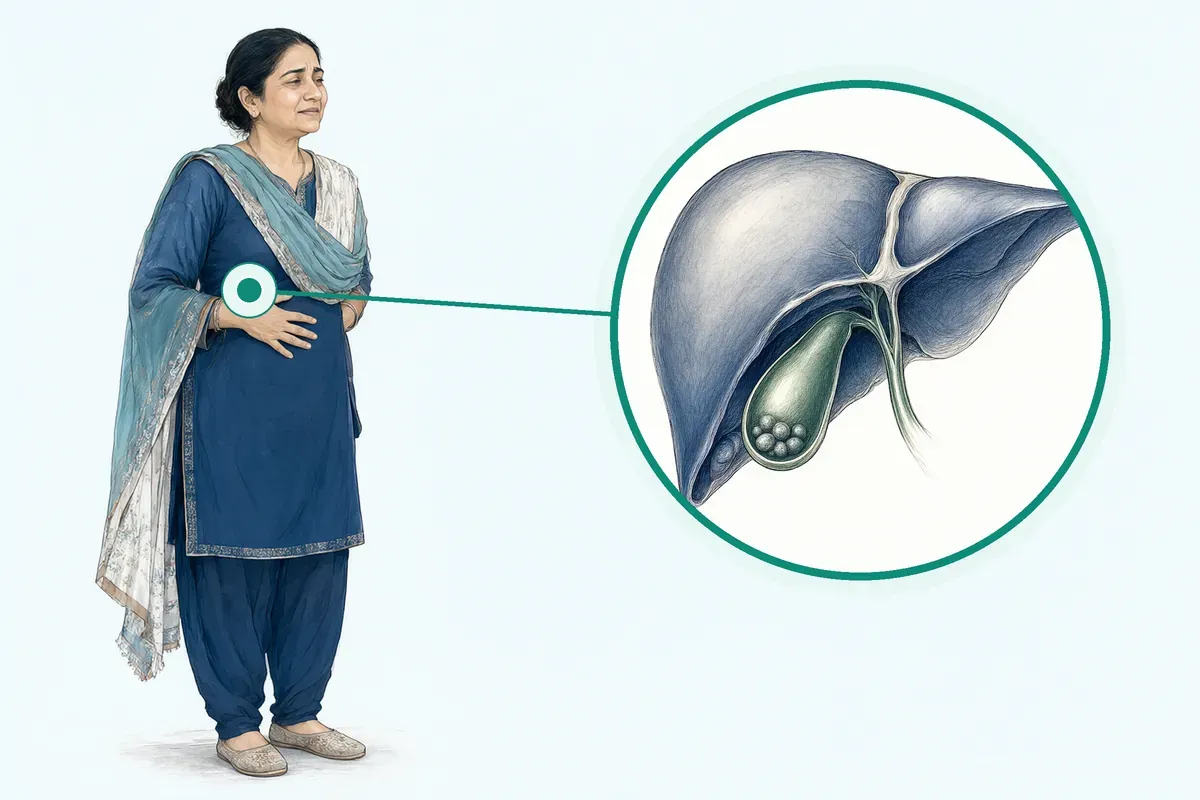
The gallbladder is a small sac under the liver that stores bile, a fluid made by the liver to help digest fats. When you eat fatty food, the gallbladder squeezes concentrated bile into the small intestine.
Gallstones are hard deposits that form inside the gallbladder.
They are made from:
- Cholesterol
- Bile pigment
- Calcium salts
The most common type are mixed stones, which contain cholesterol and salts and tend to develop in batches. Cholesterol stones are made mainly of cholesterol and can grow large enough to block bile ducts. Pigment stones are usually small but numerous.
Stones form when bile contains too much cholesterol or when the gallbladder does not empty completely. In many people, stones stay silent and cause no problems. Up to 80 percent of people with gallstones never experience biliary pain or complications such as acute cholecystitis, cholangitis or pancreatitis. Between 1 and 4 percent of adults with gallstones become symptomatic in a year.
When a stone blocks the cystic duct, it causes gallbladder inflammation called acute cholecystitis. This is responsible for 90 to 95 percent of acute cholecystitis cases. Gallstones are the most common reason for gallbladder removal surgery.
Symptoms of gallstones and warning signs that need urgent care
- High fever with chills or rigors
- Yellow skin or eyes
Many people have no symptoms at all. When symptoms occur, they often include sharp pain in the upper abdomen or back, usually after a fatty meal. The pain can be infrequent but severe.
Other symptoms are:
- Nausea
- Vomiting
- Indigestion
- Fever
If a stone blocks a bile duct, it can cause jaundice, which is yellowing of the skin and eyes, with dark urine. Infection of the gallbladder or bile duct brings fever with pain. Acute cholecystitis typically presents with acute right upper quadrant pain, fever and nausea that may be linked to eating.
Seek urgent care the same day if you have: severe abdominal pain that does not settle; high fever with chills or rigors; yellow skin or eyes; persistent vomiting so you cannot keep fluids down; or signs of pancreatitis such as severe upper abdominal pain radiating to the back. These can mean a blocked duct, infected bile (cholangitis) or an inflamed pancreas, all of which need prompt treatment.
Causes of gallstones and who is at higher risk
- 30 to 71 percent Gallstones after rapid weight loss
- Faster than 1.5 kg per week Weight loss speed that raises risk
Stones form when bile has too much cholesterol or the gallbladder does not empty well.
Some risk factors cannot be changed:
- Increasing age
- Female gender
- Family history
- Certain ethnic backgrounds
Women are more likely to get gallstones than men, especially after having children. People over 40 and those with a family history are also at higher risk.
Modifiable risks include:
- Obesity
- Rapid weight loss
- A sedentary lifestyle
Very low calorie diets or bariatric surgery with rapid weight loss are linked to gallstones in 30 to 71 percent of individuals. Weight loss faster than 1.5 kg per week raises the risk, especially in the first six weeks after surgery.
Other risks include pregnancy, certain medicines such as ceftriaxone, octreotide and thiazide diuretics, and total parenteral nutrition or prolonged fasting. Diseases like cirrhosis, chronic haemolysis and ileal Crohn's disease raise the risk of pigment stones. Sickle cell disease is linked to pigment gallstones that often need surgery.
How gallbladder stones are diagnosed: examination and tests
Doctors start with a history and physical examination, checking for right upper quadrant tenderness and Murphy's sign. Blood tests may show raised white cell count and C-reactive protein if there is inflammation.
Abdominal ultrasound is the preferred initial imaging test for suspected gallstones or acute cholecystitis. It has a sensitivity of about 81 percent for acute cholecystitis. If the ultrasound is not clear, a HIDA scan is the reference test for acute cholecystitis.
Other tests that may be used include:
- CT scan
- MRCP
- ERCP
ERCP can also treat stones stuck in the bile duct. No single clinical or laboratory finding alone can confirm or exclude acute cholecystitis; a combination of history, examination, blood tests and imaging is used.
Non-surgical options and when gallbladder stone surgery is advised
If gallstones cause no symptoms, treatment is usually not needed. Some people get relief by eating less fat. Medicines such as ursodiol can dissolve very small cholesterol stones over one to two years, but they do not work on calcified or pigment stones and stones typically return after stopping the medicine.
Lithotripsy uses soundwaves to break stones but is used only in certain centres and mainly for stones stuck in the bile duct, not gallbladder stones.
Home remedies such as apple cider vinegar or olive oil flushes have no medical evidence and can be dangerous; they may push a large stone into the narrow bile duct and turn a routine problem into a life-threatening emergency.
Surgery is advised when stones cause symptoms such as biliary colic, cholecystitis, jaundice or pancreatitis. Symptomatic gallstones do not resolve on their own. Surgery remains the only definitive treatment. In certain cases, such as abdominal surgery for other conditions, doctors may remove the gallbladder if you are at high risk of complications.
Large stones over 3 cm or a gallbladder full of stones carry a higher risk of gallbladder cancer and may be an indication for preventive removal. Your surgeon will discuss your medical history, regular medicines and any past reactions to medicines before advising surgery.
Preparing for gallbladder stone surgery at Jaipur Hospital
- Physical examination and tests Blood tests, ultrasound, sometimes CT or HIDA scan
- Tell your surgeon about all medicines Including over-the-counter tablets and supplements
- Pause blood-thinning medicines Usually five to seven days before surgery
- Adjust diabetes medicines on the day Insulin or tablet doses will be adjusted
- Fast for eight hours before surgery No food or water
- Bring an attendant To stay overnight and take you home
Before your operation you will have a physical examination and some tests to check that you are fit for general anaesthesia. Blood tests, an ultrasound and sometimes a CT scan or HIDA scan are typical. Tell your surgeon about every medicine you take, including over-the-counter tablets and supplements.
Blood-thinning medicines such as aspirin, clopidogrel or warfarin usually need to be paused five to seven days before surgery. If you have diabetes, your insulin or tablet doses will be adjusted on the day of the operation. You must not eat or drink anything, including water, for eight hours before the scheduled time.
Bring an attendant who can stay with you overnight and take you home afterwards, because you cannot drive after general anaesthesia. Wear loose, comfortable clothes and remove jewellery, nail polish and contact lenses before you come to the hospital.
How gallbladder stone surgery is done at Jaipur Hospital
- Camera and instruments Carbon dioxide gas creates space; camera and long instruments inserted
- Gallbladder removal Cystic duct and artery clipped; gallbladder separated and removed
- Closing and recovery Cuts closed with absorbable stitches or glue; procedure takes 45 to 90 minutes
The operation is called laparoscopic cholecystectomy. It is done under general anaesthesia. The surgeon makes three or four small cuts, each less than one centimetre, near the belly button and the upper abdomen. Carbon dioxide gas is put into the abdomen to create space to work.
A tiny camera on a laparoscope shows the inside of the abdomen on a screen. Long instruments are inserted through the other cuts. The surgeon clips the cystic duct and artery, separates the gallbladder from the liver bed and removes it through one of the cuts. The cuts are closed with absorbable stitches or surgical glue.
The procedure usually takes 45 to 90 minutes. If the surgeon cannot see clearly or finds severe inflammation, scarring or bleeding, they will switch to open surgery with a larger cut. This is not a complication; it is done for your safety. In some centres a surgical robot may be used to guide the instruments, which is called robotic cholecystectomy.
Your surgeon will advise which approach suits you. A single-incision (one cut) technique also exists but is not standard. If stones are found in the common bile duct during the operation, the surgeon may deal with them then or you may need a separate procedure later. You will usually stay one night in hospital; some patients go home the same day.
Risks and possible complications of gallbladder stone surgery
- 1.6% to 5.3% Overall morbidity
- 0.3% to 0.5% Bile duct injury
- 0.08% to 0.14% Mortality
- 4% to 6% Conversion to open surgery
All surgery carries some risk. In studies, overall morbidity after laparoscopic cholecystectomy ranges from 1.6% to 5.3%. Bile duct injury occurs in about 0.3% to 0.5% of cases. Mortality is very low, around 0.08% to 0.14%. Conversion to open surgery happens in roughly 4% to 6% of cases. Wound infection and pneumonia rates are lower with laparoscopic than with open surgery.
Possible complications include:
- Bleeding
- Infection
- Injury to the bile duct
- Bile leak
- Injury to the bowel or blood vessels
- Hernias at the port sites
A small number of people develop longer-term digestive problems after gallbladder removal, known as post-cholecystectomy syndrome. Most people have only short-term side effects during recovery.
Call your surgeon or the hospital if you get a fever above 38.5°C, severe pain or swelling in the belly, yellow skin, vomiting that stops you eating or drinking, blood or pus from the cuts, pain not helped by medicines, or breathing problems.
Recovery and aftercare after gallbladder stone surgery
- Shoulder tip pain Usually settles in 24 to 48 hours
- Hospital stay Same day or after one night
- Desk work Return in one to two weeks
- Full activity About four weeks
- Driving 24 hours after anaesthesia if not on strong pain medicines
- Follow-up visit Two to three weeks after discharge
After the operation you will be given pain relief. You may feel shoulder tip pain from the gas used during surgery; this usually settles in 24 to 48 hours. You will be encouraged to cough, breathe deeply and walk around as soon as you feel able. Most people go home the same day or after one night.
For the first three to five days, rest as much as you can and avoid heavy lifting. Your digestive system may take a few days to settle; bloating, mild abdominal pain and changes in bowel habit are common. You can usually return to desk work in one to two weeks and to full activity in about four weeks.
If your job involves heavy lifting, ask your surgeon when it is safe to return. You can drive 24 hours after anaesthesia if you are not taking strong pain medicines. You can shower the day after surgery. A follow-up visit with your surgeon is usually scheduled two to three weeks after discharge. Call the hospital if you develop any of the warning signs listed in the risks section.
Results of gallbladder stone surgery: how well it works
Removing the gallbladder is the only treatment that reliably prevents gallstones from coming back. In studies, early laparoscopic cholecystectomy (within a few days of an attack) leads to fewer complications and a shorter hospital stay than delayed surgery. Most people live a normal, healthy life without a gallbladder.
The liver sends bile straight to the small intestine instead of storing it. A small proportion of patients, around 10% to 33% in some studies, may still have biliary-type pain after surgery for reasons that are not always clear. Recurrent biliary disease is much less common after cholecystectomy than after drainage procedures. Your surgeon will discuss what you can expect based on your own situation.
Cost and insurance for gallbladder stone surgery in Jaipur
At Jaipur Hospital the typical price range for laparoscopic gallbladder removal is ₹45,000 to ₹1,10,000. The final amount depends on the type of room you choose, the length of stay, whether the case is straightforward or complex, and any extra tests or medicines needed. Open surgery usually costs more because of a longer stay. Ask us for a cost estimate before admission.
Jaipur Hospital accepts:
- RGHS
- MAA Yojana
- CGHS
- A panel of private insurers and TPAs
The hospital has an in-house pharmacy, diagnostic laboratory and imaging, and modular operation theatres. For a personalised estimate, contact the hospital on 0141-2551500, 0141-2554139 or +91-7414-001-001, or email [email protected].