

Orthopaedics · Jaipur Hospital
Hip Replacement in Jaipur
When severe hip pain stops daily walking, our surgical team offers clinical evaluation, clear options, and a structured treatment plan.
- Serving Jaipur since 1991 (35 years)
- NABH accredited
- 24×7 emergency & ICU
- Cashless: RGHS, MAA Yojana, CGHS + 22 insurers
- Operation time
- 1.5 to 2.5 hours
- Anaesthesia
- Spinal or epidural anaesthesia
- Recovery
- Walk with aid in 1 to 2 daysnormal activity in 6 to 12 weeks
- Price
- ₹2,00,000 to ₹4,00,000typical range in India; ask us for an estimate
Living with daily hip pain
When simple movements become difficult
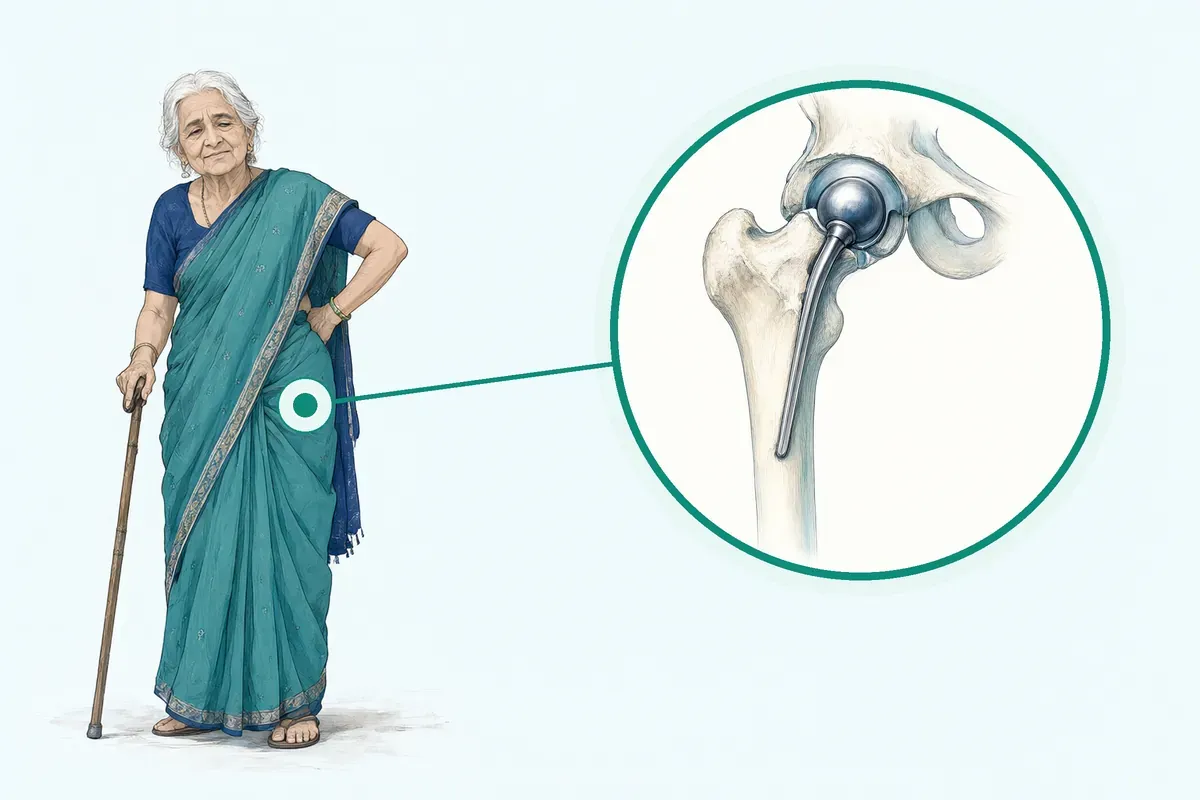
Hip pain can make ordinary routines challenging. Standing up, climbing stairs, or walking short distances may require effort and support.
-
Severe joint pain
Ongoing ache in the hip or groin can disturb rest and limit daily physical activities.
-
Stiffness and reduced motion
Difficulty bending to wear shoes, cross legs, or get up from chairs without help.
-
Difficulty walking
Needing a walking stick or the support of an attendant to move comfortably around the house.
Hip arthritis is the most common condition that damages your joint and causes these symptoms.
Why Jaipur Hospital
You may worry about the surgical risk, taking weeks away from family responsibilities, and managing hospital expenses.
Your care plan
Your first steps with us
- 1 Book an orthopaedic OPD consultation
- 2 Review your X-rays and joint health
- 3 Undergo surgery with attendant support
- 4 Begin guided physiotherapy for recovery
Surgical options for hip replacement
An orthopaedic surgeon replaces damaged bone and cartilage with prosthetic implants. Surgery usually takes 1.5 to 2.5 hours under spinal or epidural anaesthesia.
-
Total Hip Replacement (THR)
Replaces both the femoral head and acetabulum with prosthetic implants; your surgeon will discuss this option.
-
Hip Resurfacing
A bone-conserving option for younger patients; your surgeon will discuss whether this approach suits your condition.
-
Anterior Approach THR
A muscle-sparing technique associated with faster early recovery; your surgeon will discuss its suitability.
-
Cementless Implant Fixation
Uses biological bone ingrowth for long-term implant durability; your surgeon will discuss if your bone quality fits.
Why patients trust us
- 1991 Serving Jaipur for 35 years
- NABH Accredited hospital
- 5 Orthopaedics consultants
- 24×7 Emergency, ICU and ambulance
- 25 Cashless schemes and insurers
Clinical findings on hip replacement
-
75%
75% of patients reported mild to no pain after total hip arthroplasty compared to 56% after hemiarthroplasty.
-
4%
Revision surgery occurred in 4% of total hip arthroplasty patients versus 7% after hemiarthroplasty in trial follow-up.
-
4.7%
Hip dislocation occurred in 4.7% of total hip arthroplasty patients compared to 2.4% assigned to hemiarthroplasty.
If it is left untreated
Hip replacement surgery is usually considered when medication or physical therapy no longer reduces pain. Globally, hip fractures are among the top 10 causes of disability in adults. Relying on chronic opioid medications is associated with an increased risk of fractures, cardiovascular events, opioid dependence, and mortality.
Moving forward with daily life
With proper surgery and rehabilitation, most people experience improved joint function over time.
-
Easier daily walking
A hip replacement usually makes it easier to walk and climb stairs after recovery.
-
Reduced pain and stiffness
Most people experience a substantial decrease in daily pain and stiffness after healing.
-
Long-lasting implants
Prosthetic hip implants usually last a long time, and many people keep them for life.





Frequently asked questions
Questions patients ask about hip replacement
Which problems are assessed under hip replacement?
In short
Jaipur Hospital assesses several hip problems for total hip replacement. The main conditions are severe hip arthritis, displaced femoral neck fractures, and avascular necrosis of the femoral head. Other causes include hip dysplasia, old trauma, or inflammatory arthritis that has destroyed the joint. The orthopaedic team evaluates each case to confirm the joint damage is severe enough for surgery.
In detail
Hip arthritis is the most common reason for replacement, causing pain, stiffness, and loss of movement. Displaced femoral neck fractures in healthy elderly patients may be treated with total hip arthroplasty instead of hemiarthroplasty.
Avascular necrosis results from loss of blood supply to the femoral head. The surgeon reviews your history, examines the hip, and checks imaging to see if the joint surfaces are worn out or broken. Studies show total hip arthroplasty provides better function than hemiarthroplasty for displaced fractures in suitable patients.
A common belief
Many people think only arthritis leads to replacement, but fractures and loss of blood supply to the bone are also common reasons.
What actually happens
The surgeon must confirm the joint damage is severe before offering surgery.
Your next step at Jaipur Hospital
If you have persistent hip pain or a recent injury, book an OPD consultation. The surgeon will examine you and may order X-rays or MRI to confirm the diagnosis. Surgery is usually planned after non-surgical options have been tried.
How will the doctor decide which tests I need before hip replacement?
In short
At Jaipur Hospital, the orthopaedic surgeon orders tests based on your age, medical history, and the planned anaesthesia type. Standard pre-operative tests include blood counts, kidney and liver function, blood sugar, coagulation profile, chest X-ray, and ECG. Additional tests are added only if your history indicates a specific need.
In detail
Evidence shows that pre-operative evaluation aims to optimise safety for spinal or epidural anaesthesia and surgery. The surgeon reviews your medicines, allergies, and past illnesses. If you have cardiac, respiratory, or metabolic conditions, relevant specialist opinions or investigations are requested.
Imaging beyond X-rays, such as CT or MRI, is ordered only when the X-ray does not give enough detail for surgical planning.
The goal is to identify and correct anaemia, infection, or uncontrolled diabetes before surgery, reducing the risk of complications such as wound healing problems or cardiac events. Tests are not routine for every patient; they are tailored to your risk profile.
A common belief
Patients often expect a fixed panel for everyone.
What actually happens
In fact, a young, fit person needs fewer tests than someone with diabetes or heart disease. The surgeon tailors the list to your risk, not a checklist.
Your next step at Jaipur Hospital
The surgeon will give you a test list during the consultation. Complete them at our in-house laboratory and radiology, which operate 24 hours. Results are usually available within a day. Bring reports to your pre-anaesthesia check-up.
How soon should I expect improvement after hip replacement treatment?
In short
After hip replacement at Jaipur Hospital, you can usually walk with an aid within one to two days. Most people notice a dramatic decrease in pain and stiffness early on, with normal activity returning in six to twelve weeks as you progress through physiotherapy.
In detail
Recovery follows a stepped pattern. In studies, patients using the direct anterior approach had lower pain scores on the first post-operative day and more were climbing stairs normally at six weeks. However, there were no significant differences between surgical approaches at later time points.
The Harris hip score and WOMAC scores typically improve steadily over the first three months. Regular walking and prescribed exercises are essential for long-term strength and movement. People over seventy sometimes take longer to recover, and everyone's recovery is unique.
A common belief
Some think recovery is instant or takes a year.
What actually happens
Evidence shows early gains in the first six weeks, then a steady plateau. Older patients may need more time, and skipping exercises slows progress.
Your next step at Jaipur Hospital
You will start physiotherapy within twenty-four hours of surgery and continue for a few months. Plan for six to twelve weeks before using your hip without restrictions. Driving is usually possible after six weeks. Return to work depends on your job type.
How do I know whether I am ready for hip joint replacement?
In short
You may be ready for hip joint replacement when severe pain, stiffness, and limited movement persist despite medication, physiotherapy, and walking aids, and these symptoms stop you from walking, sleeping, or doing daily tasks. At Jaipur Hospital, the orthopaedic team assesses your readiness through examination, imaging, and a discussion of your goals.
In detail
Hip replacement is usually considered a last resort when other treatments have failed. Evidence shows healthcare providers suggest medication, physical therapy, or a cane before surgery.
The surgeon will compare your affected hip with the other side, check your range of motion, and review X-rays or other scans. Fitness for anaesthesia and surgery is also evaluated.
Age alone is not a barrier; patients over seventy can benefit, though recovery may take longer. Your general health, bone quality, and ability to participate in rehabilitation are key factors.
A common belief
Many people wait until they cannot walk at all.
What actually happens
Evidence shows earlier surgery before muscles waste away leads to better outcomes. Age is not a strict cutoff; fitness for rehabilitation matters more.
Your next step at Jaipur Hospital
If hip pain controls your life despite current treatment, book a consultation at Jaipur Hospital. The team will review your history, examine you, and order any needed tests.
You will receive a clear opinion on whether surgery is appropriate now or if other options remain, along with a typical cost range of ₹2,00,000 to ₹4,00,000.
How can I decide whether to seek advice about total hip replacement?
In short
You should consider seeking advice about total hip replacement when hip pain limits your daily activities, disturbs sleep, and does not improve with medicines, physiotherapy, or walking aids. Jaipur Hospital evaluates each patient with a detailed history, examination, and imaging before recommending surgery.
In detail
Clinical guidelines suggest trying non-surgical measures first. These include weight management, activity modification, oral or topical NSAIDs, and a structured physiotherapy programme.
Evidence indicates that topical diclofenac can be effective with fewer systemic side effects, while opioids carry a high risk of adverse events without clear long-term benefit for osteoarthritis.
If these steps fail and X-rays show advanced joint space loss, osteophytes, or deformity, the surgeon may discuss total hip replacement. The decision also depends on your overall fitness for anaesthesia and surgery, which is assessed during a pre-anaesthesia check-up. Age alone is not a barrier; patients in their seventies and eighties often benefit if they are medically fit.
A common belief
Some people wait until they cannot move at all, but earlier evaluation gives more options.
What actually happens
Others rush to surgery without trying a proper course of exercises and safer pain relief first. The surgeon checks your X-rays, general health, and goals before advising.
Your next step at Jaipur Hospital
Keep a simple diary of pain scores, walking distance, and sleep quality for two weeks. Bring this, your current medicines, and any previous X-rays to the orthopaedic OPD.
How will hip replacement treatment affect my walking, movement, or independence?
In short
Most patients experience a dramatic decrease in hip pain and stiffness after total hip replacement, leading to improved walking ability and independence. At Jaipur Hospital, you typically start walking with a frame or crutches within one to two days and progress to unaided walking over six to twelve weeks.
In detail
Evidence from large studies shows that the majority of patients report mild or no pain by three months and regain the ability to climb stairs, walk unlimited distances, and perform daily activities without help. The Harris Hip Score and WOMAC scores typically improve significantly.
Early recovery is supported by a structured physiotherapy programme that begins in hospital and continues at home.
You will need to follow hip precautions such as avoiding crossing legs, bending past ninety degrees, and sitting on low chairs for the first six to eight weeks to protect the new joint.
People over seventy may take a few weeks longer to reach the same milestones. The implants used today are designed to last many years, and most people keep them for life.
A common belief
Recovery is not instant.
What actually happens
You must avoid certain movements like crossing legs or sitting low for the first six to eight weeks. Older patients may need a little more time. But the implant usually lasts for life, giving long-term independence.
Your next step at Jaipur Hospital
Plan for an attendant to help at home for the first one to two weeks. Arrange a follow-up visit at six to twelve weeks to check progress.
Which symptoms should prompt me to see a specialist?
In short
You should see a specialist at Jaipur Hospital if you have severe hip pain, stiffness, and loss of range of motion that limit daily activities. Pain that persists despite rest, painkillers, or walking aids is a key sign. Difficulty walking, climbing stairs, or putting on shoes and socks suggests the hip joint is significantly affected.
In detail
The most common symptoms that lead to hip replacement are severe hip pain, stiffness, and reduced movement. Pain often worsens with activity and may disturb sleep. Stiffness makes it hard to rotate the leg or bend the hip.
Many patients report a limp or need a cane. In studies, the average baseline pain score was 6.5 on a 10 cm scale. These symptoms usually develop over years, with a median of 6.6 years since osteoarthritis diagnosis. If pain and stiffness stop you from doing routine tasks, an orthopaedic opinion is appropriate.
A common belief
Some people believe joint pain is just part of ageing and delay seeking help.
What actually happens
However, when pain stops you from normal activities and disturbs sleep, the joint damage is often advanced. Early assessment gives more treatment options.
Your next step at Jaipur Hospital
Do not wait until you are housebound. Book an OPD visit when pain affects your quality of life. The surgeon will examine your hip, check X-rays, and discuss whether non-surgical measures can help or if replacement should be planned.
How will the results change my care plan for hip replacement?
In short
At Jaipur Hospital, test results directly influence whether surgery proceeds as planned, is delayed, or needs additional preparation. Abnormal results may require medical optimisation, a change in anaesthesia technique, or specialist input before your operation date is confirmed.
In detail
Evidence shows that pre-operative optimisation reduces complications. If blood tests reveal anaemia, iron therapy or transfusion may be given before surgery. Uncontrolled blood sugar will need medication adjustment to lower infection risk. Abnormal kidney or liver function may alter the choice of antibiotics or painkillers.
Cardiac or respiratory abnormalities may need a cardiologist or pulmonologist review and could change the anaesthesia plan from spinal to general, or require intensive care standby. If imaging shows unexpected bone loss or deformity, the surgeon may plan a different implant or approach.
Each result is weighed against the urgency of your hip condition — fracture surgery cannot wait long, while elective arthritis surgery allows time for optimisation.
A common belief
Many patients assume tests are just a formality.
What actually happens
In reality, abnormal results actively change the surgical plan to protect you from complications like infection, poor wound healing, or cardiac events.
Your next step at Jaipur Hospital
After your tests, the pre-anaesthesia clinic reviews all results. You will be told if any treatment is needed before surgery and given a new timeline. Keep your reports organised and follow the medical advice promptly.
What should I do if symptoms persist or worsen after hip replacement?
In short
If you notice increasing pain, swelling, redness, fever, or difficulty moving the hip after your hip replacement at Jaipur Hospital, contact your surgeon straight away. These signs may indicate infection, dislocation, or other complications that need prompt assessment.
In detail
Complications are rare but can include hip instability, dislocation, abductor insufficiency, fracture, or nerve injury.
Evidence shows dislocation occurred in about 4.7% of total hip arthroplasty patients in one study, and serious adverse events occurred in over 40% of patients in a large trial, though many were medical rather than surgical.
The direct anterior approach carries specific risks such as fractures and nerve damage, which decrease with surgeon experience.
You should also avoid crossing your legs, bending the hip beyond ninety degrees, sitting on low chairs, and lifting heavy objects during early recovery to protect the new joint.
A common belief
Patients often wait, hoping it will settle.
What actually happens
Evidence shows early treatment of complications like dislocation or infection prevents bigger problems. Also, breaking hip precautions such as crossing legs or bending too far raises dislocation risk.
Your next step at Jaipur Hospital
Keep your follow-up appointment at six to twelve weeks so the team can check your healing. Take prescribed painkillers as advised and do your daily exercises. If any warning sign appears before that visit, call the hospital or attend the emergency department.
Which non-surgical treatments are still reasonable for me before hip replacement?
In short
Before hip replacement at Jaipur Hospital, reasonable non-surgical options include oral or topical NSAIDs, physiotherapy, walking aids such as a cane or walker, and activity modification. Topical diclofenac shows good effect with lower systemic risk. Opioids are generally not recommended due to high adverse event rates.
In detail
Evidence indicates etoricoxib 60 mg/day and diclofenac 150 mg/day are the most effective oral NSAIDs for osteoarthritis pain and function. Topical diclofenac at 70 to 81 mg/day is effective and safer.
Opioids have high dropout rates from adverse events (up to 83%) and any adverse event rates up to 90%. Guidelines focus on harm reduction for opioids. Physiotherapy and weight management also help. Your surgeon will review what you have tried and what may still help before advising surgery.
A common belief
Patients often expect strong painkillers like opioids.
What actually happens
Studies show opioids cause adverse events in up to 90% of users and do not outweigh the harm. NSAIDs and physiotherapy are safer and evidence-based first steps.
Your next step at Jaipur Hospital
Discuss your current medications and therapies at your OPD visit. The team can adjust NSAID choice, prescribe a physiotherapy programme, and advise on walking aids. If these measures no longer control symptoms, surgery can be planned.
FAQ library
Questions and answers about hip replacement
When you contact us
Schedule an orthopaedic evaluation in Jaipur
Contact Jaipur Hospital to discuss your hip symptoms, review your scans, and explore your treatment options.
- A consultation with an orthopaedic surgeon in the OPD
- Your scans and reports reviewed, with tests done in-house if you need them (laboratory, X-ray and imaging)
- Your options explained in plain words, including whether you need surgery at all
- A cost estimate before you decide
- Help with cashless treatment under RGHS, MAA Yojana, CGHS and empanelled insurers and TPAs
- Follow-up visits after your treatment
Overview
Hip Replacement: what to know
What is hip replacement surgery and how the joint wears down
Your hip joint is a ball-and-socket joint that supports your body weight and lets you walk, sit, and move smoothly. Over time, injury or disease can wear away the protective surfaces inside the joint. When the natural surfaces become damaged, bone rubs against bone, causing joint irritation, stiffness, and ongoing pain.
Hip replacement surgery replaces your natural hip joint with prosthetic implants. In this operation, an orthopaedic surgeon replaces some or all of your hip joint to rebuild a smooth joint surface. Total hip replacement replaces the femoral head and acetabulum.
At Jaipur Hospital, our surgical team evaluates your joint to determine how much damage has occurred and whether an implant is appropriate for your condition.
Symptoms of severe hip damage and warning signs that need urgent care
- Sudden inability to bear weight
- Severe swelling in leg or foot
- Signs of infection
- Sudden severe pain
Severe hip pain, stiffness, and loss of range of motion are the most common symptoms that lead people to consider a hip replacement. Loss of range of motion means you cannot move your hip as far as you normally could.
You may find it difficult to:
- Walk
- Climb stairs
- Bend down to put on footwear
Certain warning signs require immediate medical attention rather than a routine OPD visit. Contact your surgeon right away or visit an emergency room if you notice sudden inability to bear weight on your leg, severe swelling in your leg or foot, signs of infection like fever or redness around the joint, or sudden severe pain. Sudden trauma or an unexpected fall can lead to a broken bone, which requires urgent evaluation.
Causes of hip joint damage and who is at higher risk
- 50 years of age or older Age 50 or older
- 13% to 91% Female participants in arthritis studies
- 48 to 72 years Mean age in arthritis trials
Any condition or injury that damages your hip can cause severe pain and stiffness. Hip arthritis is the most common cause of joint breakdown. Another common cause is a fracture, particularly a displaced femoral neck fracture in the upper thigh bone. Avascular necrosis, where blood supply to the bone is reduced, also leads to joint damage.
Globally, hip fractures are among the top 10 causes of disability in adults. Age is a significant risk factor. People 50 years of age or older face a higher chance of joint wear and fracture. In clinical trials of hip arthritis treatments, the mean age of participants ranged from 48 to 72 years.
Women also experience high rates of joint degeneration, with female participants making up between 13% and 91% of patients in studied arthritis groups.
How hip damage is diagnosed: OPD examination and tests
- Compare both hips Surgeon checks the affected hip against the other side
- Test movement Move hip in different directions to check range and strength
- Use scoring systems Standardised scores measure pain, stiffness and daily function
- Imaging tests X-rays and other scans show bone structure and soft tissues
When you visit our OPD, your surgeon will begin by assessing your physical movement. Your surgeon will compare the hip that needs replacing with your other hip. They will have you move your hip in different directions to check your range of motion, flexibility, and strength.
In clinical practice and trials, doctors often use standardised scoring systems like the Harris hip score and the Western Ontario and McMaster Universities Arthritis Index to measure joint pain, stiffness, and daily function.
You will probably need several tests before a hip replacement. Your surgeon will examine your bone structure using X-rays. In addition to X-rays, you might need other imaging tests to inspect the surrounding soft tissues and bone quality. These clinical checks help your surgeon see the exact condition of the joint before discussing surgery.
Non-surgical treatment options and when hip replacement is advised
- 18.5% Oral NSAIDs dropout risk
- 29.8% Oral NSAIDs adverse event risk
- 83.3% Opioid dropout risk
- 89.5% Opioid adverse event risk
Before considering surgery, your healthcare provider will probably suggest other treatments like:
- Medication
- Physical therapy
- Using a cane or walker
In studies, topical diclofenac 70 to 81 mg per day was found to be effective and generally safer than oral pills because of reduced systemic exposure and lower dose.
For oral medicines in clinical trials, 18.5% of oral non-steroidal anti-inflammatory drugs (NSAIDs) had an increased risk of patients stopping treatment due to adverse events, and 29.8% had an increased risk of any adverse event. Topical NSAIDs showed 0% increased risk of dropouts and 0% increased risk of any adverse event in those trials.
Using strong painkillers such as opioids is generally discouraged for chronic joint pain. In studies, the clinical benefit of opioid treatment did not outweigh the harm it might cause in patients with osteoarthritis. Opioids carried an 83.3% increased risk of dropouts and an 89.5% increased risk of adverse events. Chronic use of opioids is associated with an increased risk of fractures, heart problems, opioid dependence, and death.
Hip replacement surgery is usually considered a last resort when other forms of treatment have failed to reduce joint pain and inflammation. If daily activities like walking, standing, or climbing stairs remain painful after medications and physical therapy, your surgeon will discuss surgical options with you.
Preparing for hip replacement surgery
Preparing for hip replacement surgery involves medical checks and planning for your stay at Jaipur Hospital. Before your operation, you will probably need several tests. Your doctor may arrange imaging tests in addition to X-rays.
In our OPD, your surgeon will examine your joint, compare the hip that needs replacing with your other hip, and have you move your hip in different directions.
Talk to your doctor about all medicines and supplements you take. If you take pain medicines like oral pain relievers or stronger prescription pain medicines, discuss these with our surgical team before admission. You can purchase any prescribed preparation from our in-house chemist or collect medicines locally.
Our surgical team will tell you when to stop eating and drinking before surgery. Wear loose, comfortable clothes for admission.
Bring:
- Comfortable flat footwear
- Any regular medical papers
- Personal toiletries
We ask that an attendant stay with you in the ward to help you settle in.
How hip replacement surgery is done
Total Hip Replacement (THR)
- Replaces femoral head and acetabulum
Hip Resurfacing
- Bone-conserving option for younger patients
Cementless Implant Fixation
- Biological fixation for long-term durability
Hip replacement surgery replaces your natural hip joint with prosthetic implants. An orthopaedic surgeon replaces some or all of your hip joint. The operation usually takes 1.5 to 2.5 hours. It takes an hour or two to complete. The anaesthesia used is typically spinal or epidural anaesthesia.
There are several surgical options to replace the joint. Your surgeon will discuss these choices and advise which option suits you:
- Total Hip Replacement (THR): This procedure replaces both the femoral head and acetabulum.
- Hip Resurfacing: This is a bone-conserving option for younger patients.
- Anterior Approach THR: This is a muscle-sparing method aimed at faster early recovery.
- Cementless Implant Fixation: This provides biological fixation for long-term durability.
A number of surgical approaches to the hip joint exist, each with unique advantages and disadvantages.
The most commonly used approaches include:
- Direct anterior
- Direct lateral
- Posterior approaches
In studies, new surgical instruments and tables designed specifically for the direct anterior approach have made the technique more accessible to surgeons. Research also notes the direct anterior approach may have a significantly longer mean operating time. Your surgeon will advise which surgical approach suits your joint and general health.
Risks and complications of hip replacement
- 4.7% vs 2.4% Dislocation rate THA vs hemiarthroplasty
- 41.8% vs 36.7% Serious adverse events THA vs hemiarthroplasty
- 14.3% vs 13.1% Mortality THA vs hemiarthroplasty
- 9% vs 3% Dislocation rate in another study
Having any surgery can feel scary when replacing a joint with a prosthesis. While complications are rare, they can happen. Possible complications of total hip arthroplasty include hip dislocation, abductor insufficiency, fracture, and nerve injury. Their relative risk varies by surgical approach. It is rare, but you might need more surgeries on your hip in the future.
Rates of complications have been measured across groups of patients in clinical research. In one large trial of 1,495 patients with femoral neck fractures, hip instability or dislocation occurred in 34 patients (4.7%) assigned to total hip arthroplasty and 17 patients (2.4%) assigned to hemiarthroplasty.
Serious adverse events occurred in 300 patients (41.8%) assigned to total hip arthroplasty and in 265 patients (36.7%) assigned to hemiarthroplasty. Mortality in that trial was 14.3% among patients assigned to total hip arthroplasty and 13.1% among those assigned to hemiarthroplasty. In another study, dislocation rates were 9% after total hip arthroplasty versus 3% after hemiarthroplasty.
In that study, equal rates were found for major complications, with 25% in total hip arthroplasty versus 24% in hemiarthroplasty, while minor complications were 13% after total hip arthroplasty versus 14% after hemiarthroplasty. One-year mortality in that trial was 13% after total hip arthroplasty versus 15% after hemiarthroplasty.
Specific surgical approaches carry their own risks. Research indicates that complications unique to the direct anterior approach include fractures and nerve damage. The incidence of these unique complications decreases with greater surgeon experience. A steep learning curve for the direct anterior approach has been described in surgical studies.
Studies also suggest that the direct anterior approach may be associated with fewer surgical complications or may have similar rates of complications as other approaches.
Recovery and aftercare after hip replacement
- Hospital stay Typically 3 to 5 nights
- Walk with aid Usually within 1 to 2 days
- Stitches removed After about 10 days
- Follow-up appointment Around 6 to 12 weeks after surgery
- Normal activity resumes Typically 6 to 12 weeks, can take several months
After surgery, your hospital stay is typically 3 to 5 nights. Right after the operation, you will spend time in a recovery room where you may be given medicines to help with the pain. You may also have a tube in your hip to drain away any fluids.
You will continue to have painkillers in the days after the operation as your hip will be sore. You will have help from nurses and physiotherapists to start walking as soon as possible after the operation. Patients typically walk with an aid in 1 to 2 days. You will need crutches or a walking frame at first. Your attendant can assist you as you learn these initial movements.
Before you go home, our physiotherapist will talk to you about managing daily activities and home exercise programmes. Following the exercises early on in your recovery will help with long-term strength and movement in your hip. A nurse will take out your stitches or clips after about 10 days.
You will also have a follow-up appointment in our OPD around 6 to 12 weeks after your surgery to check how you are recovering. Normal activity is typically resumed in 6 to 12 weeks, though recovery can take up to 12 weeks or several months. People over 70 can sometimes take longer to recover.
During recovery at home, you will need to follow movement rules to protect your healing joint:
- Do not sit with your legs crossed.
- Do not bend your hip more than 90 degrees.
- Do not bend down to touch your feet or ankles.
- Do not sit down in a low chair, low toilet seat, or a chair without arms.
- Do not do exercises involving jumping, sudden turns, or high risk of falling.
- Do not lift or move heavy objects until told it is safe.
- Regularly walk every day as far as it is comfortable.
- Sit in a reclining position, but avoid sitting still for long periods of time.
- Wait at least 6 weeks to drive.
- Try to avoid sex for 6 to 8 weeks after your operation.
- Return to work when you feel ready, which usually takes about 6 weeks depending on your job.
These restrictions will not be long-term. Contact your surgeon right away if you notice signs of complications like chest pain, severe redness, sudden shortness of breath, calf pain, or wound drainage.
Results and long-term outcomes of hip replacement
Hip replacement surgeries are usually very successful. Most people who have a hip replacement experience a dramatic decrease in pain and stiffness. Once you are fully recovered, you should have increased mobility, making it easier to walk, climb stairs, and carry out physical activities.
As you progress through physiotherapy and your body heals, it should become easier to move your hip than before surgery. Prosthetic hip implants usually last a long time, and lots of people keep their implants for the rest of their lives.
Clinical trials have evaluated joint function using standardised medical scores. In one study of patients treated for femoral neck fractures, function modestly favored total hip arthroplasty over hemiarthroplasty on the Western Ontario and McMaster Universities Osteoarthritis Index (WOMAC) total score, pain score, stiffness score, and function score.
In another report, the WOMAC score was 94 points after total hip arthroplasty versus 78 after hemiarthroplasty. On the Harris hip score, the weighted mean was 81 points after total hip arthroplasty versus 77 after hemiarthroplasty, and the pain subdomain was 42 after total hip arthroplasty versus 39 after hemiarthroplasty. The rate of patients reporting mild to no pain was 75% after total hip arthroplasty versus 56% after hemiarthroplasty.
Repeat surgeries are tracked across clinical trials. In one trial comparing surgical options over 24 months of follow-up, the incidence of secondary hip procedures did not differ significantly between total hip arthroplasty and hemiarthroplasty. In another trial, 4% of patients underwent revision surgery after total hip arthroplasty compared to 7% after hemiarthroplasty.
When researchers examined surgical approaches, subjects treated with the direct anterior approach had lower pain scores on the first day, and more subjects were walking unlimited and climbing stairs normally at 6 weeks. Scores were better for the first 6 weeks post-operatively, but there was no difference between the direct anterior and posterior approaches after the first 6 weeks. Studies show little evidence for better long-term outcomes following the direct anterior approach compared to other approaches.
Cost of hip replacement and insurance in Jaipur
The typical price for hip replacement surgery ranges from ₹2,00,000 to ₹4,00,000. This is the typical range in India; ask us for an estimate. Across India, total hip replacement prices typically range between Rs. 1,50,000/- and Rs. 4,80,000/-, while partial hip replacement may cost between Rs. 75,000/- and Rs. 1,75,000/-.
Several factors change the final cost of treatment. The severity of your joint damage and whether you require single or bilateral surgery will alter the expense. The type of surgery chosen and the specific prosthetic implants selected also influence the total cost.
If complications such as excessive blood loss or infection happen, managing them may necessitate an extended hospital stay, which directly increases treatment costs. The duration of rehabilitation and physiotherapy services required after surgery can also change your total expenses.
Jaipur Hospital works with government health schemes and private insurance panels.
We are empaneled with:
- RGHS
- MAA Yojana
- CGHS
- A panel of private insurers and TPAs
Your insurance coverage and policy terms will determine how much you need to self-fund for your care.