

Plastic Surgery · Jaipur Hospital
Rhinoplasty in Jaipur
Trouble breathing through your nose, or unhappy with how it looks? Jaipur Hospital offers a clear assessment and a plan.
- Serving Jaipur since 1991 (35 years)
- NABH accredited
- 24×7 emergency & ICU
- Cashless: RGHS, MAA Yojana, CGHS + 22 insurers
- Operation time
- 2 to 4 hours
- Anaesthesia
- General anaesthesia (local with sedation for small corrections)
- Recovery
- Back to desk work in 1 to 2 weeksfinal shape settles over 6 to 12 months
- Price
- ₹70,000 to ₹2,00,000typical range in India; ask us for an estimate
You keep noticing it
You want to breathe easily and feel at ease with your nose
You check your nose in every photo. You breathe through your mouth at night. People tell you it is nothing, but it stays on your mind. Some days the worry is about looks. Some days it is about blocked breathing. Either way, you want a straight answer, not guesswork.
-
Nose shape you dislike
A hump, a wide tip or a nose that looks uneven in photos can make you self-conscious in meetings and family gatherings.
-
Blocked breathing
A crooked septum or narrow passages can make breathing feel like work, especially at night or during exercise.
-
Worry about time off
You may be unsure how many days you need away from desk work, and whether your family can manage without you.
-
Cost and confusion
Quotes you find online differ widely, and it is hard to know what is included in the final bill.
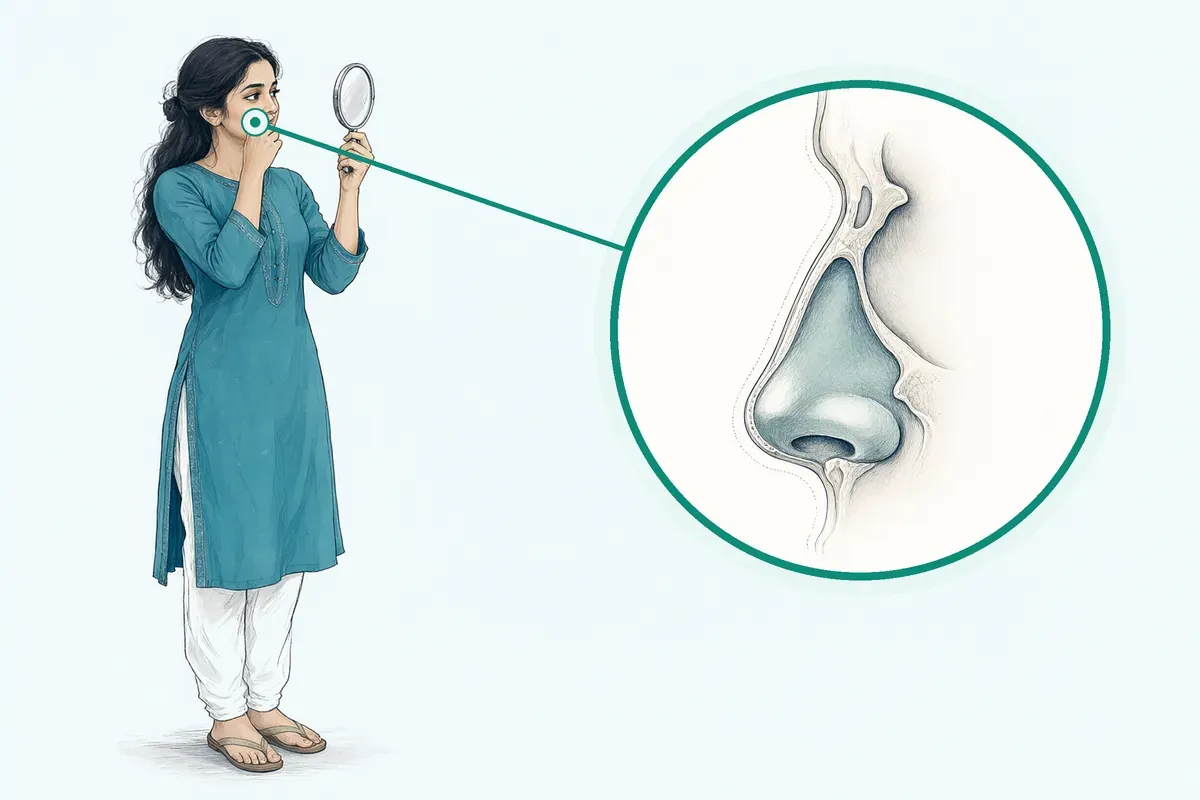
Complications in the nasal septum can affect how you breathe.
Why Jaipur Hospital
You may be worried about pain, about being judged for wanting this, about time off work, or about what the final bill will be.
Your care plan
Your first steps with us
- 1 Call us or write to book an OPD consultation
- 2 Meet a plastic surgeon and explain your concerns
- 3 Get your options, a plan and a cost estimate
- 4 Follow the recovery plan and attend follow-up visits
How the operation is done
Rhinoplasty reshapes the nose to improve appearance or to fix problems that block breathing. Your surgeon will discuss which approach fits your nose, and whether you need surgery at all. The operation usually takes 2 to 4 hours, and you go home the same day or stay one night.
-
Open rhinoplasty
A small cut across the skin between the nostrils gives your surgeon a full view of the nose framework.
-
Closed rhinoplasty
All cuts are placed inside the nostrils, so there is no visible scar on the outside.
-
Septorhinoplasty
Straightens the septum to improve breathing while the nose is reshaped.
-
Non-surgical (filler) rhinoplasty
Fillers can smooth small bumps. The change is temporary, and it does not suit every nose.
Why patients trust us
- 1991 Serving Jaipur for 35 years
- NABH Accredited hospital
- 1 Plastic Surgery consultants
- 24×7 Emergency, ICU and ambulance
- 25 Cashless schemes and insurers
What research shows about this treatment
-
1 to 2 weeks
A common guide is returning to work or school within one to two weeks after surgery.
-
about 15 in 100
Around 15 in 100 people need a small follow-up operation after the first rhinoplasty.
-
less than 1 in 100
In one review, infections after rhinoplasty were reported in less than 1 in 100 procedures.
If it is left untreated
Left alone, a blocked nose can keep disturbing sleep and daily breathing. A crooked septum can affect how you breathe. Some people also carry worry about appearance for years without ever asking a surgeon. An assessment gives you facts about your own nose, which is better than guessing.
Life after treatment
Most people go back to desk work in 1 to 2 weeks. Swelling settles over weeks, and the final shape usually settles over 6 to 12 months. Follow-up visits help your surgeon check healing along the way.
-
Back to desk work
Most people return to desk work in 1 to 2 weeks, once swelling and soreness settle.
-
Breathing feels easier
Most people who have functional rhinoplasty for a deviated septum notice breathing improvements within six weeks.
-
A shape that settles
Swelling reduces over the first weeks, and the final shape usually settles between 6 and 12 months.
-
Follow-up support
Follow-up visits let your surgeon check healing and answer your questions in the first year.
Frequently asked questions
Questions patients ask about rhinoplasty
What does rhinoplasty involve?
In short
Rhinoplasty reshapes your nose to improve how it looks or how you breathe. At Jaipur Hospital, it usually takes 2 to 4 hours. General anaesthesia is usual; small corrections may use local anaesthesia with sedation. Your surgeon makes cuts inside the nostrils or a small cut between them. You may go home that day or stay one night.
In detail
Rhinoplasty can be cosmetic, functional or both. A deviated septum or a broken nose can block airflow, and surgery can correct that. When breathing and shape are both issues, a septorhinoplasty may be discussed.
Your surgeon may use an open approach, with a small cut across the skin between the nostrils, or a closed approach, with cuts inside the nose. The plan depends on your nose and your goals.
Non-surgical filler can smooth small bumps, but it is temporary and not suitable for every nose. Studies show group improvements in nasal blockage scores after functional rhinoplasty, but results vary. Your surgeon will also discuss realistic expectations. Tests are arranged only if needed.
A common belief
People often think it is only cosmetic.
What actually happens
But a blocked nose from a bent septum or an old injury can also be corrected. The surgeon may work through cuts inside the nostrils or a small cut between them. The plan is based on your nose, not a fixed package.
Your next step at Jaipur Hospital
First, note what bothers you most: appearance, breathing, or both. List all medicines, supplements and herbal products you take. At the consultation, your surgeon will examine your nose, ask about your health and explain the options.
If you decide to go ahead, the team will guide your preparation and give you a date. To discuss rhinoplasty, book a consultation at Jaipur Hospital.
Which tests and scans do I need before rhinoplasty?
In short
There is no single test list for rhinoplasty. Your surgeon will decide what you need after examining your nose and reviewing your health. A small correction may need fewer checks than a septorhinoplasty. At Jaipur Hospital, the team will explain each test and when to do it. Bring any recent reports you have.
In detail
Tests are chosen for your health and the surgery plan, not for the shape of your nose alone. Your surgeon will decide whether any blood test, scan or specialist review is needed. The choice depends on your health, your medicines and the planned operation.
A person having a small correction may need very little. Someone with a long-term condition may need more checks. The aim is to plan anaesthesia safely and avoid surprises. A deviated septum or old injury may need a closer look inside the nose.
Not every patient needs the same checks. Bring a list of all medicines, including anything you buy without a prescription.
A common belief
People often expect a standard package of scans.
What actually happens
Rhinoplasty does not work that way. The tests are chosen to plan anaesthesia and surgery safely, not to measure how your nose looks. A small correction may need very little. A long-term condition or past nose injury may need more review. Bring old reports and a full medicine list so nothing is repeated unnecessarily.
Your next step at Jaipur Hospital
Bring recent reports, a full medicine list and the names of any specialists you see. Tell the team about allergies, past operations and long-term conditions. If tests are advised, they are usually arranged before the surgery date so the results can be reviewed.
Do not stop any prescribed medicine on your own. To find out what tests you need for rhinoplasty, book a consultation at Jaipur Hospital.
How painful is rhinoplasty and the early recovery?
In short
Most people feel mild to moderate pain after rhinoplasty, not severe pain. Jaipur Hospital plans your pain relief before surgery, so discomfort is usually manageable at home. The worst soreness and swelling come in the first few days. Pain then settles over about a week, though your nose may stay tender for one to two weeks.
In detail
During rhinoplasty you get general anaesthesia, so you feel nothing during the operation. For small corrections, local anaesthesia with sedation is sometimes used. Your surgeon may give a long-acting numbing medicine at the end, which keeps the first hours more comfortable.
After that, most discomfort comes from swelling inside and around the nose rather than the cuts. Keeping your head raised, sleeping on your back and using cold packs as advised usually help.
Studies and clinic experience show pain eases gradually over the first one to two weeks. Most people need only simple pain relief by the second week. Sharp new pain that keeps getting worse is not normal and should be checked.
A common belief
People often expect the cuts to hurt most.
What actually happens
In fact, swelling inside the nose, and around the eyes and cheeks, is the main reason for discomfort. Keeping your head raised and sleeping on your back helps. Sharp pain that keeps getting worse is not normal, so ask your surgeon to check it.
Your next step at Jaipur Hospital
Take your medicines exactly as your surgical team advises, and do not stop any regular medicine on your own. Keep follow-up appointments, including the visit at the end of the first week when splints and stitches are usually removed.
Arrange an attendant for the first 24 hours at home. If pain increases instead of settling, contact us. To plan your rhinoplasty and pain relief, book a consultation at Jaipur Hospital.
How long does rhinoplasty recovery usually take?
In short
Most people go back to desk work in one to two weeks after rhinoplasty. Swelling drops a lot in the first two weeks, and most of it is gone by about 12 weeks. The nose keeps settling slowly, and the final shape usually shows over 6 to 12 months. Jaipur Hospital plans your follow-up around these stages.
In detail
Recovery happens in stages. In the first week you rest with a splint, and your surgeon usually removes the splint and external stitches at the end of that week.
Most of the healing happens in the first two weeks, and by week two you should feel much better. Swelling is usually noticeable for four to six weeks and then fades, though some lasts three months or more.
Nasal bones and cartilage take about six weeks to heal enough for usual activities. Light exercise can start around four to six weeks. Full settling takes longer, which is why final results are judged at 6 to 12 months.
A common belief
The common mistake is judging the result too early.
What actually happens
Swelling can make the nose look uneven for weeks, and some swelling lasts months. That is normal healing, not a failed operation. Final results are judged after six to twelve months, not after the splint comes off.
Your next step at Jaipur Hospital
Plan at least a week off work, and more if your job is physical. Arrange an attendant for the first 24 hours and someone to drive you home, because the effects of anaesthesia can last up to a day.
Keep every follow-up appointment so healing can be checked. Avoid heavy lifting and strenuous exercise for four to six weeks. To plan your dates and recovery, book a consultation at Jaipur Hospital.
Are my expectations realistic for my anatomy and health with rhinoplasty?
In short
Yes, usually, but realistic expectations need a proper conversation. Your skin thickness, bone and cartilage shape, and general health all affect what rhinoplasty can do. At Jaipur Hospital, your surgeon will examine your nose and explain what is reasonable for you. No surgeon can promise an exact shape, and a good plan starts with honest limits.
In detail
Rhinoplasty reshapes the nose to improve appearance or to fix problems that interfere with breathing. In studies, most people see improvement, but results vary between patients. Your surgeon studies your photographs, examines the inside of your nose, and discusses what you want changed.
Some requests suit your anatomy and some do not. Asymmetrical healing, where swelling affects one side more, can make the nose look crooked in the first few weeks. That is part of normal recovery, not a final result.
Health matters too, since medicines, smoking and healing problems affect planning. Studies also show that about 15% of people choose a small revision later, so a first operation is a decision to take slowly.
- Studies also show that about 15% of people choose a small revision later, so a first operation is a decision to take slowly.
A common belief
Many people bring a photograph and expect that exact nose.
What actually happens
That is not how surgery works. Your anatomy sets the limits. Studies also show that about fifteen percent of people choose a small revision later. Uneven swelling in the first few weeks can look alarming, but it is part of normal healing, not the final shape.
Your next step at Jaipur Hospital
Before surgery, write down your questions and bring photographs that show the shape you have in mind. Your surgeon will explain what is achievable and what is not. A second meeting is often useful before you decide.
Recovery usually takes one to two weeks away from desk work, and the final shape settles over 6 to 12 months. To discuss your own anatomy, book a consultation at Jaipur Hospital.
How will appearance, function and realistic expectations be discussed before rhinoplasty?
In short
Your surgeon will talk through three things: how your nose looks, how it works for breathing, and what surgery can realistically change. Expect an examination of your septum, tip and skin and your health history. At Jaipur Hospital, this is discussed at your OPD consultation before a date is fixed. Bring your questions and reference pictures.
In detail
Rhinoplasty covers both cosmetic and functional goals. Some people want a change in shape, others want easier breathing, and many want both. A surgeon can correct a deviated septum or a broken nose, and rhinoplasty and septoplasty can be done together.
That is why the consultation looks at your septum, nasal valve and tip support. Published reviews note that patients often have combined functional and aesthetic problems, so both need a plan.
Your surgeon should explain the techniques being considered, the usual recovery, and the limits of what surgery can do. Your expectations should be spoken aloud, so anything unrealistic can be corrected early.
A common belief
Many people arrive with only a shape in mind and never mention blocked breathing.
What actually happens
Septorhinoplasty can address both, but the plan changes. Published reviews show patients often have combined functional and cosmetic problems. Bringing your questions and pictures helps your surgeon plan honestly.
Your next step at Jaipur Hospital
Write down what bothers you about your nose and what you hope to change. Bring a list of your medicines and past nose injuries. At the OPD visit your surgeon will examine you and explain the options, including open, closed and septorhinoplasty approaches.
Surgery usually takes 2 to 4 hours, with a same-day discharge or one night in hospital. Final shape settles over 6 to 12 months.
Why might my doctor recommend rhinoplasty?
In short
Your doctor may recommend rhinoplasty if your nose affects how you breathe or how you feel about its shape. It can be considered for a blocked nose from a deviated septum, a broken nose, a hump, a drooping tip, or wide or narrow nostrils. At Jaipur Hospital, your surgeon will first check the reason and your health.
In detail
Rhinoplasty has two main aims: appearance and breathing. Some people want to change the size, angle or tip of the nose. Others have a structural problem, such as a deviated septum, that makes breathing hard. A septorhinoplasty can address both at once.
The surgeon will examine the inside and outside of your nose, ask about your symptoms and review your health history. They will also ask what you expect from surgery. Rhinoplasty can improve appearance, but realistic expectations matter.
Studies of functional rhinoplasty show group improvements in nasal blockage scores, but they cannot predict your result. If your goal is only a small change, a non-surgical option may be discussed, though it is temporary.
A common belief
Many people assume it is only about appearance.
What actually happens
But a bent septum, an old injury or narrow nostrils can affect breathing. The surgeon will examine you and ask about your symptoms and expectations. Studies show group improvements in breathing scores, but no one can promise your exact result. A small change may sometimes be treated with temporary filler, but not every nose is suitable.
Your next step at Jaipur Hospital
Write down your symptoms, including when your breathing feels blocked. Note any past nose injury or surgery. Bring a list of all medicines and supplements. Your surgeon will use this to decide whether rhinoplasty is appropriate and which approach may suit you.
You can also ask about the likely recovery time and cost range. To discuss your options, book a consultation at Jaipur Hospital.
How should I prepare in the days before rhinoplasty?
In short
In the days before rhinoplasty, follow your surgical team's instructions and keep your routine calm. Arrange an attendant for the first 24 hours. Plan at least a week off work and someone to drive you home. At Jaipur Hospital, we will tell you what to bring and when to arrive. Do not stop prescribed medicine on your own.
In detail
Preparation is mostly practical. You need support at home because the anaesthesia can take up to 24 hours to wear off, and you should not drive yourself home. Arrange help with children or chores if you need it.
Avoid smoking and alcohol around surgery and for several weeks after, as advised, to help your incision heal and reduce scarring. Keep your head elevated when you sleep and avoid sleeping on your side or stomach for the first 1 to 3 weeks.
Do not blow your nose during that time. Follow the team's advice on medicines and fasting. These steps support healing; they do not promise a particular result.
A common belief
People often focus only on the surgery day.
What actually happens
Recovery starts at home. You should not drive after anaesthesia, and you may need help with children or chores. Avoid smoking and alcohol around surgery, keep your head raised when sleeping and do not blow your nose for the first 1 to 3 weeks. These steps support healing, but they cannot promise a perfect result.
Your next step at Jaipur Hospital
Make a simple checklist: attendant, transport, time off work, loose front-button clothes and a place to sleep with your head raised. Keep your medicine list and reports together. On the day, follow the arrival time and fasting advice given by the team. If you become unwell, tell us before coming. To plan your preparation, book a consultation at Jaipur Hospital.
What are the common side effects and the less common serious complications of rhinoplasty?
In short
Common side effects after rhinoplasty are swelling, bruising around the eyes, mild pain, a blocked nose and some blood or discharge from the nostrils. These usually settle in a few weeks. Serious complications are less common. Jaipur Hospital explains the warning signs before you go home. About 15 in 100 people need a revision operation later.
In detail
Swelling and bruising are the most common problems, and bruising under the eye can look alarming for a week or two.
One side may heal faster than the other, which can make the nose look crooked for a few weeks; this is normal healing, not a failed result. Blood or discharge from the nostrils is also expected early on.
Infection is uncommon, seen in less than one in 100 operations. Rare but serious risks include heavy bleeding, injury to the eye or its blood supply, and breathing problems. Some patients notice new or leftover blockage, and some choose revision surgery. Reports in studies suggest about 10 in 100 people notice leftover or new breathing trouble after a first rhinoplasty.
A common belief
Many people worry most about scars, but swelling and uneven healing on one side are what usually cause alarm in the first weeks.
What actually happens
That is normal healing. What matters is knowing the danger signs: fever, worsening pain, heavy bleeding or changed vision.
Your next step at Jaipur Hospital
Watch for fever, pain that gets worse, heavy bleeding, spreading redness, trouble breathing, or any change in vision. These need urgent review, so contact the hospital without waiting. Keep your follow-up visits and take medicines only as prescribed.
Do not compare your nose with anyone else's; healing differs from person to person. To discuss your risks and plan safe care, book a consultation at Jaipur Hospital.
Which symptoms are expected after rhinoplasty, and which need urgent medical attention?
In short
After rhinoplasty, expect swelling, bruising around the eyes, a blocked nose, mild pain and some blood or discharge from the nostrils. These are normal in the first week. Seek urgent help for fever, pain that keeps worsening, heavy bleeding, spreading redness, trouble breathing, or any change in vision. Jaipur Hospital gives you clear warning signs before discharge.
In detail
Swelling is fluid collecting under the skin, so your nose, eyelids, cheeks and lips can look puffy, and bruising may spread downwards for a few days. A blocked nose is common while swelling and crusting settle.
One side may look more swollen than the other, which can be alarming but is part of normal healing. In studies, serious complications are reported in less than one in 100 operations, but they still need prompt care.
Fever with increasing pain, bleeding that does not stop, spreading redness, breathing difficulty or changed vision should never wait. Heavy bleeding or a fever that does not settle needs review the same day, not at your next appointment.
A common belief
People often wait, thinking swelling explains everything.
What actually happens
Most swelling is harmless, but pain that keeps rising, spreading redness or a fever can point to infection, which is uncommon but serious. Changed vision is rare and needs immediate attention.
Your next step at Jaipur Hospital
Do not wait for your next appointment if something worries you. Contact the hospital the same day for fever, worsening pain, heavy bleeding, spreading redness, breathing trouble or any change in vision. For milder symptoms, follow your discharge instructions and keep the first-week follow-up.
Do not take extra medicines on your own. To have these warning signs explained for your case, book a consultation at Jaipur Hospital.
FAQ library
Questions and answers about rhinoplasty
When you contact us
Start with a consultation
Call Jaipur Hospital or write to us to book an OPD consultation with a plastic surgeon and get your questions answered.
- A consultation with a plastic surgeon in the OPD
- Your scans and reports reviewed, with tests done in-house if you need them (laboratory, X-ray and imaging)
- Your options explained in plain words, including whether you need surgery at all
- A cost estimate before you decide
- Help with cashless treatment under RGHS, MAA Yojana, CGHS and empanelled insurers and TPAs
- Follow-up visits after your treatment
Overview
Rhinoplasty: what to know
What Is Rhinoplasty and How Does It Change the Nose?
Rhinoplasty is nose reshaping surgery. It is commonly called a nose job. It changes the bone and cartilage that give your nose its shape, and it can improve how you breathe. The septum is the deep internal structure of your nose. If the septum is crooked, it can narrow the airway.
During rhinoplasty, your surgeon makes small cuts and works on the bone and cartilage. In an open rhinoplasty, one cut runs across the skin between the nostrils. This gives a full view of the nose framework. In a closed rhinoplasty, all cuts are inside the nostrils, so there is no visible scar.
Your surgeon may use a piece of cartilage from your septum, ear, or rib to support or build up the nose. The cuts are closed with dissolvable stitches.
Septorhinoplasty combines reshaping with straightening of the septum to improve breathing. Your surgeon will advise which approach suits your nose.
Rhinoplasty is usually done under general anaesthesia, so you are asleep. For small corrections, local anaesthesia with sedation may be used. The nose is numbed, and you are relaxed but not fully asleep. You will not feel the operation.
Rhinoplasty Symptoms and Same-Day Warning Signs
- High fever
- Severe pain with fever
- Change in vision
Rhinoplasty symptoms can be about breathing as well as appearance. A crooked septum can make it hard to breathe through the nose.
Some noses have:
- A hump
- A drooping tip
- Nostrils that are too wide or too narrow
A broken nose can leave the bridge crooked, and rhinoplasty can correct it. A blocked nose may also come from a deviated septum, where the wall inside is bent to one side. You may feel self-conscious about the shape.
After surgery, mild to moderate pain, swelling, and some blood or discharge from the nostrils are expected. Swelling can affect the nose, eyes, cheeks, and lips in the first week. Swelling should reduce considerably by week two.
Seek same-day medical care if you have a high fever, spreading redness or swelling around the eye, severe pain with fever, or any change in vision. These can be signs of a serious infection or a problem with the blood supply to the eye. Pain and fever after nose surgery should not be left until the next routine visit.
Causes of Nose Shape and Breathing Problems
- Structural support loss
- Septum loses support, airway narrows
- Broken nose
- Crooked bridge and septum deviation
- Common shape features
- Hump, wide or drooping tip, narrow or wide nostrils
- Higher risk factors
- Combined sinus surgery, rib grafts, bone-cut technique
Nose shape and breathing problems can have different causes.
The nose is supported by:
- Bone
- Cartilage
- The septum
If the septum loses support, the nose can change shape and the airway can narrow. A broken nose can leave the bridge crooked and affect the septum.
Some noses have:
- A hump
- A wide or drooping tip
- Narrow or wide nostrils
Rhinoplasty is recommended for people with these features.
You may be more likely to seek rhinoplasty if you have a deviated septum, a broken nose, or breathing problems from the shape of your nose. You may also seek it if you feel self-conscious about your nose.
Some factors raise the chance of problems after surgery. Combining sinus surgery with rhinoplasty raises the risk. Rib cartilage grafts can warp and can cause problems at the donor site. The bone-cut technique affects swelling. The risk of problems can be reduced with increasing surgical experience.
Rhinoplasty is not suitable for every person. Your surgeon will discuss whether surgery is likely to help your breathing or appearance.
How Rhinoplasty Is Assessed at Jaipur Hospital
Jaipur Hospital is a NABH-accredited multispeciality hospital, privately run. It was established in February 1991. The hospital has a 24×7 emergency department, a 24×7 ambulance service, an Intensive Care Unit, and modular operation theatres.
At your first OPD visit, you can discuss whether you are a good candidate for rhinoplasty. Surgeons who perform rhinoplasty are trained in plastic surgery or facial plastic surgery. The hospital has departments of Plastic Surgery, Otolaryngology, and Anaesthesia and Critical Care.
You may fill a nose questionnaire. Some questionnaires ask only about breathing, some only about appearance, and some about both. These questionnaires assess satisfaction and quality of life after rhinoplasty.
Your surgeon will examine the outside of your nose and the inside of the nostrils. The septum, tip, and bridge are checked. If you have a broken nose or a deviated septum, your surgeon will plan whether to correct it at the same time.
Rhinoplasty and septoplasty can be done together to improve both look and function. This combined operation is called septorhinoplasty. Your surgeon will advise if it is right for you. If you also have sinus disease, tell your surgeon, because combined sinus surgery and rhinoplasty carries a higher risk.
Non-Surgical Nose Treatment and When Rhinoplasty Is Advised
- 2 to 4 hours Operation time
- About 15 in 100 people Follow-up surgery rate
- About 10 in 100 people Breathing problems after surgery
- ₹70,000 to ₹2,00,000 Typical price range in India
Not every nose problem needs surgery. For small bumps, non-surgical rhinoplasty may be an option. Your surgeon uses filler to smooth the shape. The effect is temporary, and it does not suit every nose. Your surgeon will tell you if it is suitable for you.
Surgery may be advised if you want to change the size or angle of your nose.
It may also be advised if you have breathing problems from:
- A crooked nose
- Wide or narrow nostrils
- A hump
- A drooping tip
- A broken nose
Cosmetic rhinoplasty improves how the nose looks. Functional rhinoplasty improves breathing and nasal function. For some people, septorhinoplasty can address the septum and the shape together.
Your surgeon will advise which technique suits you. Open rhinoplasty gives a full view through a small cut between the nostrils. Closed rhinoplasty keeps all cuts inside the nostrils. Septorhinoplasty straightens the septum while reshaping the nose.
The operation usually takes 2 to 4 hours. General anaesthesia is usual. For small corrections, local anaesthesia with sedation may be used. Most patients go home the same day or stay one night. Most people return to desk work in 1 to 2 weeks. The final shape settles over 6 to 12 months.
The typical price range in India is ₹70,000 to ₹2,00,000. The cost changes with the technique, the hospital stay, and whether another procedure is done at the same time. Ask us for an estimate.
Like any operation, rhinoplasty has risks. Swelling and bruising around the eyes are common. Uneven swelling can make the nose look crooked for a few weeks, but it is part of healing. About 15 in 100 people need a small follow-up operation after the first surgery.
In studies, about 10 in 100 people report leftover or new breathing problems after a first rhinoplasty. Your surgeon will discuss these risks with you.
Preparing for rhinoplasty surgery in Jaipur
Do
- Tell team about all medicines
- Bring medicine list and reports
- Arrange someone to drive you home
Before rhinoplasty, tell our surgical team about your general health and every medicine you take.
This includes:
- Blood thinners
- Herbal supplements
- Anything you buy from a chemist
Do not stop any medicine on your own. Ask your surgeon what to do.
Your surgeon will tell you if you need any tests before the operation. Bring any recent reports you have. You will also be given a time to stop food and drink before surgery. Follow that time exactly.
Bring a list of your medicines, your reports, and your insurance or scheme papers. Wear loose, comfortable clothes. Arrange for someone to drive you home. Plan your leave from work before the date. Rhinoplasty can improve how your nose looks, but you need realistic expectations.
How rhinoplasty surgery is done at Jaipur Hospital
- Anaesthesia given General or local with sedation
- Surgeon makes cuts Open, closed, or septorhinoplasty
- Bone and cartilage reshaped Cartilage from septum, ear, or rib may be used
- Cuts closed, splints and cast placed Dissolvable stitches and packing inside nostrils
Rhinoplasty reshapes the nose to improve how it looks or to fix a problem that affects breathing. At Jaipur Hospital, the operation usually takes 2 to 4 hours. You will usually have general anaesthesia, which means you are asleep. For small corrections, local anaesthesia with sedation may be used. You will not feel anything during the operation.
Your surgeon will choose an approach that suits your nose. These are common options:
- Open rhinoplasty: a small cut across the skin between the nostrils gives a full view of the nose framework. It leaves a small scar at the base of the nose.
- Closed rhinoplasty: all cuts are inside the nostrils, so there is no visible scar.
- Septorhinoplasty: the surgeon straightens the septum to improve breathing while reshaping the nose. The septum is the wall inside the nose.
- Non-surgical rhinoplasty: fillers are used to smooth small bumps. The effect is temporary, and it does not suit every nose.
Your surgeon will advise which option suits you.
On the day of surgery, the team will prepare you for anaesthesia. The surgeon makes the cuts, then repositions or removes small parts of bone and cartilage. A small piece of cartilage from the septum, ear, or rib may be used if needed. The cuts are closed with dissolvable stitches.
Splints and a cast are usually placed to support the nose. You may have bandages and packing inside the nostrils. A long-acting numbing medicine may be given at the end. Most people go home the same day, and some stay one night.
Risks and complications of rhinoplasty
- less than 1% Infection rate
- about 5.2% Rib graft warping
- about 2.5% Rib graft infection
- 5% to 15% Revision surgery
All surgery has some risk. Swelling and bruising around the eyes are common after rhinoplasty. Swelling is normal in the first week and can affect your nose, eyes, cheeks, and lips. Some blood or discharge from the nostrils is also temporary. Pain is usually mild to moderate.
One side of the nose may swell more than the other. This is called asymmetrical healing. It can make the nose look crooked and can be alarming, but it is part of normal recovery. It usually appears in the first few weeks.
Infection is uncommon. Infections happen in less than 1% of rhinoplasty operations. If your surgeon uses rib cartilage, studies report warping in about 5.2% and infection in about 2.5% at the graft site.
At the chest donor site,:
- Infection was about 0.6%
- Scar problems about 2.9%
- Severe pain about 0.2%
- A lung problem called pneumothorax about 0.1%
Revision surgery is one possible outcome. In studies, 5% to 15% of people had a second operation after primary rhinoplasty. One clinic's patient information puts the figure at about 15%.
Less common problems include:
- Numbness
- Small cysts
- Discoloration of the upper front teeth
Serious problems are also reported, including blindness from a blocked blood vessel in the eye and infection that can become life-threatening. Your surgeon will discuss these risks with you.
Rhinoplasty recovery: first weeks and when to call the hospital
After rhinoplasty, you will have some pain and swelling. Pain should be mild to moderate and should lessen over a few days to a week. Swelling is often worst in the first week and can affect your nose, eyes, cheeks, and lips. You may have blood or discharge from the nostrils for a short time.
Your surgeon will remove the splint, cast, and outer stitches at the end of the first week. You should notice a difference in the shape when the splint comes off.
Sleep on your back with your head raised to about 35 to 45 degrees. You may need to do this for up to two weeks. Place pillows around you so you do not roll over. Do not sleep on your side or stomach for the first 1 to 3 weeks.
Do not blow your nose for 1 to 3 weeks. Avoid glasses for 1 to 3 weeks. Avoid smoking and alcohol for 1 to 3 weeks.:
- Blow your nose
- Glasses
- Smoking and alcohol
Your surgeon may ask you to avoid them for several weeks to help the incision heal and to reduce scarring.
Most healing happens in the first two weeks. Swelling reduces a lot by week two. It slowly decreases over four to six weeks and can still be present after three months. Most people have no noticeable swelling after 12 weeks, but it can take longer. The final shape usually settles over 6 to 12 months. It can take up to a year for the nose to fully settle.
You will need at least a week off work. Most people return to desk work in 1 to 2 weeks. Wait four to six weeks before light exercise. Do not lift anything heavy for four to six weeks. Keep follow-up appointments. Your surgeon may recommend taping the nose before sleep, but not everyone needs it.
Have an attendant at home for the first 24 hours. Do not drive yourself home because anaesthesia can take up to 24 hours to wear off. Call the hospital if pain gets worse instead of better, if you have a fever, if bleeding does not stop, or if you have trouble breathing.
Rhinoplasty results: appearance and breathing
- 43 to 50 points out of 100 Breathing score improvement
- 309 of 320 Patients reporting definite breathing improvement
- about 10 in 100 Leftover or new breathing problems
- 5% to 15% Revision surgery rate
Rhinoplasty can improve the appearance of your nose and can improve breathing. You should notice a difference about a week after surgery when the splint comes off. More definition appears after 4 to 6 weeks. Full results show after the nose heals, which can take up to a year.
In studies of functional rhinoplasty, breathing scores improved. One review found a 43 to 50 point improvement out of 100 on a score for nasal blockage for 12 months after surgery. In one study of 320 patients, 309 reported a definite improvement in nasal breathing. Most people who have functional rhinoplasty to fix a deviated septum see improvement within six weeks.
Rhinoplasty can improve appearance, but you need realistic expectations. Sometimes breathing problems remain or return. In one review, about 10 in 100 people reported leftover or new breathing problems after primary rhinoplasty. Revision rates in studies range from 5% to 15%.
In studies of hump removal, recurrence ranged from about 3.4% to 15% depending on the technique. A second operation may be wanted to adjust small changes after full healing.
Rhinoplasty cost and insurance in Jaipur
At Jaipur Hospital, rhinoplasty usually costs between ₹70,000 and ₹2,00,000. This is a typical range in India, and the final price depends on your case. Ask us for an estimate.
The type of surgery can change the cost. A day-care or hospital stay is charged separately in Indian price guides. More extensive changes take longer than small changes. Prices also differ between Indian cities.
Jaipur Hospital is a NABH-accredited multispeciality hospital. It is privately run and was established in February 1991.
The hospital works with:
- RGHS
- MAA Yojana
- CGHS
- A panel of private insurers and TPAs
Cover for nose surgery depends on your scheme or policy and on why the surgery is needed. Please check with the hospital and your insurer before you plan. Ask us for an estimate of your likely costs.