

Sports Injury · Jaipur Hospital
Rotator Cuff and Shoulder Pain in Jaipur
Shoulder pain limiting daily tasks? Get a clear assessment and a treatment plan at Jaipur Hospital.
- Serving Jaipur since 1991 (35 years)
- NABH accredited
- 24×7 emergency & ICU
- Cashless: RGHS, MAA Yojana, CGHS + 22 insurers
- Operation time
- 1 to 2 hours
- Anaesthesia
- General anaesthesia with interscalene block
- Recovery
- Full recovery in 4 to 6 months
- Price
- ₹1,20,000 to ₹3,00,000typical range in India; ask us for an estimate
Shoulder pain holds you back
Pain, weakness, and sleepless nights
Rotator cuff tears and impingement make lifting, reaching, and sleeping difficult. Pain often worsens at night. Weakness limits work and household tasks. Conservative care helps many, but some tears need surgical repair to prevent further damage.
-
Night pain disrupts sleep
Aching shoulder wakes you when you roll onto that side.
-
Weakness lifting overhead
Difficulty putting items on shelves or combing hair.
-
Stiffness limits movement
Shoulder feels stuck, especially in the morning.
-
Conservative care not helping
Physiotherapy and injections have not reduced pain after months.
Rotator cuff tendinopathy is a significant source of disability and loss of work.
Why Jaipur Hospital
You worry the pain will never settle, that surgery means months off work, and the cost will strain your family.
Your care plan
Your first steps with us
- 1 Book an OPD consultation with a sports injury specialist
- 2 Get scans and reports reviewed with in-house imaging if needed
- 3 Discuss your options including non-surgical care and arthroscopic surgery
- 4 Start guided rehabilitation after your procedure
How the operation is done
Surgery is usually done under general anaesthesia with an interscalene nerve block. The surgeon works through small keyhole incisions using a camera. Operation time is typically 1 to 2 hours. Stay is daycare or one night.
-
Arthroscopic Rotator Cuff Repair
Torn tendon reattached to bone using single or double-row suture anchors.
-
Subacromial Decompression
Bone spurs removed and inflamed bursa cleared to create space for tendons.
-
Superior Capsular Reconstruction
Dermal allograft used to bridge massive irreparable tears for stability.
-
Biceps Tenodesis / Tenotomy
Damaged long head of biceps tendon fixed or released to relieve pain.
Why patients trust us
- 1991 Serving Jaipur for 35 years
- NABH Accredited hospital
- 1 Sports Injury consultants
- 24×7 Emergency, ICU and ambulance
- 25 Cashless schemes and insurers
What research shows about this treatment
-
1 to 2 weeks
Incisions typically heal in this time after arthroscopic surgery.
-
3 to 6 months or longer
Guided physical rehabilitation to regain full shoulder use takes this long.
-
About 75% of patients
Show success with non-surgical treatment, meaning surgery is not always needed.
If it is left untreated
Untreated large tears can enlarge over time, leading to increased weakness, fatty infiltration of muscles, and arthritis. This may make future repair harder or impossible. Persistent pain reduces function and quality of life.
Life after treatment
Most people regain comfortable movement and strength for daily tasks after completing rehabilitation.
-
Sleep through the night
Most people no longer wake from shoulder pain when rolling over.
-
Reach overhead again
Putting items on shelves and dressing becomes easier over months.
-
Return to work and sport
Gradual return guided by your physiotherapist based on your job demands.
-
Less reliance on painkillers
Most people reduce or stop regular pain medication as healing progresses.
Frequently asked questions
Questions patients ask about rotator cuff and shoulder pain
Which problems are assessed under rotator cuff and shoulder pain?
In short
At Jaipur Hospital, rotator cuff and shoulder pain assessment covers rotator cuff tears, impingement syndrome, and tendinopathy. The orthopaedic team evaluates partial and full-thickness tears, subacromial bursitis, and long head of biceps pathology. Your surgeon will also check for acromioclavicular joint arthritis and frozen shoulder as part of a complete shoulder assessment.
In detail
The rotator cuff is a group of four tendons that stabilise the shoulder joint. Tears can be partial or full-thickness, small or massive. Impingement occurs when the acromion rubs on the tendons and bursa during overhead movement.
Tendinopathy is chronic tendon degeneration from overuse or ageing. Evidence shows these conditions often overlap; for example, impingement can lead to tendinopathy and tears over time. The team uses clinical tests and imaging to distinguish between them because the treatment pathway differs for each.
A common belief
Many people think shoulder pain is just one thing, but these conditions need different treatments.
What actually happens
A tear may need repair while tendinopathy often improves with exercise.
Your next step at Jaipur Hospital
Your first step is an OPD consultation where the surgeon takes a detailed history and examines shoulder movement, strength, and special tests. Imaging such as X-ray, ultrasound, or MRI may be ordered the same day. Based on findings, the surgeon will discuss whether conservative care or surgery fits your situation.
How will the doctor decide which tests I need for rotator cuff and shoulder pain?
In short
At Jaipur Hospital, the surgeon decides on tests based on your history, examination findings, and suspected diagnosis. X-rays are usually first to assess bone structure and arthritis. MRI or ultrasound is ordered when a rotator cuff tear is suspected or if symptoms persist despite conservative care. The choice depends on what the clinical picture suggests.
In detail
Evidence shows that clinical examination tests for rotator cuff integrity and impingement guide imaging decisions. If weakness and positive impingement signs are present, MRI helps define tear size, retraction, and muscle quality. Ultrasound is a dynamic alternative that can assess tendon movement.
For suspected instability or labral tears, MR arthrogram may be used. The surgeon avoids unnecessary imaging; studies indicate that asymptomatic tears are common with age, so imaging must correlate with symptoms. In-house radiology allows prompt scheduling.
A common belief
Patients often ask for MRI immediately.
What actually happens
But asymptomatic tears are common with age, so scanning everyone leads to over-treatment. The examination tells the surgeon whether imaging will actually change the plan. That avoids unnecessary tests and cost.
Your next step at Jaipur Hospital
Expect X-rays at the first visit if not done recently. MRI or ultrasound is arranged based on examination findings. Results are typically available within a few days. The surgeon will explain findings and how they change the plan.
How soon should I expect improvement after rotator cuff treatment?
In short
Improvement timelines depend on whether you have non-surgical treatment or surgery. With a structured physiotherapy programme, many patients notice reduced pain and better function within six to twelve weeks. After arthroscopic rotator cuff repair at Jaipur Hospital, the first phase of wound healing takes one to two weeks, but regaining full strength and motion typically requires four to six months of guided rehabilitation.
In detail
Studies show that a specific exercise strategy targeting the rotator cuff and scapular stabilisers can produce significant functional gains by twelve weeks, with 69 percent of patients reporting a successful outcome.
For surgical patients, the Constant-Murley score often improves by about 24 points in exercise groups. Early pain relief may come from an interscalene block and medication, but tendon healing to bone takes several months. Smoking, diabetes, and poor nutrition can slow recovery, while consistent attendance at physiotherapy sessions supports better long-term results.
- Studies show that a specific exercise strategy targeting the rotator cuff and scapular stabilisers can produce significant functional gains by twelve weeks, with 69 percent of patients reporting a successful outcome.
A common belief
Patients often think the shoulder is fixed once the incisions heal.
What actually happens
The tendon-to-bone healing and muscle retraining take much longer, and skipping physiotherapy is the most common reason for a poor outcome.
Your next step at Jaipur Hospital
You will start gentle pendulum exercises soon after surgery, progressing to active-assisted and then strengthening exercises under a physiotherapist's guidance. Most people return to desk work within two to four weeks, but heavy lifting or overhead sports may take five to six months. Follow your surgeon's and physiotherapist's protocol closely.
How does the term shoulder tendon tear relate to rotator cuff and shoulder pain?
In short
A shoulder tendon tear usually refers to a tear in one or more of the four rotator cuff tendons — supraspinatus, infraspinatus, teres minor, or subscapularis. These tendons stabilise the shoulder joint and enable lifting and rotation. At Jaipur Hospital, the orthopaedic team uses clinical examination and MRI to confirm which tendon is torn, the tear size, and whether it is partial or full-thickness.
In detail
Rotator cuff tendinopathy and tears are a major source of shoulder pain and disability. The tear may be acute from a fall or chronic from wear-related change. Subacromial impingement syndrome often coexists, involving the bursa, acromion, and biceps tendon.
Evidence shows that tear size correlates with weakness: tears exceeding three centimetres more often need surgical repair.
However, many partial tears and even some full-thickness tears respond well to a graduated exercise programme targeting the rotator cuff and scapular muscles, with outcomes equivalent to surgery in selected patients.
A common belief
Patients often assume any tear on MRI needs surgery.
What actually happens
Many tears, especially partial or degenerative ones, improve with a structured exercise programme, and surgery is reserved for those who fail conservative care or have large traumatic tears.
Your next step at Jaipur Hospital
Your surgeon will explain whether your tear is partial, complete, or degenerative and discuss treatment options. Small tears often start with physiotherapy; larger or symptomatic tears may be offered arthroscopic repair. The decision also considers your age, activity level, and tissue quality.
Can a rotator cuff injury heal with rehabilitation, or is an operation worth considering?
In short
Many rotator cuff injuries improve with a structured rehabilitation programme alone. At Jaipur Hospital, the team starts with non-surgical care for most tears and tendinopathy. Surgery is considered when rehabilitation has not relieved symptoms after 6 to 12 months, or when the tear is large and likely to enlarge.
In detail
Evidence shows about 75% of patients succeed with non-surgical treatment. A specific exercise strategy targeting the rotator cuff and scapular stabilisers yields outcomes equivalent to surgery for many tear types, with less sick leave and faster return to work.
However, tears exceeding 3 centimetres, acute traumatic tears in young active patients, or tears with significant retraction may not heal without surgical fixation. The decision balances tear size, age, activity level, and response to exercise. Your surgeon will discuss the pros and cons of continuing rehabilitation versus arthroscopic repair, decompression, or superior capsular reconstruction.
- Evidence shows about 75% of patients succeed with non-surgical treatment.
A common belief
People assume a tear on MRI means surgery is inevitable.
What actually happens
Studies show structured rehab gives results equal to surgery for many patients. The key is doing the right exercises, not just resting.
Your next step at Jaipur Hospital
Commit to the prescribed exercise programme for at least 12 weeks before deciding. Track your pain and function weekly. If progress stalls, request a surgical review.
How can I decide whether to seek advice about rotator cuff repair?
In short
Seek advice about rotator cuff repair at Jaipur Hospital if shoulder pain persists despite six to twelve months of non‑surgical treatment, or if imaging shows a large tear exceeding three centimetres. Night pain, weakness on overhead activities, and failed physiotherapy are common indicators. The surgeon will confirm the need for arthroscopic repair after clinical examination and MRI review.
In detail
Evidence indicates conservative treatment is the first choice, often with corticosteroid injection and physiotherapy. About 75 percent of patients improve with non‑surgical care. Surgery becomes the next option when these measures fail.
Arthroscopic rotator cuff repair using single or double‑row suture anchors is performed for symptomatic full‑thickness tears. Studies report 65 to 80 percent success at one year with improved function and decreased pain. The procedure takes one to two hours under general anaesthesia with an interscalene block.
- About 75 percent of patients improve with non‑surgical care.
A common belief
Many patients wait too long, hoping rest will heal a full‑thickness tear.
What actually happens
Evidence shows larger tears rarely heal without surgery and may enlarge over time. Conversely, some rush to surgery when a structured exercise programme could avoid it. The decision balances tear size, symptom duration, and your functional goals.
Your next step at Jaipur Hospital
If you have had shoulder pain for more than three months with overhead activities and an MRI shows a tear, schedule a consultation. The surgeon will discuss whether arthroscopic repair, subacromial decompression, or biceps tenodesis is appropriate. Recovery to full use takes four to six months with guided physiotherapy.
Can I continue any training safely while I recover from rotator cuff and shoulder pain treatment?
In short
You can continue modified training during recovery from rotator cuff and shoulder pain treatment at Jaipur Hospital, guided by the pain-monitoring model. Exercises should not exceed a pain level of 5 out of 10 during loading, and any increased pain must settle before the next session. Lower-body and cardiovascular work that does not load the shoulder is usually safe.
In detail
Evidence-based rehabilitation uses relative rest, modification of painful activities, and controlled reloading with gradual progression from simple to complex movements. The specific exercise programme includes eccentric rotator cuff exercises and scapular stabiliser work performed twice daily for eight weeks, then once daily.
Education on posture and movement patterns is essential. After arthroscopic surgery, the first healing phase takes one to two weeks, followed by guided physical rehabilitation for three to six months. Your therapist will define safe activities at each stage.
A common belief
Many people either stop all exercise or push through pain.
What actually happens
Both delay recovery. The evidence supports controlled loading — not rest, not overload — guided by a therapist.
Your next step at Jaipur Hospital
Discuss your current training with your physiotherapist and surgeon. They will prescribe a modified programme that maintains fitness while protecting the repair or healing tendon. Avoid overhead loading, heavy pushing, and pulling until cleared.
Which symptoms should prompt me to see a specialist for rotator cuff and shoulder pain?
In short
You should see a specialist at Jaipur Hospital if you have persistent shoulder pain that does not improve with rest or simple pain relief, weakness when lifting your arm, pain at night that disturbs sleep, or difficulty with overhead activities. These symptoms suggest a rotator cuff tear, impingement, or tendinopathy needing assessment.
In detail
Evidence indicates that persistent shoulder pain lasting more than three months during overhead activities warrants evaluation. Night pain is a common feature of rotator cuff pathology. Weakness on specific testing suggests tendon tear.
Clicking, catching, or a feeling of instability may indicate labral or biceps involvement. Stiffness with pain may point to frozen shoulder rather than rotator cuff disease. The surgical team looks for a combination of pain, weakness, and functional limitation that affects daily work or sport.
A common belief
People often wait months hoping pain will settle, but night pain and weakness are red flags for tendon tears.
What actually happens
Simple stiffness might be frozen shoulder, which needs different treatment. Getting the right diagnosis early avoids delays.
Your next step at Jaipur Hospital
If you have had shoulder pain for more than a few weeks despite rest and over-the-counter medication, or if you noticed sudden weakness after a fall or heavy lift, schedule an appointment. The surgeon will examine you and may order imaging. Early assessment helps decide if conservative care or surgery is appropriate.
How will the results change my care plan for rotator cuff and shoulder pain?
In short
At Jaipur Hospital, imaging results directly shape your care plan. A small partial tear or tendinopathy with intact tendons usually continues with physiotherapy and activity modification. A full-thickness tear larger than three centimetres, or a tear that fails to improve after six to twelve months of conservative care, may lead to a surgical recommendation. The surgeon correlates imaging with your symptoms.
In detail
Evidence shows that tear size, retraction, and muscle fatty infiltration influence surgical decisions. Large tears exceeding three centimetres are a primary indicator for surgery. MRI findings of muscle atrophy suggest poorer surgical outcomes. Ultrasound can confirm dynamic impingement.
If imaging shows a massive irreparable tear, options include superior capsular reconstruction or tendon transfer. If imaging is normal but symptoms persist, the focus remains on scapular rehabilitation and pain management. The surgeon also considers your age, activity level, and general health.
A common belief
A tear on MRI does not automatically mean surgery.
What actually happens
Many people have tears without pain. The decision depends on tear size, muscle quality, and how much your function is affected. Your surgeon explains what the images mean for you, not just what they show.
Your next step at Jaipur Hospital
After imaging, you will discuss the findings with your surgeon. If surgery is advised, the procedure, anaesthesia, hospital stay, and rehabilitation timeline are explained. The typical price range is ₹1,20,000 to ₹3,00,000. Recovery to full function takes four to six months.
What should I do if my shoulder symptoms persist or worsen after treatment?
In short
If pain, weakness, or stiffness continue or get worse after starting treatment, contact your surgical team promptly. At Jaipur Hospital, the orthopaedic and physiotherapy teams review such cases to adjust the plan. Warning signs include increasing night pain, sudden loss of motion, fever, wound redness, or new numbness in the arm or hand.
In detail
Persistent symptoms after physiotherapy may indicate that the tear is not healing, the exercise load needs modification, or there is an associated problem such as a biceps tendon lesion or acromioclavicular joint arthritis.
After surgery, worsening pain beyond the first two weeks can suggest infection, stiffness, or a retear. Evidence shows that early intervention for complications leads to better outcomes.
The pain monitoring model used in rehabilitation advises keeping exercise pain below 5 on a 0 to 10 scale; if pain does not return to baseline before the next session, the load should be reduced and the team informed.
A common belief
Many patients try to push through worsening pain, thinking it is normal rehabilitation soreness.
What actually happens
Pain that does not settle to baseline before the next exercise session is a signal to reduce load and seek review, not to continue unchanged.
Your next step at Jaipur Hospital
Do not wait for your next scheduled visit if you notice red flags. Call the hospital or visit the emergency department for acute concerns like fever or severe swelling. For gradual worsening, request an earlier OPD appointment for clinical reassessment and possibly repeat imaging. Your surgeon may modify physiotherapy, consider an injection, or discuss revision surgery if a retear is confirmed.
FAQ library
Questions and answers about rotator cuff and shoulder pain
When you contact us
Get your shoulder assessed
Contact Jaipur Hospital for an OPD consultation to understand your shoulder condition and the options that fit your life.
- A consultation with a sports injury specialist in the OPD
- Your scans and reports reviewed, with tests done in-house if you need them (laboratory, X-ray and imaging)
- Your options explained in plain words, including whether you need surgery at all
- A cost estimate before you decide
- Help with cashless treatment under RGHS, MAA Yojana, CGHS and empanelled insurers and TPAs
- Follow-up visits after your treatment
Overview
Rotator Cuff and Shoulder Pain: what to know
What rotator cuff and shoulder pain is
- Four muscles and tendons
- Hold the upper arm bone in the shoulder socket
- Tendinopathy
- Tendon tissue has degenerated and is painful
- Impingement
- Space under the acromion narrows and pinches tendons
- Tear types
- Partial or full-thickness tears
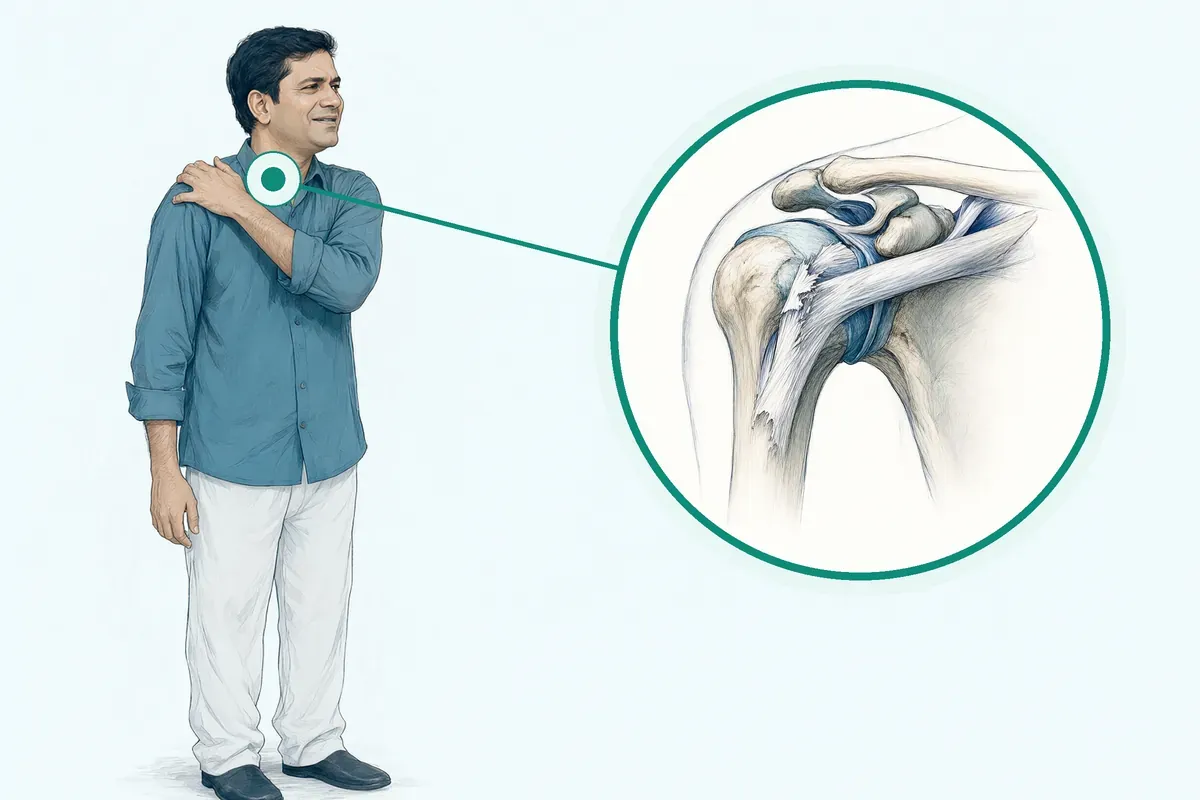
The rotator cuff is a group of four muscles and their tendons that hold the upper arm bone in the shoulder socket and help you lift and rotate your arm. When these tendons become irritated, worn, or torn, the shoulder hurts and feels weak.
Rotator cuff tendinopathy means the tendon tissue has degenerated and is painful, often from repeated overhead use or age-related wear. Subacromial impingement syndrome happens when the space under the acromion (the bony tip of the shoulder blade) narrows, pinching the rotator cuff tendons and the bursa that cushions them.
A rotator cuff tear can be partial, where the tendon is frayed but still attached, or full-thickness, where the tendon pulls away from the bone. These conditions often overlap; for example, long-standing impingement can lead to a tear.
Symptoms of rotator cuff and shoulder problems
- Inability to move the arm
- Visible shoulder deformity
- Fever with shoulder redness and warmth
Common symptoms include:
- A deep ache in the shoulder that may travel down the upper arm
- Pain when you lift your arm overhead or reach behind your back
- Weakness when lifting objects
Pain often worsens at night, especially when lying on the affected side, and can disturb sleep. You may hear or feel clicking or grinding when moving the shoulder. Stiffness and reduced range of motion develop over time.
Warning signs that need urgent care the same day: sudden severe pain after a fall or direct blow, inability to move the arm at all, visible deformity of the shoulder, numbness or tingling down the arm or hand, or fever with shoulder redness and warmth. These could mean a fracture, dislocation, or infection and should be assessed in the emergency department immediately.
Causes and who is at higher risk
- Age over 50
- Tendons lose elasticity and blood supply
- Repetitive overhead work
- Painting, throwing, lifting overload tendons
- Poor posture
- Rounded shoulders reduce space under the acromion
- Smoking
- Impairs tendon healing and linked to larger tears
- Diabetes or thyroid disorders
- Higher risk of tendinopathy
Rotator cuff problems usually develop from a mix of wear and tear and mechanical irritation. Repetitive overhead activity — such as painting, throwing, or lifting — can overload the tendons. Age is a major factor; tendons lose elasticity and blood supply over time, making tears more common after 50.
Poor posture, especially rounded shoulders and a stiff upper back, reduces the space under the acromion and increases impingement. Smoking impairs tendon healing and is linked to larger tears and poorer surgical outcomes. People with diabetes or thyroid disorders may have a higher risk of tendinopathy.
Athletes in overhead sports (cricket bowlers, badminton players, swimmers) and manual workers (construction, carpentry) are more prone to both acute tears and chronic tendinopathy. A sudden fall on an outstretched hand or a heavy lift can cause an acute tear on top of existing wear.
How rotator cuff and shoulder pain is diagnosed
- History and examination Doctor asks about pain, checks movement and strength
- X-ray Shows bone spurs, arthritis, calcific deposits
- Ultrasound Quick, radiation-free view of tears and bursitis
- MRI Detailed picture of tendon quality and tear size
Your doctor starts with a detailed history: when the pain began, what makes it worse or better, any injury, and how it affects daily activities and sleep. A physical examination checks active and passive range of motion, strength of each rotator cuff muscle, and specific impingement tests (such as Neer and Hawkins-Kennedy).
The neck is also examined because neck problems can refer pain to the shoulder. Imaging is used to confirm the diagnosis and plan treatment. X-rays show bone spurs, arthritis, or calcific deposits. Ultrasound is a quick, radiation-free way to see tendon tears, bursitis, and dynamic impingement.
MRI gives the most detailed picture of tendon quality, tear size, retraction, and muscle fatty infiltration — important for deciding whether a tear is repairable. In some cases, a diagnostic subacromial injection of local anaesthetic helps confirm that the pain comes from the subacromial space.
Non-surgical treatment for rotator cuff and shoulder pain, and when surgery is advised
- About 75% Success with non-surgical treatment
- 3 to 6 weeks Corticosteroid injection relief
- 6 to 12 months Surgery considered after
- exceeding 3 centimetres Large tear size threshold
Surgery is not the first treatment for most shoulder conditions. Conservative treatment is the first choice, often with corticosteroid injection, physiotherapy, or both. About 75% of patients show success with non-surgical treatment. A structured exercise programme is the core of non-surgical care.
Evidence shows that specific eccentric strengthening for the rotator cuff and concentric/eccentric exercises for the scapula stabilisers, plus posture correction and a posterior shoulder stretch, significantly improve pain and function in subacromial impingement syndrome. The programme typically runs for 12 weeks with progression, followed by a home maintenance phase.
Education about activity modification, pain monitoring (keeping exercise pain below 5 out of 10), and gradual reloading is essential. Corticosteroid injections give short-term relief (3 to 6 weeks) but do not improve long-term outcomes.
Platelet-rich plasma (PRP) injections have been studied; some trials show long-term functional improvement, while others find no difference from placebo at one year when combined with exercise. Prolotherapy may reduce pain in the long term.
Surgery becomes the next option when non-surgical measures fail after 6 to 12 months, or when there is a large tear exceeding 3 centimetres, significant weakness, or an acute traumatic tear in a younger active person. Arthroscopic surgery can make the experience easier with smaller incisions and faster early recovery.
Preparing for rotator cuff and shoulder pain surgery
Do
- Attend pre-operative check-up
- Bring list of all medicines
- Wear loose front-opening clothing
- Bring an attendant for discharge
- Stop smoking several weeks before
Before surgery you will attend a pre-operative check-up. The team usually asks for blood tests, a chest X-ray and an ECG to make sure you are fit for anaesthesia. Bring a list of every medicine you take, including supplements and any blood thinners. Your surgeon will tell you which medicines to stop and when to stop them.
You must not eat or drink for at least six hours before the operation. Wear loose clothing that opens at the front so it is easy to put on over a sling. An attendant should come with you to help after discharge. If you smoke, try to stop several weeks before surgery because smoking can slow tendon healing.
How rotator cuff and shoulder pain surgery is done
Arthroscopic Rotator Cuff Repair
- Torn tendon stitched back to bone
Subacromial Decompression
- Acromion shaved and bursa removed
Superior Capsular Reconstruction
- Dermal allograft bridges massive tear
Biceps Tenodesis or Tenotomy
- Biceps tendon reattached or released
The operation is performed under general anaesthesia with an interscalene nerve block. The block numbs your shoulder and arm for several hours after surgery. The surgeon makes two or three small cuts about one centimetre long. A tiny camera called an arthroscope goes through one cut. Instruments go through the others.
Your surgeon will choose the technique that matches your tear pattern and tissue quality:
- Arthroscopic Rotator Cuff Repair: The torn tendon is stitched back to the bone using single or double-row suture anchors.
- Subacromial Decompression: The underside of the acromion bone is shaved and the inflamed bursa is removed to create more space for the tendons.
- Superior Capsular Reconstruction: A dermal allograft is used to bridge a massive tear that cannot be repaired directly.
- Biceps Tenodesis or Tenotomy: The long head of the biceps tendon is either reattached or released if it is damaged.
The procedure usually takes one to two hours. Most patients go home the same day or stay one night.
Risks and possible complications of rotator cuff and shoulder pain surgery
Arthroscopic shoulder surgery is generally very safe. With any procedure there is a small risk of complications.
These can include:
- Infection
- Bleeding
- Nerve injury
- Stiffness
- A re-tear of the repaired tendon
The nerve block may cause temporary numbness or weakness in the arm. Your anaesthetist will discuss the specific risks of the block with you before surgery. The surgical team takes steps to reduce every risk, such as giving antibiotics at the time of surgery and using careful surgical technique.
Recovery and aftercare after rotator cuff and shoulder pain surgery
You will wake up with your arm in a sling. The nerve block keeps the shoulder comfortable for the first 12 to 24 hours. Take the pain medicines prescribed by your doctor before the block wears off. Keep the dressings clean and dry. You can usually remove the sling for gentle pendulum exercises as advised by your physiotherapist.
The first stage is incision healing. With arthroscopy this takes one to two weeks. Stitches or clips are removed at a follow-up visit around 10 to 14 days.
After the wounds heal, a physical therapist will guide you through a graduated exercise programme. This is an essential part of recovery. The programme usually starts with passive movements, progresses to active-assisted exercises, and then to strengthening.
A typical protocol involves specific eccentric exercises for the rotator cuff and concentric or eccentric exercises for the scapula stabilisers, done twice daily for eight weeks, then once daily for four more weeks. You should feel some muscle effort during loading but not sharp pain. Pain should return to baseline before the next session. Good posture with thoracic extension and retracted shoulders is emphasised throughout.
Full recovery of strength and function typically takes four to six months. A minor procedure heals more quickly than a more extensive one. Your overall health and how well you keep up with rehabilitation also make a difference.
Call the hospital straight away if you develop:
- A fever above 38°C
- Increasing redness or discharge from the wounds
- Sudden severe pain not relieved by medicines
- Numbness or colour change in the hand
- Shortness of breath
Results of rotator cuff and shoulder pain surgery
In studies, a success rate of 65 to 80 percent with improved shoulder function and decreased pain has been reported at one year. For subacromial impingement, a specific exercise strategy focusing on the rotator cuff and scapula stabilisers led to significantly greater improvements in function and pain over 12 weeks compared with general exercises.
At three months, 69 percent of patients in the specific exercise group reported a successful outcome versus 24 percent in the control group. Fewer patients in the exercise group went on to have surgery: 20 percent versus 63 percent.
For chronic rotator cuff tendinopathy, a well-structured and graduated exercise programme produces improvement equivalent to outcomes reported in surgical trials. Platelet-rich plasma injection added to an exercise programme did not show a significant difference in quality of life, pain, disability or range of motion at one year compared with placebo.
Corticosteroid injection was more effective only in the short term for pain reduction and functional improvement. Prolotherapy and PRP may yield better outcomes in the long term, over 24 weeks.
Re-tear rates vary with tear size, tissue quality and patient factors. Your surgeon will discuss what the evidence suggests for your specific tear pattern. Attention to lifestyle factors such as smoking cessation, nutrition, stress and sleep management may enhance outcomes.
Cost and insurance for rotator cuff and shoulder pain surgery in Jaipur
The typical price range for rotator cuff surgery in India is ₹1,20,000 to ₹3,00,000. The final amount depends on the type of procedure, the implants used, the length of hospital stay, diagnostic tests required, post-operative care and physiotherapy sessions, and the surgeon's experience. Jaipur Hospital is a NABH-accredited multispeciality hospital established in February 1991.
We accept patients under:
- RGHS
- MAA Yojana
- CGHS
- A panel of private insurers and TPAs
Our facilities include modular operation theatres, 24×7 emergency and ambulance services, in-house pharmacy, diagnostic laboratory and imaging, and a dedicated physiotherapy department. Ask our admissions team for a detailed estimate based on your planned procedure and insurance coverage.