

Neurosurgery and Neurology · Jaipur Hospital
Spinal Tumour Surgery in Jaipur
Back pain and weakness from a spinal tumour. We assess, explain options, and give you a clear plan.
- Serving Jaipur since 1991 (35 years)
- NABH accredited
- 24×7 emergency & ICU
- Cashless: RGHS, MAA Yojana, CGHS + 22 insurers
- Operation time
- 3 to 6 hours
- Anaesthesia
- General anaesthesia
- Recovery
- Walk with support in 1 to 2 weeks, full recovery in 6 to 12 weeks
- Price
- ₹2,50,000 to ₹6,00,000typical range in India; ask us for an estimate
When your back signals danger
Pain, numbness, or weakness that will not go away
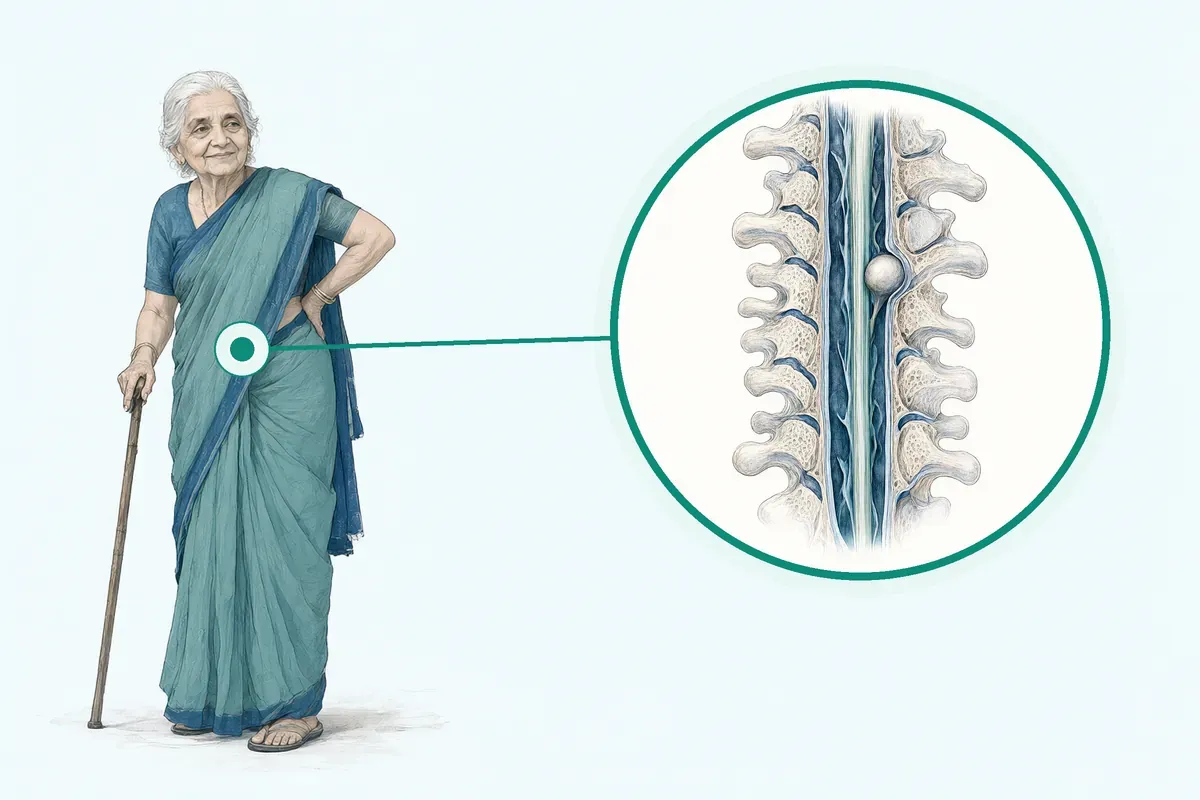
A spinal tumour can press on the cord or nerves, causing pain that spreads, numbness in the legs, or trouble walking. Without treatment, these symptoms often get worse.
-
Pain that spreads
Back or neck pain that moves into the arms or legs and does not settle with rest.
-
Numbness or tingling
Loss of feeling or pins and needles in the hands, feet, or trunk.
-
Weakness or clumsiness
Difficulty lifting the foot, gripping objects, or keeping balance while walking.
-
Bladder or bowel changes
Trouble starting urination, leakage, or loss of sensation when needing the toilet.
Spinal tumours compress the spinal cord or nerve roots, leading to progressive neurological deficits if untreated.
Why Jaipur Hospital
You are worried that the pain will stop you from working and caring for your family, and you need clear answers without delay.
Your care plan
Your first steps with us
- 1 Call or visit OPD for a neurosurgery consultation
- 2 Complete MRI, CT, and blood tests in-house
- 3 Review the surgical plan and cost estimate with your surgeon
- 4 Admit for surgery, then recover with physiotherapy support
How the operation is done
Surgery is performed under general anaesthesia. The approach depends on tumour location and type. Your surgeon will discuss the option that fits your case.
-
Posterior decompression and fusion
Standard approach for tumours inside or outside the spinal cord covering, often with instrumentation for stability.
-
Anterior corpectomy and reconstruction
Used when the tumour involves the vertebral body and the spine is unstable, with reconstruction using a cage or graft.
-
Minimally invasive biopsy
Percutaneous needle biopsy to confirm diagnosis before planning open surgery.
-
En bloc spondylectomy
Radical resection for primary malignant spinal tumours aiming to remove the tumour in one piece.
Why patients trust us
- 1991 Serving Jaipur for 35 years
- NABH Accredited hospital
- 1 Neurosurgery and Neurology consultants
- 24×7 Emergency, ICU and ambulance
- 25 Cashless schemes and insurers
What research shows about this treatment
-
Walk with support in 1 to 2 weeks
Most patients in studies were mobilising with assistance within two weeks after spinal tumour surgery.
-
Full recovery in 6 to 12 weeks
Functional improvement continued over three months, with many returning to daily activities by 12 weeks.
-
Neurologic complication rate 13.3%
Across pooled studies, about 13 in 100 patients experienced a new or worsening neurological deficit after surgery.
If it is left untreated
Without surgery, a growing tumour can cause long-term loss of strength, sensation, or bladder and bowel control. Progressive compression may lead to paralysis that cannot be reversed.
Life after treatment
Most people regain mobility and return to daily routines with guided rehabilitation.
-
Walking independently
Most people progress from assisted walking to moving around the house on their own within weeks.
-
Returning to work
Many resume light duties by three months, depending on the nature of their job and recovery.
-
Managing daily tasks
Self-care such as dressing, bathing, and cooking usually improves steadily with physiotherapy.
-
Regular follow-up
Scheduled MRI scans and clinic visits help monitor healing and detect any recurrence early.
Frequently asked questions
Questions patients ask about spinal tumour surgery
Which problems are assessed under spinal tumour and infection surgery?
In short
At Jaipur Hospital, spinal tumour and infection surgery covers intradural and extradural tumours, vertebral body tumours with instability, and spinal infections needing decompression. The surgical team evaluates the tumour type, location, and whether it started in the spine or spread from elsewhere. Your general health and age also guide the assessment.
In detail
The decision rests on whether the tumour can be removed with a manageable risk of spinal cord or nerve injury. Evidence shows that surgery is frequently preferred for tumours causing pressure on neural tissue.
Techniques include posterior decompression and fusion for intradural and extradural tumours, anterior corpectomy and reconstruction for vertebral body tumours with instability, minimally invasive biopsy for diagnosis before open surgery, and en bloc spondylectomy for primary malignant spinal tumours. The extent of excision, whether partial or complete, influences the procedure duration and approach.
A common belief
Many people think only cancerous growths need surgery.
What actually happens
In reality, benign tumours pressing on nerves or infections causing instability are also treated surgically to prevent worsening neurological deficits.
Your next step at Jaipur Hospital
You will need pre-surgical evaluations such as MRI, CT scans, biopsy, and blood tests. The typical hospital stay is 5 to 7 nights. After discharge, you can expect to walk with support in 1 to 2 weeks, with full recovery in 6 to 12 weeks.
How will the doctor decide which tests I need?
In short
At Jaipur Hospital, the doctor selects tests based on your symptoms, neurological examination, and suspected diagnosis. An MRI scan is usually the first investigation to visualise the spinal cord, nerves, and soft tissues. A CT scan may be added for bony detail. Blood tests and a biopsy help confirm whether a lesion is a tumour or infection and guide the treatment plan.
In detail
Evidence shows that MRI is ordered to investigate spinal symptoms and identify tumours between vertebrae. Preoperative MRI also confirms accompanying stenosis at segments adjacent to deformity.
A minimally invasive percutaneous needle biopsy provides a tissue diagnosis before open surgery, especially when the tumour type is unclear. The doctor also considers your age, general health, and whether the lesion originates in the spine or has spread from another site. These factors determine the extent of imaging and the need for staging scans.
A common belief
Patients sometimes expect a single test to give all answers.
What actually happens
In practice, a combination of imaging and tissue diagnosis is needed to distinguish between tumour types, infections, and other conditions, and to plan safe surgery.
Your next step at Jaipur Hospital
Expect the doctor to order MRI, CT, routine blood work, and possibly a biopsy during your work-up. Results are typically available within a few days. Once the diagnosis is clear, the surgical team will discuss the recommended approach and timing.
How soon should I expect improvement after the chosen treatment?
In short
After spinal tumour or infection surgery at Jaipur Hospital, you can usually walk with support in 1 to 2 weeks. Full recovery typically takes 6 to 12 weeks. Pain and neurological symptoms often improve steadily during this period, though the exact timeline depends on the tumour type, extent of surgery, and your pre-operative condition.
In detail
Evidence from surgical series shows that patients with neurological deficits often see improvement during follow-up. In one study, 19 of 23 patients with neurologic deficits resolved within six weeks. Functional scores such as VAS and ODI improved significantly postoperatively.
Patients with Frankel grade A injuries showed improvement in bladder and bowel function. However, recovery varies; some cases required up to six months to return to baseline. Younger patients tend to achieve greater functional improvement than older patients.
A common belief
Some expect instant relief.
What actually happens
In reality, nerve recovery is gradual. Pain at the incision site may persist for a month. Patience and consistent physiotherapy are key to achieving the most suitable functional outcome.
Your next step at Jaipur Hospital
You will spend the first 24 hours in the ICU for monitoring. Discharge usually occurs after 5 to 7 nights. Physiotherapy starts early to regain independence. Pain medication may be needed for several weeks. Attend all follow-up appointments for wound checks and neurological assessment.
How does the term "spinal tumour and infection surgery" relate to spinal tumour and infection surgery?
In short
The terms "spinal tumour and infection surgery" and "spinal tumour and infection surgery" describe the same service; the only difference is American versus British spelling. At Jaipur Hospital we use the British spelling "tumour" in all records and communication. Both phrases refer to surgical removal of spinal tumours and decompression for spinal infections.
In detail
Medical terminology varies by region. Indian clinical practice follows British English conventions, so "tumour", "orthopaedic", "anaesthesia" and "haemorrhage" are standard. International publications may use "tumour" and "anaesthesia".
The surgical indications, techniques such as posterior decompression and fusion or anterior corpectomy, and the hospital stay of five to seven nights remain identical regardless of spelling. Using the local spelling ensures clear communication with your treating team and on insurance documents.
Your next step at Jaipur Hospital
When searching for information or filling forms, use the spelling preferred by your hospital or insurer. Jaipur Hospital staff will recognise either version. If you have reports from abroad with the American spelling, bring them to your consultation.
When does a fever need testing or hospital assessment after spinal tumour surgery?
In short
A temperature of 38 degrees Celsius or higher after spinal tumour surgery should prompt immediate contact with Jaipur Hospital. Fever in the first few weeks may signal a surgical site infection, urinary tract infection or other complication that needs early evaluation and treatment.
In detail
Evidence shows surgical site infection rates range from 2.9 percent to 9.7 percent after spinal procedures. Infections can present with fever, wound redness, swelling, drainage or new pain. Early blood tests, wound swabs and imaging help identify the source.
Delaying assessment risks deeper infection, implant involvement or sepsis. The hospital's 24-hour emergency department and in-house laboratory allow rapid investigation at any time.
Your next step at Jaipur Hospital
Keep a thermometer at home and check your temperature if you feel unwell. Do not take fever-reducing medicine without informing your surgeon, as it may mask symptoms. Call the hospital or visit the emergency department if fever reaches 38 degrees Celsius or persists.
How can I decide whether to seek advice about spinal cord tumour excision?
In short
You should seek advice about spinal cord tumour excision if you have a confirmed or suspected tumour within the spinal cord causing symptoms such as weakness, numbness, pain, or bladder and bowel changes. At Jaipur Hospital, the neurosurgery team evaluates imaging, neurological examination, and your overall health to recommend whether surgery is appropriate.
In detail
Decision-making balances the risk of tumour growth against surgical risks. Evidence shows that surgery is frequently preferred for tumours that can be removed with manageable risk to the spinal cord or nerves. Microsurgical techniques and intraoperative neuromonitoring help protect neurological function.
Factors include tumour type, location, size, and whether it is causing progressive deficits. Some small, asymptomatic tumours may be monitored with serial MRI scans. The team also considers your age, comorbidities, and personal goals. A multidisciplinary discussion ensures all options, including radiotherapy or observation, are weighed.
A common belief
Some people delay because they fear surgery, but progressive nerve damage from the tumour itself can be irreversible.
What actually happens
Early evaluation gives more options.
Your next step at Jaipur Hospital
If you have new or worsening neurological symptoms, or an incidental finding on imaging, do not wait. Request a referral to a neurosurgeon. The team at Jaipur Hospital will review your scans, examine you, and discuss the risks and benefits of excision.
What changes in strength, sensation, speech, vision, or bladder control need urgent assessment after spinal tumour surgery?
In short
After spinal tumour surgery, any new or worsening weakness in the arms or legs, loss of sensation, difficulty passing urine or controlling bowels, or sudden severe back pain needs urgent assessment. At Jaipur Hospital, the surgical team monitors these signs closely during the hospital stay and advises you on what to watch for after discharge.
In detail
Neurological changes can signal cord compression, haematoma, infection, or CSF leak. Evidence shows that transient neurological deficits occur in some patients and often resolve within six weeks, but new deficits require immediate imaging and possible re-operation.
Speech and vision changes are less common after spinal surgery but may indicate a separate issue such as a stroke and should also be reported immediately. The nursing staff performs regular neurological checks while you are in hospital. After discharge, you will receive clear instructions on when to return to the emergency department.
A common belief
People often wait to see if symptoms improve, but spinal cord compression can cause long-term damage within hours.
What actually happens
Do not wait.
Your next step at Jaipur Hospital
Keep the emergency contact numbers handy. If you notice any new weakness, numbness, bladder or bowel changes, or severe pain, go to the emergency department at Jaipur Hospital without delay. Early intervention improves the chance of recovery.
Which symptoms should prompt me to see a specialist?
In short
You should see a specialist if you have persistent back or neck pain that worsens at night, numbness or weakness in the arms or legs, difficulty walking, loss of bowel or bladder control, or unexplained weight loss with fever. These symptoms may indicate a spinal tumour or infection needing timely evaluation at Jaipur Hospital.
In detail
Evidence shows that patients with spinal tumours often present with numbness in the leg and stabbing pain in the hip, while physical and mental health can deteriorate rapidly before surgery. Severe kyphosis with late-onset neurological deficits carries a high risk of complications.
Infections such as tuberculosis of the spine can cause progressive deformity and neurological decline. Early specialist review allows imaging and biopsy to confirm the diagnosis before irreversible nerve damage occurs.
A common belief
People often dismiss back pain as age-related wear.
What actually happens
However, pain that wakes you at night or comes with neurological changes is not typical mechanical back pain and should be investigated without delay.
Your next step at Jaipur Hospital
If you notice any of these symptoms, schedule an appointment promptly. The doctor will order MRI or CT scans and may arrange a minimally invasive biopsy. Early diagnosis expands treatment options and may reduce the extent of surgery needed.
How will the results change my care plan?
In short
Test results directly shape your care plan at Jaipur Hospital. If imaging shows a small, stable tumour without nerve compression, the team may recommend monitoring with regular scans. If a tumour is pressing on the spinal cord or causing instability, surgery becomes the preferred option. Biopsy results determine whether additional treatment such as radiotherapy or chemotherapy is needed after surgery.
In detail
Evidence indicates that small, non-expanding tumours may only require observation with periodic MRI or CT scans. Surgery is frequently chosen for tumours removable with manageable risk to the spinal cord. The extent of excision, whether partial or complete, influences the procedure duration and cost.
Malignant tumours often necessitate further treatment including radiotherapy or chemotherapy. Infection findings guide antibiotic choice and the need for surgical debridement and stabilisation. Your age, general health, and the tumour origin also modify the final plan.
A common belief
A common belief is that all tumours need immediate operation.
What actually happens
In reality, many incidental tumours are monitored safely, avoiding surgery until growth or symptoms appear. The results tailor the plan to your specific situation.
Your next step at Jaipur Hospital
After results are reviewed, the surgeon will explain the recommended approach, expected hospital stay of 5 to 7 nights, and recovery timeline of 6 to 12 weeks for full recovery. You will receive a detailed estimate for the procedure, typically ranging from ₹2,50,000 to ₹6,00,000.
What should I do if symptoms persist or worsen?
In short
If your symptoms persist or worsen after spinal tumour or infection surgery, contact your surgeon at Jaipur Hospital immediately. New or increasing weakness, numbness, wound redness, fever, or loss of bladder or bowel control may indicate infection, haematoma, implant failure, or disease recurrence needing urgent evaluation.
In detail
Evidence shows that re-operation rates are around 9 to 10 percent, often for neurological deficit, implant failure, or wound complications. In studies, transient neurological deficits resolved within six weeks in most cases, but new or worsening deficits require prompt MRI and possible surgical exploration.
Surgical site infection rates range from 2.9 to 9.7 percent. Late recurrence of tumour or infection can also cause symptom return. Regular follow-up with imaging helps detect these issues early.
A common belief
Patients sometimes hope symptoms will settle on their own, but new neurological changes or wound issues can signal serious complications like infection, haematoma, or recurrence.
What actually happens
Early re-evaluation improves the chance of a good outcome.
Your next step at Jaipur Hospital
Do not wait for the next scheduled visit if new symptoms appear. Call the hospital or attend the emergency department. The 24×7 emergency service and in-house imaging allow rapid assessment.
FAQ library
Questions and answers about spinal tumour surgery
When you contact us
Get your surgical plan and estimate
Contact Jaipur Hospital for a neurosurgery OPD consultation, in-house tests, a clear explanation of options, and a cost estimate before you decide.
- A consultation with a neurosurgeon in the OPD
- Your scans and reports reviewed, with tests done in-house if you need them (laboratory, X-ray and imaging)
- Your options explained in plain words, including whether you need surgery at all
- A cost estimate before you decide
- Help with cashless treatment under RGHS, MAA Yojana, CGHS and empanelled insurers and TPAs
- Follow-up visits after your treatment
Overview
Spinal Tumour Surgery: what to know
What Spinal Tumour Surgery Is
A spinal tumour is an abnormal growth that develops inside or near the spinal cord or the bones of the spine. It may start in the spine itself, which is called a primary tumour, or it may spread to the spine from cancer in another part of the body, which is called a metastatic tumour.
The tumour can press on the spinal cord or nerves and cause pain, weakness, or changes in sensation. Surgery aims to remove the tumour or reduce its size, take pressure off the spinal cord and nerves, and stabilise the spine if the bones have been weakened. The operation is done under general anaesthesia and usually takes three to six hours. You will typically stay in hospital for five to seven nights.
Symptoms and Warning Signs That Need Urgent Care
- Sudden leg weakness
- Loss of bladder or bowel control
- Numbness in saddle area
Common symptoms include:
- Back or neck pain that is worse at night or does not improve with rest
- Numbness or tingling in the arms or legs
- Weakness in the limbs
- Difficulty walking
- Problems with bladder or bowel control
Some people notice a rapid decline in their physical and mental health before diagnosis. You should seek medical care the same day if you develop sudden weakness in the legs, loss of bladder or bowel control, or numbness in the saddle area between the legs.
These can be signs of severe spinal cord compression that needs immediate decompression to reduce the risk of lasting injury.
Causes and Who Is at Higher Risk
The exact cause of most primary spinal tumours is not known. Some are linked to genetic conditions, but many occur without a clear reason.
Tumours that spread to the spine usually come from cancers of:
- Breast
- Lung
- Prostate
- Kidney
- Thyroid
Your surgeon will consider your age, general health, the type of tumour, and whether it started in the spine or spread from elsewhere when planning treatment. People with other medical conditions or older age may have a higher chance of complications after surgery.
How Spinal Tumour Surgery Is Diagnosed
Diagnosis begins with a detailed history and a neurological examination to check strength, sensation, and reflexes. An MRI scan of the spine is the main test to see the tumour, its size, and how it affects the spinal cord and nerves. A CT scan may be added to look at the bones in detail.
If the tumour type is not clear from imaging, a percutaneous needle biopsy may be done under local anaesthesia to get a tissue sample before planning open surgery. Blood tests and other scans are sometimes needed to check your general fitness for anaesthesia and to look for a primary cancer elsewhere in the body.
Treatment Options Without Surgery and When Surgery Is Advised
Not every spinal tumour needs immediate surgery. Small tumours that are not growing or pressing on nerves may be watched with regular MRI or CT scans at suitable intervals.
Corticosteroids are sometimes given for a short time to reduce swelling around the spinal cord, but they are not used long term because of side effects such as bone thinning, high blood pressure, and increased infection risk.
Radiation therapy may be used after surgery to treat any remaining tumour cells, for tumours that cannot be operated on, or when surgery would be too hazardous. Chemotherapy is used for certain tumour types that respond to these drugs.
Surgery is usually advised when the tumour is causing significant compression of the spinal cord or nerves, when there is spinal instability, when a tissue diagnosis is needed, or when the tumour continues to grow despite other treatments. Your surgeon will discuss which approach suits your situation.
Preparing for spinal tumour surgery
Do
- Regular medicines in original packets
- List of allergies
- Previous imaging films or reports
- Comfortable loose clothing
- Toiletries
- Attendant for hospital stay
Before surgery you will have a set of tests to check your fitness for general anaesthesia.
These usually include:
- Blood tests
- A chest X-ray
- An ECG
- Imaging of the spine such as MRI or CT scan
Your surgical team will review any medicines you take regularly. Blood thinners, antiplatelet drugs and certain supplements may need to be stopped several days before the operation; your surgeon and anaesthetist will tell you exactly which ones and when. You must not eat or drink anything for at least six hours before the scheduled time.
On the day of admission bring your regular medicines in their original packets, a list of allergies, any previous imaging films or reports, comfortable loose clothing, toiletries and an attendant who can stay with you during the hospital stay. The hospital provides a canteen with dietary meals and an in-house pharmacy for any new prescriptions.
How spinal tumour surgery is done
The operation is performed under general anaesthesia and typically lasts three to six hours. Your surgeon will choose the approach based on the tumour location, type and whether the spine is unstable. The main options are:
- Posterior decompression and fusion: a standard approach for tumours inside or outside the spinal cord covering. The surgeon works from the back of the spine to remove the tumour and stabilise the bones with screws and rods.
- Anterior corpectomy and reconstruction: used when the tumour involves the vertebral body and causes instability. The surgeon approaches from the front or side, removes the affected bone and rebuilds the column with a cage or graft.
- Minimally invasive biopsy: a percutaneous needle biopsy done before open surgery to confirm the diagnosis when imaging alone is not enough.
- En bloc spondylectomy: a radical resection for primary malignant spinal tumours aiming to remove the tumour in one piece.
On the day of surgery you will be taken to a modular operation theatre. The team uses an operating microscope to distinguish tumour from healthy tissue and may use intraoperative nerve monitoring to reduce the risk of nerve injury. Tranexamic acid is often given during the operation to minimise blood loss.
After the procedure you will spend the first 24 hours in the intensive care unit for close monitoring of neurological function and fluid balance.
Risks and possible complications of spinal tumour surgery
- around 32 percent Overall complication rate
- 8 to 14 percent Transient neurological injury
- 2 to 6 percent Long-term neurological deficit
- 2 to 10 percent Surgical site infection
- 6 to 10 percent Re-operation needed
All surgery carries risks. In studies of spinal tumour and deformity surgery the overall complication rate varies widely, with pooled estimates around 32 percent and some series reporting up to 69 percent. The most common problems are neurological.
Transient neurological injury such as temporary weakness or numbness occurs in about 8 to 14 percent of patients; most of these recover within six weeks. long-term neurological deficit is reported in about 2 to 6 percent of cases. Surgical site infection rates range from about 2 to 10 percent.
Re-operation is needed in roughly 6 to 10 percent of patients, usually for wound exploration, implant failure or persistent nerve compression. Other reported complications include fixation failure, compression fracture, junctional kyphosis and pseudarthrosis. Pulmonary complications such as pneumothorax and pleural effusion have been described.
Risk factors for complications include:
- Age over 60
- Significant sagittal imbalance before surgery
- Three or more medical comorbidities
Your surgical team will discuss how these numbers apply to your specific situation.
Recovery and aftercare after spinal tumour surgery
- First 24 hours ICU monitoring
- Two to three days Start sitting up and walking with support
- Five to seven nights Typical hospital stay
- Two weeks after discharge Follow-up for wound check
- Six weeks Avoid heavy lifting, bending, twisting
- Three to six months Further imaging may be scheduled
After the first 24 hours in the ICU you will be moved to a regular ward. Most patients start sitting up and walking with support within two to three days. Pain at the incision site is managed with medicines; some patients need opioid medication for a few weeks. The typical hospital stay is five to seven nights.
Before discharge the physiotherapy team will teach you safe ways to move, sit and climb stairs. You will be advised to avoid heavy lifting, bending and twisting for the first six weeks. Walking distance is increased gradually. Full recovery usually takes six to twelve weeks.
You will have a follow-up appointment with your surgeon about two weeks after discharge for wound check and suture removal if needed. Further imaging may be scheduled at three to six months.
Call the hospital or visit the 24×7 emergency department if you notice:
- Increasing wound redness, swelling or discharge
- New or worsening weakness or numbness
- Difficulty passing urine
- Fever above 38°C
- Severe headache that does not settle with prescribed pain relief
Results of spinal tumour surgery
- 6-8 to 1-2 Pain score improvement Visual analogue scale drop
- 46-56 to 18 Disability score improvement Oswestry Disability Index
- Most patients Bony fusion rate Achieved within six to nine months
In studies of patients undergoing spinal tumour and deformity surgery, the majority report significant improvement in pain, motor and sensory function, and bowel and bladder function. Mean pain scores on a visual analogue scale typically drop from around 6 to 8 before surgery to around 1 to 2 at follow-up.
Disability scores measured by the Oswestry Disability Index improve from an average of about 46 to 56 preoperatively to about 18 at last follow-up. Neurological function improves in many patients; in one series six of nine patients with complete preoperative deficits showed improvement in bladder and bowel function, and patients with incomplete deficits improved by one to two grades.
Bony fusion is achieved in most patients within six to nine months. The problem can come back. Local recurrence depends on tumour type and whether the tumour was removed completely. Malignant tumours often need additional treatment such as radiotherapy or chemotherapy after surgery.
Your surgeon will discuss the expected outcome for your specific tumour type and the plan for long-term surveillance with MRI scans.
Cost and insurance for spinal tumour surgery in Jaipur
The typical price range for spinal tumour surgery in India is ₹2,50,000 to ₹6,00,000. This range covers the operation, anaesthesia, implants, hospital stay of five to seven nights and basic investigations.
The final cost varies with the type of surgery (minimally invasive procedures tend to cost more than open surgery), the extent of tumour removal, the need for ICU care, the category of room chosen (shared, private or deluxe), the surgeon's experience and whether the hospital holds international accreditation.
Additional costs may arise from pre-surgical evaluations such as MRI, CT, biopsy and blood tests, and from any postoperative radiotherapy or chemotherapy required for malignant tumours. Jaipur Hospital is a NABH-accredited multispecialty hospital.
It accepts patients under:
- RGHS
- MAA Yojana
- CGHS
- A panel of private insurers and TPAs
The hospital has an in-house diagnostic laboratory and imaging department, a 24-hour pharmacy and a canteen with dietary meals. For a personalised estimate please contact the hospital billing office.