

Neurosurgery and Neurology · Jaipur Hospital
Spinal Trauma Surgery in Jaipur
Sudden spinal injury and loss of sensation leave you searching for answers. Jaipur Hospital provides emergency surgical assessment and a clear treatment plan.
- Serving Jaipur since 1991 (35 years)
- NABH accredited
- 24×7 emergency & ICU
- Cashless: RGHS, MAA Yojana, CGHS + 22 insurers
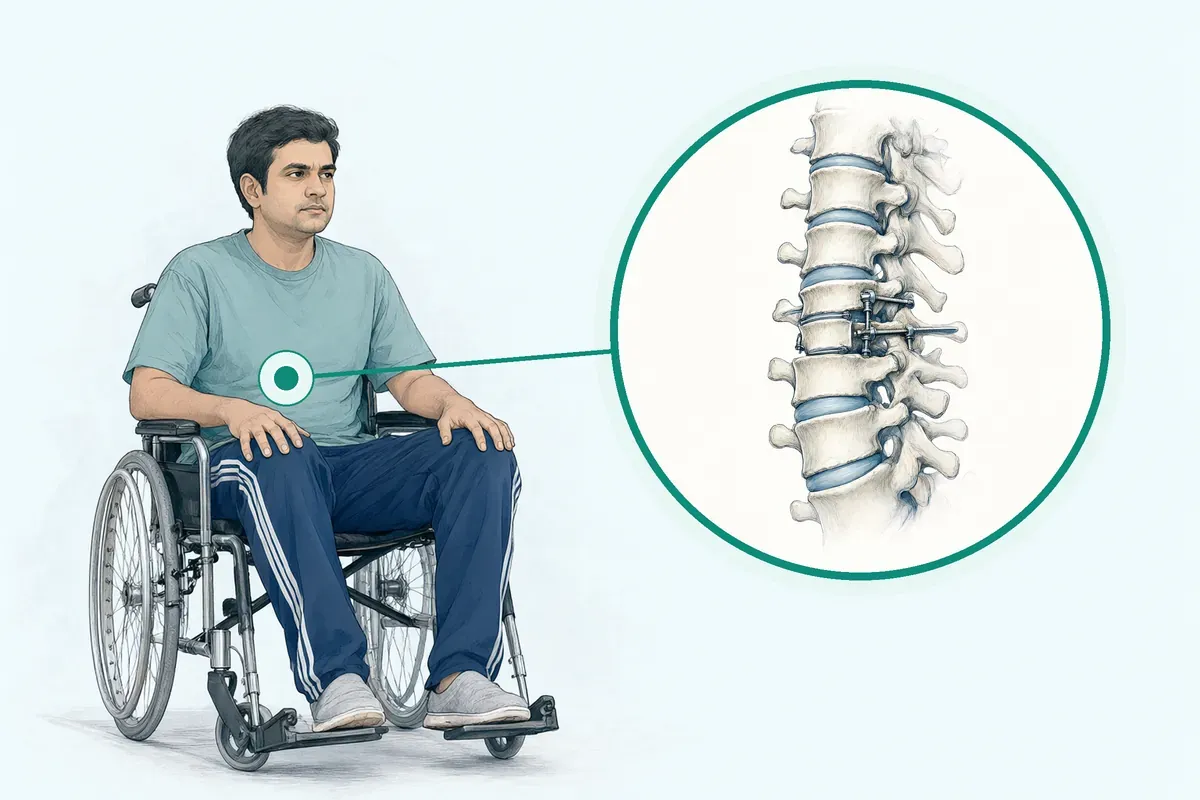
- Operation time
- 3 to 6 hours
- Anaesthesia
- General anaesthesia
- Recovery
- ICU stay 2 to 7 days, prolonged rehabilitation, outcome depends on neurological grade
- Price
- ₹2,00,000 to ₹5,50,000typical range in India; ask us for an estimate
Sudden injury and spinal damage
Sudden trauma and loss of movement
A severe accident or fall can fracture or dislocate spinal bones, compressing delicate nerves and changing normal movement or sensation.
-
Sudden impact or fall
Traffic crashes and falls can deliver sudden mechanical force directly to the spinal column.
-
Loss of movement or feeling
Pressure on spinal nerves can cause weakness, numbness, or loss of control below the injury.
-
Persistent nerve compression
Broken bone fragments or displaced discs can press on the cord, requiring prompt evaluation.
Traffic accidents are typically the most common cause of spinal cord injury, followed by falls in the elderly population.
Why Jaipur Hospital
You are worried about sudden loss of movement, long recovery, and hospital expenses.
Your care plan
Your first steps with us
- 1 Reach our 24x7 emergency department immediately.
- 2 Undergo clinical evaluation and in-house imaging.
- 3 Discuss surgical stabilisation options with your surgeon.
- 4 Begin guided recovery and physiotherapy care.
Surgical techniques for spinal trauma
Surgery typically takes 3 to 6 hours under general anaesthesia to relieve nerve compression and stabilise the injured spine.
-
Posterior Instrumentation & Fusion
Your surgeon will discuss using screws and rods to stabilise burst fractures and dislocations.
-
Anterior Corpectomy & Fusion
Your surgeon will discuss removing a damaged vertebral body and placing a reconstruction cage.
-
Minimally Invasive Percutaneous Fixation
Your surgeon will discuss using small incisions to place screws for selected stable fractures.
-
Decompression Laminectomy
Your surgeon will discuss relieving posterior pressure on the spinal cord caused by bone encroachment.
Why patients trust us
- 1991 Serving Jaipur for 35 years
- NABH Accredited hospital
- 1 Neurosurgery and Neurology consultants
- 24×7 Emergency, ICU and ambulance
- 25 Cashless schemes and insurers
Clinical findings on spinal decompression
-
<24 hours
Surgical decompression within 24 hours offers nearly a threefold higher chance of at least two-grade improvement on the impairment scale.
-
89.7%
In a meta-analysis, 89.7% of patients with incomplete neurological deficits showed improvement following early decompression.
-
first 3 months
Most functional recovery occurs during the first 3 months and typically reaches a plateau around 9 months after injury.
If it is left untreated
Leaving spinal compression untreated can allow ongoing secondary nerve damage, including tissue swelling and ischaemia, which may reduce your chances of neurological recovery.
Life during rehabilitation and recovery
Structured inpatient care and rehabilitation help patients rebuild physical independence over several months.
-
Inpatient medical monitoring
Patients typically spend 2 to 7 days in the ICU followed by ward recovery.
-
Family attendant support
Attendants stay close by as the surgical team assists with gradual mobilisation.
-
Gradual nerve recovery
Most patients work with physiotherapy over months to regain daily functional mobility.

Frequently asked questions
Questions patients ask about spinal trauma surgery
Which problems are assessed under spinal trauma surgery?
In short
Spinal trauma surgery at Jaipur Hospital assesses fractures and dislocations of the spine that cause neurological deficit. This includes burst fractures, fracture-dislocations, and injuries with spinal cord compression. The surgical team evaluates the injury level, stability, and neurological grade to plan emergency stabilisation and decompression.
In detail
The assessment focuses on the mechanism of injury and the resulting spinal pathology. Evidence shows that traumatic impact fractures or dislocates vertebrae, with the most common primary injury being impact plus persistent compression from burst fractures or fracture-dislocations.
The neurological level of injury (NLI) and ASIA Impairment Scale (AIS) grade are determined to classify the deficit as complete (AIS A) or incomplete (AIS B–D). Imaging identifies bone fragments, disc material, or ligaments compressing the spinal cord.
The surgical team then selects from posterior instrumentation and fusion, anterior corpectomy and fusion, minimally invasive percutaneous fixation, or decompression laminectomy based on the fracture pattern and canal compromise.
A common belief
Many people think any back fracture needs surgery, but the decision depends on spinal stability and whether the spinal cord or nerves are compressed.
What actually happens
Stable fractures without neurological deficit may be managed without operation.
Your next step at Jaipur Hospital
After initial resuscitation and imaging, the surgeon will discuss the injury classification and the recommended surgical approach. Surgery is typically performed within 24 hours for incomplete injuries to maximise neurological recovery.
You can expect an ICU stay of 2 to 7 days and a total hospital stay of 7 to 14 nights.
How will the doctor decide which tests I need?
In short
The doctor at Jaipur Hospital selects tests based on the injury mechanism, neurological findings, and suspected level of damage. X-rays are usually first to assess alignment and fractures. CT scans define bony detail for surgical planning. MRI evaluates soft tissue, ligament, and spinal cord compression.
In detail
Clinical examination identifies the neurological level of injury. Imaging confirms the fracture pattern, canal compromise, and cord signal change. CT is standard for bony anatomy. MRI is essential for incomplete injuries to visualise cord compression and oedema.
The choice depends on whether the injury is cervical, thoracic, or lumbar and on the ASIA grade. Polytrauma patients may need whole-body CT.
A common belief
Not every patient needs every scan.
What actually happens
X-rays show alignment. CT shows bone detail for fixation planning. MRI shows cord compression and soft tissue injury. The combination is tailored to your specific injury pattern.
Your next step at Jaipur Hospital
Tests are done in-house at the 24-hour laboratory and radiology department. Results are typically available within hours. The surgeon will review them with you and finalise the plan.
How soon should I expect improvement after spinal trauma surgery?
In short
Neurological improvement after spinal trauma surgery varies by injury severity and timing. Jaipur Hospital follows protocols for early decompression within 24 hours. Most functional recovery occurs in the first three months and often reaches a plateau by nine to twelve months, though some gains may continue up to eighteen months.
In detail
Evidence indicates that early decompression (<24 hours) is most strongly associated with improved recovery in cervical and incomplete injuries. In a multi-centre trial, 19.8% of cervical SCI patients having early surgery achieved a ≥2-grade ASIA improvement versus 8.8% with delayed surgery.
Patients with incomplete paraplegia have a good prognosis for regaining locomotor ability, with about 76% recovering within a year. Complete injuries show more limited recovery; chance of conversion to incomplete status is around 4%.
Regaining muscle flicker or motor function within the first month predicts better outcome. Age also influences recovery, with younger patients showing better ASIA grade improvement.
- Patients with incomplete paraplegia have a good prognosis for regaining locomotor ability, with about 76% recovering within a year.
- Complete injuries show more limited recovery; chance of conversion to incomplete status is around 4%.
A common belief
A common belief is that surgery instantly restores function.
What actually happens
In fact, surgery removes compression and stabilises the spine; the cord heals at its own pace. Early surgery within 24 hours gives the highest chance of meaningful improvement, especially for incomplete injuries.
Your next step at Jaipur Hospital
Your surgeon will repeat the ASIA examination at 72 hours post-injury and at follow-up visits. Rehabilitation starts in hospital and continues as outpatient physiotherapy. Plan for a prolonged recovery period with regular reviews.
Do the scan findings explain my symptoms after spinal trauma?
In short
Imaging such as CT and MRI shows the fracture pattern, canal compromise and spinal cord compression, which directly correlate with your neurological deficit. Jaipur Hospital uses these scans to decide on emergency decompression and stabilisation within twenty-four hours, as recommended by AO Spine-Praxis guidelines.
In detail
Evidence confirms that the primary injury mechanism — impact plus persistent compression from bone fragments or fracture-dislocation — is the most common cause of neurological loss.
The neurological level of injury (NLI) and ASIA grade are determined by clinical examination, but imaging reveals the structural cause: canal encroachment, ligamentous disruption or disc herniation.
In incomplete injuries (ASIA B or C), early decompression offers nearly a threefold higher chance of at least a two-grade ASIA improvement. Scan findings also guide the surgical approach: posterior instrumentation, anterior corpectomy, minimally invasive fixation or decompression laminectomy.
A common belief
Patients sometimes expect the scan to predict exact recovery.
What actually happens
Imaging shows the structural damage, but the ASIA grade and early surgical timing are stronger predictors of how much function returns.
Your next step at Jaipur Hospital
Your surgeon will review the images with you, explain the fracture type, the degree of cord compression and the planned procedure. ASIA scoring at seventy-two hours post-injury gives the baseline for tracking recovery. Follow-up scans may be needed to assess fusion or late syrinx formation.
How can I decide whether to seek advice about cervical spine fracture fixation?
In short
At Jaipur Hospital, seek urgent surgical advice if you have a neck injury with any neurological symptom — weakness, numbness, tingling, difficulty walking, or loss of bladder or bowel control. Even without deficits, a high-energy mechanism such as a road traffic crash or fall from height warrants immediate imaging and a neurosurgical or orthopaedic spine opinion.
In detail
Cervical spine fractures can compress the spinal cord and cause tetraplegia. The ASIA Impairment Scale grades the deficit from complete loss (AIS A) to normal (AIS E).
Evidence shows early decompression within 24 hours gives the strongest benefit in cervical incomplete injuries, with a nearly threefold higher chance of a two-grade ASIA improvement.
Fracture patterns such as burst fractures, facet dislocations, or distraction injuries often need posterior instrumentation and fusion or anterior corpectomy with cage reconstruction to restore alignment and stability. The decision rests on the AO Spine classification, ligament integrity on MRI, and the patient's neurological grade.
Polytrauma patients may need staged surgery once haemodynamically stable. Delaying assessment risks missing a window where surgery can limit secondary cord damage from ongoing compression, oedema and ischaemia.
A common belief
People often wait to see if symptoms improve on their own.
What actually happens
In cervical injuries, ongoing cord compression causes secondary damage within hours. Early decompression within 24 hours is linked to much better recovery, especially when the injury is incomplete.
Your next step at Jaipur Hospital
Go to the emergency department immediately if you have neck pain plus any neurological change after trauma. Jaipur Hospital's 24×7 emergency team will arrange CT and MRI, calculate the ASIA grade, and involve the spine surgeons without delay. Surgery, if indicated, is typically performed within 24 hours.
What changes in strength, sensation, speech, vision, or bladder control need urgent assessment after spinal trauma?
In short
At Jaipur Hospital, any new weakness in arms or legs, numbness or tingling, loss of bladder or bowel control, difficulty breathing, or change in consciousness after spinal trauma needs immediate emergency evaluation. These signal possible spinal cord or brainstem injury.
In detail
Spinal cord injury presents with motor and sensory deficits below the neurological level. Cervical injuries can cause tetraplegia — weakness in all four limbs — and may impair breathing if the phrenic nerve roots (C3–C5) are affected.
Thoracic and lumbar injuries cause paraplegia with leg weakness and sensory loss. Sacral sparing — preserved sensation at the perineum or voluntary anal contraction — distinguishes incomplete from complete injury (ASIA A vs B–D) and strongly predicts recovery.
Bladder and bowel changes such as retention, incontinence, or loss of urge indicate conus or cauda equina involvement. Speech and vision changes are not typical of isolated spinal trauma but suggest concomitant brain injury or high cervical brainstem involvement and require urgent neuroimaging.
The ASIA examination at 72 hours grades the deficit and guides prognosis. Early recognition allows decompression within 24 hours, which evidence links to improved neurological recovery, especially in incomplete cervical injuries.
A common belief
People often dismiss tingling or mild weakness as a bruise.
What actually happens
But sacral sparing — feeling at the perineum or control of the anal sphincter — is a key sign the injury is incomplete and may recover with early surgery. Waiting risks losing that chance.
Your next step at Jaipur Hospital
Do not wait. Call an ambulance or go to the emergency department. Jaipur Hospital's 24×7 trauma team will perform a rapid neurological assessment, obtain CT and MRI, assign an ASIA grade, and involve spine surgeons immediately. Early admission enables timely decompression and critical care support.
Which symptoms should prompt me to see a specialist?
In short
You should see a specialist at Jaipur Hospital if you have severe neck or back pain after trauma, weakness or numbness in the arms or legs, difficulty walking, loss of bladder or bowel control, or an abnormal spinal posture. These symptoms suggest a spinal fracture or dislocation with possible neurological injury.
In detail
Traumatic spinal cord injury results from sudden impact that fractures or dislocates vertebrae. The primary injury damages spinal cord tissue through displaced bone fragments, disc material, or ligaments.
Clinical manifestations depend on the injury level: cervical lesions can cause tetraplegia (impairment in all four limbs) while thoracic or lumbar lesions cause paraplegia (impairment in lower limbs). Incomplete injuries preserve some sensory or motor function below the injury level, including sacral sparing.
Complete injuries show no motor or sensory function below the level. Any new neurological deficit after trauma warrants urgent specialist evaluation to determine the ASIA grade and need for surgical decompression.
A common belief
People often wait to see if pain improves, but neurological symptoms like numbness or weakness indicate active spinal cord compression.
What actually happens
Delaying evaluation can reduce the chance of recovery, especially in incomplete injuries where early surgery helps most.
Your next step at Jaipur Hospital
If you experience any of these symptoms after a fall, road traffic accident, or sports injury, seek immediate medical attention. The emergency department at Jaipur Hospital operates 24×7 with ambulance service. Early assessment within the first 24 hours is critical for incomplete injuries.
How will the results change my care plan for spinal trauma surgery?
In short
Imaging and neurological test results at Jaipur Hospital directly determine whether surgery is needed, the surgical approach, and the urgency. They define the fracture type, spinal stability, degree of canal compromise, and ASIA grade. Incomplete injuries with compression typically proceed to urgent decompression within 24 hours.
In detail
The care plan hinges on three factors from the results: neurological status (ASIA grade), mechanical stability, and neural compression. Evidence shows patients with incomplete SCI (ASIA B/C) derive the most consistent neurological improvement with surgery within 24 hours.
Early decompression offers nearly a threefold higher chance of ≥2-grade ASIA improvement. For complete injuries (ASIA A), the benefit is less certain but stabilisation may still be needed for mobilisation.
The fracture pattern dictates the technique: posterior instrumentation for thoracolumbar burst fractures or fracture-dislocations; anterior corpectomy for vertebral body collapse with canal compromise; percutaneous fixation for stable fractures or as adjunct; decompression laminectomy for incomplete cord injury with canal encroachment. Polytrauma may delay spinal surgery until the patient is haemodynamically stable.
A common belief
Patients often think all fractures are operated the same way.
What actually happens
In reality, a burst fracture with fragments in the canal needs different surgery than a dislocation or a stable compression fracture. The ASIA grade changes the urgency — incomplete injuries get priority for early decompression.
Your next step at Jaipur Hospital
Once results are reviewed, the surgeon will confirm the surgical plan, expected operation time (3–6 hours), and postoperative ICU stay (2–7 days). The typical hospital stay is 7–14 nights. Rehabilitation begins early.
What should I do if symptoms persist or worsen after spinal trauma surgery?
In short
If you notice new or worsening weakness, numbness, loss of bladder or bowel control, increasing pain, fever, or wound discharge after spinal trauma surgery, contact Jaipur Hospital immediately. These changes may indicate infection, implant issues, haematoma, or progressive neurological injury that needs urgent assessment.
In detail
The secondary injury cascade after spinal trauma involves inflammation, oedema, and vascular changes that can evolve over hours to days. Early complications such as haematoma or infection can compress the cord again.
Late complications include syringomyelia, which develops in about one-third of spinal cord injury patients and causes progressive weakness or pain. Hardware failure or non-union can also lead to recurrent deformity and nerve compression. Prompt imaging and clinical review are essential to distinguish expected postoperative discomfort from a new compressive lesion.
A common belief
Some pain and stiffness are normal after surgery.
What actually happens
However, any new neurological deficit is not normal and should never be watched at home. The spinal cord can deteriorate quickly if compression returns. Syringomyelia can also develop months later and cause progressive symptoms.
Your next step at Jaipur Hospital
Use the 24×7 emergency department or call the hospital numbers for immediate review. Do not wait for a scheduled appointment if neurological function declines. The surgical team will arrange urgent MRI or CT and intervene if needed.
Which symptoms suggest pressure on the spinal cord or urgent nerve damage after spinal trauma?
In short
Sudden weakness or paralysis in the arms or legs, numbness or tingling, loss of bladder or bowel control, severe neck or back pain, difficulty breathing and signs of spinal shock such as low blood pressure and slow heart rate suggest spinal cord compression or urgent nerve damage. Jaipur Hospital treats these as emergencies requiring immediate imaging and possible surgery within twenty-four hours.
In detail
Evidence describes primary injury mechanisms: impact plus persistent compression (most common), impact alone with transient compression, distraction and laceration or transection.
These forces damage ascending and descending tracts, disrupt blood vessels and cause secondary injury cascades — oedema, ischaemia, inflammation and free radical damage — that worsen over hours. The ASIA impairment scale grades the deficit from complete loss (AIS A) to normal (AIS E).
Incomplete injuries (ASIA B or C) benefit most from decompression within twenty-four hours, with nearly threefold higher odds of a two-grade improvement. Sacral sparing (pinprick sensation at S4-S5) is a key sign of incomplete injury and better prognosis.
A common belief
Some people wait to see if numbness goes away, but in spinal trauma, every hour of compression reduces recovery chances.
What actually happens
Early surgery within twenty-four hours is strongly linked to better neurological outcomes, especially in incomplete injuries.
Your next step at Jaipur Hospital
If you or your attendant notice any of these symptoms after trauma, call the 24×7 ambulance or go straight to the emergency department. Do not move the patient without spinal precautions. The neurosurgery and orthopaedics teams will perform rapid CT or MRI, ASIA grading and urgent decompression if indicated.
FAQ library
Questions and answers about spinal trauma surgery
When you contact us
Consult our surgical team in Jaipur
Contact Jaipur Hospital to have your scans reviewed and receive a clear medical assessment.
- A consultation with a neurosurgeon in the OPD
- Your scans and reports reviewed, with tests done in-house if you need them (laboratory, X-ray and imaging)
- Your options explained in plain words, including whether you need surgery at all
- A cost estimate before you decide
- Help with cashless treatment under RGHS, MAA Yojana, CGHS and empanelled insurers and TPAs
- Follow-up visits after your treatment
Overview
Spinal Trauma Surgery: what to know
What is spinal trauma and how it happens
Complete injury
- No nerve signals below injury
Incomplete injury
- Some signals still travel
Your spine is made of small bones called vertebrae that protect your spinal cord. Spinal cord injury commonly happens after a sudden, hard impact that cracks, breaks, or dislocates these bones. When an accident happens, broken bone fragments, torn spinal ligaments, or disc tissue can press directly into the spinal cord, causing what doctors call a primary injury.
These mechanical forces tear cell membranes, break local blood vessels, and damage the nerve pathways that carry messages between your brain and your body.
Doctors recognise four main ways this initial damage occurs. The most common form happens when bone pieces from a burst fracture or a dislocated joint press firmly into the spinal cord and keep pushing on it. Less often, the neck or back bends backward too far, pinching the cord for a brief moment.
In other cases, vertebrae are pulled apart in an axial distraction injury, or sharp bone edges and penetrating objects cut directly into the delicate tissue.
Damage to the spinal cord is grouped into complete and incomplete injuries. In a complete injury, the spinal cord is so severely hurt across the injury site that all nerve communication stops below that point. In an incomplete injury, the spinal cord is damaged, but some signals can still travel between your brain and the areas below the injured zone.
In the hours and days after the first hit, a second wave of swelling, low blood flow, and cell breakdown can cause further nerve stress, which makes prompt medical attention vital.
Symptoms of spinal trauma and warning signs that need urgent care
- Sudden loss of power or movement In legs, arms, hands, or feet
- Cannot feel pinprick or touch Around hips, legs, or bottom
- Loss of bowel or bladder control Change in habits
- Severe stiffness or pain after accident Neck or back
- Trouble breathing Especially after neck injury
A severe injury to the spine causes immediate changes in how your body moves, feels, and controls its automatic functions. Depending on which part of your backbone is injured, you may lose movement or feeling in your legs, known as paraplegia, or in all four limbs, known as tetraplegia.
Damage in the lower thoracic area of your mid-back can lead to paraplegia, while an injury in the cervical area of your neck affects both your arms and your legs.
You or your family attendant must watch for critical warning signs that need urgent hospital care the same day:
- Sudden loss of power or movement in your legs, arms, hands, or feet.
- Complete numbness or loss of sensation below your chest, waist, or neck.
- Inability to feel a pinprick or touch around your hips, legs, or bottom.
- Loss of control over your bowel or bladder habits.
- Severe stiffness, neck pain, or back pain following an accident.
- Trouble breathing, especially if your neck has been hurt.
Inside the body, blood vessels at the injured site can rupture and cause swelling and reduced blood flow. Fluid builds up inside the damaged tissue, which puts further pressure on healthy nerves. Nerve cells also experience calcium overload and chemical stress that can trigger progressive nerve breakdown if pressure is not relieved promptly.
Causes of spinal trauma and who is at higher risk
- Young adults and adults over 60 Age peaks
- Men more often than women Gender
- About 50 percent Cervical spine injuries
- C5 vertebra Most common bone injured
Road traffic accidents are typically the most common cause of traumatic spinal cord injuries. Falls are another frequent cause, especially among elderly individuals. Spinal trauma can also happen from sharp penetrating wounds, violent physical impacts, or battlefield blast events where multiple sections of the spine are damaged at once.
Certain groups of people face higher risks. In population studies, the age distribution of spinal cord trauma shows two distinct peaks: the first peak involves young adults, and the second peak involves adults over 60 years of age.
Studies also show that men sustain these injuries much more often than women, with the highest frequency occurring in individuals younger than 30 years old. In older adults, thinning bones from conditions like osteoporosis make the vertebrae more fragile, raising the chance of compression fractures even from simpler falls.
The neck is the most exposed and mobile section of your spine. Because of this, traumatic spinal injuries typically involve the cervical spine in about 50 percent of cases, with the C5 vertebra being the single most common bone injured.
The middle back, or thoracic spine, accounts for roughly 35 percent of injuries, while the lower back, or lumbar spine, accounts for about 11 percent.
How spinal trauma is diagnosed: examination and tests
- Grade A Complete injury, no feeling or movement below injury
- Grade B No movement but some sensation remains
- Grade C Some muscle strength below injury
- Grade D Stronger movement in most muscles
- Grade E Normal muscle power and sensation
When you arrive at Jaipur Hospital, our surgical team evaluates your spine, your breathing, and your blood circulation right away. Your surgeon checks your muscle strength, your reflexes, and whether you can feel light touches or pinpricks on your skin. This detailed physical examination helps determine the exact level of the spine that is injured.
Doctors use the standardised ASIA scoring system to classify spinal injuries accurately. In this clinical test, your surgeon tests sensory function on a scale from 0 to 2, and tests muscle power in major muscle groups on a scale from 0 to 5. The overall injury is given a letter grade ranging from A to E:
- Grade A means a complete injury where there is no feeling or muscle movement below the injured level.
- Grade B means you have lost all muscle movement below the injury, but you still retain some sensation.
- Grade C and Grade D mean you have some muscle strength left below the injury, with Grade D showing stronger movement in most muscles.
- Grade E indicates normal muscle power and sensation.
Finding out whether an injury is complete or incomplete is a critical part of diagnosis. Your surgeon will carefully check for feeling in your sacral segments, because detecting preserved sensation there helps doctors assess your prognosis accurately. Clinical evaluations are typically repeated at 72 hours after the injury to confirm your neurological grade and guide your care plan.
Our in-house diagnostic laboratory and imaging facilities provide essential scans such as X-rays to check for broken bones and dislocations.
Treatment options without surgery, and when spinal trauma surgery is advised
- Nearly threefold higher Chance of major improvement
- Within 24 hours Guideline recommendation
In general spine care, non-surgical methods such as pain medications, physiotherapy, and steroid injections are tried first for long-standing back issues before surgery is ever considered. For stable spinal compression fractures caused by thinning bones, simple medical management or procedures like vertebroplasty, where bone cement is injected into the bone, may be discussed. Medicines from the hospital chemist and support from our physiotherapy team assist in general comfort and recovery.
However, acute spinal trauma with broken bone fragments pressing on your spinal cord is a medical emergency. Emergency surgical decompression and stabilisation are advised when displaced bones, torn ligaments, or herniated discs pinch your spinal cord and cause nerve weakness. The total duration of spinal cord compression is a major factor in determining how well your nerves can recover. Releasing pressure quickly helps limit ongoing secondary tissue damage.
International clinical guidelines, such as the AO Spine-Praxis guidelines, strongly recommend performing surgical decompression within 24 hours of injury. In studies, patients with incomplete spinal injuries who underwent surgical decompression within 24 hours had nearly a threefold higher chance of achieving a major improvement of two or more grades on the ASIA scale compared to those who had delayed surgery.
Early decompression within 24 hours shows its most consistent benefits in cervical neck injuries and in patients who retain some partial nerve function. Along with timely surgery, maintaining healthy blood pressure and providing proper breathing support are vital to protect the injured spinal cord.
Preparing for spinal trauma surgery
Do
- Tell team about all medicines
- Bring identity and insurance cards
- Have one attendant stay nearby
Avoid
- Avoid eating and drinking on arrival
Preparing for spinal trauma surgery happens quickly because spinal injuries with nerve deficits need rapid action. Early surgical decompression is one of several steps that our surgical team applies quickly after your diagnosis. If you have suffered a traumatic spinal injury, our medical team checks your nerve function right away.
In clinical care, nerve checks are done early and repeated around 72 hours after injury using the ASIA scoring scale.
Before surgery, you will have routine emergency tests. These typically include blood tests, an ECG, and spine imaging to plan the procedure. Tell your surgical team about all the medicines you take, especially blood thinners or diabetes tablets. Your attendant should help gather your previous medical records and current prescription slips.
Because spinal trauma surgery is an emergency, fasting rules depend on when you last had food or water. You will typically be asked to avoid eating and drinking once you arrive in our emergency area. Bring your government identity cards, insurance cards, and any recent reports. One family attendant should stay nearby to assist with consent forms and admission formalities.
How spinal trauma surgery is done on the day
On the day of surgery, our surgical team takes you into the modular operation theatre. Spinal trauma surgery typically takes 3 to 6 hours. You will receive general anaesthesia, which means you will be asleep throughout the procedure.
Our anaesthesia team monitors your blood pressure and oxygen levels closely, because maintaining blood flow to the spinal cord is vital for your care.
The operation aims to take pressure off your spinal cord and stabilise broken bones. Removing pressure helps limit secondary tissue damage. The duration of compression on the nerves is a key factor in recovery. There are four main surgical techniques for this condition. Your surgeon will advise which option suits your specific fracture and injury:
- Posterior Instrumentation & Fusion: Pedicle screw-rod fixation for thoracolumbar burst fractures or fracture-dislocations.
- Anterior Corpectomy & Fusion: Vertebral body removal and cage reconstruction for canal compromise.
- Minimally Invasive Percutaneous Fixation: Percutaneous screws for stable fractures or adjunct to anterior surgery.
- Decompression Laminectomy: Posterior decompression for incomplete cord injury with canal encroachment.
After fixing the bones and relieving pressure on the nerves, our surgical team closes the incision with sutures or staples. You are then moved to our intensive care unit for close observation.
Risks and possible complications of spinal cord injury
Spinal cord injury and major spine surgery carry recognised medical risks. Following a traumatic injury, a chain of internal reactions called secondary injury occurs inside the damaged spinal cord. These reactions include tissue swelling, lack of blood supply, and local inflammation. Small blood vessels can tear, which allows immune cells to enter and cause blood vessel spasms.
In studies, late complications can also occur within the injured nerve tissue. The continuous enlargement of the injured area can lead to cyst formation. Studies show that cyst formation leads to a fluid-filled cavity called syringomyelia in approximately one-third of patients with spinal cord injury. Syringomyelia can progress over time and may cause stiffness, numbness, or weakness in the back and limbs.
Reorganisation of nerve pathways after injury can also produce changes in muscle control. In some patients, spontaneous nerve connections lead to muscle spasticity, sudden blood pressure shifts known as autonomic dysreflexia, and chronic nerve pain. In addition, spinal trauma can lead to blood clots in the legs or breathing difficulties, especially when the injury affects the neck. Our surgical team monitors you closely in the hospital to identify and manage these issues.
Recovery and aftercare in the hospital and at home
- ICU stay 2 to 7 days
- Total hospital stay 7 to 14 nights
- Most functional recovery First 3 months
- Plateau By 9 months
- Additional improvements possible Up to 12 to 18 months
Your recovery begins in our Intensive Care Unit, where patients typically stay for 2 to 7 days. Your overall stay in the hospital is typically 7 to 14 nights. During these first days, our team checks your limb movements, manages your pain, and provides respiratory support if your neck was injured. An attendant can stay in the hospital to support you during this time.
Recovery from a spinal cord injury requires prolonged rehabilitation. Most functional recovery occurs during the first 3 months and reaches a plateau by 9 months after injury in most cases. However, studies note that additional improvements can continue up to 12 to 18 months following trauma.
Our physiotherapy team begins bedside therapy as soon as your spine is stable, helping you regain strength and mobility safely.
After you return home, you will need to continue physical exercises and care for your surgical wound. Keep your dressing clean and dry, and purchase any needed dressings or supplies from your local chemist. You will need to come back to our OPD for wound inspection and suture removal.
Call Jaipur Hospital immediately or visit our emergency department if you notice:
- High fever
- Redness or discharge at the surgical wound
- Sudden worsening of leg weakness
- Unexpected loss of bowel or bladder control
Results and nerve recovery seen in clinical studies
The outcome of spinal trauma surgery depends heavily on your initial neurological grade and how much pressure the cord suffered. Clinical guidelines strongly recommend surgical decompression within 24 hours of injury. In studies, patients undergoing decompression within 24 hours showed nearly a threefold higher chance of at least a two-grade improvement on the ASIA Impairment Scale.
In a multicenter trial of cervical injuries, 19.8% of patients with early surgery achieved a two-grade improvement compared to 8.8% with delayed surgery.
How much function returns varies by the completeness of the injury. In studies of incomplete paraplegia, about 76% of patients regained walking ability within a year. In a study by Haldrup and colleagues, 50% of patients with incomplete injuries improved after early decompression compared to 10% after delayed surgery.
Another meta-analysis found that 89.7% of patients with incomplete deficits improved after early decompression. For complete paraplegia, the chance of converting to an incomplete injury was 4% in studies, with half of those patients regaining bladder and bowel control.
Life expectancy is also studied across different disability levels. Research indicates that patients with ASIA D injuries who use a wheelchair have about 75% of normal life expectancy. Those who do not need a wheelchair or catheter can have a life expectancy up to 90% of normal.
Long-term study data from Australia between 1955 and 2006 showed a 40-year survival rate of 47% for individuals with tetraplegia and 62% for those with paraplegia.
Cost of spinal trauma surgery and insurance in Jaipur
The cost of spinal trauma surgery typically ranges from ₹2,00,000 to ₹5,50,000 in India. This is a typical range, and you can ask us for an estimate based on your condition.
The final expense depends on the specific technique your surgeon selects, whether metal rods and screws are needed, the number of days spent in the ICU, and the total length of your hospital stay.
Jaipur Hospital works with several government health schemes and insurance panels to help families cover these costs.
We accept:
- Rajasthan Government Health Scheme (RGHS)
- MAA Yojana
- Central Government Health Scheme (CGHS)
We also work with a panel of private insurance companies and third-party administrators (TPAs) for cashless claims.
Your attendant can submit your scheme card or private insurance policy at our admission counter when you arrive. Our team will verify your documents and help process pre-authorisation requests. Routine medicines and surgical consumables can be obtained directly from our in-house pharmacy during your admission.