

ENT (Ear, Nose and Throat) · Jaipur Hospital
Tympanoplasty in Jaipur
When ear discharge and hearing trouble do not stop, our surgical team offers clinical evaluation and a clear care plan.
- Serving Jaipur since 1991 (35 years)
- NABH accredited
- 24×7 emergency & ICU
- Cashless: RGHS, MAA Yojana, CGHS + 22 insurers
- Operation time
- 1 to 2 hours
- Anaesthesia
- General anaesthesia
- Recovery
- Back to desk work in 1 week, hearing improves in 2 to 3 months
- Price
- ₹50,000 to ₹1,20,000typical range in India; ask us for an estimate
Living with an eardrum tear
Persistent ear discharge and muffled sounds
An open tear in your eardrum stops sound vibrations and leaves your middle ear open to recurrent water irritation and infections.
-
Constant ear discharge
Fluid or pus drains repeatedly from the ear canal, especially after bathing.
-
Muffled hearing
A hole keeps your eardrum from vibrating properly when sounds enter.
-
Water sensitivity
Simple daily routines like washing your hair become worrisome to manage.
Having a hole keeps your eardrum from vibrating.
Why Jaipur Hospital
You may worry about missing work, the cost of treatment, or whether your ear will finally stay dry.
Your care plan
Your first steps with us
- 1 Consult an ENT surgeon in our OPD
- 2 Complete in-house hearing tests and ear assessments
- 3 Discuss your surgical plan and cost estimate
- 4 Recover at home with scheduled follow-up visits
How the operation is done
Under general anaesthesia, your surgeon repairs the tear using a tissue graft to close the opening and help protect the middle ear.
-
Underlay Technique
Your surgeon will discuss placing the graft medial to the eardrum remnant, which provides a high success rate.
-
Overlay Technique
Your surgeon will discuss placing the graft lateral to the remnant, a common option for anterior perforations.
-
Endoscopic Tympanoplasty
Your surgeon will discuss a transcanal endoscopic approach that avoids a cut behind the ear.
-
Cartilage Tympanoplasty
Your surgeon will discuss using tragal or conchal cartilage tissue to reinforce the repair.
Why patients trust us
- 1991 Serving Jaipur for 35 years
- NABH Accredited hospital
- 2 ENT (Ear, Nose and Throat) consultants
- 24×7 Emergency, ICU and ambulance
- 25 Cashless schemes and insurers
What clinical studies show
-
90%
Studies show tympanoplasty successfully treats 90% of people, depending on hole size and location.
-
1 to 2 weeks
Most patients in clinical reports return to work or their normal routine within one to two weeks.
-
7.6 and 15.5 %
In a study of 1,286 patients, re-perforation rates were 7.6% with cartilage and 15.5% with fascia.
If it is left untreated
If a tear does not heal, you may face ongoing ear drainage, recurrent infections, and worsening conductive hearing loss over time.
Life after treatment
Most people return to everyday activities steadily while the eardrum tissue heals.
-
Return to desk work
Most people typically resume desk work within one to two weeks.
-
Protection from infections
The graft usually acts as a barrier against germs entering the middle ear.
-
Gradual hearing checks
Surgeons typically test hearing two to three months after the ear heals.


Frequently asked questions
Questions patients ask about tympanoplasty
What does tympanoplasty involve?
In short
Tympanoplasty is microsurgery to repair a perforated eardrum and restore hearing. At Jaipur Hospital, the operation typically takes one to two hours under general anaesthesia. The surgeon places a tissue graft to close the hole in the eardrum. You may go home the same day or stay one night in hospital.
In detail
The surgeon accesses the eardrum through the ear canal or via a small incision behind the ear. A graft, often taken from your own temporalis fascia or cartilage, is placed either under or over the eardrum remnant.
Techniques include underlay, overlay, endoscopic transcanal, or cartilage reinforcement. In studies, closure rates for endoscopic and microscopic approaches were comparable at around 85 to 86 percent. Cartilage grafts show a higher graft integration rate of about 92 percent compared to 82 percent for fascia. The choice of technique depends on perforation size, location, and surgeon preference.
A common belief
Many people think the surgeon always cuts behind the ear.
What actually happens
In fact, endoscopic techniques can work entirely through the ear canal with no external scar. Studies show similar closure rates for both approaches, around 85 to 86 percent.
Your next step at Jaipur Hospital
Before surgery, you will need a hearing test, tympanometry, and possibly an ear discharge culture. The surgical team will explain the planned technique and expected recovery. You can usually return to desk work in one week, while hearing improvement continues over two to three months.
Which tests and scans do I need before tympanoplasty?
In short
Before tympanoplasty at Jaipur Hospital you typically need pure tone audiometry, tympanometry, and an ear discharge culture if there is active drainage. Tuning fork tests may be done in clinic. A high-resolution CT scan of the temporal bone is ordered if the surgeon suspects cholesteatoma, ossicular erosion, or unusual anatomy. Routine blood tests and a pre-anaesthesia check are also required.
In detail
Audiometry measures your air and bone conduction thresholds to quantify conductive hearing loss; evidence shows mean pre-operative air-bone gaps around 28 to 32 dB. Tympanometry assesses middle ear pressure and compliance.
Discharge culture identifies pathogens such as Pseudomonas aeruginosa or Staphylococcus aureus to guide antibiotic choice. CT imaging defines the extent of disease, especially for cholesteatoma or prior surgery.
These tests help the surgeon choose the technique, counsel on expected hearing gain, and plan for possible ossicular reconstruction. Costs for these diagnostics in India typically range from ₹250 to ₹1,000 each.
A common belief
Patients sometimes think a simple ear look is enough, but the surgeon needs exact hearing numbers and middle ear pressure to predict how much hearing can improve.
What actually happens
The CT scan is not routine for everyone; it is only when disease extent is unclear.
Your next step at Jaipur Hospital
All tests are available at Jaipur Hospital's in-house laboratory and radiology department. You can complete them in one or two visits before surgery. The surgeon reviews results and confirms the plan at a pre-operative visit.
How painful is tympanoplasty and the early recovery?
In short
Tympanoplasty at Jaipur Hospital is done under general anaesthesia, so you feel no pain during the operation. After surgery, most people have moderate ear pain or soreness for the first few days. This is usually managed with over-the-counter pain relievers. If a cut was made behind the ear, that area may also feel sore.
In detail
Pain after tympanoplasty comes from the ear canal packing, the graft site, and any post-auricular incision. Studies and clinical experience show moderate pain for the first three to five days, often described as a throbbing or fullness sensation. Over-the-counter paracetamol or ibuprofen is typically enough.
Stronger prescription pain medicine is rarely needed. Dizziness or a blocked feeling in the ear is common and can feel uncomfortable but is not usually painful. Pain scores drop significantly by day seven.
The type of technique (endoscopic vs microscopic, underlay vs overlay) can influence incision pain, but the overall pain profile is similar.
A common belief
Many expect severe pain, but the ear canal packing and graft site cause only moderate discomfort.
What actually happens
The blocked feeling and mild dizziness are more common than sharp pain. Pain typically fades by the end of the first week.
Your next step at Jaipur Hospital
Take pain medicine as advised by your surgeon. Keep your head elevated while sleeping for the first few nights. Avoid blowing your nose, straining, or getting water in the ear. Most people return to desk work in one week. If pain worsens after day three, or you develop fever or foul-smelling discharge, contact Jaipur Hospital.
How long does recovery usually take after tympanoplasty?
In short
After tympanoplasty at Jaipur Hospital, most people return to desk work in one week. Full healing of the eardrum takes about two to three months, and hearing improvement continues over that period. You may need to avoid heavy lifting, flying, swimming, and water in the ear for four to twelve weeks depending on your surgeon's advice.
In detail
The hospital stay is daycare or one night. Packing in the ear canal dissolves or is removed in one to two weeks. Pain and dizziness settle in the first week. The graft integrates over weeks; studies show closure rates assessed at 12 months.
Air-bone gap improvement is measurable by three months. Strenuous activity, nose blowing, and pressure changes (flying, diving) are restricted for four to twelve weeks to protect the graft. Children may return to school in three to five days if feeling well. Follow-up visits are typically at two to three weeks and again at two to three months for audiometry.
A common belief
People often think they are fully healed when the pain stops in a week.
What actually happens
The graft is still fragile for months. Pressure changes or water exposure too early can ruin the repair. Patience during the silent healing phase is crucial.
Your next step at Jaipur Hospital
Plan for one week off desk work, longer if your job involves heavy lifting or pressure changes. Keep the ear dry using a cotton ball with petroleum jelly when bathing. Attend all follow-up appointments at Jaipur Hospital for packing checks and hearing tests.
What type and degree of hearing loss do I have?
In short
Only a detailed audiological evaluation can define the exact type and degree of your hearing loss. Jaipur Hospital conducts pure-tone audiometry, tympanometry, and speech testing to determine whether the loss is conductive, sensorineural, or mixed, and to grade it from mild to profound. Your surgeon will explain the results and how they relate to your perforated eardrum.
In detail
A perforated eardrum typically causes conductive hearing loss because sound vibrations cannot reach the middle ear ossicles efficiently. Evidence shows the mean pre-operative air-bone gap ranges from 28 to 32 dB, which corresponds to a mild-to-moderate conductive loss.
Sensorineural loss may coexist if chronic infection has affected the inner ear. The degree depends on perforation size, location, and duration, as well as any ossicular chain damage. Tympanometry measures middle ear pressure and compliance, while pure-tone thresholds at 250–8000 Hz quantify the loss. Speech discrimination scores assess clarity. These tests together classify the loss and guide surgical planning.
Your next step at Jaipur Hospital
You will need a formal audiogram and tympanometry before surgery. The tests take about 30 minutes in our audiology suite. Results are discussed the same day. If tympanoplasty is advised, hearing improvement is expected over two to three months.
Could a perforated eardrum affect hearing, balance, breathing, speech, or swallowing?
In short
A perforated eardrum primarily affects hearing and can lead to recurrent ear infections with drainage. It does not directly affect breathing, speech, or swallowing. Balance disturbance may occur if infection spreads to the inner ear. Jaipur Hospital evaluates each patient for these complications during the ENT assessment.
In detail
The eardrum separates the ear canal from the middle ear. A hole prevents normal vibration, causing conductive hearing loss—typically a 28–32 dB air-bone gap. Chronic infection can produce inflammatory mediators that penetrate the round window, potentially causing sensorineural loss or vertigo.
Cholesteatoma, a skin cyst, may form behind the perforation and erode bone, threatening the balance organ or facial nerve. Breathing, speech, and swallowing are not directly affected because the eustachian tube and pharynx are separate pathways.
However, large perforations with chronic drainage can cause social embarrassment and speech avoidance in children. The main risks are progressive hearing loss, persistent otorrhoea, and rare intracranial complications if infection spreads.
A common belief
Patients often worry the hole will affect their voice or breathing, but the eardrum is not connected to those pathways.
What actually happens
The real danger is silent progression to inner ear damage or cholesteatoma.
Your next step at Jaipur Hospital
If you notice sudden vertigo, facial weakness, persistent drainage, or worsening hearing, seek prompt ENT review. A baseline audiogram and examination define the current impact. Tympanoplasty aims to close the perforation, stop infections, and improve hearing.
Why might my doctor recommend tympanoplasty?
In short
Your doctor may recommend tympanoplasty at Jaipur Hospital if a hole in your eardrum has not healed after two to three months, or if you have repeated ear infections, ear drainage, or hearing loss that affects daily life. The surgery aims to close the perforation, stop infections, and improve hearing. A persistent perforation can let germs enter the middle ear and cause further damage.
In detail
Evidence shows that untreated chronic perforations can lead to conductive hearing loss because the eardrum cannot vibrate properly. Inflammatory mediators from ongoing infection may reach the inner ear through the round window. Cholesteatoma, a skin growth behind the eardrum, can form and erode bone.
Surgery closes the hole, blocks germs, and allows the middle ear to function again. Studies report successful closure in about 85 to 90 percent of cases, with hearing improvement in most patients. The decision also considers perforation size, location, and whether the middle ear bones are intact.
A common belief
Some people wait hoping the hole will close by itself, but evidence shows most chronic perforations do not heal without surgery.
What actually happens
Delaying can let infections damage the tiny hearing bones or allow a cholesteatoma to grow, making later repair harder.
Your next step at Jaipur Hospital
If you have had ear discharge, recurrent infections, or hearing difficulty for several months, an ENT assessment is the next step. The surgeon will examine your ear, review audiometry and tympanometry results, and discuss whether surgery is appropriate.
How should I prepare in the days before tympanoplasty?
In short
In the days before tympanoplasty at Jaipur Hospital you should keep the ear dry, avoid inserting anything into the ear canal, and take any prescribed antibiotic drops or oral antibiotics to clear active infection. Stop smoking if possible, as it impairs graft healing. Arrange for an attendant to stay with you if an overnight stay is planned. Confirm your admission time and fasting instructions with the hospital.
In detail
Evidence shows that active infection at the time of surgery lowers graft success rates. Your surgeon may prescribe a course of antibiotic ear drops or oral antibiotics for five to seven days pre-operatively to make the middle ear mucosa as healthy as possible.
Avoid water exposure during bathing by using a cotton ball coated with petroleum jelly. Do not use earbuds or earplugs that go into the canal. If you take blood thinners or aspirin, discuss with your surgeon and anaesthetist whether to pause them. Bring all test reports, insurance cards, and a list of current medicines on admission day.
A common belief
People often forget that an active infection at surgery time makes the graft fail more often.
What actually happens
Also, putting cotton buds or earplugs in the canal can irritate the skin and introduce bacteria. Simple steps like a petroleum jelly cotton ball for bathing make a real difference.
Your next step at Jaipur Hospital
On the day before surgery, follow the fasting rule given by the anaesthesia team, usually nothing to eat or drink after midnight. Pack loose, comfortable clothing and a change of clothes for discharge. The hospital will provide a consent form and final instructions.
What are the common side effects and the less common serious complications of tympanoplasty?
In short
Common side effects after tympanoplasty at Jaipur Hospital include ear pain for about a week, a blocked or stuffy feeling, bloody drainage from the ear canal, and temporary hearing reduction. Less common serious complications include graft failure, damage to the tiny middle ear bones, taste disturbance, facial nerve weakness, dizziness that persists, or a cholesteatoma that needs removal.
In detail
Studies show the most frequent complication is graft failure, meaning the eardrum patch does not heal fully. This happens in roughly 10 to 15 percent of cases depending on graft type and perforation size.
The small bones behind the eardrum can be injured during surgery; if so, the surgeon repairs them at the same time. Cholesteatoma, a skin growth behind the eardrum, may be found and removed. Facial nerve injury is rare. Taste change from the chorda tympani nerve can occur but often recovers.
A common belief
Many patients worry most about pain, but the key surgical risk is whether the graft heals.
What actually happens
Studies show graft failure in about 10 to 15 percent of cases. The surgeon checks this at follow-up and can revise if needed.
Your next step at Jaipur Hospital
Keep the ear dry, avoid straining, and attend all follow-up visits. The surgeon checks graft healing at two to three weeks and hearing at two to three months. Report sudden severe pain, heavy bleeding, facial weakness, or high fever immediately.
Which symptoms are expected after tympanoplasty, and which need urgent medical attention?
In short
Expected symptoms after tympanoplasty at Jaipur Hospital include ear fullness, muffled hearing, mild dizziness for a few days, bloody or watery drainage for up to a week, mild ear pain, and soreness behind the ear if an incision was made. Urgent signs are profuse bleeding, foul-smelling discharge, high fever, sudden severe pain, facial weakness, or sudden complete hearing loss.
In detail
The ear feels blocked because of gel foam packing and ointment; this is normal and clears as packing dissolves in one to two weeks. Bloody drainage is common initially. Dizziness usually resolves in two to three days.
Taste alteration on the tongue side may occur if the chorda tympani nerve was stretched; it often improves over months. Warning signs suggest infection, graft displacement, or nerve injury. Facial weakness, though very rare, needs immediate evaluation.
Fever above 38.5 degrees Celsius or pus-like discharge indicates infection. Sudden hearing drop may mean graft failure or inner ear issue. Contact the hospital or visit the 24-hour emergency department if any urgent symptom appears.
A common belief
Patients often panic about the blocked feeling or bloody drainage, which are routine.
What actually happens
They may ignore facial weakness or high fever, thinking it is unrelated. Knowing the difference prevents delayed care for real complications.
Your next step at Jaipur Hospital
Keep the follow-up appointment at two to three weeks for packing check. Use prescribed ear drops. Keep water out of the ear. Do not blow your nose. If you notice any urgent symptom, call Jaipur Hospital at 0141-2551500 or visit the emergency department.
FAQ library
Questions and answers about tympanoplasty
When you contact us
Consult an ENT specialist in Jaipur
Book an OPD evaluation at Jaipur Hospital to review your ear condition and discuss surgical options.
- A consultation with an ENT surgeon in the OPD
- Your scans and reports reviewed, with tests done in-house if you need them (laboratory, X-ray and imaging)
- Your options explained in plain words, including whether you need surgery at all
- A cost estimate before you decide
- Help with cashless treatment under RGHS, MAA Yojana, CGHS and empanelled insurers and TPAs
- Follow-up visits after your treatment
Overview
Tympanoplasty: what to know
What is an eardrum hole and tympanoplasty
- Stops normal vibration
- Hearing loss follows
- Fluid gathers behind the tear
- Tiny bones cannot send sound
- Skin growths may form
- Called cholesteatomas
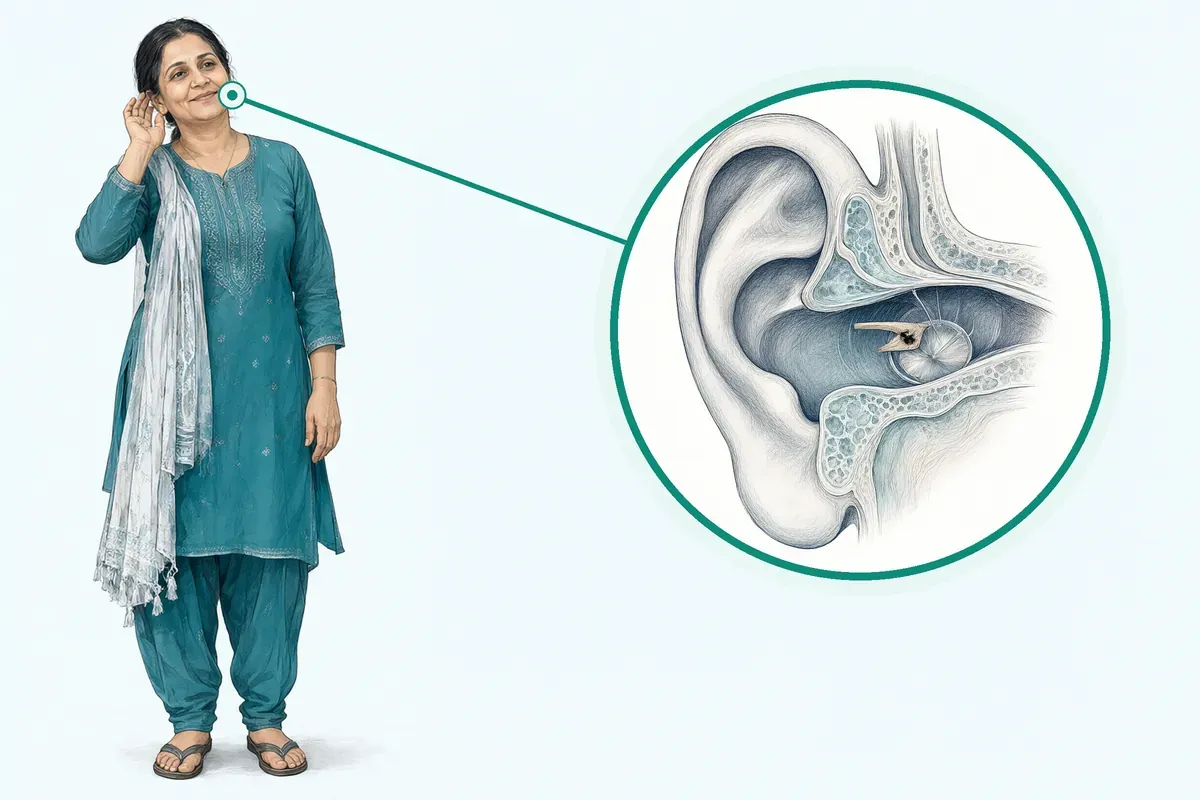
Your eardrum is a thin layer of tissue that separates your ear canal from your middle ear. It vibrates when sound waves reach it, carrying sound to your brain. Having a hole in this tissue keeps your eardrum from vibrating normally. A hole can form after an ear injury or from a long-term ear infection. A ruptured eardrum is treatable.
When a hole does not close on its own, it can leave your middle ear open to dirt and water. Fluid can also gather behind the tear. This fluid stops the three tiny bones in the middle ear from sending sound vibrations to your inner ear, leading to hearing loss.
In some people, the tiny middle ear bones get damaged as well. Skin growths called cholesteatomas can also form behind the torn membrane.
To repair this damage, an ear specialist carries out a surgery called tympanoplasty. In this procedure, your surgeon places a patch over the hole in your eardrum. The patch helps restore your hearing and protects your middle ear from germs that cause discharge. At Jaipur Hospital, our surgical team evaluates the hole and explains what surgery involves.
Symptoms of a perforated eardrum and warning signs
- Sudden severe ear pain
- Heavy bleeding or fluid gushing
- High fever or sudden chills
- Sudden dizziness or spinning
- Facial weakness or numbness
A hole in your eardrum can cause several noticeable ear symptoms. Many people experience hearing loss or find that sounds feel muffled. You may also see fluid, watery discharge, or pus leaking from your ear canal. Frequent ear infections that keep returning despite routine care are another common problem.
After any ear procedure or sudden ear trauma, certain symptoms need prompt attention. Normal healing can bring mild discomfort or a feeling of fullness in the ear. But some signs indicate that the ear needs immediate evaluation by a medical team.
You should visit the hospital or an emergency department the same day if you notice warning signs such as:
- Sudden, severe ear pain that gets worse
- Heavy bleeding or sudden fluid gushing from your ear
- High fever or sudden chills
- Sudden dizziness or severe spinning sensations
- Weakness or numbness in your facial muscles
Jaipur Hospital operates a 24-hour emergency department to handle sudden ear pain, trauma, or urgent complications without delay.
Causes of eardrum perforations and risk factors
- 5.8% higher than adults Paediatric graft failure
- Pseudomonas aeruginosa and Staphylococcus aureus Common bacteria in CSOM
Eardrum perforations happen for a few clear reasons. A common cause is a long-term ear infection known as chronic suppurative otitis media, or CSOM. In medical studies, bacteria named Pseudomonas aeruginosa and Staphylococcus aureus are the most common germs found to cause this infection. These germs trigger continuous inflammation inside your middle ear. The inflammatory chemicals produced can pass into the inner ear through an opening called the round window.
Physical trauma is another frequent cause of a torn eardrum. Poking cotton buds, hairpins, or matchsticks into the ear canal can puncture the thin membrane. Sudden pressure changes from a slap to the ear, sports collisions, or loud blasts can also burst the eardrum.
Certain people face a higher risk of developing persistent ear holes. Children have a slightly higher risk of ear infections and perforation issues than adults. In one study of ear surgeries, paediatric patients had a 5.8% higher rate of graft failure compared to adults.
People with recurrent colds, nasal allergies, or past ear damage also carry an increased risk of long-term ear infections. If you work in dusty conditions or swim in untreated water, germs can enter easily once a tiny tear starts.
How an ear perforation is diagnosed: examination and tests
When you visit the OPD at Jaipur Hospital, your surgeon will first examine your ear using a lighted otoscope or a clinical microscope. This lets the doctor look directly down your ear canal to check the size, position, and edges of the hole. The doctor also checks whether your ear canal is dry or discharging fluid.
Diagnostic tests are usually carried out to measure your hearing and check for active infection. Typical tests include:
- Tuning fork evaluation: A simple clinic test to check the type of hearing loss you have, usually costing ₹200 to ₹700 in India.
- Audiology exam: A formal hearing test in a sound booth, typically costing ₹400 to ₹1000 in India.
- Tympanometry: A pressure test to assess how well your eardrum moves and middle ear pressure, usually costing ₹250 to ₹800 in India.
- Ear discharge culture: A laboratory swab test to identify bacteria and pick the right medicine, typically costing ₹400 to ₹800 in India.
These tests help your surgeon plan the safest approach to repair the eardrum and restore sound vibration.
Non-surgical treatments and when tympanoplasty is advised
Not every tear in the eardrum requires immediate surgery. Small, fresh tears may heal on their own without surgery. Your doctor may prescribe ear drops or oral antibiotics from a chemist to clear infections while the tissue heals. During this healing period, you must keep water strictly out of your ear while bathing to prevent reinfection.
If your eardrum does not heal after two to three months, your surgeon will usually advise surgery. When holes remain open, they rarely close by themselves and need surgical repair to restore hearing and prevent repeated infections. Surgery is also needed if you suffer from ongoing ear discharge or if middle ear bones have sustained damage.
Your surgeon will discuss surgical approaches with you. Common options include:
- Underlay Technique: Your surgeon places the graft under the eardrum remnant; this method shows high success in closing holes.
- Overlay Technique: The graft is placed over the outer surface of the remnant, which helps treat perforations near the front of the drum.
- Endoscopic Tympanoplasty: Your surgeon works entirely through the ear canal using an endoscope, leaving no cut behind the ear.
- Cartilage Tympanoplasty: Your surgeon takes a small piece of firm cartilage from your ear to reinforce the new eardrum.
Your surgeon will advise which technique suits your ear condition and perforation size. At Jaipur Hospital, our surgical team carries out these evaluations to help protect your hearing and ear health.
Preparing for tympanoplasty surgery
Do
- Complete routine evaluations
- Review all regular medicines
- Follow fasting instructions
- Arrive with a family attendant
- Bring previous reports and documents
- Wear loose front-opening clothing
Before your tympanoplasty, our surgical team will ask you to complete routine evaluations to check your ear and overall health.
Typical diagnostic tests include:
- Tympanometry (Rs. 250 to Rs. 800)
- An audiology examination (Rs. 400 to Rs. 1000)
- An ear discharge culture and other lab tests (Rs. 400 to Rs. 800)
- A tuning fork evaluation (Rs. 200 to Rs. 700)
In addition, routine pre-operative tests such as laboratory blood work, X-ray, and ECG are arranged at Jaipur Hospital to confirm that you are fit for surgery.
During your OPD consultation, review all your regular medicines with your surgeon. You must talk with your doctor about any blood-thinning tablets, over-the-counter painkillers, or herbal supplements you take, and follow their advice on which tablets to take or pause before the operation. You should never stop or change your medicines without speaking directly to your doctor.
Because the operation is usually carried out under general anaesthesia, you will be given clear instructions on fasting. Your healthcare provider will give you general anaesthesia that puts you to sleep. You must not eat or drink anything for the specified number of hours before your scheduled admission.
On the morning of surgery, arrive at Jaipur Hospital with a family attendant who can stay with you during your admission. Bring your previous hearing test reports, doctor notes, government identity cards, and insurance papers if you plan to use cashless coverage.
Wear loose, comfortable clothing with a front-opening shirt that does not need to be pulled over your head or ears.
How tympanoplasty surgery is done
- Admission and preparation Admitted to ward and prepared for modular operation theatre
- General anaesthesia You are asleep under general anaesthesia
- Microsurgical repair Surgeon patches the hole using your own tissue
When you arrive for your operation, you are admitted to the ward and prepared for the modular operation theatre. A tympanoplasty operation typically takes 1 to 2 hours, though it can take as little as 30 minutes up to several hours depending on the size of the perforation, the damage inside the ear, and the surgical technique used.
Once you are asleep under general anaesthesia, your surgeon begins the microsurgical repair. During this procedure, an ENT specialist patches the hole in your eardrum, usually using tissue taken from your own body.
There are several surgical techniques available, and your surgeon will advise which option suits your ear condition:
- Underlay Technique: The graft tissue is placed medial to the remaining eardrum border. This approach provides reliable support and has a high success rate.
- Overlay Technique: The graft tissue is placed lateral to the eardrum remnant. This option is often selected for anterior perforations.
- Endoscopic Tympanoplasty: The surgeon works through the ear canal using an endoscope, avoiding an incision behind the ear.
- Cartilage Tympanoplasty: Cartilage taken from the tragus or concha of the ear is used as a sturdy graft to reinforce the repair.
During the repair, the surgeon checks the middle ear space. If chronic infection has damaged the tiny hearing bones behind your eardrum, your surgical team will address them. If abnormal skin growths called cholesteatomas have formed behind the eardrum, your surgeon may have to remove them during the procedure.
Once the graft is secure, protective packing is placed inside your ear canal to hold the new tissue in place while it heals. After the repair is finished, you are moved to the recovery area until you wake up fully.
Risks and possible complications of tympanoplasty
- 7.6% re-perforation Cartilage grafts
- 15.5% re-perforation Temporalis fascia grafts
- approximately 10% Cartilage revision surgery
- 19% Fascia revision surgery
Tympanoplasty is a routine surgical procedure, but like every operation, it carries specific risks that you should discuss with your surgical team. The most common complication is graft failure, which means the patch does not heal completely or solve the problem. Your eardrum may develop another hole during surgery, or your hearing may get worse.
In scientific studies, rates of re-perforation have been measured between different techniques. In one research review of 1,286 treated patients, the rate of re-perforation was 7.6% with cartilage grafts and 15.5% with temporalis fascia grafts. In another review of studies, the need for revision surgery was approximately 10% when cartilage was used, compared with 19% when temporalis fascia was used. Studies also show that paediatric surgery has a 5.8% higher failure rate than adult surgery.
Other surgical steps depend on the anatomy of the ear canal. In a study comparing surgical methods, 5 out of 30 patients in the microscopy group required canalplasty due to canal overhangs, and 4 out of 30 required canal wall curettage to assess the ossicles.
In that same trial, none of the 30 patients in the endoscopy group required canalplasty or canal wall curettage. In larger pooled analyses, the canalplasty rate of endoscopic tympanoplasty was significantly lower than that of microscopic tympanoplasty.
Short-term side effects can also happen after the operation. You may feel dizzy for a few days. If your doctor made an incision behind your ear, that area may feel sore.
You may also have ear pain for about a week, bloody fluid draining from the ear canal or incision, and temporary ear fullness or muffled hearing while the packing remains in place.
Recovery and aftercare after ear surgery
- Hospital stay Daycare or 1 night
- Return to desk work 1 week
- Light routines 1 to 2 weeks
- Children back to school 3 to 5 days
- Packing dissolves 1 to 2 weeks
- Keep water out of ear 1 to 3 months
Hospital stay for tympanoplasty is typically daycare or 1 night. Most people go home on the day of the procedure, though your healthcare provider may have you stay overnight in the hospital so our surgical team can monitor your initial healing. Most patients manage early postoperative soreness with over-the-counter pain relievers.
You can expect to return to desk work in 1 week, while returning to normal light routines generally takes 1 to 2 weeks. If you have children who had surgery, they are usually safe to return to school 3 to 5 days after surgery if they feel well.
Full recovery of hearing typically takes 2 to 3 months, though it may take 3 or more months in some cases.
Protecting your ear during the first few weeks is essential for graft healing. The packing placed in your ear will dissolve about 1 to 2 weeks after surgery. If external stitches were placed, they will either dissolve on their own or your doctor will remove them during a follow-up visit.
For 2 to 4 weeks, avoid heavy lifting, strenuous exercise, or any activity that causes you to strain. If your job requires strenuous physical activity or heavy lifting, you may need to take more time off. Do not fly in an airplane, swim, scuba dive, or play contact sports until your doctor tells you it is safe.
Keeping moisture out of the ear canal is critical. You must avoid getting water in your ear for 1 to 3 months, or until your surgeon says it is safe. You can take baths, but do not shower or wash your hair near the operated ear until your doctor permits it.
When bathing, plug your ear with a cotton ball lightly coated in petroleum jelly. Never insert plastic earplugs deep into the ear canal while you have packing inside, and use only earplugs recommended by your doctor.
You will typically return to the hospital OPD for a follow-up check about 2 to 3 weeks after surgery. Your doctor will test your hearing after your ear has healed, typically 8 to 12 weeks after the procedure. If you experience sudden severe dizziness, persistent fever, worsening pain, or heavy bleeding from the ear canal, contact Jaipur Hospital immediately.
Results: how well tympanoplasty works in studies
Tympanoplasty is performed to repair the eardrum hole, restore natural vibration, and help improve your hearing. It also seals the middle ear, helping prevent bacteria from entering and causing recurring discharge. In published clinical literature, studies show that tympanoplasty successfully treats 90% of people, although this success depends on the size and location of the hole.
Clinical studies have evaluated closure rates across thousands of patients. In a large meta-analysis of 1,475 patients, the weighted average success rate of tympanic membrane closure was 86.6%. Having a perforation size of less than 50% of the total drum area improved closure rates by 6.1%. Researchers also observed no correlation between the length of the follow-up period and the success of the repair.
Studies comparing surgical tools and graft materials show encouraging outcomes. In one trial comparing endoscopic and microscopic approaches, pooled tympanic membrane closure rates were comparable at 85.1% and 86.4%, respectively. In that trial, both groups showed a graft uptake rate of 83.3% after 24 weeks.
Pre-operative mean air-bone gaps were 28.5 dB in the endoscopic group and 32.4 dB in the microscopic group, improving post-operatively to 18.13 dB and 16.9 dB, respectively. In addition, patients undergoing endoscopic repair experienced better cosmetic results.
Regarding graft materials, a meta-analysis involving 3,606 patients showed a mean graft integration rate of 92.4% with cartilage grafts compared with 84.3% with temporalis fascia grafts. In another evaluation, overall graft integration was 92% for cartilage compared with 82% for temporalis fascia. Studies confirm that both cartilage and fascia provide similar hearing improvements after surgery.
Cost of tympanoplasty and insurance coverage in Jaipur
The cost of tympanoplasty in India typically ranges from ₹50,000 to ₹1,20,000. In published healthcare studies across India, average total costs have been reported around ₹47,500, with minimum costs of ₹35,000 and maximum costs of ₹60,000 for standard repairs.
The specific type of tympanoplasty also influences the price: reported minimum to maximum costs in India are ₹45,000 to ₹60,000 for myringoplasty, ₹65,000 to ₹94,500 for Type II tympanoplasty, ₹50,000 to ₹1,20,000 for Type III tympanoplasty, ₹40,000 to ₹60,000 for Type IV tympanoplasty, and ₹50,000 to ₹70,000 for Type V tympanoplasty.
The total amount depends on several individual factors. These include the choice of surgical approach, whether the tiny hearing bones require reconstruction, whether an overnight stay is needed, your pre-operative laboratory investigations, and post-operative medications.
Published cost breakdowns show:
- Average surgeon fees of ₹22,873
- Hospital facility charges of ₹7,389
- Modular operation theatre charges of ₹10,381
- Anaesthesia fees of ₹5,190
- Post-operative care and medicines of ₹1,667
You can ask our surgical team at Jaipur Hospital for an individualised estimate based on your specific ear evaluation.
Jaipur Hospital accepts major government health schemes, including Rajasthan Government Health Scheme (RGHS), MAA Yojana, and Central Government Health Scheme (CGHS). We also work with a panel of private insurance companies and Third Party Administrators (TPAs) to assist eligible patients with cashless hospitalisation.
When you come for your initial OPD visit, bring your scheme card or private insurance policy documents so your attendant can coordinate paperwork smoothly before admission.