

Urology · Jaipur Hospital
Ureteric Stone Surgery in Jaipur
Severe flank pain from a stuck stone; we assess, explain options and give a clear plan.
- Serving Jaipur since 1991 (35 years)
- NABH accredited
- 24×7 emergency & ICU
- Cashless: RGHS, MAA Yojana, CGHS + 22 insurers
- Operation time
- 45 to 90 minutes
- Anaesthesia
- Spinal or general anaesthesia
- Recovery
- Back to desk work in 3 to 5 days
- Price
- ₹60,000 to ₹1,50,000typical range in India; ask us for an estimate
Stone stuck in the ureter
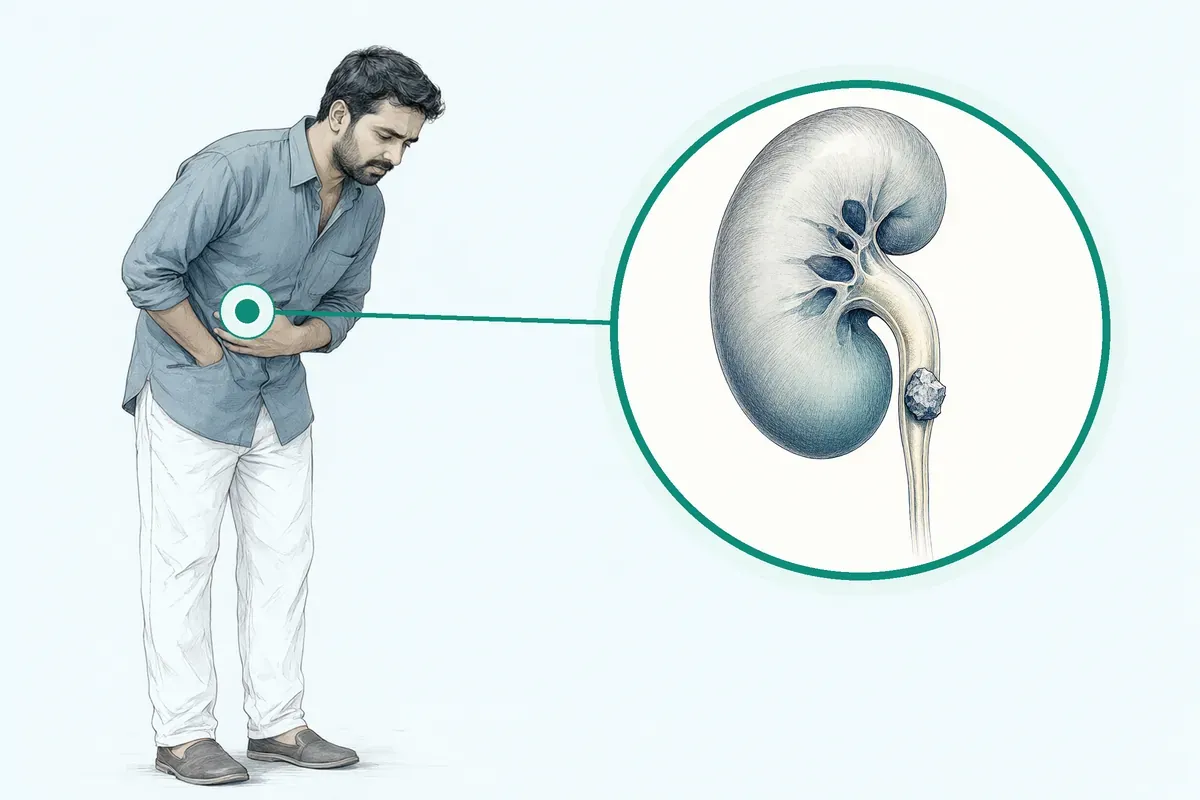
A stone blocking the ureter causes sudden, severe pain and can damage the kidney
When a stone moves from the kidney into the ureter it can get stuck. This blocks urine flow, causing intense flank pain, nausea, blood in the urine and sometimes fever. If the blockage stays, the kidney can swell and lose function.
-
Sudden severe flank pain
Pain comes in waves, often radiating to the groin, making it hard to sit still or sleep.
-
Blood in the urine
Urine may look pink, red or cola-coloured because the stone scrapes the ureter lining.
-
Risk of infection
Blocked urine can become infected, leading to fever, chills and a serious condition called urosepsis.
-
Kidney damage over time
Prolonged obstruction stretches the kidney and may reduce its function permanently.
-
Repeated emergency visits
Pain often brings patients to the emergency department multiple times before definitive treatment.
About 1 in 10 people develop a kidney stone at least once in their lifetime.
Why Jaipur Hospital
You are in agony, worried about missing work and the cost of surgery, and you just want the stone gone safely.
Your care plan
Your first steps with us
- 1 Call or visit OPD for urologist consultation
- 2 Complete blood tests, urine test and imaging in-house
- 3 Undergo laser ureteroscopy with stent placement as daycare or one-night stay
- 4 Return for stent removal and follow-up within two weeks
How the operation is done
Under spinal or general anaesthesia, a thin scope is passed through the urethra to the stone. A laser breaks the stone into dust or small pieces. A temporary stent is placed to keep the ureter open while fragments pass.
-
Semirigid URS with Holmium laser
Standard approach for stones in the lower and middle ureter; laser fragments the stone under direct vision.
-
Flexible URS for upper ureter
Flexible scope reaches stones near the kidney (PUJ) where a rigid scope cannot bend.
-
DJ stenting alone
If the ureter is too narrow or infection is present, a stent is placed first to drain the kidney and dilate the ureter for a later procedure.
-
Laser dusting vs basketing
Dusting turns fragments into fine powder that passes naturally; basketing removes larger pieces through the scope. Your surgeon chooses based on stone size and location.
Why patients trust us
- 1991 Serving Jaipur for 35 years
- NABH Accredited hospital
- 24×7 Emergency, ICU and ambulance
- 25 Cashless schemes and insurers
What research shows about laser ureteroscopy
-
Mean operative time 82.5 minutes
In a pooled series the average procedure lasted about 82 minutes.
-
Overall complication rate 10.1%
About 1 in 10 patients had a complication; most were minor such as stent discomfort or urinary infection.
-
Postoperative urosepsis 5.0%
The pooled incidence of serious infection (urosepsis) after ureteroscopy was 5% across studies.
If it is left untreated
Untreated ureteric stones can lead to recurrent severe pain, repeated infections, progressive loss of kidney function and, in rare cases, life-threatening urosepsis.
Life after treatment
Most people return to desk work within a few days. Stent discomfort improves after the stent is removed, usually within one to two weeks.
-
Back to work in days
Most people resume desk work in 3 to 5 days; heavy lifting may need a week or two.
-
Stent removed in clinic
The temporary stent is taken out in the OPD a few days to two weeks after surgery, usually without anaesthesia.
-
Stone fragments pass naturally
Small dust and fragments flush out with urine over the first week; drinking water helps.
-
Follow-up imaging confirms clearance
An ultrasound or X-ray at follow-up checks that the ureter is clear and the kidney is draining well.
Meet the team
Our Urology specialists
Care led by Jaipur Hospital's urology consultants, backed by round-the-clock surgical, diagnostic and critical care support.
Frequently asked questions
Questions patients ask about ureteric stone surgery
What does ureteroscopy and DJ stenting involve?
In short
Ureteroscopy and DJ stenting at Jaipur Hospital is a minimally invasive operation to remove stones from the ureter. A thin scope passes through the urethra and bladder to reach the stone. A holmium laser breaks the stone into dust or small pieces. The surgeon then places a temporary plastic stent, called a DJ stent, inside the ureter to keep it open while you heal.
In detail
The procedure uses either a semirigid or flexible ureteroscope depending on the stone location. Semirigid scopes treat stones in the lower and middle ureter. Flexible scopes reach stones higher up near the kidney.
The laser fibre fragments the stone, and a basket may retrieve larger pieces. Most patients receive spinal or general anaesthesia. The operation typically lasts 45 to 90 minutes.
A DJ stent is placed in most cases to prevent swelling from blocking urine flow or stone fragments. The stent stays in place for a few days to a couple of weeks and is removed later in a brief clinic visit.
A common belief
Many people think this needs a cut on the skin.
What actually happens
It does not. The whole procedure is done through the urethra, so there are no stitches or scars on your abdomen.
Your next step at Jaipur Hospital
You will meet your surgeon in the OPD to review imaging and plan the surgery. Pre-operative tests include urine culture, blood counts, and kidney function. The hospital stay is usually daycare or one night. You can return to desk work in 3 to 5 days. Stent removal is scheduled before you leave.
Which tests and scans do I need before ureteroscopy and DJ stenting?
In short
Before ureteroscopy and DJ stenting at Jaipur Hospital, you will typically need a CT scan or ultrasound to locate the stone, blood tests for kidney function and infection markers, a urine routine and culture, and basic fitness tests such as ECG and chest X-ray if required for anaesthesia.
In detail
The imaging defines stone size, location and degree of obstruction. A non-contrast CT is the standard for surgical planning. Blood tests include serum creatinine, urea, complete blood count and coagulation profile.
Urine culture identifies any infection that must be treated before surgery to reduce the risk of urosepsis. Evidence shows that treating preoperative UTI and using antibiotic prophylaxis lowers infectious complications.
Depending on age and comorbidities, the anaesthesia team may request an ECG, chest X-ray or other clearance. All reports should be recent, usually within two weeks of the planned procedure.
A common belief
Patients sometimes skip the urine culture if they feel fine.
What actually happens
Evidence shows that untreated urine infection raises the risk of serious sepsis after the procedure, so the culture is essential.
Your next step at Jaipur Hospital
Collect all recent reports and bring them to your preoperative visit. The nursing team will guide you on any additional tests needed. Fasting instructions and medication adjustments will be given at that time.
How painful is ureteric stone surgery and the early recovery?
In short
At Jaipur Hospital, ureteric stone surgery is done under spinal or general anaesthesia, so you do not feel pain during the operation. After surgery, most patients describe mild to moderate discomfort that is managed with oral pain relief. The stent placed in the ureter can cause a dull ache or bladder irritation for a few days.
In detail
The procedure uses a ureteroscope passed through the urethra to reach the stone. A holmium laser breaks the stone into dust or small fragments, which are then removed or flushed out.
A temporary DJ stent is usually placed to keep the ureter open while swelling settles. Evidence shows that stent-related symptoms such as flank pain when passing urine, urinary frequency, and blood in the urine are common but typically improve once the stent is removed. Studies report that major complications are uncommon, and most discomfort resolves within the first week.
A common belief
Many patients expect severe pain, but the stent causes a dull ache or bladder irritation rather than sharp surgical pain.
What actually happens
This usually settles within a few days and improves greatly once the stent is removed.
Your next step at Jaipur Hospital
You will receive pain tablets before discharge and a short course of antibiotics if needed. Drink two to three litres of water daily to help flush fragments and reduce stent irritation. Avoid heavy lifting for one week. The stent is usually removed after one to two weeks during a brief OPD visit.
How long does recovery usually take after ureteric stone surgery?
In short
At Jaipur Hospital, most patients go home the same day or after one night. You can usually return to desk work in three to five days. Full recovery, including stent removal, takes about one to two weeks. Heavy lifting and strenuous activity should be avoided for at least one week.
In detail
The operation takes 45 to 90 minutes under spinal or general anaesthesia. After a brief observation period, you are discharged with pain relief and antibiotics if needed.
The DJ stent placed during surgery stays in for one to two weeks to allow the ureter to heal and fragments to pass.
Evidence shows that stent-related symptoms such as flank pain, urinary frequency, and blood in the urine are common during this period but improve after stent removal.
Most patients resume normal daily activities within a week, though physical exertion should be limited until the stent is out. Follow-up imaging may be arranged to confirm stone clearance.
A common belief
Some patients expect a long bed rest, but this is a daycare or one-night procedure.
What actually happens
The main limitation is the stent, which causes urinary symptoms until it comes out. Once the stent is removed, recovery is usually complete.
Your next step at Jaipur Hospital
Drink two to three litres of water daily to flush fragments and reduce stent irritation. Take prescribed pain tablets and finish any antibiotic course. The stent is removed during a short OPD visit, usually without anaesthesia. Watch for fever, chills, heavy bleeding, or inability to pass urine — these need urgent review.
Can my ureteric stone pass on its own, and how is that likelihood assessed?
In short
Whether a ureteric stone passes on its own depends mainly on its size and location. At Jaipur Hospital, your surgeon reviews imaging and symptoms to estimate the chance of spontaneous passage. Small stones in the lower ureter pass more often than large or upper ureter stones.
In detail
Stones smaller than 5 millimetres in the distal ureter have a higher probability of passing without intervention. Larger stones, or those stuck near the pelviureteric junction, are less likely to clear spontaneously.
Your surgeon checks stone dimensions on CT or ultrasound, looks for signs of obstruction such as hydronephrosis, and asks about pain severity and infection markers.
If the stone has not moved after a period of observation with pain control and hydration, or if there is fever, rising creatinine, or intolerable pain, active treatment is usually advised. The decision balances the natural history of the stone against the risk of kidney damage or sepsis.
A common belief
Many people wait too long hoping the stone will pass, risking infection or kidney damage.
What actually happens
Your surgeon uses stone size, position, and your symptoms to decide the safe window for observation.
Your next step at Jaipur Hospital
You will need a recent CT KUB or ultrasound and a urine culture before the consultation. The surgeon will explain the observation plan or recommend ureteroscopy with laser fragmentation and stenting if indicated. Most patients return to desk work in three to five days after surgery.
Which urinary symptoms need urgent assessment after ureteric stone surgery?
In short
After ureteric stone surgery, certain symptoms need urgent medical attention. At Jaipur Hospital, you are advised to seek care immediately if you develop fever above 38 degrees Celsius, shaking chills, inability to pass urine, severe flank or abdominal pain not relieved by prescribed medication, or heavy bleeding with clots. These can signal infection, blockage, or injury that must be treated quickly.
In detail
Evidence shows that infectious complications, including urosepsis, occur in a small but significant proportion of patients after ureteroscopy. Risk factors include pre-existing infection, diabetes, longer operative time, and prolonged stent dwell. Fever and chills suggest bacteria have entered the bloodstream.
Inability to pass urine may mean a clot or fragment is blocking the stent or ureter. Severe pain can indicate ureteric spasm, stent migration, or a missed fragment. Heavy bleeding is uncommon but may need irrigation or stent adjustment. Prompt assessment reduces the chance of serious morbidity.
A common belief
Many patients think some fever or pain is normal after surgery.
What actually happens
But fever after ureteroscopy can mean sepsis, which escalates fast. Do not wait at home.
Your next step at Jaipur Hospital
Keep the emergency numbers handy and do not wait to see if symptoms improve. If you have a pull-out stent string, do not remove it early unless instructed. Contact Jaipur Hospital at any hour for guidance.
Why might my doctor recommend ureteroscopy and DJ stenting?
In short
Your doctor at Jaipur Hospital may recommend ureteroscopy and DJ stenting if you have a ureteric stone between 5 and 20 millimetres that is unlikely to pass on its own or is causing pain, blockage, infection or blood in the urine. The procedure removes the stone and relieves the obstruction in a single sitting.
In detail
Ureteroscopy is the standard treatment for stones in the ureter that are too large to pass spontaneously or have failed medical expulsive therapy. It is also used when a stone causes recurrent urinary tract infections, persistent pain or kidney swelling due to blockage.
The laser breaks the stone effectively and the stent ensures drainage while the ureter heals. In studies, flexible ureteroscopy with laser lithotripsy has shown high stone-free rates for stones in the upper ureter and near the kidney.
The procedure is minimally invasive with no external cuts. Your surgeon will consider stone size, location, composition and your overall health before recommending this option.
A common belief
Some patients hope the stone will pass with medicines alone.
What actually happens
For stones above 5 to 10 millimetres or those causing complications, waiting often leads to more pain, infection or kidney damage.
Your next step at Jaipur Hospital
If you have been advised to have this procedure, bring your imaging and blood reports to the consultation. The team will review your fitness for anaesthesia and plan the surgery. Most patients return to desk work within 3 to 5 days.
How should I prepare in the days before ureteroscopy and DJ stenting?
In short
In the days before ureteroscopy and DJ stenting at Jaipur Hospital, follow your surgeon's specific instructions on medications, hydration, and bowel preparation. Stop blood thinners only if told by the prescribing doctor and the surgical team. Keep well hydrated unless fluid restriction is advised for a medical condition.
In detail
You may be asked to start an antibiotic a day before surgery based on your urine culture results. Evidence supports antibiotic prophylaxis to reduce urinary tract infection and urosepsis risk.
If you take aspirin, clopidogrel, apixaban, or other anticoagulants, the team will balance bleeding risk against the risk of stopping them. Herbal supplements like ginkgo, garlic, or ginseng can increase bleeding and should be disclosed. Do not start new vitamins or supplements without asking.
The anaesthesia team will assess you for spinal or general anaesthesia fitness. You will receive fasting instructions, usually nothing by mouth for six hours before the procedure. Arrange for an attendant to stay with you if an overnight stay is planned. Pack loose comfortable clothing and any regular medicines you will need after discharge.
A common belief
Patients often stop their heart or stroke medicines on their own.
What actually happens
That can be dangerous. Always coordinate with both your cardiologist and the urology team before changing any regular medication.
Your next step at Jaipur Hospital
On the morning of surgery, take only the medicines the anaesthetist approved with a sip of water. Shower with antiseptic soap if advised. Remove jewellery, contact lenses, and dentures. The operation takes 45 to 90 minutes.
You will be monitored in recovery for one to two hours. Most patients go home the same day or the next morning. Stent removal is usually within two weeks.
What are the common side effects and the less common serious complications of ureteric stone surgery?
In short
At Jaipur Hospital, common side effects after ureteric stone surgery include blood in the urine, mild burning when passing urine, urinary frequency, and flank discomfort from the stent. These usually settle within a few days. Less common but serious complications include ureteric injury, significant bleeding requiring intervention, and urosepsis, which needs urgent hospital treatment.
In detail
The procedure involves passing a ureteroscope through the urethra to the stone, fragmenting it with a holmium laser, and placing a DJ stent. Evidence shows that stent-related symptoms such as haematuria, dysuria, and flank pain are the most frequently reported issues.
Infectious complications including urinary tract infection and urosepsis occur in a minority of patients; risk factors include pre-operative infection, longer operative time, diabetes, and prolonged stent dwell. Major complications such as ureteric perforation or stricture are reported in a small percentage of cases.
Most infectious complications are minor and respond to antibiotics, but urosepsis can progress to multi-organ failure if not treated promptly.
A common belief
Many people worry about the laser damaging the ureter, but studies show major injuries are rare.
What actually happens
The bigger concern is infection, especially if a urine infection was present before surgery or the stent stays in too long. That is why we treat any infection first and remove the stent promptly.
Your next step at Jaipur Hospital
You will be given antibiotics and pain relief at discharge. Drink plenty of fluids and finish the antibiotic course. Watch for fever above 38°C, chills, inability to pass urine, or heavy bleeding with clots — these need immediate attention. The stent is typically removed after one to two weeks in OPD.
Which symptoms are expected after ureteric stone surgery, and which need urgent medical attention?
In short
At Jaipur Hospital, expected symptoms after ureteric stone surgery include blood-tinged urine, mild burning when passing urine, urinary frequency, and flank discomfort especially when voiding, caused by the stent. These usually improve over a few days. Urgent signs are fever above 38°C, chills, heavy bleeding with clots, inability to pass urine, or severe uncontrolled pain.
In detail
The procedure places a DJ stent to keep the ureter open while swelling settles. Evidence shows stent-related symptoms such as haematuria, dysuria, urgency, and flank pain are very common and typically resolve after stent removal.
Infectious complications occur in a minority; a pooled analysis reported postoperative urosepsis in about five percent of cases. Risk factors include pre-operative infection, diabetes, longer operative time, and prolonged stent dwell.
Urosepsis can progress rapidly to multi-organ failure, so any fever with shaking chills needs immediate evaluation. Ureteric injury or significant bleeding is rare but may present as worsening flank pain or frank blood clots blocking the catheter or urine stream.
A common belief
Many patients think any blood in the urine is dangerous, but light pink urine is expected for a few days.
What actually happens
The real danger is infection — fever with chills means possible urosepsis and needs immediate hospital care, not waiting at home.
Your next step at Jaipur Hospital
Take all prescribed antibiotics and pain relief. Drink plenty of fluids. If you develop fever, chills, cannot pass urine, or see heavy clots, go to the emergency department at Jaipur Hospital immediately. The stent is usually removed in OPD after one to two weeks.
FAQ library
Questions and answers about ureteric stone surgery
When you contact us
Get your assessment and plan
Contact Jaipur Hospital for a urology OPD consultation, in-house tests, a clear explanation of options, a cost estimate and help with cashless insurance.
- A consultation with a urologist in the OPD
- Your scans and reports reviewed, with tests done in-house if you need them (laboratory, X-ray and imaging)
- Your options explained in plain words, including whether you need surgery at all
- A cost estimate before you decide
- Help with cashless treatment under RGHS, MAA Yojana, CGHS and empanelled insurers and TPAs
- Follow-up visits after your treatment
Overview
Ureteric Stone Surgery: what to know
What a ureteric stone is and how it forms
- Substances in urine
- Calcium, oxalate or uric acid become concentrated and crystallise
- Start in kidney
- Most stones start small in the kidney and may pass on their own
- Blockage in ureter
- Stone blocks urine flow and causes severe pain
A ureteric stone is a hard mass that forms in the kidney and moves down into the ureter, the narrow tube that carries urine from the kidney to the bladder. Stones develop when substances in the urine such as calcium, oxalate or uric acid become concentrated and crystallise.
Most stones start small in the kidney and may pass on their own, but once a stone enters the ureter it can block the flow of urine and cause severe pain. Ureteroscopy with laser fragmentation is a common way to treat these stones.
A thin instrument called a ureteroscope is passed through the urethra and bladder up to the stone, and a laser breaks the stone into dust or small pieces that can be removed or passed naturally.
Symptoms of a ureteric stone and when to seek urgent care
- Fever and chills May indicate urinary tract infection
- Unable to pass urine Despite urge to pass urine
The most common symptom is sudden, severe pain in the side or back, below the ribs, that may radiate to the lower abdomen and groin. The pain often comes in waves and can be accompanied by nausea and vomiting. You may notice blood in the urine, a frequent urge to pass urine, or a burning sensation while passing urine.
If you develop fever and chills along with these symptoms, it may indicate an infection in the urinary tract, which needs urgent medical attention the same day. Inability to pass urine despite the urge is another warning sign that requires immediate care.
After the procedure, discomfort and blood in the urine may occur for a few days, especially if a stent is in place, and pain or nausea may occur as remaining stone fragments pass.
Causes and factors that increase the risk of ureteric stones
- Diet and fluids
- Low fluid intake, high salt or animal protein diet
- Medical conditions
- Diabetes, gout, obesity, family history
- Infection risk factors
- Older age, diabetes, female gender, high BMI, positive urine culture
Stones form when the urine contains more crystal-forming substances than the fluid in the urine can dilute. Low fluid intake, a diet high in salt or animal protein, obesity, and certain medical conditions such as diabetes or gout can raise the risk. A family history of stones also makes them more likely.
In studies, older age, diabetes mellitus, ischaemic heart disease, high body mass index, female gender, neurogenic bladder, and a positive urine culture before the procedure have been associated with a higher risk of infection after ureteroscopy. Preoperative stent placement and longer procedure time have also been linked to increased infection risk.
How a ureteric stone is diagnosed: examination and tests
- Blood tests Assess kidney function and calcium or uric acid levels
- Imaging Ultrasound first, then non-contrast CT scan for detailed picture
Your doctor will ask about your symptoms and medical history and examine your abdomen and flank.
A urine test checks for:
- Blood
- Infection
- Crystals
Blood tests assess kidney function and look for high levels of calcium or uric acid. Imaging confirms the stone's size and location. An ultrasound of the abdomen is often the first imaging test. A non-contrast CT scan of the kidneys, ureters and bladder gives the most detailed picture and is the standard for planning treatment.
X-rays may be used in some cases. MRI is rarely needed. These tests help your surgeon decide whether the stone is likely to pass on its own or needs intervention.
Non-surgical treatment options and when surgery is advised
Small stones, usually under 5 millimetres, often pass on their own with plenty of fluids and pain relief. Your doctor may prescribe medicines such as alpha-blockers to relax the ureter and help the stone pass.
If the stone is larger than about 5 to 10 millimetres, causing persistent pain, blocking urine flow, or associated with infection, surgery is usually advised.:
- Persistent pain
- Blocking urine flow
- Associated with infection
Ureteroscopy with laser lithotripsy is commonly used for stones between 5 and 20 millimetres in the ureter. For stones near the kidney, a flexible ureteroscope gives better access. If the ureter is too narrow for the scope, a stent may be placed first to dilate the ureter and the procedure is rescheduled after two to three weeks.
In some cases, a stent alone is placed for temporary drainage if the stone cannot be reached or if there is sepsis.
Preparing for ureteric stone surgery
Do
- Test reports
- Insurance or scheme cards
- List of current medicines
- Comfortable clothes
- Attendant to help after discharge
Before ureteric stone surgery, your surgical team will ask for a few routine tests. These usually include a blood test, a urine test to check for infection, and imaging such as an X-ray or ultrasound to confirm the stone position and size.
If you have a urinary tract infection, it will be treated with antibiotics before the operation because a pre-operative infection raises the risk of urosepsis after the procedure.
Tell your surgeon about every medicine you take, especially blood thinners, diabetes tablets or insulin, and any antibiotics you have used recently. The anaesthesia team will review your health and decide whether spinal or general anaesthesia is safer for you. You will be asked to stop eating and drinking for at least six hours before the scheduled time.
On the day of surgery, bring your test reports, insurance or scheme cards (RGHS, MAA Yojana, CGHS, or private TPA details), a list of current medicines, and comfortable clothes to wear home. An attendant should come with you to help after discharge.
Jaipur Hospital has a 24×7 emergency department, in-house pharmacy, and diagnostic laboratory on site if any last-minute tests are needed.
How ureteric stone surgery is done
Ureteric stone surgery at Jaipur Hospital is performed by our urology team using a ureteroscope — a thin tube with a light and camera — passed through the urethra and bladder up to the stone in the ureter or kidney. The procedure is done under spinal or general anaesthesia and usually takes 45 to 90 minutes.
Your surgeon will choose the technique based on the stone's location, size, and hardness:
- Location
- Size
- Hardness
- Semirigid ureteroscopy with Holmium laser: standard for stones in the lower and middle ureter.
- Flexible ureteroscopy for upper ureter: better access for stones near the pelvi-ureteric junction.
- DJ stenting alone: temporary drainage if the stone cannot be reached safely or if there is sepsis.
- Laser dusting versus basketing: dusting breaks the stone into fine particles that pass with urine; basketing removes larger fragments with a tiny basket.
During the operation, the laser fibre breaks the stone into pieces or dust. The fragments are either removed with a basket or flushed out. A temporary plastic stent (DJ stent) is placed in the ureter in most cases to keep it open while swelling settles and fragments pass. The stent is completely inside the body; no external bag is needed.
If the ureter is too narrow for the scope, a stent is placed first to dilate it, and the procedure is rescheduled after two to three weeks.
The operation is minimally invasive with no cuts or scars. Most patients go home the same day or stay one night.
Risks and possible complications of ureteric stone surgery
- about 10% Overall complication rate
- roughly 5% of patients Minor complications
- about 5% Major complications
- 5% (95% CI 2.4–8.2%) Urosepsis pooled incidence
Ureteric stone surgery is generally safe, but complications can occur. In studies, the overall complication rate was about 10%. Minor complications such as stent discomfort, blood in urine, or mild infection happened in roughly 5% of patients. Major complications such as ureteral injury, significant bleeding, or urosepsis occurred in about 5%.
The most frequently reported issues are ureteral stent discomfort, ureteral wall injury, and stone migration. Infectious complications account for almost half of all post-operative problems. The pooled incidence of urosepsis in studies was 5% (95% confidence interval 2.4–8.2%). Urosepsis is a serious condition that can lead to multi-organ failure and death, though reported rates are low. Most infectious complications are minor.
Certain factors raise the risk of infection:
- Diabetes
- Older age
- Female gender
- High BMI
- Ischaemic heart disease
- Neurogenic bladder
- Positive urine culture before surgery
- Longer operation time
- Stent left in place for a long time before the procedure
To reduce these risks, our team uses antibiotic prophylaxis, treats any infection before surgery, keeps the operation time short, and removes the stent as early as appropriate.
Other risks include failure to remove all stone fragments and needing to keep a stent in place for a longer period. Your surgeon will discuss how these risks apply to you.
Recovery and aftercare after ureteric stone surgery
- Same day Most patients go home
- Few days to couple of weeks Stent typically removed
- First week Avoid heavy lifting and strenuous exercise
After the procedure, you will be monitored in the recovery room for one to two hours. The nursing team will explain how to manage any discomfort or pain. Most patients go home the same day after a brief observation period. You can usually return to desk work in three to five days.
While the stent is in place, you may feel discomfort in the flank or bladder, have urgency to pass urine, or see blood in the urine. Pain and nausea can occur as remaining stone fragments pass. These symptoms usually improve after the stent is removed.
The stent is typically taken out a few days to a couple of weeks after surgery. Some stents have a pull-out string taped to the thigh so you or your attendant can remove it at home; otherwise, a short clinic visit is needed.
Drink plenty of water (about two to three litres a day unless your doctor advises otherwise) to help flush fragments. Take any prescribed pain relief or antibiotics exactly as directed. Avoid heavy lifting and strenuous exercise for the first week.
Call Jaipur Hospital or visit the 24×7 emergency department if you develop a fever above 38°C, severe pain not relieved by medicines, heavy bleeding with clots, inability to pass urine, or signs of infection such as chills and vomiting. These could indicate urosepsis or a blocked stent and need prompt attention.
Results of ureteric stone surgery
In studies, ureteric stone surgery using flexible ureteroscopy and laser lithotripsy achieved a mean stone-free rate of about 94%. For stones between 2 and 3 cm, the stone-free rate was 95.7%; for stones larger than 3 cm, it was 84.6%.
In experienced hands, flexible ureteroscopy can successfully treat stones greater than 2 cm with a high stone-free rate and low complication rate. A comparative study found that for renal stones 2–3 cm, flexible ureteroscopy needed fewer second-stage procedures and was just as effective as percutaneous nephrolithotomy.
Stone-free rates vary between studies because of differences in how "stone-free" is defined and what imaging is used for follow-up. The size and position of the stone also affect the result. Your surgeon will advise whether a single procedure is likely to clear your stone or if a second sitting may be needed.
Stone recurrence is possible over time. Drinking enough fluids, dietary changes, and treating any underlying metabolic cause can reduce the chance of new stones forming. Your urologist may suggest a metabolic work-up after the surgery to guide long-term prevention.
Cost and insurance for ureteric stone surgery in Jaipur
The typical price range for ureteric stone surgery (ureteroscopy with laser lithotripsy and stenting) in India is ₹60,000 to ₹1,50,000. The final cost depends on the technique used (semirigid or flexible ureteroscopy), the size and location of the stone, whether a DJ stent is placed, the type of anaesthesia, and the length of hospital stay (daycare or one night). Diagnostic tests such as X-ray, ultrasound, blood tests, and urine analysis are billed separately.
Jaipur Hospital is empanelled under RGHS, MAA Yojana, CGHS, and a panel of private insurers and TPAs. If you are covered under one of these schemes, the hospital's insurance desk will help you with pre-authorisation and cashless admission where applicable. Bring your scheme or insurance card, photo ID, and any referral letters on the day of admission. The hospital has an in-house pharmacy and diagnostic laboratory, so all tests and medicines can be coordinated on site.