

Urology · Jaipur Hospital
Bladder Stone Removal in Jaipur
Pain while passing urine disrupts your daily routine; our surgical team provides a thorough clinical assessment and a clear treatment plan.
- Serving Jaipur since 1991 (35 years)
- NABH accredited
- 24×7 emergency & ICU
- Cashless: RGHS, MAA Yojana, CGHS + 22 insurers
- Operation time
- 30 to 60 minutes
- Anaesthesia
- Spinal or general anaesthesia
- Recovery
- Catheter for 1 to 2 days, normal activity in 1 week
- Price
- ₹40,000 to ₹1,00,000typical range in India; ask us for an estimate
Difficulty passing urine
Pain and interruption to your daily routine
Hard mineral deposits in the bladder can make urination uncomfortable and disrupt your regular work and rest.
-
Pain while peeing
Stones in the bladder can cause irritation, lower belly pain, or discomfort during urination.
-
Interrupted routine
Frequent visits to the toilet or sudden discomfort make regular daily tasks difficult to manage.
-
Worry about surgery
Not knowing the surgical options or time off work can make planning your care stressful.
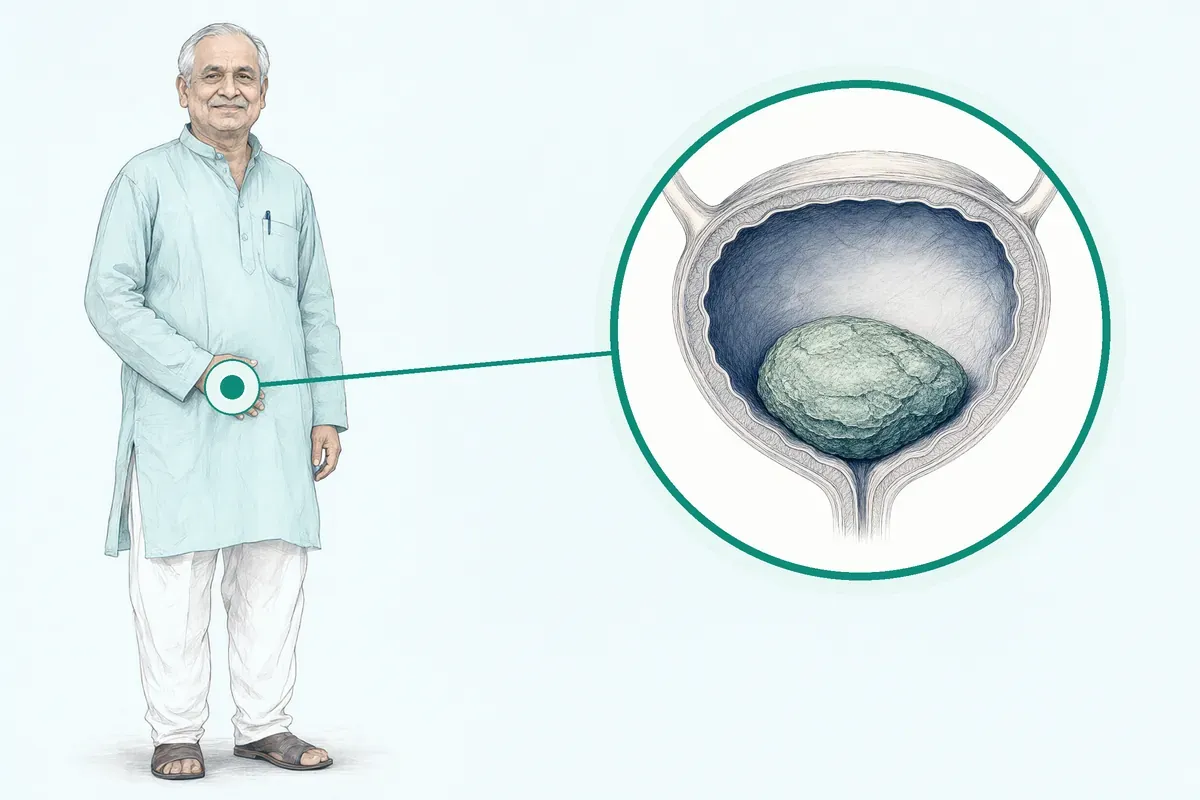
Bladder stones are hard deposits of minerals that can form inside your bladder.
Why Jaipur Hospital
You may worry about surgical pain, hospital costs, or taking days away from your family and work.
Your care plan
Your first steps with us
- 1 Consult our urology team in the OPD
- 2 Review your scans and surgical options
- 3 Undergo endoscopic stone removal in theatre
- 4 Recover at home with scheduled follow-up
How the procedure is carried out
Your surgeon inserts a cystoscope through the urethra to find the stones, fragment them, and wash the bladder clear.
-
Cystolitholapaxy with Holmium laser
Your surgeon will discuss precise stone fragmentation designed to minimise mucosal injury inside your bladder.
-
Pneumatic lithotripsy
Your surgeon will discuss mechanical energy to fragment large, hard stones in a cost-effective manner.
-
Combined laser and pneumatic
Your surgeon will discuss using both tools together for efficient debulking of bulky stone burdens.
-
Open cystolithotomy
Your surgeon will discuss an open incision, rarely required for giant stones or concurrent prostate surgery.
Why patients trust us
- 1991 Serving Jaipur for 35 years
- NABH Accredited hospital
- 24×7 Emergency, ICU and ambulance
- 25 Cashless schemes and insurers
Clinical findings on stone removal
-
77.3%
In a study of laser lithotripsy, complete stone clearance at 48 hours was documented in 77.3% of cases.
-
1 to 2 weeks
Follow-up appointments after cystolitholapaxy are typically scheduled about one to two weeks after surgery.
-
4.6%
In an endoscopic study, the observed incidence of urinary tract infection was 4.6%.
If it is left untreated
Untreated bladder stones can cause persistent discomfort and obstruction, and stones can come back unless the underlying cause is addressed.
What to expect after treatment
Most people recover steadily following endoscopic treatment and return to their usual routines within days.
-
Normal daily activity
Most people can return to work or school within two to three days after the procedure.
-
Catheter removal
If a temporary catheter is placed, your provider typically removes it within one to two days.
-
Resuming regular meals
Most people can go back to eating and drinking as usual once they return home.
Meet the team
Our Urology specialists
Care led by Jaipur Hospital's urology consultants, backed by round-the-clock surgical, diagnostic and critical care support.
Frequently asked questions
Questions patients ask about bladder stone removal
What does bladder stone removal involve?
In short
Bladder stone removal at Jaipur Hospital is an endoscopic procedure called cystolitholapaxy. A surgeon passes a cystoscope through the urethra into the bladder, locates the stones, and breaks them into small pieces using a laser or pneumatic device. The fragments are then washed out. The operation usually takes 30 to 60 minutes under spinal or general anaesthesia.
In detail
The surgeon inserts a thin tube with a camera, called a cystoscope, into your urethra and guides it into the bladder to see the stones clearly. A laser fibre or pneumatic probe is then passed through the scope to fragment the stones.
Laser energy offers precise fragmentation with minimal injury to the bladder lining, while pneumatic lithotripsy is cost-effective for large, hard stones. Sometimes both methods are combined for bulky stone burdens. After fragmentation, the pieces are irrigated and removed.
The procedure is minimally invasive, requiring no external cuts. According to clinical sources, the procedure is relatively short, about 30 to 60 minutes, and is usually performed as daycare or with a one-night stay.
A common belief
Many people think open surgery is needed, but endoscopic cystolitholapaxy avoids any cuts on the abdomen.
What actually happens
Laser gives precise fragmentation with less injury to the bladder wall, while pneumatic is cost-effective for very hard stones. The choice depends on stone size and hardness.
Your next step at Jaipur Hospital
You will typically have a urinary catheter for one to two days after surgery and can resume normal activity within a week. A follow-up appointment is usually scheduled within one to two weeks to check healing and ensure all fragments are cleared. The typical price range in India is ₹40,000 to ₹1,00,000; ask us for an estimate.
Which tests and scans do I need before bladder stone removal?
In short
Before bladder stone removal at Jaipur Hospital, you will typically need a urine routine and culture, blood tests including haemoglobin, kidney function, and coagulation profile, and imaging such as an ultrasound abdomen and pelvis or a CT scan. A diagnostic cystoscopy may also be done to confirm stone details and assess the bladder and prostate.
In detail
The urine routine checks for infection, blood, and crystals. A urine culture identifies bacteria and guides antibiotic prophylaxis if needed. Blood tests assess your fitness for anaesthesia and surgery: haemoglobin for anaemia, creatinine and urea for kidney function, and PT/INR for bleeding risk.
Imaging is essential to know the stone size, number, location, and density. An ultrasound is often the first test; a non-contrast CT scan gives the most detail. A plain X-ray KUB may be used for radio-opaque stones.
If not done recently, a diagnostic cystoscopy allows the surgeon to see the stones directly, evaluate the bladder mucosa, and check for prostate enlargement or strictures.
These tests help plan the technique, whether laser, pneumatic, or combined, and ensure you are fit for spinal or general anaesthesia.
A common belief
Patients often assume a single scan is enough.
What actually happens
But each test gives different information: urine culture guides antibiotics, blood tests check anaesthesia safety, and CT shows stone hardness which decides laser versus pneumatic technique. Missing any test can delay surgery.
Your next step at Jaipur Hospital
Most tests can be done at our in-house laboratory and radiology department. Bring any recent reports to avoid duplication. The pre-anaesthesia check-up is usually scheduled a day before surgery.
How painful is the bladder stone removal procedure and the early recovery?
In short
At Jaipur Hospital, bladder stone removal is done under spinal or general anaesthesia, so you do not feel pain during the operation. After surgery, most patients have mild to moderate discomfort, mainly from the catheter and bladder irritation, which is managed with regular pain relief medicines.
In detail
The procedure takes 30 to 60 minutes. Evidence from clinical sources confirms that anaesthesia blocks pain completely during cystolitholapaxy. After the anaesthetic wears off, you may feel a burning sensation when passing urine, a constant urge to void, or cramping in the lower abdomen.
These symptoms are common in the first 72 hours. A catheter stays in place for one to two days to drain urine and allow the bladder lining to heal. Simple analgesics such as paracetamol or a prescribed anti-inflammatory are usually enough. Stronger painkillers are rarely needed. Walking around after surgery helps prevent blood clots and reduces cramping.
A common belief
Some patients expect severe pain or think they will need strong opioids.
What actually happens
In reality, simple painkillers and the catheter itself are the main sources of discomfort, and both are temporary.
Your next step at Jaipur Hospital
Expect the catheter to be removed at one to two days. Discomfort usually settles within a week. Take prescribed pain relief on schedule for the first 48 hours, then as needed. Drink plenty of fluids once home. Avoid heavy lifting for two weeks. Contact the hospital if pain worsens after three days or you cannot pass urine after catheter removal.
How long does recovery usually take after bladder stone removal?
In short
At Jaipur Hospital, recovery after bladder stone removal is usually quick. The catheter stays in for one to two days. Most people return to normal daily activity within one week and achieve full recovery by two weeks. You can go home the same day or after one night in hospital.
In detail
Our usual protocols state the operation takes 30 to 60 minutes under spinal or general anaesthesia, with a hospital stay of daycare or one night. Evidence from clinical sources shows that most patients make a full recovery within two weeks.
In the first 72 hours, burning on urination, urgency and blood-tinged urine are normal. The catheter is removed at one to two days. Walking is encouraged from day one to prevent blood clots. You can eat and drink normally once home.
Most people return to desk work in two to three days, depending on job demands. Heavy lifting, strenuous exercise and sports are advised after 14 days. A post-operative appointment is scheduled at one to two weeks to check healing and review imaging.
A common belief
People often think they can lift weights or play sport after a few days because they feel fine.
What actually happens
The bladder lining needs two weeks to heal fully. Early strain can cause bleeding or stricture.
Your next step at Jaipur Hospital
Plan for one week off heavy work. Keep the catheter clean and drink two to three litres of fluid daily. Take prescribed antibiotics and pain relief as directed. Avoid driving or signing legal documents for 24 hours after anaesthesia. Contact the hospital if you develop fever, heavy bleeding, inability to pass urine after catheter removal, or worsening pain.
What tests can identify why the bladder stones formed?
In short
After bladder stone removal at Jaipur Hospital, the stone is sent for chemical analysis. Blood tests check kidney function, calcium, uric acid and infection markers. Urine culture and 24-hour urine metabolic evaluation identify infection, pH imbalance or crystal risk factors. Imaging such as ultrasound or CT assesses bladder emptying and structural problems.
In detail
Bladder stones usually form because urine stays in the bladder too long or becomes too concentrated. Stone analysis tells whether the stone is made of calcium oxalate, uric acid, struvite or other minerals. Blood tests reveal high calcium, uric acid or kidney impairment.
Urine culture detects bacteria that cause struvite stones. A 24-hour urine collection measures volume, pH, citrate, oxalate and other stone-risk factors. Ultrasound or CT urogram shows prostate enlargement, urethral stricture, bladder diverticula or neurogenic bladder that prevent complete emptying. Treating the underlying cause is essential because stones often recur if the reason is not addressed.
A common belief
Many patients assume the surgery alone solves the problem.
What actually happens
Without finding the cause — such as incomplete emptying, infection or metabolic disorder — stones often come back. A complete work-up guides long-term prevention.
Your next step at Jaipur Hospital
Expect stone analysis results in one to two weeks. Blood and urine tests are done before or soon after surgery. A 24-hour urine collection may be scheduled after the catheter is removed. Imaging is arranged based on your history.
Which urinary symptoms need urgent assessment after bladder stone removal?
In short
Contact Jaipur Hospital immediately if you cannot pass urine, see large blood clots, develop a fever above 38.5 °C, have severe abdominal or flank pain, or feel faint. These may indicate catheter blockage, significant bleeding, infection, or injury to the urinary tract. The evidence advises calling your provider for pain while peeing, abdominal or back pain, or blood clots in your urine after a cystolitholapaxy.
In detail
After endoscopic stone removal, a catheter stays in for one to two days. If the catheter stops draining, the bladder can overdistend and cause pain or kidney back‑pressure. Blood clots can obstruct the catheter. Infection may present with fever, chills, or cloudy, foul‑smelling urine.
The evidence notes one case of postoperative haemorrhage requiring three days of bladder irrigation, one case of urinary retention lasting a week, and one case of flash pulmonary oedema.
Severe pain unrelieved by prescribed medication, sudden inability to void after catheter removal, or signs of sepsis warrant urgent review. Early intervention prevents complications such as stricture formation or renal impairment.
A common belief
Mild burning or pink urine is common for a few days.
What actually happens
Patients often wait too long when the catheter stops draining or clots appear, risking kidney damage or sepsis.
Your next step at Jaipur Hospital
Keep the emergency numbers handy. If the catheter blocks, do not attempt to flush it yourself; come to the 24×7 emergency department. After catheter removal, if you cannot void within six hours, return for assessment. A follow‑up visit is scheduled at one to two weeks.
Why might my doctor recommend bladder stone removal?
In short
Your doctor may recommend bladder stone removal at Jaipur Hospital if you have stones causing symptoms such as pain, frequent urinary infections, difficulty passing urine, or blood in the urine. Stones larger than 5 mm or those causing persistent obstruction are often treated surgically because they are unlikely to pass on their own and can damage the bladder wall over time.
In detail
Bladder stones form when minerals in concentrated urine crystallise. Small stones may pass spontaneously, but larger ones typically remain and irritate the bladder lining. This irritation leads to recurrent urinary tract infections, haematuria, and lower urinary tract symptoms like urgency, frequency, or incomplete emptying.
If left untreated, stones can grow larger, cause chronic inflammation, or lead to bladder outlet obstruction. Surgical removal relieves these symptoms and prevents complications such as bladder wall damage or upper urinary tract deterioration. The procedure is a safe, minimally invasive treatment for bladder stones.
Your surgeon will assess stone size, number, and composition, along with any underlying cause like prostate enlargement or neurogenic bladder, before recommending cystolitholapaxy.
A common belief
Some patients hope stones will pass naturally or that medicines will dissolve them.
What actually happens
However, most bladder stones are composed of calcium oxalate or uric acid and do not dissolve with medication. Delaying treatment often leads to more infections, larger stones, and a more difficult procedure later.
Your next step at Jaipur Hospital
If you have been diagnosed with bladder stones and experience any of these symptoms, do not ignore them. A consultation will clarify whether surgery is needed now or if observation is appropriate. The typical cost range is ₹40,000 to ₹1,00,000.
How should I prepare in the days before bladder stone removal?
In short
In the days before bladder stone removal at Jaipur Hospital, follow your surgeon's specific instructions. You may be asked to stop blood-thinning medicines, maintain good hydration, and treat any active urinary infection with antibiotics. Arrange for an attendant to stay with you during admission and for the first day after discharge.
In detail
Your surgeon will review all your regular medicines. Blood thinners like aspirin, clopidogrel, or warfarin are usually stopped several days before surgery to reduce bleeding risk; the exact timing depends on the drug and your condition.
If you have a urinary tract infection, a course of antibiotics is completed before the procedure. You should drink plenty of fluids unless told otherwise. On the day before surgery, you may be given a bowel preparation or enema if required.
You will need to fast from midnight before the operation. Pack comfortable clothes, your regular medicines, and any test reports. An attendant is required to help you after discharge, especially while the catheter is in place. The hospital provides a canteen with dietary meals and a 24-hour pharmacy for any prescribed drugs.
A common belief
Many patients continue their usual medicines without checking.
What actually happens
Blood thinners must be stopped at the right time, or surgery may be cancelled. Also, an untreated urine infection can lead to sepsis after instrumentation. Do not self-medicate or stop drugs without your surgeon's guidance.
Your next step at Jaipur Hospital
Confirm your admission time with the hospital. Complete the pre-anaesthesia check-up as scheduled. Do not shave the operative area yourself. The typical hospital stay is daycare or one night.
What are the common side effects and the less common serious complications of bladder stone removal?
In short
At Jaipur Hospital, common side effects after bladder stone removal include burning on passing urine, blood-tinged urine, urinary urgency and mild lower abdominal cramping for a few days. Less common serious complications are urinary tract infection, significant bleeding needing bladder irrigation, urinary retention after catheter removal, bladder injury or stricture formation.
In detail
Evidence from surgical series shows that intraoperative complications are comparable across techniques. Postoperative fever occurs in some patients, and shivering can happen during recovery from anaesthesia.
One study reported a case of flash pulmonary oedema, one case of postoperative haemorrhage that stopped after three days of bladder irrigation, one case of urinary retention needing a catheter for a week, and one case of ureteral abrasion requiring a stent for two months.
No adverse events above grade III on the Clavien-Dindo scale were recorded. The catheter stays for one to two days, and normal activity resumes in one week. Most people recover fully within two weeks.
A common belief
Patients often ignore a low-grade fever or small clots, thinking they are routine.
What actually happens
These can signal infection or bleeding that needs treatment. Do not wait more than a day if these appear.
Your next step at Jaipur Hospital
Drink two to three litres of water daily to flush the bladder. Take all prescribed antibiotics and pain relief. Watch for high fever, heavy bleeding with clots, inability to pass urine after catheter removal, or worsening abdominal pain. These need urgent review. A follow-up appointment is usually scheduled at one to two weeks.
Which symptoms are expected after bladder stone removal, and which need urgent medical attention?
In short
At Jaipur Hospital, expected symptoms after bladder stone removal include burning or stinging when passing urine, pink or blood-tinged urine, frequent urge to void, and mild lower abdominal cramping for the first three to seven days. Urgent symptoms are high fever above 38.5 degrees Celsius, heavy bleeding with large clots, inability to pass urine after the catheter is removed, severe worsening abdominal pain, or signs of infection such as chills and flank pain.
In detail
Evidence from clinical sources lists normal postoperative symptoms in the first 72 hours as dysuria, haematuria, urgency and suprapubic discomfort. A catheter remains for one to two days.
Fever incidence in studies ranged from 13.5 to 38.9 percent depending on irrigation fluid temperature, and shivering occurred in up to 22 percent of patients.
Serious but rare complications reported include postoperative haemorrhage needing bladder irrigation, urinary retention requiring re-catheterisation, ureteral abrasion, and flash pulmonary oedema. No adverse events above Clavien-Dindo grade III were recorded. Most people recover fully within two weeks. Bladder stones can recur if the underlying cause is not addressed.
A common belief
Patients often wait too long with a fever or heavy bleeding, hoping it will settle.
What actually happens
These can mean infection or active bleeding that needs immediate treatment. Do not wait overnight if these red flags appear.
Your next step at Jaipur Hospital
Take all prescribed antibiotics and pain relief. Drink two to three litres of water daily. Do not drive or operate machinery for 24 hours after anaesthesia.
If you develop high fever, pass large clots, cannot urinate after catheter removal, or have severe pain not relieved by tablets, go to the emergency department or call the hospital immediately. A follow-up visit is scheduled at one to two weeks.
FAQ library
Questions and answers about bladder stone removal
When you contact us
Schedule your urology evaluation in Jaipur
Contact Jaipur Hospital to discuss your symptoms and plan your bladder stone assessment with our surgical team.
- A consultation with a urologist in the OPD
- Your scans and reports reviewed, with tests done in-house if you need them (laboratory, X-ray and imaging)
- Your options explained in plain words, including whether you need surgery at all
- A cost estimate before you decide
- Help with cashless treatment under RGHS, MAA Yojana, CGHS and empanelled insurers and TPAs
- Follow-up visits after your treatment
Overview
Bladder Stone Removal: what to know
What bladder stones are and how bladder stone removal works
- Insert cystoscope Through urethra into bladder
- Locate stones Camera shows stone position
- Break stones Laser or pneumatic device
- Wash out fragments Fluids flush stone pieces
Bladder stones are hard deposits of minerals that can form inside your urinary bladder. When urine stays in your bladder without emptying out fully, concentrated minerals begin to settle down together. Over time, these mineral crystals stick to one another and build up into stones.
Cystolitholapaxy is a procedure to remove bladder stones. It is a surgical treatment that cleans out these mineral deposits from your urinary bladder. During this procedure, your surgeon does not need to make open cuts on your skin in most situations. Instead, our surgical team uses an endoscopic route through your natural urinary passage.
Surgeons use an instrument called a cystoscope to locate the stone or stones inside your bladder. A cystoscope is a thin tube with a camera on the end. Your surgeon gently inserts this cystoscope through your urethra and moves it directly into the bladder. The camera on the instrument shows your surgeon exactly where the stones sit.
Once the stones are found, specialised energy tools break them apart into tiny pieces. In our operating rooms, a laser or pneumatic mechanical device crushes the stones into smaller fragments. Finally, your surgeon washes the small stone fragments out of your bladder using fluids. Jaipur Hospital provides this surgical care through our Urology department.
Symptoms of bladder stones and warning signs needing urgent medical care
- Severe pain while peeing
- Passing blood clots in urine
- Sudden inability to pass urine
- High fever or chills
Kidney and urinary stones can cause painful interruptions to your daily routine. When stones sit inside your bladder, they can rub against the sensitive inner lining. You may experience difficulty passing urine, pain or discomfort in your lower belly, and an urge to pee frequently.
Certain warning signs require immediate medical attention on the same day. You should contact your healthcare provider or visit our 24×7 emergency department if you notice any of these problems:
- Severe pain while peeing
- Persistent or severe lower abdominal pain or back pain
- Passing blood clots in your urine
- Sudden inability to pass urine at all
- High fever or chills
Our casualty team and emergency doctors at Jaipur Hospital evaluate acute urinary symptoms at any hour of the day or night. If a stone blocks the passage of urine completely, urine collects inside your bladder and needs prompt attention from our urologists.
Causes of bladder stones and who is at higher risk
- Prostate enlargement
- Presses on urethra and blocks urine flow
- Nerve problems
- Weakens bladder muscles so urine stays behind
- Bladder outlet narrowing
- Strictures or scarring obstruct urine flow
- Foreign devices
- Catheters or stents collect mineral crusts
- Recurrent infections
- Change urine chemistry and encourage deposits
Bladder stones form when minerals in concentrated urine crystallise and join together. The primary reason this occurs is that the bladder fails to empty out its urine completely. When residual urine remains behind after each visit to the toilet, stone-forming salts settle at the base of the bladder.
Several physical conditions put individuals at a higher risk of developing vesical calculi:
- Prostate enlargement: In men, an enlarged prostate gland presses on the urethra. This blocks the normal flow of urine and leaves urine behind in the bladder.
- Nerve problems affecting the bladder: Conditions that weaken the nerves controlling the bladder prevent the muscles from squeezing out urine completely.
- Bladder outlet narrowing: Strictures or scarring in the urinary pipe obstruct the free flow of urine.
- Foreign devices in the urinary tract: Catheters or stents left in the urinary tract can allow mineral crusts to settle along their surfaces.
- Recurrent urinary tract infections: Chronic bacterial infections change urine chemistry and encourage mineral deposits to stick together.
Bladder stones are likely to come back again unless the underlying condition that causes them is diagnosed and managed properly. For this reason, our surgical team evaluates the urinary tract thoroughly to identify why the bladder failed to empty.
How bladder stones are diagnosed through examination and tests
- Clinical evaluation Doctor asks about symptoms and checks medical history
- Physical examination Checks lower abdomen for tenderness or urine retention
- Imaging tests Ultrasound and CT scans confirm stones and measure them
- Cystoscopy Slender tube with lens inspects bladder directly
When you visit the urology OPD at Jaipur Hospital, your doctor begins with a clinical evaluation. Your surgeon discusses your symptoms, asks how often you pass urine, and checks your medical history. A physical examination of your lower abdomen helps check for bladder tenderness or urine retention.
Your doctor will order diagnostic imaging and laboratory investigations to confirm the stone. Ultrasound imaging of the pelvis and kidneys checks the bladder wall, measures residual urine volume, and looks for stones. In studies of stone diagnosis, computed tomography scans are used to measure the exact diameters and total burden of urinary calculi. Jaipur Hospital conducts these scans through our in-house diagnostic laboratory and imaging department.
Your surgeon may also perform a cystoscopy to inspect the bladder directly. A cystoscopy is a procedure that looks inside your bladder and urethra. Healthcare providers mainly use it to diagnose bladder problems, such as bladder stones or frequent urinary tract infections. During a cystoscopy, your doctor passes a slender tube with a lens into the urethra.
It is possible that you have a cystoscopy as part of your diagnosis and a cystolitholapaxy as part of your surgical treatment. If a stone is spotted during diagnostic cystoscopy, your surgeon can discuss planning the surgical breakdown and removal in the operation theatre.
Treatment options without surgery and when bladder stone removal is advised
Medical management without surgery depends largely on the size of the stone and whether it blocks the flow of urine. Small stones may pass spontaneously without any surgical procedure. Your doctor may advise drinking adequate fluids and taking medications from our in-house chemist to help ease mild symptoms while watching if a tiny particle passes out on its own.
However, stones causing severe symptoms may require surgical intervention. Stones larger than 5 mm or stones causing persistent pain or obstruction may be considered for surgical removal. Bladder stones cannot dissolve on their own once they become dense and bulky. If left untreated, they can cause ongoing urinary obstruction, recurrent infections, and damage to the bladder lining.
When surgery is advised, several surgical techniques exist to clear the stones:
- Cystolitholapaxy with Holmium laser: This technique uses laser energy pulses to break stones into tiny dust or fragments with minimal mucosal injury. In medical research, dust is defined as fragments smaller than 3 mm.
- Pneumatic lithotripsy: This method uses mechanical pressure waves to crack large, hard stones into pieces so your surgeon can remove them.
- Combined laser and pneumatic lithotripsy: This combined approach provides efficient debulking when there is a bulky stone burden in the bladder.
- Open cystolithotomy: This is an open surgical procedure, which remains rare and is reserved for giant stones or when you need concurrent prostate surgery.
Your surgeon will advise which surgical technique suits your condition after reviewing your scan reports and stone size. If you are preparing for surgical treatment, our surgical team will give you specific instructions on how to prepare before coming to the hospital.
Preparing for bladder stone removal surgery
Do
- Bring list of all medicines
- Fast as instructed
- Bring ID, records, insurance papers
- Arrange adult attendant
Before your bladder stone removal surgery, your healthcare provider will give you clear instructions on how to prepare. You will have routine pre-operative tests and checks done by our hospital team to ensure you are ready for the operation.
You must speak with your doctor at the OPD about all the medicines you currently take. It is helpful to bring a full list of your daily tablets and supplements. Do not alter any medicine doses on your own, but let your surgeon check every prescription. Your chemist can also give you a printed summary of your current medicines if needed.
Fasting is necessary before your procedure. In studies evaluating patients before stone procedures, patients fasted for 12 hours without solid food and 6 hours without clear liquids prior to surgery under anaesthesia. Our surgical team will inform you of the exact hours to stop eating and drinking.
On the day of admission, bring your identification documents, any previous medical records, and your insurance papers. You should also arrange for an adult family attendant to accompany you to Jaipur Hospital to assist you during your stay and help you return home.
How bladder stone removal is done on the day of surgery
- Anaesthesia given Spinal or general anaesthesia
- Cystoscope inserted Through urethra into bladder
- Stones broken into fragments Laser or pneumatic tool
- Fragments washed out Fluids flush bladder
Bladder stone removal is commonly performed as an endoscopic procedure called cystolitholapaxy. On the day of surgery, you will be taken into the operation theatre where our surgical team will prepare you. The procedure typically takes 30 to 60 minutes.
Before the operation begins, you will receive anaesthesia so you do not feel pain. In typical practice at Jaipur Hospital, surgeons use spinal or general anaesthesia. Evidence notes that surgeons perform the procedure using local or general anaesthesia. With general anaesthesia, you are asleep during the procedure. Most people in studies receive general anaesthesia. When local anaesthesia is used, you stay awake but do not feel pain in your groin area.
During a cystolitholapaxy, your surgeon gently inserts a cystoscope through your urethra and into your bladder. A cystoscope is a thin tube with a camera at the end that shows your surgeon the inside of your bladder and the exact location of the stones. A surgical tool then breaks the stones into small fragments. Finally, fluids are used to wash the stone fragments out of your bladder.
There are several surgical options to treat bladder stones. Your surgeon will advise which option suits you:
- Cystolitholapaxy with Holmium laser: This technique uses laser energy for precise fragmentation with minimal mucosal injury.
- Pneumatic lithotripsy: This method uses mechanical impact energy and is cost-effective for large, hard stones.
- Combined laser and pneumatic: This method combines both energies for efficient debulking of bulky stone burden.
- Open cystolithotomy: This is an open surgical procedure, which is rare and reserved for giant stones or concurrent prostate surgery.
Risks and possible complications of bladder stone surgery
- 9.2% (10 of 108 patients) Postoperative fever
- 4.6% Urinary tract infection
- 2.7% to 22.2% Shivering during recovery
Cystolitholapaxy is considered a safe, minimally invasive procedure, but like any surgical procedure, complications can occur. In one clinical study of laser lithotripsy using different irrigation fluid temperatures, adverse events above grade III on the Clavien-Dindo grading system did not occur.
In that study, researchers observed a few individual complications. There was 1 case of postoperative bleeding out of 37 patients in the 37 °C irrigation group, which stopped 3 days after placement of a catheter for bladder irrigation. That same group had 1 case of urinary retention, where the catheter was successfully removed after 1 week.
There was also 1 case of flash pulmonary oedema in the 37 °C group, and 1 case of ureteral abrasion in the 17 °C group. In another study of laser technology, 1 patient developed a stricture that required endoureterotomy.
Postoperative fever can also occur after urinary stone procedures. In one trial of 108 patients, 10 patients (9.2%) developed a body temperature higher than 38.5 °C after the operation. Fever rates in that trial ranged from 13.5% to 38.9% depending on the irrigation temperature used. The overall rate of urinary tract infection in that study was 4.6%.
Shivering was noted in 2.7% to 22.2% of patients during recovery. In other medical literature cited in the study, fever after ureteroscopy is reported in less than 5% of patients, and urinary tract infection rates are typically 1% to 1.8%.
Recovery and aftercare following bladder stone removal
Following the procedure, you will spend time resting in a recovery room. Bladder stone removal is commonly an outpatient procedure, meaning you can often go home on the same day. At Jaipur Hospital, your stay is typically daycare or 1 night.
In typical hospital protocol, you will have a urinary catheter for 1 to 2 days. A catheter is a soft tube that carries urine from your bladder into an external drainage bag while your urinary passage rests.
In clinical evidence, a catheter may remain in place for up to a week while your body heals before your healthcare provider removes it. It is normal to have mild post-operative symptoms for about one week.
During the first 24 hours, you must avoid driving, operating machinery, drinking alcohol, or signing legal papers because leftover anaesthesia may still affect your system. Once you return home, you can resume eating and drinking as normal. Your provider will advise you to walk around gently after surgery to prevent blood clots in your legs.
Most people can return to work or school within 2 to 3 days, depending on physical activity. Normal everyday activity is typically resumed in 1 week, and overall recovery takes about 1 week. You can usually restart strenuous exercise, lifting heavy objects, and sports after 14 days. Most people complete their full recovery within 2 weeks.
Your surgeon will schedule a follow-up appointment about 1 to 2 weeks after surgery. If you went home with a catheter, a visit will be scheduled for its removal. You should contact Jaipur Hospital or your doctor immediately if you develop pain while peeing, abdominal pain, back pain, or blood clots in your pee.
Results and long-term stone clearance in studies
Clinical studies show that endoscopic stone fragmentation provides high rates of stone clearance. In a study evaluating laser dusting and extraction for urinary stones, complete stone clearance at 48 hours was achieved in 77.3% of cases. The remaining 22.7% of patients achieved complete clearance at their 1-month follow-up scan.
Studies also show that modern pulse modulation laser technologies significantly reduce stone fragmentation time and reduce retropulsion. However, overall success rates at 3 months remain comparable between standard and newer laser delivery modes. After treatment, your doctor may arrange follow-up imaging, such as an X-ray or CT scan, to confirm that all stones have been removed.
Bladder stones can form again unless the medical condition that caused them is identified and treated. Stones often develop when urine remains trapped in the bladder due to an enlarged prostate, nerve issues, or a blockage. Our urology team will evaluate the underlying reason for your stone formation so you can take proper long-term preventive steps.
Cost of bladder stone removal and insurance options in Jaipur
The typical cost of bladder stone removal at Jaipur Hospital ranges from ₹40,000 to ₹1,00,000. You can ask our hospital team for an individual estimate based on your specific clinical condition.
Across India, the cost of surgical stone removal can vary depending on several factors.
These factors include:
- The exact type of procedure needed
- The hospital location
- Your overall general health
For example, patients with chronic conditions like high blood pressure or diabetes may require additional care and monitoring, which can alter the final cost. The surgeon's level of experience, the specific technology used, and the length of hospital stay also influence the expense.
Jaipur Hospital is a NABH-accredited multispeciality hospital serving patients across Rajasthan. We work with various government healthcare schemes and third-party administrators (TPAs). Our empannelment includes the Rajasthan Government Health Scheme (RGHS), MAA Yojana, and the Central Government Health Scheme (CGHS). We also partner with a panel of private insurance companies and TPAs to facilitate cashless and reimbursement claims. Please visit our hospital counter with your scheme card or insurance policy to verify your coverage.