

General & Laparoscopic Surgery · Jaipur Hospital
Varicose Vein Treatment in Jaipur
Aching legs and visible veins? Get a clear assessment and a simple plan at Jaipur Hospital.
- Serving Jaipur since 1991 (35 years)
- NABH accredited
- 24×7 emergency & ICU
- Cashless: MAA Yojana + 32 insurers
- Procedure time
- 30 to 90 minutes
- Anaesthesia
- Local anaesthesia (tumescent), sometimes spinal
- Recovery
- Discharge generally within 24 hoursback to normal activity in 1 to 3 days for most patients
- Price
- ₹40,000 to ₹1,20,000 per legtypical range in India; ask us for an estimate
Leg veins that hurt and show
Your legs ache, swell, and show bulging veins that make you self-conscious
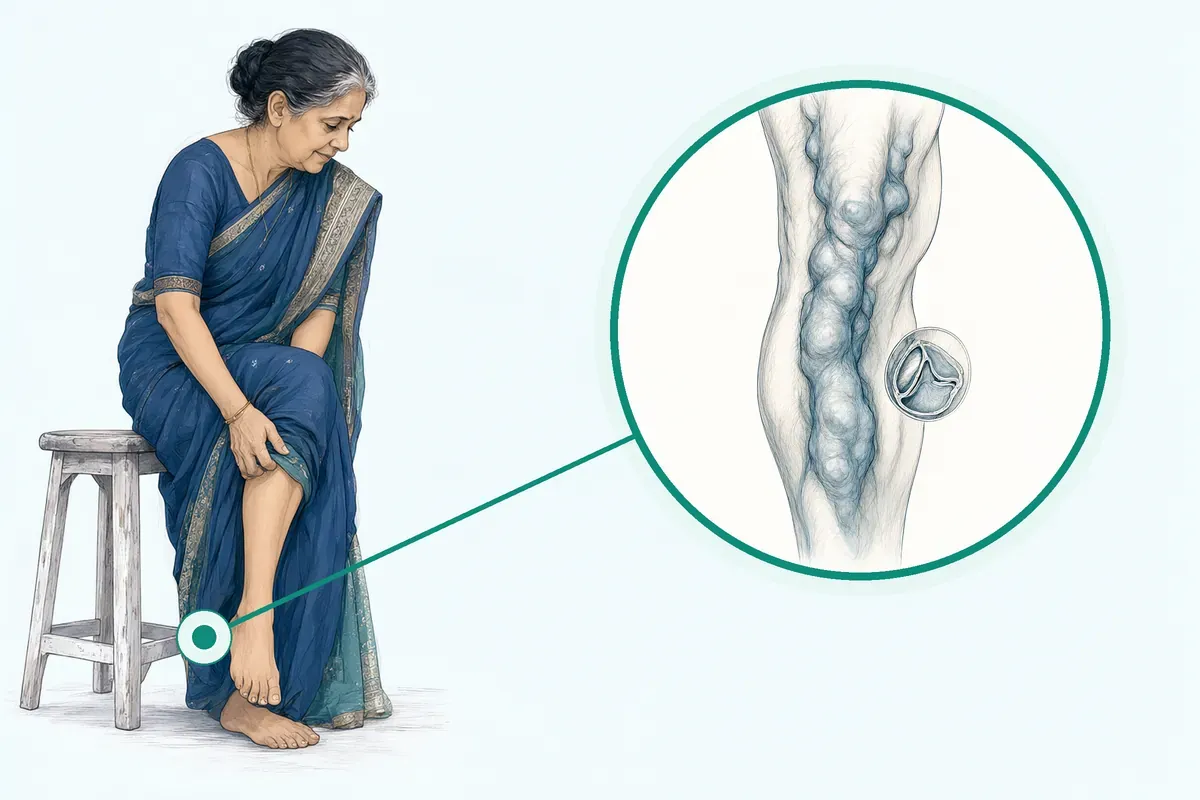
Varicose veins happen when valves in the leg veins fail. Blood pools, veins stretch, and you feel heaviness, throbbing or itching. Standing or sitting for long hours makes it worse. Over time the skin can darken or ulcerate.
-
Aching and heaviness
Legs feel tired, heavy or throb after standing or sitting for a while.
-
Visible bulging veins
Twisted, blue or purple veins appear under the skin, often on the calf or thigh.
-
Swelling and skin changes
Ankles swell by evening; skin may darken, itch or become dry near the ankle.
-
Risk of ulcers
Long-standing vein disease can lead to open sores near the ankle that heal slowly.
-
Impact on daily work
Pain and swelling make it hard to stand for long shifts or walk comfortably.
Untreated varicose veins may sometimes lead to ulceration of the leg, which is difficult to manage.
Why Jaipur Hospital
You worry about taking time off work, the cost of treatment, and whether your legs will look and feel normal again.
Your care plan
Your first steps with us
- 1 Call or visit OPD for a surgeon consultation
- 2 Get a duplex ultrasound scan done in-house
- 3 Review options and receive a cost estimate
- 4 Have day-care treatment and go home the same day
Insurance and schemes
How cashless works
Cashless treatment under MAA Yojana and with 32 insurers.
-
Tell us when you book
Say you are insured or have a scheme card, and send a photo of the card on WhatsApp so our insurance desk can check it in advance.
-
We get the approval
Once your doctor advises admission, the insurance desk sends the pre-authorisation request to your insurer or TPA; for planned surgery, approval can come before you are admitted.
-
Settled at discharge
The approved amount is settled between the insurer and the hospital; you pay only what the policy does not cover.
How the operation is done
Under local tumescent anaesthesia, a thin catheter or needle is guided into the vein using ultrasound. Heat or medicine seals the vein shut. The procedure takes 30 to 90 minutes and is usually day care.
-
Endovenous laser ablation (EVLA)
A laser fibre inside the vein delivers heat to seal it shut under ultrasound guidance.
-
Radiofrequency ablation
A catheter uses radiofrequency energy to heat and close the vein from inside.
-
Foam sclerotherapy
A foam medicine is injected into the vein under ultrasound to make it collapse and seal.
-
Compression stockings
Medical-grade stockings support the leg, reduce swelling, and are used alone or after a procedure.
Why patients trust us
- 1991 Serving Jaipur for 35 years
- NABH Accredited hospital
- 3 General & Laparoscopic Surgery consultants
- 24×7 Emergency, ICU and ambulance
- 32 Cashless insurers, plus MAA Yojana
What research shows about these treatments
-
About 1 day off work after foam sclerotherapy
The mean duration of sick leave after ultrasound-guided foam sclerotherapy was 1 day in studies.
-
About 8 days off work after laser ablation
The mean duration of sick leave after endovenous laser ablation was 8 days in studies.
-
Skin pigmentation in about 67 per cent after foam
Skin pigmentation was more common after foam sclerotherapy (67 per cent) than after laser or surgery (5 and 4 per cent).
If it is left untreated
If left untreated, varicose veins can progress to chronic venous insufficiency. The skin around the ankle may darken, thicken, or develop eczema. In some cases, untreated varicose veins may lead to leg ulceration, which is difficult to manage.
Life after treatment
Most people return to normal activity within a few days. Leg symptoms such as aching and swelling usually improve, and the treated veins fade over weeks.
-
Back to routine quickly
Most patients resume normal activity in 1 to 3 days after the procedure.
-
Less aching and swelling
Leg heaviness, throbbing and ankle swelling typically reduce after successful vein closure.
-
Veins fade over weeks
Treated veins shrink and become less visible over several weeks to months.
-
Wear stockings as advised
Compression stockings are usually worn for a short period after treatment to support healing.
Meet the team
Your general & laparoscopic surgery doctors
Explore our general and laparoscopic surgery department in Jaipur: every treatment, the doctors and what to expect at your visit.
Frequently asked questions
Questions patients ask about varicose vein treatment
What does varicose vein laser ablation involve?
In short
Varicose vein laser ablation at Jaipur Hospital uses a thin laser fibre inserted into the faulty vein under ultrasound guidance. The laser heat seals the vein shut so blood reroutes through healthy veins. The procedure usually takes 30 to 90 minutes under local tumescent anaesthesia and is done as day care.
In detail
During endovenous laser ablation (EVLA), your surgeon passes a catheter into the great saphenous vein or short saphenous vein using duplex ultrasound. A laser fibre is threaded through the catheter and positioned 1.5 to 2 cm below the saphenofemoral junction.
Tumescent anaesthetic is injected around the vein to protect surrounding tissue and compress the vein wall. Laser energy, typically at 1470 nm wavelength, is delivered in a pulsed mode aiming for about 70 joules per centimetre of vein length.
The heat causes the vein wall to collapse and fibrose. Mini-phlebectomies may be performed at the same time to remove visible varicose tributaries.
Evidence from randomised trials shows anatomic success rates of about 88 to 97 percent at one year after EVLA, with occlusion rates of 89 percent at five years. Quality of life scores improve significantly in most patients.
A common belief
Many people think the vein is stripped out through cuts.
What actually happens
Laser ablation avoids groin incisions and general anaesthesia. Studies show similar long-term results to surgery with less wound infection and faster return to work.
Your next step at Jaipur Hospital
You will have a duplex scan in the OPD to map the refluxing segments. On the day of treatment, wear loose clothing and bring a pair of class 2 compression stockings if prescribed.
After the procedure you walk for 20 to 30 minutes before going home. Most people return to normal activity in one to three days. Stockings are worn continuously for three days then during daytime for about two weeks.
A follow-up duplex scan is scheduled at one month. To discuss whether laser ablation suits your veins, book a consultation at Jaipur Hospital.
Which tests and scans do I need before varicose vein laser ablation?
In short
Before laser ablation at Jaipur Hospital you need a duplex ultrasound scan of both legs to map the refluxing veins, measure diameter, and check for deep vein thrombosis. Routine blood tests — complete blood count, coagulation profile, blood sugar, and renal function — are done for anaesthesia fitness. A pre-anaesthesia check-up is also required.
In detail
The duplex scan is the essential investigation. It identifies the incompetent saphenofemoral or saphenopopliteal junction, measures the great saphenous vein diameter (important because foam is not recommended above 6 mm), assesses tortuosity, and rules out deep venous thrombosis.
In trials, all patients had pre-operative duplex mapping. Blood tests ensure you can safely receive tumescent local anaesthesia, which uses lidocaine in large volumes.
If you take blood thinners, the surgeon will advise on timing — usually they are continued for thermal ablation but may be adjusted. An ECG and chest X-ray may be asked for if you are over 45 or have cardiac history.
No special vascular lab tests beyond duplex are routinely needed. The scan also serves as a baseline for post-procedure comparison at one month and one year.
A common belief
Some patients expect an MRI or venogram.
What actually happens
Duplex ultrasound is the standard — it shows reflux, vein size, and clots in one non-invasive test. Blood tests are for anaesthesia safety, not for diagnosing varicose veins.
Your next step at Jaipur Hospital
Schedule the duplex scan at our in-house radiology department. Blood tests can be done the same day at the hospital laboratory. The pre-anaesthesia review is arranged once results are available, usually within 24 to 48 hours.
If all is clear, the procedure is booked as day care within the next week. Bring previous scan reports and a list of current medicines. To arrange your pre-operative workup, book a consultation at Jaipur Hospital.
How painful is the varicose vein procedure and the early recovery?
In short
At Jaipur Hospital, varicose vein treatment with laser ablation or foam sclerotherapy is done under local tumescent anaesthesia, so you feel little pain during the procedure. Afterward, most patients report mild to moderate discomfort, bruising, or tightness in the treated leg for a few days. Pain is usually managed with simple oral analgesics.
In detail
Evidence shows endovenous laser ablation and radiofrequency ablation use heat to seal the vein, while foam sclerotherapy uses a chemical irritant. Studies note that foam sclerotherapy is associated with lower postoperative pain compared to surgery and laser ablation.
Tumescent anaesthesia numbs the area during laser treatment. Palpable lumps under the skin are common at one month after laser (47 percent) and after foam (91 percent), which can feel tender. Most people return to normal activity in one to three days.
A common belief
People often fear severe pain because they think of old stripping surgery.
What actually happens
Modern laser and foam methods are far less painful, though foam can cause more lumpiness and laser more bruising in the first month.
Your next step at Jaipur Hospital
Wear the prescribed compression stockings as advised, usually continuously for a few days then during the day. Take prescribed pain tablets if needed. Walk regularly but avoid strenuous exercise for about a week. Contact the hospital if pain worsens, the leg swells significantly, or you develop fever.
How long does recovery usually take after varicose vein treatment?
In short
At Jaipur Hospital, most patients return to normal activity within one to three days after varicose vein treatment. The procedure is usually a day-care stay of 30 to 90 minutes under tumescent local anaesthesia, sometimes with spinal anaesthesia. Full healing of the treated vein takes weeks, but daily routine resumes quickly.
In detail
Studies report the mean duration of sick leave was about eight days after EVLA and just one day after foam sclerotherapy. However, many patients in those trials had phlebectomies as well.
At Jaipur Hospital, the surgical team advises walking immediately after the procedure, wearing compression stockings continuously for three days then daytime for about 11 days, and avoiding strenuous exercise for one week.
Bruising, tightness, and palpable lumps may persist for a few weeks but do not usually limit light activity. Skin pigmentation after foam can last months. Quality of life scores improve significantly by one year in all treatment groups.
The day-care nature means you go home the same day with an attendant. Your surgeon will give a personalised timeline based on the technique used and any additional phlebectomies.
A common belief
Some patients expect weeks off work like with old stripping surgery.
What actually happens
Modern laser and foam techniques are much faster. Studies show sick leave averaged eight days after laser but only one day after foam. Your actual return depends on your job and whether phlebectomies were added.
Your next step at Jaipur Hospital
Plan for one to three days of light activity at home. Keep walking, wear your stockings as told, and attend the follow-up scan. Most people return to desk work in two to three days and heavier work in one to two weeks. If your job involves prolonged standing, discuss a gradual return with your surgeon.
Will a Doppler scan be needed before choosing varicose vein treatment?
In short
Yes, a Doppler ultrasound scan is standard before any varicose vein treatment at Jaipur Hospital. The scan maps the refluxing veins, measures their size, and checks the deep venous system. Your surgeon uses this information to decide which technique suits your anatomy.
In detail
Evidence from randomised trials shows that all interventional treatments — endovenous laser ablation, radiofrequency ablation, foam sclerotherapy and surgery — are guided by duplex ultrasound.
The scan identifies the saphenofemoral or saphenopopliteal junction incompetence, the diameter of the great or short saphenous vein, and any tributary reflux. Foam sclerotherapy is generally not recommended for veins larger than 6 mm.
Laser and radiofrequency ablation need a relatively straight vein segment for catheter passage. The scan also rules out deep vein thrombosis before treatment.
A common belief
Some people think a clinical examination alone is enough.
What actually happens
Without a scan, the surgeon cannot see the exact anatomy or choose the safest technique. The scan also checks for deep vein thrombosis, which would change the plan.
Your next step at Jaipur Hospital
The scan is done in the outpatient department and takes about 30 minutes. No special preparation is needed. After the scan, your surgeon will explain the options and give a cost estimate.
How will the surgeon decide whether an operation is necessary for my varicose veins?
In short
The surgeon at Jaipur Hospital decides based on your symptoms, clinical examination, and duplex Doppler ultrasound findings. Treatment is offered when you have symptomatic reflux in the great or small saphenous vein, skin changes, or recurrent phlebitis. Asymptomatic cosmetic veins may not need intervention.
In detail
Evidence from trial eligibility criteria shows that patients with primary symptomatic great saphenous vein reflux, classified as CEAP C2 to C6, are candidates for intervention. The duplex scan confirms the site of reflux, measures vein diameter, and excludes deep vein thrombosis.
Veins larger than six millimetres are less suitable for foam sclerotherapy alone. The surgeon also checks your general fitness for local or spinal anaesthesia. If symptoms are mild and you prefer conservative care, compression stockings and lifestyle changes may be tried first.
The decision is shared: the surgeon explains the options, and you choose based on your priorities for recovery time, recurrence risk, and cost.
A common belief
Some people have visible veins but no reflux or symptoms; they may not need treatment.
What actually happens
Others have skin changes or ulcers that mean the vein should be closed to prevent worsening.
Your next step at Jaipur Hospital
Bring any previous scan reports to the consultation. The surgeon will examine your legs, review the duplex images, and discuss whether a procedure is indicated now or can be deferred. Most treatments are day care.
Why might my doctor recommend varicose vein laser ablation?
In short
Your doctor may recommend varicose vein laser ablation at Jaipur Hospital if you have symptomatic great saphenous vein reflux confirmed on duplex ultrasound. The procedure aims to relieve aching, heaviness, swelling, or skin changes and to prevent complications such as ulceration.
In detail
Evidence from randomised trials shows that endovenous laser ablation (EVLA) improves disease-specific quality of life scores and generic health scores significantly at six months and one year.
At one year, the great saphenous vein is occluded or absent in about 88 to 97 percent of patients after EVLA. Compared with conventional surgery, EVLA has a lower risk of wound infection and haematoma.
Compared with foam sclerotherapy, EVLA achieves higher vein occlusion rates and better long-term quality of life scores at five years. The National Institute for Health and Care Excellence (NICE) guidelines recommend endothermal ablation as a first-line option for truncal vein incompetence.
A common belief
Some people wait until the skin breaks down.
What actually happens
Ulcers are much harder to heal than treating the vein early. Foam sclerotherapy is cheaper but has lower long-term vein closure rates. Surgery works but means a bigger cut and more wound problems.
Your next step at Jaipur Hospital
The surgeon will review your symptoms, examine your legs, and check the duplex scan to confirm the source of reflux. If EVLA is appropriate, you will receive a cost estimate within the typical range of ₹40,000 to ₹1,20,000 per leg.
How should I prepare in the days before varicose vein laser ablation?
In short
In the days before laser ablation at Jaipur Hospital, continue your usual medicines unless the surgeon advises otherwise. If you take blood thinners, discuss timing at your pre-anaesthesia check. Wear loose trousers on the day. Arrange for an attendant to accompany you home. Buy or bring the prescribed class 2 compression stockings measured for your leg.
In detail
No special diet or bowel preparation is needed. The procedure uses tumescent local anaesthesia, sometimes with light sedation, so fasting rules are minimal — usually clear fluids up to two hours before. Shave the leg only if instructed; otherwise the team will prepare the skin.
Avoid applying cream or oil on the legs on the day. If you develop a fever, cold, or leg infection before the date, inform the hospital — the procedure may be postponed.
Bring your duplex report, blood test results, insurance or scheme cards (MAA Yojana or private TPA), and a list of medicines. The hospital provides a gown. You will walk to the operation theatre and walk back after the procedure.
A common belief
People often think they must stop all blood thinners or fast from midnight.
What actually happens
For tumescent local anaesthesia, most blood thinners continue. Heavy fasting is not needed. The key is having stockings ready and someone to take you home.
Your next step at Jaipur Hospital
Confirm the appointment time and fasting instruction the day before. Reach the admission desk two hours before the scheduled slot. The attendant waits in the day-care lounge. After the procedure you walk for 20 to 30 minutes, then go home with stockings on.
Most people resume desk work in one to three days. A follow-up duplex is booked at one month. To schedule your procedure, book a consultation at Jaipur Hospital.
What are the common side effects and the less common serious complications of varicose vein treatment?
In short
At Jaipur Hospital, common side effects after varicose vein treatment include bruising, mild pain, tightness, and temporary skin pigmentation. Less common serious complications are deep vein thrombosis, wound infection, nerve injury, and significant haematoma. Your surgeon will discuss the risks that apply to your chosen technique.
In detail
Studies show haematoma at one month in about 42 per cent of EVLA patients and palpable lumps in 47 per cent. Skin pigmentation occurs in 4 to 5 per cent after EVLA but in 67 per cent after foam sclerotherapy.
Paraesthesia is rare, around 1 to 3 per cent. Wound infection after EVLA was reported in 3 to 4 per cent of patients, lower than after surgery.
Deep vein thrombosis occurred in about 0.6 per cent of EVLA cases and 1 per cent of surgery cases in one trial. Sural nerve injury is a recognised risk with thermal ablation but is usually transient.
Foam sclerotherapy can cause more pigmentation and lumps, with 91 per cent having palpable lumps at one month. Recurrence rates vary: at five years, great saphenous vein occlusion was 89 per cent after EVLA, 96 per cent after surgery, and 51 per cent after foam. Clinical recurrence was around 18 per cent for EVLA in some studies.
- Foam sclerotherapy can cause more pigmentation and lumps, with 91 per cent having palpable lumps at one month.
- Clinical recurrence was around 18 per cent for EVLA in some studies.
A common belief
Many people think laser treatment has no side effects.
What actually happens
In studies, nearly half of patients had visible haematoma or lumps at one month. Foam causes more skin pigmentation. Deep vein thrombosis is rare but real. Knowing the facts helps you spot warning signs early.
Your next step at Jaipur Hospital
Wear compression stockings as instructed, walk regularly, and attend follow-up scans. Seek urgent care if you develop sudden severe leg swelling, calf pain, shortness of breath, fever, or worsening redness around any puncture site. These could signal deep vein thrombosis or infection.
Which symptoms are expected after varicose vein treatment, and which need urgent medical attention?
In short
At Jaipur Hospital, expected symptoms after varicose vein treatment include bruising, mild pain, tightness along the treated vein, palpable lumps under the skin, and some skin darkening. Urgent symptoms are sudden severe leg swelling, calf pain, shortness of breath, chest pain, fever above 38°C, or spreading redness and heat around puncture sites.
In detail
Studies show haematoma at one month in 42 per cent of EVLA patients and palpable lumps in 47 per cent. Skin pigmentation occurs in 4 to 5 per cent after EVLA but in 67 per cent after foam sclerotherapy.
Paraesthesia is rare, around 1 to 3 per cent. These are normal and improve with time, compression stockings, and walking. Serious complications are uncommon but require immediate care. Deep vein thrombosis occurred in about 0.6 per cent of EVLA cases in one trial.
Wound infection was reported in 3 to 4 per cent. Sural nerve injury can cause numbness or tingling but is usually transient.
If you develop a painful, swollen calf, sudden breathlessness, or signs of infection, go to the emergency department at Jaipur Hospital, which is open 24 hours. Early treatment prevents progression.
- Deep vein thrombosis occurred in about 0.6 per cent of EVLA cases in one trial.
A common belief
Patients often mistake a growing haematoma or infection for normal bruising.
What actually happens
Deep vein thrombosis can present as calf pain and swelling, not just chest symptoms. Knowing the difference saves lives. The 24×7 emergency at Jaipur Hospital is ready for any complication.
Your next step at Jaipur Hospital
Wear compression stockings as instructed, walk regularly, and take prescribed pain relief. Keep the puncture sites clean and dry. Attend your follow-up duplex scan.
If any urgent symptom appears, do not wait; go to the 24×7 emergency department at Jaipur Hospital or call the hospital numbers.
FAQ library
Questions and answers about varicose vein treatment
When you contact us
Get your vein assessment and plan
Contact Jaipur Hospital for an OPD consultation with a general and laparoscopic surgeon to review your scans, discuss options, and receive a cost estimate.
- A consultation with a general and laparoscopic surgeon in the OPD
- Your scans and reports reviewed, with tests done in-house if you need them (laboratory, X-ray and imaging)
- Your options explained in plain words, including whether you need surgery at all
- A cost estimate before you decide
- Help with cashless treatment under MAA Yojana and empanelled insurers and TPAs
- Follow-up visits after your treatment
Overview
Varicose Vein Treatment: what to know
What varicose veins are and how they happen
Varicose veins are swollen, twisted veins visible under the skin, usually on the legs, caused by faulty valves that let blood pool. The great and short saphenous veins are the main superficial veins involved. If untreated, they can sometimes lead to leg ulcers that are hard to manage.
- Valve failure
- Valves weaken and let blood flow backwards
- Blood pooling
- Pooled blood stretches and twists the vein
- Main veins involved
- Great and short saphenous veins in the legs
Varicose veins are swollen, twisted veins that you can see under the skin, usually on the legs. They happen when the tiny valves inside the veins stop working properly. In a healthy vein, these valves open to let blood flow up towards the heart and then close to stop it flowing backwards.
When the valves weaken or become damaged, blood can flow backwards and pool in the vein. This makes the vein stretch, bulge and twist.
The great saphenous vein runs from the ankle up the inside of the leg to the groin, where it joins the femoral vein. The short saphenous vein runs up the back of the calf to the knee, where it joins the popliteal vein.
If the junction where these veins meet the deep system becomes incompetent, reflux flows down the superficial vein and causes varicose veins.
Varicose veins are common. Short saphenous vein varices account for about 15% of varicose veins. They are not just a cosmetic problem. If left untreated, they may sometimes lead to ulceration of the leg, which is difficult to manage.
Symptoms of varicose veins and warning signs that need urgent care the same day
Common symptoms are aching, heaviness, throbbing, burning, ankle swelling, skin changes and visible blue or purple veins. Urgent same-day care is needed for bleeding that will not stop, a red hot tender vein, sudden severe calf pain and swelling, or a non-healing ankle ulcer.
- Bleeding vein Does not stop with pressure and leg elevation
- Red, hot, tender vein Could be superficial thrombophlebitis
- Sudden calf pain and swelling Could be deep vein thrombosis
- Non-healing ankle ulcer Open sore near ankle that does not heal
Common symptoms include aching, heaviness, throbbing or a burning feeling in the legs, especially after standing for a long time. Your ankles and feet may swell towards the end of the day. The skin over the vein may become dry, itchy or change colour. You may see bulging, rope-like veins that are blue or dark purple.
Some signs need medical attention on the same day. If a varicose vein bleeds and does not stop with firm pressure and leg elevation, go to the emergency department. If the skin over a vein becomes red, hot, tender and hard, it could be a condition called superficial thrombophlebitis.
If you get sudden severe pain, swelling, warmth or redness in one calf, it could be a deep vein thrombosis. This is a medical emergency. If you develop an open sore or ulcer near the ankle that does not heal, see a doctor promptly.
Causes of varicose veins and who is at higher risk
Valve failure is the main cause, made more likely by age, female sex, pregnancy, family history, obesity, prolonged standing or sitting, and past leg injury or deep vein thrombosis. Short saphenous varices result from an incompetent sapheno-popliteal junction.
The main cause is valve failure that lets blood pool in the superficial veins. Several factors make this more likely:
- Age: veins lose elasticity and valves weaken over time.
- Sex: women are more often affected, partly due to hormonal changes during pregnancy, menstruation or menopause.
- Pregnancy: the growing uterus puts pressure on pelvic veins, and blood volume increases.
- Family history: if your parents or siblings have varicose veins, your risk is higher.
- Obesity: extra weight puts more pressure on leg veins.
- Standing or sitting for long periods: this reduces the muscle pump action that helps push blood up the legs.
- Previous leg injury or deep vein thrombosis: these can damage valves.
Short saphenous vein varices occur as a result of an incompetent sapheno-popliteal junction, where the short saphenous vein joins the popliteal vein, resulting in reflux in the short saphenous vein.
How varicose veins are diagnosed: examination and tests
Diagnosis starts with a standing examination for swelling, skin changes and visible veins, plus a cough impulse check at the groin or knee. The key test is a duplex ultrasound scan that shows vein size, reflux direction and any clots. Scans are repeated at intervals up to five years to check if the vein stays closed.
- Before treatment Duplex scan to map veins
- After 12 days Early post-treatment check
- 1, 3, and 6 months Regular follow-up scans
- Yearly up to 5 years Long-term monitoring for reflux and recurrence
Your surgeon will ask about your symptoms and examine your legs while you are standing. They will look for swelling, skin changes and visible veins. They may feel for a cough impulse at the groin or knee to check for reflux at the saphenofemoral or saphenopopliteal junction.
The key test is a duplex ultrasound scan. This uses sound waves to create a picture of the veins and shows the direction and speed of blood flow. It tells your surgeon which veins are incompetent, how wide they are, and whether there are any clots. Duplex scanning is used before treatment and at follow-up to check for reflux and recurrence.
In studies, patients were examined with duplex scanning before treatment and after 12 days, then at 1, 3, and 6 months, and yearly thereafter for up to 5 years. The scan measures whether the treated vein is open or closed (occluded) and whether reflux has returned.
Non-surgical treatment options for varicose veins and when surgery is advised
Compression stockings relieve symptoms but do not remove varicose veins. Minimally invasive options like EVLA, radiofrequency ablation and foam sclerotherapy seal the vein from inside under local anaesthesia. Surgery may be advised if these methods are not suitable or have failed.
Compression stockings are often the first step. They apply graduated pressure to the leg, helping the veins push blood upwards. They relieve symptoms such as aching and swelling but do not remove the varicose veins. They may be used alone or after a procedure.
Minimally invasive techniques seal the faulty vein from the inside. Endovenous laser ablation (EVLA) passes a laser fibre into the vein under ultrasound guidance; the laser heat seals the vein shut. Radiofrequency ablation uses a catheter that delivers heat to close the vein.
Ultrasound-guided foam sclerotherapy (UGFS) injects a foam medicine into the vein to irritate the lining and close it. These procedures are usually done under local anaesthesia (tumescent), sometimes with spinal anaesthesia, and do not normally require a general anaesthetic.
In studies, EVLA, radiofrequency ablation and UGFS are alternatives to conventional surgery for great saphenous and short saphenous vein varices. EVLA and surgery have similar outcomes for symptom relief and quality of life at 1 year and 5 years.
UGFS has a shorter recovery time but lower vein occlusion rates at 1 year and 5 years compared with EVLA and surgery.
Your surgeon will advise which option suits you based on the ultrasound findings, the size and shape of your veins, your general health and your preference. For example, UGFS should not be recommended for great saphenous veins larger than 6 mm in diameter. Veins with many twists and turns may be difficult to treat with thermal ablation.
Surgery (high ligation and stripping) may be advised if minimally invasive methods are not suitable or have failed. All interventional treatments, including UGFS, EVLA and surgery, have been found to be cost-effective compared with compression stockings alone.
Preparing for Varicose Vein Treatment
Bring a list of all medicines, including blood thinners and supplements, for your doctor to review. You may need blood tests and an ultrasound scan to map the veins before the procedure. Wear loose clothing and bring an attendant to help you go home.
Do
- Bring list of all medicines Include blood thinners, aspirin, herbal supplements
- Wear loose clothing over compression stocking Comfortable for day of treatment
- Bring insurance or scheme cards For coverage check at OPD
- Bring an attendant To help you go home afterwards
Before your procedure, your surgeon will review your medical history and any medicines you take. Bring a list of all tablets, including blood thinners, aspirin, or herbal supplements, so your doctor can tell you which ones to stop and when. You may need routine blood tests and an ultrasound scan of your legs to map the veins.
This scan helps your surgeon plan the treatment. On the day of the procedure, you will usually be asked to fast for a few hours if sedation or spinal anaesthesia is planned. Wear loose, comfortable clothing that fits over a compression stocking. Bring your regular medicines, your insurance or scheme cards, and an attendant to help you go home afterwards. Jaipur Hospital provides a gown and the compression stocking you will need after treatment.
How Varicose Vein Treatment Is Done
Treatment is a day-care procedure taking 30 to 90 minutes under local or spinal anaesthesia. The main techniques are EVLA, radiofrequency ablation and foam sclerotherapy, guided by ultrasound. A compression stocking is applied before you go to the recovery area.
- Change into gown and clean leg Leg is cleaned and draped
- Ultrasound guides catheter or needle Into the faulty vein
- Vein sealed with chosen technique EVLA, radiofrequency or foam sclerotherapy
- Larger branches removed if needed Through tiny punctures
- Compression stocking applied Before you go to recovery area
At Jaipur Hospital, varicose vein treatment is usually a day-care procedure that takes 30 to 90 minutes. You will receive local anaesthesia with tumescent fluid injected around the vein; sometimes spinal anaesthesia is used. Your surgeon will discuss which technique suits your veins.
The main options are endovenous laser ablation (EVLA), where a laser fibre inside the vein seals it shut; radiofrequency ablation, where heat from a catheter seals the vein; and foam sclerotherapy, where a medicine injected into the vein closes it. Compression stockings are used alone or after treatment for symptom support.
On the day, you change into a gown, the leg is cleaned and draped, and ultrasound guides the catheter or needle into the vein. After the vein is sealed, any larger varicose branches may be removed through tiny punctures. A compression stocking is applied before you go to the recovery area. Your surgeon will advise which method is appropriate for you.
Risks and Possible Complications of Varicose Vein Treatment
EVLA has lower wound infection and haematoma risks than surgery, but 42 percent of EVLA patients had a haematoma at one month. Foam sclerotherapy causes skin pigmentation in 67 percent and palpable lumps in 91 percent at one month. Nerve injury is rare and usually transient.
- pooled risk ratio of 0.3 EVLA wound infection risk
- 42 per cent EVLA haematoma at 1 month
- 67 per cent Foam sclerotherapy skin pigmentation
- EVLA 0.6%, surgery 1% Deep vein thrombosis at six weeks
All procedures carry some risk. In studies, endovenous laser ablation (EVLA) had a lower risk of wound infection compared to surgery, with a pooled risk ratio of 0.3. EVLA also had a lower risk of haematoma compared to surgery, with a pooled risk ratio of 0.5.
However, at 1-month follow-up, 42 per cent of patients in the EVLA group had a haematoma (visible localised collection of blood) in the operated leg. Palpable lumps in the veins under the skin were present at 1 month in 47 per cent of patients after EVLA.
Skin pigmentation was more common after foam sclerotherapy (67 per cent) than after surgery and EVLA (5 and 4 per cent respectively). Palpable lumps in the veins under the skin are present at 1 month in 91 per cent of patients after foam sclerotherapy. Paraesthesia (numbness or tingling) was rare in all groups (2, 3 and 1 per cent respectively).
Main complications reported at six weeks included sural nerve injury, wound infection and deep vein thrombosis (one case in each treatment group; EVLA 0.6%, surgery 1%). Nerve injury remains a risk with thermal ablation, but when it occurs it tends to be transient. Your surgeon will explain the risks that apply to your case.
Recovery and Aftercare After Varicose Vein Treatment
You usually go home the same day and wear a compression stocking for up to two weeks. Walking is encouraged immediately and most patients return to normal activity in one to three days. A follow-up visit within a week checks the wound and does an ultrasound.
- Day of procedure Go home same day, wear stocking continuously
- First week Avoid heavy lifting, prolonged standing, hot baths
- Within a week Follow-up for wound check and ultrasound
- 1 to 3 days Return to normal activity for most patients
Most patients go home the same day. You will wear a compression stocking continuously for the first few days, then during the day for up to two weeks. Walking is encouraged straight away. In studies, the mean duration of sick leave was about 8 days after EVLA and 1 day after foam sclerotherapy.
Foam sclerotherapy is associated with lower postoperative pain compared to surgery and EVLA. At Jaipur Hospital, recovery to normal activity is usually 1 to 3 days for most patients. Avoid heavy lifting, prolonged standing, and hot baths for the first week. Keep the leg elevated when sitting.
You will have a follow-up appointment, usually within a week, for a wound check and ultrasound. Call the hospital if you develop increasing pain, swelling, redness, warmth, fever, or calf tenderness, as these may indicate infection or a blood clot. Continue any regular medicines unless your doctor tells you otherwise.
Results: How Well Varicose Vein Treatment Works and Recurrence Rates
In studies, all interventional treatments improve symptoms and quality of life. After 1 year, the great saphenous vein was completely occluded or absent in 88.5 per cent of patients after EVLA, 88.2 per cent after surgery, and 72.2 per cent after foam sclerotherapy.
At 5 years, the Kaplan-Meier estimate of obliteration or absence of the treated great saphenous vein segment was 77 per cent after EVLA and 23 per cent after foam sclerotherapy. The absence of above-knee great saphenous vein reflux at 5 years was found in 82 per cent after EVLA and 41 per cent after foam sclerotherapy.
Overall, recurrent varicose veins were observed in 45 per cent of patients after EVLA at median 5-year follow-up. More different-site recurrences were observed after surgery (50 per cent) compared to EVLA (31 per cent). Quality of life scores improved significantly in all groups after 1 year and EQ-5D scores improved equally in all groups over 5 years.
Foam sclerotherapy was associated with inferior disease-specific quality of life scores compared with EVLA and surgery at 5 years. Your surgeon will discuss what outcomes you can expect based on your vein anatomy.
Cost and Insurance for Varicose Vein Treatment in Jaipur
The typical price range in India is ₹40,000 to ₹1,20,000 per leg. The final cost depends on the technique, number of legs, vein extent, anaesthesia type and any extra procedures. Jaipur Hospital accepts MAA Yojana and private insurers; bring your card to the OPD for a coverage check.
The typical price range for varicose vein treatment in India is ₹40,000 to ₹1,20,000 per leg.
The final cost depends on:
- The technique used (laser, radiofrequency, or foam)
- Whether one or both legs are treated
- The extent of the veins
- The type of anaesthesia
- Any additional procedures such as phlebectomies
Jaipur Hospital is a NABH-accredited multispeciality hospital. We accept MAA Yojana and a panel of private insurers and TPAs. Please bring your scheme or insurance card to the OPD so our team can check your coverage and explain any out-of-pocket amount. Estimates are given after your surgeon assesses your veins on ultrasound.
