

General & Laparoscopic Surgery · Jaipur Hospital
Hernia Surgery in Jaipur
Bulge or pain holding you back? Get a clear assessment and a simple plan at Jaipur Hospital.
- Serving Jaipur since 1991 (35 years)
- NABH accredited
- 24×7 emergency & ICU
- Cashless: RGHS, MAA Yojana, CGHS + 22 insurers
- Operation time
- 30 minutes to 2 hours, depending on type
- Anaesthesia
- General or spinallocal for some small hernias
- Recovery
- Desk work in 1 to 2 weeksheavy lifting after 4 to 6 weeks
- Price
- ₹40,000 to ₹1,20,000typical range in India; ask us for an estimate
A bulge that won't go away
A bulge, discomfort or pain that limits your day
You may notice a lump in your groin, belly-button or an old scar. It can ache when you lift, cough or stand for long. The worry about it getting stuck or growing larger stays with you.
-
Visible bulge
A lump appears when you stand or strain and may disappear when you lie down.
-
Ache or pressure
Discomfort increases with activity and eases with rest.
-
Fear of emergency
Worry that the hernia could become stuck and need urgent surgery.
-
Time off work
Pain or doctor visits make it hard to keep up with your job.
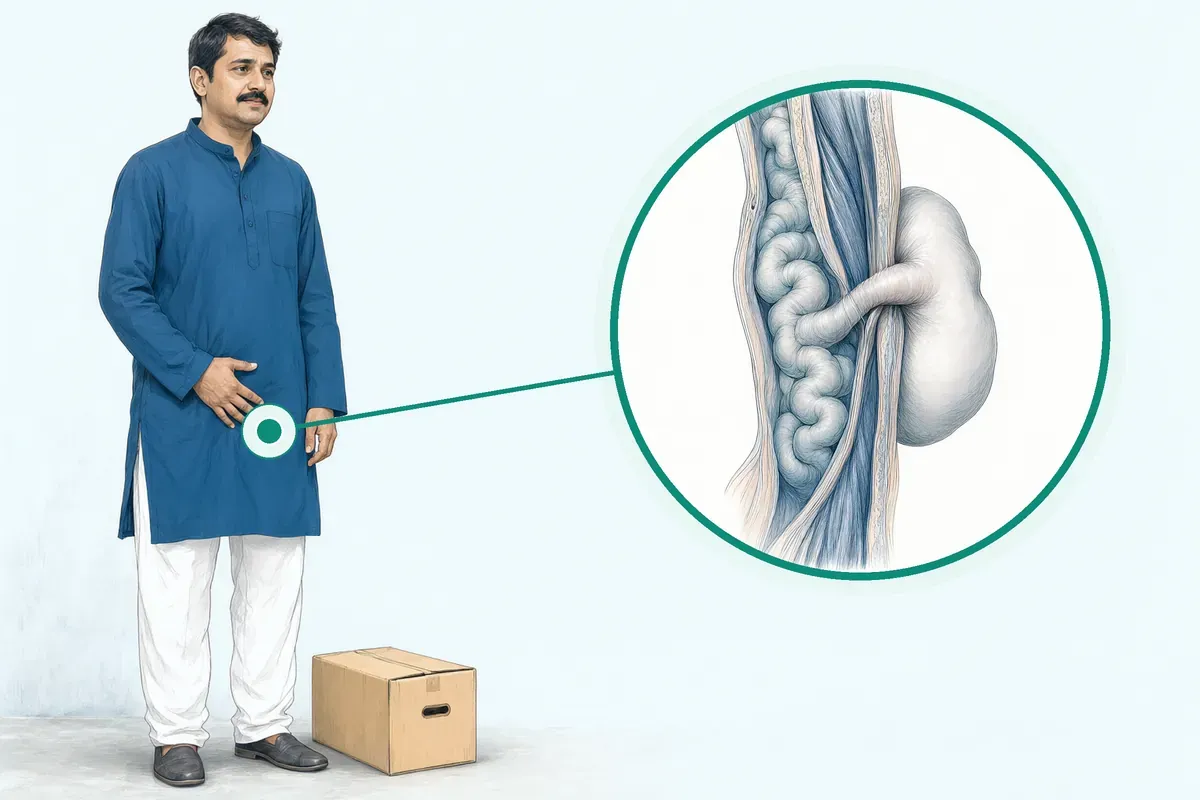
Hernias can create bulges where interior tissue presses outward through a tear or gap in a muscle or tissue wall.
Why Jaipur Hospital
You want the pain to stop and the fear of an emergency to go away, without a long stay or a bill you cannot plan for.
Your care plan
Your first steps with us
- 1 Call or visit OPD for a surgeon consultation.
- 2 Get scans and tests done in-house if needed.
- 3 Review options and cost estimate with your surgeon.
- 4 Have surgery and recover with follow-up visits.
How the operation is done
Surgery pushes the tissue back and strengthens the weak spot, usually with a mesh. Your surgeon will discuss which approach fits your hernia.
-
Laparoscopic (keyhole) mesh repair
Small cuts, camera and instruments; TEP or TAPP for groin hernias. General anaesthesia is used.
-
Open mesh repair
A single cut over the hernia; Lichtenstein repair for groin hernias. Can use spinal or local anaesthesia.
-
Open or keyhole for belly-button and incision hernias
Mesh choice depends on hernia size; your surgeon will explain the options.
Why patients trust us
- 1991 Serving Jaipur for 35 years
- NABH Accredited hospital
- 3 General & Laparoscopic Surgery consultants
- 24×7 Emergency, ICU and ambulance
- 25 Cashless schemes and insurers
What research shows about this treatment
-
8 days vs 14 days
Patients returned to light activity in 8 days after laparoscopic repair compared to 14 days after open repair in studies.
-
about 1 in 10
Chronic pain after one year was reported in about 6 to 9 out of 100 patients after laparoscopic repair versus 9 to 13 out of 100 after open repair.
-
about 16 in 100
About 16 in 100 people needed another surgery within 10 years because the hernia returned.
If it is left untreated
If left untreated, a hernia can grow larger and become stuck (incarcerated). This can cut off blood supply to the trapped tissue (strangulation), which is a surgical emergency.
Life after treatment
Most people return to desk work in one to two weeks and heavy lifting after four to six weeks.
-
Back to routine
Most people return to desk work within one to two weeks.
-
Less daily pain
The bulge and the ache with lifting or coughing usually go away.
-
Small scars
Keyhole surgery leaves a few small marks; open surgery leaves one scar.
-
Follow-up included
Your surgeon checks your healing at follow-up visits.
Frequently asked questions
Questions patients ask about hernia surgery
What does hernia surgery involve?
In short
Hernia surgery at Jaipur Hospital repairs the weak spot in the abdominal wall using mesh. The operation takes 30 minutes to 2 hours under general, spinal, or local anaesthesia. Most groin and belly-button hernias are done as day surgery or with one night in hospital.
In detail
The surgeon chooses between open and keyhole (laparoscopic) methods. Open repair uses a single cut near the hernia; the Lichtenstein technique places mesh over the defect.
Keyhole repair uses three small cuts, a camera, and instruments to place mesh from inside the abdomen (TAPP) or outside the lining (TEP). For belly-button and incision hernias, mesh type depends on defect size.
Evidence shows keyhole repair links to less wound infection, less haematoma, and less chronic pain than open repair, while recurrence rates are similar when done by experienced surgeons. Seroma occurs in 15 to 22 percent of keyhole cases. Operation time and cost are usually higher for keyhole methods.
A common belief
Many people think every hernia needs a big cut.
What actually happens
In fact, keyhole repair uses three tiny cuts and a camera. Studies show keyhole surgery leads to less wound infection, less bruising, and less long-term pain than open repair, though seroma is a bit more common. Recurrence rates are similar when surgeons are experienced.
Your next step at Jaipur Hospital
You will meet the surgical team in OPD for a clinical check and review of any scans. Blood tests and fitness for anaesthesia are done before the date. Plan for an attendant to stay with you and drive you home. Desk work usually resumes in 1 to 2 weeks; heavy lifting after 4 to 6 weeks.
Which tests and scans do I need before hernia surgery?
In short
Before hernia surgery at Jaipur Hospital, routine tests usually include blood counts, kidney and liver function, blood sugar, HbA1c if diabetic, and a coagulation profile. A chest X-ray and ECG are done for patients over 40 or with heart or lung disease. Ultrasound or CT scan may be needed if the hernia is complex, recurrent, or the diagnosis is unclear. The anaesthetist decides final requirements at the pre-anaesthesia check.
In detail
Guidelines recommend optimising HbA1c below 8% for elective ventral hernia repair; patients with HbA1c 6.5 to 8% need individualised preparation. BMI 30 to 50 also requires risk reduction measures.
Imaging is not routine for simple groin hernias but is standard for large incisional hernias to plan mesh size and approach. For keyhole repair, fitness for general anaesthesia is essential; lung function tests may be asked for if you have severe lung disease.
If you take blood thinners, the surgeon and anaesthetist will plan when to stop them. All reports should be recent, usually within 4 weeks.
A common belief
Many people think everyone needs a CT scan.
What actually happens
For simple groin hernias, clinical examination is usually enough. Scans are reserved for large, recurrent or unclear cases. The anaesthetist finalises the list based on your health.
Your next step at Jaipur Hospital
Collect your recent lab reports and bring them to the pre-anaesthesia clinic. If you need new tests, the hospital's in-house laboratory can do them. Fasting may be required for blood sugar and lipids.
How painful is hernia surgery and the early recovery?
In short
Pain after hernia surgery varies by person and technique. At Jaipur Hospital, your surgical team uses mesh repair and modern anaesthesia to keep you comfortable. Most patients feel soreness rather than severe pain. You will receive pain relievers for the first few days. Laparoscopic repair usually causes less discomfort than open repair.
In detail
Studies show laparoscopic patients use about 42 percent fewer pain medicines in the first 48 hours compared with open repair. Mean pain scores on a visual scale are lower after keyhole surgery both in the first two weeks and at six months.
Chronic pain lasting more than three months occurs in roughly 10 percent after laparoscopic repair versus 13 percent after open repair. Your surgeon will choose general, spinal or local anaesthesia based on the hernia type and your health. After surgery you may feel pulling or bruising around the cuts; this settles as the tissues heal.
- Studies show laparoscopic patients use about 42 percent fewer pain medicines in the first 48 hours compared with open repair.
A common belief
A common worry is that mesh causes long‑term pain.
What actually happens
Evidence shows chronic pain rates are similar or slightly lower with keyhole methods. Good pain control and early walking reduce the risk.
Your next step at Jaipur Hospital
Plan to rest for the first 24 hours at home. Take prescribed pain tablets on schedule for the first two to three days, then as needed. Light walking is encouraged from day one.
Desk work often resumes in one to two weeks; heavy lifting waits four to six weeks. If pain worsens, spreads, or comes with fever or swelling, contact the hospital.
How long does recovery usually take after hernia surgery?
In short
Recovery time depends on the repair type and your job. At Jaipur Hospital, our surgical team advises that desk work usually resumes in one to two weeks, while heavy lifting waits four to six weeks. Most patients go home the same day or after one night.
In detail
Evidence shows laparoscopic patients return to light activity in about eight days and full activity in 13 to 14 days, compared with 14 and 20 days for open repair. Hospital stay is similar for groin and belly-button hernias: same-day or one night.
Pain typically peaks in the first two to three days and is managed with tablets. Walking is encouraged from day one. Strenuous exercise and heavy lifting should wait at least four weeks, often six, to allow mesh integration.
Driving is allowed once you can brake hard without pain and are off strong painkillers. Your surgeon will give a personalised timeline at discharge.
A common belief
Many expect a long bed rest.
What actually happens
In fact, walking starts day one. Keyhole surgery shortens the return to light activity by about a week compared with open repair. The six-week lifting limit protects the mesh while it knits into the tissues. Rushing this step raises recurrence risk.
Your next step at Jaipur Hospital
Plan for one to two weeks off desk work, four to six weeks off heavy labour. Arrange an attendant for the first 24 hours. Take pain medicine regularly for 48 hours, then as needed. Increase walking daily. Attend the two-week follow-up.
Can a hernia get better on its own?
In short
A hernia will not heal or disappear on its own. At Jaipur Hospital, surgeons explain that the muscle gap stays open unless it is repaired. Some people have few symptoms for a while, but the bulge usually grows and discomfort increases over time. Surgery is the only way to close the defect and prevent complications.
In detail
Evidence shows non-operative management carries a low risk of short-term morbidity, but most hernias eventually worsen. Guidelines recommend surgery when the hernia causes pain, limits activity, or risks incarceration or strangulation. For ventral hernias, mesh reinforcement is advised for defects 2 cm or larger.
Watchful waiting may be offered for small, asymptomatic groin hernias, but the hernia does not resolve spontaneously. Risk factors like obesity (BMI ≥ 30), smoking and uncontrolled diabetes (HbA1c ≥ 6.5%) increase complication rates if surgery is delayed.
- Risk factors like obesity (BMI ≥ 30), smoking and uncontrolled diabetes (HbA1c ≥ 6.5%) increase complication rates if surgery is delayed.
A common belief
Some people hope a truss or lifestyle change will fix it.
What actually happens
A truss only holds the bulge in temporarily and does not close the defect. Delaying surgery can make the repair harder if the hernia enlarges or becomes stuck.
Your next step at Jaipur Hospital
If your hernia is small and comfortable, the surgeon may discuss observation with regular review. However, any increase in size, new pain, vomiting or irreducible bulge needs urgent assessment. The typical operation takes 30 minutes to 2 hours with same-day or one-night stay.
How can I decide whether to seek advice about open mesh inguinal hernia repair?
In short
Consider seeking advice if you have a groin bulge, pain, or discomfort that affects daily life, or if a doctor has diagnosed an inguinal hernia. At Jaipur Hospital, the surgical team evaluates whether open mesh repair (Lichtenstein) suits you based on hernia size, side, previous repairs, and your fitness for anaesthesia.
In detail
Open mesh repair is a standard, effective method for inguinal hernias. It is often chosen when keyhole surgery is not suitable — for example, if you cannot have general anaesthesia, have severe lung disease, a very large or recurrent hernia, or previous pelvic surgery.
Studies show recurrence rates are similar to keyhole repair when done by experienced surgeons. Open repair uses a single groin incision and can be done under spinal or local anaesthesia in selected cases. The surgeon will explain the pros and cons for your situation.
Your next step at Jaipur Hospital
If you notice a groin lump, pain on coughing or lifting, or have been told you have an inguinal hernia, book a consultation. The surgeon examines you, may order an ultrasound, and discusses open versus keyhole options.
Most open inguinal hernia repairs go home the same day or after one night. Desk work in one to two weeks; heavy lifting after four to six weeks.
How will the surgeon decide whether an operation is necessary?
In short
The surgeon decides whether an operation is necessary by examining you, asking about your symptoms, and reviewing any imaging. Jaipur Hospital follows this assessment process. Surgery is usually recommended if the hernia causes pain, discomfort, limits your activities, or carries a risk of obstruction or strangulation.
In detail
Evidence shows that surgical repair is recommended for hernias that cause symptoms or put you at risk of complications.
The surgeon will check if the lump is reducible, ask about pain, heaviness, or dragging sensation, and assess your general health, including BMI, smoking status, and diabetes control, as these affect surgical risk.
For ventral hernias, guidelines suggest elective repair may not be recommended for patients with BMI 50 or above, current smokers, or HbA1c 8% or above until these are optimised. Imaging such as ultrasound or CT may be used to define the defect size and contents.
The surgeon will then discuss open or keyhole mesh repair options and the typical recovery of one to two weeks for desk work and four to six weeks before heavy lifting.
- For ventral hernias, guidelines suggest elective repair may not be recommended for patients with BMI 50 or above, current smokers, or HbA1c 8% or above until these are optimised.
A common belief
Some patients think every hernia needs immediate surgery.
What actually happens
In fact, small asymptomatic hernias can sometimes be watched, especially if your health risks are high. But symptomatic hernias or those with a high risk of complications are better repaired electively. The surgeon balances the risk of the hernia against the risk of surgery for you.
Your next step at Jaipur Hospital
Bring any previous reports and a list of your medicines to the consultation. The surgeon will examine you, explain the findings, and recommend whether surgery is needed now or can be deferred. If surgery is advised, you will receive information about the procedure, anaesthesia options, and recovery.
Why might my doctor recommend hernia surgery?
In short
Your doctor at Jaipur Hospital may recommend hernia surgery when the hernia causes pain, discomfort or a visible bulge that affects daily life, or when there is a risk of the bowel becoming trapped (incarceration) or strangulated. Surgery is the only way to repair the defect and prevent these complications.
In detail
Guidelines suggest repair for symptomatic hernias and for most inguinal hernias in adults. In studies, non-operative management carries a low short-term risk but hernias usually enlarge over time and can eventually cause obstruction or strangulation, which need emergency surgery.
Keyhole repair is often preferred for bilateral or recurrent groin hernias because the surgeon can see both sides through the same small cuts. Open repair remains a good option if you cannot have general anaesthesia or have a very large, complex hernia. Mesh reinforcement is recommended for defects 2 cm or wider because it lowers recurrence risk.
A common belief
Some people hope a hernia will go away on its own.
What actually happens
It will not. Hernias usually get bigger over time. Waiting too long can lead to an emergency if the bowel gets stuck. Early planned repair is safer and recovery is easier.
Your next step at Jaipur Hospital
If you notice increasing pain, a bulge that does not reduce, nausea or vomiting, seek care immediately. For a planned repair, you will need a pre-anaesthesia assessment and basic investigations. The typical cost range in India is ₹40,000 to ₹1,20,000.
How should I prepare in the days before hernia surgery?
In short
Jaipur Hospital advises you to prepare for hernia surgery by following your surgeon's specific instructions. You will usually attend a pre-operative check-up where the team reviews your medical history and orders basic blood tests. Stop smoking if you can, as smoking raises the risk of wound problems and recurrence. Arrange for an attendant to take you home and stay with you for the first night after discharge.
In detail
Preparation focuses on lowering surgical risk and ensuring a smooth recovery. Evidence shows that current smokers have higher complication rates after ventral hernia repair, so stopping even a few weeks before helps.
Patients with a body mass index above 30 or HbA1c between 6.5% and 8% may need individualised measures such as weight optimisation or tighter glucose control before elective repair.
Your surgeon will review all regular medicines and may ask you to pause blood thinners or certain supplements a few days before the operation. Fasting instructions will be given for the night before surgery. The hospital's pre-anaesthesia clinic will confirm your fitness for general or spinal anaesthesia, which is required for laparoscopic repair.
Your next step at Jaipur Hospital
Complete any blood tests or imaging the surgeon orders at least two to three days before the scheduled date. Buy loose, comfortable clothing and any prescribed pain relievers from the chemist beforehand. Confirm your attendant's availability for the day of surgery and the first 24 hours at home.
What are the common side effects and the less common serious complications of hernia surgery?
In short
Common side effects after hernia surgery include bruising, swelling and a fluid collection called a seroma at the repair site. At Jaipur Hospital, your surgical team monitors these closely. Serious complications such as wound infection, significant bleeding, blood clots in the leg or mesh infection are uncommon. Laparoscopic repair is linked to lower wound infection and haematoma rates than open repair.
In detail
In studies, seroma occurs in about 16 to 22 percent of laparoscopic cases and is usually self‑limiting. Wound infection and haematoma are significantly reduced with TAPP and TEP keyhole techniques compared with open Lichtenstein repair.
Deep vein thrombosis and sepsis are rare but require emergency care if they appear. Chronic pain lasting beyond three months affects roughly 10 percent of laparoscopic patients and 13 percent of open patients. Recurrence rates are similar across techniques when performed by experienced surgeons. Your surgeon will explain the risks that apply to your hernia type and health.
A common belief
Many patients fear mesh rejection.
What actually happens
Mesh infection is rare, and modern lightweight meshes integrate well. Laparoscopic repair further lowers wound infection and haematoma risk compared with open surgery.
Your next step at Jaipur Hospital
After discharge, watch for increasing redness, warmth, pus, fever above 38°C, calf pain or sudden shortness of breath. Keep the dressings clean and follow the activity limits. Most seromas resolve without treatment in a few weeks. Attend your follow‑up visit so the team can check healing.
FAQ library
Questions and answers about hernia surgery
When you contact us
Get your plan and cost estimate
Contact Jaipur Hospital for a surgeon consultation, in-house tests, a clear explanation of options, a cost estimate and help with cashless schemes.
- A consultation with a general and laparoscopic surgeon in the OPD
- Your scans and reports reviewed, with tests done in-house if you need them (laboratory, X-ray and imaging)
- Your options explained in plain words, including whether you need surgery at all
- A cost estimate before you decide
- Help with cashless treatment under RGHS, MAA Yojana, CGHS and empanelled insurers and TPAs
- Follow-up visits after your treatment
Read more
Read more about hernia surgery
- Hernia Symptoms and When Surgery Is Needed
Learn about hernia symptoms, warning signs, and when surgery is recommended. Plain guide from Jaipur Hospital. Explained in plain words for patients and families.
- Hernia Surgery Cost and Mesh Options in Jaipur
Understand hernia surgery costs, mesh types, and insurance coverage at Jaipur Hospital. Plan your treatment with clear pricing factors.
- Recurrent Hernia Repair Results and Long Term Outlook
What to expect after recurrent hernia surgery, recovery timelines, and the chance of another recurrence explained. A patient guide from Jaipur Hospital, Jaipur.
- Open Mesh Inguinal Hernia Repair Surgery in Jaipur
Learn about the Lichtenstein open mesh repair for groin hernia, including who it suits, how it is done, recovery time, risks and comparison with keyhole surgery.
- Femoral Hernia Repair Surgery in Jaipur
Learn about femoral hernia repair techniques, recovery time, risks, and when surgery is needed. Plain language guide for patients.
- Epigastric and Ventral Hernia Repair: Techniques and Recovery
Understand repair options for epigastric and ventral hernias, including open and keyhole surgery, mesh use, recovery time, and risks.
Overview
Hernia Surgery: what to know
What a hernia is and how it happens
- Weak spot appears Gap in muscle or tissue wall
- Pressure builds Coughing, straining, lifting
- Tissue pushes through Fat or bowel forms a bulge
A hernia is a gap or weak spot in the muscle or tissue wall of the abdomen. Through this gap, internal tissue such as fat or a loop of bowel can push outward and form a bulge.
The bulge may appear:
- In the groin
- At the belly button
- At the site of a previous surgical cut
In men, the tissue can sometimes slip down into the scrotum and cause swelling there.
The weakness may be present from birth or develop over time. Everyday actions that raise pressure inside the abdomen — such as coughing, straining on the toilet, or lifting heavy loads — can make the gap larger and the bulge more obvious. Most hernias do not go away on their own and tend to grow slowly larger with time.
Symptoms and warning signs that need urgent care the same day
- Bulge hard, tender, painful Does not go back in when lying down
- Skin colour change Red, purple, or dark over the bulge
- Sudden severe pain In abdomen or groin
- Vomiting or no gas or stool Cannot pass gas or stool
- Fever with fast heartbeat Feel feverish
You may notice a soft lump under the skin that becomes more visible when you:
- Stand
- Cough
- Strain
The lump often disappears or becomes smaller when you lie down. Around the lump you may feel a dragging sensation, pressure, discomfort, or an ache that worsens with activity.
Some hernias cause no symptoms at all and are found during a routine check-up.
Seek medical help on the same day if you notice any of the following:
- The bulge becomes hard, tender, or painful and does not go back in when you lie down or press it gently.
- The skin over the bulge turns red, purple, or dark.
- You develop sudden severe pain in the abdomen or groin.
- You vomit or cannot pass gas or stool.
- You feel feverish with a fast heartbeat.
These signs can mean the bowel is trapped (incarcerated) or its blood supply is cut off (strangulated). Both are emergencies that need immediate surgery.
Causes and who is at higher risk
- Long-standing cough
- Chronic lung disease increases abdominal pressure
- Smoking
- Impairs healing and raises recurrence risk
Anything that increases pressure inside the abdomen or weakens the abdominal wall can lead to a hernia. Common factors include:
- Long-standing cough or chronic obstructive lung disease.
- Frequent straining during bowel movements or urination.
- Repeated heavy lifting.
- Being overweight or obese.
- Pregnancy.
- Previous abdominal surgery — the scar can weaken and form an incisional hernia.
- Advancing age, as muscles naturally lose strength.
- Smoking, which impairs tissue healing and is linked to higher rates of incisional hernias and recurrence after repair.
People with poorly controlled diabetes (HbA1c ≥ 6.5%) also have a higher chance of complications after hernia surgery.
How a hernia is diagnosed: examination and tests
- Ask about symptoms Surgeon listens to your history
- Examine standing and lying Check for bulge in both positions
- Ask to cough or strain Makes the bulge more obvious
- Ultrasound if needed For small or hidden hernias
- CT scan for complex cases Shows exact size and position before surgery
Your surgeon will ask about your symptoms and examine you while you stand and lie down. You may be asked to cough or strain so the bulge becomes more obvious. In most cases this clinical examination is enough to confirm the diagnosis.
If the hernia is small, difficult to feel, or hidden by body habitus, an ultrasound scan of the area may be requested. For complex or recurrent hernias, or when the surgeon needs to see the exact size and position of the defect before planning the operation, a CT scan of the abdomen may be advised. These imaging tests are done in our in-house radiology department.
Treatment options without surgery and when surgery is advised
Not every hernia needs an operation straight away. If the hernia is small, causes no symptoms, and can be pushed back easily, your surgeon may suggest watching it for a while. This is sometimes called watchful waiting. In studies, non-operative management has been described as having a low risk of short-term problems for selected patients.
A supportive belt or truss can sometimes hold the hernia in place and relieve discomfort, but it does not repair the defect. It is generally used only when surgery is not possible or is being delayed.
Surgery is usually advised when:
- The hernia causes pain, discomfort, or limits your daily activities.
- The hernia is growing larger.
- There is a risk of the bowel becoming trapped or strangulated.
- The hernia is at the belly button (umbilical) or at a previous surgical scar (incisional) and is wider than 2 cm, because mesh reinforcement is recommended for defects of this size.
- You have had a previous repair that has come back (recurrent hernia).
Open surgery remains a suitable choice for certain people, such as those who cannot have general anaesthesia or who have complex hernias. Laparoscopic (keyhole) repair may not be an option if you have an incarcerated or strangulated hernia, severe lung disease, severe obesity, or are pregnant. Your surgeon will discuss which approach fits your situation.
Preparing for hernia surgery
Do
- Bring regular medicines in original packets
- Bring list of allergies
- Bring comfortable loose clothing
Before your operation, your surgeon will ask for a few routine tests. These usually include blood tests, a chest X-ray and an ECG to check that you are fit for anaesthesia. If you take blood-thinning medicines, diabetes tablets or insulin, or any regular prescription, tell your surgeon at the pre-operative visit.
The team will advise which medicines to stop and when to restart them. You will be asked not to eat or drink for about six hours before the procedure. Bring your regular medicines in their original packets, a list of any allergies, comfortable loose clothing, and an attendant who can stay with you and drive you home.
If you smoke, try to stop at least a few weeks before surgery, as smoking increases the risk of wound problems and recurrence. If you have diabetes, your surgeon may want your HbA1c to be below 8% before an elective repair.
A high body mass index can also raise the chance of complications, so your surgeon may discuss weight optimisation if your BMI is above 50.
How hernia surgery is done
On the day of surgery, you will be admitted to the ward and taken to the modular operation theatre. Anaesthesia is usually general or spinal; for some small hernias, local anaesthesia with sedation may be an option. The operation takes between 30 minutes and 2 hours, depending on the type and size of the hernia.
Your surgeon will choose one of the following approaches based on the hernia site, size, whether it is a first or repeat repair, and your general health:
- Laparoscopic (keyhole) mesh repair: For groin hernias, this is done as TEP (totally extraperitoneal) or TAPP (transabdominal preperitoneal) repair. The surgeon makes three small cuts, inflates the abdomen with carbon dioxide to create space, and places a mesh behind the muscle layer using a camera and long instruments.
- Open mesh repair (Lichtenstein): For groin hernias, a single cut is made over the hernia. The defect is covered with a mesh placed in front of the muscle layer and fixed with sutures or glue.
- Belly-button (umbilical) and incision (incisional) hernias: These can be repaired by an open or a keyhole approach. The choice of mesh and its position (onlay, sublay, or intraperitoneal) depends on the size of the defect. For larger defects, a component separation or a transversus abdominis release (TAR) may be needed to bring the muscle edges together without tension.
Your surgeon will explain which method suits you and why. In some cases, a hybrid approach is used, where most steps are done laparoscopically and a small open step is added.
Risks and possible complications of hernia surgery
- 15 to 22 out of 100 patients Seroma after laparoscopic repair
- 7 to 13 out of 100 patients Chronic pain lasting over three months
Hernia surgery is generally safe, but like any operation it carries risks.
In studies, short-term complications include:
- Wound infection
- Blood collection (haematoma)
- Fluid collection (seroma)
- Injury to nearby structures
Laparoscopic repair is linked to lower rates of wound infection and haematoma compared with open Lichtenstein repair. Seroma occurs at similar rates after open and keyhole surgery, though some series report seroma in about 15 to 22 out of 100 patients after laparoscopic repair.
Chronic pain lasting more than three months (post-herniorrhaphy neuralgia) is reported in about 7 to 13 out of 100 patients in long-term follow-up, with lower rates after laparoscopic repair. Deep vein thrombosis and pulmonary embolism are rare but serious; you will be given compression stockings and, if needed, blood-thinning injections to reduce this risk.
Sepsis is a life-threatening emergency; go to the nearest emergency department if you develop high fever, rapid breathing, confusion or cold extremities. Other rare risks include injury to the bowel, bladder, blood vessels or the testicular vessels in men. Your surgeon will discuss the risks that apply to your specific hernia and health status.
Recovery and aftercare after hernia surgery
- Same day Walk gently after anaesthesia wears off
- 1 to 2 weeks Return to desk work
- 4 to 6 weeks Avoid heavy lifting over 5 kg and strenuous exercise
- 8 days Light activity after laparoscopic repair (study average)
- 14 days Full activity after laparoscopic repair (study average)
Most groin and belly-button hernia repairs are done as day cases or with one night in hospital. After anaesthesia, it takes a few hours to regain full awareness. You will be encouraged to walk gently on the same day. Pain is usually managed with tablets for a few days to a couple of weeks.
You can shower once the dressing is waterproof, usually after 24 to 48 hours. Avoid heavy lifting (more than 5 kg) and strenuous exercise for 4 to 6 weeks. Desk work can typically be resumed in 1 to 2 weeks; jobs involving heavy lifting may need 4 to 6 weeks off.
In studies, patients having laparoscopic repair returned to light activity in about 8 days and full activity in about 14 days, compared with 14 and 20 days for open repair. You will be given a follow-up appointment, usually within 1 to 2 weeks.
Call the hospital or visit the emergency department if you notice:
- Increasing pain
- Redness or swelling around the wound
- Fever above 38°C
- Persistent vomiting
- Inability to pass urine
- Sudden shortness of breath or calf pain
Results of hernia surgery: how well it works and recurrence
The aim of hernia surgery is to repair the defect and prevent the hernia from returning. In studies, recurrence rates are low and similar for open and laparoscopic repairs when performed by experienced surgeons. For open ventral hernia repair, placing the mesh in the sublay (retrorectus) position is associated with the lowest recurrence and wound infection rates.
One large review of 21 studies involving 5,891 patients found that sublay mesh placement had an odds ratio of 0.22 for recurrence compared with other mesh positions. For groin hernias, a network meta-analysis of 35 randomised trials with 7,777 patients showed no significant difference in recurrence between Lichtenstein, TAPP and TEP repairs.
Patient satisfaction tends to be higher after laparoscopic repair; in one study, 88.7% of laparoscopic patients reported high satisfaction versus 79.3% after open repair. Laparoscopic patients also used fewer painkillers in the first 48 hours and reported better physical functioning at one month. A long-term study found that about 16 in 100 people needed another operation for recurrence within 10 years.
The chance of recurrence can be influenced by:
- Age
- Overall health
- Smoking
- Diabetes control
- The size of the original hernia
Cost and insurance for hernia surgery in Jaipur
The typical price range for hernia surgery at Jaipur Hospital is ₹40,000 to ₹1,20,000.
The final cost depends on:
- The type of hernia (groin, belly-button, or incision)
- The surgical approach (open or keyhole)
- The mesh used
- The anaesthesia method
- Whether you stay overnight or go home the same day
Laparoscopic techniques usually have higher upfront costs because of specialised equipment and longer operating time, especially during a surgeon's early experience. Open surgery may cost less initially. Other factors that can change the bill include the surgeon's experience, your age, any other medical conditions, and the severity of the hernia. If you are travelling from another city, accommodation for your attendant adds to the overall expense.
Jaipur Hospital is empaneled under:
- RGHS
- MAA Yojana
- CGHS
- A panel of private insurers and TPAs
If you are covered under one of these schemes, bring your card and authorisation letter. The hospital's insurance desk can help with pre-authorisation and cashless claims. For self-pay patients, an itemised estimate will be provided after the surgeon reviews your case.