

Orthopaedics · Jaipur Hospital
Implant (Plate and Rod) Removal Surgery in Jaipur
Metalwork causing pain or irritation? Get a clear assessment and a simple plan from our orthopaedic team.
- Serving Jaipur since 1991 (35 years)
- NABH accredited
- 24×7 emergency & ICU
- Cashless: MAA Yojana + 32 insurers
- Operation time
- 45 to 90 minutes
- Anaesthesia
- General or Regional anaesthesia
- Recovery
- Desk work in 1 to 2 weeks, sports in 4 to 6 weeks
- Price
- ₹30,000 to ₹80,000typical range in India; ask us for an estimate
When metalwork becomes the problem
My plate or rod hurts, catches or limits my daily life
After a fracture heals, the metal that held it can rub on tendons, irritate skin or ache in cold weather. You may feel a prominent lump, pain on kneeling, or stiffness that stops sport or work.
-
Pain over the implant
Aching or sharp pain at the plate or screw site, worse with pressure or activity.
-
Tendon irritation
Screws or plate edges rub on tendons, causing clicking, catching or swelling.
-
Prominent hardware
Metal palpable under thin skin, uncomfortable on kneeling or leaning.
-
Cold weather ache
Deep throbbing in the bone around the implant when temperature drops.
-
Planned second surgery
Surgeon advised routine removal after union, often 12 to 24 months later.
The two most common reasons for removal are to optimise function and reduce the risk of broken metalwork complicating future surgery.
Why Jaipur Hospital
You worry the ache will never settle, that another operation means more weeks off work, and the bill might stretch your savings.
Your care plan
Your first steps with us
- 1 Call or visit OPD for surgeon review
- 2 Bring old X-rays; we arrange new imaging if needed
- 3 Agree the plan and receive a cost estimate
- 4 Daycare or one-night stay, then guided rehab at home
How the operation is done
Surgery is under general or regional anaesthesia. The surgeon reopens the old scar, frees the hardware from bone and removes it. Operation time is usually 45 to 90 minutes.
-
Open Implant Removal
Standard approach through the old scar to remove plates and screws.
-
Intramedullary Nail Removal
Removal of tibial or femoral nails via a proximal or distal incision.
-
Wire and Screw Removal
Small incision for K-wires, cannulated screws or tension band wiring.
-
Arthroscopic Assisted Removal
For intra-articular screws near joints to minimise soft tissue dissection.
Why patients trust us
- 1991 Serving Jaipur for 35 years
- NABH Accredited hospital
- 4 Orthopaedics consultants
- 24×7 Emergency, ICU and ambulance
- 33 Cashless schemes and insurers
What research shows about this treatment
-
1 to 2 weeks
Most patients return to desk work within one to two weeks after elective hardware removal.
-
4 to 6 weeks
Return to sport typically occurs at four to six weeks in published recovery data.
-
Very few complications
Only two major complications were reported across 129 cases in a recent series.
If it is left untreated
Leaving symptomatic metalwork can mean ongoing pain, tendon damage or a prominent lump that limits kneeling and sport. If a screw breaks later, revision surgery becomes more difficult.
Life after treatment
Most people return to desk work in one to two weeks and sport in four to six weeks, with the irritating hardware gone.
-
Easier daily movement
No catching or rubbing when you bend, kneel or lean on the limb.
-
Comfort in cold weather
The deep ache around the implant usually settles once the metal is out.
-
Return to sport
Most people resume training at four to six weeks with guided physiotherapy.
-
Simpler future care
No retained hardware to complicate any later surgery or imaging.
Meet the team
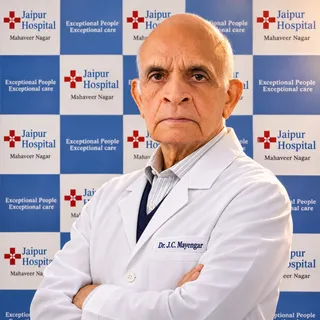
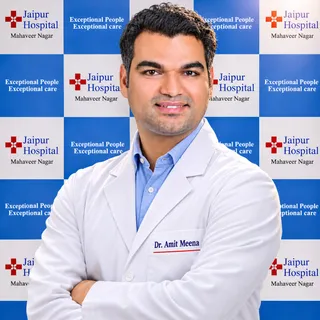
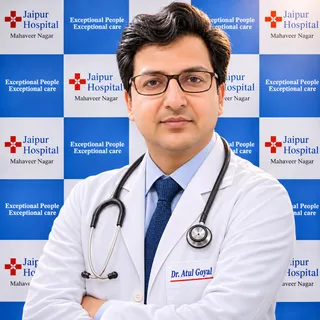
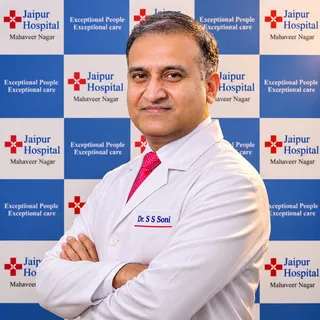
Your orthopaedics doctors
Explore our orthopaedic hospital in Jaipur: every treatment, the doctors and what to expect at your visit.
Frequently asked questions
Questions patients ask about implant (plate and rod) removal surgery
What does implant removal surgery involve?
In short
Implant removal surgery at Jaipur Hospital involves taking out metal plates, screws, rods or wires that were used to fix a broken bone after the fracture has healed. The operation usually takes 45 to 90 minutes under general or regional anaesthesia. Most patients go home the same day or stay one night in hospital.
In detail
The surgeon reopens the old scar or makes a small new incision to reach the metalwork. For plates and screws, an open approach through the previous scar is standard.
For intramedullary nails in the thigh or shin, the implant is removed through an incision at the top or bottom of the bone. Small wires or cannulated screws need only a tiny cut.
If a screw sits inside a joint, an arthroscopic assisted technique may be used to limit soft tissue damage. The choice depends on the implant type, its location and how deeply it is covered by bone or scar tissue.
In studies, implants were removed between six weeks and twenty-seven months after the original fixation, using plates, screws, nails and staples.
A common belief
Many people think the metal must stay forever once the bone heals.
What actually happens
In reality, metalwork often causes irritation, pain or stiffness, and removing it can improve comfort and function. The technique varies: plates need an open approach, nails come out from the end of the bone, and joint screws may use a keyhole camera.
Your next step at Jaipur Hospital
Bring your old X-rays and the discharge summary from your fracture surgery to the orthopaedic OPD. The surgeon will examine the healed bone, check for tenderness over the metalwork and order fresh X-rays to confirm union.
If removal is advised, you will receive a date, a cost estimate in the typical range of ₹30,000 to ₹80,000 and pre-operative instructions.
Which tests and scans do I need before implant removal surgery?
In short
Before implant removal surgery at Jaipur Hospital, you will need recent X-rays of the operated bone in two planes to confirm the fracture has united. Routine blood tests such as complete blood count, kidney and liver function, blood group and infection markers are standard. The anaesthesia team may request an ECG and chest X-ray depending on your age and medical history. No CT or MRI scan is required at the hospital; if advanced imaging is needed, the surgeon will refer you to an outside imaging centre.
In detail
The surgeon uses X-rays to verify solid bone union, locate the exact position of plates, screws or nails, and plan the incision. Blood tests assess fitness for anaesthesia and rule out anaemia or infection.
In studies, intraoperative fluoroscopy was sometimes used to locate migrated implants, but for routine removal, standard X-rays are sufficient. The hospital has an in-house X-ray facility; CT and MRI are not available on site.
If the surgeon suspects a complex problem such as a deeply buried screw or joint involvement, they may advise a CT scan at an external centre before the operation.
A common belief
Some people expect a CT or MRI scan before every implant removal.
What actually happens
In routine cases, plain X-rays are enough to confirm union and locate the hardware. The hospital does not have a CT or MRI scanner; if the surgeon needs advanced imaging, they will refer you to an outside centre.
Your next step at Jaipur Hospital
Arrange the blood tests and X-rays a few days before your scheduled pre-anaesthesia check. Bring all old X-rays, the operative note and discharge summary from your fracture surgery. The anaesthesia team will review the results and clear you for surgery.
How painful is implant removal surgery and the early recovery?
In short
Implant removal surgery at Jaipur Hospital is done under general or regional anaesthesia, so you feel no pain during the operation. After surgery, most people have moderate soreness at the incision site for a few days, which is managed with regular pain tablets. The discomfort is usually less than the original fracture surgery.
In detail
The operation takes 45 to 90 minutes through the old scar or a small new incision. Because the bone has already healed, there is less deep tissue work than during fixation.
Studies show that early removal reduces pain from prominent hardware and irritation of surrounding soft tissue. In the first one to two weeks you may need prescribed analgesics; after that, simple paracetamol is often enough.
Swelling and bruising around the wound are normal and settle within two weeks. The surgical team gives a clear pain-relief schedule before discharge.
A common belief
A common fear is that re-opening the scar means the same agony.
What actually happens
In reality the bone is solid, so the surgeon only deals with the metal and the scar tissue, not a fresh fracture.
Your next step at Jaipur Hospital
Take pain medicine on time for the first 48 hours, then as needed. Keep the limb elevated when resting to reduce throbbing. Avoid heavy loading on the operated bone for four to six weeks. Stitches or clips are removed at 10 to 14 days. Contact the hospital if pain suddenly worsens or the wound becomes red and hot.
How long does recovery usually take after implant removal surgery?
In short
Recovery after implant removal at Jaipur Hospital typically allows desk work in one to two weeks and return to sports in four to six weeks. The hospital stay is daycare or one night. Full bone remodelling at the screw holes continues for three to six months.
In detail
The operation takes 45 to 90 minutes under general or regional anaesthesia. Because the fracture has already united, there is no bone healing to wait for, only soft-tissue healing and bone remodelling at the old screw tracks.
In the first week you manage swelling and wound care. By two weeks most patients walk comfortably with a stick if needed. Physiotherapy starts early to regain joint range and muscle strength.
Heavy loading and contact sports are delayed until the screw-hole bone is strong again, usually around six weeks. Studies show early mobilisation reduces stiffness without increasing re-fracture risk when guided by the surgical team.
A common belief
A common mistake is treating it like a fresh fracture and staying immobile for months.
What actually happens
The bone is already healed; only the screw tracks need time to fill in.
Your next step at Jaipur Hospital
Keep the limb elevated for the first 48 hours. Take prescribed pain medicine regularly. Start gentle range-of-motion exercises as shown by the physiotherapist. Avoid running, jumping or heavy lifting for six weeks. Attend the wound check at 10 to 14 days and the six-week review with X-ray.
What specific problem is implant removal surgery intended to solve?
In short
Implant removal surgery addresses symptoms caused by the metalwork itself, such as pain, irritation, prominence under the skin, restricted joint movement or allergic reaction. Jaipur Hospital evaluates each case to confirm the metal is the source of your trouble before recommending removal.
In detail
Evidence shows the two most common reasons for elective removal are to optimise physiological function and to reduce the risk of broken implants making future surgery harder.
Other indications include painful hardware, soft-tissue irritation from prominent screws or plates, cold sensitivity, and patient anxiety about retained metal. In children, removal may prevent growth disturbance. The decision is based on individual factors: your symptoms, implant location, fracture healing status and overall health. Asymptomatic implants are not routinely removed because the surgery carries its own risks.
A common belief
Many patients believe all metal must come out once the bone heals.
What actually happens
Evidence says asymptomatic implants can stay in safely. Removal is advised only when the hardware itself is the proven source of trouble.
Your next step at Jaipur Hospital
Bring your previous X-rays and operative notes to the consultation. The surgeon will examine the site, confirm fracture union on imaging, and discuss whether your symptoms match the hardware. If removal is advised, the procedure is planned as daycare or one-night stay.
How will implant removal surgery affect my walking, movement, or independence?
In short
Most people walk with full weight bearing immediately or within a few days after plate or screw removal. After intramedullary nail removal, protected weight bearing may be advised for 2 to 4 weeks. Jaipur Hospital tailors mobilisation advice to the implant type and bone quality.
In detail
Evidence indicates desk work returns in 1 to 2 weeks and sports in 4 to 6 weeks. For plate and screw removal, the bone cortex is intact, so immediate weight bearing is usual.
Nail removal leaves a cortical window; crutches and partial weight bearing protect against fracture through the screw holes during early remodelling. Upper limb removal allows light use within days.
Independence for daily activities returns quickly; an attendant is helpful for the first 24 to 48 hours after anaesthesia. The surgical team gives written weight-bearing instructions at discharge.
A common belief
Patients often fear they will be bedbound for weeks.
What actually happens
In reality, only nail removal requires temporary protection. The bone is already healed; the surgery just takes the metal out.
Your next step at Jaipur Hospital
Arrange a walking aid if nail removal is planned. Prepare your home for limited stair use for the first week. Follow the specific weight-bearing chart given by your surgeon. Attend the two-week wound check and six-week X-ray to confirm bone remodelling.
Why might my doctor recommend implant removal surgery?
In short
Your doctor at Jaipur Hospital may recommend implant removal surgery if the metalwork causes pain, irritation, stiffness or a feeling of hardware prominence under the skin. Other reasons include a broken implant, infection around the metal, allergy to the metal, or the need for another operation in the same area. The decision is based on your symptoms and examination, not on a fixed timeline.
In detail
In studies, the two most commonly chosen reasons for removal were to optimise physiological function and to reduce the risk of broken metalwork making future surgery more difficult.
The time of removal depends mainly on the time of bone healing, which varies by fracture site, severity, fixation type and patient factors.
Elective removal in asymptomatic patients is controversially discussed; the decision should be primarily based on individual patient factors such as chronic pain, physical functioning, complications, reoperations, negative body sensation and spatial limitation.
Over one third of surgeons surveyed reported they routinely remove metalwork after Lisfranc injury fixation at a median of six months, but practice varies widely.
A common belief
A common belief is that all metal must come out after a set time, like one year.
What actually happens
Evidence shows routine removal in people with no symptoms is debated. The choice depends on your specific symptoms, not a calendar date. Many surgeons remove metalwork routinely after certain injuries, but others wait for a clear reason.
Your next step at Jaipur Hospital
If you have persistent ache, swelling, rubbing over the plate or difficulty with activities, tell your surgeon at the follow-up visit. Fresh X-rays will confirm solid union. The surgeon will then explain whether removal is likely to help and what the typical recovery looks like.
How should I prepare in the days before implant removal surgery?
In short
In the days before implant removal surgery at Jaipur Hospital, stop smoking if you can, as it slows wound healing. Inform the surgeon about every medicine, supplement or herbal product you take. Arrange for an attendant to stay with you on the day of surgery and to take you home afterwards. Keep the skin around the old scar clean and avoid any cuts, scratches or insect bites near the operation site.
In detail
The anaesthesia team will give you specific fasting instructions during the pre-anaesthesia check. You may need to stop blood-thinning medicines such as aspirin, clopidogrel or warfarin several days before; the surgeon and anaesthetist will decide the exact timing together.
If you take diabetes medication, the dose may be adjusted on the day of surgery. Bring all your regular medicines to the hospital. In studies, patients were advised to arrange transportation home because the procedure is often done as daycare or with a one-night stay.
A common belief
People often think they can just turn up on the day.
What actually happens
In reality, blood thinners may need to be stopped days earlier, diabetes doses change on the day, and you must have someone to collect you. The pre-anaesthesia check is where these details are finalised.
Your next step at Jaipur Hospital
Complete the blood tests and X-rays a few days before the pre-anaesthesia visit. On the day of surgery, wear loose clothing that fits over the dressing. Do not apply oil, cream or antiseptic on the incision area. The hospital will give you a final checklist at the pre-anaesthesia appointment.
What are the common side effects and the less common serious complications of implant removal surgery?
In short
Common side effects after implant removal at Jaipur Hospital include swelling, bruising, and temporary numbness near the scar. Less common serious complications are infection, nerve injury, fracture during removal, and anaesthesia reactions.
In detail
Swelling and bruising settle in one to two weeks. A patch of numb skin around the incision is common because small skin nerves are cut; it often improves over months. Infection occurs in a small minority and may need antibiotics or, rarely, wound washout.
Nerve injury can cause lasting numbness or weakness. The bone can crack while the implant is being extracted, especially if the metal is stuck or the bone is thin. Anaesthesia risks are low but include breathing or heart events. The surgical team checks the old scar and imaging beforehand to lower these risks.
A common belief
Many patients worry the metal will leave a hole in the bone.
What actually happens
The screw holes fill with bone over time. The real risks are the ones the surgeon checks for before you go to theatre.
Your next step at Jaipur Hospital
Watch for increasing redness, heat, pus, fever above 38°C, or sudden severe pain and inability to move the limb. These need urgent review. Routine follow-up is at two weeks for wound check.
Which symptoms are expected after implant removal surgery, and which need urgent medical attention?
In short
Expected symptoms after implant removal at Jaipur Hospital include mild to moderate pain at the incision, swelling and bruising around the scar, and temporary numbness near the wound. These improve over one to two weeks. Urgent signs are fever above 38°C, increasing redness or pus, sudden severe pain, inability to move the limb, or the wound gaping open.
In detail
Normal post-operative discomfort is managed with oral analgesics and limb elevation. Bruising may track down the limb with gravity and change colour over days. Numbness from small nerve branches cut during the approach usually shrinks over weeks.
Warning signs suggest infection, haematoma, nerve injury or re-fracture through a screw hole. Deep vein thrombosis is rare but presents as calf swelling and tenderness.
The team gives a written list of red-flag symptoms before discharge so you and your attendant know when to call or return to the emergency department.
A common belief
Patients often confuse normal healing inflammation with infection.
What actually happens
The rule: if the redness spreads beyond two centimetres from the stitches or you feel unwell, come in.
Your next step at Jaipur Hospital
Take pain medicine on schedule for the first 48 hours. Keep the dressing dry. Do not bear full weight until cleared. If any red-flag symptom appears, call the hospital immediately or go to the 24×7 emergency department. Attend the wound check at 10 to 14 days.
FAQ library
Questions and answers about implant (plate and rod) removal surgery
When you contact us
Your next step: a clear plan
Contact Jaipur Hospital for an OPD consultation where your scans are reviewed, options explained and a cost estimate given before you decide.
- A consultation with an orthopaedic surgeon in the OPD
- Your scans and reports reviewed, with tests done in-house if you need them (laboratory, X-ray and imaging)
- Your options explained in plain words, including whether you need surgery at all
- A cost estimate before you decide
- Help with cashless treatment under MAA Yojana, various government health care schemes and empanelled insurers and TPAs
- Follow-up visits after your treatment
Overview
Implant (Plate and Rod) Removal Surgery: what to know
What implant removal surgery is and how it happens
- Metalwork types
- Plates, screws, nails, wires
- Typical timing
- Within 24 months of original surgery
- How often removed
- Over 80 percent in some countries
Implant removal surgery is an operation to take out metal plates, screws, rods or wires that were put in to hold a broken bone while it healed. Once the bone has knitted together, the metal has done its job. In many people the metal stays in place for life without causing any trouble.
In others it can become painful, prominent under the skin or limit movement, and then the surgeon may advise taking it out. The procedure is done through the old scar or a new small cut, usually under general or regional anaesthesia, and takes about 45 to 90 minutes.
The metalwork used for fixation includes:
- Plates
- Screws
- Intramedullary nails
- Tension band wires
The timing of removal depends mainly on when the bone has healed, which varies with the site of the fracture, the type of break, the device used and the patient's own healing capacity.
Most internal fixation devices are removed within 24 months of the original operation. In some countries more than 80 percent of fractures treated with metalwork go on to have the metal removed.
Symptoms and warning signs that need urgent care the same day
- Sudden severe pain At the implant site
- Rapid swelling Around the old scar
- Redness spreading up limb Possible infection sign
- Fever with wound discharge Sign of infection
- Cannot move the limb May mean new fracture or breakage
Common reasons people ask for removal are:
- Pain over the implant
- A prominent plate or screw that rubs on clothing or shoes
- Stiffness of a nearby joint
- A feeling that the metal is limiting activity
Some patients notice a lump that causes no pain but can be felt under the skin.
Warning signs that need medical attention on the same day include sudden severe pain at the site, rapid swelling, redness spreading up the limb, fever with wound discharge, or an inability to move the limb. These may indicate infection, implant breakage or a new fracture through the screw holes and should be assessed in the emergency department without delay.
Causes and who is at higher risk of needing implant removal
- Implants near skin surface
- Ankle, clavicle, elbow
- Thin soft tissue cover
- Less padding over metal
- Heavy manual work or contact sports
- More stress on hardware
- Children and adolescents
- Metal can affect growing bone
The two most commonly chosen reasons for removal are to improve physiological function and to reduce the risk of broken metalwork making any future surgery more difficult. Other reasons include irritation of tendons or nerves by prominent hardware, cold sensitivity over the metal, and patient preference after the fracture has healed.
People at higher risk of symptomatic metalwork include:
- Those with plates or screws close to the skin surface such as at the ankle, clavicle or elbow
- Patients with thin soft tissue cover
- Those who do heavy manual work or contact sports
Children and adolescents may also be advised to have implants removed once growth is complete because the metal can interfere with growing bone.
How implant removal is diagnosed: examination and tests
- Clinical examination
- Scar, tenderness, movement, nerves
- X-rays
- Confirm bone union and implant position
- No routine CT or MRI
- Done at external centre if needed
- Blood tests
- Infection markers and anaesthesia fitness
The surgeon will ask about your symptoms, examine the old scar and check for:
- Tenderness
- Swelling
- Joint range of movement
- Any nerve irritation
X-rays are taken to confirm that the bone has united, to see the position of the implants and to look for signs of loosening, breakage or infection.
No CT or MRI scan is needed for routine planning. If a scan is advised to assess a complex problem, the doctor will arrange it at an imaging centre outside the hospital and review the images with you. Blood tests may be done before surgery to check for infection markers and fitness for anaesthesia.
Treatment options without surgery and when surgery is advised
If the metalwork is not causing symptoms, the usual approach is to leave it in place. Elective removal in asymptomatic patients is controversially discussed and many surgeons advise against routine removal. Simple measures such as padding over a prominent area, activity modification and anti-inflammatory medication can help mild irritation.
Surgery is advised when the implant causes persistent pain, limits function, rubs on skin or tendons, has broken or loosened, or when infection is suspected. The decision is based on individual factors including your symptoms, the site of the implant, your age, activity level and overall health. Your surgeon will discuss the expected benefits and the risks so you can decide together.
Preparing for Implant (Plate and Rod) Removal Surgery
Before the operation your surgeon will review the original fracture records and any recent X‑rays to confirm that the bone has healed. You will be asked about medicines you take regularly, especially blood thinners, steroids or diabetes drugs, so the anaesthesia team can plan any adjustments.
Routine blood tests, a chest X‑ray and an ECG are usually done a day or two before surgery. You must not eat or drink for at least six hours before the scheduled time.
Bring your current medicines, the old operation notes if you have them, comfortable loose clothing and an attendant who can stay with you and take you home afterwards.:
- Current medicines
- The old operation notes if you have them
- Comfortable loose clothing
- An attendant who can stay with you and take you home afterwards
The hospital provides a patient gown and basic toiletries; you may bring your own if you prefer.
How Implant (Plate and Rod) Removal Surgery Is Done
The operation is performed under general or regional anaesthesia and typically lasts 45 to 90 minutes. Your surgeon will choose the approach that matches the type of metalwork and its location:
- Open Implant Removal: The standard approach uses the old scar to expose and remove plates and screws.
- Intramedullary Nail Removal: Tibial or femoral nails are taken out through a small incision at the top or bottom of the bone.
- Wire and Screw Removal: K‑wires, cannulated screws or tension‑band wiring are removed through a short incision.
- Arthroscopic Assisted Removal: For screws that sit inside a joint, a keyhole camera is used to limit soft‑tissue dissection.
On the day of surgery you are admitted to the daycare ward, the anaesthetist meets you, and the surgical site is marked. After the metalwork is removed the wound is closed in layers and a sterile dressing is applied. Most patients go home the same day; some stay one night for observation. The removed implants are sent for inspection and then discarded unless you ask to keep them.
Risks and Possible Complications of Implant Removal
- Wound infection
- Most frequent issue
- Temporary numbness near scar
- Common but usually short-lived
- Joint stiffness
- Nearby joint may stiffen
- Refracture through screw hole
- Less common
- Higher infection risk if previous infection
- Persistent or recurrent infection more likely
All surgery carries some risk. In studies of metalwork removal, major complications were very rare; one series of 129 cases reported only two major complications. The most frequent issues are wound infection, temporary numbness near the scar, stiffness of the nearby joint and, less often, a refracture through a screw hole. Nerve injury and deep vein thrombosis are uncommon.
If you had an infection around the implant before, the risk of a persistent or recurrent infection is higher. Your surgeon will discuss the risks that apply to your specific implant and bone. Contact the hospital if you develop increasing pain, redness, swelling, fever or drainage from the wound after you go home.
Recovery and Aftercare After Implant Removal
- Day of surgery Observed until anaesthesia wears off; pain tablets for few days
- 10 to 14 days Stitches or clips removed
- 1 to 2 weeks Desk work usually possible
- 4 to 6 weeks Heavier activities, sports, full weight-bearing on lower limb
After the operation you will be observed in the recovery area until the anaesthesia wears off. Pain is managed with oral tablets; most people need them for only a few days. The dressing is kept clean and dry; stitches or clips are usually removed at 10 to 14 days. You can start gentle movement of the joint as comfort allows.
Desk work is typically possible in 1 to 2 weeks. Heavier activities, sports and full weight‑bearing on a lower limb are usually resumed at 4 to 6 weeks, guided by your surgeon and physiotherapist. A follow‑up visit is scheduled at two weeks and again at six weeks.
Call the hospital sooner if you notice:
- Worsening pain
- Spreading redness
- Fever above 38 °C
- Sudden inability to move the limb
- Calf swelling and tenderness
Results of Implant (Plate and Rod) Removal Surgery
- over 90 % Over 90%
- majority Majority satisfied
- 9 weeks to 31 months Follow-up range
Studies that measured pain scores, functional mobility and quality of life after elective metalwork removal show that most patients report improvement in symptoms such as pain, irritation from prominent hardware and restricted movement.
In one large European series, over 90 % of internal fixations were removed within 24 months of the original surgery, and the majority of patients were satisfied with the outcome. The problem rarely comes back because the bone has already healed; refracture through a screw hole occurs in a small minority.
Long‑term follow‑up in the published studies ranged from 9 weeks to 31 months. Your surgeon will explain what outcome you can reasonably expect based on the site and type of implant.
Cost and Insurance for Implant Removal in Jaipur
The typical price range for elective implant removal in India is ₹30,000 to ₹80,000.
The final cost depends on:
- The type of implant (plate, nail, wires or screws)
- The surgical approach (open or arthroscopic)
- The anaesthesia used
- Whether you stay as a daycase or overnight
- Any implants or investigations needed beforehand
Jaipur Hospital is empanelled under MAA Yojana, various government health care schemes and a panel of private insurers and TPAs; cashless or reimbursement claims can be processed through the hospital’s insurance desk. The hospital has an in‑house pharmacy, diagnostic laboratory and X‑ray facility; CT or MRI scans, if required, are arranged at an external imaging centre. For a personalised estimate please contact the hospital on 0141‑2551500, 0141‑2554139 or 7414 001 001, or email [email protected].
