

Orthopaedics · Jaipur Hospital
Non-union and Malunion Correction in Jaipur
Your fracture still has not joined, and you are unsure why. We offer a clear assessment and a plan.
- Serving Jaipur since 1991 (35 years)
- NABH accredited
- 24×7 emergency & ICU
- Cashless: MAA Yojana + 32 insurers
- Operation time
- 2 to 4 hours
- Anaesthesia
- General or Spinal anaesthesia
- Recovery
- Protected weight bearing 8 to 12 weeks, full union 4 to 6 months
- Price
- ₹1,20,000 to ₹3,50,000typical range in India; ask us for an estimate
The bone that did not join
Why is my fracture still not healed?
Months have passed since your injury, but the bone has not joined. You may still have pain, or the arm or leg may look bent. This is called non-union or malunion. It is a real problem, and it can be treated.
-
A bone that will not join
Some fractures stop healing before the bone joins. The gap stays, and the bone feels weak or painful when you use it.
-
Bone healed at an angle
Sometimes the bone joins in the wrong position. The limb may look bent, and moving it may feel awkward or uncomfortable.
-
Pain when you walk
A fracture that has not settled can hurt with daily activity. Many people stop using the arm or leg as they did before.
-
Time lost from work
Waiting for a bone to heal can mean weeks away from your job, and repeated visits to doctors without a clear plan.
Fracture non-union is a common complication, seen in 5% to 10% of all acute fractures.
Why Jaipur Hospital
You have waited months for the bone to heal, and you are worried about the pain, the time off work and what the surgery will cost.
Your care plan
Your first steps with us
- 1 Call us or visit the orthopaedic OPD.
- 2 Your surgeon reviews your reports and examines the limb.
- 3 You get a plan and a cost estimate before you decide.
- 4 Plan surgery, then follow-up visits while the bone heals.
How the operation is done
Revision surgery aims to give the bone a fresh chance to heal. Your surgeon removes the old scar tissue, corrects the position, adds bone graft where it is needed and fixes the bone with a stable implant. General or spinal anaesthesia is used.
-
Autologous Iliac Crest Bone Graft
Bone taken from your own hip bone and packed into the gap. Your surgeon may discuss it where the bone needs more material to heal.
-
Bone Morphogenetic Protein (BMP)
A synthetic growth factor that signals bone formation. Research on how much it helps is still inconclusive. Your surgeon may discuss it for a difficult non-union.
-
Locking Compression Plate Revision
A plate fixed with screws that hold the bone ends steady. Your surgeon may discuss it when the bone is thin or has healed at an angle.
-
Intramedullary Nail Exchange
A larger rod placed inside the bone, after clearing the canal. Your surgeon may discuss this for a thigh or shin bone that has not joined.
Why patients trust us
- 1991 Serving Jaipur for 35 years
- NABH Accredited hospital
- 4 Orthopaedics consultants
- 24×7 Emergency, ICU and ambulance
- 33 Cashless schemes and insurers
What research shows about revision surgery
-
86 in 100
In one review of 767 patients with non-union, about 86 in 100 healed after treatment.
-
84 and 80 in 100
In scaphoid non-union, mean union rates after bone grafting were about 84 in 100 with a vascularised graft and 80 in 100 without.
-
about 28 days
Smokers took about 28 days longer for the bone to join than non-smokers in the studies reviewed.
If it is left untreated
If a fracture does not join, the bone stays weak and the limb may not take your weight. Movement can remain painful, and the arm or leg may stay bent. Non-union is the most serious complication after fracture fixation, and its treatment can be prolonged and unpredictable.
Life after treatment
Most people need protected weight bearing for 8 to 12 weeks, and the bone usually joins in 4 to 6 months. Follow-up visits and physiotherapy help you return to daily activity at your own pace.
-
Walking with support first
Most people use crutches or a walker for a few weeks, then gradually take more weight as the bone settles.
-
Follow-up visits and X-rays
Your surgeon checks the bone with X-rays at set intervals and tells you when it is safe to do more.
-
Physiotherapy to regain movement
A physiotherapist usually guides exercises for the nearby joints, so the arm or leg does not stiffen while it heals.
-
Back to daily work
Return to work depends on your job and the bone involved. Most people need a few months before heavier work.
Meet the team
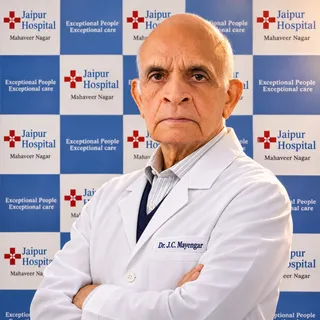
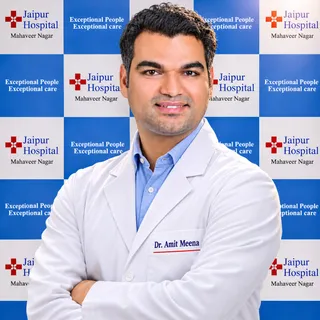
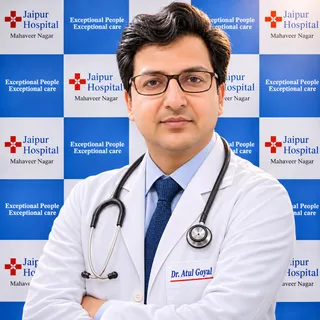
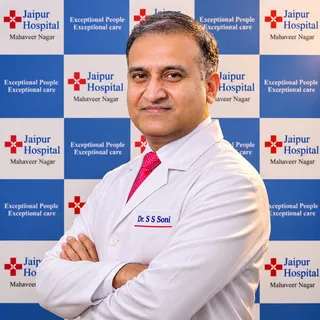
Your orthopaedics doctors
Explore our orthopaedic hospital in Jaipur: every treatment, the doctors and what to expect at your visit.
Frequently asked questions
Questions patients ask about non-union and malunion correction
What does non-union and malunion correction involve?
In short
Non-union and malunion correction at Jaipur Hospital is revision surgery to fix a fracture that has failed to heal or has healed in the wrong position. The operation usually takes 2 to 4 hours under general or spinal anaesthesia. The surgeon removes scar tissue, realigns the bone, adds bone graft to stimulate healing, and applies stable fixation with plates or nails.
In detail
The procedure addresses two different problems. A non-union means the bone ends have not joined despite adequate time; this may be atrophic with little callus due to poor biology, or hypertrophic with excessive callus due to instability.
A malunion means the bone has healed with deformity such as shortening, angulation or rotation. The surgeon first identifies the cause using X-rays and clinical assessment.
For atrophic non-unions, biological stimulation is needed, typically with autologous iliac crest bone graft which provides osteogenic cells, growth factors and a scaffold. For hypertrophic non-unions, mechanical stability is the priority, achieved with revision plating or intramedullary nail exchange using a larger reamed nail.
In malunions, the bone is osteotomised (cut) at the deformity site, realigned, and fixed with stable constructs. Locking compression plates give angular stability in osteoporotic bone. Bone morphogenetic protein (BMP) may be used in difficult cases without donor-site pain. The diamond concept of healing requires osteogenic cells, growth factors, osteoconductive scaffold and mechanical stability together.
A common belief
Many people think the bone just needs more time, but if it has not healed in nine months or has healed with deformity, waiting longer will not help.
What actually happens
The biology or mechanics must be corrected surgically.
Your next step at Jaipur Hospital
You will stay in hospital for 3 to 5 nights. Protected weight bearing is required for 8 to 12 weeks, and full bone union typically takes 4 to 6 months. Physiotherapy starts early to maintain joint range.
The typical cost range in India is ₹1,20,000 to ₹3,50,000; ask us for an estimate. Your surgeon will plan the exact steps after reviewing your imaging.
Which tests and scans do I need before non-union and malunion correction?
In short
Before non-union and malunion correction at Jaipur Hospital, you will need recent X-rays of the affected bone in two planes (AP and lateral), often including the joints above and below. Blood tests typically include complete blood count, CRP, ESR, blood sugar, and renal and liver function. If infection is suspected, the surgeon may order a sinus swab or aspiration for culture. A CT scan may be advised for complex deformity or medullary canal assessment; this is done at an imaging centre outside the hospital and the surgeon reviews the images.
In detail
X-rays are the primary tool. They show the fracture pattern, callus formation, bone quality, implant position, and any shortening, angulation or rotation. Serial X-rays over three months confirm the non-union diagnosis by showing no progressive bridging callus in at least three of four cortices.
For malunions, comparative views of the opposite limb help measure deformity. Blood tests screen for anaemia, diabetes, infection markers, and fitness for anaesthesia. CRP and ESR are useful to differentiate septic from aseptic non-union; however, they can be elevated after recent surgery.
If a sinus tract is present, a swab or deep tissue culture guides antibiotic choice. CT scan provides 3D detail of the deformity, bone loss, and medullary canal diameter for nail planning; it is performed at an external imaging centre.
MRI is rarely needed but may assess soft tissue or marrow oedema; it is also done externally. The surgeon correlates all findings to classify the non-union type and plan the revision strategy.
A common belief
Patients often assume MRI is routine, but X-rays and blood tests give most of the information.
What actually happens
CT is only for complex cases. MRI is rarely needed and also done externally.
Your next step at Jaipur Hospital
Bring all previous X-rays, operation notes, implant details and recent blood reports to your consultation. The surgeon will advise which additional tests are needed. Typical hospital stay is 3 to 5 nights.
How painful is the non-union and malunion correction procedure and the early recovery?
In short
The non-union and malunion correction operation at Jaipur Hospital is done under general or spinal anaesthesia, so you feel nothing during the 2 to 4 hour procedure. After surgery, the care team gives regular pain relief through intravenous and oral medicines. Most patients describe the first 24 to 48 hours as uncomfortable but manageable with the prescribed regimen.
In detail
Pain comes from the surgical incision, bone graft harvest if taken from the iliac crest, and the deep dissection needed to revise the fixation.
The team uses a multimodal approach: paracetamol, an anti-inflammatory if kidney function allows, and a short course of opioids for breakthrough pain. Ice packs and limb elevation help reduce swelling. By day three, oral tablets usually control discomfort.
The bone graft site at the hip can be sore for one to two weeks. Protected weight bearing for 8 to 12 weeks limits stress on the healing bone, which also reduces pain.
A common belief
Some people expect either no pain or severe agony.
What actually happens
The reality is a steady soreness that improves daily with scheduled tablets, ice and elevation. The hip graft site may ache longer than the main incision.
Your next step at Jaipur Hospital
Take pain medicine on schedule for the first 48 hours, then as needed. Keep the operated limb elevated on pillows when resting. Report any sudden increase in pain, calf tenderness or fever. The hospital stay is typically 3 to 5 nights.
How long does recovery usually take after non-union and malunion correction?
In short
Recovery after non-union and malunion correction at Jaipur Hospital follows a phased timeline. Protected weight bearing with crutches or a frame lasts 8 to 12 weeks. Full bone union typically takes 4 to 6 months. Most patients regain daily function by 3 to 4 months, while return to heavy work or sport may need 6 months or more.
In detail
The 2 to 4 hour operation uses stable fixation such as a locking compression plate or intramedullary nail exchange, often combined with autologous iliac crest bone graft or bone morphogenetic protein. Hospital stay is 3 to 5 nights.
For the first 2 weeks, the focus is wound healing, pain control and swelling reduction. Weeks 2 to 6 introduce gentle range of motion and non-weight bearing exercises. From week 6 to 12, partial weight bearing progresses as X-rays show early callus.
After 12 weeks, full weight bearing starts once bridging callus is seen in at least three of four cortices. Physiotherapy continues throughout to restore strength and joint mobility. Healing speed varies with age, bone quality, smoking status and diabetes control.
A common belief
Patients often confuse wound healing with bone union.
What actually happens
The skin closes in two weeks, but the bone needs months of protected loading. Starting full weight bearing too early is a common cause of implant failure or recurrent non-union.
Your next step at Jaipur Hospital
Keep all follow-up appointments for clinical and X-ray checks. Do not increase weight bearing before the surgeon confirms adequate healing. Eat a protein-rich diet and take calcium and vitamin D if advised.
How will the injury be assessed for displacement, instability, or damage to nerves and blood vessels before non-union and malunion correction?
In short
At Jaipur Hospital, the surgeon assesses the injury with a clinical examination and X-rays taken in the OPD. The doctor checks for abnormal movement, limb alignment, skin condition, pulses and nerve function. If infection is suspected, blood tests such as CRP and ESR are ordered. CT or MRI scans are advised at an outside imaging centre when the X-rays do not give enough detail.
In detail
The evidence describes non-union types by the amount of callus and the stability of the fracture site. Hypertrophic non-unions show excessive callus but remain unstable because of inadequate fixation. Atrophic non-unions have little callus and poor biology.
Clinical findings of motion and pain at the fracture site, along with the absence of bridging callus in three of four cortices on X-ray, guide the diagnosis. Vascular and nerve status is recorded before any revision surgery to plan safe exposure and fixation.
A common belief
Patients often assume a single X-ray is enough.
What actually happens
In reality, the type of non-union — hypertrophic or atrophic — and the stability of the bone decide the fixation method, so a full clinical and radiological work-up is essential.
Your next step at Jaipur Hospital
Bring all previous X-rays, operation notes and discharge summaries to the OPD. The surgeon will examine the limb, order fresh X-rays and decide if a CT or MRI is needed at an imaging centre. Blood tests for infection markers are done in our in-house laboratory. The assessment is usually completed in one or two visits.
How will non-union and malunion correction treatment affect my walking, movement, or independence?
In short
After non-union and malunion correction at Jaipur Hospital, you will need walking aids such as crutches or a walker for eight to twelve weeks. Independence for daily activities like toileting and bathing is reduced during this period. Most patients regain full independence by four to six months once the bone unites and muscle strength returns with physiotherapy.
In detail
The evidence shows that protected weight bearing is essential to allow the bone graft and fixation to heal without disruption. The limb is immobilised in a splint or brace initially. Physiotherapy starts early to maintain joint range of motion and prevent stiffness.
Smoking, diabetes and poor nutrition can prolong the dependent phase. The surgeon and physiotherapist set realistic milestones based on your fracture pattern, fixation type and general health.
A common belief
Many patients expect to walk normally within weeks.
What actually happens
The reality is that the bone must grow across the gap, which takes months. Rushing weight bearing risks breaking the fixation and starting over.
Your next step at Jaipur Hospital
Plan for help at home for the first two to four weeks. Arrange a ground-floor sleeping area if possible. The physiotherapy team teaches safe transfers and walking with aids before discharge. Follow-up visits at two weeks, six weeks, three months and six months track progress. Full weight bearing and return to work depend on radiological union.
Why might my doctor recommend non-union and malunion correction?
In short
Your doctor may recommend non-union and malunion correction at Jaipur Hospital when a fracture shows no signs of healing after nine months or has healed with deformity that limits function. Persistent pain, abnormal movement at the fracture site, limb shortening, angulation or inability to bear weight are common reasons. The aim is to restore bone continuity, alignment and mechanical stability so you can return to daily activities.
In detail
Non-union is defined as no visible progressive healing for three months after at least nine months since injury. Atrophic non-unions lack biological healing potential due to poor blood supply, soft tissue loss, or patient factors such as smoking, diabetes or steroid use.
Hypertrophic non-unions have abundant callus but remain unstable because the original fixation was inadequate or weight bearing started too early.
Malunions cause functional problems: limb length discrepancy leads to gait abnormality and joint overload; angular deformity alters joint mechanics and accelerates arthritis; rotational deformity affects limb alignment. Infection must be ruled out before revision.
Risk factors include open fractures, comminution, high initial displacement, tibial location, and smoking which doubles non-union risk and delays union by about 28 days.
The surgeon matches the treatment to the cause: biological augmentation for atrophic non-unions, mechanical stabilisation for hypertrophic non-unions, and corrective osteotomy with stable fixation for malunions.
A common belief
Patients often hope more time or a brace will fix it, but after nine months without healing progress, the biology has stalled.
What actually happens
A malunion also will not remodel enough in an adult to correct shortening or angulation.
Your next step at Jaipur Hospital
If you have ongoing pain, a limp, or a visible deformity months after your original fracture, an assessment is appropriate. The surgeon will review your X-rays, check for infection, and discuss whether revision surgery is indicated. Typical hospital stay is 3 to 5 nights with protected weight bearing for 8 to 12 weeks.
How should I prepare in the days before non-union and malunion correction?
In short
In the days before non-union and malunion correction at Jaipur Hospital, stop smoking completely as it doubles non-union risk and delays healing by about 28 days. Ensure any diabetes is well controlled. Arrange for an attendant to stay with you during the 3 to 5 night hospital stay. Follow the anaesthesia team's instructions on stopping blood thinners, herbal supplements, or other medicines. Keep the skin over the surgical site clean and free of cuts or infection.
In detail
Smoking cessation is the single most important modifiable factor. Nicotine causes vasoconstriction, carbon monoxide reduces oxygen delivery, and hydrogen cyanide impairs cellular metabolism; all directly impair bone healing. Studies show smokers have 2.2 times the risk of non-union and take 27.7 days longer to unite.
Diabetic control reduces infection risk and improves healing. The anaesthesia team will review your medicines; blood thinners (aspirin, clopidogrel, warfarin, DOACs) usually need stopping several days before surgery with bridging if required.
Herbal products such as ginkgo, garlic, ginseng and fish oil can increase bleeding and should be stopped 1 to 2 weeks prior. If you take steroids, the dose may need adjustment. Bring all medicines in original packets.
Pre-operative physiotherapy to maintain joint range and muscle strength can aid post-operative recovery. Plan for protected weight bearing for 8 to 12 weeks after surgery; arrange crutches or a walker at home. The hospital provides a canteen with dietary meals; discuss any special dietary needs in advance.
A common belief
Many patients keep smoking up to the day of surgery, but even a few cigarettes impair the microcirculation the graft needs.
What actually happens
Herbal supplements are not harmless; they increase bleeding risk.
Your next step at Jaipur Hospital
Complete any advised blood tests and imaging before admission. Stop smoking now. Confirm medicine adjustments with the anaesthesia team. Pack comfortable clothes, your regular medicines, and any walking aids. Typical hospital stay is 3 to 5 nights.
What are the common side effects and the less common serious complications of non-union and malunion correction?
In short
Common side effects after non-union and malunion correction at Jaipur Hospital include swelling, bruising, stiffness and soreness at the incision and bone graft site. Less common serious complications are infection, bleeding needing transfusion, nerve or vessel injury, non-union recurrence, implant failure and blood clots in the leg or lung.
In detail
Swelling and bruising peak in the first week and settle over several weeks. Stiffness improves with guided physiotherapy. The iliac crest graft site can cause persistent numbness or pain in up to 15 percent of patients.
Infection occurs in roughly 2 to 5 percent of revision cases and may need antibiotics or further surgery. Deep vein thrombosis risk is lowered with early ankle exercises, compression stockings and blood-thinning injections during the 3 to 5 night stay.
Implant loosening or breakage is rare with modern locking plates and nails but can happen if weight bearing starts too early. The surgeon discusses all risks specific to your bone quality and fracture pattern before you sign consent.
A common belief
Patients often worry most about the graft site pain, which is common but usually temporary.
What actually happens
The rarer risks like deep infection or blood clots need urgent treatment, so knowing the warning signs is important.
Your next step at Jaipur Hospital
Follow the dressing and weight bearing instructions exactly. Attend all follow-up appointments for wound checks and X-rays. Report fever, increasing redness, sudden calf pain or shortness of breath immediately.
Which symptoms are expected after non-union and malunion correction, and which need urgent medical attention?
In short
Expected symptoms after non-union and malunion correction at Jaipur Hospital include moderate pain at the incision and graft site, swelling that peaks in the first week, bruising tracking down the limb, stiffness, and numbness around the scar. Urgent symptoms are fever above 38.5°C, increasing redness or discharge from the wound, sudden severe pain not relieved by medicine, calf swelling or tenderness, shortness of breath, and inability to move the toes or foot.
In detail
Pain and swelling are part of the normal inflammatory response to bone surgery and graft harvest. Bruising may appear far from the incision due to gravity. Numbness around the scar is common from small skin nerve injury and often improves over months.
Fever, spreading redness or pus suggest infection. Calf pain with swelling may indicate deep vein thrombosis. Shortness of breath could mean a pulmonary embolus. Sudden loss of movement or sensation suggests nerve or vascular injury. The care team explains these warning signs before discharge during the 3 to 5 night stay.
A common belief
Some patients wait days with a fever or calf pain, thinking it is just part of recovery.
What actually happens
Early treatment of infection or blood clot prevents serious complications. Know the red flags before you leave the hospital.
Your next step at Jaipur Hospital
Take prescribed pain medicine regularly for the first 48 hours. Keep the limb elevated on pillows. Do ankle pumps every hour while awake. Contact the hospital immediately if any urgent symptom appears. Attend the 2-week wound check and 6-week X-ray review.
FAQ library
Questions and answers about non-union and malunion correction
When you contact us
What you get at Jaipur Hospital
Visit the orthopaedic OPD at Jaipur Hospital, and our team will review your reports and explain your options in plain words.
- A consultation with an orthopaedic surgeon in the OPD
- Your scans and reports reviewed, with tests done in-house if you need them (laboratory, X-ray and imaging)
- Your options explained in plain words, including whether you need surgery at all
- A cost estimate before you decide
- Help with cashless treatment under MAA Yojana, various government health care schemes and empanelled insurers and TPAs
- Follow-up visits after your treatment
Overview
Non-union and Malunion Correction: what to know
What non-union and malunion mean after a broken bone
A broken bone normally heals over some weeks. When it does not join, the condition is called a non-union. Doctors often define a non-union as a break that has not healed after at least nine months from the injury, with no visible sign of healing on X-rays for three months.
Non-union is common. It is seen in about 5 to 10 out of every 100 acute fractures.
There are two main types. In atrophic non-union, the bone ends make little callus, the new bone that forms around a healing break. In hypertrophic non-union, there is plenty of callus, but it is disorganised and sits away from the break, so the bone still does not join.
Malunion is different. The bone does join, but it heals out of line or in a poor shape. The strain across the bone can then be wrong, and this may need correction.
Non-union is rarely one single cause. In most people, several things act together. It is the most serious complication after fracture fixation, and it can place a heavy burden on you, your surgeon and the health system.
Symptoms of non-union and malunion, and signs that need care the same day
- Wound red, hot, swollen or leaking Contact the hospital the same day
- Fever after surgery Contact the hospital the same day
- Fall on the treated limb Come to the emergency department the same day
- Limb suddenly bent or unstable Come to the emergency department the same day
The main sign of a non-union is that the bone has not joined. You may feel movement at the site of the break, or pain there, or both.
An X-ray shows that the two ends have not bridged. The gap may stay open for months.
Some non-unions become infected. Doctors call these septic, and those without infection are called aseptic. Infection changes the way the problem is treated.
After an operation for this problem, contact the hospital the same day if the wound becomes red, hot or swollen, if it leaks fluid or pus, or if you develop a fever. Your care team will tell you which symptoms to watch for.
Come to the emergency department the same day if you have a fall on the treated limb, or if the limb suddenly looks bent or feels unstable.
Causes of non-union and who is at higher risk
- Mechanical problems
- Too much movement or unstable fixation
- Fracture factors
- Open, comminuted, displaced breaks or poor blood supply
- Patient factors
- Older age, diabetes, anaemia, hormone problems, steroids, NSAIDs
- Smoking
- 2.2 times the risk and 27.7 days longer to unite
Non-union has many causes, and they often overlap. The tibia, the shin bone, and the femur, the thigh bone, are the long bones most often affected.
Mechanical problems are a major cause. If the broken ends move too much, or the fixation is not stable enough, the tissue between them stays fibrous and does not turn into bone. Too much strain is the main reason for a hypertrophic non-union. Poor immobilisation or poor fixation can also lead to an oligotrophic non-union, where there is very little callus.
Fracture factors matter. A break that was open, broken into several pieces, or widely displaced at the start is more likely to fail to heal. So is a gap left after surgery, an implant that does not hold well, or a break in a part of the bone with poor blood supply.
Infection at the break is another cause.
Patient factors also play a part.
These include:
- Older age
- Diabetes
- Anaemia
- Hormone problems
- Use of steroids or non-steroidal anti-inflammatory medicines
Smoking is one of the strongest risk factors. Smokers have about 2.2 times the risk of delayed or non-union compared with non-smokers. They also take about 27.7 days longer for the bone to unite. Across a wide range of orthopaedic operations, smoking doubles the risk of non-union.
Smoking narrows blood vessels, lowers the oxygen carried in the blood, and reduces bone density. If you smoke, stopping before surgery can improve the result of orthopaedic treatment.
Some people carry gene variations linked to non-union, including in the pathways that control bone morphogenetic proteins. Non-union tissue can also show reduced BMP signalling, which may help explain slower healing in some people.
How non-union and malunion are diagnosed
- History and examination Ask about injury, first operation, illnesses, medicines, smoking; feel for movement at the break
- CT scan if needed Done at an imaging centre outside the hospital; team reviews the report
- Check for infection Tissue colour and fluid help tell septic from aseptic non-union
Your surgeon will ask about the injury, the first operation, your other illnesses, your medicines and whether you smoke.
On examination, the surgeon looks for movement or pain at the break. Feeling movement there is a useful sign.
X-rays are the main test. A common sign is the absence of bridging callus in at least three of the four cortices, the outer layers of bone seen on the film. X-rays taken over time matter, because the definition of non-union depends on no progress in healing over three months.
If the X-ray is not clear, or your surgeon needs more detail, a CT scan may be advised. The scan is done at an imaging centre outside the hospital, and our team reviews the report with you.
Your surgeon will also look for infection. The colour of the tissue and the fluid around the break can help tell a septic non-union from an aseptic one.
Non-unions are also described as hypertrophic or atrophic, based on how much callus has formed and how stable the break is. This helps your surgeon plan the right operation.
Treatment without surgery, and when revision surgery is advised
Not every slow-healing break needs an operation at once. A cast, splint or brace can hold the limb still so the bone can heal in the right position. If the break is in a leg, you will need to avoid putting weight on it. Physiotherapy can help you regain strength and movement.
Shock wave therapy has been studied for non-union. In a review of studies, it gave an average union rate of 76%. Low-intensity ultrasound has also been studied, but reviews have found that more good research is needed before its benefit is clear. Your surgeon will advise whether a non-surgical option suits you.
Revision surgery is advised when the break is not healing and the mechanical or biological conditions around it need to be corrected. Atrophic non-unions need the biological environment corrected, and hypertrophic non-unions need the mechanical environment corrected.
The operation usually takes 2 to 4 hours and is done under general or spinal anaesthesia. You will usually stay in hospital for 3 to 5 nights.
Bone grafting is often part of the operation. Bone taken from your own body, called an autologous graft, has been the main graft used for many years because it brings living bone cells and growth factors to the break. The graft may be taken from your hip bone.
This means a second surgical site, and the area can be sore afterwards. Donated bone and prepared bone substitutes are other options. Your surgeon will advise which graft suits you.
Bone morphogenetic protein is a lab-made growth factor. Two types are licensed for orthopaedic use. Reviews have found that the evidence for its effect on bone healing is not yet clear. It can also cause side effects, such as extra bone forming in soft tissue. Your surgeon will advise whether it suits you.
For fixation, a locking compression plate holds the bone with screws that lock to the plate, which gives stable fixation. Another option is exchanging the nail for a wider one, with reaming of the canal, for non-union of the femur or tibia. Your surgeon will advise which fixation suits your bone.
After surgery, you will wake in a recovery area, and the team will check that you are safe. Typically you will take only protected weight bearing on the leg for 8 to 12 weeks. Full union usually takes 4 to 6 months. Follow-up X-rays are done to check healing. You may need physiotherapy to regain strength and movement.
Revision surgery for non-union typically costs between ₹1,20,000 and ₹3,50,000 in India. The final cost depends on the bone involved, the type of graft, whether infection is present, the implant used, and the length of stay. Ask us for an estimate.
Preparing for non-union and malunion correction surgery
Non-union correction is an operation under general or spinal anaesthesia. Your surgeon will first examine the limb, study your old X-rays and ask how the fracture was first treated. The plan is made for your bone, not from a fixed checklist.
Before the date is fixed, your surgeon will ask for the tests you need. These usually include blood tests, an ECG and a chest X-ray, which are done in our laboratory and X-ray room. If a CT or MRI scan is advised, it is done at an imaging centre outside the hospital, and our team reviews the result with you.
The same applies to a DEXA bone density scan: the doctor advises it, it is done outside, and we review the report.
Give your doctor a full list of your medicines. Steroids and non-steroidal anti-inflammatory drugs are among the medicines linked with slower fracture healing. Do not stop or change any medicine yourself. Your doctor will tell you what to do.
Smoking is the one risk you can change. Smokers have double the risk of non-union after fracture treatment, and their bones take about 28 days longer to unite. Giving up smoking improves the result of orthopaedic treatment. Ask your doctor for help with this.
You will usually be asked not to eat or drink for some hours before surgery. The ward team will tell you the exact time. Bring your old X-ray films and scan reports, your medicine list, and your scheme or insurance card. One adult attendant should plan to stay with you. Most patients stay 3 to 5 nights.
How non-union and malunion correction is done
The operation has two aims: to improve the biology of healing and to improve stability. Managing a non-union is a challenge even for specialist orthopaedic surgeons. Atrophic non-union happens when the biological factors for healing are poor, and the bone ends make little callus.
Hypertrophic non-union happens when the bone is not held still enough, so plenty of callus forms but the fracture does not bridge. Your surgeon will decide which problem is dominant in your case.
Bone grafting is often part of the repair. A graft is a piece of bone placed into the gap, and your bone grows around it and heals into one piece. Bone can be taken from your own hip, the iliac crest.
This autologous graft is still the standard against which other grafts are measured, because it carries living cells and growth factors. It does need a second incision, and the hip site has its own risks.
Bone morphogenetic protein is a manufactured growth factor that signals stem cells to become bone-forming cells. Two forms are licensed for orthopaedic use. It avoids a second incision at the hip, but studies in non-union are mixed and researchers call for better trials. There is also concern about side effects such as extra bone forming in soft tissue and collections of blood.
If the old implant is loose or allows movement, your surgeon may change it. A locking compression plate holds the bone with angular stability. An intramedullary nail can be exchanged for a larger one after the canal is reamed. Movement at the fracture prevents fibrous tissue from turning into bone, so correcting the strain is central to healing.
For a malunion, where the bone has joined out of line, the aim is to correct the alignment and hold it with stable fixation while it settles.
Your surgeon will advise which technique, or which combination, suits your fracture. The operation usually takes 2 to 4 hours. You are moved to the recovery area afterwards, and the team makes sure you wake safely from the anaesthesia.
Risks and complications of non-union surgery
- Infection
- Can keep a non-union going and makes treatment harder
- Hip donor site problems
- Pain and other complications at the graft site
- BMP side effects
- Extra bone in soft tissue, blood collections, implant loosening
- Smoking
- 2.2 times the risk of delayed or non-union
Every operation has risks, and bone grafting is no different. Your surgeon will explain the risks that matter for your bone and your health before you give consent.
Infection is one of the most important. Infection at the fracture site can keep a non-union going and makes treatment harder. A fracture that was already opened, or that had a gap after the first operation, is more likely to develop problems.
Taking bone from the hip is not without risk, and the donor site can be painful and cause problems of its own. When bone morphogenetic protein is used, there is concern about side effects such as extra bone in soft tissues, blood collections and loosening around the implant.
Some causes are outside your control: the blood supply of that part of the bone, the pattern of the original fracture, and whether there was infection. Most non-unions have more than one cause.
Smoking is the risk factor you can act on. Smokers have 2.2 times the risk of delayed or non-union than non-smokers.
How often these problems happen is hard to give as one figure, because studies use different definitions of non-union and different treatments. Reported union rates vary widely.
Recovery after non-union and malunion correction
- Protected weight bearing 8 to 12 weeks
- Full union usually seen 4 to 6 months
- Complete recovery A few weeks up to a year
After surgery you are watched in the recovery area until you are stable. You will usually have a cast, splint or brace to hold the bone in the right position while the graft heals.
If the graft is in your leg, you will be asked not to put weight on it at first. In our practice, protected weight bearing usually lasts 8 to 12 weeks. Full union is usually seen at 4 to 6 months. Your surgeon will give you your own timeline.
Recovery after bone grafting varies. It depends on which bone was treated, the type of graft, your general health and whether you smoke. It can take a few weeks to up to a year to recover completely. You may need physiotherapy to regain strength and movement.
Follow-up visits include X-rays to check that the bone is healing. Keep every appointment, even if you feel well.
Call the hospital right away if you notice any of the warning symptoms your team has explained to you. If you are worried between visits, phone us rather than waiting.
How well non-union correction works
- 86 in 100 healed Large series of 767 patients
- 84 in 100 Scaphoid non-union with vascularised graft
- 80 in 100 Scaphoid non-union with non-vascularised graft
- 74 in 100 With avascular necrosis and vascularised graft
Studies report results as union rates, and these rates vary a lot between studies.
In one large series of 767 patients with non-union, 86 in 100 healed after treatment. In a review of scaphoid non-union, the average union rate was 84 in 100 with a vascularised bone graft and 80 in 100 with a non-vascularised graft.
In one review of patients who also had avascular necrosis, union was 74 in 100 with a vascularised graft and 62 in 100 with a non-vascularised graft.
Adding bone morphogenetic protein-7 to an autologous graft was better than graft alone in some studies. Other reviewers found the evidence for bone morphogenetic protein in non-union inconclusive and asked for better-designed trials.
These are results from groups of patients. They cannot tell you what will happen in your case. Treatment of non-union can be prolonged and unpredictable. Some fractures heal after one operation and others need more time and further treatment. Your surgeon will explain what is realistic for your bone.
Cost of non-union correction in Jaipur
- Bone involved and number of bones
- Which bone and whether more than one needs surgery
- Technique, graft type and implant
- Surgical method and materials used
- Length of stay
- Usually 3 to 5 nights
- Infection treatment if present
- Adds time and cost
The typical range for non-union and malunion correction in India is ₹1,20,000 to ₹3,50,000. Ask us for an estimate for your case.
The final bill depends on which bone is involved, whether one bone or more needs surgery, the technique chosen, the type of graft and implant, and the number of nights you stay, which is usually 3 to 5. Treatment of infection, if present, adds time and cost.
Jaipur Hospital is a NABH-accredited, privately run multispeciality hospital. It has been in Jaipur since February 1991.
We work with:
- Various government health care schemes
- MAA Yojana
- A panel of private insurers and TPAs
Bring your scheme card and policy papers so you can discuss what is covered.
The hospital has modular operation theatres, an Intensive Care Unit, an in-house pharmacy and an in-house diagnostic laboratory. X-ray and ECG are done here. There is no CT or MRI scanner and no DEXA machine. If you need a CT, MRI or DEXA scan, the doctor advises it and it is done at an imaging centre outside the hospital. That scan is billed by the imaging centre.
Ask about your insurance cover before your admission date so the position is clear to you.
