

Pulmonology · Jaipur Hospital
Breathlessness Assessment in Jaipur
Short of breath? Get clear tests and a plan from our pulmonology team.
- Serving Jaipur since 1991 (35 years)
- NABH accredited
- 24×7 emergency & ICU
- Cashless: RGHS, MAA Yojana, CGHS + 22 insurers
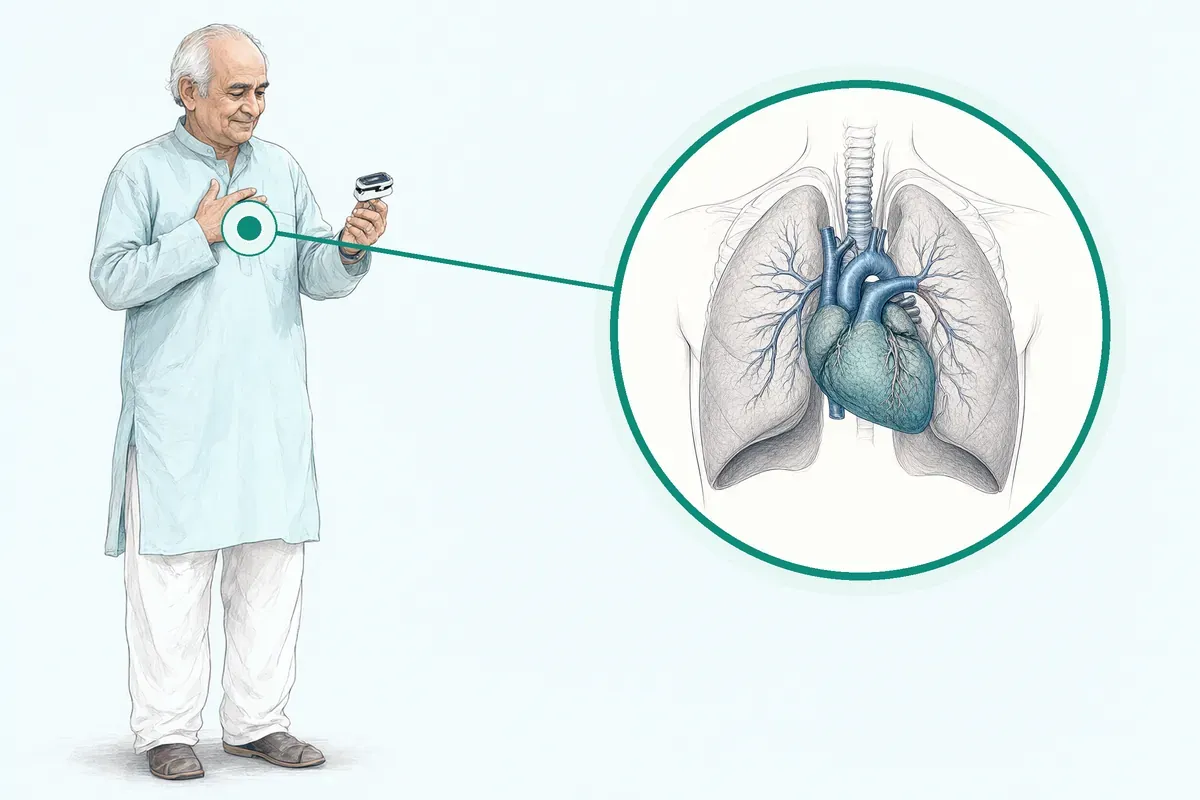
- Session length
- 1 to 2 hours
- Anaesthesia
- Not needed
- Recovery
- Immediate
- Price
- ₹3,000 to ₹8,000typical range in India; ask us for an estimate
Breathlessness limits daily life
You get breathless doing simple things and do not know why
Walking up stairs or crossing the room leaves you gasping. Rest helps, but the worry stays. You want to understand the cause and what can be done.
-
Breathless on exertion
Some breathing problems appear only during activity, not at rest.
-
Distressing symptom
Breathlessness is common and distressing, increasing as disease progresses.
-
Hard to manage alone
Breathlessness is difficult to manage without a clear diagnosis.
-
Multiple possible causes
Dyspnoea arises from heart, lung, or neuromuscular conditions.
Dyspnoea activates brain areas linked to interoception and pain perception.
Why Jaipur Hospital
You worry that breathlessness will stop you from working or caring for your family.
Your care plan
Your first steps with us
- 1 Call or visit OPD for appointment
- 2 Complete pulmonary function and walk tests
- 3 See pulmonologist for evaluation and plan
- 4 Start treatment and schedule follow-up
how the assessment is done
The visit takes 1 to 2 hours as an outpatient. No anaesthesia is needed. You wear comfortable clothes and avoid heavy meals, smoking, or vigorous exercise beforehand.
-
Spirometry with Reversibility
Measures airflow obstruction and checks response to a bronchodilator.
-
Six Minute Walk Test (6MWT)
Walks for six minutes while oxygen and heart rate are monitored; you can stop anytime.
-
DLCO (Diffusing Capacity)
Evaluates how well oxygen moves from air sacs into the bloodstream.
-
Cardiopulmonary Exercise Test (CPET)
Differentiates whether the heart or lungs limit your exercise capacity.
Why patients trust us
- 1991 Serving Jaipur for 35 years
- NABH Accredited hospital
- 1 Pulmonology consultants
- 24×7 Emergency, ICU and ambulance
- 25 Cashless schemes and insurers
what research shows about assessment and support
-
Breathlessness mastery improved
Patients in a holistic breathlessness service improved mastery scores at 6 weeks versus usual care.
-
Survival benefit in COPD and ILD
Survival at 6 months was better for COPD and interstitial lung disease patients receiving breathlessness support.
-
Opioids modestly reduce breathlessness
Systemic opioids showed a small reduction in breathlessness scores across studies.
If it is left untreated
Untreated breathlessness can lead to reduced activity, deconditioning, and shorter life expectancy in refractory cases.
life after assessment
Most people leave with a clear diagnosis, a management plan, and confidence in next steps.
-
Know the cause
You understand whether the heart, lungs, or both limit your breathing.
-
Practical plan
You receive tailored advice on medication, pacing, and exercises.
-
Fewer crises
An individualised plan helps you manage sudden breathlessness episodes.
-
Ongoing support
Follow-up visits track progress and adjust treatment as needed.
Frequently asked questions
Questions patients ask about breathlessness assessment
Which problems are assessed under breathlessness and functional assessment?
In short
At Jaipur Hospital, the breathlessness and functional assessment evaluates unexplained shortness of breath, reduced exercise tolerance, and suspected lung or heart conditions. The service uses pulmonary function tests, a six-minute walk test, and specialist review to identify the cause of dyspnoea. The session lasts one to two hours as an outpatient visit.
In detail
The assessment covers several clinical problems. Chronic obstructive pulmonary disease, interstitial lung disease, and asthma are common respiratory causes. Cardiac limitation, deconditioning, and obesity-related breathlessness are also evaluated. Spirometry with reversibility measures airflow obstruction and bronchodilator response.
The six-minute walk test assesses functional exercise capacity and oxygen desaturation during exertion. DLCO evaluates gas exchange across the alveolar-capillary membrane. Cardiopulmonary exercise testing differentiates cardiac from respiratory limitation.
Evidence shows breathlessness is a common distressing symptom in cardiopulmonary and neuromuscular diseases, and some problems appear only during exercise. The multidisciplinary approach helps distinguish between overlapping causes.
A common belief
Many people think breathlessness is only a lung problem, but it can also come from heart limitation, deconditioning, or obesity.
What actually happens
Our tests like spirometry, DLCO, and cardiopulmonary exercise testing help tell the difference.
Your next step at Jaipur Hospital
You will receive a detailed report sent to your referring consultant, who will arrange a follow-up to discuss results and further management. No hospital stay is needed, and recovery is immediate. The typical price range is ₹3,000 to ₹8,000.
Please bring comfortable clothing, walking aids if used, and take medications as normal. Avoid a large meal, alcohol, smoking for one hour, and vigorous exercise two hours before the test.
How will the doctor decide which tests I need for breathlessness assessment?
In short
At Jaipur Hospital, the specialist decides which tests you need based on your symptom history, clinical examination findings, and suspected underlying cause. The doctor considers whether breathlessness occurs at rest or on exertion, associated symptoms like cough or wheeze, and risk factors such as smoking or occupational exposure. The choice is tailored to differentiate cardiac, respiratory, and deconditioning causes.
In detail
The available techniques include spirometry with reversibility to measure airflow obstruction and bronchodilator response, the six-minute walk test to assess functional exercise capacity and oxygen desaturation, DLCO to evaluate gas exchange across the alveolar-capillary membrane, and cardiopulmonary exercise testing to differentiate cardiac from respiratory limitation.
Evidence shows some breathing problems appear only during exercise, supporting the use of exercise testing. The Multidimensional Dyspnea Profile examines sensory and affective dimensions during specific activities. Management starts with optimising treatment of underlying causes, especially bronchoconstriction.
Non-pharmacologic treatments such as positioning, breathing techniques, mobility aids, and muscle strengthening are then considered. Oxygen has a clear role for hypoxia. The specialist integrates findings to select the most informative tests for your situation.
A common belief
Patients often expect the same tests for everyone, but the choice is tailored.
What actually happens
Spirometry checks airflow, the walk test checks exercise capacity and oxygen levels, DLCO checks gas exchange, and cardiopulmonary exercise testing separates heart from lung limitation.
Your next step at Jaipur Hospital
You will be given clear instructions before the test: take all medication as normal, wear comfortable clothing and footwear, bring any walking aids, avoid nail varnish, large meals, alcohol, smoking for one hour, and vigorous exercise for two hours before the appointment.
The session lasts one to two hours as an outpatient with immediate recovery. The typical price range is ₹3,000 to ₹8,000. Results are documented and sent to your referring consultant for a follow-up discussion.
How soon should I expect improvement after the chosen treatment for breathlessness?
In short
Improvement after breathlessness treatment varies by cause and therapy. At Jaipur Hospital, bronchodilators may ease symptoms within minutes to hours, while pulmonary rehabilitation and holistic breathlessness services typically show benefit over four to eight weeks. In studies, a breathlessness support service improved mastery scores at six weeks. Oxygen helps only if hypoxia is present. Opioids, when used, give modest relief. Your timeline will be discussed at your follow up.
In detail
Evidence indicates that progress in treating dyspnoea has not matched the understanding of its mechanisms. Holistic breathlessness services combining palliative care, respiratory medicine, physiotherapy, and occupational therapy lead to significant improvements in distress and psychological health including depression.
In a randomised trial, breathlessness mastery improved at six weeks with a mean difference of 0.58. Opioids reduce breathlessness modestly (SMD -0.35) but do not improve exercise capacity. Oxygen provides benefit similar to medical air in nonhypoxemic patients.
Nonpharmacologic measures such as positioning, breathing techniques, mobility aids, and muscle strengthening are recommended early. The six minute walk test helps monitor treatment effectiveness and assess need for interventions to improve exercise tolerance.
A common belief
A common belief is that treatment brings instant relief.
What actually happens
In reality, breathlessness is complex. Opioids give only modest reduction and do not improve exercise capacity. Oxygen helps only if your blood oxygen is low. Nonpharmacologic strategies like pacing, breathing techniques, and muscle strengthening take weeks to show effect but provide lasting benefit.
Your next step at Jaipur Hospital
Your consultant will set realistic expectations based on your diagnosis and the treatment plan. Follow up appointments are usually scheduled at four to six weeks to review symptom scores, walk test distance, and quality of life. Adjustments are made if targets are not met.
Which breathlessness symptoms need urgent help rather than routine review?
In short
Seek urgent help if you develop sudden severe breathlessness, inability to speak in full sentences, chest pain, confusion, drowsiness, blue lips or fingers, or oxygen saturation below 90 percent at rest. At Jaipur Hospital, the 24 hour emergency department and ambulance service are available for acute deterioration. These signs may indicate a life threatening exacerbation, pulmonary embolism, heart failure, or pneumothorax.
In detail
Evidence shows that as an exercise test, the six minute walk test requires exertion and some patients may feel breathless, dizzy, or faint during the test. Serious complications are rare.
However, in clinical practice, acute worsening with new chest pain, haemoptysis, syncope, or rapidly falling saturations warrants immediate evaluation. The breathlessness support service provides individualised crisis management plans for patients to recognise red flags and act quickly.
Opioids and benzodiazepines carry risks of sedation and respiratory depression if not monitored. Oxygen is indicated only for documented hypoxia.
A common belief
Patients often wait too long, hoping it will pass.
What actually happens
Red flags like new chest pain, coughing blood, fainting, or rapidly dropping saturations need immediate assessment. The crisis plan given at Jaipur Hospital lists these clearly so you and your attendant know when to act.
Your next step at Jaipur Hospital
Keep your crisis plan accessible. Teach your attendant the red flag symptoms. Call the emergency number or attend the emergency department without delay if any red flag appears. Routine reviews are for stable or gradually changing symptoms.
How can I decide whether to seek advice about breathlessness?
In short
You should seek advice at Jaipur Hospital if breathlessness is new, getting worse, limits your daily activities, or occurs with chest pain, fainting, coughing blood, or swelling of the legs. Sudden severe breathlessness needs emergency care at once.
In detail
Breathlessness is a common and distressing symptom of cardiopulmonary and neuromuscular diseases and becomes more prevalent as disease progresses. Evidence shows that refractory breathlessness, which persists despite optimal treatment of the underlying condition, is associated with shortened life expectancy.
Early specialist evaluation helps identify treatable causes such as bronchoconstriction, heart failure, anaemia, or deconditioning. Holistic breathlessness services that combine tailored non pharmacologic and pharmacologic management can improve breathlessness mastery and psychological health.
A common belief
People often wait until they cannot climb stairs or walk short distances.
What actually happens
Earlier evaluation finds treatable causes like bronchoconstriction or anaemia before they become advanced.
Your next step at Jaipur Hospital
If you notice breathlessness on exertion that is new for you, breathlessness at rest, waking at night short of breath, or needing more pillows to sleep, book an appointment. The outpatient assessment takes one to two hours with immediate recovery. Bring a list of your medicines and any previous reports.
Which changes in breathing, chest symptoms, or oxygen levels need urgent help?
In short
Go to the emergency department at Jaipur Hospital at once if you have sudden severe breathlessness, cannot speak in short sentences, feel faint or confused, have chest pain, cough blood, lips or fingers turn blue, or your oxygen saturation drops below ninety percent on your home monitor.
In detail
Breathlessness can signal life threatening conditions such as acute heart failure, pulmonary embolism, severe asthma or COPD exacerbation, pneumothorax, or pneumonia. Evidence shows that acute self limiting dyspnoea can occur with certain contrast agents but serious complications from exercise testing are rare.
During a six minute walk test, some patients may feel breathless, dizzy, or faint, and the test is stopped if healthcare professionals notice something concerning. However, these warning signs at rest or with minimal exertion need immediate hospital evaluation.
A common belief
People often wait to see if it passes.
What actually happens
Delay with these signs can be dangerous because they may mean a heart attack, pulmonary embolism, or severe asthma attack needing urgent treatment.
Your next step at Jaipur Hospital
Jaipur Hospital has a 24x7 emergency department and 24x7 ambulance service. If you are unsure, call 0141-2551500 or 0141-2554139 for guidance. Do not drive yourself. Keep a list of your medicines and allergies ready. For non urgent but worsening symptoms, book a prompt outpatient consultation with the pulmonology team at Jaipur Hospital.
Which symptoms should prompt me to see a specialist?
In short
You should see a specialist at Jaipur Hospital if you have persistent breathlessness that limits daily activities, worsens on exertion, or does not improve with current treatment. New or changing breathing difficulty, especially with cough, wheeze, or chest tightness, also warrants evaluation.
In detail
Evidence shows breathlessness is a common and distressing symptom that becomes increasingly prevalent as disease progresses. Patients with chronic obstructive pulmonary disease commonly suffer from breathlessness, deconditioning, and reduced health-related quality of life despite medical management.
Some breathing problems do not occur at rest but are more noticeable during exercise. Refractory breathlessness that persists despite optimal treatment of the underlying condition is associated with shortened life expectancy. Early specialist review allows optimisation of treatment for underlying causes such as bronchoconstriction and timely non-pharmacologic interventions.
Your next step at Jaipur Hospital
If you notice breathlessness that stops you from doing usual activities, wakes you at night, or occurs with minimal effort, schedule a consultation. Bring a list of current medicines and any previous test reports. The doctor will take a detailed history, examine you, and decide which tests are needed.
How will the results change my care plan for breathlessness?
In short
At Jaipur Hospital, the test results guide your care plan by confirming the diagnosis, assessing severity, and identifying whether the limitation is cardiac, respiratory, or due to deconditioning. The referring consultant receives a detailed report and arranges a follow-up to discuss findings and adjust treatment. This may include optimising medication, starting rehabilitation, or planning further investigations.
In detail
Evidence shows the six-minute walk test helps monitor treatment effectiveness and assess the need for interventions to improve exercise tolerance. Holistic breathlessness services combine tailored non-pharmacologic and pharmacologic management, often involving respiratory medicine, palliative care, physiotherapy, and occupational therapy.
In studies, a breathlessness support service improved breathlessness mastery and quality of life, with a mean difference of 0.58 on the Chronic Respiratory Disease Questionnaire at six weeks. Survival differences were significant for chronic obstructive pulmonary disease and interstitial lung disease.
Opioids can modestly reduce breathlessness but do not improve exercise capacity. Oxygen benefits patients with hypoxia; in mild or non-hypoxemic breathlessness, benefit is similar to medical air. Non-pharmacologic strategies include positioning, breathing techniques, pacing, mobility aids, and muscle strengthening. The results determine which of these approaches are appropriate for you.
A common belief
People often think tests just give a label, but they actually guide specific choices: oxygen only helps if you have hypoxia, opioids modestly reduce breathlessness but don't improve exercise capacity, and pulmonary rehabilitation targets deconditioning.
What actually happens
The right test steers you to the right therapy.
Your next step at Jaipur Hospital
After testing, your consultant will review the report and discuss next steps at a follow-up appointment. The assessment is outpatient with immediate recovery. The typical price range is ₹3,000 to ₹8,000.
You may be advised medication changes, pulmonary rehabilitation, lifestyle modifications, or referral to a holistic breathlessness service. Bring an attendant if you wish.
What should I do if breathlessness symptoms persist or worsen after treatment?
In short
If breathlessness persists or worsens despite treatment, contact your care team promptly. At Jaipur Hospital, the pulmonology and palliative care teams review symptom scores, repeat pulmonary function tests or six minute walk tests if needed, and adjust the plan. Worsening may signal infection, disease progression, or a new cardiac issue. Do not wait for a scheduled visit if you notice a clear change.
In detail
Evidence shows refractory breathlessness that persists despite optimal treatment of the underlying condition is associated with shortened life expectancy. Holistic breathlessness services integrate palliative care, respiratory medicine, physiotherapy, and occupational therapy to address persistent symptoms.
In studies, the breathlessness support service improved mastery and survival in COPD and interstitial lung disease. Management escalation includes optimising bronchodilators, adding nonpharmacologic measures, considering low dose opioids for refractory cases, and ensuring oxygen is used only when hypoxia is documented. Crisis management plans and hand held fans are provided for acute episodes.
A common belief
Many patients wait for their next routine appointment.
What actually happens
That can delay important changes. Evidence shows refractory breathlessness is linked to poorer outcomes. Holistic services with crisis plans, hand held fans, and rapid access to clinicians improve mastery and survival. Do not wait if you notice a clear change.
Your next step at Jaipur Hospital
Keep a symptom diary using a simple scale and share it at each review. If you develop new chest pain, confusion, inability to speak in sentences, or oxygen saturation dropping below 90 percent at rest, seek emergency care immediately. The team at Jaipur Hospital can arrange urgent review or admission through the 24 hour emergency department.
Could breathlessness symptoms be caused by the heart, lungs, anaemia, or another condition?
In short
Yes, breathlessness can arise from heart disease, lung disease, anaemia, obesity, deconditioning, or a combination. At Jaipur Hospital, the breathlessness assessment uses spirometry, six minute walk test, DLCO, and cardiopulmonary exercise testing to differentiate cardiac from respiratory limitation. Blood tests including haemoglobin are part of the workup. The pulmonology and cardiology teams collaborate to identify the primary driver.
In detail
Evidence shows dyspnoea is a common distressing symptom of cardiopulmonary and neuromuscular diseases. Brain imaging studies link dyspnoea stimuli to activation of cortico limbic areas involved in interoception and nociception. Endogenous and exogenous opioids may modulate perception. Some breathing problems appear only during exercise.
Cardiopulmonary exercise testing differentiates cardiac versus respiratory limitation. Anaemia reduces oxygen carrying capacity and can mimic or worsen cardiopulmonary breathlessness. The Multidimensional Dyspnea Profile assesses sensory qualities and emotional responses to help characterise the experience.
A common belief
Many people assume breathlessness is only a lung problem.
What actually happens
In reality, heart failure, anaemia, obesity, and deconditioning all produce similar sensations. Cardiopulmonary exercise testing is the key tool to tell them apart. Treating the wrong target delays relief.
Your next step at Jaipur Hospital
Your consultant will order the appropriate tests based on history and examination. Results are usually available within a few days. A joint review by pulmonology and cardiology ensures no cause is missed. Treatment targets the primary condition while addressing contributing factors.
FAQ library
Questions and answers about breathlessness assessment
When you contact us
Get your breathlessness assessed
Contact Jaipur Hospital to book a pulmonology OPD appointment and start understanding your breathing.
- A consultation with a pulmonologist (chest physician) in the OPD
- Your scans and reports reviewed, with tests done in-house if you need them (laboratory, X-ray and imaging)
- Your options explained in plain words, including whether you need surgery at all
- A cost estimate before you decide
- Help with cashless treatment under RGHS, MAA Yojana, CGHS and empanelled insurers and TPAs
- Follow-up visits after your treatment
Overview
Breathlessness Assessment: what to know
What breathlessness is and how it happens
- Definition
- Uncomfortable feeling of not getting enough air
- How it happens
- Brain receives signals that breathing is not meeting body needs
- Brain response
- Activates areas for sensing internal state and discomfort
- Body's opioid system
- Can change how strongly the sensation is felt
Breathlessness, also called dyspnoea, is the uncomfortable feeling of not getting enough air. It is a common and distressing symptom that becomes more prevalent as many diseases progress. The sensation arises when the brain receives signals from the lungs, chest wall, and blood that breathing is not meeting the body's needs.
Brain imaging studies show that breathlessness activates areas involved in sensing the body's internal state and discomfort. The body's own opioid system can also change how strongly this sensation is felt. Breathlessness can happen at rest or only during activity; some problems do not appear at rest but become noticeable during exercise.
Symptoms and warning signs that need urgent care the same day
- Sudden severe breathlessness
- Cannot speak in short sentences
- Blue lips or fingertips
- Confusion or drowsiness
- Chest pain with breathlessness
You may feel short of breath, tight in the chest, or unable to take a deep breath. The feeling can come on suddenly or build up over weeks. A simple hand-held fan blowing cool air on the face can ease the sensation for some people.
Seek medical help the same day if breathlessness starts suddenly and severely, if you cannot speak in short sentences, if your lips or fingertips turn blue, if you feel confused or drowsy, or if you have chest pain with the breathlessness. These signs can mean the heart or lungs are not getting enough oxygen and need immediate assessment.
Causes and who is at higher risk
- Work exposure
- Dust, fumes, or chemicals raise risk of lung conditions
- Personal risk factors
- Older age, smoking, existing heart or lung disease
- Refractory breathlessness
- Persists despite optimal treatment, linked to shorter life expectancy
Many heart and lung conditions cause breathlessness, including:
- Chronic obstructive pulmonary disease
- Interstitial lung disease
- Heart failure
- Neuromuscular diseases
People with chronic obstructive pulmonary disease often have breathlessness, deconditioning, and reduced quality of life despite medical treatment. Work-related exposure to dust, fumes, or chemicals can also raise the risk of lung conditions that lead to breathlessness. Older age, smoking, and existing heart or lung disease increase the chance of developing troublesome breathlessness. Refractory breathlessness, which persists despite optimal treatment of the underlying condition, is linked to a shorter life expectancy.
How breathlessness is diagnosed: examination and tests
Do
- Take medicines as normal
- Wear comfortable clothes and shoes
- Bring any walking aids
Avoid
- Avoid nail varnish
- Avoid large meals
- Avoid alcohol
Your doctor will ask about your symptoms, examine your chest, and listen to your breathing. Several tests help find the cause and measure how much your breathing is limited. Spirometry with reversibility measures airflow obstruction and checks if a bronchodilator improves it.
The six minute walk test measures how far you can walk in six minutes and records oxygen levels, heart rate, and breathlessness score before and after. This test shows how well the lungs supply oxygen during exercise and helps monitor treatment effect. DLCO (diffusing capacity) evaluates gas exchange across the lung membrane.
Cardiopulmonary exercise testing (CPET) helps tell whether the limitation comes from the heart or the lungs. Before the walk test you should take medicines as normal, wear comfortable clothes and shoes, bring any walking aids, avoid nail varnish, large meals, alcohol, smoking for at least one hour, and vigorous exercise for two hours before the appointment.
You can stop the walk test at any time if you feel you cannot continue, and staff will stop it early if they see a concern. Supplemental oxygen may be used during the test if you already use it or need it. The results are documented and sent to your referring consultant, who will arrange a follow-up to discuss them.
Pulmonary function tests are rapid, non-invasive, and assess:
- Lung volumes
- Airflow
- Gas exchange efficiency
In India, pulmonary function tests typically cost between Rs 1,200 and Rs 2,500 depending on the city and facility.
Treatment options without surgery, and when surgery is advised
- Oxygen
- Clear role when blood oxygen levels are low
- Opioids
- Can reduce breathlessness modestly by mouth or injection
- Holistic services
- Combine non-drug and drug approaches from several specialties
Management starts with optimising treatment of the underlying cause, such as bronchodilators for airway narrowing.
Non-drug measures are important:
- Positioning
- Breathing techniques
- Pacing activity
- Mobility aids
- Muscle strengthening
Oxygen has a clear role when blood oxygen levels are low. For symptom relief, opioids by mouth or injection can reduce breathlessness, though the effect is modest or small. Nebulised opioids are less consistent. Evidence does not support benzodiazepines as first-line treatment because there is no overall evidence of benefit and there is possible harm.
Holistic breathlessness services combine tailored non-drug and drug approaches with input from several specialties and can improve distress, mastery, and aspects of psychological health including depression. In studies, such services improved breathlessness mastery compared with usual care.
Surgery is not a standard treatment for breathlessness itself; it may be considered for specific underlying conditions such as severe emphysema or certain heart valve problems after detailed assessment by the specialist team.
Preparing for Breathlessness Assessment at Jaipur Hospital
Do
- Take all regular medicines
- Remove nail varnish
- Bring medicine list and previous reports
Avoid
- Avoid alcohol on the day
The assessment is an outpatient visit that usually takes one to two hours. You do not need to fast. Take all your regular medicines as normal on the day of the test. Wear comfortable clothing and flat, closed footwear suitable for walking. If you use a walking stick, frame or any other aid, bring it with you.
Remove nail varnish before you come, as it can interfere with the oxygen sensor. Do not eat a large meal just before the appointment. Avoid alcohol on the day of the test. Do not smoke for at least one hour before the test. Avoid vigorous exercise for two hours before the test.
Let the healthcare team know in advance if you have difficulty walking or any concerns about doing the test. Arrive with enough time to settle before your appointment. Bring a list of your current medicines and any previous lung or heart test reports. An attendant may stay with you in the waiting area.
How the Breathlessness Assessment Is Done at Jaipur Hospital
- Spirometry with reversibility Measures airflow and bronchodilator response
- Six minute walk test Records distance, oxygen and heart rate
- DLCO (diffusing capacity) Checks oxygen transfer into blood
- Cardiopulmonary exercise testing (CPET) Identifies heart or lung limitation
The assessment combines several tests to understand why you feel breathless. Your surgeon will advise which tests are right for you. Spirometry with reversibility measures how much air you can breathe in and out and whether a bronchodilator improves the flow.
The six minute walk test measures how far you can walk on a flat corridor in six minutes while your oxygen level and heart rate are recorded continuously. You will rate your breathlessness on a simple scale before and after the walk.
The test may be done with supplemental oxygen if you already use it or if the team feels it is needed. You can stop the walk at any time if you feel you cannot continue, and the team will also stop it early if they see anything concerning.
DLCO (diffusing capacity) checks how well oxygen passes from the air sacs into the blood. Cardiopulmonary exercise testing (CPET) helps tell whether the limitation is mainly from the heart or the lungs. All results are documented in a report that is sent to your referring consultant. The consultant will then arrange a follow-up appointment to discuss the findings and any further management.
Risks and Possible Complications of Breathlessness Assessment
The tests are non-invasive and do not need anaesthesia. Serious complications are rare. During the six minute walk test you may feel breathless, dizzy or faint because it is an exercise test. The team monitors you closely and can stop the test at once if needed. No patient in the studies required treatment for self-limited breathlessness that occurred during testing.
There were no serious adverse effects reported. If you have any worries about how you might tolerate the walk, tell the team beforehand so they can plan accordingly.
Recovery and Aftercare After Breathlessness Assessment
Recovery is immediate. You can go home as soon as the tests are finished and resume your normal activities straight away. There are no wounds, stitches or activity restrictions. The results will be sent to your referring consultant, who will contact you to discuss them and any next steps.
If you develop new or worsening breathlessness, chest pain, or feel unwell after you leave, call the hospital on 0141-2551500 or 0141-2554139, or attend the 24×7 emergency department. Bring your test report if you have it.
Results of Breathlessness Assessment: What Studies Show
The assessment gives your doctor objective measurements of lung function, exercise capacity and gas exchange. These measurements help guide treatment decisions. In studies, holistic breathlessness services that use such assessments alongside tailored non-pharmacologic and pharmacologic management have been shown to improve breathlessness mastery and reduce distress.
One trial found better survival at six months for patients with chronic obstructive pulmonary disease and interstitial lung disease who received a structured breathlessness support service compared with usual care. Opioids can reduce breathlessness modestly at rest and on exertion, but they do not improve exercise capacity.
Oxygen helps when blood oxygen levels are low; in mild or non-hypoxemic breathlessness the benefit is similar to medical air. Non-pharmacologic measures such as positioning, breathing techniques, pacing, a hand-held fan and muscle strengthening are recommended as first steps. The test results also help monitor how well treatment is working over time.
Cost and Insurance for Breathlessness Assessment in Jaipur
The typical price range for the full assessment in India is ₹3,000 to ₹8,000. The final cost depends on which tests are done, the equipment used and the consultant's fees. Pulmonary function tests alone usually cost between ₹1,200 and ₹2,500 in India. Jaipur Hospital is a NABH-accredited multispeciality hospital established in 1991.
We accept:
- RGHS
- MAA Yojana
- CGHS
- A panel of private insurers and TPAs
Please ask our admissions team for an estimate and to check your scheme coverage before your visit.