

Sports Injury · Jaipur Hospital
Revision ACL Reconstruction in Jaipur
Failed ACL graft? We assess the cause and plan your revision surgery.
- Serving Jaipur since 1991 (35 years)
- NABH accredited
- 24×7 emergency & ICU
- Cashless: MAA Yojana + 32 insurers
- Operation time
- 2 to 3 hours
- Anaesthesia
- Spinal or General anaesthesia
- Recovery
- Return to sports in 9 to 12 months
- Price
- ₹2,50,000 to ₹4,50,000typical range in India; ask us for an estimate
Your knee gives way again
The reconstructed ligament has torn or stretched
A repeat injury or gradual loosening leaves the knee unstable. Swelling, pain or locking may appear. Daily activities and sport become difficult.
-
Recurrent instability
The knee buckles during pivoting or even walking on uneven ground.
-
Persistent swelling
The joint swells after activity and does not settle with rest.
-
Stiffness or locking
Reduced range of motion or a mechanical block when bending.
-
Loss of confidence
You avoid sport or stairs because the knee feels unreliable.
Tunnel malposition and recurrent trauma are the most common causes of graft failure.
Why Jaipur Hospital
You worry that another operation means more months off work and sport, with no certainty it will hold.
Your care plan
Your first steps with us
- 1 Call or visit OPD for specialist assessment
- 2 Review scans and plan graft choice together
- 3 Admit for surgery and early mobilisation
- 4 Complete phased rehabilitation over 9 to 12 months
How the operation is done
Under spinal or general anaesthesia, the surgeon removes old hardware, prepares new tunnels and fixes the chosen graft. Operation time is typically 2 to 3 hours with a 2 to 3 night stay.
-
Two-stage revision with bone grafting
First stage grafts widened tunnels; second stage reconstructs the ligament.
-
Single-stage revision with allograft
Uses donor tendon to avoid harvesting from your own knee.
-
Single-stage revision with autograft
Uses your opposite patellar tendon or quadriceps tendon as the new graft.
-
Hardware removal and simultaneous reconstruction
Removes impinging or infected implants and rebuilds the ACL in one sitting.
Why patients trust us
- 1991 Serving Jaipur for 35 years
- NABH Accredited hospital
- 1 Sports Injury consultants
- 24×7 Emergency, ICU and ambulance
- 33 Cashless schemes and insurers
What research shows about revision ACL outcomes
-
Return to sport in 9 to 12 months
Most patients resume some sport by 9 to 12 months, though pre-injury level is often lower.
-
Graft survival around 80% at 5 years
Revision grafts show roughly 80% survival at five years, below primary reconstruction rates.
-
Complication rate about 10%
Reported complications include stiffness, anterior knee pain and rare infection or donor-site issues.
If it is left untreated
Without revision, repeated giving-way episodes can damage meniscus and cartilage, increasing osteoarthritis risk and further limiting function.
Life after revision ACL reconstruction
Most people regain a stable knee for daily life and recreational sport, though elite return rates are lower than after primary surgery.
-
Stable knee for daily tasks
Walking, stairs and routine activities usually become reliable again.
-
Return to recreational sport
Many resume jogging, cycling or social sport by 9 to 12 months.
-
Managed expectations
Pre-injury competitive level is reached by fewer patients than after first surgery.
Meet the team
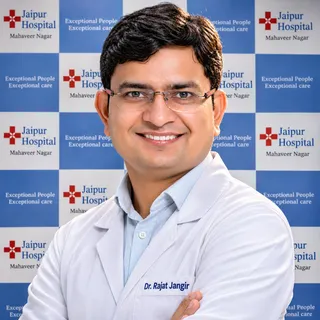
Your sports injury doctors
Explore our sports injury treatment centre in Jaipur: every treatment, the doctors and what to expect at your visit.
Frequently asked questions
Questions patients ask about revision acl reconstruction
What does revision ACL reconstruction involve?
In short
Revision ACL reconstruction at Jaipur Hospital replaces a failed graft from a previous surgery. The operation takes two to three hours under spinal or general anaesthesia. You stay in hospital for two to three nights. The surgeon removes the old graft, addresses tunnel widening or malposition, and places a new graft using autograft or allograft tissue.
In detail
Revision surgery is more complex than primary reconstruction because earlier tunnel placement may limit options for new tunnels. The surgeon evaluates tunnel position, bone loss, and any associated meniscus or cartilage injuries.
Techniques include single-stage revision with autograft (contralateral patellar tendon or quadriceps tendon) or allograft, or a two-stage approach with bone grafting when tunnels are significantly widened. Evidence shows autografts are often preferred for lower re-tear rates, while allografts avoid donor-site morbidity. The choice depends on tunnel condition, previous graft type, and your activity goals.
A common belief
Many people think revision is just a repeat of the first surgery.
What actually happens
It is more complex because old tunnels may be widened or malpositioned, and there may be cartilage or meniscus damage that needs attention at the same time.
Your next step at Jaipur Hospital
After surgery, you begin protected weight-bearing and physiotherapy. Return to sports typically takes nine to twelve months. The typical cost range in India is ₹2,50,000 to ₹4,50,000; ask us for an estimate. Your surgeon will discuss graft options and the rehabilitation plan at the consultation.
Which tests and scans do I need before revision ACL reconstruction?
In short
Before revision ACL reconstruction at Jaipur Hospital, you need a detailed clinical examination and imaging to assess the previous tunnels, bone quality, and any associated injuries. Standard tests include weight-bearing X-rays of the knee in multiple views and an MRI scan to evaluate graft status, tunnel position, meniscus, and cartilage. The MRI and any CT scan are performed at an imaging centre outside the hospital; our team reviews the images.
In detail
Evidence highlights that studying details of the index surgery and imaging is critical prior to planning revision. X-rays show tunnel widening, osteolysis, and alignment. MRI provides soft-tissue detail: graft integrity, tunnel position, meniscus tears, and cartilage defects.
In some cases, a CT scan may be advised for precise three-dimensional tunnel measurement, especially if bone loss is suspected. Blood tests (haemoglobin, infection markers, coagulation profile) and a pre-anaesthesia check are also required. Infection must be ruled out before any reconstructive procedure.
A common belief
Patients often assume the hospital does the MRI or CT on site.
What actually happens
Jaipur Hospital has X-ray but no CT or MRI scanner. The scans are done at a diagnostic centre, and our team analyses the results to plan the surgery.
Your next step at Jaipur Hospital
Bring all previous operative notes, implant records, and imaging to your appointment. The surgeon will advise which additional scans are needed after the initial review.
How painful is revision ACL reconstruction and the early recovery?
In short
Revision ACL reconstruction at Jaipur Hospital is performed under spinal or general anaesthesia so you do not feel pain during the operation. After surgery you will have pain and swelling around the knee and at the graft harvest site if an autograft is used. The team gives regular pain relief and ice therapy to keep you comfortable.
In detail
Pain after revision surgery comes from the new bone tunnels, the graft fixation and the donor site if your own tendon is taken. Studies show anterior knee pain and stiffness are the most frequent complaints after revision ACL reconstruction.
A quadriceps tendon autograft tends to cause less donor-site pain than a hamstring or patellar tendon graft. The anaesthetist plans a multimodal regimen including nerve blocks, oral tablets and anti-inflammatory medicines.
Most patients need strong pain relief for the first two to three days, then switch to milder tablets. Early movement and physiotherapy reduce stiffness and improve pain scores over the first two weeks.
A common belief
Many people expect revision surgery to be much more painful than the first operation.
What actually happens
In reality the pain pattern is similar; the main difference is the donor-site discomfort if a new autograft is taken. Quadriceps tendon grafts usually cause less harvest pain than hamstring or patellar tendon grafts.
Your next step at Jaipur Hospital
You will stay in hospital for two to three nights while pain is controlled and you learn to walk with crutches. Before discharge the nurse shows you how to ice the knee, do ankle pumps and take your tablets on schedule. A follow-up visit is usually at ten to fourteen days for wound check and suture removal.
How long does recovery usually take after revision ACL reconstruction?
In short
Recovery after revision ACL reconstruction at Jaipur Hospital takes longer than after a first ACL surgery. You will use crutches and a brace for several weeks. Return to daily activities and desk work is usually possible by six to eight weeks. Full return to sports typically takes nine to twelve months. The hospital stay is two to three nights.
In detail
Studies show revision surgery produces good but inferior outcomes compared with primary reconstruction. The pivot shift test remains abnormal in more patients after revision. Return to any sport is reported in a majority, but return to pre-injury level is lower.
Professional athletes often shift to amateur participation. Graft survival at five years is around eighty percent, lower than the ninety percent seen after primary surgery.
Rehabilitation progresses through phases: protection and range of motion in the first six weeks, strengthening from six weeks to six months, and sport-specific drills after six months.
Your surgeon and physiotherapist will guide the timeline based on your graft type, any additional procedures and your knee's response.
A common belief
Patients often expect the same timeline as their first ACL surgery.
What actually happens
Evidence shows revision recovery is slower: graft survival at five years is about eighty percent versus ninety percent for primary, and fewer athletes return to their previous competitive level. Many shift from professional to amateur sport.
Your next step at Jaipur Hospital
You will attend physiotherapy two to three times a week initially. Follow-up visits are at two weeks, six weeks, three months, six months and one year. A gradual return-to-sport test battery is done around nine months.
Can a failed ACL heal with rehabilitation alone, or is revision ACL reconstruction worth considering?
In short
A failed ACL graft does not heal on its own. Rehabilitation can improve muscle control and reduce episodes of giving way, but it cannot restore the mechanical stability that a torn or stretched graft has lost. Revision ACL reconstruction at Jaipur Hospital is considered when the knee remains unstable despite adequate physiotherapy, or when you wish to return to pivoting sports. The decision depends on your symptoms, activity goals and the condition of the knee.
In detail
Studies show recurrent instability is the major indication for revision surgery. Non-operative management may be suitable for low-demand patients who are willing to modify activities and use a brace. However, ongoing instability increases the risk of further meniscus tears and cartilage damage, which accelerates osteoarthritis.
In young active patients, revision surgery restores anterior-posterior laxity to near-normal levels and improves pivot shift grades, though outcomes are inferior to primary reconstruction. Return to sport at any level is common, but return to pre-injury level is lower. Your surgeon will assess laxity, imaging findings and your functional demands before recommending surgery.
A common belief
Some patients hope that more physiotherapy will eventually stabilise the knee.
What actually happens
Evidence shows persistent instability leads to more meniscus and cartilage damage over time. Surgery restores stability but has a longer recovery and slightly lower success rates than the first operation.
Your next step at Jaipur Hospital
A trial of supervised rehabilitation for three to six months is reasonable if instability is mild. If giving way persists or you cannot do your desired activities, revision surgery is the next step. Imaging at an outside centre will evaluate tunnel position, bone loss and cartilage health.
Can I continue any training safely while I recover from revision ACL reconstruction?
In short
During recovery from revision ACL reconstruction at Jaipur Hospital you can maintain upper-body fitness and core strength from the early weeks. Lower-body training is restricted to protected range-of-motion and isometric exercises initially. Cardiovascular options such as upper-body ergometry or swimming with a pull buoy may be allowed once the wound heals.
In detail
Evidence shows that early protected motion reduces stiffness, which is a frequent complication after revision surgery. However, loading the graft too soon risks tunnel widening and graft laxity.
The physiotherapy team designs a programme that preserves cardiovascular fitness and proximal strength without compromising the healing graft. Activities are progressed based on clinical milestones, not a fixed calendar.
A common belief
Many patients either stop all exercise or push lower-body work too soon.
What actually happens
Both increase risk: inactivity causes deconditioning, while early loading can widen tunnels. A structured cross-training plan balances fitness and graft protection.
Your next step at Jaipur Hospital
Your physiotherapist will give you a weekly plan showing what is allowed at each stage. Do not add exercises without clearance.
Why might my doctor recommend revision ACL reconstruction?
In short
Your doctor may recommend revision ACL reconstruction at Jaipur Hospital if your knee remains unstable after a previous ACL surgery. Recurrent giving way, pain, or stiffness despite rehabilitation suggests the graft has failed. The most common causes are tunnel malposition and a new traumatic injury to the graft.
In detail
Studies report that technical error, especially femoral tunnel malposition, contributes to failure in a majority of cases. A traumatic re-rupture accounts for about 55% of failures, while gradual non-traumatic failure occurs in about 25%.
Tunnel widening (osteolysis) and associated meniscus or cartilage damage also drive the decision.
If the knee gives way during daily activities or pivoting sports, and imaging shows graft rupture or laxity with malpositioned tunnels, revision surgery is considered to restore stability and protect the joint from further wear.
A common belief
Some patients think instability will improve with more physiotherapy.
What actually happens
In revision cases, the anatomy is changed and the graft is often ruptured or stretched. Physiotherapy alone cannot fix a torn graft or malpositioned tunnels.
Your next step at Jaipur Hospital
The surgeon will review your symptoms, examine your knee, and assess imaging before advising surgery. Delaying may lead to further meniscus tears or cartilage wear. The typical cost range in India is ₹2,50,000 to ₹4,50,000.
How should I prepare in the days before revision ACL reconstruction?
In short
In the days before revision ACL reconstruction at Jaipur Hospital, you should complete all advised blood tests and the pre-anaesthesia assessment. Stop smoking if you smoke, as it impairs bone and soft-tissue healing. Arrange for an attendant to stay with you during the two to three night hospital stay. Prepare your home for limited mobility: keep essentials within reach and plan for help with daily tasks.
In detail
Evidence shows that revision surgery is more complex than primary reconstruction, with compromised anatomy and limited graft options. Good pre-operative conditioning helps recovery. The surgeon may advise pre-habilitation exercises to maintain quadriceps strength and knee range of motion.
Confirm which regular medicines to continue or pause, especially blood thinners, diabetes medication, and supplements. Ensure any skin infections, cuts, or dental issues are treated before surgery to reduce infection risk. The hospital will give you a specific fasting and medication instruction sheet closer to the date.
A common belief
Some patients think preparation is just fasting the night before.
What actually happens
In reality, stopping smoking, doing pre-hab exercises, and clearing infections weeks ahead make a measurable difference to healing after a complex revision procedure.
Your next step at Jaipur Hospital
Pack comfortable clothing, your regular medicines in original packs, and any imaging reports. The admission process usually starts on the morning of surgery.
What are the common side effects and the less common serious complications of revision ACL reconstruction?
In short
Common side effects after revision ACL reconstruction at Jaipur Hospital include knee stiffness, swelling, anterior knee pain and numbness around the incision. These usually improve with physiotherapy over several weeks. Less common serious complications are deep infection, graft re-rupture, blood clot in the leg veins, nerve or vessel injury and persistent instability. The overall complication rate in studies is about ten percent.
In detail
Stiffness and anterior knee pain are reported as the most frequent issues after revision surgery. Donor-site morbidity occurs in up to fourteen percent with quadriceps tendon and up to twenty-four percent with hamstring autografts. Reoperations are mostly for débridement or meniscectomy.
Infection rates in large series are below two percent. Graft failure rates vary by graft type: quadriceps tendon around seven to ten percent, hamstring tendon around thirteen to seventeen percent, and bone-patellar tendon-bone around eight to nine percent. Your surgeon will discuss the risks that apply to your knee.
A common belief
Patients often worry most about infection or the graft tearing again.
What actually happens
In studies the overall complication rate is about ten percent, with infection under two percent. Stiffness and anterior knee pain are actually far more common but usually improve with guided rehabilitation.
Your next step at Jaipur Hospital
You will be taught exercises to minimise stiffness and swelling. Watch for increasing redness, warmth, fever, calf pain or sudden giving way of the knee and contact the hospital immediately if they occur. Routine follow-ups are at two weeks, six weeks, three months and six months.
Which symptoms are expected after revision ACL reconstruction, and which need urgent medical attention?
In short
Expected symptoms after revision ACL reconstruction at Jaipur Hospital include moderate knee pain, swelling, bruising around the thigh or calf, stiffness especially in the morning, a clicking sensation and patchy numbness near the incision. These improve steadily over weeks. Urgent symptoms are increasing redness or heat around the wound, fever above 38°C, severe calf pain or swelling, sudden inability to bear weight, or the knee giving way completely.
In detail
Pain and swelling peak in the first three days and then decline. Bruising may track down the leg due to gravity. Stiffness is common because the knee is protected in a brace initially.
Numbness over the front of the knee is normal after skin nerves are divided. Studies report anterior knee pain and stiffness as the most frequent ongoing issues. Infection occurs in under two percent of cases but needs immediate treatment.
Deep vein thrombosis is rare but presents as calf pain and swelling. Graft re-rupture usually happens with a twisting injury and a popping sensation.
A common belief
Patients often mistake normal bruising tracking down the calf for a complication.
What actually happens
Conversely, they may ignore a hot, red wound thinking it is just healing. Infection and blood clots are rare but need same-day assessment.
Your next step at Jaipur Hospital
Keep the leg elevated and apply ice packs as advised. Take prescribed painkillers on schedule. Do the prescribed exercises to prevent stiffness. If any urgent symptom appears, call the hospital or visit the emergency department at once. Routine wound check is at ten to fourteen days.
FAQ library
Questions and answers about revision acl reconstruction
When you contact us
Get a clear plan and cost estimate
Contact Jaipur Hospital to have your scans reviewed, understand your graft options and receive a cost estimate before you decide.
- A consultation with a sports injury specialist in the OPD
- Your scans and reports reviewed, with tests done in-house if you need them (laboratory, X-ray and imaging)
- Your options explained in plain words, including whether you need surgery at all
- A cost estimate before you decide
- Help with cashless treatment under MAA Yojana, various government health care schemes and empanelled insurers and TPAs
- Follow-up visits after your treatment
Overview
Revision ACL Reconstruction: what to know
What revision ACL reconstruction is and how it happens
Revision ACL reconstruction is a repeat operation to replace a failed anterior cruciate ligament graft. The first reconstruction may fail because the new ligament tears again, stretches out, or does not heal in a way that keeps the knee stable. In plain terms, the knee gives way, feels loose, or stays painful and stiff after the first surgery and rehabilitation.
The frequency of primary ACL reconstruction is rising, so the number of revision surgeries is also increasing. Revision surgery is more complex than the first operation because the bone tunnels from the previous surgery may be widened, malpositioned, or filled with hardware that must be removed.
The surgeon must assess the state of the old tunnels, the condition of the cartilage and menisci, and the overall alignment of the leg before planning the new reconstruction.
Symptoms and warning signs that need urgent care the same day
- Knee locks and cannot straighten Mechanical block
- Hot, red, very painful with fever Possible infection
- Cannot bear weight after fresh injury Possible fracture
The main symptom of a failed ACL graft is a feeling that the knee gives way or cannot be trusted during daily activities or sport. This recurrent instability is the major indication for revision. Other common symptoms include pain, swelling, and stiffness that do not settle with a proper rehabilitation programme.
Seek care on the same day if the knee suddenly locks and you cannot straighten it, if it becomes hot, red and very painful with fever, or if you cannot bear weight at all after a fresh injury. These suggest a mechanical block, an infection, or a fracture that needs immediate assessment in the emergency department.
Causes and who is at higher risk
- 55% Traumatic re-rupture Most common reason for re-rupture
- 58% Technical error contribution Contributing factor in revisions
- 30 to 40 times Young athletes re-injury risk Greater risk than uninjured adolescents
- 2.1 times Hamstring autograft revision odds Greater odds vs bone-patellar tendon-bone
Failure after ACL reconstruction is usually grouped into patient-related, surgeon-related, and biological factors. The most common causes are tunnel malposition and recurrent trauma. In a large cohort, a traumatic non-contact injury to the graft was the most common reason for re-rupture (55%), while about 25% had a gradual, non-traumatic onset. In patients needing multiple revisions, gradual non-traumatic failure was the most common cause (47%).
Technical error during the first surgery is judged to be a contributing factor in 58% of revisions. The most frequent technical error is a non-anatomical femoral tunnel position. An anteriorly placed femoral tunnel stretches the graft during knee flexion, leading to plastic deformation and eventual graft incompetence. Malpositioned tunnels were found in 40% of patients undergoing revision in one series.
Tunnel widening (osteolysis) is driven by fixation technique, surgical approach, rehabilitation, and biological factors. Wider tunnels make the revision more difficult and may require a two-stage procedure with bone grafting.
Younger patients, especially those under 21, have the highest probability of needing revision within five years. Young athletes who return to sport after ACL reconstruction have a 30 to 40 times greater risk of a new ACL injury compared with uninjured adolescents. Patients under 25 have a combined ipsilateral and contralateral reinjury rate of about 21%.
Females have a higher risk of contralateral ACL injury after reconstruction. Female athletes also face higher re-injury rates, lower return-to-sport rates, and suboptimal clinical outcomes after revision.
Graft choice in the first surgery influences revision risk. Hamstring autografts have been associated with about 2.1 times greater odds of revision compared with bone-patellar tendon-bone autografts. Concomitant meniscus tears and cartilage injuries are more common at the time of revision and must be managed during the same operation.
How revision ACL failure is diagnosed: examination and tests
- Weight-bearing X-rays
- Assess alignment, joint space, tunnel position
- CT scan
- Measure tunnel diameter, position, bone loss
- MRI
- Evaluate graft, menisci, cartilage, other ligaments
- Blood tests
- Rule out infection before revision surgery
Diagnosis starts with a detailed history of the original injury, the first surgery, rehabilitation, and the current symptoms. The surgeon reviews the operative notes and images from the index procedure. Clinical examination checks for laxity using the Lachman test, pivot shift test, and instrumented side-to-side measurement (KT-1000).
In revision patients, preoperative Lachman grades are often 2 or higher, while postoperative tests typically become negative after successful revision. Pivot shift grades II or III are more common after revision than after primary surgery (7% vs 2%). Side-to-side laxity improves from a weighted mean of 8.0 mm preoperatively to 1.9 mm postoperatively.
Imaging includes weight-bearing X-rays of the knee to assess alignment, joint space, and tunnel position. CT scan is often used to measure tunnel diameter, position, and the degree of bone loss (osteolysis). MRI evaluates the graft integrity, menisci, cartilage, and other ligaments.
Jaipur Hospital has in-house X-ray; CT and MRI are done at an imaging centre outside the hospital and the surgical team reviews the images.
Infection must be ruled out before any revision surgery is planned. Blood tests (CRP, ESR) and, if needed, joint aspiration are used for this. Coronal or sagittal plane malalignment (varus/valgus or increased tibial slope) is also assessed because it may need correction with an osteotomy before or during the revision.
Treatment options without surgery and when surgery is advised
Non-surgical management focuses on physiotherapy to improve muscle control, proprioception, and strength. A hinged knee brace may provide external stability for daily activities. Activity modification — avoiding pivoting and contact sports — can reduce episodes of giving way. This approach is considered when the patient has low functional demands, minimal instability, or medical conditions that make surgery unsafe.
Surgery is advised when recurrent instability interferes with daily life or desired activities, when there are repairable meniscus tears or cartilage lesions that need a stable knee to heal, or when the patient wishes to return to pivoting sports.
The decision is based on the degree of laxity, the condition of the joint surfaces, the state of the bone tunnels, and the patient's goals.
Revision ACL reconstruction is typically performed arthroscopically. It may be done in a single stage or as a two-stage procedure if there is severe tunnel widening (over 14 mm), infection, or arthrofibrosis. Graft options include autograft from the contralateral patellar tendon or quadriceps tendon, allograft, or a combination with extra-articular reconstruction for anterolateral instability.
The surgeon will discuss which graft and technique suit your knee based on tunnel condition, donor site availability, and the need for additional procedures.
Preparing for revision ACL reconstruction
Do
- Bring records from first ACL surgery Operative note, implant details, imaging
- Get fresh X-rays and usually MRI Check graft, bone tunnels, menisci, cartilage
- Tell doctor about all medicines Especially blood thinners and allergies
- Bring comfortable clothes, crutches, regular medicines For hospital stay of two to three nights
Before the operation your surgeon will review the records from your first ACL surgery, including the operative note, implant details and any imaging you already have. You will need a fresh set of X-rays of the knee and usually an MRI to check the graft, the bone tunnels, the menisci and the cartilage.
If the tunnel position or size is unclear, a CT scan may be advised; this is done at an imaging centre outside the hospital and the surgeon reviews the images. Blood tests for infection markers and routine pre-anaesthesia work-up are standard. Tell your doctor about every medicine you take, especially blood thinners, and any allergies.
You will be asked to stop eating and drinking for at least six hours before the anaesthetic. Bring comfortable clothes, a pair of crutches if you already use them, and any regular medicines. An attendant should plan to stay with you during the hospital stay of two to three nights.
How revision ACL reconstruction is done
- Anaesthesia and approach Spinal or general, two to three hours
- Assess bone tunnels and remove hardware Based on tunnel condition and tissue quality
- Choose graft and technique Autograft, allograft, or two-stage with bone grafting
- Perform reconstruction arthroscopically In modular theatre
- Recovery area then ward Post-operative monitoring
The operation takes two to three hours under spinal or general anaesthesia. Your surgeon will choose the approach based on the condition of the bone tunnels, the quality of the remaining tissue and whether any hardware must be removed.
The main options are: single-stage revision using an autograft taken from your other knee (contralateral patellar tendon or quadriceps tendon); single-stage revision using an allograft (donor tissue) to avoid a second donor site; two-stage revision with bone grafting first when the tunnels are significantly widened or there is osteolysis, followed by reconstruction once the bone has healed; and hardware removal with simultaneous reconstruction if the old implants are causing impingement or infection.
Allograft tissue has become a recognised choice of graft for revision surgery. Autografts are preferred for revision ACL due to their lower re-tear rates and better outcomes. Quadriceps tendon autograft has similar clinical outcomes when compared to hamstring tendon and bone-patellar tendon-bone autografts for revision ACL reconstruction.
In studies, mean weighted Lysholm scores were 85.8 for quadriceps tendon, 82.5 for hamstring tendon, and 86.6 for bone-patellar tendon-bone autografts. The graft choice for revision ACL surgery should be decided before surgery based on the state of the bone tunnels, in particular their position and degree of bone resorption. Severe tunnel dilatation, infection, or arthrofibrosis necessitates a two-stage approach.
Extra-articular reconstruction for controlling anterolateral instability is frequently required as well. On the day of surgery you are admitted to the ward, the anaesthetist sees you, and the operation is performed in a modular theatre. After the procedure you go to the recovery area and then back to the ward.
Risks and possible complications of revision ACL reconstruction
- 14.6% Donor site morbidity quadriceps Quadriceps tendon autograft
- 23.6% Donor site morbidity hamstring Hamstring tendon autograft
- 9.7% Overall complication rate 27 out of 277 patients
- around 80% Revision graft survival at five years Lower than primary grafts
Revision ACL reconstruction is a complex undertaking due to limited graft options, compromised anatomy and a high frequency of associated injuries. The most frequent complications reported in studies are knee stiffness and anterior knee pain. Donor site morbidity was 14.6% for quadriceps tendon and 23.6% for hamstring tendon autografts.
In one series a complication was reported in 27 out of 277 patients (9.7%), including hypersensitive scars in five patients, infection in two cases, donor-site morbidity in two cases, and cyclops syndrome in one case. Reoperations were primarily débridement and meniscectomies.
Graft failure rates in studies vary: overall failure rates were 7.6% for quadriceps tendon, 13.3% for hamstring tendon, and 8.7% for bone-patellar tendon-bone autografts. In another cohort the average graft failure was 9.8% for quadriceps tendon and 17.4% for hamstring tendon.
The survival rate of revision grafts is around 80% at five years, which is lower than that of primary grafts. Associated meniscus tears and cartilage injuries are more common in revision than in primary surgery and need to be managed appropriately. Your surgeon will discuss the risks that apply to your knee before you decide.
Recovery and aftercare after revision ACL reconstruction
- Hospital stay Two to three nights
- Physiotherapy starts Day after surgery
- Stitches or clips removed About two weeks
- Return to running Four to six months
- Return to sports Nine to twelve months
- Follow-up visits Two weeks, six weeks, three months, six months, one year
You will stay in hospital for two to three nights. Pain is managed with regular medication. A hinged knee brace and crutches are used for the first few weeks; weight-bearing is guided by your surgeon and physiotherapist. Physiotherapy starts the day after surgery with gentle range-of-motion exercises and progresses through strengthening, balance and neuromuscular control.
The programme is longer and more gradual than after a primary ACL reconstruction. Return to running is usually around four to six months, and return to sports takes nine to twelve months.
In studies, a relatively high rate of return to sport at any level was reported, but the rate of return to sport at the pre-injury level was relatively low. Many patients continued to play sports but switched from professional to amateur activities. The postoperative level of sports participation decreased slightly.
You should call the hospital or your surgeon if you develop increasing pain, swelling, redness, wound discharge, fever, or sudden giving way of the knee. Stitches or clips are removed at about two weeks. Follow-up visits are scheduled at two weeks, six weeks, three months, six months and one year, with X-rays at the later visits.
Results of revision ACL reconstruction
Studies show that revision ACL reconstruction produces good but inferior patient-reported and objective outcomes compared with primary ACL reconstruction. The degree to which outcomes are inferior varies widely among published studies and may be influenced by heterogeneity of patients, techniques, and endpoints assessed.
Patients who had revision surgery reported inferior Lysholm Knee Scoring Scale scores and inferior clinician-reported knee function on the objective IKDC classification. They also had more radiographic evidence of tibiofemoral osteoarthritis compared with patients who had primary surgery.
Revision ACL reconstruction restored similar anterior-posterior knee laxity compared with primary ACL reconstruction, but patients had inferior pivot shift test results (grade II or III: 7% vs 2%). In one study, Lysholm scores demonstrated good knee function in 6%, fair in 29%, and poor in 64% of revision patients.
According to IKDC scores, 5% had nearly normal knee function, 28% abnormal, and 67% very abnormal. Graft survival after revision was lower than after the primary operation. The 5-year autograft survival after revision was around 80%, compared with about 91% after primary intervention.
Considering re-rupture alone as a failure endpoint likely underestimates the real failure rate; the percentage of failures increases noticeably when objective criteria are also considered. Patient expectations must be tempered because functional outcomes and return to pre-injury sports are inferior to a primary surgery. Your surgeon will explain what a realistic goal looks like for your knee.
Cost and insurance for revision ACL reconstruction in Jaipur
The typical price range for revision ACL reconstruction in India is ₹2,50,000 to ₹4,50,000. The final cost depends on the choice of graft (autograft or allograft), whether the surgery is single-stage or two-stage, the type of implants and fixation devices used, the length of hospital stay, and any additional procedures such as meniscus repair, cartilage treatment or extra-articular reconstruction.
Jaipur Hospital is a NABH-accredited multispeciality hospital established in February 1991. It accepts MAA Yojana, various government health care schemes and a panel of private insurers and TPAs. The hospital has a 24×7 emergency department, ICU, in-house pharmacy, in-house diagnostic laboratory and imaging (X-ray; no CT or MRI scanner), modular operation theatres and a physiotherapy department.
For an estimate specific to your case, contact the hospital on 0141-2551500, 0141-2554139 or 7414 001 001, or email [email protected].
