

Anaesthesia and Critical Care · Jaipur Hospital
Interventional Pain Management in Jaipur
Chronic pain limiting your life? Get a clear assessment and a step-by-step plan at Jaipur Hospital.
- Serving Jaipur since 1991 (35 years)
- NABH accredited
- 24×7 emergency & ICU
- Cashless: RGHS, MAA Yojana, CGHS + 22 insurers
- Procedure time
- 20 to 45 minutes
- Anaesthesia
- Local anaesthesia +/- sedation
- Recovery
- Observation 1 to 2 hours, home same day
- Price
- ₹8,000 to ₹40,000 per proceduretypical range in India; ask us for an estimate
Pain that stays
Chronic pain makes daily tasks hard and medicines stop working
You have tried rest, physiotherapy, and painkillers. The relief is short or the side effects are troubling. Work, sleep, and family time suffer. You need a clear next step that does not mean major surgery.
-
Medicines lose effect
Painkillers help less over time and can upset your stomach or kidneys.
-
Activity drops
Walking, sitting, or lifting becomes difficult, so you avoid them.
-
Sleep breaks
Pain wakes you up, leaving you tired and irritable the next day.
-
Surgery feels too big
You want relief but fear the risks and long recovery of an operation.
Current treatments for chronic pain have limited effectiveness and commonly known side effects.
Why Jaipur Hospital
You worry that the pain will never let you work a full day or play with your grandchildren again.
Your care plan
Your first steps with us
- 1 Call or visit OPD for a consultation with a pain specialist
- 2 Get scans and blood tests done in-house if needed
- 3 Undergo the image-guided procedure as a daycare case
- 4 Go home after observation and return for follow-up visits
How the procedure is done
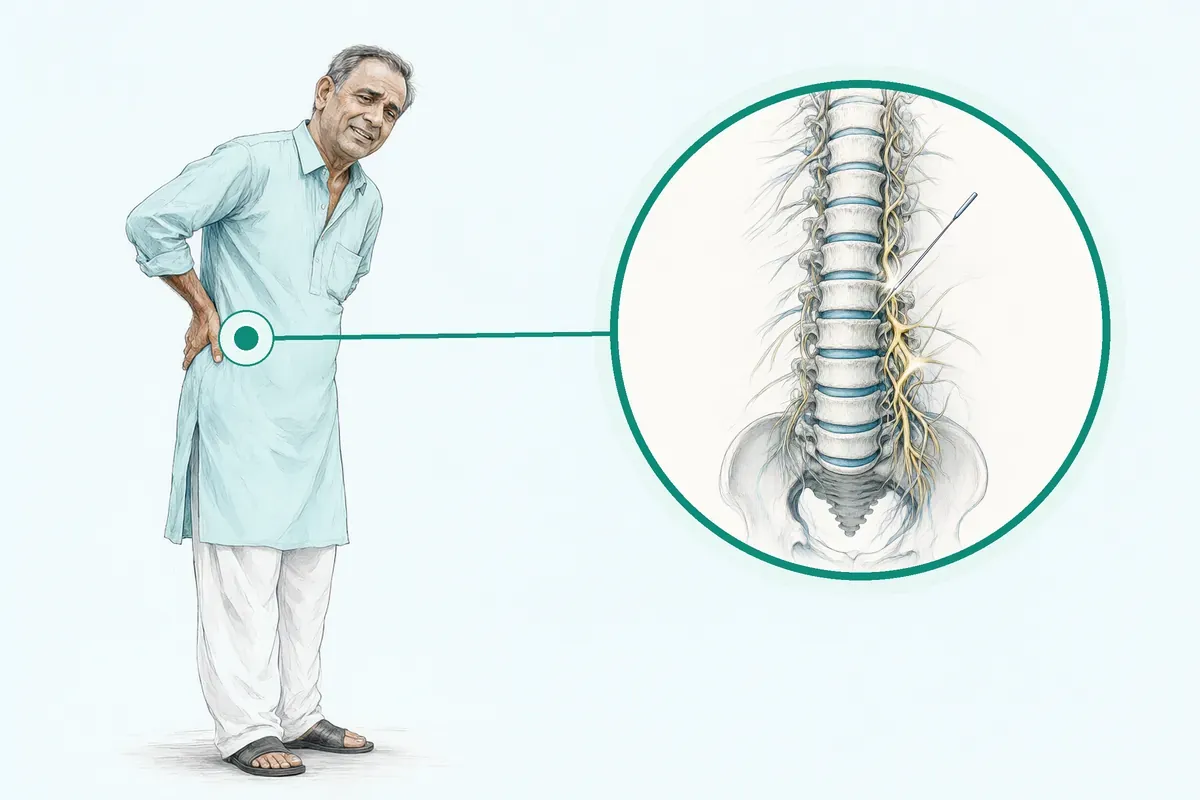
Under local anaesthesia with mild sedation, your surgeon uses X-ray or ultrasound guidance to place a thin needle near the target nerve or joint. The procedure takes 20 to 45 minutes. You stay for observation 1 to 2 hours and go home the same day.
-
Epidural Steroid Injection
Transforaminal or interlaminar approach for radiculopathy; steroid reduces nerve inflammation.
-
Facet Joint Injection / RFA
Medial branch block confirms the source; radiofrequency ablation may give longer relief.
-
Sympathetic Blocks
Stellate ganglion or lumbar sympathetic block for complex regional pain or vascular issues.
-
Peripheral Nerve Blocks
Ultrasound-guided injection around specific nerves for neuropathic pain.
Why patients trust us
- 1991 Serving Jaipur for 35 years
- NABH Accredited hospital
- 1 Anaesthesia and Critical Care consultants
- 24×7 Emergency, ICU and ambulance
- 25 Cashless schemes and insurers
What research shows about radiofrequency ablation
-
months to years
Many patients experience significant pain relief lasting months to years after RFA.
-
same day
RFA is often performed on an outpatient basis, meaning patients can go home the same day.
-
low, but includes infection
Risks are low but include infection; serious adverse events are uncommon in studies.
If it is left untreated
Untreated chronic pain can lead to reduced mobility, muscle weakness, sleep disturbance, low mood, and greater reliance on strong pain medicines with side effects.
Life after treatment
Most people return to daily routines with less pain and better movement within days to weeks.
-
Easier movement
Walking, sitting, and bending usually become more comfortable.
-
Less medicine
Many patients reduce or stop daily painkillers after effective relief.
-
Better sleep
Night pain often improves, so you wake up more rested.
-
Return to work
Most people resume light duties within a few days.
Frequently asked questions
Questions patients ask about interventional pain management
Which problems are assessed under interventional pain management?
In short
Interventional pain management at Jaipur Hospital assesses chronic pain conditions that have not responded to initial treatments. Our pain specialists evaluate persistent back pain, neck pain, radiculopathy, facet joint syndrome, neuropathic pain, and joint pain from osteoarthritis. The assessment focuses on identifying the specific pain generator to guide targeted image-guided therapy.
In detail
The evaluation follows a stepwise approach. First, the specialist reviews your history, previous imaging, and response to medicines or physiotherapy. A physical examination helps localise the pain source.
If the clinical picture suggests a specific nerve, joint, or sympathetic pathway, diagnostic blocks may be used to confirm the pain generator.
Evidence from pain literature shows that accurate diagnosis through controlled blocks improves the selection of patients for radiofrequency ablation or therapeutic injections, leading to better functional outcomes. The team considers conditions such as lumbar or cervical radiculopathy, facet-mediated pain, complex regional pain syndrome, and peripheral neuropathies.
A common belief
Many people assume any chronic pain qualifies for an injection.
What actually happens
In reality, the specialist must confirm the exact pain source with a diagnostic block before offering radiofrequency ablation or a therapeutic injection. Treating without a confirmed source often gives poor results.
Your next step at Jaipur Hospital
You can book a consultation at the pain clinic through the OPD. Bring prior MRI or CT reports, a list of current medicines, and notes on previous treatments. The specialist will discuss whether a diagnostic block or a therapeutic procedure is appropriate. Typical wait for a new appointment is a few days.
How will the doctor decide which tests I need for interventional pain management?
In short
At Jaipur Hospital, the pain specialist selects tests based on your history, examination, and the suspected pain generator. Common investigations include MRI of the relevant spine region, CT for bony detail, ultrasound for peripheral nerves or joints, and blood tests such as complete blood count, coagulation profile, and inflammatory markers. The choice is tailored to confirm the target before any image-guided procedure.
In detail
The decision follows a clinical reasoning pathway. If radiculopathy is suspected, MRI shows nerve root compression and disc morphology. For facet joint pain, MRI or CT reveals degenerative changes, but diagnostic medial branch blocks confirm the source.
Neuropathic pain may need nerve conduction studies or high-resolution ultrasound to visualise nerve entrapment. Blood tests assess fitness for the procedure, especially coagulation status, because needles are placed near neural structures. Prior imaging is reviewed to avoid duplication. The specialist orders only what changes management, adhering to the principle of justification for each investigation.
A common belief
Patients often expect a full panel of scans.
What actually happens
In practice, the doctor avoids unnecessary radiation or cost by ordering only the study that confirms the specific pain generator, such as an MRI for radiculopathy or a diagnostic block for facet pain.
Your next step at Jaipur Hospital
Bring all previous scans and blood reports to your OPD consultation at Jaipur Hospital. The doctor will review them and order only additional tests needed. Most imaging is available in-house, so MRI or CT can often be done the same day or within 48 hours.
Blood tests are drawn at the 24-hour laboratory. Once results are available, the procedure can be scheduled as a daycare case.
How soon should I expect improvement after the chosen interventional pain management treatment?
In short
At Jaipur Hospital, improvement timing varies by procedure. Epidural steroid injections may take a few days to two weeks. Facet joint radiofrequency ablation typically shows effect within two to four weeks. Nerve blocks can give immediate but temporary relief. Your surgeon will give a realistic timeline for your specific procedure.
In detail
Evidence shows many patients experience significant pain relief for months or even years after radiofrequency ablation, with improved mobility and functionality. Epidural steroids reduce inflammation gradually. Medial branch blocks are diagnostic; if positive, radiofrequency ablation follows for longer relief.
Recovery after each procedure involves 1 to 2 hours observation, then home the same day. Full benefit may build over weeks as inflammation settles or nerve ablation takes effect.
A common belief
Patients often expect instant, long-term relief.
What actually happens
In reality, the full effect builds over weeks, and some procedures are diagnostic first. Knowing the timeline avoids frustration.
Your next step at Jaipur Hospital
Plan for a follow-up at 2 to 4 weeks to assess response. Keep a pain diary. Most procedures can be repeated if needed.
How will you identify the source of my pain before an interventional pain management procedure?
In short
The pain specialist at Jaipur Hospital identifies the pain source through a detailed history, focused physical examination, and review of imaging such as MRI or CT scans. Diagnostic blocks using local anaesthetic under image guidance are then used to confirm which nerve or joint is generating the pain before any therapeutic injection or radiofrequency ablation is performed.
In detail
Chronic pain often arises from multiple structures, so a systematic approach is essential. The clinician first maps your pain pattern, aggravating and relieving factors, and neurological signs. Imaging shows structural changes but does not always correlate with symptoms.
Therefore, diagnostic nerve blocks or medial branch blocks are performed under fluoroscopy or ultrasound. If the block produces significant temporary relief, it confirms the target. This step reduces the chance of treating the wrong level or missing a contributing source. Evidence supports that image-guided diagnostic blocks improve the accuracy of subsequent therapeutic procedures such as radiofrequency ablation.
A common belief
Many patients assume an MRI alone pinpoints the pain source.
What actually happens
Imaging shows anatomy, not pain. Diagnostic blocks are the standard way to prove which structure is responsible before treatment.
Your next step at Jaipur Hospital
Bring all previous imaging reports, medication lists, and referral notes to your first OPD visit. The specialist may order updated scans if the existing ones are older than six months. A diagnostic block is usually scheduled as a separate daycare appointment. Based on the result, the therapeutic plan is finalised.
How can I decide whether to seek advice about epidural steroid injection?
In short
You may consider advice about an epidural steroid injection when back or leg pain from a disc prolapse or spinal stenosis limits daily activity despite rest, physiotherapy and simple analgesics. Jaipur Hospital offers image-guided epidural steroid injections as a daycare procedure under local anaesthesia with sedation.
In detail
An epidural steroid injection places corticosteroid near the inflamed nerve root to reduce swelling and pain signals. The procedure takes 20 to 45 minutes using fluoroscopic or ultrasound guidance.
In studies, many patients report meaningful relief for weeks to months, which can allow progress in rehabilitation. It is usually tried after conservative measures and before surgery is considered. The technique may be transforaminal or interlaminar depending on the level and anatomy. Risks include temporary soreness, headache, infection or bleeding, all of which are uncommon with image guidance.
A common belief
Some people expect the injection to fix the disc itself.
What actually happens
It does not repair the structure; it reduces inflammation around the nerve so you can move and strengthen. Relief varies and may last weeks to months.
Your next step at Jaipur Hospital
Bring recent MRI films, a list of current medicines and any allergy details to the pain OPD. The surgeon will review imaging, examine you and discuss whether an injection fits your care plan. If indicated, the procedure can be scheduled within days. You will need an attendant to take you home after observation.
How will my medical history and current medicines affect the care plan?
In short
Your medical history and current medicines directly shape the care plan at Jaipur Hospital because they influence bleeding risk, sedation safety, infection risk, and the choice of injection technique or medication. The surgeon reviews every detail before recommending a procedure.
In detail
Blood thinners such as warfarin, clopidogrel, apixaban, or aspirin increase bleeding risk during needle placement near nerves or the spinal canal.
Guidelines typically advise stopping aspirin or clopidogrel seven to ten days before, warfarin three to five days before with INR check, and bridging with heparin in selected cases. Diabetes affects steroid choice and blood sugar monitoring after steroid injections. Uncontrolled hypertension may delay elective procedures.
Allergies to local anaesthetics, contrast, or steroids require alternative agents. Active infection or fever postpones the procedure. Kidney or liver impairment may alter drug dosing. The surgeon coordinates with your cardiologist or physician for safe medication adjustments.
A common belief
Patients sometimes stop blood thinners on their own.
What actually happens
That can cause a stroke or heart attack. Always let the pain team coordinate with your cardiologist for a safe bridging plan.
Your next step at Jaipur Hospital
Bring a complete list of medicines including over-the-counter supplements, recent blood reports (INR, blood sugar, creatinine), and letters from other specialists. Do not stop any medicine without the surgeon's instruction. The team will give you a written plan for medication changes before the procedure date.
Which symptoms should prompt me to see a specialist for interventional pain management?
In short
You should see a pain specialist at Jaipur Hospital when pain persists beyond three months despite medicines, physiotherapy, and activity modification. Typical symptoms include radiating arm or leg pain suggesting nerve root compression, localised back or neck pain worsened by movement or posture, burning or shooting neuropathic pain, and joint pain that limits daily function. Pain that disturbs sleep or reduces walking distance also warrants assessment.
In detail
Chronic pain is defined as pain lasting longer than the expected healing time, usually over twelve weeks. When first-line measures such as NSAIDs, neuropathic agents, and structured rehabilitation fail to give meaningful relief, guidelines recommend referral for interventional evaluation.
The specialist looks for a match between your symptom pattern, examination findings, and imaging. For example, dermatomal leg pain with a corresponding disc prolapse on MRI supports a transforaminal epidural steroid injection. Neuropathic pain with allodynia may indicate a peripheral nerve block. The goal is to identify a treatable target before proceeding.
A common belief
Patients often wait years or keep increasing painkillers.
What actually happens
Guidelines suggest referral when first-line treatments fail, so the specialist can confirm a treatable target with imaging and examination before offering an injection or nerve block.
Your next step at Jaipur Hospital
Ask your treating doctor for a referral to the pain clinic at Jaipur Hospital or call the OPD directly. Carry all recent investigations, a list of current medicines, and any prior procedure records. The consultation typically lasts 20 to 30 minutes.
If a procedure is advised, it can be scheduled as a daycare case within the same week. Early referral avoids unnecessary opioid escalation.
How will the results change my care plan for interventional pain management?
In short
Test results at Jaipur Hospital directly shape whether you proceed with an image-guided injection, nerve block, or radiofrequency ablation, or need a different pathway. Imaging that confirms a clear target such as a compressed nerve root or arthritic facet joint supports a therapeutic procedure. If scans show no treatable lesion, or reveal red flags like infection or tumour, the plan shifts to medical management, urgent referral, or surgery instead.
In detail
The care plan is built on the match between symptoms, examination, and investigations. A positive diagnostic block with over 50 percent pain relief confirms the facet joint as the source and predicts benefit from radiofrequency ablation.
An epidural steroid injection is offered when MRI shows concordant nerve root compression. If imaging is negative but pain persists, the specialist may trial medications, physiotherapy, or refer for multidisciplinary pain management. Blood results affect timing: abnormal coagulation delays the procedure until corrected. Each result either green-lights the intervention, modifies the technique, or redirects care entirely.
A common belief
Patients often assume an abnormal scan automatically means a procedure.
What actually happens
In reality, the specialist looks for concordance between your symptoms, exam, and imaging. A mismatch may lead to non-interventional care, while a clear target with a positive diagnostic block green-lights radiofrequency ablation.
Your next step at Jaipur Hospital
After your tests are complete, the pain specialist at Jaipur Hospital will discuss the findings and the revised plan in a follow-up OPD visit or by phone. If a procedure is indicated, it is booked as a daycare case, typically within one to two weeks. If results suggest an alternative path, the doctor will explain the options and arrange the appropriate referral.
What should I do if symptoms persist or worsen after an interventional pain management procedure?
In short
If your pain or other symptoms persist or worsen after an interventional pain management procedure at Jaipur Hospital, contact your surgeon or the pain management team immediately. You may need a follow-up assessment to review the treatment response and adjust the plan. Do not wait for the next scheduled visit if you notice increasing pain, new numbness, weakness, fever, or signs of infection at the injection site.
In detail
Interventional procedures such as epidural steroid injections, facet joint blocks, or radiofrequency ablation aim to reduce chronic pain, but individual responses vary.
Evidence shows that while many patients experience significant relief for months or years, some may have incomplete relief or a return of symptoms over time.
Persistent or worsening symptoms could indicate that the treated nerve was not the sole pain source, that inflammation has recurred, or that a complication such as infection or bleeding has developed.
Early reporting allows your surgeon to arrange timely imaging, repeat examination, or a change in therapy, which may include medication adjustment, physiotherapy referral, or a repeat procedure if appropriate.
A common belief
Some people hope the pain will settle on its own, but delaying can miss an infection or a nerve issue that needs quick attention.
What actually happens
Early review lets the team adjust medicines, order a scan, or plan a repeat procedure if needed.
Your next step at Jaipur Hospital
Keep a simple pain diary noting the score, timing, and activities that affect your symptoms. Call the hospital on 0141-2551500 or 0141-2554139 to speak with the pain management coordinator.
If you develop fever, severe headache, progressive weakness, or loss of bladder or bowel control, attend the 24×7 emergency department at Jaipur Hospital without delay.
Is the injection or procedure intended to diagnose the pain, treat it, or both?
In short
At Jaipur Hospital, interventional pain management procedures can be diagnostic, therapeutic, or both. A diagnostic block uses a small amount of local anaesthetic to confirm whether a specific nerve or joint is the pain source. A therapeutic injection adds a steroid or uses radiofrequency ablation to provide longer-lasting relief. Your surgeon will explain which type is planned for you.
In detail
Diagnostic blocks are typically short-acting; if your pain drops significantly during the anaesthetic effect, it confirms the target. Therapeutic epidural steroid injections aim to reduce inflammation around nerves for weeks to months.
Radiofrequency ablation uses heat to disrupt pain signals from medial branch nerves, with evidence showing relief lasting months to years in many patients.
Some procedures combine both: a diagnostic block is done first, and if positive, radiofrequency ablation follows in the same or a later session. The choice depends on your clinical picture, imaging findings, and previous treatment response. Your surgeon discusses the goal, expected duration, and next steps before you consent.
A common belief
Patients often think every injection is a treatment.
What actually happens
In reality, a diagnostic block is a test — it tells the surgeon if radiofrequency ablation or a steroid injection at that spot is likely to help. Knowing the purpose sets the right expectations for how long relief may last.
Your next step at Jaipur Hospital
Ask your surgeon at the consultation whether the planned procedure is diagnostic, therapeutic, or both. Note the expected duration of any relief and what the follow-up plan is if relief is partial or temporary.
FAQ library
Questions and answers about interventional pain management
When you contact us
Get your pain plan today
Contact Jaipur Hospital for a consultation, in-house tests, a clear explanation of options, a cost estimate, cashless help, and follow-up care.
- A consultation with an anaesthesia and critical care specialist in the OPD
- Your scans and reports reviewed, with tests done in-house if you need them (laboratory, X-ray and imaging)
- Your options explained in plain words, including whether you need surgery at all
- A cost estimate before you decide
- Help with cashless treatment under RGHS, MAA Yojana, CGHS and empanelled insurers and TPAs
- Follow-up visits after your treatment
Overview
Interventional Pain Management: what to know
What is chronic pain and how it happens
- Lasts over three months
- Continues after injury heals
- Nerves misfire
- Send pain signals without damage
- Targets specific sources
- Image-guided injections and ablation
Chronic pain is pain that lasts longer than three months, often continuing after the original injury or illness has healed. It can affect the back, neck, joints, or nerves and may come from problems in the spine, muscles, or nervous system. In many cases the nerves keep sending pain signals to the brain even when there is no ongoing damage.
Current treatments for chronic pain have limited effectiveness and commonly known side effects. Interventional pain management uses image-guided injections, nerve blocks, and radiofrequency ablation to target the specific nerves or joints that are generating the pain signals.
Symptoms and warning signs that need urgent care the same day
- Loss of bladder or bowel control
- Progressive weakness in legs or arms
- Numbness in saddle area
- Pain after a fall or injury
Common symptoms include:
- A dull ache
- Sharp shooting pain
- Burning
- Tingling
- Numbness
- Weakness in the area supplied by the affected nerve
Pain may worsen with certain movements, sitting, or standing for long periods. Some people notice reduced mobility or difficulty doing daily activities.
Warning signs that need medical attention on the same day are sudden loss of bladder or bowel control, progressive weakness in the legs or arms, numbness in the saddle area (inner thighs and buttocks), fever with severe back or neck pain, or pain after a fall or injury. These can indicate serious nerve compression, infection, or fracture and should be evaluated in the emergency department without delay.
Causes and who is at higher risk
- Disc herniation
- Disc presses on nerve
- Lifestyle risks
- Obesity, smoking, poor posture
Chronic pain often starts from:
- A disc herniation
- Spinal stenosis
- Facet joint arthritis
- Nerve injury
- Previous surgery
Age-related wear and tear, repetitive strain, poor posture, obesity, and smoking increase the risk. Inflammatory conditions such as rheumatoid arthritis and metabolic conditions like diabetes can also damage nerves and joints. People with physically demanding jobs, those who sit for long hours without breaks, and those with a family history of spine problems are more likely to develop persistent pain.
In studies of thyroid nodules, larger size and certain locations correlated with compressive symptoms, showing how structural changes can press on nerves and cause pain.
How it is diagnosed: examination and tests
Diagnosis begins with a detailed history and physical examination. Your doctor will check movement, reflexes, sensation, and muscle strength. Pain scores are often recorded using a visual analogue scale from 0 to 10.
Imaging is used to confirm the source:
- X-rays show bone alignment and arthritis
- MRI shows discs, nerves, and soft tissues
- CT scans give detailed bone images
For nerve-related pain, nerve conduction studies or electromyography may be done. In some cases, a diagnostic injection with local anaesthetic near a suspected nerve or joint is used — if the pain improves briefly, that spot is confirmed as the source. Ultrasound examination is important to characterise the anatomy and evaluate surrounding structures before any image-guided procedure. Blood tests such as complete blood count, coagulation profile, and kidney and liver function are checked before an intervention.
Treatment options without surgery and when surgery is advised
Non-surgical treatment is tried first for most people. It includes physiotherapy, activity modification, pain medications (paracetamol, NSAIDs, neuropathic pain drugs like gabapentin or pregabalin), and psychological support for chronic pain coping. Image-guided interventions are the next step when these measures do not give enough relief.
Options include epidural steroid injections for radiculopathy, facet joint injections or medial branch blocks with radiofrequency ablation for facet joint pain, sympathetic blocks for complex regional pain syndrome, and peripheral nerve blocks for neuropathic pain. Radiofrequency ablation uses heat to interrupt pain signals from specific nerves and can give relief for months to years.
It is minimally invasive, usually done as a daycare procedure, and recovery is shorter than surgery. RFA is typically considered when patients have exhausted other treatment options such as physical therapy, medications, or other interventional procedures.
Surgery is advised when there is progressive neurological deficit, cauda equina syndrome, spinal instability, or when imaging shows a structural problem that cannot be managed with injections or ablation. Your surgeon will discuss the risks and expected outcomes of each option based on your condition and overall health.
Preparing for interventional pain management at Jaipur Hospital
Do
- Confirm blood thinner schedule with surgeon
- Bring insurance cards and photo ID
Avoid
- Wear jewellery or bring valuables
Before your procedure, you will have a consultation with your surgeon and the anaesthesia team. They will review your medical history, current medicines, and any allergies. You should bring a list of all medicines you take, including those bought from a chemist without a prescription, and any supplements.
Blood thinners such as aspirin, clopidogrel, or warfarin may need to be stopped several days before the procedure; your surgeon will tell you exactly when to stop and when to restart them. Other medicines for blood pressure, diabetes, or thyroid are usually continued, but confirm with your doctor.
You may need blood tests to check haemoglobin, clotting function, and kidney and liver function. Imaging such as an MRI, CT scan, or ultrasound may be reviewed or repeated to plan the needle path. If you are on anticoagulants, the team will assess the risk of stopping them versus the risk of bleeding during the procedure.
You will be asked to fast for at least six hours before the procedure if sedation is planned. Wear loose, comfortable clothing and leave jewellery and valuables at home. Arrange for an attendant to stay with you at the hospital and to take you home afterwards, as you will not be allowed to drive after sedation. Bring your insurance cards, any scheme documents such as RGHS, MAA Yojana, or CGHS papers, and a photo ID.
How interventional pain management is done at Jaipur Hospital
- Lie on procedure table, skin cleaned
- Contrast dye confirms correct spread
- Medicine or radiofrequency energy delivered
All procedures are performed in a modular operation theatre under image guidance using fluoroscopy or ultrasound. You will lie on the procedure table, and the skin is cleaned with antiseptic. Local anaesthetic is injected to numb the skin and deeper tissues. Sedation may be given through an intravenous line to keep you comfortable and relaxed.
Your surgeon will choose the technique based on your pain pattern, imaging findings, and response to previous treatments. The main options are:
- Epidural steroid injection (transforaminal or interlaminar) for radiculopathy from a slipped disc or spinal stenosis.
- Facet joint injection or medial branch block, followed by radiofrequency ablation (RFA) of the medial branch nerves if the block gives good relief.
- Sympathetic blocks such as stellate ganglion block or lumbar sympathetic block for complex regional pain syndrome or vascular pain.
- Peripheral nerve blocks under ultrasound guidance for neuropathic pain in the arms or legs.
A thin needle is advanced under real-time imaging to the target site. Contrast dye may be injected to confirm correct spread. For injections, a mixture of local anaesthetic and steroid is deposited. For RFA, a special needle delivers radiofrequency energy that heats the nerve tissue to interrupt pain signals. The procedure usually takes 20 to 45 minutes.
After the needle is removed, a small dressing is applied. You are then moved to the recovery area for observation for one to two hours before discharge the same day.
Risks and possible complications of interventional pain management
- Common minor effects
- Soreness, brief pain flare, temporary numbness
- Less common complications
- Infection, bleeding, nerve injury
- Rare serious events
- Dural puncture, pneumothorax, stroke
Interventional pain procedures are generally safe, but like any medical procedure they carry risks.
Common minor side effects include:
- Temporary soreness or bruising at the needle site
- A brief flare of pain for a day or two
- Numbness or weakness that lasts a few hours from the local anaesthetic
Less common but recognised complications include infection at the injection site, bleeding or haematoma (more likely if blood thinners are not stopped correctly), and nerve injury causing new numbness or weakness. Rare complications reported in studies include dural puncture with headache after epidural injections, pneumothorax with certain neck or chest approaches, and allergic reaction to contrast or steroid. Serious adverse events such as stroke, spinal cord injury, or death are extremely rare.
If you are on anticoagulants, the risk of bleeding is higher; the team will balance this against the risk of stopping the medicine. Patients with abnormal platelet counts or clotting tests need careful evaluation before proceeding. Your surgeon will discuss the risks that apply to your specific procedure and anatomy.
Recovery and aftercare after interventional pain management
- First 24 hours No driving, machinery, legal documents, or alcohol if sedated
- Few days to weeks Steroid injection relief may start
- Two to four weeks RFA relief usually develops
After the procedure you will rest in the recovery area for one to two hours. Nurses will check your blood pressure, heart rate, and the movement and sensation in your limbs. You can eat and drink once you are fully awake. Most patients go home the same day.
For the first 24 hours, avoid driving, operating machinery, signing legal documents, or drinking alcohol if you had sedation. Keep the dressing clean and dry; you may remove it the next day. You may feel some soreness at the needle site; a simple painkiller such as paracetamol is usually enough.
If you stopped blood thinners, your surgeon will tell you when to restart them; typically heparin can be restarted 2 to 6 hours after the procedure, warfarin the same night, and aspirin or clopidogrel the next day.
Pain relief from steroid injections may start within a few days and can last weeks to months. Relief from RFA usually develops over two to four weeks and can last months to years. You can resume light activities the next day and return to work in one to three days depending on your job. Physiotherapy is often recommended after the pain settles to improve strength and flexibility.
Call the hospital or visit the emergency department if you develop fever above 38°C, severe or worsening pain, new numbness or weakness, difficulty passing urine, severe headache that gets worse when sitting up, or signs of infection at the needle site such as increasing redness, swelling, or discharge.
Results of interventional pain management in studies
In studies of patients with chronic back and neck pain, many people report significant pain relief for months to years after radiofrequency ablation. One large trial of spinal cord stimulation showed that at three months, about 84% of patients receiving high-frequency therapy had at least 50% reduction in back pain and 83% had similar relief in leg pain.
For RFA of facet joint pain, pain relief lasting six to twelve months is commonly reported, and the procedure can be repeated if the pain returns.
Epidural steroid injections for radiculopathy often give relief for several weeks to a few months, allowing time for natural healing and physiotherapy. Sympathetic blocks and peripheral nerve blocks may provide diagnostic information as well as therapeutic relief; the duration varies with the underlying condition.
Outcomes depend on the exact diagnosis, how long the pain has been present, and whether there is ongoing nerve compression or structural instability. In studies, quality of life scores generally improve after successful pain intervention, though the degree of improvement varies between individuals. Your surgeon will discuss what level of relief is realistic for your condition.
Cost and insurance for interventional pain management in Jaipur
The typical price range for an image-guided pain procedure at Jaipur Hospital is ₹8,000 to ₹40,000 per procedure. The final cost depends on the type of injection or ablation, the number of levels treated, whether sedation is used, the imaging modality (fluoroscopy or ultrasound), and any disposable needles or electrodes required.
Jaipur Hospital is empanelled under RGHS, MAA Yojana, CGHS, and a panel of private insurers and TPAs. If you are covered under one of these schemes, bring your scheme card and any pre-authorisation letter. The hospital's insurance coordination team will help verify coverage and process the claim.
For self-pay patients, a cost estimate can be provided after the surgeon reviews your case. The hospital has an in-house pharmacy and diagnostic laboratory, so medicines and any post-procedure tests are available on site.