

ENT (Ear, Nose and Throat) · Jaipur Hospital
Throat Voice and Swallowing in Jaipur
Hoarse voice or trouble swallowing? We assess the cause and give you a clear plan.
- Serving Jaipur since 1991 (35 years)
- NABH accredited
- 24×7 emergency & ICU
- Cashless: RGHS, MAA Yojana, CGHS + 22 insurers
- Consultation length
- 20 to 30 minutes
- Anaesthesia
- Topical spray if scoped
- Recovery
- Immediate
- Price
- ₹1,000 to ₹4,500typical range in India; ask us for an estimate
Voice and swallowing problems
My voice is hoarse and swallowing hurts
Hoarseness that lasts weeks, pain when you swallow, or a constant lump sensation can make eating and talking hard. These symptoms often point to vocal cord lesions, reflux or a swallowing disorder that needs proper checking.
-
Hoarse or raspy voice
Voice changes that do not go away with rest.
-
Pain or effort swallowing
Food feels stuck or causes coughing and choking.
-
Lump in throat feeling
Persistent sensation of something stuck when nothing is there.
-
Frequent throat clearing
Constant need to clear throat, often with reflux.
Vocal cord nodules and polyps form from repeated voice overuse or misuse, creating callus-like growths on the cords.
Why Jaipur Hospital
You worry that your voice will not come back or that eating will stay difficult, affecting work and family meals.
Your care plan
Your first steps with us
- 1 Call or visit OPD for an appointment.
- 2 Surgeon examines you and may scope the throat.
- 3 Review findings and agree on a treatment plan.
- 4 Start therapy, medicine or schedule surgery if needed.
How the assessment is done
A 20 to 30 minute OPD visit. The surgeon uses a thin flexible scope with topical spray to view your vocal cords and throat. Swallowing may be watched in real time with food or liquid.
-
Flexible Laryngoscopy
Office-based view of vocal cords and pharynx using a thin flexible scope with topical anaesthetic spray.
-
Videostroboscopy
Slow-motion analysis of vocal fold vibration to detect subtle lesions affecting voice quality.
-
FEES (Fiberoptic Endoscopic Evaluation of Swallowing)
Real-time swallowing safety assessment with different food textures to identify aspiration risk.
-
Laryngopharyngeal Reflux Therapy
Diet, lifestyle changes and acid suppression protocol to reduce throat irritation from reflux.
Why patients trust us
- 1991 Serving Jaipur for 35 years
- NABH Accredited hospital
- 2 ENT (Ear, Nose and Throat) consultants
- 24×7 Emergency, ICU and ambulance
- 25 Cashless schemes and insurers
What research shows
-
6 to 12 weeks
Vocal cord nodules often resolve within this period with proper voice therapy in studied patients.
-
A few weeks
Vocal cord polyps frequently go away on their own with voice rest in observed cases.
-
≥3-fold increase
Stroke patients with dysphagia show at least three times higher pneumonia risk in research cohorts.
If it is left untreated
Untreated swallowing difficulty can lead to malnutrition, dehydration and aspiration pneumonia, which carries a 21% 30-day mortality rate overall.
Life after assessment
Most people understand their condition and start a plan that lets them eat, speak and work with less worry.
-
Clear diagnosis
You know what is causing the hoarseness or swallowing trouble.
-
Practical plan
Therapy, diet changes or surgery options explained in plain words.
-
Safer eating
Swallowing strategies reduce choking risk and help nutrition.
-
Voice recovery
Guided voice rest and exercises help most people regain their voice.

Frequently asked questions
Questions patients ask about throat voice and swallowing
Which problems are assessed under throat voice and swallowing?
In short
Jaipur Hospital assesses hoarseness, throat pain, swallowing difficulty, and reflux under its throat voice and swallowing service. The consultation lasts 20 to 30 minutes and is done as an outpatient visit. A topical spray may be used if a scope is needed. The typical price range is ₹1,000 to ₹4,500.
In detail
The assessment covers four main areas. Hoarseness or voice change is examined by looking at the vocal cords for nodules, polyps, cysts, or other lesions that can develop from overuse, misuse, smoking, or reflux. Throat pain is evaluated for infection, inflammation, or structural causes.
Swallowing difficulty, or dysphagia, is assessed for oropharyngeal and oesophageal causes, including neurological conditions such as stroke or Parkinson's disease, where prevalence can exceed 80 percent.
Reflux, specifically laryngopharyngeal reflux, is reviewed through symptom history and examination, as it often contributes to voice and throat symptoms. The team uses flexible laryngoscopy for a direct view, videostroboscopy for slow-motion vibration analysis, and FEES for real-time swallowing safety evaluation.
- Swallowing difficulty, or dysphagia, is assessed for oropharyngeal and oesophageal causes, including neurological conditions such as stroke or Parkinson's disease, where prevalence can exceed 80 percent.
A common belief
Many people think hoarseness is just a cold or that swallowing trouble is only due to age.
What actually happens
In fact, these can be signs of vocal cord lesions, neurological conditions, or reflux that need specific evaluation.
Your next step at Jaipur Hospital
You can book a consultation at Jaipur Hospital for a 20 to 30 minute outpatient assessment. Bring any previous reports or medication lists. The specialist will decide which tests are needed based on your symptoms. Recovery is immediate after the visit. To arrange an appointment, contact Jaipur Hospital.
How will the doctor decide which tests I need?
In short
At Jaipur Hospital, the specialist decides tests based on your symptom history, voice use pattern, and a physical examination of the head and neck. The consultation lasts 20 to 30 minutes. Tests may include flexible laryngoscopy, videostroboscopy, or FEES, chosen to match your specific complaint.
In detail
The doctor first asks how you use your voice and examines your head and neck. If hoarseness is the main issue, flexible laryngoscopy gives a direct view of the vocal cords for nodules, polyps, or cysts.
Videostroboscopy adds slow-motion analysis of vocal fold vibration when vibration detail is needed. For swallowing difficulty or coughing when eating, FEES provides a real-time safety assessment of the swallow.
If reflux is suspected, the doctor may start with a symptom-based diagnosis and lifestyle review, as there is no single consensus test for laryngopharyngeal reflux. Screening tools such as the EAT-10 questionnaire may be used to quantify swallowing risk.
The goal is to identify the pathophysiology and select the corresponding treatment. High sensitivity is prioritised to avoid missing dysphagia.
A common belief
Patients often expect every test at once.
What actually happens
But each test answers a specific question. Doing the right one first avoids unnecessary procedures and gives a faster diagnosis.
Your next step at Jaipur Hospital
After the consultation, the specialist will explain which test is recommended and why. Most tests are done in the outpatient setting with topical spray if needed. Recovery is immediate. You will receive the findings and a care plan the same day.
How soon should I expect improvement after the chosen treatment for throat voice and swallowing problems?
In short
Improvement timing depends on the diagnosis and treatment plan. At Jaipur Hospital, voice therapy for nodules often shows change within six to twelve weeks. Reflux-related symptoms may improve within weeks of diet and acid suppression. Swallowing therapy progress varies with the underlying cause. Your surgeon will give a realistic timeline at your consultation.
In detail
Evidence shows vocal cord nodules can often disappear within six to twelve weeks with proper voice training by a certified therapist. Vocal cord polyps may resolve in a few weeks with voice rest.
Contact ulcers can take longer, sometimes needing at least six weeks of voice rest. Laryngitis from viral infection usually clears in one to three weeks, while overuse-related laryngitis improves in a few days with rest.
Reflux therapy follows a stepwise diet, lifestyle, and acid suppression protocol. Swallowing rehabilitation uses compensatory and rehabilitative strategies tailored to your pattern. The multidisciplinary team selects methods based on instrumental assessment findings such as FEES or videostroboscopy.
A common belief
Many people expect instant results, but tissue healing and muscle retraining take time.
What actually happens
Stopping therapy too early or returning to strain habits can delay recovery. The team sets realistic milestones so you know what to expect at each stage.
Your next step at Jaipur Hospital
You will receive a personalised plan after assessment. Follow-up visits track progress and adjust therapy. Most treatments are outpatient with immediate recovery after scoping. If symptoms do not improve within the expected window, further evaluation is arranged.
What symptoms suggest an infection, voice strain, reflux, or another cause for throat voice and swallowing problems?
In short
Different causes have overlapping but distinct clues. At Jaipur Hospital, infection often brings fever, sudden sore throat, and voice change that improves in one to three weeks. Voice strain shows hoarseness after heavy use, easing with rest. Reflux gives chronic throat clearing, globus sensation, and post-nasal drip without heartburn. Swallowing difficulty with coughing or weight loss suggests structural or neurological causes. Your surgeon identifies the pattern at consultation.
In detail
Evidence lists key symptoms: aspiration, residue, excessive throat clearing, coughing, hoarse voice, atypical ventilation periods, and repetitive swallowing point to oropharyngeal dysphagia. Vocal cord nodules and polyps present with hoarseness or raspy voice, often after overuse.
Polypoid corditis (Reinke's oedema) is almost exclusively linked to smoking. Contact ulcers cause pain and voice change. Laryngitis from viral infection resolves in one to three weeks; overuse laryngitis settles in days with rest.
Laryngopharyngeal reflux typically lacks classic heartburn but causes globus, chronic cough, and throat clearing. Neurological dysphagia appears in stroke, Parkinson's, and dementia with slowing of the swallow and self-feeding difficulty. Instrumental assessment with FEES or videostroboscopy separates these patterns by visualising vocal fold vibration and real-time swallowing safety.
A common belief
Many people treat everything as 'throat infection' and take antibiotics unnecessarily.
What actually happens
Reflux and neurological causes need completely different management. Self-diagnosis delays the right treatment. A quick scope shows the vocal cords and swallow in real time, giving a clear answer.
Your next step at Jaipur Hospital
Note when symptoms occur — after meals, at night, during talking — and any triggers. Bring a list of medications and dietary habits. The 20 to 30 minute consultation includes flexible laryngoscopy if needed.
How can I decide whether to seek advice about tonsillectomy?
In short
You should seek advice about tonsillectomy at Jaipur Hospital if you have frequent sore throats, difficulty swallowing, breathing problems during sleep, or a peritonsillar abscess. The surgeon will assess your history, examine the throat, and discuss whether surgery is appropriate. The decision is based on symptom frequency, severity, and impact on daily life.
In detail
Evidence shows tonsillectomy is considered when recurrent tonsillitis affects quality of life, typically defined as seven episodes in one year, five per year for two years, or three per year for three years.
Other indications include obstructive sleep apnoea caused by enlarged tonsils, asymmetric tonsil growth raising suspicion of tumour, or chronic tonsillitis with persistent bad breath and debris.
The surgeon will review your medical records, perform a clinical examination, and may order blood tests or a sleep study. Risks such as postoperative bleeding, pain, and infection are explained.
The procedure is done under general anaesthesia with a hospital stay of one to two days. Recovery takes about two weeks.
A common belief
Not every sore throat means surgery.
What actually happens
Guidelines look at how many infections you have had in a year and how much they disrupt your life. The surgeon uses those numbers, not just a one-off illness.
Your next step at Jaipur Hospital
Keep a diary of sore throat episodes, missed school or work days, and any breathing or swallowing issues. Bring this to your consultation. The surgeon will explain benefits and risks so you can decide. To book an assessment, contact Jaipur Hospital.
Could a throat voice and swallowing problem affect hearing, balance, breathing, speech, or swallowing?
In short
Yes, a throat voice and swallowing problem assessed at Jaipur Hospital can affect speech and swallowing directly. It may also impact breathing if the airway is narrowed. Hearing and balance are not typically affected by primary throat or laryngeal conditions, but related infections or reflux can involve the Eustachian tube and middle ear.
In detail
The larynx sits at the top of the airway. Vocal cord paralysis, large lesions, or swelling can reduce the airway space and cause noisy breathing or shortness of breath. Swallowing difficulty (dysphagia) is a core symptom when the pharynx or oesophagus is involved.
Evidence shows oropharyngeal dysphagia can lead to aspiration pneumonia. Reflux (LPR) can irritate the Eustachian tube opening, causing ear fullness or recurrent otitis media, which may affect hearing. Balance is rarely affected unless infection spreads to the inner ear. The surgeon will evaluate each domain during the consultation.
A common belief
People often treat voice, breathing, and swallowing as separate.
What actually happens
In the throat they share the same space, so one condition can touch several functions. The surgeon checks all of them in one visit.
Your next step at Jaipur Hospital
Tell the surgeon about any breathing noise, choking episodes, ear pain, or dizziness. The assessment includes flexible laryngoscopy and, if needed, FEES to check swallowing safety. A hearing test or balance assessment may be arranged separately. To book a comprehensive review, contact Jaipur Hospital.
Which symptoms should prompt me to see a specialist?
In short
You should see a specialist at Jaipur Hospital if you have hoarseness lasting more than two weeks, persistent throat pain, difficulty swallowing food or liquids, a sensation of a lump in the throat, frequent throat clearing, chronic cough, or voice fatigue. These symptoms may indicate vocal cord lesions, reflux, or swallowing disorders that need evaluation.
In detail
Hoarseness or a raspy voice is the most common symptom of vocal cord lesions such as nodules, polyps, or cysts, which often result from voice overuse or misuse. Throat pain can signal infection, inflammation, or contact ulcers.
Swallowing difficulty, including coughing or choking when eating, suggests oropharyngeal dysphagia, which is highly prevalent after stroke, in Parkinson's disease, and in dementia. A persistent lump sensation, known as globus pharyngis, may relate to reflux or muscle tension.
Frequent throat clearing and chronic cough are typical of laryngopharyngeal reflux. Voice fatigue after speaking, especially in teachers, singers, or coaches, points to possible lesions. Early assessment helps identify the cause before complications such as aspiration pneumonia or malnutrition develop.
A common belief
People often wait months hoping symptoms will go away.
What actually happens
But hoarseness that persists can mean nodules or polyps, and swallowing trouble can lead to aspiration pneumonia if not assessed early.
Your next step at Jaipur Hospital
If you notice any of these symptoms, schedule a consultation at Jaipur Hospital. The outpatient visit takes 20 to 30 minutes. The specialist will take a detailed history and may perform a flexible laryngoscopy or other tests. Recovery is immediate.
How will the results change my care plan?
In short
Test results at Jaipur Hospital directly shape your care plan by confirming the diagnosis, locating the problem, and measuring severity. The specialist uses findings from laryngoscopy, videostroboscopy, or FEES to decide between observation, medicine, rehabilitation, lifestyle changes, or a procedure.
In detail
If flexible laryngoscopy shows vocal cord nodules from overuse, the plan typically starts with voice therapy and vocal hygiene. If videostroboscopy reveals a polyp or cyst affecting vibration, microlaryngeal surgery may be considered. FEES results guide swallowing therapy, texture modification, and safe feeding strategies.
If reflux is identified, a diet, lifestyle, and acid suppression protocol is started. In neurological dysphagia, such as after stroke or in Parkinson's disease, the results determine whether compensatory manoeuvres, rehabilitation exercises, or enteral feeding are needed.
The kind and duration of nutrition interventions depend on the type and extent of the swallowing disturbance, nutritional status, and comorbidities. Instrumental assessment also evaluates whether therapeutic manoeuvres work during the test itself. A multidisciplinary approach is used for complex cases.
A common belief
Some patients think a test just gives a label.
What actually happens
In fact, FEES can show which swallowing manoeuvres work in real time, and videostroboscopy tells the surgeon exactly what to address. The result changes the plan, not just the file.
Your next step at Jaipur Hospital
You will discuss the results and the recommended plan during or soon after your visit. The specialist will explain each option and the expected timeline. Follow-up appointments are arranged as needed.
What should I do if symptoms persist or worsen after treatment for throat voice and swallowing problems?
In short
If symptoms persist or worsen, contact your care team promptly. At Jaipur Hospital, the ENT and swallowing specialists will review your progress and adjust the plan. Persistent hoarseness beyond three weeks, increasing swallowing difficulty, weight loss, or new breathing problems need urgent re-evaluation. Do not wait for the next scheduled visit if you notice these changes.
In detail
Evidence highlights that untreated dysphagia raises the risk of malnutrition, dehydration, and aspiration pneumonia. Aspiration pneumonia can present with non-specific symptoms such as fever, confusion, or only mild discomfort, and may be silent in up to one-third of cases.
Persistent hoarseness in a smoker warrants examination for malignant growths. Vocal cord lesions that do not respond to conservative therapy may need surgical review. The multidisciplinary team uses repeat FEES, videostroboscopy, or manometry to reassess swallowing physiology and vocal fold vibration. Treatment is then modified — intensifying therapy, adjusting reflux protocol, or considering microlaryngeal surgery if indicated.
A common belief
Waiting too long can allow silent aspiration or missed lesions to progress.
What actually happens
Some people think they should just finish the course of therapy, but new or worsening signs mean the diagnosis or treatment needs updating. Early re-evaluation prevents complications like pneumonia.
Your next step at Jaipur Hospital
Keep a symptom diary noting triggers, timing, and severity. Report any coughing during meals, voice fatigue, or throat pain immediately. The hospital provides 24×7 emergency access if breathing becomes difficult. Follow-up consultations are typically scheduled within two to four weeks after starting therapy.
When does persistent hoarseness or swallowing difficulty need further investigation for throat voice and swallowing problems?
In short
Persistent hoarseness beyond three weeks, especially in smokers, needs examination. Swallowing difficulty with coughing, choking, weight loss, or recurrent chest infections warrants urgent assessment. At Jaipur Hospital, the ENT team uses flexible laryngoscopy and FEES to evaluate vocal cords and swallowing safety in a single outpatient visit. Early investigation prevents complications.
In detail
Evidence shows most vocal cord lesions form from overuse or misuse, but smoking-linked polypoid corditis and malignant growths must be excluded. Hoarseness lasting over three weeks in a smoker is a red flag.
Dysphagia affects up to 68% of nursing home residents and 30% of hospitalised elderly, yet most remain undiagnosed. Aspiration pneumonia risk rises threefold with dysphagia and elevenfold with confirmed aspiration. Silent aspiration occurs in up to one-third of cases.
Neurological conditions — stroke, Parkinson's, dementia — carry high dysphagia prevalence. The gold-standard evaluations are FEES and videofluoroscopic swallowing study. High-resolution manometry adds oesophageal detail. Screening tools like EAT-10 (score ≥2 abnormal) identify at-risk patients. Instrumental assessment confirms presence, location, and severity of impairment.
A common belief
People often dismiss hoarseness as 'just strain' or think swallowing trouble is 'just age'.
What actually happens
But silent aspiration and early tumours have no dramatic symptoms until late. Screening questionnaires miss many cases. Instrumental evaluation catches what history and exam cannot.
Your next step at Jaipur Hospital
Do not wait if you notice voice change lasting three weeks, pain on swallowing, food sticking, or unexplained weight loss. The consultation takes 20 to 30 minutes. Topical spray is used for scoping. Recovery is immediate.
FAQ library
Questions and answers about throat voice and swallowing
When you contact us
Get your assessment and plan
Contact Jaipur Hospital to book an OPD consultation with an ENT surgeon and receive a cost estimate before you decide.
- A consultation with an ENT surgeon in the OPD
- Your scans and reports reviewed, with tests done in-house if you need them (laboratory, X-ray and imaging)
- Your options explained in plain words, including whether you need surgery at all
- A cost estimate before you decide
- Help with cashless treatment under RGHS, MAA Yojana, CGHS and empanelled insurers and TPAs
- Follow-up visits after your treatment
Overview
Throat Voice and Swallowing: what to know
What throat voice and swallowing problems are and how they happen
- Breathing Vocal cords stay open
- Speaking Air pushes through closed cords
- Swallowing Food moves to food pipe
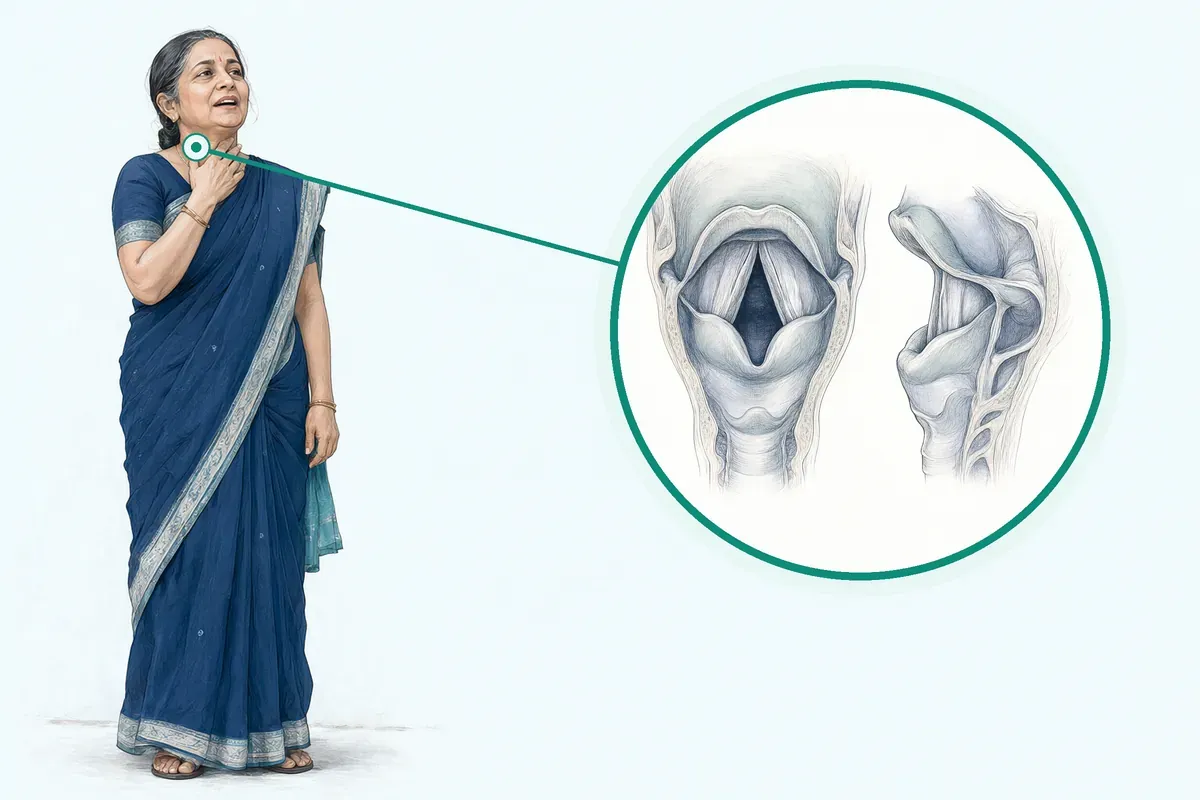
Your voice box (larynx) sits at the top of your windpipe. It holds two bands of elastic muscle tissue called vocal cords. When you breathe, the cords stay open. When you speak, air from your lungs pushes through the closed cords and makes them vibrate, producing sound.
Swallowing is a coordinated movement that carries food and liquid from your mouth, through your throat, and into your food pipe (oesophagus).
Problems arise when the vocal cords cannot vibrate cleanly or when the swallowing pathway does not move the bolus safely. Benign lesions such as nodules, polyps, or cysts can form on the cords. Nodules are small, hard, callus-like growths that often appear on both cords at the midpoint.
Polyps are usually larger, softer, and often form on one cord; a specific type called polypoid corditis (Reinke's oedema) is linked almost exclusively to smoking. Cysts are sac-like growths with a fluid or semisolid centre and are less common than nodules or polyps.
Swallowing difficulty (dysphagia) means any disruption in the process of moving food from the mouth to the stomach. Oropharyngeal dysphagia affects the mouth and throat; oesophageal dysphagia affects the food pipe. Aspiration occurs when food, liquid, or saliva enters the airway below the level of the true vocal cords. This can lead to aspiration pneumonia, a lung infection caused by inhaled material.
A common sensation called globus pharyngis feels like a lump or phlegm in the throat when nothing is there. It is a recognised diagnosis and not a structural blockage.
In older adults, swallowing difficulty is highly prevalent and often goes unrecognised. It is considered a geriatric syndrome because it is multifactorial, linked to multiple health conditions, and needs a multidimensional approach.
Symptoms of throat voice and swallowing problems and warning signs that need urgent care the same day
- Sudden inability to swallow
- Choking that does not clear
- Sudden voice loss with breathing difficulty
- Coughing up blood
The most common symptom of a vocal cord lesion is hoarseness or a raspy voice. The change in voice depends on the lesion's size and how much it interferes with the cords opening, closing, and vibrating together. Lesions can make it difficult or even painful to talk or sing.
Swallowing difficulty includes a group of symptoms: trouble forming or moving a bolus safely, aspiration, residue left in the throat, excessive throat clearing, coughing, hoarse voice, atypical breathing patterns during swallowing, and repetitive swallowing. People with dementia often show a slowing of the swallowing process and difficulties with self-feeding.
Warning signs that need medical attention the same day include sudden inability to swallow, choking that does not clear, sudden voice loss with breathing difficulty, coughing up blood, and high fever with throat pain and drooling. These can indicate a blocked airway, severe infection, or acute aspiration pneumonia.
Aspiration pneumonia may present with nonspecific symptoms such as fever, headache, nausea, vomiting, muscle pain, and confusion, or it may be silent and only discovered later.
Causes of throat voice and swallowing problems and who is at higher risk
- 40% to 60% Stroke patients (acute phase)
- Over 80% Parkinson's disease
- Exceeds 80% Advanced dementia
- 33% Independently living adults 80+
Vocal cord nodules and polyps usually result from repeatedly overusing or misusing the voice. Speaking or singing for extended periods, yelling, or straining the voice irritates and inflames the cords, eventually causing lesions. Professional voice users such as singers, teachers, coaches, and salespeople are at higher risk. Children who scream or talk loudly regularly are also commonly affected.
Cysts can form if a gland in the vocal cord gets blocked or cell debris gets trapped. Contact ulcers are erosions and sores on the cords. Laryngitis is irritation caused by inflammation or infection.
Swallowing difficulty has many causes. Neurological conditions such as stroke, Parkinson's disease, and Alzheimer's disease are major risk factors. In stroke, dysphagia affects 30% to 65% of patients; in the acute phase, 40% to 60% have swallowing difficulties. Over 80% of people with Parkinson's disease develop dysphagia during their illness. In dementia, prevalence exceeds 80% at advanced stages.
Oesophageal dysphagia is caused by diseases affecting the enteric nervous system or the oesophageal muscular layers.
Older age, functional impairment, frailty, multiple medications, and multiple health conditions increase risk. Many older people are unaware of their swallowing dysfunction. Hospitalised older patients with functional or cognitive impairments have higher prevalence. Among independently living older adults, prevalence is about 16% in the 70 to 79 age group and 33% in those 80 and above. In nursing homes, dysphagia affects up to 68% of residents.
Smoking is a strong risk factor for Reinke's oedema and for malignant growths. Acid reflux (GERD) can cause ulcers on the vocal folds.
How throat voice and swallowing problems are diagnosed: examination and tests
Your surgeon will examine your head and neck and ask how you have been using your voice. If you smoke and become hoarse, evaluation for lesions and malignant growths is advised.
Direct examination of the vocal cords is done with flexible laryngoscopy, an office-based view of the cords and pharynx. Videostroboscopy provides slow-motion analysis of vocal fold vibration. Both are typically performed with topical anaesthetic spray; recovery is immediate.
For swallowing assessment, fiberoptic endoscopic evaluation of swallowing (FEES) allows real-time safety evaluation. It is also used to test the effectiveness of therapeutic manoeuvres and texture modification of food and liquids. Videofluoroscopic swallowing study (VFS) is another instrumental method.
Both FEES and VFS are considered the reference methods for evaluating Parkinson's-related dysphagia and allow reliable detection of aspiration events and typical impairment patterns.
Screening questionnaires such as the EAT-10 help identify patients at risk. A score of 3 or more is considered abnormal and offers high sensitivity for dysphagia. High sensitivity is prioritised because undetected swallowing difficulty carries serious risks.
Clinical swallowing assessment establishes the diagnosis by evaluating the pathophysiology, signs, symptoms, and mechanism of the impaired swallow. This is especially useful for patients who cannot easily undergo instrumental tests.
High-resolution manometry may be helpful for oesophageal evaluation. Multichannel intraluminal impedance-pH monitoring and pepsin or bile salt detection are used for laryngopharyngeal reflux diagnosis, although standardised criteria are still evolving.
Most patients with oropharyngeal dysphagia are not diagnosed and do not receive any treatment. Early screening and referral to a dysphagia expert are essential.
Treatment options without surgery for throat voice and swallowing problems and when surgery is advised
- Polyps Few weeks with voice rest
- Overuse laryngitis Few days with voice rest
Many benign vocal cord lesions improve with non-surgical care. Vocal cord nodules often disappear within six to twelve weeks with proper voice training by a certified voice therapist. Polyps often go away on their own within a few weeks with voice rest. Contact ulcers may need voice rest for a minimum of six weeks.
Laryngitis from a viral infection usually resolves in one to three weeks; laryngitis from vocal overuse often settles in a few days with voice rest.
Laryngopharyngeal reflux therapy uses diet changes, lifestyle modifications, and acid suppression protocols.
Swallowing management is multidisciplinary and includes compensatory and rehabilitative strategies. The methods used are selected according to each patient's individual dysphagia pattern. A modified water test assessing maximum swallowing volume is recommended to uncover oropharyngeal dysphagia in Parkinson's disease.
Nutrition interventions depend on the type and extent of swallowing disturbance, nutritional status, and comorbidities. The consistency of foods and fluids that can be swallowed safely is carefully examined by a swallowing specialist before starting nutritional support. An individually adjusted nutritional care plan supports safe, easy, and appealing oral consumption. Meals may be enriched and oral nutritional supplements added. If oral intake is insufficient or impossible, enteral feeding is indicated.
Expiratory muscle strength training and newer stimulation techniques are emerging rehabilitation approaches.
Surgery is advised when lesions do not respond to conservative treatment, when there is suspicion of malignancy, or when structural problems such as vocal cord paralysis affect breathing. Noncancerous tumours generally do not go away and must be removed surgically. Cancerous tumours must be treated immediately to prevent spread.
For bilateral vocal cord paralysis with the cords in a closed position, a tracheotomy is the most common procedure. Microlaryngeal surgery under general anaesthesia is used for vocal cord polyps and other lesions; it is minimally invasive and usually takes around 30 minutes.
Vocal cord paresis or paralysis may result in the voice returning on its own within a year.
Consultation at Jaipur Hospital typically lasts 20 to 30 minutes and is an outpatient visit. The typical price range for the consultation and related diagnostics in India is ₹1,000 to ₹4,500. Surgical costs vary widely based on severity, location, and follow-up needs; your surgeon will advise what applies to you.
Your first visit and tests for throat voice and swallowing assessment
Your first visit to the Otolaryngology department at Jaipur Hospital usually takes 20 to 30 minutes. Your doctor will ask how long you have had hoarseness, throat pain, difficulty swallowing, or a sensation of a lump in the throat. They will also ask about your voice use, smoking history, and any reflux symptoms such as heartburn or regurgitation.
A clinical examination of your head and neck is performed. If needed, a flexible laryngoscopy is done in the OPD using a topical anaesthetic spray to numb the nose and throat. This gives a clear view of the vocal cords and pharynx. In some cases, videostroboscopy may be advised to analyse vocal fold vibration in slow motion.
For swallowing difficulty, a Fiberoptic Endoscopic Evaluation of Swallowing (FEES) may be performed to watch you swallow different food consistencies in real time. Please bring any previous prescriptions, imaging reports, or endoscopy records. If you take blood thinners or diabetes medicines, tell your doctor before the visit.
How throat voice and swallowing treatment works
Treatment depends on the cause found during assessment. For benign vocal cord lesions such as nodules or polyps, the first line is usually voice rest and voice therapy with a trained therapist. Nodules often improve within six to 12 weeks with proper voice training. Polyps may resolve in a few weeks with rest.
Contact ulcers may need voice rest for six weeks or more. Laryngitis from viral infection typically settles in one to three weeks; laryngitis from overuse often resolves in a few days with voice rest. If reflux is contributing to throat symptoms, your doctor will advise a laryngopharyngeal reflux protocol that includes dietary changes, lifestyle modifications, and acid suppression medication.
For swallowing difficulty, management is planned by a multidisciplinary team. It may include compensatory strategies such as posture changes, texture modification of food and liquids, and specific swallowing manoeuvres. Rehabilitation exercises may be prescribed to improve strength and coordination. If oral intake is unsafe or insufficient, enteral feeding may be considered.
If a structural lesion or tumour is found, or if vocal cord paralysis does not recover, your doctor will discuss referral for microlaryngeal surgery or other surgical options. These procedures are performed under general anaesthesia in the modular operation theatres. Your surgeon will advise which technique suits your condition.
Risks and possible complications of throat voice and swallowing conditions
Untreated voice and swallowing problems can lead to complications. Persistent hoarseness may signal a lesion that grows or becomes cancerous. Smoking is strongly linked to polypoid corditis (Reinke's oedema) and increases cancer risk. Dysphagia raises the risk of malnutrition, dehydration, and aspiration pneumonia. Aspiration pneumonia occurs when saliva, food, or liquid carrying bacteria enters the airway.
It can present with fever, cough, confusion, or may be silent without obvious symptoms. In studies, dysphagia is associated with a threefold or higher increase in pneumonia risk, and an 11-fold increase when aspiration is confirmed. Malnutrition is common in patients with swallowing difficulty and worsens during hospitalisation.
Older adults with dysphagia have higher rates of functional decline, institutionalisation, and mortality. Vocal cord paralysis can cause breathing difficulty if both cords are affected. Your doctor will explain the risks relevant to your diagnosis and monitor you closely.
Recovery and aftercare for throat voice and swallowing treatment
After an OPD assessment with flexible laryngoscopy or FEES, you can go home immediately. There is no recovery time needed from the scoping itself; the topical spray wears off in 30 to 60 minutes. You may eat and drink normally once the numbness passes. If you start voice therapy, sessions are typically weekly and continue for several weeks.
Improvement in nodules is often seen in six to 12 weeks. Polyps may shrink with rest in a few weeks. Contact ulcers need at least six weeks of voice rest. Reflux therapy requires consistent dietary and lifestyle changes for several weeks before symptoms improve.
Swallowing therapy progress is reviewed at intervals; food textures are upgraded only after a repeat safety assessment. If you have had microlaryngeal surgery, you will be observed for a few hours and usually discharged the same day or the next. Voice rest is advised for about one week after surgery, followed by gradual voice use and therapy.
Contact the hospital if you develop increasing throat pain, difficulty breathing, coughing up blood, fever, or if swallowing becomes worse after a procedure. Follow-up visits are scheduled as needed to check healing and voice or swallow function.
Results of throat voice and swallowing treatment
Outcomes vary by condition. Vocal cord nodules respond well to voice therapy in most people, with resolution in six to 12 weeks. Polyps often resolve with conservative management, though some need surgery. Contact ulcers heal slowly but respond to prolonged voice rest and reflux control. Laryngitis from infection or overuse usually resolves completely.
Reflux-related throat symptoms improve in the majority of patients who adhere to diet, lifestyle, and medication plans. Swallowing therapy reduces aspiration risk and improves nutritional intake in many neurological and elderly patients. In studies, early identification and multidisciplinary management of dysphagia lower pneumonia rates and improve survival. Vocal cord paralysis may recover spontaneously within a year in some cases.
Surgical correction of benign lesions has high success rates for voice restoration. Malignant lesions require prompt treatment; outcomes depend on stage at diagnosis. Your doctor will discuss the expected timeline and likelihood of recurrence for your specific condition.
Cost and insurance for throat voice and swallowing care in Jaipur
The typical price range for an OPD consultation and diagnostic assessment at Jaipur Hospital is ₹1,000 to ₹4,500. The final cost depends on which tests are performed — flexible laryngoscopy, videostroboscopy, or FEES — and whether any medication or therapy sessions are started. Voice therapy sessions, if needed, are charged per session.
Surgical procedures such as microlaryngeal surgery are separate and cost more; your surgeon will give an estimate after evaluation. Jaipur Hospital accepts patients under RGHS, MAA Yojana, CGHS, and a panel of private insurers and TPAs. Coverage for consultations, diagnostics, and procedures depends on your policy terms. The hospital has an in-house pharmacy and diagnostic laboratory. For any estimate or scheme-related query, you can ask at the reception during your visit.