

General & Laparoscopic Surgery · Jaipur Hospital
Endoscopy in Jaipur
Persistent heartburn or stomach pain leaves you worried. Jaipur Hospital offers clear clinical assessment, thoughtful discussion, and a simple evaluation plan.
- Serving Jaipur since 1991 (35 years)
- NABH accredited
- 24×7 emergency & ICU
- Cashless: RGHS, MAA Yojana, CGHS + 22 insurers
- Procedure time
- 10 to 20 minutes
- Anaesthesia
- Throat spray, or light sedation
- Recovery
- Back to normal activity the same dayno driving after sedation
- Price
- ₹2,000 to ₹6,000 for a diagnostic test (biopsy extra)typical range in India; ask us for an estimate
Living with digestive discomfort
When stomach pain and indigestion do not settle
Ongoing acidity, nausea, or trouble swallowing can disrupt your daily routine. Taking medicines without knowing the underlying reason often leaves you uncertain about what is happening inside.
-
Frequent heartburn and acidity
Burning sensations in your chest or food pipe that persist despite regular antacids.
-
Difficulty swallowing food
A feeling of food sticking in your throat or chest during meals.
-
Persistent upper stomach pain
Unexplained discomfort or nausea that makes it hard to eat normal meals.
Upper endoscopy is indicated for persistent symptoms of gastro-oesophageal reflux that do not respond to medical therapy.
Why Jaipur Hospital
You may worry about gagging during the test, what the camera might find, or having to take time away from work.
Your care plan
Your first steps with us
- 1 Visit our surgical team in the OPD for an assessment.
- 2 Prepare with empty stomach guidance from your care team.
- 3 Undergo your gentle 10 to 20 minute daycare procedure.
- 4 Receive your report and discuss next steps with your doctor.
Treatments
Types of endoscopy
How an upper GI endoscopy is done
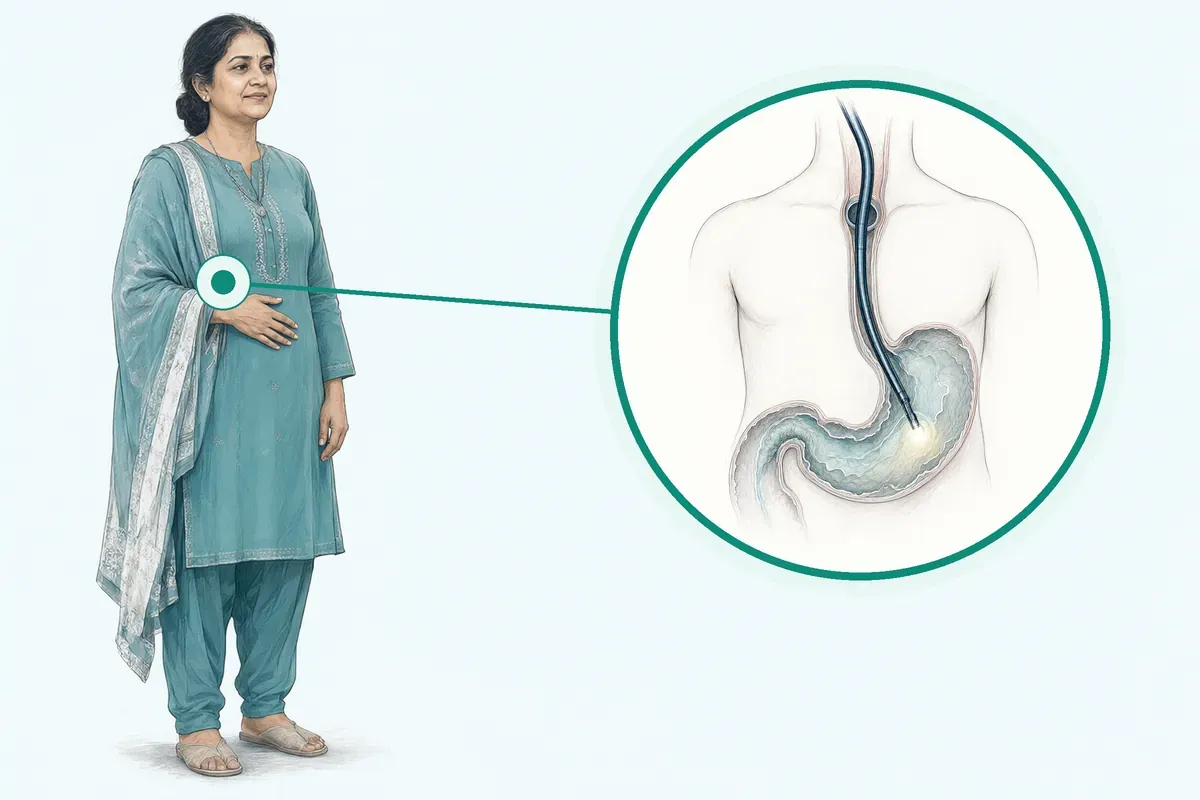
An endoscope is a thin, flexible tube with a camera that looks at your food pipe, stomach, and duodenum. It is typically performed as a day care procedure under local throat spray or light sedation.
-
Diagnostic endoscopy
Your surgeon will discuss using a thin camera to examine the food pipe, stomach, and duodenum.
-
Biopsy
Your surgeon will discuss collecting tiny tissue samples during the test, including tests for H. pylori.
-
Therapeutic endoscopy
Your surgeon will discuss options such as controlling bleeding, stretching a narrowing, or removing a polyp.
Why patients trust us
- 1991 Serving Jaipur for 35 years
- NABH Accredited hospital
- 3 General & Laparoscopic Surgery consultants
- 24×7 Emergency, ICU and ambulance
- 25 Cashless schemes and insurers
Clinical findings on upper endoscopy
-
27.5%
In a study of upper endoscopies, changes in medical management were seen in 27.5% of procedures.
-
10 to 20 minutes
A typical diagnostic upper gastrointestinal examination usually takes 10 to 20 minutes to complete.
-
4.9% to 52.4%
Sedation choices carry differing side effects; pain on injection varied between sedative types in clinical trials.
If it is left untreated
Persistent digestive symptoms left unexamined may delay identifying ulcers, narrowing of the food pipe, or early cellular changes. Early visual evaluation helps doctors confirm diagnoses and adjust treatments before complications develop.
Life after your evaluation
Understanding your digestive tract brings clarity and direction to your health management.
-
Clear clinical answers
Most people receive immediate visual findings to understand what causes their symptoms.
-
Prompt return to routine
Patients typically head home within 1 to 2 hours with an attendant.
-
Structured medical plan
Your doctor usually adjusts medicines or diet based on direct visual and biopsy results.
Frequently asked questions
Questions patients ask about endoscopy
What is upper GI endoscopy, and why has it been recommended?
In short
Upper GI endoscopy at Jaipur Hospital is a short day-care test where a thin flexible camera examines your food pipe, stomach and duodenum. It is recommended to find the cause of symptoms such as persistent heartburn, difficulty swallowing, unexplained weight loss or bleeding, and to allow biopsy or treatment during the same session.
In detail
The endoscope is a small lighted camera on a long flexible tube that gives a direct view of the upper digestive tract. Evidence shows this test is more accurate than X-rays for diagnosing ulcers, inflammation, infection with H. pylori, Barrett's oesophagus and early cancers.
During the procedure the doctor can take tiny tissue samples (biopsy) or treat problems such as bleeding, a narrowing or a small polyp. The test usually takes 10 to 20 minutes and you go home within one to two hours.
A common belief
Many people think it is a major surgery or needs an overnight stay.
What actually happens
In fact it takes only 10 to 20 minutes, you are awake or lightly sedated, and you go home the same day.
Your next step at Jaipur Hospital
Your surgeon will explain why the test is advised for your symptoms and what alternatives exist. If you decide to proceed, the hospital will give you a preparation sheet with fasting instructions and a consent form. You can book a consultation at Jaipur Hospital to discuss the timing and any questions you have.
Do I need a referral or an appointment for upper GI endoscopy?
In short
You need an appointment for an upper GI endoscopy at Jaipur Hospital. A referral from your treating doctor is helpful but not mandatory; you can also book directly. The hospital will schedule a pre-procedure consultation with the surgical team to confirm the indication and explain preparation.
In detail
The process begins with a consultation where the surgeon reviews your symptoms, previous reports and medicines. Informed consent is obtained and a safety checklist is completed before the test. The procedure slot is typically 20 minutes or more depending on the indication. Day-care admission is arranged for the test day and you go home within one to two hours after recovery.
A common belief
Some patients assume they can walk in for the test the same day.
What actually happens
The test needs a prior consultation, consent and fasting preparation, so it is scheduled in advance as a day-care procedure.
Your next step at Jaipur Hospital
Call the hospital on the listed numbers or email to fix a convenient date. Bring any referral letter, previous endoscopy or imaging reports and a list of current medicines.
What happens during upper GI endoscopy?
In short
During upper GI endoscopy at Jaipur Hospital, a thin flexible camera is passed through your mouth into the food pipe, stomach and duodenum. The procedure takes 10 to 20 minutes. You receive throat spray to numb the area, and may also get light sedation through a vein to keep you comfortable.
In detail
You lie on your left side with a mouthguard in place. The doctor advances the scope slowly, inspecting the lining and taking photos. If needed, tiny instruments take biopsies, stop bleeding, stretch a narrowing or remove a polyp.
Air or water may be used to clean the view. You may feel bloating or an urge to burp, but the test is not painful. Sedation makes you sleepy and relaxed; you may not remember the procedure.
A common belief
Many people fear choking or pain.
What actually happens
The throat spray numbs the gag reflex, and sedation keeps you relaxed. You breathe normally throughout.
Your next step at Jaipur Hospital
After the scope is removed, you rest in the recovery area for 1 to 2 hours until the sedation wears off. You cannot drive that day if sedation was given. The doctor may share initial findings before you leave; biopsy results take up to two weeks.
How does the term gastroscopy relate to upper GI endoscopy?
In short
Gastroscopy is another name for an upper GI endoscopy at Jaipur Hospital. Both terms describe the same test where a thin camera examines the food pipe, stomach and duodenum. The medical term is oesophagogastroduodenoscopy, often shortened to OGD or EGD.
In detail
The word gastroscopy comes from 'gastro' meaning stomach and 'scopy' meaning to look. In practice, the camera always passes through the food pipe to reach the stomach and continues into the first part of the small intestine, the duodenum.
So the examination covers all three areas. Doctors may use gastroscopy, upper endoscopy, OGD or EGD interchangeably. The procedure steps, preparation, sedation options and recovery are identical regardless of the name used.
The technique allows diagnosis, biopsy and treatment such as stopping bleeding or stretching a narrowing in any of those segments.
A common belief
Patients get confused by the different names.
What actually happens
They think each name means a different procedure. In reality, every name refers to the exact same examination of the upper digestive tract.
Your next step at Jaipur Hospital
If your doctor writes gastroscopy or OGD on the request form, it is the same appointment. No extra preparation is needed. Ask your surgeon at the consultation which term they prefer and what they will be looking for.
Will I be awake during the upper GI endoscopy?
In short
You will usually be awake but relaxed during an upper GI endoscopy at Jaipur Hospital. Most people receive a throat spray to numb the area and light sedation through a vein to make you feel sleepy and comfortable, though you may not be completely asleep.
In detail
Evidence confirms that intravenous sedation and local anaesthetic throat spray can be used together. The sedative makes you feel drowsy and relaxed while the throat spray has a numbing effect. You may not remember the test afterward.
General anaesthesia, where you are completely asleep, is not typical for this procedure. The sedation wears off quickly and recovery is usually rapid, with most patients becoming fully alert within a few minutes after the scope is removed.
A common belief
Many people expect to be fully asleep under general anaesthesia.
What actually happens
For a standard upper GI endoscopy, that is not usual. Light sedation keeps you breathing on your own and allows a faster recovery so you can go home within a couple of hours.
Your next step at Jaipur Hospital
You must not drive or operate machinery for the rest of the day if you receive sedation. An attendant should accompany you home. You can return to normal activities the same day.
How will the surgeon decide whether an operation is necessary after upper GI endoscopy?
In short
The surgeon at Jaipur Hospital decides on surgery based on what the endoscopy shows, your symptoms, biopsy results and your overall health. The endoscopy provides a direct view and tissue diagnosis that guides whether an operation, medical treatment or surveillance is the appropriate next step.
In detail
Evidence shows that upper endoscopy allows direct visualisation of the upper digestive system and can be more accurate than X-rays for diagnosing problems. Biopsy results, which may take up to two weeks, confirm the nature of any lesion.
The surgeon reviews the endoscopic images, the biopsy report, the severity of your symptoms and any response to medication. Conditions like early cancer, large bleeding ulcers that cannot be controlled endoscopically, or strictures that do not respond to dilatation may require an operation. The decision is made in discussion with you.
A common belief
Some patients believe an abnormal endoscopy automatically means surgery.
What actually happens
Many conditions like gastritis, small ulcers or early changes are treated with medicines or repeat scopes. Surgery is reserved for specific situations such as uncontrolled bleeding, obstruction or confirmed cancer.
Your next step at Jaipur Hospital
You will discuss the findings and the recommended plan at a follow-up visit. If surgery is advised, the surgeon will explain the reasons, the procedure and the expected recovery.
What can upper GI endoscopy find out?
In short
Upper GI endoscopy can identify inflammation, ulcers, narrowing, growths and early cancer in the food pipe, stomach and duodenum. Jaipur Hospital uses this test to give a clear diagnosis when symptoms suggest a problem in the upper digestive tract.
In detail
The camera provides a direct view of the mucosal lining, which is more accurate than X-rays for detecting subtle changes. The doctor can take biopsies to confirm conditions such as H. pylori infection, coeliac disease, Barrett's oesophagus or cancer.
Studies show that endoscopy misses about 9 to 10 percent of gastric cancers in some settings, so thorough inspection and biopsy protocols are followed. The test also allows immediate treatment of bleeding vessels, stretching of strictures or removal of polyps during the same session.
A common belief
X-rays or scans may miss flat or small lesions.
What actually happens
Endoscopy gives a live view and lets the doctor act immediately, which imaging alone cannot.
Your next step at Jaipur Hospital
Results of the visual examination are often discussed right after the procedure. Biopsy reports usually take up to two weeks. Your surgeon will review the findings and plan further care.
Which reports, scans, and medicine details should I bring for upper GI endoscopy?
In short
Bring any previous endoscopy or colonoscopy reports, imaging such as ultrasound or CT abdomen, blood test results and a complete list of current medicines including blood thinners, diabetes drugs and over-the-counter supplements. Also carry your insurance or scheme card if applicable.
In detail
The surgical team needs to know your full medical history to assess fitness and plan sedation safely. Evidence shows patients should tell their doctor about all medicines, especially blood thinners such as warfarin or clopidogrel, and any allergies.
Do not stop or adjust prescribed medicines unless the healthcare team instructs you to do so. Previous biopsy or H. pylori test results help avoid repeat sampling.
A common belief
Patients often forget to mention blood thinners or herbal supplements.
What actually happens
These can affect bleeding risk and sedation safety, so the team must know about every tablet you take.
Your next step at Jaipur Hospital
Organise these documents in a folder before your consultation. The nurse will review them during the pre-procedure check.
How long will an upper GI endoscopy take?
In short
An upper GI endoscopy at Jaipur Hospital usually takes 10 to 20 minutes for the camera examination itself. You should plan to spend about one to two hours at the hospital in total. This includes the time for registration, preparation, the procedure, and a short recovery period before you go home.
In detail
The procedure time of 10 to 20 minutes is the standard range for a diagnostic check of the food pipe, stomach and duodenum.
If your surgeon needs to take a biopsy or perform a therapeutic step such as stretching a narrowing, the camera time may be a little longer.
International guidelines suggest allocating a minimum slot of 20 minutes for a standard diagnostic endoscopy to allow for careful inspection of all landmarks. You will lie on your left side while the thin flexible camera is passed through your mouth. The team will monitor your vital signs throughout.
A common belief
Many people think it is a long operation.
What actually happens
It is actually a quick day-care procedure. The extra time is for checking you in, giving the throat spray or sedation, and letting you recover safely before you leave.
Your next step at Jaipur Hospital
You can usually go home one to two hours after the test finishes. If you receive sedation, you must not drive or operate machinery for the rest of that day. Please arrange for an attendant to take you home. Your surgeon will explain the findings before you leave, though biopsy results may take up to two weeks.
How does the term oesophagogastroduodenoscopy relate to upper GI endoscopy?
In short
Oesophagogastroduodenoscopy is the full medical term for an upper GI endoscopy at Jaipur Hospital. It is often shortened to OGD or EGD. The name describes the three parts examined: the oesophagus (food pipe), the stomach (gastro) and the duodenum (first part of the small intestine).
In detail
The term breaks down into oesophago (food pipe), gastro (stomach) and duodenoscopy (duodenum). During the test, the flexible camera passes through all three areas in sequence.
International guidelines define a complete OGD as reaching the second part of the duodenum and inspecting landmarks like the gastro-oesophageal junction, fundus, antrum and duodenal bulb.
Whether the request says upper GI endoscopy, gastroscopy or OGD, the preparation, procedure time of 10 to 20 minutes, sedation options and recovery are the same. The technique also allows biopsy and therapeutic interventions in any of these segments.
A common belief
The medical term sounds complicated and different.
What actually happens
Patients think it might be a more complex procedure. It is not. OGD, EGD, gastroscopy and upper GI endoscopy are all labels for the identical camera test.
Your next step at Jaipur Hospital
You do not need to know the long word. Your referral may use any of these names. The surgeon will explain what they will check during the examination. If you have specific symptoms like difficulty swallowing or upper abdominal pain, mention them at the consultation.
FAQ library
Questions and answers about endoscopy
When you contact us
Consult our surgical team in Jaipur
Reach out to Jaipur Hospital to schedule an OPD consultation and discuss your digestive evaluation options.
- A consultation with a general and laparoscopic surgeon in the OPD
- Your scans and reports reviewed, with tests done in-house if you need them (laboratory, X-ray and imaging)
- Your options explained in plain words, including whether you need surgery at all
- A cost estimate before you decide
- Help with cashless treatment under RGHS, MAA Yojana, CGHS and empanelled insurers and TPAs
- Follow-up visits after your treatment
Overview
Endoscopy: what to know
What is upper GI endoscopy and how it works
- Endoscope inserted Flexible tube with camera goes through mouth
- Live images viewed Camera sends pictures to monitor screen
- Tissue samples taken Tiny instruments collect biopsy if needed
Upper gastrointestinal endoscopy is a medical procedure to look inside the upper part of your digestive system. Doctors often call it an EGD, which stands for oesophagogastroduodenoscopy, or simply an upper endoscopy. In this test, an endoscopist examines the organs that carry and digest your food.
These organs include:
- Your oesophagus or food pipe
- Your stomach
- Your duodenum, which is the upper part of your small intestine
It is an established test for checking upper digestive symptoms.
During the examination, our surgical team uses an instrument known as an endoscope. The endoscope is a long, flexible tube fitted with a small, lighted camera at its tip. Your doctor gently guides this tube through your mouth and throat, moving down the swallowing tube into your stomach and duodenum.
The camera transmits live images to a monitor screen in the room. This provides a clear, direct view of your internal lining so the doctor can spot irritation, ulcers, or growths.
Endoscopy is not limited to viewing the digestive tract. The endoscope allows our surgical team to pass tiny instruments through specialised channels to collect tissue samples or manage certain problems immediately. At Jaipur Hospital, your surgeon will discuss your test in the OPD so you understand what to expect.
An upper endoscopy is typically performed as a day care procedure. It usually takes about 10 to 20 minutes to complete. You can usually return home within 1 to 2 hours after your rest period.
Symptoms and warning signs that need urgent care
- Difficulty or severe pain when swallowing
- Vomiting blood or coffee-ground material
- Black, sticky, or tar-coloured stools
- Repeated vomiting stopping liquid intake
- Unexplained significant weight loss
- New or worsening tiredness with anaemia
Doctors often recommend an upper endoscopy when you have long-lasting digestive troubles that do not settle with basic medicines. You may feel ongoing discomfort in your upper belly, frequent nausea, trouble keeping food down, or severe acid indigestion. Bloating, early fullness while eating, and sour fluid rising into your throat are also common reasons for a check-up.
Certain symptoms are red flags that need urgent medical attention the same day. You should seek immediate hospital care if you notice any of the following warning signs:
- Difficulty or severe pain when swallowing your food
- Bleeding from your digestive tract, such as vomiting blood or coffee-ground material
- Passing black, sticky, or tar-coloured stools
- Repeated or persistent vomiting that stops you from keeping liquids down
- Unexplained, significant weight loss
- New or worsening tiredness accompanied by low red blood cell counts, known as anaemia
Our surgical team evaluates these alarm signals promptly. If you experience these urgent symptoms, visit the 24x7 emergency department at Jaipur Hospital without delay.
Causes of upper digestive issues and who is at higher risk
- Acid reflux
- Stomach acid flows up into the food pipe
- H. pylori infection
- Bacteria that inflames the stomach lining
- Pain medicines
- Regular use irritates the stomach lining
- Barrett's oesophagus
- Cell changes from long-term acid exposure
- Higher risk groups
- Men over 50 with chronic reflux over 5 years
Problems in the upper digestive tract happen for several reasons. Persistent reflux occurs when stomach acid flows upward into the food pipe, irritating the lining and causing heartburn. Ongoing inflammation can also stem from infection with Helicobacter pylori bacteria or regular use of pain medicines that irritate the stomach lining.
Over time, persistent acid exposure may alter the cell lining of the lower oesophagus, a condition known as Barrett's oesophagus.
Certain individuals face a higher risk of developing significant upper digestive conditions. In scientific studies, upper endoscopy is particularly considered for men older than 50 years who have had chronic reflux symptoms for more than 5 years. Risk factors identified in medical research include:
- Severe nighttime acid reflux symptoms
- The presence of a hiatal hernia, where part of the stomach slides up into the chest
- Higher body mass index and excess abdominal body fat
- Regular tobacco use
- Ongoing heartburn that does not improve after 4 to 8 weeks of twice-daily medicine
If you have these risk factors, an assessment helps identify tissue changes early. Your surgeon will evaluate your personal health history to determine whether an upper endoscopy is suitable for you.
How endoscopy is diagnosed: examination and tests
- Health check and consent Fitness review, allergy check, informed consent
- Fasting and medicine review Avoid food and drinks, tell doctor about all prescriptions
- Sedation and monitoring Throat spray or IV sedation, vital signs checked
- Examination and biopsy Scope inspects lining, tissue samples taken if needed
Before scheduling an upper endoscopy, our surgical team evaluates your overall fitness, existing health conditions, and current medicines. You will be asked about any past allergic reactions to sedatives or local numbing medicines. You will also give informed consent before the test begins.
Before the procedure, you are usually asked to avoid food and drinks for a specified period so that your stomach is clear. It is essential to tell your doctor about all prescriptions you take, especially blood thinners like warfarin or clopidogrel, but do not stop or adjust any medicine unless your healthcare team tells you to do so.
In the endoscopy room, a nurse checks your vital signs and places an intravenous line in your arm to deliver medicines if needed. A mouthguard is placed between your teeth to protect your mouth and the endoscope. You will lie comfortably on your left side.
For anaesthesia, a local anaesthetic spray is typically applied to your throat to numb the area, or you may receive light sedation through the vein to keep you relaxed and sleepy.
During the examination, the endoscope provides a direct view that can be more accurate than standard X-rays for detecting mucosal changes and ulcers. The doctor inspects the lining from the upper food pipe down to the second part of the duodenum.
If an abnormal area or polyp is seen, the doctor can insert small instruments to take tiny tissue samples called a biopsy. Diagnostic endoscopy checks the organs directly, while biopsy samples can confirm conditions such as H. pylori infection or tissue changes. Biopsy results can take up to two weeks to arrive from the laboratory. Once ready, your surgeon will discuss the findings and plan any further steps with you.
Treatment options and when surgery is advised
Upper gastrointestinal conditions are managed with non-surgical treatments whenever possible. In many cases, lifestyle adjustments and medicines form the foundation of care. Your doctor may advise dietary changes, meal timing adjustments, and acid-suppressing tablets to settle heartburn and promote mucosal healing.
If an infection such as Helicobacter pylori is detected on a biopsy test, specific antibacterial courses obtained from the chemist can eradicate the organism. In clinical studies, changes in medical management were seen in 27.5% of upper endoscopies.
Techniques available through endoscopy also include therapeutic procedures. Using delicate tools passed through the scope, our surgical team can treat bleeding blood vessels, remove polyps, or gently stretch narrowed areas in the food pipe. These endoscopic techniques allow doctors to manage specific problems without the incisions or physical stress of traditional open surgery.
Surgery is generally advised when non-surgical therapies or endoscopic procedures are insufficient to manage the condition. For instance, surgical repair may be considered for large hiatal hernias that cause severe reflux unresponsive to medicines, or for structural blockages in the stomach outlet.
Major complications of upper endoscopy, such as bleeding or perforation of the digestive wall, are uncommon, but severe complications may occasionally require urgent surgical repair. In research studies, upper endoscopy resulted in a change in surgical management in about 7.8% of patients.
For a standard diagnostic endoscopy, the typical cost ranges from ₹2,000 to ₹6,000 in India, though charges for biopsies, tissue analysis, or therapeutic interventions are extra. Total expenses vary based on whether tissue sampling or therapeutic procedures are needed, as well as the anaesthesia option chosen.
Your surgeon will discuss which approach suits you, and our team can provide an estimate for your planned care at Jaipur Hospital.
Preparing for your endoscopy
Do
- Fast as instructed before the test
Avoid
- Do not drive home after sedation
Preparing for an upper endoscopy begins with a careful medical check. You will be assessed for your fitness before having the test. Our surgical team will review your existing medical conditions and all the medicines you currently take. You should tell your doctor about everything you take, especially blood thinners like warfarin or clopidogrel, as well as any drug allergies. You should not stop or change any prescribed medicines unless our team tells you to do so.
Fasting is necessary before an upper endoscopy. You are usually asked to avoid food and drinks for a specified period beforehand. This ensures your stomach is clear so that your doctor has an unobstructed view. Before the procedure begins, you will receive clear information about what will happen, and you will give written informed consent. Our clinical staff will also complete a standard safety checklist before the examination starts.
On the day of your test, wear loose, comfortable clothing. You will be visiting the hospital for day care, and you should bring an adult attendant with you. Because light sedation makes you drowsy, you will not be able to drive home yourself. Having a family member or attendant present helps ensure you return home safely and comfortably.
How the endoscopy procedure is done
On the day of your test, you will arrive at the hospital and a nurse will check your vital signs. A small intravenous tube will be placed in a vein in your arm to deliver your medicine. To make the examination comfortable, local anaesthetic spray is applied to your mouth and throat. This spray produces a numbing effect.
Intravenous sedation and the numbing throat spray can be used together if required. light sedation helps you feel relaxed and sleepy, though most people are not completely asleep. If general anaesthesia is used, the medicine puts you completely to sleep. A mouthguard is placed in your mouth to protect your teeth and the instrument. You will then lie on your left side on the procedure table.
The endoscope is a long, flexible tube with a small, lighted camera on the tip. Your gastroenterologist gently passes the tube through your mouth and down your throat into your food pipe, stomach, and duodenum. The camera transmits live images to a screen, giving our surgical team a direct view of your upper digestive tract.
In studies, doctors use air and washing to clear the lining and take careful photos of key landmarks. The procedure itself usually takes 10 to 20 minutes.
Several common techniques may be used during the test, and your surgeon will advise which option suits your condition. One technique is diagnostic endoscopy, where the camera inspects the lining of the food pipe, stomach, and duodenum to look for irritation or sores.
Another technique is a biopsy, where tiny tissue samples are gently collected through the tube to test in the laboratory, including checks for H. pylori bacteria. A third technique is therapeutic endoscopy, where small instruments passed through the tube can treat bleeding, stretch a narrowed area, or remove a polyp.
Risks and possible complications of endoscopy
- 9 of 144 patients Respiratory events with ciprofol
- 15 of 145 patients Respiratory events with propofol
- 7 of 144 patients Vein pain with ciprofol
- 76 of 145 patients Vein pain with propofol
Upper endoscopy is generally considered a low-risk procedure. However, unwanted reactions and complications can occasionally occur. Bleeding and perforation are the major complications of an upper endoscopy. In one clinical study, the only reported adverse event was bleeding from a target lesion after a biopsy was taken. Caution is also needed during sedation for patients who may be at risk of inhaling fluid.
Sedation medicines can cause temporary side effects.
In clinical trials, commonly reported adverse reactions have included:
- Dizziness
- Headache
- Tiredness
- Nausea
- Vomiting
- Temporary drops in blood pressure
- Slow heart rate
- Changes in breathing such as mild oxygen dips
In a trial evaluating sedative options, respiratory events occurred in 9 of 144 patients receiving ciprofol and 15 of 145 patients receiving propofol, all of which were mild or moderate. Pain where the medicine entered the vein was reported by 7 of 144 patients in the ciprofol group and 76 of 145 patients in the propofol group. Overall, clinical trials report that adverse events are generally mild or moderate and do not interfere with the procedure.
After the test, mild physical side effects are common. You may feel bloated or pass gas through burping as air is cleared from your digestive tract. You may also have a mild sore throat for a day or two once the numbing spray wears off.
Recovery and aftercare following your test
- Rest in recovery area Until sedation wears off
- Go home same day With an adult attendant
- Resume normal activities Same day, but no driving
- Biopsy results Up to two weeks
Upper endoscopy is performed as a day care procedure, which means you go home on the same day. Immediately after the examination, your healthcare team will confirm your samples, check the sedation medicines given, and review your follow-up plans. You will rest in the recovery area until the sedative begins to wear off and you are alert enough to leave. Patients are typically ready to go home in 1 to 2 hours.
You can usually return to your normal daily activities the same day. However, because light sedation impairs your coordination and memory, you must not drive any vehicle or operate machinery after sedation. Your attendant should accompany you home. If you notice a scratchy or uncomfortable throat, having cold drinks or cold foods can help soothe the irritation. Any trapped air or bloated feelings will pass naturally over the next day or so.
If tissue samples were collected for a biopsy, the laboratory analysis can take up to two weeks to be completed. In some cases, your doctor will discuss basic visual findings with you on the day of the test, while in other situations a separate OPD appointment will be scheduled once the laboratory reports arrive.
If you develop high fever, severe stomach pain, persistent vomiting, or black stools, you should contact our hospital team immediately.
Results and findings from endoscopy studies
In clinical practice, an upper endoscopy provides a direct view that can be more accurate than X-rays for evaluating upper digestive tract problems. In large studies, an upper endoscopy resulted in changes to medical management in 27.5% of cases. When treatments to eradicate Helicobacter pylori bacteria were removed, medical management changed in 2.5% of cases.
In the same group of studies, endoscopy led to a change in surgical plans in 7.8% of patients. When benign findings like hiatal hernia, gastritis, and peptic ulcers were excluded, surgical management changed in .4% of patients.
Endoscopy is also widely studied for the detection of gastric neoplasms and stomach cancers. In published research, the pooled negative predictive value for gastric cancer detection during upper gastrointestinal endoscopy was 99.7%. However, studies note that small lesions can occasionally be overlooked due to their subtle appearance. The average proportion of missed gastric cancers across studies was 9.4%.
In studies following patients with an initial negative endoscopy over time, the missed cancer proportion was 10.0%. In studies reviewing patients known to have gastric cancer, the missed rate was 8.3%. For patients evaluated for simultaneous additional lesions, the proportion of missed cancers was 23.3%. In Eastern research cohorts, 39% of missed gastric lesions were located in the gastric body. Most missed cancers identified in these investigations were adenocarcinomas.
Research also shows that procedure technique directly influences detection. In one study, endoscopists who spent an average of more than 7 minutes inspecting during an examination showed a threefold increase in identifying gastric cancer and abnormal tissue compared with those spending less than 7 minutes.
Cost of endoscopy and insurance in Jaipur
In India, the typical price for a diagnostic endoscopy ranges from ₹2,000 to ₹6,000. Across different major Indian cities, published ranges vary: in Delhi NCR costs range from ₹2,100 to ₹10,500; in Mumbai from ₹2,200 to ₹11,000; in Bengaluru, Hyderabad, and Pune from ₹2,000 to ₹10,000; and in Chennai from ₹1,900 to ₹9,500.
The final amount changes depending on whether extra procedures are needed, such as collecting biopsy samples for laboratory tests or performing therapeutic interventions like polyp removal.
Jaipur Hospital is a NABH-accredited multispeciality hospital established in February 1991, located at S16A-17, Mahaveer Nagar, Near Gopalpura Flyover, Main Tonk Road, Jaipur. We provide care across several government schemes and private plans. Patients covered under RGHS, MAA Yojana, or CGHS can access their benefits here, and our hospital is on the panel of private insurers and TPAs. For an accurate estimate tailored to your recommended test, please ask our team at the OPD.