

General & Laparoscopic Surgery · Jaipur Hospital
Adrenal Gland Surgery (Adrenalectomy) in Jaipur
Adrenal tumour or hormone excess? We assess, explain options and plan your surgery.
- Serving Jaipur since 1991 (35 years)
- NABH accredited
- 24×7 emergency & ICU
- Cashless: MAA Yojana + 32 insurers
- Operation time
- 2 to 3 hours
- Anaesthesia
- General anaesthesia
- Recovery
- Back to desk work in 2 to 3 weeks
- Price
- ₹1,20,000 to ₹2,50,000typical range in India; ask us for an estimate
Adrenal problems disrupt daily life
A tumour or hormone excess makes you feel unwell
An adrenal tumour can cause high blood pressure, weight changes, weakness or anxiety. You may worry about cancer, surgery risks or long recovery.
-
High blood pressure spikes
Pheochromocytoma can cause severe headaches, sweating, rapid heartbeat and dangerously high blood pressure.
-
Low potassium and weakness
Aldosteronoma leads to high blood pressure, low potassium, muscle cramps, tiredness and frequent urination.
-
Weight gain and skin changes
Cortisol-producing tumours cause Cushing syndrome with weight gain in face and torso, thinner skin, stretch marks and high blood sugar.
-
Fear of cancer
Large tumours or those suspected to be cancerous may need open surgery and longer recovery.
-
Time off work and cost
You worry about weeks away from your desk, hospital bills and whether insurance will cover it.
The most common cause of adrenal gland problems is a tumour in the gland.
Why Jaipur Hospital
You want the tumour removed safely, your hormones balanced and to return to work without a long, painful recovery.
Your care plan
Your first steps with us
- 1 Call or visit OPD for surgeon consultation
- 2 Review scans and blood tests in-house
- 3 Undergo laparoscopic adrenalectomy with general anaesthesia
- 4 Recover at home and attend follow-up visits
Insurance and schemes
How cashless works
Cashless treatment under MAA Yojana and with 32 insurers.
-
Tell us when you book
Say you are insured or have a scheme card, and send a photo of the card on WhatsApp so our insurance desk can check it in advance.
-
We get the approval
Once your doctor advises admission, the insurance desk sends the pre-authorisation request to your insurer or TPA; for planned surgery, approval can come before you are admitted.
-
Settled at discharge
The approved amount is settled between the insurer and the hospital; you pay only what the policy does not cover.
How the operation is done
Under general anaesthesia, the surgeon removes the adrenal gland through small incisions using a camera and instruments; operation takes 2 to 3 hours and typical stay is 2 to 3 nights.
-
Laparoscopic Adrenalectomy
Standard keyhole approach with 3 to 4 ports through the abdomen to reach the adrenal gland.
-
Retroperitoneoscopic Adrenalectomy
Direct posterior access through 3 small incisions in the back, avoiding the peritoneal cavity.
-
Open Adrenalectomy
Larger incision for big tumours, suspected cancer or when keyhole surgery is not safe.
Why patients trust us
- 1991 Serving Jaipur for 35 years
- NABH Accredited hospital
- 3 General & Laparoscopic Surgery consultants
- 24×7 Emergency, ICU and ambulance
- 32 Cashless insurers, plus MAA Yojana
What research shows about this treatment
-
2 to 4 weeks
After laparoscopic adrenalectomy most patients return to normal routine in 2 to 4 weeks.
-
1 to 2 percent
Wound infections occur in about 1 to 2% of cases and are more likely after open operations.
-
less than 1 percent
Significant bleeding needing transfusion happens in less than 1% of adrenalectomies.
If it is left untreated
Untreated hormone-producing tumours keep raising blood pressure, disturbing blood sugar and potassium, and strain the heart; large or cancerous tumours can grow into nearby organs and spread.
Life after treatment
Most people go home in 1 to 2 days, manage pain with simple tablets and return to desk work in 2 to 3 weeks; hormone symptoms usually settle quickly.
-
Shorter hospital stay
After keyhole surgery most patients leave the hospital the next day.
-
Mild pain at home
Discomfort at incision sites is usually mild to moderate and controlled with paracetamol or ibuprofen.
-
Back to desk work
Typical return to desk work is 2 to 3 weeks after laparoscopic surgery.
-
Hormone balance restored
Symptoms from excess hormones often improve almost immediately after the tumour is removed.
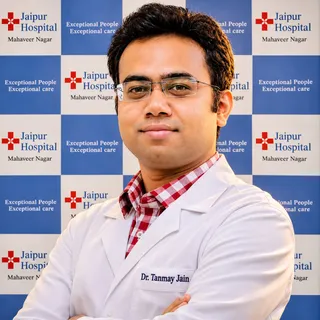
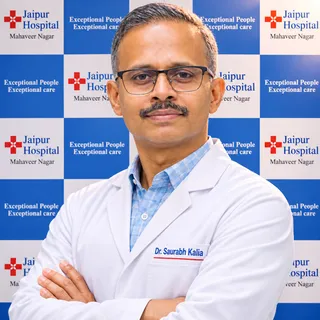
Meet the team
Your general & laparoscopic surgery doctors
Explore our general and laparoscopic surgery department in Jaipur: every treatment, the doctors and what to expect at your visit.

Frequently asked questions
Questions patients ask about adrenal gland surgery (adrenalectomy)
What does adrenalectomy involve?
In short
Adrenalectomy at Jaipur Hospital is the surgical removal of one or both adrenal glands. The operation usually takes two to three hours under general anaesthesia. Most patients stay in hospital for two to three nights and return to desk work in two to three weeks.
In detail
The surgeon makes three or four small incisions for a laparoscopic approach, using a camera and instruments to remove the gland. A retroperitoneoscopic approach uses incisions in the back to avoid the abdominal cavity.
For large tumours or suspected cancer, an open operation with a larger incision may be needed. The team decides the method based on tumour size, past abdominal surgery, and whether the tumour appears malignant.
In studies, laparoscopic adrenalectomy has become the standard for non-cancerous tumours because it causes less pain and allows faster recovery than open surgery.
A common belief
Many people think every case needs a big open cut.
What actually happens
In fact, most tumours come out through three or four keyhole cuts. Open surgery is kept for large or possibly cancerous growths, or when scar tissue from past operations makes keyhole work unsafe.
Your next step at Jaipur Hospital
You will meet the surgical team in the OPD for a detailed assessment. They will review your scans and blood tests, explain the chosen approach, and discuss the typical cost range of ₹1,20,000 to ₹2,50,000 in India. An attendant should plan to stay with you during the hospital stay.
Which tests and scans do I need before adrenalectomy?
In short
Before adrenalectomy at Jaipur Hospital, you need blood and urine hormone tests and a CT or MRI scan of the abdomen. The hormone tests check for excess aldosterone, cortisol, and catecholamines. The scan shows tumour size, location, and relation to nearby organs.
In detail
Standard blood work includes a full blood count, kidney and liver function, clotting profile, and blood group. Hormone panels measure plasma free metanephrines, aldosterone and renin, cortisol after a dexamethasone suppression test, and potassium.
A 24-hour urine collection for metanephrines and cortisol may also be asked. The CT or MRI is done at an imaging centre outside the hospital because Jaipur Hospital has no CT or MRI scanner.
The surgeon reviews the images to plan the approach — laparoscopic transabdominal, retroperitoneal, or open. Past abdominal surgery history is also noted because scar tissue affects the choice of ports.
A common belief
Many patients assume the hospital does the CT or MRI.
What actually happens
Jaipur Hospital has no CT or MRI scanner, so the scan is done at an outside imaging centre and the surgeon reviews the report and images.
Your next step at Jaipur Hospital
Bring all recent reports, films, or CDs to your OPD appointment. The team will tell you if any test needs repeating. Surgery is usually scheduled within a few weeks once the work-up is complete. Typical stay is two to three nights and the cost range in India is ₹1,20,000 to ₹2,50,000.
How painful is adrenal gland surgery and the early recovery?
In short
At Jaipur Hospital, pain after laparoscopic adrenal gland surgery is usually mild to moderate. Most patients need only paracetamol and an anti-inflammatory medicine such as ibuprofen. A small number may need a short course of a stronger painkiller. Open surgery causes more discomfort and may need patient-controlled analgesia for the first day.
In detail
Laparoscopic adrenalectomy uses three or four small incisions. Studies show the large majority of patients have excellent pain control with paracetamol and NSAIDs alone, and only a minority require opioid medication.
Pain is typically around the incision sites and sometimes in the shoulder tip from the gas used during surgery; shoulder-tip pain is less common with the retroperitoneal approach.
After open adrenalectomy, patients stay longer in hospital mainly to control post-operative discomfort and often use a patient-controlled analgesia pump. Pain scores drop quickly: diminished pain intensity within 48 hours is reported for minimally invasive approaches.
The team gives regular paracetamol and an NSAID to reduce the need for opioids, and switches to oral tablets once you are eating and pain is controlled.
A common belief
People often expect severe pain after any abdominal operation.
What actually happens
Keyhole surgery changes that. The small cuts mean less tissue damage. Shoulder-tip pain from the gas is real but usually brief and less common with the back approach. Open surgery is different: the larger cut means more soreness and a longer need for strong pain relief.
Your next step at Jaipur Hospital
Expect some soreness around the cuts for a few days. Take the prescribed painkillers on time for the first 48 hours, then as needed. You can shower after two days. Most people return to desk work in 2 to 3 weeks. If pain is not helped by medicines, or you develop increasing swelling or fever, contact the hospital.
How long does recovery usually take after adrenal gland surgery?
In short
At Jaipur Hospital, recovery after laparoscopic adrenalectomy usually takes 2 to 3 weeks to return to desk work and normal activities. Hospital stay is typically 2 to 3 nights. After open adrenalectomy, recovery is slower at 4 to 6 weeks with a longer hospital stay of 3 to 5 days. Everyone heals at a different pace.
In detail
After laparoscopic surgery, most patients leave hospital the day after the operation or within 24 hours. You can eat, drink and walk the night of surgery. Pain is usually mild to moderate, controlled with paracetamol and NSAIDs.
You can shower after two days, but avoid soaking the cuts or swimming for a week. Studies show earlier oral intake (around 4 to 7 hours) and earlier ambulation (6 to 11 hours) with the retroperitoneal approach compared to the transabdominal approach.
Most people feel better in a day or two and return to normal activity within a week, but full return to desk work takes 2 to 3 weeks. Heavy lifting and strenuous exercise should wait 4 to 6 weeks.
After open surgery, patients stay 3 to 5 days mainly for pain control, need stronger pain relief initially, and take 4 to 6 weeks to feel back to normal. The surgical team reviews you at 2 to 3 weeks.
A common belief
Patients often confuse leaving hospital with full recovery.
What actually happens
You may go home quickly, but your body still needs weeks to heal inside. Heavy lifting, core exercises and contact sports wait 4 to 6 weeks even after keyhole surgery. The 2 to 3 week mark is for desk work, not the gym.
Your next step at Jaipur Hospital
Plan for 2 to 3 weeks off desk work after laparoscopic surgery, longer for physical jobs. Keep the follow-up appointment at 2 to 3 weeks. Watch for fever, increasing pain, swelling, bleeding, or inability to eat or drink. Contact the hospital if any of these occur.
Could the adrenal problem be producing too much or too little hormone?
In short
Yes. Adrenal tumours often make excess hormones. At Jaipur Hospital, the surgical team sees tumours that produce too much cortisol (Cushing syndrome), aldosterone (Conn syndrome), or adrenaline and noradrenaline (pheochromocytoma). These cause high blood pressure, weight changes, low potassium, or episodes of sweating and rapid heartbeat. A tumour can also be silent and make no extra hormones.
In detail
The adrenal cortex makes cortisol, aldosterone, and small amounts of sex hormones. The medulla makes adrenaline and noradrenaline. A growth in either layer can become overactive. Blood and urine tests measure hormone levels and their breakdown products.
For example, high metanephrines suggest pheochromocytoma; high aldosterone with low renin suggests Conn syndrome; loss of the normal daily cortisol rhythm suggests Cushing syndrome. Imaging (CT or MRI) shows the size and side of the tumour.
The surgeon uses these results to decide if surgery is needed and to plan safe anaesthesia, especially for pheochromocytoma where blood pressure control before surgery is critical.
A common belief
People often think every lump is cancer or that all cause symptoms.
What actually happens
In fact, silent non-functioning tumours are common and found by chance on scans for other reasons. Only hormone testing tells the difference.
Your next step at Jaipur Hospital
Your doctor will order blood and urine hormone panels and a CT or MRI scan. If hormone excess is confirmed, medication may be started before surgery (alpha-blockers for pheochromocytoma, potassium for Conn syndrome). The surgical team at Jaipur Hospital will explain the findings and the operation plan.
How will the surgeon decide whether an operation is necessary for adrenalectomy?
In short
The surgeon at Jaipur Hospital decides based on three factors: hormone test results, tumour size and imaging features, and your overall health. Surgery is recommended when the tumour produces excess hormones, exceeds 4 to 6 cm, or shows signs of possible cancer on CT or MRI. Small silent tumours with benign features may be observed instead.
In detail
Blood and urine tests identify functioning tumours: high cortisol suggests Cushing syndrome, high aldosterone with low renin suggests Conn syndrome, high metanephrines suggest pheochromocytoma. These conditions need surgery to stop hormone damage. Imaging assesses size, density, borders, and relation to vessels.
Tumours over 10 cm or with irregular enhancement are usually removed openly. Tumours 4 to 6 cm are discussed case by case.
Your fitness for general anaesthesia and any past abdominal surgery (which may cause adhesions) also influence the decision and the choice of laparoscopic versus open approach.
A common belief
Patients often think size alone decides.
What actually happens
In reality, a 3 cm tumour making excess aldosterone needs removal, while a 5 cm silent benign tumour may be watched. Hormone status changes everything.
Your next step at Jaipur Hospital
Bring all scan films, hormone reports, and a list of medicines to the surgical OPD. The team will review them and explain the options: observation with repeat testing, or laparoscopic or open adrenalectomy. If surgery is advised, a pre-anaesthesia check and any needed medication (such as alpha-blockers for pheochromocytoma) will be arranged.
Why might my doctor recommend adrenalectomy?
In short
A doctor at Jaipur Hospital may recommend adrenalectomy when a tumour in the adrenal gland makes excess hormones, grows large, or looks suspicious for cancer. The most common reason is a tumour causing hormone excess such as high blood pressure, low potassium, or Cushing syndrome.
In detail
Adrenal tumours can produce too much aldosterone, cortisol, or catecholamines. Excess aldosterone causes high blood pressure and low potassium. Excess cortisol leads to weight gain, thin skin, and high blood sugar. Excess catecholamines cause severe headaches, sweating, and a racing heart.
Tumours larger than six centimetres or those with features of cancer on imaging are usually removed. Even non-functioning tumours may need removal if they grow or cannot be clearly diagnosed as benign. In studies, laparoscopic removal is standard for tumours under ten centimetres with low cancer risk.
A common belief
Some patients think a small silent lump can always be watched.
What actually happens
But hormone-producing tumours damage the heart, kidneys, and bones over time. Large or suspicious tumours carry a risk of cancer spread. Waiting can make surgery harder and riskier.
Your next step at Jaipur Hospital
Your surgeon will order blood and urine hormone tests and review your CT or MRI scans done at an imaging centre. If surgery is advised, the team explains the approach, typical hospital stay of two to three nights, and the usual cost range in India.
How should I prepare in the days before adrenalectomy?
In short
In the days before adrenalectomy at Jaipur Hospital, you follow the surgeon's specific instructions on medicines, diet, and bowel preparation. If the tumour makes catecholamines, you will start alpha-blocker tablets two to three weeks before surgery to control blood pressure.
In detail
For pheochromocytoma, pretreatment with phenoxybenzamine or doxazosin is standard to prevent dangerous blood pressure swings during the operation. Blood pressure and heart rate targets are checked regularly during this period. A beta-blocker may be added after alpha-blockade if the heart rate stays high.
Intravenous saline is often given the day before surgery to expand blood volume. For other tumours, you may need to stop blood thinners, certain herbal products, or diabetes medicines as advised. The anaesthesia team reviews your fitness for general anaesthesia. You should arrange an attendant to stay with you during the two to three night hospital stay.
A common belief
Patients sometimes stop their blood pressure pills on their own, thinking it helps.
What actually happens
For pheochromocytoma, stopping alpha-blockers can cause a life-threatening pressure surge during surgery. Always check with the team before changing any medicine.
Your next step at Jaipur Hospital
The surgical team gives a written preoperative checklist at the OPD visit. Complete any pending tests, confirm your medication plan, and organise transport and an attendant. Typical cost range in India is ₹1,20,000 to ₹2,50,000.
What are the common side effects and the less common serious complications of adrenal gland surgery?
In short
At Jaipur Hospital, common side effects after laparoscopic adrenalectomy include mild to moderate pain at the incision sites, shoulder-tip pain from the gas, nausea, and tiredness for a few days. Less common serious complications are bleeding, infection, injury to nearby organs such as the spleen or kidney vessels, blood clots, adrenal insufficiency, and blood pressure swings during surgery for hormone-producing tumours.
In detail
Wound infections and abscesses occur in about 1 to 2 percent of cases and are more likely after open operations. Significant bleeding needing transfusion is rare, under 1 percent.
The spleen is the most commonly injured organ on the left side (under 1 percent) and may need removal. On the right, the liver, duodenum, kidney vessels and the inferior vena cava are close by; injury to kidney vessels can cause high blood pressure.
For large or cancerous tumours, the kidney may be removed with the adrenal gland. Adrenal insufficiency is life-threatening but usually only happens if both glands are removed or the remaining gland is suppressed by Cushing syndrome; these patients need steroid tablets for months or lifelong.
Blood clots in the legs (DVT) or lungs (PE) are very rare. Pneumonia occurs in up to 6 percent after open surgery but is rare after laparoscopy. Temporary bowel slowdown (ileus) happens in under 3 percent and usually resolves in a week.
Conversion to open surgery occurs in about 2 percent of laparoscopic cases, usually for large tumours, scar tissue, bleeding or suspected cancer.
- The spleen is the most commonly injured organ on the left side (under 1 percent) and may need removal.
- Conversion to open surgery occurs in about 2 percent of laparoscopic cases, usually for large tumours, scar tissue, bleeding or suspected cancer.
A common belief
Many patients worry about losing both adrenal glands.
What actually happens
If only one gland is removed and the other works normally, you have more than enough hormone reserve. Adrenal insufficiency mainly happens when both glands are gone or the remaining gland is asleep from Cushing syndrome. Conversion to open surgery is low, about 2 percent, and usually planned for safety when the tumour is large or stuck to nearby organs.
Your next step at Jaipur Hospital
Watch for fever above 38.5°C, increasing belly swelling, bleeding, creamy discharge from a cut, spreading redness, severe weakness, difficulty breathing, or pain not helped by medicines. These need urgent review.
If one adrenal gland is removed and the other is normal, you usually do not need long-term steroids. The team will check blood pressure, potassium and cortisol after surgery.
Which symptoms are expected after adrenal gland surgery, and which need urgent medical attention?
In short
At Jaipur Hospital, expected symptoms after laparoscopic adrenalectomy include mild to moderate pain at the cuts, shoulder-tip ache, nausea, tiredness, and feeling groggy for a few hours. Urgent symptoms are fever above 38.5°C, increasing belly swelling, bleeding, creamy discharge from a cut, spreading redness, severe weakness, difficulty breathing, persistent cough, pain not helped by medicines, and inability to eat or drink.
In detail
Pain after laparoscopic surgery is usually mild to moderate and managed with paracetamol and ibuprofen. Shoulder-tip pain from the gas settles in a day or two. Nausea and vomiting can happen after anaesthesia. You can take bandages off and shower the day after surgery.
If the tumour made aldosterone, potassium is checked and blood pressure medicines may continue. If the tumour made cortisol, you must take steroid tablets and reduce the dose slowly.
Call the hospital or go to the emergency department if you have fever above 38.5°C, bleeding, increasing abdominal swelling, creamy drainage or pus from an incision, redness that gets worse or spreads, severe weakness preventing normal activity, difficulty breathing or a cough that does not go away, chills, or pain not relieved by prescribed medicines.
These can signal infection, bleeding, blood clot, or adrenal crisis. After open surgery, pneumonia risk is higher (up to 6 percent) so breathing problems need prompt review.
A common belief
Patients often wait too long with a fever or worsening pain, thinking it is part of healing.
What actually happens
Infection and bleeding show up in the first week. Adrenal crisis after bilateral removal can look like severe weakness and low blood pressure — it is a medical emergency. Know the difference before you go home.
Your next step at Jaipur Hospital
Keep the emergency numbers handy. Take painkillers regularly for the first 48 hours. Attend the 2 to 3 week follow-up. If you had both glands removed, carry a steroid emergency card and know the signs of adrenal crisis (severe weakness, low blood pressure, confusion).
FAQ library
Questions and answers about adrenal gland surgery (adrenalectomy)
When you contact us
Clear assessment and a cost estimate
Contact Jaipur Hospital for a surgeon consultation, in-house test review, plain explanation of options, a cost estimate before you decide, cashless help and follow-up care.
- A consultation with a general and laparoscopic surgeon in the OPD
- Your scans and reports reviewed, with tests done in-house if you need them (laboratory, X-ray and imaging)
- Your options explained in plain words, including whether you need surgery at all
- A cost estimate before you decide
- Help with cashless treatment under MAA Yojana and empanelled insurers and TPAs
- Follow-up visits after your treatment
Overview
Adrenal Gland Surgery (Adrenalectomy): what to know
What adrenal gland surgery is and how the condition develops
- Location
- Upper abdomen, one above each kidney
- Function
- Control blood pressure, sugar, stress response
- Surgery name
- Adrenalectomy removes one or both glands
- Main reason
- Tumour in the gland
The adrenal glands are two small organs in the upper abdomen, each about the size of a thumb and shaped like a triangle. They make hormones that control blood pressure, blood sugar, and the body's response to stress. Adrenal gland surgery, called adrenalectomy, is the surgical removal of one or both adrenal glands.
The most common reason for surgery is a tumour in the gland. Tumours can cause problems if they are large or might be cancerous. Some tumours make extra hormones that lead to specific syndromes. Adrenal gland cancers are rare and are often large when found, sometimes requiring open surgery for removal.
Symptoms of adrenal tumours and warning signs that need urgent care the same day
Symptoms depend on which hormone the tumour makes.
A pheochromocytoma can cause:
- Severe headaches
- Sweating
- Anxiety
- A pounding or fluttering heart
- Rapid heartbeat
- High blood pressure
An aldosterone-producing tumour (aldosteronoma) can cause:
- High blood pressure
- Low potassium level
- Weakness
- Tiredness
- Muscle cramps
- Frequent urination
A cortisol-producing tumour causes Cushing syndrome with weight gain in the face and torso, thinner skin, stretch marks, changes in menstrual periods, high blood pressure, and high blood sugar levels. Some tumours are found by chance during a scan for another problem and cause no symptoms.
Warning signs that need urgent care the same day include a fever of 39 degrees Celsius or higher, bleeding that does not stop, increasing belly swelling, pain not helped by medications, vomiting that prevents eating or drinking, chills, difficulty breathing or a cough that does not go away, creamy drainage or pus from an incision, redness around an incision that gets worse or spreads, and severe weakness or tiredness that prevents getting out of bed.
If you feel generally unwell with nausea, vomiting and confusion, or if friends or family notice a sudden change in your behaviour, seek care immediately.
Causes of adrenal tumours and who is at higher risk
- Tumour size over 6 cm
- May affect surgical approach
- BMI over 35 to 40
- May affect surgical approach
- Previous abdominal surgery
- Scar tissue can make operation harder
- Cushing syndrome
- Poor wound healing raises infection risk
- Surgeon experience
- Complication risk linked to surgeon volume
The exact cause of most adrenal tumours is not always known. They arise from the cells of the adrenal cortex or medulla. Overproduction of catecholamines is a key feature of phaeochromocytoma and paraganglioma and raises cardiovascular risk. Previous abdominal surgery can leave scar tissue (adhesions) inside the abdomen that may make another operation more difficult.
Tumours larger than 6 cm, a body mass index over 35 to 40, or back problems may influence the surgical approach chosen. Larger tumours (usually over 10 to 15 cm) and those thought to be adrenocortical cancer are usually removed through an open operation. Research shows that the risk of complications in surgery is directly related to the surgeon's experience.
Since adrenal surgery is relatively uncommon, it is important to find a surgeon who specialises in this type of operation. Infections are more common in patients with Cushing's syndrome because the disease causes poor wound healing. This is also more likely during open operations and in patients with phaeochromocytoma or very large tumours.
How adrenal tumours are diagnosed: examination and tests
Doctors may find adrenal gland tumours incidentally when performing a CT scan to look for something else. A tumour may need to be removed if blood or urine tests show it is making extra hormones. A tumour may also need removal if the doctor thinks it might be cancer. You may need additional imaging tests before adrenalectomy.
You might need to take medication or follow specific dietary guidelines before surgery. For tumours that make catecholamines, pretreatment with alpha-adrenergic receptor blockers is recommended to prevent blood pressure instability during surgery. Common drugs used for this are phenoxybenzamine and doxazosin.
An experienced adrenal surgeon should explain the risks and benefits of the approach and whether it is the ideal choice for you. A pre-operative evaluation helps determine these risks and potential ways to avoid them.
Treatment options without surgery and when adrenal gland surgery is advised
Not every adrenal tumour needs surgery. Small, non-functioning tumours that show no sign of cancer may be watched with repeat scans and hormone tests. Surgery is advised when a tumour is large, makes excess hormones, or has features that suggest cancer. In general, tumours smaller than 10 cm with a low risk of being adrenocortical cancer can be removed laparoscopically.
Laparoscopic adrenalectomy has replaced open adrenalectomy as the standard operation for non-malignant adrenal tumours. The two main ways to perform the operation are a minimally invasive (laparoscopic) approach or an open operation.
Cortical-sparing adrenalectomy, which preserves some normal adrenal cortex, can be done through laparoscopic or open approaches and may be possible for bilateral tumours or small, clearly benign tumours like aldosterone-producing adenomas. Your surgeon will review the options and determine which method is most suitable for your situation.
Preparing for adrenal gland surgery
- Pre-operative evaluation Assess risks and how to avoid them
- Review hormone tests Blood and urine show extra hormones
- IV fluids 24 hours before Given in hospital
- Discuss all medicines Especially blood pressure drugs, blood thinners, steroids
- Fast from midnight No food or drink before operation
Before adrenal gland surgery you will have a pre-operative evaluation to help determine the risks and potential ways to avoid them. Your doctor will review blood and urine tests that show whether the tumour is making extra hormones. You may need additional imaging tests before adrenalectomy.
If the tumour produces catecholamines, pretreatment with an alpha-adrenergic receptor blocker such as phenoxybenzamine or doxazosin is recommended to prevent blood pressure swings during the operation. Treatment is usually started two to three weeks before surgery with dose titration guided by blood pressure targets. A beta-blocker may be added if heart rate targets are not met.
Intravenous fluids are given in the last 24 hours before surgery. The operation may be postponed if blood pressure remains above target on the day before surgery.
Discuss all medicines you take with your doctor, especially:
- Blood pressure drugs
- Blood thinners
- Steroids
You will need to fast from midnight before the operation.
Bring:
- An attendant to stay with you
- Comfortable clothes
- Any regular medicines in their original packs
How adrenal gland surgery is done
Adrenal gland surgery is performed under general anaesthesia and usually takes two to three hours. The operation can be done in several ways. Laparoscopic adrenalectomy uses three or four very small incisions and a camera with special instruments to remove the gland. The transabdominal approach places incisions in the front of the abdomen just below the ribcage.
The retroperitoneal approach uses three small incisions in the back below the ribcage to reach the gland from outside the abdominal cavity, which avoids scar tissue from past abdominal surgery. Retroperitoneoscopic adrenalectomy is an increasingly popular alternative minimally invasive approach.
Open adrenalectomy uses a larger incision in the abdomen or chest and is chosen for large tumours, suspected cancer, or when the surgeon cannot see well enough through the laparoscope. Your surgeon will advise which approach suits your tumour size, anatomy and any previous surgery. On the day of surgery you will be taken to the modular operation theatre.
Sequential compression devices are placed on your legs and a mild blood thinner may be given to prevent blood clots. A urinary catheter is inserted and usually removed within 12 hours of the end of the operation. The surgeon removes the adrenal gland and places it in a bag for removal through one of the incisions.
If both adrenal glands are removed, lifelong steroid replacement is needed. If only one gland is removed and the other is normal, adrenal insufficiency is unlikely. In some cases the surgeon may preserve part of the normal adrenal cortex (cortical-sparing adrenalectomy).
Risks and possible complications of adrenal gland surgery
- 1 to 2% Wound infection or abscess
- less than 1% Significant bleeding needing transfusion
- less than 1% Injury to nearby organs
- up to 6% Pneumonia after open surgery
- less than 3% Temporary bowel slowing (ileus)
As with any operation there is a risk of infection and bleeding. Wound infections and abscess occur in about 1 to 2% of cases and are more likely after open operations. Significant bleeding requiring transfusion is rare, happening in less than 1% of cases. A reaction to general anaesthesia is possible.
High or low blood pressure can occur during or after surgery, especially with hormone-producing tumours. Injury to nearby organs is rare (less than 1%). The left adrenal gland lies near the spleen, pancreas, stomach, kidney and colon; the spleen is the most commonly injured organ and may sometimes need removal.
The right adrenal gland lies near the liver, duodenum, colon, pancreas, kidney and the inferior vena cava; injury to kidney vessels may cause hypertension. For large tumours or adrenocortical cancer the kidney may need to be removed with the adrenal gland. Blood clots in the legs (deep vein thrombosis) or lungs (pulmonary embolus) are very rare.
Lung infection (pneumonia) is rare after laparoscopic surgery but can happen in up to 6% of patients after open surgery. Temporary slowing of the bowels (ileus) occurs in less than 3% of patients and usually resolves in a few days to a week; it is more common after open surgery.
Stroke, heart attack and other major problems are extremely rare and depend mostly on overall health. If the adrenal cortex is removed and the remaining gland is suppressed (as in Cushing syndrome) or both glands are removed, adrenal insufficiency can develop and steroid medication is needed. Pain at the incision sites is normal after surgery.
Most patients after laparoscopic surgery have good pain control with paracetamol and NSAIDs alone; a minority may need stronger pain medicine for a short time. After open surgery, patient-controlled analgesia may be used. Shoulder-tip pain is less common with the retroperitoneal approach.
Recovery and aftercare after adrenal gland surgery
- Day of surgery Groggy for an hour, then visitors allowed
- Night of surgery Eat, drink, walk (laparoscopic)
- Day after surgery Bandages off, shower allowed
- Laparoscopic discharge Usually within 24 hours
After laparoscopic adrenalectomy most patients are able to leave the hospital the day after the operation, and many go home within 24 hours. The typical hospital stay at Jaipur Hospital is two to three nights. After open adrenalectomy patients often remain in hospital for three to five days.
You will feel groggy for an hour or so after the operation but should be able to receive visitors. Most patients can eat, drink and walk around the night of the operation; after open surgery this may start the next day.
Pain after laparoscopic surgery is usually mild to moderate and managed with paracetamol and ibuprofen; a small amount of stronger pain medicine may be prescribed. You can take bandages off and shower the day after surgery, but avoid bathing or swimming for one week. Schedule a follow-up appointment with your surgeon two to three weeks after surgery.
Most people return to desk work in two to three weeks; full recovery after open surgery takes four to six weeks. If the tumour made aldosterone, your potassium level will be checked after surgery and you may need to continue blood pressure medicines.
If the tumour made cortisol and you have Cushing syndrome, you must take steroid tablets after surgery with the dose reduced gradually as the remaining adrenal gland recovers.
Call the hospital or your doctor if you have:
- A fever of 39°C or higher
- Bleeding
- Increasing belly swelling
- Pain not helped by medicines
- Persistent nausea or vomiting
- Chills
- Difficulty breathing or a cough that does not go away
- Pus or creamy drainage from an incision
- Spreading redness around an incision
- Severe weakness that prevents normal activity
Results of adrenal gland surgery
Laparoscopic adrenalectomy has replaced open adrenalectomy as the standard operation for non-malignant adrenal tumours. In experienced hands the risks of adrenal surgery, especially laparoscopic adrenalectomy, are low. The symptoms you had before surgery should go away almost immediately after adrenalectomy. Adrenalectomy can stop symptoms of adrenal gland cancer, hyperaldosteronism or Cushing disease.
If a cancerous tumour was removed, you will be monitored to make sure the cancer does not return. Studies show laparoscopic adrenalectomy provides superior perioperative and recovery outcomes without increasing complications compared with open surgery. Laparoscopic surgery is associated with lower estimated blood loss and smaller tumour size at operation.
Conversion from laparoscopic to open surgery occurs in approximately 2% of cases, usually because of signs of cancer, unexpected findings, difficult anatomy, a larger-than-expected tumour, or tumour invasion into surrounding organs. The retroperitoneal approach may offer shorter surgery duration, less blood loss, less postoperative pain, faster recovery and lower cost compared with the transabdominal approach.
There were no differences in complication rates between techniques in studies. No 30-day mortality was reported in recent trials. Long-term outcomes depend on the underlying condition; your doctor will discuss the need for ongoing hormone replacement or surveillance.
Cost and insurance for adrenal gland surgery in Jaipur
The typical price range for adrenal gland surgery in India is ₹1,20,000 to ₹2,50,000. The final cost depends on the surgical approach (laparoscopic or open), the complexity of the case, length of hospital stay, and whether additional procedures or intensive care are needed. Jaipur Hospital is a NABH-accredited multispeciality hospital in service since 1991. We accept MAA Yojana and a panel of private insurers and TPAs for cashless treatment.
The hospital provides:
- A 24×7 emergency department
- Intensive care unit
- In-house pharmacy
- Diagnostic laboratory and X-ray (CT and MRI scans are done at an outside imaging centre)
- Modular operation theatres
- A canteen with dietary meals
For an estimate specific to your case, please contact the hospital on 0141-2551500, 0141-2554139 or 7414 001 001, or email [email protected].
