

General & Laparoscopic Surgery · Jaipur Hospital
Child Hernia and Hydrocele Surgery in Jaipur
A lump in your child's groin can worry you. We assess, explain options, and plan safe day-care repair.
- Serving Jaipur since 1991 (35 years)
- NABH accredited
- 24×7 emergency & ICU
- Cashless: MAA Yojana + 32 insurers
- Operation time
- 30 to 60 minutes
- Anaesthesia
- General anaesthesia given by an anaesthetist experienced with children
- Recovery
- Discharge generally within 24 hoursback to school in 3 to 7 days for most children
- Price
- ₹30,000 to ₹80,000typical range in India; ask us for an estimate
A swelling that will not go away
You noticed a lump in your child's groin or scrotum
A bulge that appears when your child cries or strains can be a hernia or hydrocele. It may not hurt, but it will not heal on its own if the passage stays open.
-
Visible bulge
A lump in the groin or scrotum that gets bigger when the child cries or stands.
-
Risk of trapping
Bowel or ovary can get stuck in the passage, cutting off blood supply.
-
No medicine fixes it
No medical therapy is effective for a hernia or communicating hydrocele.
-
Not caused by you
Inguinal hernias and hydroceles are not due to anything a mother did during pregnancy.
Most hernias and hydroceles in children are due to failure of the processus vaginalis to close after birth.
Why Jaipur Hospital
You worry the lump might hurt your child or turn into an emergency while you wait for an appointment.
Your care plan
Your first steps with us
- 1 Call or visit OPD for a surgeon consultation
- 2 Get scans and tests done in-house if needed
- 3 Agree on a plan and receive a cost estimate
- 4 Day-care surgery and follow-up visits after discharge
Insurance and schemes
How cashless works
Cashless treatment under MAA Yojana and with 32 insurers.
-
Tell us when you book
Say you are insured or have a scheme card, and send a photo of the card on WhatsApp so our insurance desk can check it in advance.
-
We get the approval
Once your doctor advises admission, the insurance desk sends the pre-authorisation request to your insurer or TPA; for planned surgery, approval can come before you are admitted.
-
Settled at discharge
The approved amount is settled between the insurer and the hospital; you pay only what the policy does not cover.
How the operation is done
The surgeon closes the open passage through a small cut. The child receives general anaesthesia from a paediatric anaesthetist and usually goes home the same day.
-
Open herniotomy
The open passage is tied off through a small groin cut. The operation lasts about an hour.
-
Laparoscopic repair
Keyhole repair; both sides can be checked and the other side closed if needed.
-
Watchful waiting for hydrocele
Many hydroceles in babies close by themselves in the first 1 to 2 years. Surgery is considered if still present after age 2 to 3 years.
Why patients trust us
- 1991 Serving Jaipur for 35 years
- NABH Accredited hospital
- 3 General & Laparoscopic Surgery consultants
- 24×7 Emergency, ICU and ambulance
- 32 Cashless insurers, plus MAA Yojana
What research shows about this treatment
-
Back to school in about a week
Most children are ready to return to school or nursery about a week after the operation.
-
Recurrence rate around 1 in 100
Studies report total recurrence incidence of 0.70% (range 0-15.5%) after paediatric hernia repair.
-
Low complication rates overall
Major injury to cord structures occurs in about 0.32% of cases; conversion to open surgery is rare at 0.05%.
If it is left untreated
If left untreated, bowel or ovary can become trapped in the passage. This cuts off blood flow, causing tissue death, severe infection, and possible loss of the testis or ovary. This is a surgical emergency.
Life after treatment
Most children recover quickly and return to normal activity within a week.
-
Normal play resumes
Most children feel comfortable and return to school or nursery about a week after surgery.
-
Small scars fade
Dissolvable stitches and skin glue mean small scars that usually become barely visible over time.
-
No long-term limits
The remaining testicle functions normally; future fertility is not affected by the operation.
-
Low chance of return
Recurrence is uncommon; most children do not need another operation for the same problem.
Meet the team
Your general & laparoscopic surgery doctors
Explore our general and laparoscopic surgery department in Jaipur: every treatment, the doctors and what to expect at your visit.



Frequently asked questions
Questions patients ask about child hernia and hydrocele surgery
What does paediatric hernia and hydrocele surgery involve?
In short
Paediatric hernia and hydrocele surgery at Jaipur Hospital is a day-care operation that closes the open passage in the groin. The operation takes 30 to 60 minutes under general anaesthesia given by an anaesthetist experienced with children. Most children go home the same day.
In detail
The surgeon makes a small cut in the groin for open repair or uses keyhole cuts for laparoscopic repair. In a hernia, bowel or lining is pushed back and the passage is tied off. In a hydrocele, fluid is drained and the passage is closed.
Evidence shows both methods have similar recurrence rates. Laparoscopic repair allows the surgeon to check the other side and close it if needed. The hospital uses modular operation theatres and an in-house diagnostic laboratory for safety.
A common belief
Some parents think a large cut or long hospital stay is needed.
What actually happens
In reality, the operation takes 30 to 60 minutes and recovery is quick. Watchful waiting is only for hydroceles in babies, not for hernias.
Your next step at Jaipur Hospital
Your surgeon will explain which technique suits your child at the OPD consultation. Plan for 3 to 7 days off school for recovery. The typical price range in India is ₹30,000 to ₹80,000; ask for an estimate.
Which tests and scans does my child need before paediatric hernia and hydrocele surgery?
In short
At Jaipur Hospital, most children do not need any scans before hernia or hydrocele surgery. The diagnosis is made by clinical examination alone. The surgeon feels the groin and scrotum and may shine a torch through the scrotum to confirm fluid in a hydrocele. Routine blood tests are not required for healthy children. The anaesthetist will assess your child on the day of surgery and may order basic tests only if there is a specific medical concern.
In detail
Evidence shows doctors diagnose inguinal hernias and hydroceles by physical examination. Transillumination of the scrotum distinguishes fluid from solid tissue. Imaging such as ultrasound is not routinely recommended because the clinical findings are reliable.
In preterm infants or children with other medical conditions, the anaesthetist may request a haemoglobin check or other tests to plan safe anaesthesia. The hospital has an in-house diagnostic laboratory and imaging facility if any test is needed.
The operation is carried out under general anaesthetic, either open or laparoscopic, and lasts about an hour. The anaesthetist will visit before surgery to explain the anaesthetic and pain relief.
A common belief
Parents often expect an ultrasound or X-ray.
What actually happens
In children, these are rarely needed because the physical examination is accurate. Unnecessary tests add cost and delay without changing the plan.
Your next step at Jaipur Hospital
Bring any previous medical records or test reports to the consultation. The surgeon will tell you if any test is needed for your child. On admission day, the surgeon will visit to explain the operation and take consent. Fasting instructions will be given in the appointment letter.
How painful is child hernia and hydrocele surgery and the early recovery?
In short
Most children feel sore for a day or two after child hernia and hydrocele surgery at Jaipur Hospital. Regular paracetamol given every four to six hours usually keeps them comfortable. The surgical team will provide stronger medicine before discharge if it is needed. Children may also feel sick or dizzy for the first 24 hours from the anaesthetic.
In detail
The operation uses general anaesthesia given by an anaesthetist experienced with children. Evidence shows that after an anaesthetic some children may feel sick, vomit, have a headache, sore throat or feel dizzy. These side effects are usually short-lived and not severe.
The groin area will be bruised for a while but this is temporary and fades over a few days. Open repair offers the possibility for regional (caudal) anaesthesia, which might be beneficial as repeated or prolonged general anaesthesia carries risks for near critical incidents.
Regional anaesthesia is associated with a decrease of postoperative apnoea and pain in preterm infants. Your surgeon will discuss the anaesthetic plan during the pre-operative visit.
A common belief
Some parents worry about strong painkillers or long discomfort.
What actually happens
Evidence shows side effects like nausea or dizziness from the anaesthetic are short-lived. The bruising fades in a few days. Regional anaesthesia can reduce pain and apnoea in preterm babies.
Your next step at Jaipur Hospital
Give paracetamol regularly for the first day or two without waking the child at night. Encourage plenty of fluids; eating less for a couple of days is normal. Avoid sit-on toys, bicycles and rough play until the area has healed.
Most children are ready for school or nursery about a week after the operation. Call the ward or your family doctor if pain relief does not help or if there is any oozing from the wound.
How long does recovery usually take after child hernia and hydrocele surgery?
In short
Most children recover quickly after child hernia and hydrocele surgery at Jaipur Hospital. The operation takes 30 to 60 minutes and is usually day care. Children feel sore for a day or two and are typically back at school or nursery in 3 to 7 days. Very young babies may stay overnight for monitoring after the anaesthetic.
In detail
Evidence shows the average operative time for unilateral repair is about 19 to 27 minutes for single-site laparoscopic percutaneous extraperitoneal closure, and bilateral repair about 27 minutes. Laparoscopic bilateral repair is faster than open bilateral repair by about 7 minutes.
Unilateral operation time, length of hospital stay and time to recovery are similar between open and laparoscopic methods. After the operation, the child may feel tired and clumsy for the first day.
Sit-on toys, bicycles and rough play should be avoided until the area has healed. The stitches dissolve within two weeks. Steri-strips fall off on their own or can be soaked off after a week. Skin glue flakes away over days.
A common belief
Some parents expect a long bed rest.
What actually happens
Evidence shows unilateral and bilateral recovery times are similar. Laparoscopic bilateral repair is about 7 minutes faster than open. Very young babies stay overnight for monitoring. The key is avoiding sit-on toys and rough play for about a week while the groin heals.
Your next step at Jaipur Hospital
Plan for a quiet few days at home. Give paracetamol regularly for the first day or two. Encourage fluids; reduced appetite is normal. No bath or shower for two days, then showers are fine but avoid long baths.
The child should be ready for school or nursery about a week after the operation. Call the ward or your family doctor if pain is not controlled or there is oozing from the wound.
Can a hernia get better on its own in a child?
In short
A hernia in a child will not get better on its own. The passage (processus vaginalis) that failed to close stays open, allowing abdominal lining or bowel to bulge through. Surgery is needed to close the passage and prevent the risk of incarceration or strangulation. Hydroceles in babies often close by themselves in the first one to two years.
In detail
Evidence shows no medical therapy is effective for a hernia or a communicating hydrocele. Most hernias and hydroceles in children are due to idiopathic failure of the processus vaginalis to close. Inguinal hernias and hydroceles are not due to anything a mother did during pregnancy.
There is no known way of preventing either condition. The risk of incarceration of bowel, testis or ovary occurs in approximately 3 to 16 percent of children with inguinal hernia.
If bowel becomes incarcerated, it may become oedematous, impair venous drainage, lead to bowel ischaemia and possible rupture. This is a surgical emergency. Watchful waiting is appropriate for many hydroceles in babies as they often resolve spontaneously.
A common belief
Some parents hope the lump will disappear.
What actually happens
Evidence says no medicine fixes a hernia. The risk of bowel getting stuck is 3 to 16 percent. If that happens, it is an emergency that can damage the bowel or testicle. Hydroceles are different — most close naturally. The surgeon will tell you which one your child has.
Your next step at Jaipur Hospital
If you see a lump in the groin or scrotum that comes and goes, or a swelling that gets bigger when your child cries or strains, have it checked by a surgeon.
A hydrocele in a baby may be watched until age two to three years. A hernia needs an operation, usually arranged within a few weeks. If the lump becomes hard, painful and cannot be pushed back, go to the emergency department immediately.
How will the surgeon decide whether an operation is necessary?
In short
The surgeon decides by examining your child. If a solid lump in the groin reduces when pushed, it is an inguinal hernia and needs an operation. If the swelling is fluid-filled and transilluminates, it is a hydrocele; in babies, the surgeon may wait up to two to three years. At Jaipur Hospital, our surgical team follows this approach.
In detail
The surgeon feels the abdomen and scrotum to check if the swelling is solid or fluid. A torch is shone through the scrotum; fluid lights up, confirming a hydrocele. A solid lump that reduces confirms a hernia.
Evidence shows no medical therapy works for a hernia. Incarceration risk is 3 to 16 percent. For a hydrocele, many close spontaneously in the first one to two years. If it persists after two to three years or causes problems, surgery is suggested.
The surgeon also checks both testicles are in the scrotum. Premature infants and low birth weight babies have higher hernia incidence. The decision is based on the clinical diagnosis, not on imaging.
A common belief
Some parents think a scan is needed.
What actually happens
The diagnosis is clinical. The surgeon feels the lump and uses a torch. No blood test or ultrasound is required routinely. For hernia, waiting risks incarceration. For hydrocele, waiting is safe in babies because most close by themselves. The surgeon will tell you which one your child has.
Your next step at Jaipur Hospital
Bring your child for an examination at Jaipur Hospital. The surgeon will examine the groin and scrotum, confirm the diagnosis and explain if and when surgery is needed. If surgery is advised, it is usually scheduled within a few weeks. Day-care stay is typical.
Why might my child's doctor recommend paediatric hernia and hydrocele surgery?
In short
A doctor at Jaipur Hospital recommends surgery when a hernia will not close on its own and carries a risk of bowel or ovary becoming trapped, or when a hydrocele persists beyond two to three years. Inguinal hernias do not heal without an operation, and a trapped bowel can lose its blood supply, becoming a surgical emergency. Hydroceles often resolve in babies, but if they remain after age two or cause discomfort, repair is advised.
In detail
Evidence shows that most hernias and hydroceles in children are due to the processus vaginalis failing to close after birth. A hernia allows abdominal contents to protrude, and the risk of incarceration is approximately 3 to 16 percent.
Strangulation can lead to bowel damage, infection, and even death. In girls, an ovary or fallopian tube can also become trapped. Hydroceles that communicate with the abdomen do not respond to medicine; aspiration and sclerosing agents are used in adults, not children.
Watchful waiting is appropriate for many infant hydroceles because they often close spontaneously in the first one to two years. Surgery is considered a minor procedure and is usually done as day care.
A common belief
Some families hope a hernia will heal with time or medicine.
What actually happens
Evidence confirms no medical therapy works for a hernia or communicating hydrocele. Waiting too long with a hernia raises the chance of a dangerous incarceration.
Your next step at Jaipur Hospital
If your child has a lump in the groin that appears when crying or straining, or a scrotal swelling that changes size, see a surgeon promptly. The surgeon will examine the swelling and may shine a light through the scrotum to check for fluid. If surgery is advised, it is typically scheduled within a few weeks.
How should my child prepare in the days before paediatric hernia and hydrocele surgery?
In short
In the days before surgery at Jaipur Hospital, keep your child's routine normal. Ensure they are well hydrated. Avoid giving aspirin or ibuprofen unless the surgeon says otherwise. Bring loose, comfortable clothes for the day of surgery and for the ride home.
In detail
The anaesthetist will meet you on admission day to explain the anaesthetic and pain relief. No special diet or bowel preparation is needed. If your child develops a fever, cough, or cold, call the hospital as the operation may be rescheduled.
The modular operation theatres and 24×7 emergency department are ready for the scheduled day. An attendant should plan to stay with the child.
A common belief
Families sometimes restrict activity or give extra supplements.
What actually happens
These are not required. The only firm rule is the fasting time on the day of surgery. The anaesthetist will guide you on pain relief after the operation.
Your next step at Jaipur Hospital
Follow the fasting instructions given in your admission letter. Arrive at the admitted time with the consent form signed. The surgeon will visit before the operation to answer any last questions.
What are the common side effects and the less common serious complications of child hernia and hydrocele surgery?
In short
Common side effects after child hernia and hydrocele surgery at Jaipur Hospital include bruising around the groin, feeling sick or dizzy for the first 24 hours, and mild discomfort for a day or two. Less common serious complications include wound infection, damage to the testicular cord or blood vessel, and recurrence of the hernia or hydrocele.
In detail
Evidence shows the total incidence of injury to spermatic vessels or cord is 0.32 percent, conversion to open surgery 0.05 percent, recurrence 0.70 percent, hydrocele formation 0.23 percent, knot reaction 0.33 percent, severe pain 0.05 percent and scrotal swelling 0.03 percent.
No testicular atrophy was reported. Wound infections are higher with open repair compared with laparoscopic repair, especially in infants. Operative complications such as injury to spermatic vessels, tuba lesions and bleeding were only reported in the laparoscopic group.
Shoulder pain occurred in some children after laparoscopic repair. Incarcerated or strangulated hernia is a surgical emergency that can lead to bowel ischaemia, perforation, peritonitis, sepsis and even death. An incarcerated ovary is an urgent problem that may result in infarction of the ovary.
A common belief
Many parents fear the worst.
What actually happens
Data shows injury to the cord happens in about 0.3 percent, recurrence in 0.7 percent, and wound infection is higher with open repair. Laparoscopic repair has a small risk of shoulder pain and unique operative injuries. Strangulated hernia is a life-threatening emergency needing immediate surgery.
Your next step at Jaipur Hospital
Watch for increasing pain, redness, swelling, oozing from the wound, fever, or vomiting that does not settle. If the swelling returns or the child has severe pain, seek urgent medical attention. The stitches dissolve on their own within two weeks.
Steri-strips usually fall off on their own; if not, soak them off after a week. Skin glue flakes away over days.
Which symptoms are expected after child hernia and hydrocele surgery and which need urgent medical attention?
In short
Expected symptoms after child hernia and hydrocele surgery at Jaipur Hospital include bruising around the groin, mild discomfort for a day or two, feeling sick or dizzy for the first 24 hours, and tiredness. Urgent symptoms include severe pain not relieved by medicine, oozing or bleeding from the wound, fever, vomiting that does not settle, and a hard lump that cannot be pushed back.
In detail
Evidence shows the area around the child's groin will be bruised for a while but this is temporary and fades over a few days. After an anaesthetic some children may feel sick, vomit, have a headache, sore throat or feel dizzy.
These side effects are usually short-lived and not severe. It is quite normal for the child to feel uncomfortable for a day or two. If bowel becomes incarcerated it may become oedematous; increased pressure may impair venous drainage leading to bowel ischaemia and possible rupture.
In a male, pressure on the spermatic cord by an incarcerated hernia may affect blood flow to the testis. An incarcerated ovary is an urgent problem that may result in infarction. Strangulated hernia can lead to perforation, peritonitis, sepsis and death.
A common belief
Parents often mistake normal bruising for infection.
What actually happens
The bruise fades in days. But a hard, painful lump that will not reduce is an emergency — bowel or ovary may be trapped and losing blood supply. That can lead to gangrene and sepsis within hours. Do not wait; go to the emergency department.
Your next step at Jaipur Hospital
Give paracetamol every four to six hours for the first day or two. Encourage fluids. No bath for two days; then showers are fine. Avoid sit-on toys and rough play for about a week.
Call the ward or your family doctor if pain relief does not help, there is oozing from the wound, fever, persistent vomiting, or a hard painful lump in the groin. For a hard lump that will not reduce, go to the emergency department immediately.
FAQ library
Questions and answers about child hernia and hydrocele surgery
When you contact us
Get a clear plan for your child
Contact Jaipur Hospital for a surgeon consultation, in-house tests if needed, a plain explanation of options, a cost estimate, and help with cashless schemes.
- A consultation with a general and laparoscopic surgeon in the OPD
- Your scans and reports reviewed, with tests done in-house if you need them (laboratory, X-ray and imaging)
- Your options explained in plain words, including whether you need surgery at all
- A cost estimate before you decide
- Help with cashless treatment under MAA Yojana and empanelled insurers and TPAs
- Follow-up visits after your treatment
Overview
Child Hernia and Hydrocele Surgery: what to know
What is a child hernia and hydrocele
A child hernia happens when a groin passage stays open after birth, letting bowel push through as a lump. A hydrocele forms when the same narrow passage lets only fluid collect in the scrotum. Both are common, especially in preterm babies.
- 0.8 to 5% Inguinal hernia in children
- more than 30% Preterm infants
- six times more common Boys vs girls
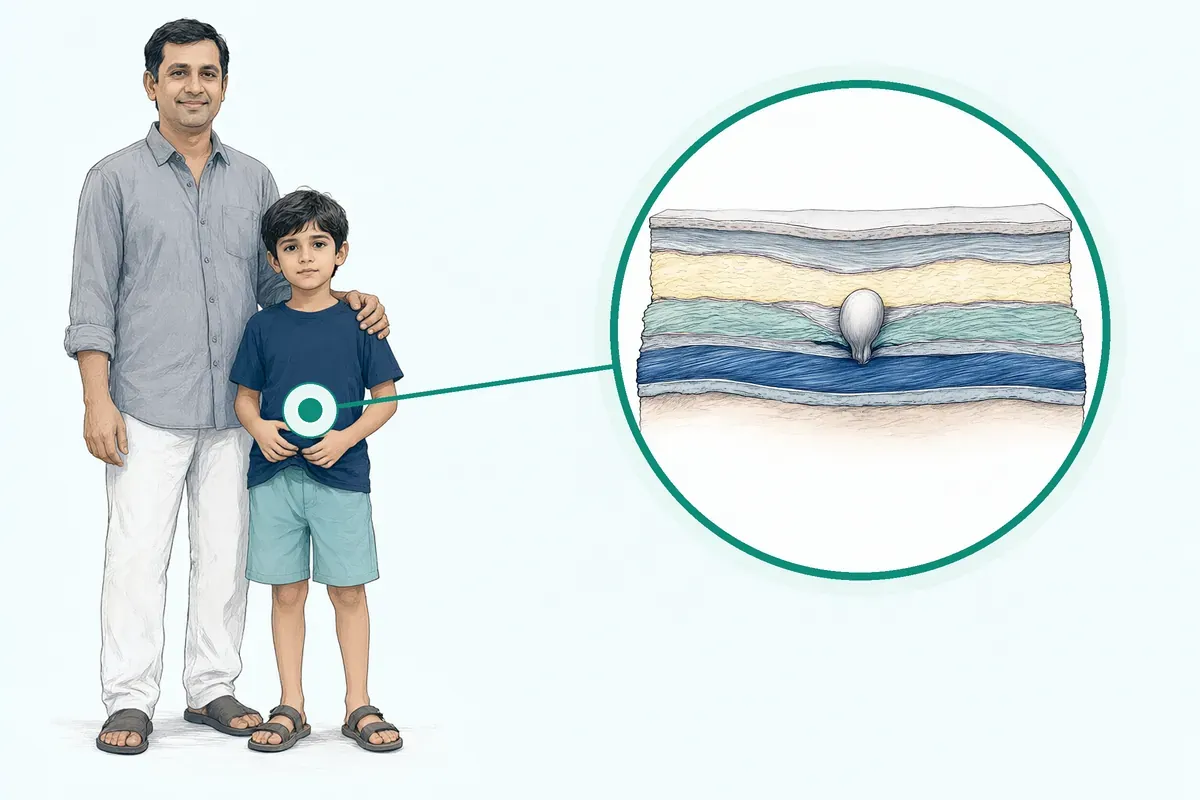
A hernia in a child happens when a small passage in the groin, called the processus vaginalis, does not close after birth. During development, the testicle moves from the abdomen down into the scrotum through this passage. In a healthy infant, the passage closes and becomes a fibrous cord with no space inside. If it stays open, abdominal lining or bowel can push through, causing a lump in the groin or scrotum.
A hydrocele happens when the same passage stays open but is very narrow. Only fluid from the abdomen can flow through it into the scrotum, making a fluid-filled sac. A hydrocele can also form after inflammation or injury around the testicle even when the passage is closed.
Both conditions are common in children. Inguinal hernia is one of the most common surgical conditions in infants and children. The incidence of paediatric inguinal hernia ranges from 0.8 to 5% and rises to more than 30% in preterm infants. Hernias are six times more common in boys than in girls.
Many hydroceles in newborns go away on their own as the passage closes naturally in the first months of life.
Symptoms and warning signs that need urgent care the same day
A bulge in the groin or scrotum that appears with crying and vanishes at rest is the usual sign. Seek care the same day if the lump turns hard, red, or tender, or if your child vomits, has a swollen tummy, or becomes very drowsy. These warn of a trapped hernia needing urgent surgery.
- Hard, red, tender lump Cannot be pushed back
- Vomiting or swollen painful tummy May mean bowel is trapped
- Unusually drowsy or irritable child Change in behaviour
The usual sign is a bulge in the groin or swelling of the scrotum. The lump may come and go, often appearing when the child cries, coughs, or strains, and disappearing when the child is calm or lying down. Pain is generally not a strong feature, but a hydrocele that grows quickly can cause discomfort.
Some signs mean the hernia is trapped and the blood supply may be cut off. This is called a strangulated hernia and it is a surgical emergency. Seek care the same day if you notice:
- Severe pain in the groin or scrotum
- The lump becomes hard, red, or tender and cannot be pushed back
- Vomiting or a swollen, painful tummy
- The child is unusually drowsy or irritable
In girls, an ovary or fallopian tube can slip into the hernia sac and become trapped. This is an urgent problem that can damage the ovary. If bowel is trapped, it can lead to perforation, severe infection, and sepsis. In boys, pressure on the spermatic cord from a trapped hernia can affect blood flow to the testicle.
Causes and who is at higher risk
The passage that should close after birth stays open, which is not caused by anything during pregnancy. Premature babies under 1500 grams have a 20 times higher chance of hernia. Boys are affected far more often than girls.
Most hernias and hydroceles in children happen because the processus vaginalis does not close on its own after birth. This is not caused by anything the mother did during pregnancy. The passage may stay wide, allowing bowel to pass through (hernia), or stay narrow, allowing only fluid (communicating hydrocele).
Some children have a higher chance of developing these conditions:
- Premature babies, especially those born weighing less than 1500 grams. Hernias are 20 times more common in this group than in full-term babies.
- Low birth weight
- Conditions such as abdominal wall defects, meconium peritonitis, or connective tissue disease
- Boys are affected much more often than girls.
In girls, bowel incarceration is less common, but an ovary or fallopian tube can enter the hernia sac and become trapped more often than bowel does. There is no known way to prevent either condition.
How it is diagnosed: examination and tests
The doctor feels the groin and scrotum and shines a torch through the swelling; light passing through confirms fluid in a hydrocele. A lump that pushes back into the tummy means an inguinal hernia. Scans or blood tests are not routinely needed.
Doctors diagnose a hernia or hydrocele by examining the child. They feel the abdomen and scrotum to check whether the swelling is caused by fluid or something solid. To confirm a hydrocele, the doctor may shine a torch through the scrotum; light passes through fluid, so the outline of the testicles shows up while the rest of the scrotum glows.
If the lump is solid and can be pushed back into the tummy, it is an inguinal hernia. The doctor will also check that both testicles are in the scrotum during the same examination.
In most children, this physical examination is enough. Special scans or blood tests are not routinely needed unless the diagnosis is unclear or the child has other health problems.
Treatment options without surgery, and when surgery is advised
Hernias need surgery because they do not close on their own and carry a 3 to 16% risk of bowel trapping. Hydroceles in babies often close by age two, so watchful waiting is tried first. Surgery is advised if a hydrocele remains after two to three years or causes discomfort.
No medicine, cream, or truss can fix a hernia or a communicating hydrocele. Aspiration (drawing out fluid with a needle) and injection of sclerosing agents are sometimes used for non-communicating hydroceles in adults, but this is not standard for children.
For a hydrocele in a baby, watchful waiting is often the first step. Many hydroceles close by themselves in the first one to two years of life. If the hydrocele is still present after two to three years, or if it is causing problems such as discomfort or getting larger, an operation may be suggested.
For an inguinal hernia, surgery is advised because the hernia will not close on its own and there is a risk of the bowel or other organs becoming trapped. The risk of incarceration is about 3 to 16% in children with an inguinal hernia. If a child has an inguinal hernia, it will need to be corrected in an operation.
The operation is usually arranged within a few weeks. In preterm infants, repair after discharge from the neonatal unit is linked to fewer breathing problems and fewer recurrences.
Preparing for child hernia and hydrocele surgery
Your child will meet the surgeon and anaesthetist in the OPD before surgery. Fasting is required: six hours for solids and milk, two hours for clear water. Bring loose clothes, a favourite toy, and extra nappies for babies; an attendant should stay overnight if advised.
Do
- Bring loose clothing
- Bring favourite toy or book
- Follow fasting times in admission letter
- Bring regular medicine prescription
Before the operation, your child will be seen in the OPD. The surgeon will examine the groin and scrotum again and explain the plan. You will meet the anaesthetist who will give the general anaesthesia. The anaesthetist will ask about any allergies, current medicines, and past illnesses.
If your child takes any regular medicine, bring the prescription so the team can decide what to continue or pause on the day of surgery.
Your child must not eat or drink for the time specified in the admission letter. This is usually six hours for solid food and milk, and two hours for clear water. Fasting reduces the risk of vomiting during anaesthesia.
Bring loose, comfortable clothing for your child to wear home, such as pyjamas or a loose kurta. A favourite toy or book can help them feel calm. If your child is a baby, carry extra nappies and a change of clothes. An attendant should plan to stay with the child through the day and overnight if the surgeon advises it.
How child hernia and hydrocele surgery is done
The operation uses general anaesthesia and takes 30 to 60 minutes. The surgeon chooses open herniotomy (groin cut) or laparoscopic repair (keyhole) based on age and side. Most children go home the same day; very young babies may stay overnight.
- General anaesthesia given By an anaesthetist experienced with children
- Surgeon chooses open or laparoscopic technique Based on age, side, and whether both sides need checking
The operation is done under general anaesthesia given by an anaesthetist experienced with children. The surgeon will choose one of two main techniques based on your child's age, the side affected, and whether both sides need checking.
Open herniotomy: The surgeon makes a small cut in the groin, finds the open passage (processus vaginalis), separates it from the blood vessels and cord, and ties it off. If it is a hydrocele, the fluid is drained first. The skin is closed with dissolvable stitches and skin glue.
Laparoscopic repair: The surgeon makes a small cut near the tummy button for a camera and two smaller cuts lower down on the abdomen. The passage is closed from inside using stitches. A key advantage is that the surgeon can look at the other side and close a patent passage there at the same time if needed.
Watchful waiting for hydrocele: In babies, many hydroceles close on their own in the first one to two years. If the hydrocele is still present after two to three years, or if it causes discomfort, surgery is usually advised.
On the day of surgery, the surgeon will visit before the operation to confirm consent. The operation itself takes about 30 to 60 minutes. After the anaesthetic wears off, your child will be offered a drink. Once comfortable, most children go home the same day. Very young babies may stay overnight for monitoring.
Risks and possible complications of child hernia and hydrocele surgery
Risks include wound infection, bruising, and rare injury to the testicular cord or blood vessels. Recurrence after repair averages about 0.7% in studies. Laparoscopic repair may cause shoulder tip pain in 10 to 17% of cases and converts to open in up to 0.89%.
- less than 0.5% Hydrocele after hernia repair
- around 0.7% Hernia recurrence average
- 10 to 17% Shoulder tip pain after laparoscopic repair
- up to 0.89% Conversion to open surgery
Every operation carries some risks. The anaesthetist will discuss the small risks of general anaesthesia, such as nausea, sore throat, or dizziness, which are usually short-lived.
Specific risks of the surgery include:
- Infection at the wound site, which can be treated with antibiotics if it occurs.
- Bruising around the groin, which fades over a few days.
- Damage to the testicular cord or blood vessels while separating them from the passage. If this happens, the testicle on that side may be smaller, or very rarely, it may shrink away.
- A hydrocele (fluid collection) forming after hernia repair. In studies, this happens in less than 0.5% of children after either open or laparoscopic repair.
- Recurrence of the hernia. In studies, the total incidence of recurrence ranges from 0 to 15.5%, with a pooled average around 0.7%.
- Shoulder tip pain after laparoscopic repair, reported in some studies in about 10 to 17% of patients, usually settling quickly.
- Conversion from laparoscopic to open surgery, reported in up to 0.89% of cases in studies.
- Injury to the bowel or other structures during laparoscopic surgery, reported only in the laparoscopic group in studies, with a total incidence around 0.32%.
If the hernia becomes stuck (incarcerated) before surgery, the bowel or ovary can lose its blood supply (strangulation). This is a surgical emergency and can lead to serious infection or loss of the bowel or ovary. The risk of incarceration in children with an inguinal hernia is reported as approximately 3 to 16%.
Recovery and aftercare after child hernia and hydrocele surgery
Your child may feel sick from the anaesthetic in the first 24 hours. Give paracetamol every four to six hours for pain and keep the wound dry for two days. Most children return to school or nursery in three to seven days.
- Two days Keep wound dry; quick shower allowed after
- Two weeks Dissolvable stitches and glue flake or fall off
- 3 to 7 days Most children ready for school or nursery
In the first 24 hours, your child may feel sick from the anaesthetic. Encourage plenty of fluids; eating can wait a day or two if they are not hungry. Paracetamol given every four to six hours is usually enough for pain. You do not need to wake your child at night to give it. If stronger medicine is needed, the hospital will provide it before discharge.
Keep the wound dry for two days. After that, a quick shower is fine, but avoid long baths for about a week so the scab does not soften and come off too early. The dissolvable stitches and skin glue will flake or fall off on their own within two weeks.
If steri-strips are used and have not fallen off after a week, you can soak them off with a wet flannel.
Your child may feel tired and a bit clumsy for the first day. Avoid sit-on toys, bicycles, and rough play until the area feels comfortable. Most children are ready to go back to school or nursery in 3 to 7 days.
Call the ward or your family doctor if your child has severe pain that medicine does not help, or if there is any oozing, redness, or swelling at the wound that gets worse.
Results of child hernia and hydrocele surgery
Surgery is the standard treatment for inguinal hernia in children and for hydrocele that lasts beyond two to three years. Recurrence rates are low and similar for open and laparoscopic repair. Laparoscopic repair takes less time for bilateral hernias and has fewer wound infections.
- around 0.7% Recurrence average
- about 7 minutes shorter with laparoscopic Bilateral hernia operating time
- 19.9% to 66% Contralateral patent passage found
Surgical repair is the accepted treatment for inguinal hernia in children. For hydrocele, surgery is advised if it persists beyond two to three years.
In studies, recurrence rates are similar between open and laparoscopic repair. The pooled odds ratio from seven randomised trials (693 children) showed no significant difference (OR 0.88, 95% CI 0.20 to 3.88). The total incidence of recurrence in large series ranges from 0 to 15.5%, with an average around 0.7%.
Ipsilateral recurrence after open repair is reported under 1% in some series, and around 3.4% after laparoscopic repair in others. Recurrences are often linked to other medical conditions.
For bilateral hernias, laparoscopic repair takes less operating time than open repair (about 7 minutes shorter on average in trials). For unilateral hernias, operating time is similar.
Postoperative complications such as wound infection are reported more often after open repair, especially in infants. However, operative complications like injury to the cord vessels are reported only in the laparoscopic group in studies. Overall, level 1 evidence supports that minimally invasive repair has lower postoperative complication rates, though differences are small and seen with experienced surgeons.
A contralateral patent processus vaginalis is found in 19.9% to 66% of children during laparoscopy for a unilateral hernia. Closing it at the same time may reduce the chance of a future hernia on the other side, though long-term outcome data is not conclusive. The International Paediatric Endosurgery Group concluded that laparoscopic repair is a safe and effective method with proper training.
Cost and insurance for child hernia and hydrocele surgery in Jaipur
The typical price range for day-care hernia or hydrocele repair in children in India is ₹30,000 to ₹80,000. Jaipur Hospital accepts MAA Yojana and private insurance panels. Contact the OPD or call the hospital for an estimate specific to your child.
In India, the typical price range for day-care hernia or hydrocele repair in children is ₹30,000 to ₹80,000. The final cost depends on the technique used (open or laparoscopic), whether one side or both sides are operated on, the type of room chosen, and any additional investigations or medicines needed.
Jaipur Hospital is a NABH-accredited multispeciality hospital established in 1991. It has modular operation theatres, a 24×7 emergency department, in-house pharmacy, and in-house diagnostic laboratory and imaging.
The hospital accepts patients under several government schemes and private insurance panels. These include MAA Yojana and a panel of private insurers and TPAs. If you are covered under any of these, bring your scheme card and identity documents at admission. The billing team can help with pre-authorisation and claim paperwork.
For an estimate specific to your child, please ask at the OPD or contact the hospital on 0141-2551500, 0141-2554139, or 7414 001 001.
