

General & Laparoscopic Surgery · Jaipur Hospital
Colonoscopy in Jaipur
Worried about bowel symptoms? Get a clear assessment and a simple plan at Jaipur Hospital.
- Serving Jaipur since 1991 (35 years)
- NABH accredited
- 24×7 emergency & ICU
- Cashless: RGHS, MAA Yojana, CGHS + 22 insurers
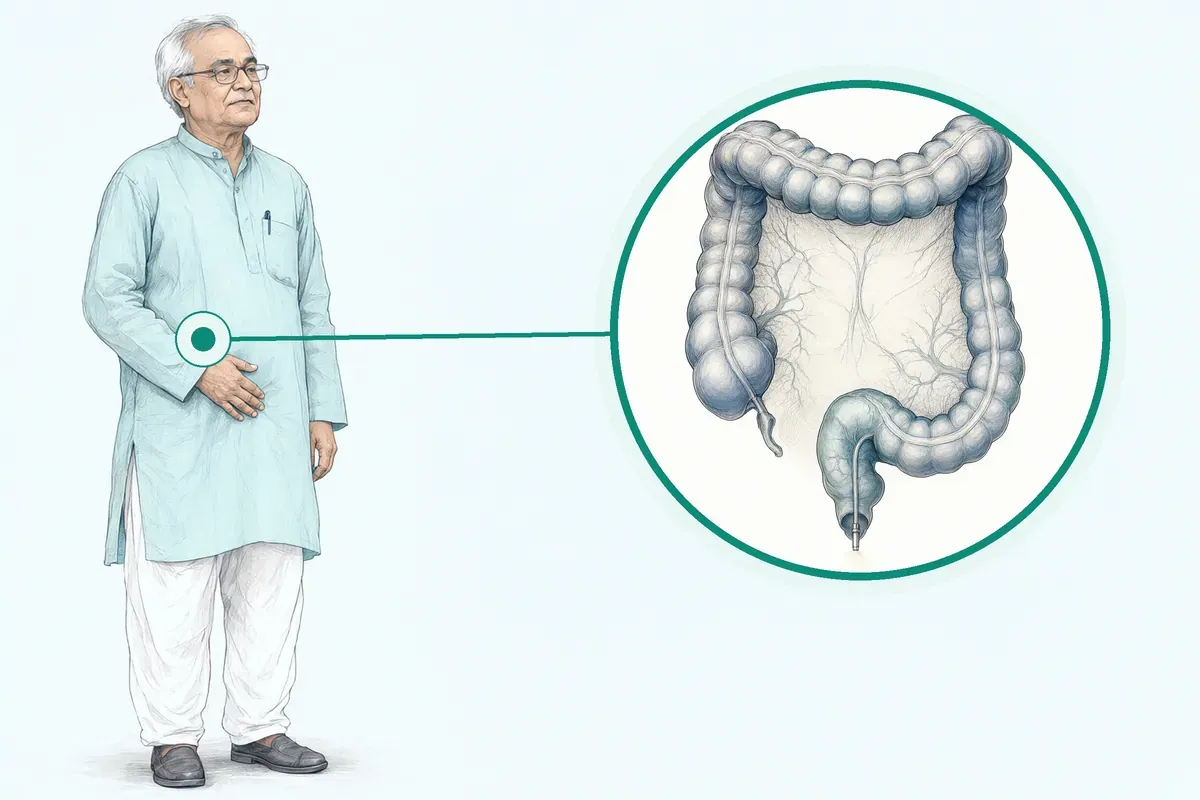
- Procedure time
- 20 to 45 minutes
- Anaesthesia
- Light sedation
- Recovery
- Back to normal activity the next dayno driving after sedation
- Price
- ₹4,000 to ₹12,000 (polyp removal and biopsy extra)typical range in India; ask us for an estimate
Bowel symptoms cause worry
You have symptoms but do not know the cause
Blood in stool, ongoing diarrhoea, or a family history of bowel cancer can make you anxious. Waiting for answers affects work and family life.
-
Unexplained bleeding
Seeing blood in the toilet or on paper is alarming and needs a proper check.
-
Changed bowel habit
Diarrhoea or constipation lasting weeks disrupts daily routine and sleep.
-
Family history
A close relative with bowel cancer means you may need screening earlier than most.
-
Anaemia without cause
Low haemoglobin with no obvious reason may point to hidden blood loss.
Colonoscopy is widely used as a screening test to detect colorectal cancer.
Why Jaipur Hospital
You want to know what is wrong without a long hospital stay or hidden costs.
Your care plan
Your first steps with us
- 1 Call or visit OPD for a surgeon consultation
- 2 Complete bowel preparation at home as advised
- 3 Undergo the camera test with light sedation
- 4 Go home in 1 to 2 hours and resume normal activity next day
How the camera test is done
A flexible tube with a camera examines the whole large bowel. Polyps can be removed and tissue samples taken during the same session.
-
Diagnostic colonoscopy
A camera examines the whole large bowel to find the cause of symptoms.
-
Polypectomy
Polyps are removed during the same test to prevent them turning into cancer.
-
Biopsy
Tissue samples are taken for the laboratory to confirm or rule out disease.
Why patients trust us
- 1991 Serving Jaipur for 35 years
- NABH Accredited hospital
- 3 General & Laparoscopic Surgery consultants
- 24×7 Emergency, ICU and ambulance
- 25 Cashless schemes and insurers
What research shows about colonoscopy
-
69% reduction in colorectal cancer incidence
Meta-analyses of observational studies estimated incidence reduced by 69% (95% CI 23% to 88%).
-
68% reduction in colorectal cancer mortality
Three studies found a summary estimate of 68% mortality reduction (95% CI 57% to 77%).
-
Major bleeding in 15 patients after polyp removal
In one study, 15 participants had major bleeding after polyp removal during colonoscopy.
If it is left untreated
Untreated polyps can grow into cancer over years. Delayed diagnosis of bleeding or changed bowel habit may mean more extensive treatment later.
Life after the test
Most people return to normal routine the next day with answers about their bowel health.
-
Clear results
You will know if polyps were found and removed or if biopsies were taken.
-
Simple follow-up
Your surgeon will explain the next check-up interval based on what was found.
-
Back to work
Most people resume normal activity the day after the procedure.
Frequently asked questions
Questions patients ask about colonoscopy
What is colonoscopy, and why has it been recommended?
In short
Colonoscopy is a camera test of the large bowel that lets the doctor see the inside lining and remove polyps during the same visit. Jaipur Hospital offers this as a day‑care procedure under light sedation. It is recommended to check for colorectal cancer, investigate bleeding, anaemia, or a change in bowel habit, and to remove growths before they can turn cancerous.
In detail
A long flexible tube with a tiny camera is passed through the anus into the colon. Air or carbon dioxide inflates the bowel so the lining is clearly visible.
If polyps are seen they are usually removed at once (polypectomy) and any abnormal area can be sampled (biopsy). Evidence shows colonoscopy reduces colorectal cancer incidence and death by detecting adenomas early.
In studies, screening colonoscopy lowered cancer risk by about 69% and mortality by about 68% over ten years. The test serves both diagnostic and therapeutic purposes in one session.
A common belief
Many people think it is only for cancer screening.
What actually happens
In fact it also investigates anaemia, bleeding or a change in bowel habit and treats polyps before they become cancer.
Your next step at Jaipur Hospital
Your surgeon will explain why colonoscopy is advised for you and what the alternatives are. You will receive written bowel‑preparation instructions and a consent form.
Plan to arrive with an attendant, expect to stay one to two hours after the test, and do not drive for the rest of the day.
Do I need a referral or an appointment?
In short
You need an appointment for colonoscopy at Jaipur Hospital. A referral from another doctor is not mandatory but it is helpful if you have one. You can call the hospital directly or book through the front desk. The surgeon will see you first in the OPD to confirm the indication and explain preparation.
In detail
The initial OPD consultation lets the surgeon review your symptoms, past reports and medicines. This visit also covers consent, bowel‑preparation instructions and any blood tests needed before sedation.
If you are covered under RGHS, MAA Yojana, CGHS or a private TPA, bring the relevant card and authorisation letter. The hospital’s 24‑hour laboratory and imaging are on site for any pre‑procedure checks.
A common belief
Some patients think they can book the test directly without seeing a doctor first.
What actually happens
The consultation is essential to check fitness for sedation and to choose the right bowel‑preparation regimen.
Your next step at Jaipur Hospital
Call 0141‑2551500 or 0141‑2554139 to fix an OPD slot. Bring an attendant on the procedure day because you cannot drive after sedation. Expect to stay one to two hours after the test.
What happens during the assessment?
In short
You lie on your left side under light sedation. The doctor passes a flexible colonoscope through the anus into the rectum and advances it around the whole colon. Air or carbon dioxide inflates the bowel for a clear view. The camera sends live video to a screen. If polyps are seen they are removed with a snare or forceps. Biopsies are taken from any abnormal area. Jaipur Hospital performs this as a day‑care procedure.
In detail
An IV cannula is placed for sedation and fluids. Vital signs are monitored throughout. The scope is advanced to the caecum and sometimes the terminal ileum. Withdrawal is slow to inspect the mucosa carefully. Polypectomy uses a wire loop that cuts and cauterises the stalk.
Biopsy forceps pinch off tiny tissue pieces. Studies show the adenoma miss rate in tandem colonoscopy is about 26%, so thorough withdrawal and good preparation matter. Complications such as bleeding after polypectomy occur in a small number of cases; perforation is rare. The procedure usually lasts 20 to 45 minutes.
- Studies show the adenoma miss rate in tandem colonoscopy is about 26%, so thorough withdrawal and good preparation matter.
A common belief
People often think it is painful or that they will be fully asleep.
What actually happens
Light sedation keeps you comfortable but breathing on your own, and most patients remember little afterwards.
Your next step at Jaipur Hospital
After the scope is removed you rest in the recovery area until the sedation wears off, usually one to two hours. The surgeon explains the findings before you leave. You receive a written report and a surveillance plan if polyps were removed. An attendant must take you home; you cannot drive for the rest of the day.
How does the term lower gastrointestinal endoscopy relate to colonoscopy?
In short
Lower gastrointestinal endoscopy is a broad term for camera tests that examine the lower digestive tract. Colonoscopy is one type of lower gastrointestinal endoscopy that looks at the entire large bowel. At Jaipur Hospital, your surgeon uses colonoscopy to check the whole colon and rectum, and can remove polyps or take biopsies during the same test.
In detail
Lower gastrointestinal endoscopy includes several procedures. Colonoscopy examines the full large bowel. Flexible sigmoidoscopy looks only at the lower part of the colon. The evidence describes colonoscopy as a test that serves both diagnostic and therapeutic purposes. It is widely used for colorectal cancer screening.
The term lower gastrointestinal endoscopy may appear on referral letters or insurance forms. Your surgeon will choose the specific test based on your symptoms, age, and risk factors. The preparation and sedation are similar for these tests.
A common belief
People often think the terms mean the same thing.
What actually happens
The preparation, reach, and what the doctor can do differ. Colonoscopy is the most complete view.
Your next step at Jaipur Hospital
If your referral says lower gastrointestinal endoscopy, ask your surgeon which specific test is planned. Colonoscopy needs a full bowel preparation. Sigmoidoscopy may need a simpler preparation. Both are day-care procedures at Jaipur Hospital. You will need an attendant and cannot drive after sedation.
Could I need part of my bowel removed after colonoscopy?
In short
Colonoscopy at Jaipur Hospital is a camera test, not surgery. It does not remove part of your bowel. If a large polyp or early cancer is found that cannot be removed safely through the scope, your surgeon will discuss a separate operation. That decision is made after the test results are reviewed, not during the colonoscopy itself.
In detail
During colonoscopy, the surgeon can remove polyps (polypectomy) and take tissue samples (biopsy). These are done through the scope. If a polyp is too large, flat, or looks like it might be cancer, removing it through the scope could risk bleeding or a tear.
In that case, the surgeon marks the spot and recommends a surgical consultation. The evidence shows colonoscopy is diagnostic and therapeutic for most polyps. Surgery to remove a bowel segment is a separate procedure with its own risks, recovery, and hospital stay. Your surgeon will explain the findings and next steps.
A common belief
People worry the test turns into major surgery on the spot.
What actually happens
It does not. You go home the same day. Any surgery is a separate, planned decision.
Your next step at Jaipur Hospital
After the test, you go home the same day. If the biopsy shows something that needs surgery, the surgical team will see you in the OPD to plan it. You will have time to ask questions and arrange your affairs. Most polyps are removed completely during colonoscopy.
How will the surgeon decide whether an operation is necessary after colonoscopy?
In short
The surgeon at Jaipur Hospital decides on surgery based on the colonoscopy findings and biopsy report. If a polyp is too large to remove safely by scope, or if cancer is found, an operation may be recommended. The decision also considers your overall health and preferences.
In detail
During the colonoscopy, the doctor assesses the size, shape, and location of any growths. Large flat polyps or those with suspicious features may need surgical removal. Biopsy results confirm whether cells are benign, pre-cancerous, or cancerous.
In studies, patients with high-risk adenomas or multiple polyps often need closer surveillance or surgery. Guidelines suggest surveillance intervals based on what is found. The surgical team reviews the images and pathology together before advising you.
A common belief
Patients often think any polyp means an operation.
What actually happens
Most polyps are taken out during the colonoscopy itself. Surgery is for the few that are too big, too flat, or turn out to be cancer.
Your next step at Jaipur Hospital
You will have a detailed discussion with your surgeon about the options, risks, and recovery. If surgery is advised, pre-operative tests and planning follow. You can ask about laparoscopic or open approaches.
What can this test or assessment find out?
In short
Colonoscopy can find polyps, inflammation, diverticula, strictures and tumours throughout the large bowel. Jaipur Hospital uses the test to diagnose the cause of rectal bleeding, iron‑deficiency anaemia, persistent diarrhoea or constipation and to screen for colorectal cancer. Any suspicious tissue is biopsied and polyps are usually removed during the same procedure.
In detail
The camera gives a direct view of the mucosa from the rectum to the caecum. Studies show colonoscopy detects more adenomas than stool‑based tests.
In a large European trial the invited group had a 10‑year colorectal cancer risk of 0.98% versus 1.20% in the usual‑care group. The miss rate for advanced adenomas in tandem studies is about 9%, so a good bowel preparation and careful withdrawal are important. Biopsy results confirm whether a lesion is benign, pre‑cancerous or malignant and guide further treatment.
- The miss rate for advanced adenomas in tandem studies is about 9%, so a good bowel preparation and careful withdrawal are important.
A common belief
A stool test only checks for hidden blood or DNA markers.
What actually happens
Colonoscopy actually sees the lining and treats pre‑cancerous growths immediately.
Your next step at Jaipur Hospital
After the test your surgeon will discuss the findings immediately and send biopsy results within a few days. If polyps were removed you will receive a surveillance schedule based on their number, size and histology. Bring any previous endoscopy or imaging reports to the consultation.
Which reports, scans, and medicine details should I bring?
In short
Bring all recent blood reports, especially haemoglobin, kidney function, coagulation profile and blood sugar. Carry any previous colonoscopy, CT abdomen, MRI or ultrasound reports. List every medicine you take, including blood thinners, diabetes drugs, iron supplements and over‑the‑counter painkillers. Jaipur Hospital will review these at the OPD consultation.
In detail
Blood thinners such as warfarin, apixaban or clopidogrel may need to be paused or bridged before polypectomy. Diabetes medicines often require dose adjustment on the fasting day.
Iron tablets can darken the stool and affect the view, so the surgeon may ask you to stop them a few days earlier. Previous imaging helps the surgeon anticipate anatomy, strictures or surgical adhesions. The in‑house laboratory can repeat any test that is older than two weeks.
A common belief
Patients often forget to mention blood thinners or diabetes tablets.
What actually happens
These change the preparation and sedation plan, so the surgeon must know them beforehand.
Your next step at Jaipur Hospital
Organise your papers in a folder: latest blood work, imaging CDs or films, a written medicine list with doses, and your insurance or scheme card. Arrive 30 minutes before your OPD time. The surgeon will finalise the preparation plan and tell you which medicines to hold.
How long will it take?
In short
The colonoscopy itself usually takes 20 to 45 minutes. Jaipur Hospital schedules it as a day‑care procedure; you arrive, have the test, recover for one to two hours and go home the same day. Total time at the hospital is typically three to four hours including preparation check‑in and recovery.
In detail
Procedure length depends on how clean the bowel is, whether polyps are found and removed, and how far the scope must travel. In studies the average colonoscopy lasts 30 to 60 minutes, but the protocol range here is 20 to 45 minutes.
Polypectomy adds a few minutes per polyp. Sedation recovery varies; most people are alert within an hour but must not drive for 24 hours. The hospital’s 24‑hour laboratory and recovery area are on site for any delayed observations.
A common belief
Some patients expect to be in and out in 30 minutes.
What actually happens
Recovery from sedation and the mandatory no‑driving rule mean you need a half‑day and someone to take you home.
Your next step at Jaipur Hospital
Plan to spend the morning or afternoon at the hospital. Bring an attendant who can stay through recovery and drive you home. You will receive a verbal summary before discharge and a written report later.
How does the term bowel camera test relate to colonoscopy?
In short
Bowel camera test is a plain-language name for colonoscopy. At Jaipur Hospital, a long flexible tube with a tiny camera at the tip is passed through the anus into the rectum and through the entire large bowel. The camera sends a live video to a screen so your surgeon can see the lining, take biopsies, and remove polyps if needed.
In detail
The term bowel camera test describes what happens during the procedure. The colonoscope inflates the bowel with air or carbon dioxide for a better view. The test takes 20 to 45 minutes. You receive light sedation through an IV so you are comfortable.
The evidence notes that colonoscopy is a fairly common test serving both diagnostic and therapeutic purposes. Bowel camera test is not a different procedure; it is simply a way patients and some doctors refer to colonoscopy in everyday language.
A common belief
Some patients think a bowel camera test is simpler or shorter.
What actually happens
It is the same procedure with the same preparation, sedation, and recovery.
Your next step at Jaipur Hospital
Whether you hear colonoscopy or bowel camera test, the preparation is the same: a special diet, laxatives, and fasting to clean the bowel. You will need an attendant to drive you home after sedation. Most people resume normal activity the next day.
FAQ library
Questions and answers about colonoscopy
When you contact us
Get your assessment and plan
Contact Jaipur Hospital for a surgeon consultation, in-house tests if needed, a clear explanation of options, a cost estimate, and help with cashless schemes.
- A consultation with a general and laparoscopic surgeon in the OPD
- Your scans and reports reviewed, with tests done in-house if you need them (laboratory, X-ray and imaging)
- Your options explained in plain words, including whether you need surgery at all
- A cost estimate before you decide
- Help with cashless treatment under RGHS, MAA Yojana, CGHS and empanelled insurers and TPAs
- Follow-up visits after your treatment
Overview
Colonoscopy: what to know
What a colonoscopy is and why it is done
- Sedation given Light sedation through a needle in your arm
- Scope inserted Flexible tube passed through the back passage
- Bowel examined Camera sends live picture to a screen
- Polyps removed Polypectomy done through the same tube
- Recovery Rest for one to two hours then go home
A colonoscopy is a camera test that lets a doctor see the inside of your large bowel, also called the colon. A thin, flexible tube with a light and a tiny camera on the end is passed through the back passage and moved along the whole length of the colon.
The camera sends a live picture to a screen so the doctor can look for any changes in the lining of the bowel.
The test is used for two main reasons. First, it checks for signs of bowel cancer or growths called polyps that could turn into cancer over time.
Second, it helps find the cause of symptoms such as bleeding from the back passage, a change in bowel habit that lasts more than a few weeks, unexplained tummy pain, or weight loss without trying.
If the doctor sees a polyp during the test, it can usually be removed at the same time. This is called a polypectomy. Small pieces of tissue may also be taken for laboratory testing. This is called a biopsy. Both are done through the same tube, so you do not need a separate procedure.
The test itself takes about 20 to 45 minutes. You will be given light sedation through a small needle in your arm so you stay comfortable and usually do not remember the procedure. After the test you rest for a short while and can go home in one to two hours.
You will need someone to take you home because you must not drive after sedation. Most people return to their normal activities the next day.
Symptoms that may lead to a colonoscopy and warning signs needing same-day care
- Large bright red bleeding Large amounts of bright red blood from the back passage
- Black tarry stools Black, tarry stools
- Severe tummy pain Severe tummy pain that does not settle
- Fainting or dizziness Fainting, dizziness, or feeling very cold and sweaty
- Vomiting blood Vomiting blood or material that looks like coffee grounds
Your doctor may suggest a colonoscopy if you have any of the following:
- Bleeding from the back passage or blood mixed with your stool
- A change in bowel habit such as looser stools, constipation, or going more or less often than usual that lasts more than a few weeks
- Ongoing tummy pain, cramps, or bloating
- A feeling that your bowel does not empty completely
- Unexplained weight loss
- Unexplained tiredness that may be due to low iron (anaemia)
Some symptoms need urgent medical attention on the same day. Go to the emergency department if you have:
- Large amounts of bright red blood from the back passage
- Black, tarry stools
- Severe tummy pain that does not settle
- Fainting, dizziness, or feeling very cold and sweaty
- Vomiting blood or material that looks like coffee grounds
These can be signs of serious bleeding or a tear in the bowel and should not wait for a routine appointment.
What causes bowel polyps and cancer and who is at higher risk
- Age over 50
- Risk rises steadily after age 50
- Family history
- Close relative with bowel cancer or polyps
- Inherited conditions
- Lynch syndrome or familial adenomatous polyposis
- Personal history
- Previous polyps or bowel cancer
- Inflammatory bowel disease
- Long-standing ulcerative colitis or Crohn's disease
- Lifestyle factors
- Low fibre, high red meat, overweight, inactivity, smoking, alcohol
Most bowel cancers start as small growths on the inner lining of the colon called polyps. Not all polyps become cancer, but some types can change over several years. The exact cause is not always known, but several factors make polyps and cancer more likely.
Age is the strongest risk factor. The risk rises steadily after age 50.
A family history of bowel cancer or polyps in a close relative (parent, brother, sister, or child) increases your risk, especially if the relative was diagnosed before age 60.
Certain inherited conditions, such as Lynch syndrome or familial adenomatous polyposis, greatly increase the risk and often mean screening starts at a younger age.
A personal history of polyps or bowel cancer means you are more likely to develop new polyps.
Long-standing inflammatory bowel disease, such as ulcerative colitis or Crohn's disease affecting the colon, also raises the risk.
Lifestyle factors linked to higher risk include:
- A diet low in fibre and high in red or processed meat
- Being overweight
- Low physical activity
- Smoking
- Regular alcohol intake
People with type 2 diabetes have a higher risk of bowel cancer.
If you fall into any of these groups, your doctor may advise a colonoscopy earlier or more often than the usual screening schedule.
How bowel conditions are diagnosed: examination and tests
Diagnosis starts with your doctor asking about your symptoms, medical history, and family history. A physical examination includes feeling your tummy and a rectal examination with a gloved finger to check for any lumps or bleeding.
Blood tests may be done to check for anaemia (low haemoglobin), which can be a sign of hidden bleeding, and to check your general health. A stool test called FIT (faecal immunochemical test) looks for tiny amounts of blood in the stool that you cannot see.
Colonoscopy is the main test to look directly at the whole colon. It is considered the most thorough way to find polyps and early cancer.
If the colonoscopy cannot be completed or is not suitable, other imaging tests may be used. These include CT colonography (a special CT scan of the bowel) or a flexible sigmoidoscopy, which looks at the lower part of the colon only.
During a colonoscopy, if the doctor sees a polyp or an abnormal area, it can be removed or sampled straight away. The tissue is sent to a laboratory where a pathologist checks it under a microscope. This confirms whether it is benign, pre-cancerous, or cancerous.
Good bowel preparation is essential for a clear view. You will be given a special diet and strong laxatives to take the day before the test so the colon is empty and clean. Poor preparation can mean polyps are missed and the test may need to be repeated.
Non-surgical treatment options and when surgery is advised
Most polyps found during a colonoscopy are removed during the test itself. This is called a polypectomy. It is done by passing a tiny wire loop or forceps through the colonoscope to snare the polyp and cut it off. The polyp is then sent for testing. Removing polyps prevents them from turning into cancer.
If a polyp is too large, flat, or in a difficult position to remove safely during a standard colonoscopy, a specialist technique called endoscopic mucosal resection (EMR) or endoscopic submucosal dissection (ESD) may be used. These are still done through the colonoscope but take longer and need more expertise. Your surgeon will advise which method suits you.
If the laboratory report shows the polyp was completely removed and has no cancer cells, no further treatment is usually needed. You will be given a surveillance plan for repeat colonoscopy based on the type, size, and number of polyps found.
If cancer is found in a polyp, the need for surgery depends on how deep the cancer goes and whether it has spread to the edges of the removed piece. If the cancer is early and low-risk, close surveillance may be enough. If there is a higher risk of spread, surgery to remove that section of the colon is usually advised.
For people with many polyps (10 or more) or certain inherited syndromes, surgery to remove a large part or all of the colon may be discussed to prevent cancer. Genetic counselling is recommended in these cases.
Medicines do not treat polyps or early bowel cancer. Lifestyle changes such as eating more fibre, less red and processed meat, keeping a healthy weight, regular exercise, stopping smoking, and limiting alcohol can lower the risk of new polyps forming.
The typical cost range for a colonoscopy in India is ₹4,000 to ₹12,000. Polyp removal and biopsy are charged extra. The final cost depends on whether polyps are removed, if biopsies are taken, the type of sedation, and any additional medications or tests needed.
Preparing for colonoscopy
- Medicine review Stop or change blood thinners, diabetes medicines, iron supplements
- Pre-procedure tests Blood test and ECG a day or two before
- Bowel cleansing Split-dose laxative, low-fibre diet, clear fluids only
- What to bring Insurance card, referral, medicine list, change of clothes
Your doctor will ask about any medicines you take, especially blood thinners, diabetes tablets or insulin, and iron supplements. You may need to stop or change some of these a few days before the test. Tell the team about any allergies, past reactions to sedation, or heart and lung conditions. You will usually have a blood test and an ECG a day or two before the appointment.
The bowel must be completely clean so the camera can see the lining clearly. You will be given a laxative preparation to drink at home. Most people follow a split-dose schedule: part of the laxative the evening before and the rest early on the day of the test, finished at least two hours before you arrive.
A low-fibre diet is advised on the day before the procedure. Clear fluids such as water, clear soup, or strained juice are allowed up to the fasting time. You must not eat solid food after the fasting time given by the hospital.
Bring your insurance card, any referral letter, a list of current medicines, and a change of clothes. An attendant must come with you because you cannot drive or travel alone after sedation. Leave jewellery and valuables at home.
How colonoscopy is done
On the day of the test you will be admitted to the day-care unit. A nurse will check your vital signs and place a small needle (cannula) in a vein in your arm or hand. Light sedation is given through this needle so you stay comfortable and usually have little memory of the procedure. You will lie on your left side on the examination table.
The doctor passes a long, flexible tube called a colonoscope through the anus into the rectum and around the whole large bowel. The scope blows a small amount of air or carbon dioxide into the bowel to open it up for a better view.
A tiny camera at the tip sends a live video picture to a screen so the doctor can examine the lining carefully. The test usually takes 20 to 45 minutes.
If the doctor sees a polyp, it can be removed during the same session using a small wire loop or forceps passed through the scope. This is called a polypectomy. If an area looks abnormal, tiny pieces of tissue (biopsies) are taken for laboratory testing. Both polypectomy and biopsy add a small amount of time to the procedure. Your surgeon will discuss which technique applies to you after the test.
Risks and possible complications of colonoscopy
- 1.8 percent Complication stopping the test
- 6.7 percent Vomiting during preparation
- 6 percent Abdominal pain needing medicine
- 0.6 percent Head injuries from falls
Colonoscopy is a safe test for most people. Serious complications are uncommon. In a large study of nearly 10,000 people preparing for colonoscopy, about 1.8 percent had a complication that stopped the test from going ahead. The most frequent issues during bowel preparation were vomiting (about 6.7 percent) and abdominal pain needing medicine (about 6 percent).
Some people felt faint or had a brief loss of consciousness; head injuries from falls occurred in about 0.6 percent.
Heart rhythm changes such as palpitations were reported in about 3.7 percent of people during preparation. A small number developed chest pain or acute coronary syndrome. Blood sugar levels dropped low enough to need treatment in about 3.3 percent, mostly in people with known diabetes. Allergic skin reactions were rare.
During or after the procedure itself, the main risks are bleeding and a tear in the bowel wall (perforation). In one study, 15 people had major bleeding after a polyp was removed. No perforations or deaths within 30 days were recorded in that study.
Other rare events reported in studies include rectal prolapse, bowel obstruction during preparation, and a single case of cardiac arrest that was successfully resuscitated. Your team monitors you closely during and after the test to detect and treat any problem early.
Recovery and aftercare after colonoscopy
Do
- Rest until sedation wears off Usually one to two hours in recovery area
- Drink water and eat light food Once fully awake
- Have an attendant take you home Stay with you overnight
Avoid
- Do not drive or operate machinery For the rest of the day
- Do not sign legal documents For the rest of the day
- Do not drink alcohol For the rest of the day
After the test you will rest in the recovery area until the sedation wears off, usually one to two hours. You may feel bloated or pass wind because of the air used during the test; this settles within a few hours. You can start drinking water and eating light food once you are fully awake.
You must not drive, operate machinery, sign legal documents, or drink alcohol for the rest of the day. An attendant should take you home and stay with you overnight. Most people return to normal activity the next day.
If a polyp was removed or a biopsy taken, you may see a small amount of blood in the stool for a day or two. Call the hospital or go to the emergency department if you have heavy rectal bleeding, severe abdominal pain that does not improve, a fever above 38°C, or feel faint and cannot keep fluids down.
The doctor will give you a written report before you leave and will tell you when to expect biopsy results, usually within a few days. A follow-up appointment or phone call will be arranged to discuss the findings and any further plan.
Results of colonoscopy
- Low-risk findings One or two small tubular adenomas
- 10 or more adenomas Referred for genetic counselling
Colonoscopy is the standard test for finding and removing polyps before they can turn into cancer. In large screening studies, people invited to have a one-time colonoscopy had a lower risk of colorectal cancer at 10 years (0.98 percent) compared with those not invited (1.20 percent). The number needed to invite to prevent one cancer case was 455. Death from colorectal cancer was also lower in the invited group (0.28 percent versus 0.31 percent).
Observational studies and meta-analyses have shown reductions in colorectal cancer incidence of about 69 percent and in mortality of about 68 percent among people who actually underwent screening colonoscopy. The benefit was strongest for cancers in the lower (distal) colon, but a significant reduction was also seen for the upper (proximal) colon.
Polyps can be missed. In tandem colonoscopy studies, where a second colonoscopy is done immediately after the first, the adenoma miss rate was about 26 percent and the advanced adenoma miss rate about 9 percent. Miss rates were higher for flat polyps and for people at high risk. Good bowel preparation and careful technique reduce the miss rate.
After polyp removal, your doctor will recommend when to have the next colonoscopy based on the number, size and type of polyps found. Low-risk findings (one or two small tubular adenomas) usually mean a repeat test in 10 years. High-risk findings (larger polyps, villous features, high-grade dysplasia, or three or more adenomas) usually mean a repeat test in three years.
If no high-risk polyps are seen at the first surveillance, the interval may be extended to five years. People with 10 or more adenomas are referred for genetic counselling. These intervals follow international guidelines and are adjusted for your personal history.
Cost and insurance for colonoscopy in Jaipur
The typical price range for a colonoscopy in Jaipur is ₹4,000 to ₹12,000. This range matches published data for similar cities such as Bhubaneswar. The final amount depends on whether the test is diagnostic only or includes polyp removal or biopsy, which are charged extra.
The type of sedation, the need for additional medicines, and the length of stay in the recovery area can also affect the bill.
Jaipur Hospital is a NABH-accredited multispeciality hospital established in 1991.
The hospital accepts patients under:
- RGHS
- MAA Yojana
- CGHS
- A panel of private insurers and TPAs
If you are covered under one of these schemes, bring your scheme card and any pre-authorisation letter. For self-pay patients, the hospital can give an estimate before admission. The in-house pharmacy and diagnostic laboratory are available on the same campus for any medicines or tests needed before or after the procedure.