

General & Laparoscopic Surgery · Jaipur Hospital
Hiatus Hernia Surgery in Jaipur
Severe reflux and hernia pain? Get a clear assessment and a simple plan at Jaipur Hospital.
- Serving Jaipur since 1991 (35 years)
- NABH accredited
- 24×7 emergency & ICU
- Cashless: MAA Yojana + 32 insurers
- Operation time
- 1.5 to 3 hours
- Anaesthesia
- General anaesthesia
- Recovery
- Desk work in 1 to 2 weekssoft diet for 4 to 6 weeks
- Price
- ₹1,00,000 to ₹2,50,000typical range in India; ask us for an estimate
When reflux takes over
Acid and discomfort that medicines no longer control
You feel burning in your chest after meals, wake up choking at night, or struggle to swallow. Pills help less each month. The hernia lets stomach acid surge upward, damaging the food pipe and making simple meals a gamble.
-
Night-time choking
Acid rises when you lie flat, disturbing sleep and leaving you tired for work.
-
Food gets stuck
Swallowing solids becomes painful or feels blocked at the chest.
-
Medicines stop working
Higher doses give less relief and side effects add up.
-
Risk to food pipe
Long-term acid exposure can lead to Barrett's changes and cancer risk.
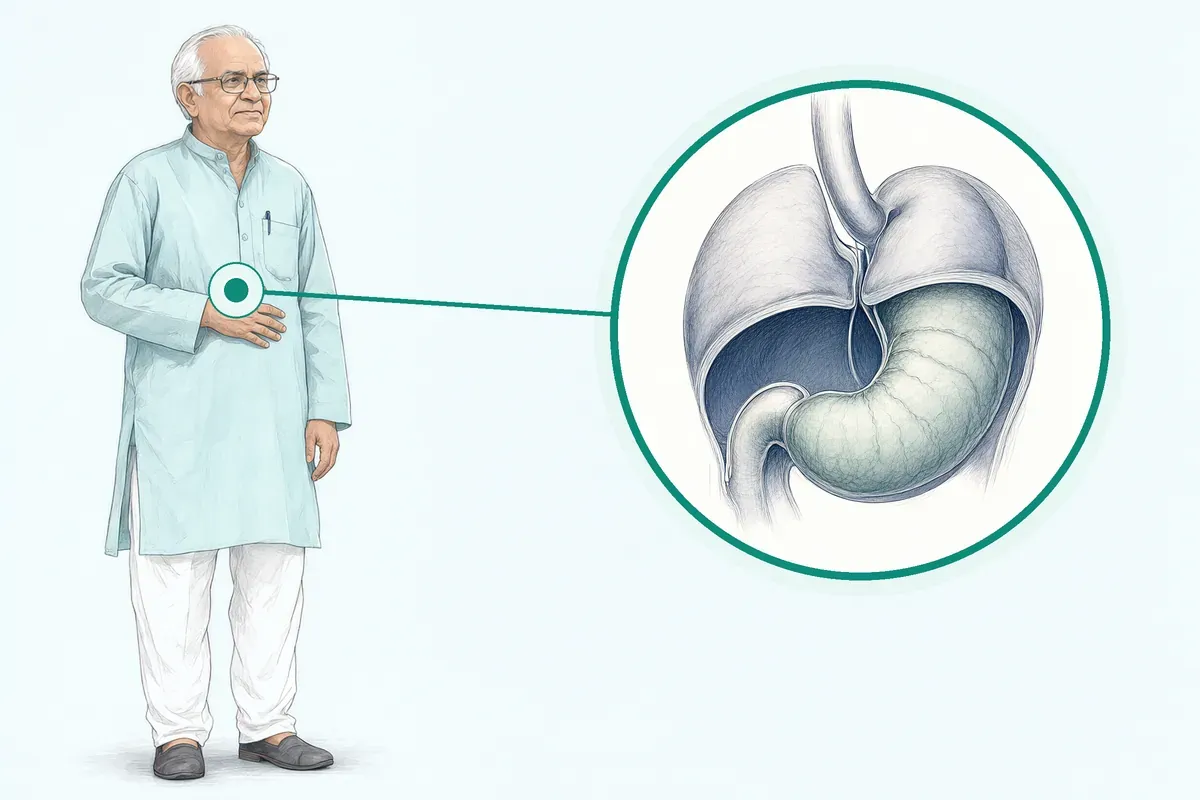
A hiatus hernia is a bulge of the stomach through the diaphragm, letting acid flow back into the oesophagus when the lower sphincter fails.
Why Jaipur Hospital
You worry that surgery means weeks off work, hidden costs, and not knowing if the relief will last.
Your care plan
Your first steps with us
- 1 Call or visit OPD for a surgeon consultation
- 2 Complete in-house tests: endoscopy, imaging, blood work
- 3 Review options and receive a written cost estimate
- 4 Schedule surgery and recover with follow-up visits
Insurance and schemes
How cashless works
Cashless treatment under MAA Yojana and with 32 insurers.
-
Tell us when you book
Say you are insured or have a scheme card, and send a photo of the card on WhatsApp so our insurance desk can check it in advance.
-
We get the approval
Once your doctor advises admission, the insurance desk sends the pre-authorisation request to your insurer or TPA; for planned surgery, approval can come before you are admitted.
-
Settled at discharge
The approved amount is settled between the insurer and the hospital; you pay only what the policy does not cover.
How the operation is done
Under general anaesthesia, the surgeon uses keyhole cuts to pull the stomach down, narrow the diaphragm opening, and wrap the stomach top around the lower food pipe to stop reflux. The procedure usually takes one to three hours.
-
Laparoscopic hiatus hernia repair
The stomach is returned to the abdomen and the diaphragm opening is narrowed with stitches, sometimes using mesh at the surgeon's discretion.
-
Nissen (360°) fundoplication
The stomach fundus is wrapped fully around the lower oesophagus to reinforce the valve and prevent acid reflux.
-
Partial (Toupet) fundoplication
A 270-degree posterior wrap that may reduce swallowing difficulty and gas-bloat for some patients.
Why patients trust us
- 1991 Serving Jaipur for 35 years
- NABH Accredited hospital
- 3 General & Laparoscopic Surgery consultants
- 24×7 Emergency, ICU and ambulance
- 32 Cashless insurers, plus MAA Yojana
What research shows about this treatment
-
1 night typical stay
Most patients stay one night in hospital after laparoscopic repair, with lower morbidity than open surgery.
-
10% to 62% recurrent heartburn
Long-term studies report heartburn returns in 10% to 62% of patients after antireflux surgery.
-
Up to 85% gas-bloat syndrome
Gas-bloat occurs in up to 85% of patients after fundoplication, often improving over months.
If it is left untreated
Without repair, a large hernia can twist (volvulus), cause bleeding anaemia, block food, or perforate. Chronic acid exposure raises the risk of Barrett's oesophagus and cancer.
Life after treatment
Most people return to desk work within one to two weeks and follow a soft diet for four to six weeks while swelling settles.
-
Fewer reflux episodes
Studies show the surgery eases GERD symptoms when medicines fail.
-
Easier eating
Swallowing improves as swelling drops; most tolerate normal textures by six weeks.
-
Back to routine
Light activity and desk work usually resume in one to two weeks; heavy lifting waits longer.
-
Ongoing follow-up
Regular OPD visits check healing, diet progress, and any late symptoms.
Meet the team
Your general & laparoscopic surgery doctors
Explore our general and laparoscopic surgery department in Jaipur: every treatment, the doctors and what to expect at your visit.



Frequently asked questions
Questions patients ask about hiatus hernia surgery
What does hiatus hernia surgery involve?
In short
Hiatus hernia surgery at Jaipur Hospital is a laparoscopic operation that returns the stomach to the abdomen and narrows the diaphragm opening. The surgeon then wraps the top of the stomach around the lower food pipe to stop acid reflux. The operation takes one and a half to three hours under general anaesthesia.
In detail
The procedure uses small keyhole cuts in the abdomen. First, the stomach is pulled down from the chest and the wide hiatus is stitched tighter, often with non-absorbable sutures.
Then a fundoplication is created: a Nissen wrap goes 360 degrees around the food pipe, while a Toupet wrap covers 270 degrees and may cause fewer swallowing problems.
Evidence shows that mesh can be added at the surgeon's discretion to lower recurrence, though long-term data are still being studied. Most patients stay one to two nights in hospital.
A common belief
Many people think the stomach is simply stitched in place.
What actually happens
In reality, the wrap type — full or partial — is chosen to balance reflux control against swallowing difficulty, and mesh may be used to reduce the chance of the hernia coming back.
Your next step at Jaipur Hospital
You will start with a clear liquid diet for about two days, then full liquids for three days, followed by a soft diet for four to six weeks. Desk work is usually possible in one to two weeks. Avoid heavy lifting for six to eight weeks. Your surgeon will review you at two to three weeks.
Which tests and scans do I need before hiatus hernia surgery?
In short
Before hiatus hernia surgery at Jaipur Hospital, you typically need an upper GI endoscopy, a barium swallow study, a CT scan of the chest and abdomen (done at an imaging centre outside the hospital), oesophageal manometry, and 24-hour pH impedance monitoring. A gastric emptying scan may be added if delayed emptying is suspected. These tests confirm reflux, measure oesophageal function, and define hernia anatomy.
In detail
Endoscopy grades oesophagitis and excludes Barrett's or malignancy. Barium swallow shows hernia size, oesophageal emptying, and any stricture. CT defines the hernia contents and rules out other mediastinal pathology.
Manometry ensures the oesophagus has enough peristalsis to push food through a wrap; weak peristalsis may favour a partial Toupet wrap. pH monitoring proves abnormal acid exposure when endoscopy is normal. Gastric emptying study excludes gastroparesis, which would worsen post-operative bloating. Blood tests, ECG, and chest X-ray are done for anaesthesia fitness.
A common belief
Patients often think a simple endoscopy is enough.
What actually happens
But without manometry and pH studies, the surgeon cannot choose the right wrap tightness or confirm that reflux is truly the problem.
Your next step at Jaipur Hospital
Most tests are available in-house at Jaipur Hospital. The surgical team coordinates the schedule so you can complete them in one or two visits. Results are reviewed at a follow-up OPD visit where the operation plan is finalised.
How painful is laparoscopic hiatus hernia surgery and the early recovery?
In short
Laparoscopic hiatus hernia surgery at Jaipur Hospital uses small incisions and general anaesthesia so you feel no pain during the operation. After surgery most people have mild to moderate soreness at the incision sites and referred shoulder pain from the gas used during laparoscopy. The shoulder pain usually settles in 7 to 10 days. You will receive pain relief in hospital and a short course of tablets to take home.
In detail
The operation is done through 5 to 6 small ports. Carbon dioxide inflates the abdomen to give the surgical team space to work. This gas irritates the diaphragm and causes shoulder tip pain, which is common after any laparoscopic procedure.
Incisions are closed with dissolvable stitches or skin glue. Evidence shows most patients describe the discomfort as manageable with regular paracetamol and a mild opioid for the first 48 hours. Severe pain is uncommon and should be reported because it can signal a complication such as bleeding or perforation.
A common belief
Many people expect severe pain because it is surgery on the stomach and diaphragm.
What actually happens
In reality the cuts are tiny and the shoulder pain is temporary gas irritation, not muscle damage. Strong painkillers are rarely needed beyond the first two days.
Your next step at Jaipur Hospital
Plan to take it easy for the first few days at home. You can shower after 24 hours and pat the wounds dry. Avoid heavy lifting for 4 to 6 weeks. Most people return to desk work in 1 to 2 weeks. If pain increases, you develop a fever, or the shoulder pain lasts beyond two weeks, contact the hospital.
How long does recovery usually take after hiatus hernia surgery?
In short
After laparoscopic hiatus hernia surgery at Jaipur Hospital, most people stay in hospital for one to two nights. You can return to desk work in 1 to 2 weeks. A soft diet is needed for 4 to 6 weeks while the swelling at the wrap settles. Heavy lifting and strenuous activity should be avoided for at least 3 to 4 weeks. Full energy levels may take 6 to 8 weeks to return.
In detail
Evidence shows laparoscopic repair has a shorter recovery and hospital stay than open repair. Most patients stay one night. Shoulder tip pain from gas lasts 7 to 10 days. Dysphagia is common for up to 6 weeks as the junction heals.
The diet advances from clear liquids (2 days) to full liquids (3 days) to a Nissen soft diet (about 2 weeks), then gradually to normal texture over 4 to 6 weeks. Many people need light duty for about 8 weeks.
Walking is encouraged from day one. Driving resumes when you have full range of motion and are off strong painkillers. Flying is avoided until the surgeon clears you, usually at the 2 to 3 week follow-up when a chest X-ray checks for pneumothorax.
A common belief
People often think laparoscopic means instant recovery, but the internal wrap needs weeks to heal.
What actually happens
The diet progression is strict and skipping stages can cause problems.
Your next step at Jaipur Hospital
Plan for one to two weeks off work if you have a desk job, longer for physical work. Follow the diet stages exactly as the surgeon advises. Attend the follow-up at 2 to 3 weeks for imaging and clinical review. Increase activity gradually, balancing walk and rest. Report any fever, worsening pain, or swallowing blockage immediately.
Can a hiatus hernia get better on its own?
In short
A hiatus hernia does not resolve on its own once the diaphragmatic opening has widened enough to let the stomach bulge into the chest. At Jaipur Hospital, surgery is considered when the hernia causes persistent symptoms such as severe reflux, dysphagia, regurgitation, chest pain, or shortness of breath that do not improve with medication and lifestyle changes.
In detail
Evidence indicates that asymptomatic hiatus hernia recurrence does not warrant repair, but a symptomatic hernia causing dysphagia, heartburn, regurgitation, vomiting, shortness of breath, or chest pain should be considered for surgery.
Giant paraesophageal hernias carry risks of gastric volvulus, anaemia, obstruction, strangulation, or perforation, and treatment is recommended in all such cases. Medical management with proton pump inhibitors can control acid symptoms but does not fix the anatomical defect. The hernia may enlarge over time, increasing the risk of complications.
A common belief
Many patients believe long-term medication can make the hernia disappear.
What actually happens
It cannot. Surgery is the only way to restore normal anatomy. The decision depends on how much the hernia affects your daily life and whether there is a risk of complications like volvulus or strangulation.
Your next step at Jaipur Hospital
If you have a diagnosed hiatus hernia with troublesome symptoms despite medical treatment, a surgical evaluation is the next step. The surgeon will assess the hernia size, symptom severity, and your overall health to decide if operation is appropriate.
How will the surgeon decide whether an operation is necessary?
In short
The surgeon decides based on your symptoms, test results, hernia size, and how much the condition affects your daily life. At Jaipur Hospital, our surgical team follows a structured evaluation. Surgery is typically advised when medicines fail to control reflux, when the hernia is large enough to risk complications, or when symptoms like difficulty swallowing, chest pain, or regurgitation persist.
In detail
Pre-operative investigations usually include barium swallow to confirm good oesophageal emptying, CT scanning to rule out recurrent hernia and confirm gastric distention, oesophageal physiology studies to rule out GERD, isotope gastric emptying studies to rule out delayed gastric emptying, and gastroscopy to rule out gastritis.
The surgeon also checks for hiatal hernias and may do tests for narrowing in the oesophagus. Giant hernias — defined by stomach position in the thorax, hernia length over 6 cm, or crural distance over 5 cm — are recommended for repair in all cases. Symptomatic recurrence with dysphagia, heartburn, or shortness of breath also warrants surgery.
A common belief
It is not just about the hernia being there.
What actually happens
Many people have hernias on scans but feel fine. The surgeon looks for objective evidence — poor oesophageal emptying, delayed gastric emptying, large defect size — and matches it with your symptom burden. Asymptomatic hernias are usually watched, not operated on.
Your next step at Jaipur Hospital
Expect a detailed history, review of prior reports, and possibly new tests during your consultation. The surgeon will explain the findings and whether the benefits of surgery outweigh the risks for you.
Why might my doctor recommend hiatus hernia surgery?
In short
Your doctor may recommend hiatus hernia surgery at Jaipur Hospital when medicines and lifestyle changes no longer control severe reflux symptoms such as heartburn, regurgitation, or chest pain. Surgery is also advised if the hernia is large, causes difficulty swallowing, leads to anaemia from bleeding, or carries a risk of the stomach twisting or becoming trapped in the chest.
In detail
Evidence shows that giant hernias with half the stomach in the chest can lead to volvulus, obstruction, strangulation or perforation if left untreated.
For patients with proven gastro-oesophageal reflux disease that does not respond to proton pump inhibitors, fundoplication reinforces the lower oesophageal sphincter and reduces acid exposure.
Studies report significant symptom improvement in the majority of operated patients, and the procedure lowers the long-term risk of Barrett's oesophagus. The decision balances symptom severity, hernia size, and your overall fitness for general anaesthesia.
A common belief
Patients often hope a higher dose of acid tablets will work eventually.
What actually happens
But a wide hiatus and a broken valve are structural faults. No amount of medicine can pull the stomach down or recreate a competent sphincter.
Your next step at Jaipur Hospital
Your surgeon will review endoscopy, barium swallow, and oesophageal physiology tests before advising surgery. If you have persistent symptoms despite maximum medical therapy, or a large paraesophageal hernia, a consultation is the next step.
How should I prepare in the days before hiatus hernia surgery?
In short
Jaipur Hospital will give you a personalised checklist before your laparoscopic fundoplication. You usually have blood tests, an ECG and a chest X-ray in the pre-operative work-up. Stop smoking if you can, because it slows healing. Eat light meals the day before and follow the fasting rule you are given. Your surgeon reviews all regular medicines and tells you which to pause.
In detail
Preparation aims to lower anaesthetic risk and make the operation smoother. Blood tests check haemoglobin, kidney function and clotting. An ECG and chest X-ray screen your heart and lungs for general anaesthesia safety.
Smoking increases wound infection and lung complications, so stopping even a few days helps. The surgical team also needs a clear picture of every tablet, supplement or herbal product you take because some affect bleeding or interact with anaesthetic drugs. You will be told exactly which medicines to continue on the morning of surgery with a sip of water.
A common belief
Many people think they only need to fast the night before.
What actually happens
In fact, the medicine review is just as important because blood thinners, diabetes tablets and some supplements must be adjusted days in advance to prevent bleeding or sugar swings during anaesthesia.
Your next step at Jaipur Hospital
Expect a pre-admission call or visit one to two weeks before the operation date. Bring a list of all medicines and any recent test reports. The nursing team will confirm your fasting start time and the arrival time at the hospital. An attendant should plan to stay with you for the first night at home after discharge.
What are the common side effects and the less common serious complications of laparoscopic hiatus hernia surgery?
In short
Common side effects after laparoscopic hiatus hernia surgery at Jaipur Hospital include temporary difficulty swallowing, feeling full quickly, bloating, inability to belch or vomit, and loose stools. These affect a large proportion of patients in the first weeks. Serious complications such as bleeding, injury to the food pipe or stomach, pneumothorax, cardiac tamponade, or mesh erosion are rare but can be life‑threatening and may need urgent treatment.
In detail
Studies report dysphagia in 10 to 50 percent of patients, gas‑bloat syndrome in up to 85 percent, and diarrhoea in 18 to 33 percent after fundoplication. Most swallowing trouble improves as swelling settles over 4 to 6 weeks.
The wrap prevents belching and vomiting, which is expected.
Serious risks include conversion to open surgery (under 2.5 percent), perforation recognised during surgery (repaired immediately), delayed perforation (may need re‑operation), splenic injury, and very rare but catastrophic events such as aortic erosion from mesh or gastro‑aortic fistula. Cardiac tamponade has been reported up to 14 days after surgery.
A common belief
Patients often think the wrap will just stop acid.
What actually happens
They do not realise the same mechanism stops normal belching and vomiting, and that gas gets trapped causing bloating. These are not complications — they are the expected result of a tight valve.
Your next step at Jaipur Hospital
You will be monitored in hospital for 1 to 2 nights. Before discharge the team checks you can tolerate fluids and soft food. At home follow the stepped diet: clear liquids, then full liquids, then soft moist foods for 4 to 6 weeks.
Avoid fizzy drinks, chewing gum, and gas‑producing vegetables. If you develop chest pain, shortness of breath, vomiting blood, black stools, or fever, go to the emergency department.
Which symptoms are expected after hiatus hernia surgery, and which need urgent medical attention?
In short
After hiatus hernia surgery at Jaipur Hospital, you can expect some shoulder pain for 7 to 10 days, swelling where the food pipe joins the stomach, feeling full quickly, and trouble swallowing for up to 6 weeks. You may also have gas, bloating, and less energy than usual. Contact your surgeon at once if you have new or worsening shortness of breath, new pain, bleeding from the incision, signs of infection, or if your reflux symptoms come back.
In detail
These common symptoms happen because the diaphragm and stomach are healing after the wrap is created. Shoulder pain comes from the gas used during laparoscopic surgery. Swelling at the join makes swallowing harder at first.
Gas-bloat syndrome affects up to 85% of patients after antireflux surgery, and dysphagia occurs in 10% to 50%.
Urgent signs like chest pain, hypotension, or irregular pulse can indicate rare but serious complications such as cardiac tamponade or bleeding, which may appear in the first 14 days. Inability to swallow saliva or water, severe epigastric pain, or sudden drop in blood pressure need immediate review.
A common belief
But new shortness of breath, chest pain radiating to the shoulder blade, sudden severe belly pain, bleeding from the cuts, fever, or your reflux coming back are not normal.
What actually happens
They can signal bleeding, infection, or a heart-related complication that needs urgent care.
Your next step at Jaipur Hospital
Keep the hospital's emergency number handy for the first two weeks. If you cannot swallow liquids, have severe chest or shoulder pain that does not settle, notice bleeding or pus at the cuts, or develop fever, go to the emergency department at Jaipur Hospital. For milder issues like nausea or constipation, call your surgeon's office during working hours.
FAQ library
Questions and answers about hiatus hernia surgery
When you contact us
Get your assessment and plan
Contact Jaipur Hospital to book a surgical OPD consultation, review your reports, and receive a clear cost estimate before you decide.
- A consultation with a general and laparoscopic surgeon in the OPD
- Your scans and reports reviewed, with tests done in-house if you need them (laboratory, X-ray and imaging)
- Your options explained in plain words, including whether you need surgery at all
- A cost estimate before you decide
- Help with cashless treatment under MAA Yojana and empanelled insurers and TPAs
- Follow-up visits after your treatment
Read more
Read more about hiatus hernia surgery
- Hernia Symptoms and When Surgery Is Needed
Hernia symptoms, warning signs and when surgery is recommended, explained in plain words for patients and families by Jaipur Hospital.
- Hernia Surgery Cost and Mesh Options in Jaipur
Hernia surgery cost and mesh options in Jaipur are explained with factors that affect price and mesh choice. Read the guide to plan your treatment.
Overview
Hiatus Hernia Surgery: what to know
What is a hiatus hernia and how it happens
A hiatus hernia is when the upper part of your stomach pushes up through the diaphragm into your chest. This happens when the muscle around the opening for your food pipe becomes weak or stretched. The valve that keeps acid in your stomach may then stop working properly.
- Diaphragm opening Food pipe passes through hiatus
- Muscle weakens Hiatus stretches over time
- Stomach bulges up Valve mechanism fails
A hiatus hernia is a bulge in your stomach at the top of your food pipe (oesophagus). The diaphragm is a sheet of muscle that separates your chest from your abdomen. It has a small opening (hiatus) for the food pipe to pass through.
When the muscle around this opening becomes weak or stretched, the upper part of the stomach can push up through the opening into the chest.
Normally, the lower oesophageal sphincter relaxes to let food move from your food pipe to your stomach, then tightens to keep stomach acid out. When the stomach slides up through the hiatus, this valve mechanism can stop working properly. If you have GERD, the acid in your stomach flows back up to your food pipe. This can happen if your lower oesophageal sphincter does not work as it should.
A giant paraoesophageal hiatus hernia is defined as a defect in which at least half of the stomach is located within the chest on contrast radiography. It can also be defined as a hernia measuring at least 6 cm in length on preoperative endoscopy, or a distance between the crura of at least 5 cm noted during surgery.
Symptoms of hiatus hernia and warning signs needing urgent care
Common symptoms are heartburn, regurgitation, difficulty swallowing, chest pain and feeling full quickly. Urgent signs include sudden severe chest pain, vomiting blood, black stools, inability to swallow liquids and severe shortness of breath. These may mean the stomach is strangled, bleeding or perforated.
- Sudden severe chest pain
- Vomiting blood or coffee-ground material
- Black or tarry stools
- Cannot swallow liquids or saliva
- Severe shortness of breath
Common symptoms include:
- Heartburn
- Regurgitation of food or sour liquid
- Difficulty swallowing
- Chest pain
- Feeling full quickly after eating
You may also have shortness of breath if the hernia presses on the lungs.
Warning signs that need medical attention the same day include sudden severe chest pain, vomiting blood or material that looks like coffee grounds, black or tarry stools, inability to swallow liquids or saliva, and severe shortness of breath. These can indicate complications such as strangulation of the stomach, bleeding, or perforation.
After surgery, it is normal to feel full more quickly than usual. Eating or drinking too much at once can cause discomfort. It is common to have trouble swallowing for a period. Referred pain in the shoulder can last for 7 to 10 days after laparoscopic surgery. Dumping syndrome can cause nausea, weakness, cold sweats, cramps, or diarrhoea.
Causes of hiatus hernia and who is at higher risk
Increased abdominal pressure from coughing, vomiting, straining, heavy lifting or obesity can weaken the diaphragm over time. Age-related changes and injury also contribute. People over 50, those who are overweight, pregnant women and those with chronic constipation or cough are at higher risk.
- Age over 50
- Diaphragm muscle weakens with age
- Overweight or obese
- Extra abdominal pressure strains the diaphragm
- Pregnancy
- Growing uterus increases abdominal pressure
- Chronic constipation or cough
- Repeated straining weakens the diaphragm over time
The exact cause is not always clear. Increased pressure in the abdomen from persistent coughing, vomiting, straining during bowel movements, heavy lifting, or obesity can weaken the diaphragm muscle over time. Age-related changes in the diaphragm and injury to the area can also contribute.
The crura (muscular pillars of the diaphragm) can separate into a wide asymmetrical V-shape due to destruction of the anterior muscular component of the hiatus and excessive stretching of the left crural fibres. This structural change allows the stomach to move upward.
People over 50, those who are overweight or obese, pregnant women, and people with chronic constipation or chronic cough are at higher risk.:
- People over 50
- Those who are overweight or obese
- Pregnant women
- People with chronic constipation or chronic cough
A family history of hiatus hernia may also increase risk.
How hiatus hernia is diagnosed: examination and tests
Your surgeon will ask about symptoms and may order an upper GI endoscopy, barium swallow X-ray or oesophageal manometry. A CT scan of the chest and abdomen may be done for large or complex hernias. These tests confirm the hernia and check how well your food pipe works.
Do
- Upper GI endoscopy
- Barium swallow X-ray
- Oesophageal manometry
- CT scan of chest and abdomen
Your surgeon will ask about your symptoms and medical history. They may do tests to check for narrowing in your food pipe and check for hiatus hernias.
Common investigations include:
- An upper GI endoscopy (gastroscopy) to see the lining of the food pipe and stomach
- A barium swallow X-ray to watch the movement of liquid and check for hernia
- Oesophageal manometry to measure muscle pressure and coordination
A CT scan of the chest and abdomen may be done for large or complex hernias.
Pre-operative investigations should include barium swallow to confirm good oesophageal emptying, CT scanning to rule out a recurrent hiatus hernia and confirm gastric distention with gas, oesophageal physiology to rule out GERD, isotope gastric emptying studies to rule out delayed gastric emptying, and a gastroscopy to rule out gastritis. Confirmation of the diagnosis can be sought by radio-isotope gastric emptying studies.
Treatment options without surgery and when surgery is advised for hiatus hernia
Surgery is advised when medicines and lifestyle changes do not control reflux, or for giant hernias due to risk of serious complications. Recurrent hernias causing symptoms like swallowing difficulty or chest pain also need repair. Most Indian health insurance plans cover this surgery, but check waiting periods and pre-existing condition clauses.
Non-surgical management includes lifestyle changes and medicines.
You may be advised to:
- Lose weight if overweight
- Avoid large meals
- Not lie down for 2 to 3 hours after eating
- Raise the head of your bed
- Avoid foods that trigger reflux (such as spicy, fatty, or acidic foods)
Medicines like proton pump inhibitors (PPIs) reduce stomach acid and can control symptoms for many people.
Surgery is considered when other treatments do not ease GERD symptoms. Treatment of giant hiatus hernias is recommended in all cases due to potential complications such as gastric volvulus, anaemia, obstruction, strangulation, or perforation. Hiatus hernia recurrence causing symptoms such as difficulty swallowing, heartburn, regurgitation, vomiting, shortness of breath, or chest pain should be considered for surgery.
Patients with intractable symptoms and severe impairment of quality of life may be considered for redo surgery. Asymptomatic hiatus hernia recurrence does not warrant a repair.
Hiatus hernia surgery is covered by most health insurance plans in India. Patients should check the waiting period clause in insurance and pre-existing condition coverage.
Preparing for hiatus hernia surgery
Before surgery you will have a barium swallow, endoscopy, and sometimes a CT scan or pressure tests, plus routine blood work, ECG and chest X-ray. Tell your surgeon about all medicines, especially blood thinners and diabetes drugs, so the anaesthesia team can advise which to stop. You must not eat or drink for at least six hours before the operation.
Do
- Tell surgeon all medicines
- Pack loose clothes and test reports
- Bring an attendant if you wish
Before your operation, our surgical team will arrange the tests needed to plan a safe procedure. These usually include a barium swallow to check how well your food pipe empties, an endoscopy to look at the stomach lining, and sometimes a CT scan or tests that measure pressure and acid in the food pipe. You will also have routine blood work, an ECG and a chest X-ray as part of the pre-anaesthesia check.
Tell your surgeon about every medicine you take, especially blood thinners, diabetes tablets or insulin, and any herbal supplements. The anaesthesia team will advise which medicines to stop and which to continue on the morning of surgery. You will receive general anaesthesia, so you must not eat or drink for at least six hours before the operation.
Pack loose, comfortable clothes, your regular medicines in their original boxes, and any test reports or insurance papers. An attendant can stay with you in the room. Jaipur Hospital provides a 24-hour in-house pharmacy and canteen with dietary meals, so you do not need to bring food or routine medicines unless your doctor asks you to.
How hiatus hernia surgery is done
The operation uses five or six small abdominal cuts under general anaesthesia and takes one and a half to three hours. The stomach is pulled down, the diaphragm opening is stitched narrower, and the stomach top is wrapped around the food pipe (Nissen or Toupet). A mesh may be used to reinforce the repair, and most patients stay one to two nights.
- Pull stomach back into abdomen Stomach gently returned to its normal position
- Narrow the diaphragm opening (hiatus) Stitches tighten the hiatus so only the food pipe passes through
The operation is performed under general anaesthesia and usually takes one and a half to three hours. The surgeon works through five or six small cuts in the abdomen, using a camera and long instruments.
First, the stomach is gently pulled back into the abdomen. The opening in the diaphragm (the hiatus) is narrowed with stitches so that only the food pipe can pass through. This is the hiatus hernia repair.
To stop acid reflux, the top part of the stomach (the fundus) is wrapped around the lower end of the food pipe. There are two common ways to do this:
- Nissen (360°) fundoplication: a full wrap that gives strong reflux control.
- Partial (Toupet) fundoplication: a 270-degree wrap that may cause fewer swallowing problems for some patients.
Your surgeon will discuss which wrap suits your anatomy and symptoms.
In some cases, a mesh may be placed to reinforce the diaphragm repair. Current evidence suggests mesh should be used at the surgeon's discretion until more long-term data on symptoms and recurrence are available. Robotic assistance is an alternative to standard laparoscopy in some centres.
On the day of surgery, you will be taken to the modular operation theatre. After the anaesthetic takes effect, the small cuts are made and the procedure is carried out. A drain may be left near the repair for a short time. You will wake up in the recovery area and then move to a ward room. Most patients stay one to two nights.
Risks and possible complications of hiatus hernia surgery
Common risks include difficulty swallowing (10-50%), gas-bloat syndrome (up to 85%), diarrhoea (18-33%), and return of heartburn (10-62%). Serious but rare risks are bleeding, injury to the food pipe or vessels, pneumothorax, and cardiac tamponade. Mesh problems and wound infections can also occur, and the team monitors you closely to treat them early.
- 10% to 50% Difficulty swallowing
- up to 85% Gas-bloat syndrome
- 18% to 33% Diarrhoea
- 10% to 62% Heartburn or regurgitation return
Like any operation, this surgery carries risks. The anaesthesia team will explain the general risks of general anaesthesia. Specific to this procedure, studies report the following:
- Difficulty swallowing (dysphagia) occurs in 10% to 50% of patients after anti-reflux surgery. Most people have mild to moderate trouble for up to six weeks while swelling settles. Occasionally it lasts longer and may need a stretch procedure (dilatation) or a second operation.
- Gas-bloat syndrome — feeling full quickly, unable to belch, with bloating and flatulence — is reported in up to 85% of patients. It often improves with dietary changes and time.
- Diarrhoea occurs in 18% to 33% of patients. It is usually managed with diet and medicine.
- Heartburn or regurgitation can return in 10% to 62% of patients.
- Bleeding during or soon after surgery is one of the most common reasons for an early return to the operating room.
- Injury to the food pipe, stomach, or major blood vessels is rare but serious.
- The spleen can be injured during the operation; splenectomy is exceedingly rare in laparoscopic procedures.
- A pneumothorax (collapsed lung) is a rare and treatable complication.
- Cardiac tamponade (fluid around the heart) is the most serious cardiac complication and can develop from the time of surgery up to two weeks later. It is rare but can be fatal if not recognised quickly.
- Mesh-related problems such as erosion into the food pipe or major blood vessels have been described.
- Wound infection or hernia at the port sites can occur.
Your surgical team monitors you closely in hospital and at follow-up to detect and treat any of these early.
Recovery and aftercare after hiatus hernia surgery
You usually stay one to two nights and follow a step-up diet from liquids to soft foods over several weeks. Walk gently from day one, avoid lifting more than a kettle for four to six weeks, and keep cuts dry until Steri-Strips fall off. Call your surgeon if you get shortness of breath, severe pain, fever, or vomiting that will not stop.
Most people stay in hospital for one to two nights. You will start with sips of water and progress to a clear liquid diet for about two days, then a full liquid diet for about three days, then a soft, moist diet (Nissen soft diet) for about two weeks. Your doctor will tell you when to move to the next stage.
Eat six small meals a day instead of three large ones. Sit upright while eating and for 30 minutes afterwards. Chew well, take small bites, and avoid fizzy drinks, drinking through a straw, chewing gum, and foods that cause gas such as cabbage, cauliflower, onions and beans.
If you feel nauseous, take the prescribed anti-sickness medicine or try ginger tea, flat ginger ale, or saltine crackers softened with broth.
You will have five or six small cuts on your abdomen. Stitches inside dissolve on their own. Steri-Strips or skin glue may be used; they can get wet in the shower and will peel off on their own within 10 days. Do not soak in a tub bath until your surgeon says it is safe.
Shoulder tip pain from the gas used during surgery is common and lasts about 7 to 10 days. Walking gently from day one helps prevent blood clots and constipation. Increase activity gradually and balance it with rest. Do not lift anything heavier than a kettle for the first four to six weeks.
You can usually return to desk work in one to two weeks. A soft diet continues for four to six weeks. Driving is allowed when you are no longer sore and have full movement back.
Your first follow-up appointment is usually two to three weeks after discharge. An imaging scan may be done to check for a pneumothorax.
Call the hospital or your surgeon if you have:
- New or worsening shortness of breath
- New or severe pain
- Persistent vomiting or inability to keep liquids down
- Fever or signs of wound infection (redness, swelling, discharge)
- Bleeding from the cuts
- Diarrhoea that does not settle
- Symptoms of heartburn or swallowing difficulty returning
Results of hiatus hernia surgery: how well it works and recurrence
Most patients get good relief from reflux after fundoplication, and surgery lowers the chance of Barrett's oesophagus. Hernia recurrence on scans is about 23% with stitches and 31% with absorbable mesh at six months, though symptoms often stay similar. Reoperation rates range from 0% to 15%, usually within two years.
In studies, the majority of patients report significant improvement in reflux symptoms after fundoplication. One large trial found that a transoral fundoplication eliminated troublesome regurgitation in 67% of patients compared with 45% on medication alone. Acid exposure in the food pipe improved after surgery.
A Nissen fundoplication reinforces the lower valve so stomach acid stays in the stomach. It also reduces the risk of developing Barrett’s oesophagus, a pre-cancerous change.
Recurrence of the hernia is seen on imaging in about 23% of patients after suture repair and about 31% after absorbable mesh repair at six months. Non-absorbable mesh lowers the odds of recurrence compared with suture repair. However, clinical outcomes such as heartburn, bloating and swallowing trouble are often similar between mesh and no-mesh groups, and the differences are small. The quality of evidence for routine mesh use is low.
Reoperation rates after anti-reflux surgery range from 0% to 15% in published series. One study noted that 10% of patients needed a second procedure. Failures usually occur within the first two years.
Most late complications improve during the three to six months after surgery. Redo surgery is not certain to resolve all symptoms and may bring back acid reflux. Your surgeon will discuss what results are realistic for your situation.
Cost and insurance for hiatus hernia surgery in Jaipur
In India, laparoscopic hiatus hernia surgery with fundoplication typically costs ₹1,00,000 to ₹2,50,000, covering the operation, anaesthesia, stay, medicines and nursing. The final bill depends on the fundoplication type, mesh use, length of stay, any extra tests, and room category. Jaipur Hospital is empanelled under MAA Yojana and private insurers; most plans cover this surgery.
In India, the typical price range for laparoscopic hiatus hernia surgery with fundoplication is ₹1,00,000 to ₹2,50,000. This range covers the operation, anaesthesia, hospital stay of one to two nights, routine medicines and consumables, and standard nursing care.
The final bill can vary depending on:
- The type of fundoplication (Nissen or partial)
- Whether mesh is used
- The length of stay if recovery is slower
- Any additional tests or treatments needed for complications
- Room category chosen
Published Indian data show wider ranges across different hospitals: government hospitals ₹50,000 to ₹1,50,000; private hospitals ₹1,50,000 to ₹4,50,000; premium metro hospitals ₹3,00,000 to ₹6,00,000. Laparoscopic surgery specifically ranges from ₹1,80,000 to ₹3,50,000 in those reports.
Jaipur Hospital is a NABH-accredited multispeciality hospital established in 1991. We are empanelled under MAA Yojana and a panel of private insurers and TPAs. Hiatus hernia surgery is covered by most health insurance plans in India. Check your policy for any waiting period clause and for pre-existing condition coverage before planning admission.
Our insurance desk can help with pre-authorisation and cashless claims. Ask us for a personalised estimate based on your room choice and clinical needs.
