

General & Laparoscopic Surgery · Jaipur Hospital
Laparoscopic Inguinal Hernia Repair in Jaipur
Groin bulge and pain affecting work? Get a clear assessment and a simple plan.
- Serving Jaipur since 1991 (35 years)
- NABH accredited
- 24×7 emergency & ICU
- Cashless: RGHS, MAA Yojana, CGHS + 22 insurers
- Operation time
- 45 to 90 minutes
- Anaesthesia
- General anaesthesia
- Recovery
- Desk work in about 1 weekheavy lifting after 4 to 6 weeks
- Price
- ₹60,000 to ₹1,40,000, including meshtypical range in India; ask us for an estimate
Groin hernia disrupts daily life
A bulge in the groin that hurts when you move or lift
The bulge may appear when you stand or cough and disappear when you lie down. It can cause a dragging ache, limit your work, and make you worry about it getting stuck.
-
Visible bulge
A lump in the groin or scrotum that comes and goes with position.
-
Pain on effort
Ache or sharp pain when lifting, bending, or standing for long periods.
-
Work disruption
Difficulty doing physical tasks or sitting comfortably at a desk.
-
Fear of emergency
Worry that the hernia could become trapped and need urgent surgery.
A groin hernia will not heal on its own and can lead to obstruction or strangulation if the bowel becomes trapped.
Why Jaipur Hospital
You want the pain and bulge gone without a long time off work or a big scar.
Your care plan
Your first steps with us
- 1 Call or visit OPD for a surgeon consultation
- 2 Get scans and tests done in-house if needed
- 3 Undergo keyhole repair under general anaesthesia
- 4 Follow up after discharge for wound check and advice
How the operation is done
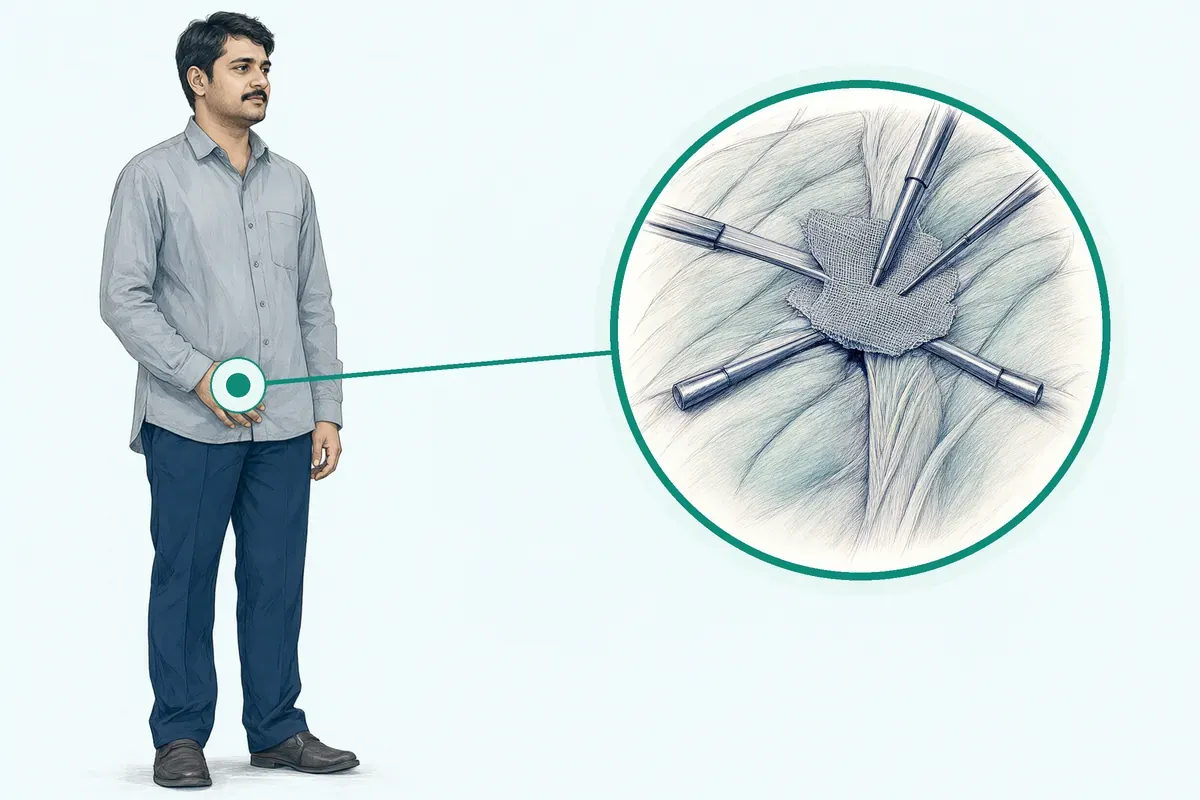
Under general anaesthesia, the surgeon makes small cuts near the belly button and lower abdomen, places mesh over the weak spot, and closes the cuts. The procedure usually takes 45 to 90 minutes.
-
TEP (totally extraperitoneal)
Mesh is placed in the preperitoneal space without entering the abdominal cavity.
-
TAPP (transabdominal preperitoneal)
The surgeon enters the abdominal cavity to place mesh behind the peritoneum.
-
Bilateral repair
Both sides can be repaired in the same operation if hernias are present on both sides.
Why patients trust us
- 1991 Serving Jaipur for 35 years
- NABH Accredited hospital
- 3 General & Laparoscopic Surgery consultants
- 24×7 Emergency, ICU and ambulance
- 25 Cashless schemes and insurers
What research shows about this treatment
-
4 to 6 weeks for full recovery
Most people return to desk work within a week and heavy lifting after 4 to 6 weeks.
-
about 16 in 100 need re-operation within 10 years
Long-term studies show hernia recurrence requiring further surgery in about 16% of patients over 10 years.
-
17 in 100 experience a complication
In a large series, 17.2% of laparoscopic hernia patients had complications such as seroma, wound infection or pain.
If it is left untreated
If left untreated, a hernia can grow larger and become irreducible. The bowel may become trapped (obstruction) or its blood supply cut off (strangulation), which is a life-threatening emergency needing immediate surgery.
Life after treatment
Most people return to normal routines within weeks, with small scars and less pain than open surgery.
-
Back to desk work
Most people resume office or light duties within about a week.
-
Smaller scars
Keyhole surgery leaves a few small cuts instead of a long groin incision.
-
Less pain medication
Patients typically need fewer painkillers compared to open repair.
-
Normal activity returns
Quality of life improves significantly and stays improved at follow-up.
Frequently asked questions
Questions patients ask about laparoscopic inguinal hernia repair
What does laparoscopic inguinal hernia repair involve?
In short
Laparoscopic inguinal hernia repair at Jaipur Hospital uses small cuts near the belly button and lower tummy. Under general anaesthesia, the surgeon pushes the hernia back and places a mesh over the weak spot. The operation usually takes 45 to 90 minutes and you may go home the same day or stay one night.
In detail
The surgeon makes a few small incisions and pumps air into the tummy to create space. A thin tube with a camera (laparoscope) lets the surgical team see the hernia on a screen.
The hernia sac is returned to the abdomen and a mesh sheet is fixed over the defect with small stitches or staples.
Two main techniques exist: TEP, where the mesh is placed without entering the abdominal cavity, and TAPP, where the mesh is placed from inside the abdomen. Both methods give similar long-term results for pain, quality of life and return to normal activities. The air is released at the end and the cuts are closed with stitches or clips.
A common belief
Many people think open surgery with a large cut is the only way.
What actually happens
Laparoscopic repair uses tiny cuts, causes less scarring, and usually needs fewer pain medicines. Both TEP and TAPP techniques give similar long-term outcomes.
Your next step at Jaipur Hospital
You will have a preoperative check-up and basic blood tests. On the day of surgery you fast for a few hours. After the operation you can walk the same day and shower after a few days with a waterproof dressing. Desk work usually resumes in about one week. Heavy lifting and strenuous activity should wait 4 to 6 weeks.
Which tests and scans do I need beforehand for laparoscopic inguinal hernia repair?
In short
Before laparoscopic inguinal hernia repair at Jaipur Hospital, you will usually need routine pre-anaesthesia tests. These include a complete blood count, blood sugar, kidney and liver function tests, a coagulation profile, a chest X-ray and an ECG. The exact list depends on your age, medical history and the anaesthetist's assessment.
In detail
Most hernias are diagnosed clinically, so imaging is not always required. An ultrasound of the groin may be ordered if the examination is unclear, if a hernia is suspected but not felt, or to check for a hydrocele.
In older patients or those with cardiac risk factors, a 2D echo or stress test may be added. If you take blood thinners, the team will advise when to stop them. Diabetic patients need good sugar control before surgery.
All tests are done in-house at our diagnostic laboratory. The anaesthetist reviews the results in the pre-anaesthesia clinic a few days before the operation and grades your fitness for general anaesthesia.
A common belief
Patients often expect a CT scan or MRI for every hernia.
What actually happens
In practice, a good clinical examination is enough for most cases. Extra imaging adds cost and delay without changing the plan unless the hernia is hidden or complex.
Your next step at Jaipur Hospital
Carry your regular medicines and any previous test reports to the pre-anaesthesia check-up. The typical cost range for the surgery is ₹60,000 to ₹1,40,000 including mesh; test charges are separate.
How painful is laparoscopic inguinal hernia repair and the early recovery?
In short
Laparoscopic inguinal hernia repair at Jaipur Hospital is done under general anaesthesia so you feel no pain during the operation. After surgery most people have mild to moderate pain at the small incision sites for a few days. Shoulder tip pain from the gas used during the procedure is common for 24 to 48 hours. Regular pain tablets usually control discomfort well.
In detail
Evidence shows laparoscopic repair causes less acute pain than open repair (mean difference -1.19 on a pain scale) and lower odds of chronic pain (OR 0.41). TAPP may cause more early postoperative pain than TEP.
Seroma fluid collection occurs in about 2.9% of patients and wound infection in about 5.8%. Most seromas resolve on their own within weeks. Numbness below the wounds can happen and usually improves over months.
A common belief
Many patients expect severe pain because they hear about open surgery.
What actually happens
Studies show laparoscopic repair actually causes less acute pain and half the risk of long-term nerve pain compared with open repair. TAPP tends to hurt a little more in the first week than TEP, but both are well tolerated.
Your next step at Jaipur Hospital
You will receive a prescription for pain relief before discharge. Take tablets regularly for the first two to three days then as needed. Walk gently from day one. Avoid heavy lifting for four to six weeks. Shoulder pain settles with movement and simple analgesia. If pain worsens, you develop fever or the wound becomes red and hot, contact the hospital.
How long does recovery usually take after laparoscopic inguinal hernia repair?
In short
Recovery after laparoscopic inguinal hernia repair at Jaipur Hospital is usually quick. Most people go home the same day or stay one night. You can walk gently from day one. Desk work is possible in about one week. Heavy lifting and strenuous activity should wait four to six weeks. Full recovery, meaning no restrictions, typically takes four to six weeks. Bloating and shoulder tip pain from the gas settle in two to three days.
In detail
Our usual protocols state hospital stay is same day or one night, desk work in about one week, heavy lifting after four to six weeks. NHS guidance confirms up to four to six weeks for full recovery.
Studies show time to return to normal activity is similar for TEP and TAPP. Laparoscopic repair has a quicker recovery than open repair. You may shower after a few days with a waterproof dressing.
Baths and swimming wait until the wound is healed, usually two weeks. Numbness below the wound may persist for months but rarely causes problems.
A common belief
People often think keyhole means instant recovery.
What actually happens
The cuts are small but the deep repair needs time to heal. Open surgery takes longer for the wound but the deep healing is similar. Studies show laparoscopic patients get back to work a few days sooner and use fewer painkillers. The four to six week lifting restriction protects the mesh fixation.
Your next step at Jaipur Hospital
Plan for one week off desk work and four to six weeks off heavy manual work. Arrange an attendant for the first 24 hours at home. Take pain tablets regularly for the first two to three days. Walk short distances often.
Avoid driving until you can do an emergency stop comfortably, usually one to two weeks. Follow the specific advice your surgeon gives at discharge.
Can a hernia get better on its own?
In short
A hernia will not heal or go away on its own. The gap in the muscle wall stays open and the tissue or bowel can keep pushing through. At Jaipur Hospital, surgeons advise that untreated hernias often get bigger over time and may cause more discomfort. Surgery is the only way to repair the defect and place mesh to strengthen the area.
In detail
A hernia is a hole or weakness in the abdominal wall. Muscles cannot knit themselves back together across that gap. Without repair, the hernia sac may enlarge and more fat or bowel can slip through.
This can lead to the hernia becoming irreducible, where the contents cannot be pushed back. If bowel gets trapped, it can become strangulated, cutting off blood supply. That is a surgical emergency.
Evidence shows newer methods like laparoscopic repair with mesh have improved outcomes, including lower recurrence rates and faster recovery. Watchful waiting may be discussed for very small, asymptomatic hernias, but the defect remains.
A common belief
Some people hope a truss or rest will fix it.
What actually happens
These only manage symptoms. The defect stays open and risks trapping bowel, which becomes an emergency.
Your next step at Jaipur Hospital
If you notice a bulge in the groin that appears on standing or coughing, see a surgeon for an assessment. The surgeon will examine you and may order an ultrasound. Early repair is usually simpler and has a quicker recovery.
How will the surgeon decide whether an operation is necessary for laparoscopic inguinal hernia repair?
In short
The surgeon at Jaipur Hospital decides on surgery based on your symptoms, clinical examination, and fitness for anaesthesia. A reducible hernia that causes pain, discomfort, or limits work usually warrants repair. Asymptomatic hernias may be observed. The surgeon also checks for signs of incarceration or strangulation which need urgent surgery. Your preference and lifestyle are part of the shared decision.
In detail
Clinical evaluation includes asking about pain, heaviness, swelling, and impact on daily activities. The surgeon examines the groin standing and lying, checks reducibility, and assesses the contralateral side. Ultrasound may be used if the diagnosis is uncertain.
Fitness for general anaesthesia is confirmed by the anaesthesia team. Evidence supports elective repair for symptomatic hernias to prevent complications. For asymptomatic hernias, watchful waiting is an option, but the cumulative risk of incarceration over time is discussed.
The surgeon explains the natural history, the benefits of mesh repair, and the small risks of surgery. If you have significant comorbidities, the anaesthetist may optimise them first. The final recommendation balances hernia characteristics, your health, and your goals.
A common belief
Patients often think a bulge alone means immediate surgery.
What actually happens
Many hernias are and that causes no pain reducible. The surgeon weighs the risk of future strangulation against the small risks of elective surgery. Your daily discomfort and work needs guide the timing.
Your next step at Jaipur Hospital
Attend the OPD at Jaipur Hospital for a thorough assessment. Bring a list of medications and any previous reports. The surgeon will outline the options: watchful waiting, open repair, or laparoscopic repair. If surgery is advised, you will receive a cost estimate and a date for pre-anaesthesia checks.
Why might my doctor recommend laparoscopic inguinal hernia repair?
In short
Your doctor may recommend laparoscopic inguinal hernia repair at Jaipur Hospital if you have a groin hernia that causes pain, discomfort or a visible bulge. The keyhole approach usually means less acute pain, smaller scars and a quicker return to daily activities compared with open surgery. It is also useful when hernias are on both sides.
In detail
Evidence from large studies shows laparoscopic repair is linked to significantly less acute and chronic pain than open repair. The odds of chronic pain are lower, and quality of life improves significantly after both TEP and TAPP.
For bilateral hernias, both sides can be fixed through the same small ports in one operation. If you have had previous open surgery or a recurrent hernia, the laparoscopic route avoids old scar tissue.
The mesh is placed in the preperitoneal space, which gives strong reinforcement. Your surgeon will weigh factors such as hernia size, whether it is one-sided or both-sided, your general health and any past abdominal operations before advising this method.
A common belief
Some patients believe open surgery is stronger because the cut is bigger.
What actually happens
Studies show recurrence rates are similar, while laparoscopic patients report less chronic pain and better quality of life scores at follow-up.
Your next step at Jaipur Hospital
At your OPD visit, the surgeon will examine the hernia, review any imaging and discuss your activity goals. If laparoscopic repair is advised, you will receive a typical price range of ₹60,000 to ₹1,40,000 including mesh. Pre-anaesthesia checks are done a few days before surgery.
How should I prepare in the days before laparoscopic inguinal hernia repair?
In short
Jaipur Hospital will give you a short checklist before your laparoscopic inguinal hernia repair. You usually attend a pre-admission visit where the anaesthetist reviews your health, blood tests are done, and you sign the consent form. Stop smoking if you can, because it slows wound healing and raises the risk of chest infection after general anaesthesia.
In detail
Preparation focuses on making general anaesthesia safe and reducing complications. Evidence shows higher BMI and diabetes are linked to more postoperative complications, so your surgeon may ask for tighter blood-sugar control or weight advice before the operation.
The team will check for any cough, cold, or skin infection near the groin, as these can delay surgery. You will be told which regular medicines to continue and which to pause, especially blood thinners. Arranging an attendant for the first night at home is also part of the plan.
Your next step at Jaipur Hospital
Complete any blood tests or imaging the hospital requests at least two days before the operation. Buy loose, comfortable clothing and a supportive underwear for after surgery. Confirm your admission time and fasting instructions with the OPD desk.
What are the common side effects and the less common serious complications of laparoscopic inguinal hernia repair?
In short
Common side effects after laparoscopic inguinal hernia repair at Jaipur Hospital include wound bruising, swelling or a soft lump (seroma) at the hernia site, shoulder tip pain for one to two days, and numbness below the incisions. These usually settle within weeks. Less common serious complications include wound infection (about 5.8%), mesh infection (1.8%), significant bleeding, injury to the vas deferens or testicular vessels, bowel injury, and deep vein thrombosis.
In detail
In studies, seroma formed in 2.9% of patients and most resolved spontaneously. Wound infection occurred in 5.8%, mesh infection in 1.8%, and mesh removal was needed in 1.5%. TAPP carries a higher risk of early pain and cord swelling; TEP has more seromas.
Rare but serious events include iliac vessel bleeding, bladder or bowel injury, mesh erosion into the bladder, and tack erosion into bowel. Chronic groin pain lasting over three months (post-herniorrhaphy neuralgia) affects a small percentage. Urinary retention occurs in about 2%.
- In studies, seroma formed in 2.9% of patients and most resolved spontaneously.
- Urinary retention occurs in about 2%.
A common belief
Patients often worry about the mesh causing problems.
What actually happens
Data shows mesh infection is under 2% and mesh removal under 2%. The biggest risks are actually wound infection at about 6% and seroma at 3%. Rare events like bowel injury or major bleeding happen in well under 1% with experienced surgeons. Chronic nerve pain is the main long-term concern but is less frequent than after open surgery.
Your next step at Jaipur Hospital
Watch for increasing redness, heat, pus, fever above 38°C, severe abdominal pain, vomiting, inability to pass urine, or calf swelling and pain. These need urgent review. Most side effects improve with simple care: pain tablets, supportive underwear, gentle walking. Your surgeon will explain which risks apply to your hernia type and health.
Which symptoms are expected after laparoscopic inguinal hernia repair, and which need urgent medical attention?
In short
After laparoscopic inguinal hernia repair at Jaipur Hospital, you can expect some pain around the wound, bruising in the groin or genitals, swelling where the hernia was, and shoulder tip pain from the gas used during surgery. These usually settle within days to weeks. Seek urgent care if you develop fever, spreading redness, severe pain not relieved by tablets, vomiting, inability to pass urine, or sudden shortness of breath.
In detail
Expected symptoms come from the small cuts, the mesh placement, and the carbon dioxide gas used to create working space. Pain, bruising, and a lump (seroma) are common and typically resolve without treatment; studies show seromas resolve spontaneously in about 90% of patients.
Shoulder pain is due to diaphragm irritation from residual gas and fades in a couple of days. Urgent signs such as wound infection, mesh infection, deep vein thrombosis, sepsis, or bowel obstruction are rare but documented complications that need immediate evaluation.
- Pain, bruising, and a lump (seroma) are common and typically resolve without treatment; studies show seromas resolve spontaneously in about 90% of patients.
A common belief
Many people mistake a seroma for a recurrence or ignore fever and severe pain thinking it is just healing.
What actually happens
Infection, blood clots, or bowel obstruction are rare but need same-day medical attention.
Your next step at Jaipur Hospital
Take prescribed pain relief regularly for the first few days. Wear supportive underwear to reduce swelling. Walk gently from day one. Contact the hospital or go to the nearest emergency department if you notice any urgent symptoms. Your surgeon will review you at the follow-up visit, usually within one to two weeks.
FAQ library
Questions and answers about laparoscopic inguinal hernia repair
When you contact us
Get your assessment and plan
Contact Jaipur Hospital for a surgeon consultation, in-house tests, a clear explanation of options, a cost estimate, and help with cashless schemes.
- A consultation with a general and laparoscopic surgeon in the OPD
- Your scans and reports reviewed, with tests done in-house if you need them (laboratory, X-ray and imaging)
- Your options explained in plain words, including whether you need surgery at all
- A cost estimate before you decide
- Help with cashless treatment under RGHS, MAA Yojana, CGHS and empanelled insurers and TPAs
- Follow-up visits after your treatment
Read more
Read more about laparoscopic inguinal hernia repair
- Hernia Symptoms and When Surgery Is Needed
Learn about hernia symptoms, warning signs, and when surgery is recommended. Plain guide from Jaipur Hospital. Explained in plain words for patients and families.
- Hernia Surgery Cost and Mesh Options in Jaipur
Understand hernia surgery costs, mesh types, and insurance coverage at Jaipur Hospital. Plan your treatment with clear pricing factors.
- Recurrent Hernia Repair Results and Long Term Outlook
What to expect after recurrent hernia surgery, recovery timelines, and the chance of another recurrence explained. A patient guide from Jaipur Hospital, Jaipur.
- Open Mesh Inguinal Hernia Repair Surgery in Jaipur
Learn about the Lichtenstein open mesh repair for groin hernia, including who it suits, how it is done, recovery time, risks and comparison with keyhole surgery.
- Femoral Hernia Repair Surgery in Jaipur
Learn about femoral hernia repair techniques, recovery time, risks, and when surgery is needed. Plain language guide for patients.
- Epigastric and Ventral Hernia Repair: Techniques and Recovery
Understand repair options for epigastric and ventral hernias, including open and keyhole surgery, mesh use, recovery time, and risks.
Overview
Laparoscopic Inguinal Hernia Repair: what to know
What an inguinal hernia is and how it happens
- Bulge in the groin
- Intestine or fat pushes through a weak spot
- Inguinal canal
- Natural passage carrying spermatic cord or round ligament
- Does not heal alone
- Tends to get larger over time
An inguinal hernia is a bulge in the groin that appears when a part of the intestine or fatty tissue pushes through a weak spot in the lower abdominal wall. The weak spot is in the inguinal canal, a natural passage in the groin. In men, the canal carries the spermatic cord to the testicles.
In women, it contains the round ligament that supports the womb. When the muscles around this canal do not close properly after birth or become weak later in life, tissue can slip through and create the bulge you can see or feel.
The bulge often becomes more obvious when you stand up, cough, or strain to lift something heavy. It may disappear or become smaller when you lie down. A hernia does not heal on its own. Over time it tends to get larger and may cause more discomfort.
Symptoms of an inguinal hernia and warning signs that need urgent care the same day
- Bulge very painful, tender, or red
- Bulge cannot be pushed back in
- Sudden severe groin or abdomen pain
- Nausea and vomiting
- Fever with groin pain
The most common symptom is a visible lump or swelling in the groin or scrotum. You may feel a dragging sensation, heaviness, or a dull ache in the groin, especially after standing for a long time or lifting something. Some people notice pain or discomfort when they cough, bend over, or exercise. The lump may go back inside when you lie down or push it gently.
Certain signs mean the hernia has become trapped (incarcerated) or its blood supply has been cut off (strangulated). This is a surgical emergency. Go to the emergency department the same day if you notice any of the following:
- The bulge becomes very painful, tender, or red
- The bulge cannot be pushed back in
- Sudden severe pain in the groin or abdomen
- Nausea and vomiting
- Inability to pass gas or have a bowel movement
- Fever along with groin pain
These symptoms suggest that a loop of intestine is stuck and may be losing its blood supply. Delaying treatment can lead to serious complications.
Causes and who is at higher risk of an inguinal hernia
- Raised abdominal pressure
- Chronic cough, constipation, heavy lifting, overweight
- Higher BMI and diabetes
- Linked to more complications after surgery
- Men and older age
- Men far more likely; mean age around 57 years
Anything that increases pressure inside the abdomen can contribute to a hernia.
Common factors include:
- Chronic coughing
- Straining during bowel movements because of constipation
- Heavy lifting
- Being overweight
Pregnancy also raises abdominal pressure. Some people are born with a weaker abdominal wall, which makes a hernia more likely later in life.
Studies show that higher body mass index (BMI) is significantly associated with more complications after hernia surgery. Diabetes mellitus is also linked to a higher rate of complications. Having other medical conditions (comorbidities) increases the risk as well. A hernia that has come back after a previous repair (recurrent hernia) carries a higher chance of complications.
Smoking may affect healing, though the evidence is mixed. Men are far more likely than women to develop an inguinal hernia. Age is another factor; the mean age of patients undergoing laparoscopic repair in studies was around 57 years.
How an inguinal hernia is diagnosed: examination and tests
Your doctor will usually diagnose an inguinal hernia by asking about your symptoms and examining your groin while you stand and cough. The cough impulse helps the doctor feel the bulge. In most cases, this clinical examination is enough to confirm the diagnosis.
If the diagnosis is unclear, or if the doctor wants to check the size and contents of the hernia before planning surgery, an ultrasound of the groin may be done. Occasionally a CT scan or MRI is used for complex or recurrent hernias. These imaging tests help the surgical team decide which technique is most suitable for you.
Non-surgical options and when surgery is advised for inguinal hernia
A hernia will not go away without surgery. A supportive truss or belt can sometimes hold the hernia in place and relieve discomfort for a short time, but it does not fix the defect in the muscle wall. Trusses are generally used only when surgery is not possible because of other serious health problems.
Surgery is advised when the hernia causes pain, limits your daily activities, or grows larger. It is also recommended to prevent the risk of strangulation, where the trapped bowel loses its blood supply. In studies, laparoscopic repair was associated with less acute pain and less chronic pain compared to open repair.
Both laparoscopic techniques (TEP and TAPP) showed significant improvement in quality of life after surgery. Your surgeon will discuss whether a keyhole (laparoscopic) approach or an open repair is better for your particular hernia, taking into account whether it is on one side or both sides, whether it is a first-time or recurrent hernia, and your overall health.
Preparing for laparoscopic inguinal hernia repair
Do
- Attend pre-operative check-up
- Tell team about blood-thinning medicines
- Bring attendant, medicines, insurance cards
Your surgeon will ask you to attend a pre-operative check-up a few days before the operation. This usually includes a blood test, a chest X-ray and an ECG to make sure you are fit for general anaesthesia. If you take blood-thinning medicines such as aspirin, clopidogrel or warfarin, tell the surgical team at that visit.
Your doctor will advise whether to stop or adjust the dose before surgery. If you have diabetes, your medicines may need to be changed on the day of the operation.
You must not eat or drink anything for at least six hours before the procedure. Clear water is sometimes allowed up to two hours beforehand; the anaesthesia team will confirm the exact timing. Wear loose, comfortable clothing that does not press on the groin. Bring an attendant who can stay with you and take you home afterwards.
Pack your regular medicines, your insurance or scheme cards (RGHS, MAA Yojana, CGHS or private TPA), and any recent test reports. Jaipur Hospital has an in-house pharmacy and diagnostic laboratory, so any last-minute tests can be done on site.
How laparoscopic inguinal hernia repair is done
- General anaesthesia given You are asleep and feel no pain
- Three small cuts made One near belly button, two lower on abdomen
- Gas pumped in for space Carbon dioxide creates working room
- Mesh placed to cover weak spot Fixed with stitches or staples
- Gas let out, cuts closed Dressing applied
The operation is performed under general anaesthesia, so you are asleep and feel no pain. The surgeon makes three small cuts: one near the belly button and two lower down on the abdomen. Carbon dioxide gas is pumped into the tummy to create space to work.
A thin tube with a camera (laparoscope) is inserted through one cut so the surgeon can see the hernia on a screen.
There are two common keyhole techniques. In TEP (totally extraperitoneal) repair, the mesh is placed without entering the abdominal cavity. In TAPP (transabdominal preperitoneal) repair, the surgeon goes inside the abdomen and places the mesh through the peritoneum. Both methods use a synthetic mesh to cover the weak spot in the groin.
The mesh is fixed with small stitches or staples. If you have hernias on both sides, they can be repaired in the same operation.
At the end, the gas is let out, the cuts are closed with stitches or clips and covered with a dressing. The operation usually takes between 45 and 90 minutes. Your surgeon will discuss which technique suits you most suitable.
Risks and possible complications of laparoscopic inguinal hernia repair
- 5% to 13% Overall complication rate
- roughly 1% Major complications
- 5 to 6% Wound infection
- about 3% Seroma formation
- 1 to 2% Mesh infection
Most people recover without serious problems, but complications can happen. In studies, the overall complication rate after laparoscopic hernia repair ranges from about 5% to 13%. Major complications occur in roughly 1% of cases when the surgeon is experienced.
Common short-term issues include pain or discomfort around the wounds for a few days. A lump or swelling (seroma) may appear where the hernia was and can last a few weeks or months; in most people it goes away on its own. A large bruise in the groin or genitals can take a few months to fade.
Wound infection is reported in about 5 to 6% of patients in some series. Seroma formation is seen in about 3% of cases. Mesh infection is less common, around 1 to 2%.
TAPP repair is linked to more early post-operative pain and cord swelling compared with TEP. TEP repair is linked to a higher rate of seroma. Long-term pain lasting more than three months (post-herniorrhaphy neuralgia) affects some patients. Nerve injury causing numbness or pain in the thigh or groin is a known risk.
Rare but serious complications include injury to the vas deferens or testicular vessels, which can affect fertility. Ischaemic orchitis (damage to the testicle's blood supply) is extremely rare after the laparoscopic approach. Bowel injury, bladder injury or major bleeding from the iliac vein are very rare but can be life-threatening.
If the peritoneal layer is not closed properly after TAPP, an internal hernia can form later. Adhesions to tacks used in TAPP can cause bowel obstruction years later. Trocar-site hernias almost never occur after TEP.
Higher body weight, diabetes, other medical conditions, smoking and a previous hernia repair increase the chance of complications. Your surgical team will assess these factors before the operation.
Recovery and aftercare after laparoscopic inguinal hernia repair
- Same day or one night Most patients go home
- Few hours after surgery Encouraged to walk around
- One week Desk work can restart
- 4 to 6 weeks Heavy lifting and strenuous exercise can resume
Most patients go home the same day or stay one night in hospital. You will be encouraged to walk around a few hours after surgery. Shoulder tip pain or bloating from the gas used during the operation is common for the first couple of days. Simple painkillers such as paracetamol or ibuprofen are usually enough.
Keep the dressings dry for the first few days. You can shower once you have a waterproof dressing, usually after two to three days. Avoid baths or swimming until the wounds are fully healed, about two weeks. Light activity such as walking is fine from the next day. Desk work can usually be restarted in about one week.
Do not lift anything heavier than a kettle (about 2 to 3 kg) for the first two weeks. Heavy lifting and strenuous exercise should wait 4 to 6 weeks.
Some bleeding or oozing from the wound for a day or two is normal. Numbness below the cuts may last for weeks or months; a small patch sometimes stays numb permanently.
Call the hospital or your surgeon if you develop:
- Fever
- Increasing redness or pus at the wound
- Severe pain not relieved by tablets
- Vomiting
- Inability to pass urine
- Swelling in the calf (possible blood clot)
A follow-up appointment is usually arranged for one to two weeks after discharge.
Results of laparoscopic inguinal hernia repair
In large studies, laparoscopic repair and open mesh repair have similar recurrence rates. A meta-analysis of over 7,000 patients found no significant difference in hernia recurrence between the two approaches (odds ratio 1.14, 95% CI 0.51-2.55). Another analysis noted that TAPP had recurrence rates similar to open repair, while TEP showed a higher recurrence risk in some data.
Laparoscopic repair is associated with less acute pain after surgery compared with open repair. Chronic pain lasting beyond three months is also reported less often after laparoscopic repair (odds ratio 0.41). Quality of life scores improve significantly after both TEP and TAPP, with no difference between the two techniques at follow-up. Return to normal activities and time off work are similar for TEP and TAPP.
About 16% of people may need another operation for a recurrent hernia within 10 years, regardless of the technique used. The risk of recurrence is higher if you are overweight, have diabetes, smoke, or have had a previous repair. Your surgeon will discuss what these numbers mean for your situation.
Cost and insurance for laparoscopic inguinal hernia repair in Jaipur
At Jaipur Hospital, the typical price range for laparoscopic inguinal hernia repair with mesh is ₹60,000 to ₹1,40,000. This includes the surgeon's fee, anaesthesia, hospital stay (same day or one night), the mesh and other surgical charges.
The final cost depends on the type of mesh chosen, whether one side or both sides are repaired, and the complexity of the case. Costs in other Indian centres are reported in a similar range, roughly ₹50,000 to ₹1,20,000 on average.
Jaipur Hospital is empanelled under RGHS, MAA Yojana and CGHS, and works with a panel of private insurers and TPAs. If you are covered under one of these schemes, the hospital's insurance desk can help with pre-authorisation and cashless admission. Bring your scheme or policy card and a photo ID on the day of admission.
The hospital has a 24-hour laboratory, X-ray and ECG facilities, and an in-house pharmacy, so all pre-operative needs can be met on campus.