

General & Laparoscopic Surgery · Jaipur Hospital
Umbilical Hernia Repair in Jaipur
A bulge at your belly button hurts and worries you. We assess it and give you a clear plan.
- Serving Jaipur since 1991 (35 years)
- NABH accredited
- 24×7 emergency & ICU
- Cashless: RGHS, MAA Yojana, CGHS + 22 insurers
- Operation time
- 30 to 60 minutes
- Anaesthesia
- General or spinallocal for small hernias
- Recovery
- Desk work in 1 to 2 weeksheavy lifting after 4 to 6 weeks
- Price
- ₹40,000 to ₹1,10,000typical range in India; ask us for an estimate
A bulge that will not go away
You feel a lump at your belly button that gets bigger when you cough or lift
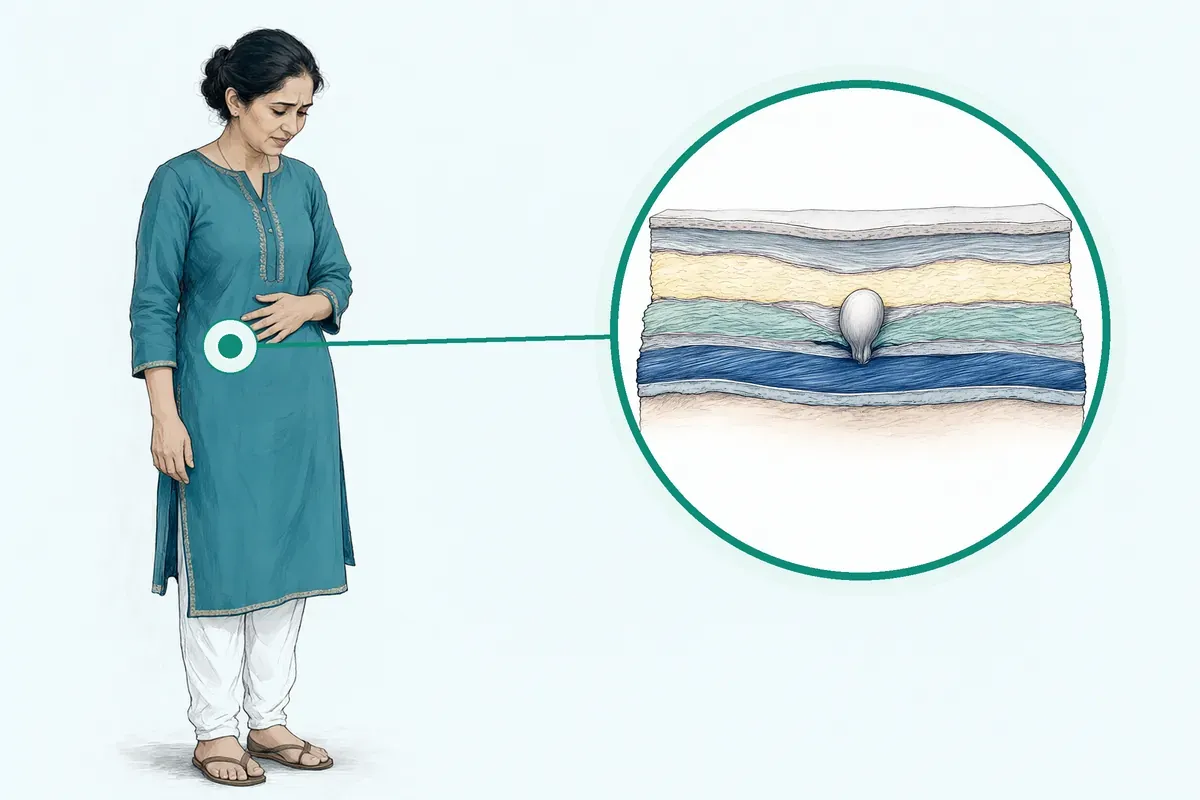
An umbilical hernia is a weakness in the abdominal wall at the belly button. Fat or intestine pushes through, causing a bulge and discomfort. It does not heal on its own and can grow larger over time.
-
Visible bulge
A soft lump at the belly button that may pop out more when you strain or stand up.
-
Discomfort or pain
Pressure, aching or sharp pain around the navel, especially after lifting or long standing.
-
Risk of trapping
The hernia can become stuck, causing severe pain, nausea and vomiting. This needs emergency care.
-
Worry about surgery
You wonder if you need an operation, how long you will be off work and what it will cost.
An umbilical hernia in an adult will not go away or get better without treatment.
Why Jaipur Hospital
You are tired of the ache when you lift your child, the embarrassment of the bulge, and the fear that it might turn into an emergency.
Your care plan
Your first steps with us
- 1 Call or visit OPD for a surgeon consultation
- 2 Get examined and review scans in-house if needed
- 3 Agree on the repair method and receive a cost estimate
- 4 Have surgery and follow up for recovery
How the operation is done
The surgeon pushes the bulge back, closes the defect and usually reinforces it with mesh. The operation takes 30 to 60 minutes under general, spinal or local anaesthesia. You go home the same day or stay one night.
-
Open repair with mesh
A small cut near the belly button. Mesh is placed to strengthen the wall. Standard for most adult hernias above about 1 cm.
-
Suture repair
The defect is stitched closed without mesh. Used for very small hernias.
-
Laparoscopic repair
Keyhole surgery with a camera and mesh. Often chosen for larger or recurrent hernias.
Why patients trust us
- 1991 Serving Jaipur for 35 years
- NABH Accredited hospital
- 3 General & Laparoscopic Surgery consultants
- 24×7 Emergency, ICU and ambulance
- 25 Cashless schemes and insurers
What research shows about this treatment
-
1 to 2 weeks
Most people return to desk work within one to two weeks after surgery.
-
3.6% vs 11.4%
At two years, mesh repair had a 3.6% recurrence rate compared with 11.4% for suture repair in adults.
-
35% vs 58%
Closing the fascial defect during laparoscopic repair cut 30-day seroma rates from 58% to 35%.
If it is left untreated
If left untreated, the hernia usually gets larger and more uncomfortable. It can become trapped (incarcerated), cutting off blood supply to the intestine. This causes severe pain, vomiting and requires emergency surgery.
Life after treatment
Most people return to normal routines quickly. The bulge is gone and the risk of an emergency is removed.
-
Back to desk work
Most people return to office work within one to two weeks.
-
Heavy lifting later
You usually wait four to six weeks before lifting heavy loads or doing strenuous exercise.
-
Bulge is gone
The belly button looks flat again and the discomfort stops for most patients.
-
Low recurrence risk
Mesh repair keeps the hernia from coming back in the great majority of adults.



Frequently asked questions
Questions patients ask about umbilical hernia repair
What does umbilical hernia repair involve?
In short
Umbilical hernia repair at Jaipur Hospital involves pushing the bulging tissue back into the abdomen and strengthening the weak spot near the belly button. The operation usually takes 30 to 60 minutes. You may receive general, spinal, or local anaesthesia depending on the hernia size. Most patients go home the same day or stay one night in the hospital.
In detail
The surgeon makes a small cut near the navel to reach the hernia sac. The protruding fat or intestine is returned to the abdominal cavity.
For defects larger than about one centimetre, a synthetic mesh is typically placed to reinforce the wall and lower the chance of recurrence. Studies show mesh repair results in fewer recurrences than suture repair alone.
The technique may be open or laparoscopic; laparoscopic repair is often chosen for larger or recurrent hernias and may involve a slightly longer operation time. The surgical team selects the method based on hernia size, previous surgeries, and your overall health.
A common belief
Many people think the bulge is simply stitched shut.
What actually happens
For most adults, stitches alone have a higher recurrence rate. Mesh gives the repair long-term strength, and laparoscopic options can mean smaller cuts for bigger hernias.
Your next step at Jaipur Hospital
Before surgery you will have a physical examination and basic blood tests. You should arrange for an attendant to drive you home and stay with you for the first 24 hours.
Desk work can usually resume in one to two weeks, while heavy lifting is restricted for four to six weeks. The team will give you written instructions on wound care, pain relief, and when to return for a follow-up visit.
Which tests and scans do I need before umbilical hernia repair?
In short
Before umbilical hernia repair at Jaipur Hospital, you will usually need a physical examination and basic blood tests such as haemoglobin, blood sugar, and clotting profile. An abdominal ultrasound may be ordered if the hernia size or contents are unclear on examination. Additional tests like an ECG or chest X-ray are requested based on your age and medical history.
In detail
The surgeon uses the clinical exam to measure the defect and check reducibility. Ultrasound helps confirm the diagnosis, assess defect size, and rule out other abdominal pathology when the exam is uncertain. Blood tests ensure you are fit for anaesthesia and surgery.
If you have liver disease, ascites, or cardiac conditions, further evaluation such as liver function tests or cardiology clearance may be needed. The pre-anaesthesia check-up reviews all results and decides on the type of anaesthesia — general, spinal, or local. This work-up is typically completed in one or two visits.
A common belief
Patients often expect a CT scan or MRI.
What actually happens
For most umbilical hernias, a good clinical exam and a simple ultrasound are enough. Extra scans are only ordered if something unusual is suspected.
Your next step at Jaipur Hospital
Bring any previous reports to your pre-operative appointment. The nursing team will guide you on fasting instructions and medication adjustments. Most patients complete tests within a week of the surgical consultation. Surgery is then scheduled at a mutually convenient date.
How painful is umbilical hernia repair and the early recovery?
In short
You will feel no pain during umbilical hernia repair because the operation is done under general or spinal anaesthesia. After surgery, most people have soreness around the belly button for a few days. Jaipur Hospital provides pain medicine and clear instructions to keep you comfortable at home.
In detail
During the operation you are asleep or numb from the waist down, so there is no pain. In the first 24 to 48 hours you may feel a dull ache or pulling sensation when you move, cough or laugh.
Evidence shows that laparoscopic repair usually causes less postoperative pain than open repair because the incisions are smaller. Your surgical team will give you a prescription for pain relief and advise you to hold a pillow over the wound when coughing. Most patients say the discomfort improves noticeably by day three or four.
A common belief
Many people expect severe pain, but studies show most patients describe it as a dull ache that fades by day three or four.
What actually happens
Laparoscopic cuts tend to hurt less than a single open cut.
Your next step at Jaipur Hospital
Take the prescribed pain tablets regularly for the first two days, then only when needed. Walk gently from day one but avoid lifting anything heavier than a kettle for at least two weeks.
If pain suddenly worsens, you develop a fever, or the wound becomes red and hot, contact the hospital straight away.
How long does recovery usually take after umbilical hernia repair?
In short
At Jaipur Hospital, recovery after umbilical hernia repair typically allows desk work in one to two weeks and heavy lifting after four to six weeks. The operation itself takes 30 to 60 minutes. Most patients go home the same day or stay one night in hospital.
In detail
Evidence shows laparoscopic repair usually has a quicker recovery than open repair, with less pain and earlier return to normal activities. You should feel better after a few days.
Walking is encouraged from the day after surgery, but strenuous exercise, heavy lifting, and activities that strain the abdomen should wait until your surgeon clears you, usually around four to six weeks. A binder may be provided to reduce swelling and support the wound.
A common belief
A common mistake is returning to heavy work too early.
What actually happens
Studies show laparoscopic patients recover faster, but both approaches need four to six weeks before lifting heavy loads to prevent recurrence.
Your next step at Jaipur Hospital
Plan for an attendant to drive you home and stay with you the first night. Keep the incision clean, shower after 24 to 48 hours if approved, and avoid baths for two weeks. Take prescribed pain medicine and antibiotics exactly as directed.
Can an umbilical hernia get better on its own?
In short
An umbilical hernia in an adult will not go away or get better without treatment. At Jaipur Hospital, the surgical team explains that the defect in the abdominal wall remains open unless it is repaired surgically.
In detail
Evidence states that adult umbilical hernias do not close spontaneously. Over time, raised intra-abdominal pressure from coughing, straining, or weight gain can enlarge the defect and increase the risk of incarceration or strangulation.
In infants, small umbilical hernias often close by age three to four years, but in adults the fibrous ring does not heal on its own. Surgery is the only way to close the gap and prevent complications.
A common belief
Some people confuse adult hernias with infant ones, which often close by age four.
What actually happens
In adults the tissue does not regenerate that way, and delaying repair can let the hernia grow or become trapped.
Your next step at Jaipur Hospital
Waiting and watching is sometimes offered for tiny, asymptomatic hernias, but the hernia will not disappear. If you notice a bulge, discomfort, or any change, seek a surgical opinion promptly.
How will the surgeon decide whether an operation is necessary for umbilical hernia repair?
In short
The surgeon decides based on your symptoms, hernia size, and risk of complications such as incarceration. Jaipur Hospital follows the guideline that surgical repair is recommended for most symptomatic adults. Asymptomatic small hernias may be watched, but most eventually need repair because they tend to worsen over time.
In detail
Diagnosis is made by history and thorough physical examination; ultrasound may be used if there is doubt.
Surgery is indicated if the hernia causes pain, discomfort, or a bulge that interferes with daily activity, or if there is a risk of the bowel becoming trapped (incarceration).
Mesh repair is typically recommended for defects 1 cm or larger because studies show lower recurrence than suture repair. Your surgeon will also consider your general health and any conditions like ascites that affect healing.
Your next step at Jaipur Hospital
Attend the General and Laparoscopic Surgery OPD at Jaipur Hospital for a clinical assessment. The surgeon will examine you, discuss risks and benefits, and recommend a plan.
Why might my doctor recommend umbilical hernia repair?
In short
A doctor at Jaipur Hospital may recommend umbilical hernia repair when the hernia causes pain, discomfort, or a visible bulge that interferes with daily activities. Repair is also advised if there is a risk of the bowel becoming trapped, known as incarceration, which can lead to a surgical emergency. Most adult hernias do not improve without surgery.
In detail
Evidence shows that umbilical hernias in adults tend to enlarge over time and can become incarcerated, causing severe pain, nausea, vomiting, and inability to pass gas. Surgical repair prevents these complications and relieves symptoms.
Mesh repair is standard for defects above one centimetre because studies report lower recurrence rates compared with suture repair. The decision also considers your general health, hernia size, and whether you have conditions such as ascites that increase abdominal pressure. Controlling underlying conditions like ascites is important to reduce recurrence risk after surgery.
A common belief
Some people wait hoping it will go away.
What actually happens
In adults it does not. Delaying only makes the repair harder and raises the chance of an urgent operation.
Your next step at Jaipur Hospital
If you notice a growing bulge, discomfort when coughing or lifting, or any signs of incarceration such as sudden severe pain or vomiting, seek medical evaluation promptly. The surgeon will examine you, discuss the risks and benefits, and schedule the operation at a convenient time. Recovery typically allows a return to desk work in one to two weeks.
How should I prepare in the days before umbilical hernia repair?
In short
Jaipur Hospital will give you a clear checklist before umbilical hernia repair. You usually have blood tests and a fitness check a few days before surgery. Stop smoking if you can, because it slows wound healing. Eat light, healthy meals and stay hydrated. Your surgeon may ask you to shower with an antiseptic soap the night before or the morning of the operation.
In detail
Preparation aims to lower the risk of infection and breathing problems during anaesthesia. Blood tests check haemoglobin, clotting, and sugar levels so the anaesthetist can plan safely. Stopping smoking even for a short period improves oxygen delivery to tissues.
Antiseptic showering reduces skin bacteria that could enter the wound. If you take regular medicines, the team will tell you which ones to continue and which to pause. Following these steps helps the operation run smoothly and supports faster recovery.
A common belief
Many patients think they can eat normally or skip the shower.
What actually happens
Both raise infection risk and can delay the operation. Following the list keeps you safer.
Your next step at Jaipur Hospital
You will receive written instructions at your pre-operative visit. Complete any tests at least two days before surgery so results are ready. Arrange an attendant to bring you home and stay with you the first night.
Do not eat or drink after the fasting time given by the anaesthetist. Call Jaipur Hospital if you develop a fever, cough, or any new illness before the date.
What are the common side effects and the less common serious complications of umbilical hernia repair?
In short
At Jaipur Hospital, the most common side effect after umbilical hernia repair is a seroma, a fluid collection near the wound that usually settles on its own. Bruising and mild swelling around the belly button are also typical. Less common but serious complications include wound infection, bleeding, injury to the intestine, blood clots in the leg, or a recurrence of the hernia.
In detail
Studies report seroma as the most frequent postoperative issue. Analyses comparing open and laparoscopic techniques found no significant difference in infection, seroma, or haematoma rates between the two methods. General surgical risks such as heart or lung problems can also occur.
Your surgical team will explain which risks apply to your hernia size and health status and will give you clear instructions on when to seek urgent care.
A common belief
Patients often worry most about the hernia returning, yet studies show mesh repair lowers recurrence to about 3 to 4 percent at two years.
What actually happens
Infection and clots are uncommon but need quick action if they appear.
Your next step at Jaipur Hospital
Watch for increasing redness, warmth, or pus at the incision, fever, severe pain not relieved by medicine, inability to pass stool or gas, or calf swelling and pain. These need prompt medical attention. Most people go home the same day or after one night.
Which symptoms are expected after umbilical hernia repair, and which need urgent medical attention?
In short
After umbilical hernia repair at Jaipur Hospital, you can expect mild pain, swelling around the belly button, bruising, and tiredness for a few days. These are normal and usually improve with rest and prescribed pain medicine. Contact your surgeon or visit the emergency department if you develop a fever, severe pain that does not settle with medication, redness spreading from the wound, persistent vomiting, inability to pass urine or stool, or signs of a blood clot such as calf swelling and pain.
In detail
Evidence shows that short-term side effects like pain, fatigue, and local swelling are common after hernia surgery and typically resolve within a week. Seroma, a fluid collection under the wound, is the most frequent complication and often settles without intervention.
Serious complications such as wound infection, bleeding, injury to the intestine, deep vein thrombosis, or sepsis are rare but require immediate care. The sources list specific warning signs: fever, unrelieved pain, inability to pass stool or gas, and signs of a blood clot or sepsis. Your surgical team will give you a written list of these red flags before discharge.
A common belief
Many people think any pain means something went wrong, but some discomfort is expected.
What actually happens
The danger signs are specific: fever, unrelieved pain, bowel or bladder changes, and signs of a blood clot. Knowing the difference prevents unnecessary panic and dangerous delays.
Your next step at Jaipur Hospital
Keep the emergency numbers handy for the first two weeks. Take pain medicine as advised, walk gently several times a day, and avoid straining. If any red-flag symptom appears, do not wait — go to the nearest emergency department or call Jaipur Hospital. Your surgeon will review your recovery at the first follow-up, usually within seven to ten days.
FAQ library
Questions and answers about umbilical hernia repair
When you contact us
Get your assessment and plan
Contact Jaipur Hospital to book a surgeon consultation, review your reports and receive a clear cost estimate.
- A consultation with a general and laparoscopic surgeon in the OPD
- Your scans and reports reviewed, with tests done in-house if you need them (laboratory, X-ray and imaging)
- Your options explained in plain words, including whether you need surgery at all
- A cost estimate before you decide
- Help with cashless treatment under RGHS, MAA Yojana, CGHS and empanelled insurers and TPAs
- Follow-up visits after your treatment
Read more
Read more about umbilical hernia repair
- Hernia Symptoms and When Surgery Is Needed
Learn about hernia symptoms, warning signs, and when surgery is recommended. Plain guide from Jaipur Hospital. Explained in plain words for patients and families.
- Hernia Surgery Cost and Mesh Options in Jaipur
Understand hernia surgery costs, mesh types, and insurance coverage at Jaipur Hospital. Plan your treatment with clear pricing factors.
- Recurrent Hernia Repair Results and Long Term Outlook
What to expect after recurrent hernia surgery, recovery timelines, and the chance of another recurrence explained. A patient guide from Jaipur Hospital, Jaipur.
- Open Mesh Inguinal Hernia Repair Surgery in Jaipur
Learn about the Lichtenstein open mesh repair for groin hernia, including who it suits, how it is done, recovery time, risks and comparison with keyhole surgery.
- Femoral Hernia Repair Surgery in Jaipur
Learn about femoral hernia repair techniques, recovery time, risks, and when surgery is needed. Plain language guide for patients.
- Epigastric and Ventral Hernia Repair: Techniques and Recovery
Understand repair options for epigastric and ventral hernias, including open and keyhole surgery, mesh use, recovery time, and risks.
Overview
Umbilical Hernia Repair: what to know
What an umbilical hernia is and how it happens
- Weak spot at belly button
- Abdominal wall weakness around the umbilicus
- Bulge with fat or intestine
- Sac pushes out through the weakness
- Does not heal on its own
- Adult hernias need treatment
An umbilical hernia is a weakness that develops in the abdominal wall through and around the belly button, called the umbilicus. With a hernia, an organ pushes through the muscle or tissue wall that holds it. A bulge or sac containing fat or intestine pushes out through that weakness, sometimes causing an "outie" belly button.
Most patients with umbilical hernias first notice a belly button bulge or discomfort. Over time these hernias can get larger and more uncomfortable as the hernia sac gets pushed out from inside the abdomen. Like other hernias, an umbilical hernia in an adult will not go away or get better without treatment.
Symptoms of umbilical hernia and warning signs that need urgent care the same day
- Strong pain, nausea, vomiting Hernia may be stuck or incarcerated
- Cannot pass gas or stool Sign of possible bowel obstruction
- Pain not better after pain medicine Contact doctor or seek immediate care
- Fever May indicate infection
- Signs of blood clot in leg Go to emergency room
- Signs of sepsis Go to emergency room
You may see or feel a bulge near the belly button. The area can be tender, and you may feel:
- Pressure
- Discomfort
- Or pain
Hernias can also cause unpleasant symptoms, like pressure, discomfort or pain.
If the hernia becomes stuck or "incarcerated," you may have:
- Strong pain
- Nausea
- Vomiting
- Or the inability to pass gas from the rectum
These are warning signs that need urgent care the same day. After surgery, you are likely to have pain for a few days. The area around your belly button may be swollen. You may also feel tired and have less energy than normal.
Contact your doctor now or seek immediate medical care if you have pain that does not get better after you take pain medicine, if you have a fever, or if you cannot pass stool or gas. Go to the emergency room if you notice signs of a blood clot in your leg or signs of sepsis.
Causes of umbilical hernia and who is at higher risk
- Raised abdominal pressure
- Can cause or enlarge the weakness
- Liver cirrhosis with ascites
- Enormous pressure enlarges hernias rapidly
- High frequency in cirrhosis
- 20% of such patients develop umbilical hernia
A hernia forms when an organ pushes through the muscle or tissue wall that holds it. Increased pressure inside the abdomen can cause the weakness to develop or enlarge. In patients with liver cirrhosis and ascites, the enormous intra-abdominal pressure makes umbilical hernias enlarge rapidly and complicate. Umbilical hernia occurs in 20% of patients with liver cirrhosis complicated with ascites.
Most hernias form in the abdomen or groin. Not all hernias require immediate treatment, but most eventually do since they usually worsen over time. If a hernia causes symptoms or puts you at risk of a complication, you may need surgery.
How umbilical hernia is diagnosed: examination and tests
Umbilical hernias can be diagnosed by your doctor by listening to your history and performing a thorough physical examination. In case of any doubt, an abdominal ultrasound may be used to confirm the diagnosis. Your healthcare provider will determine whether you are a candidate for hernia surgery and which type of surgery is suitable.
Treatment options without surgery and when umbilical hernia repair is advised
An umbilical hernia in an adult will not go away or get better without treatment. Because of the risk of incarceration and symptoms caused by the umbilical hernia, surgical repair is recommended for most patients. Surgery is the most common treatment for a hernia.
Hernia surgery allows your surgeon to push the organ and herniated tissue back into place and reinforce the barrier holding it there using stitches or surgical mesh.
The main types of surgery for hernia are:
- Open
- Laparoscopic (minimally invasive)
- And robotic repair
Mesh repair is recommended for umbilical hernia of 1 to 4 cm. For very small defects, suture repair may be an option. Your surgeon will advise which technique suits you. In patients with ascites, control of ascites is the mainstay to reduce hernia recurrence and postoperative complications.
If you have a good perspective to be transplanted within 3 to 6 months, herniorrhaphy should be performed during transplantation.
Preparing for Umbilical Hernia Repair Surgery
Do
- Stop certain medicines
- Complete routine tests
- Bring attendant and documents
- Wear loose clothing
Your surgeon will ask about any medicines you take regularly, including blood thinners, aspirin, or herbal supplements. Some medicines may need to be stopped a few days before the operation. You will usually have a few routine tests such as blood work, an ECG, and sometimes a chest X-ray to check that you are fit for anaesthesia.
If you have other medical conditions such as diabetes or high blood pressure, your doctor will make sure they are well controlled before the day of surgery.
You must not eat or drink anything for at least six hours before the procedure if you are having general or spinal anaesthesia. For local anaesthesia, light food may be allowed but your surgeon will confirm this. Wear loose, comfortable clothing that does not press on your belly button.
Bring an attendant who can stay with you and drive you home afterwards. Pack any regular medicines you take, your insurance or scheme cards, and a photo ID. If you use a binder or abdominal support, bring it along as you may need it after the operation.
How Umbilical Hernia Repair Is Done
- Admission and checks Ward or day-care unit, ID band
- Anaesthesia given General, spinal or local with sedation
- Surgeon repairs hernia Mesh or stitches used to strengthen wall
- Recovery room monitoring Vital signs watched until fully awake
The operation usually takes 30 to 60 minutes. You will receive either general anaesthesia, where you are asleep, or spinal anaesthesia, which numbs you from the waist down. For very small hernias, local anaesthesia with sedation may be used. Your surgeon will discuss which type of anaesthesia is suitable for you.
There are three common techniques. Open repair with mesh is the standard choice for most adult hernias larger than about 1 cm. The surgeon makes a cut near the belly button, pushes the hernia contents back into the abdomen, and places a synthetic mesh over the weak spot to strengthen the wall.
Suture repair uses stitches alone to close the defect and is generally reserved for very small defects. Laparoscopic repair uses several small cuts and a camera; the mesh is placed from inside the abdomen. This approach is often chosen for larger or recurrent hernias.
Your surgeon will advise which technique suits your hernia size, whether it has been repaired before, and your overall health.
On the day of surgery, you will be admitted to the ward or day-care unit. The nursing team will check your details, put an identification band on your wrist, and take you to the modular operation theatre. After the anaesthesia takes effect, the surgeon performs the repair.
The skin is closed with stitches, staples, or skin glue, and a dressing is applied. You will then go to the recovery room where staff monitor your vital signs until you are fully awake.
Risks and Possible Complications of Umbilical Hernia Repair
- 35 to 58 percent Seroma rate
- Lower with mesh Mesh vs suture recurrence
As with any operation, complications such as bleeding, infection, injury to the intestines, blood clots, or heart or lung problems may occur. The most common postoperative complication after umbilical hernia repair is seroma, a collection of fluid under the wound.
In studies, seroma was reported in about 35 to 58 percent of patients depending on whether the fascial defect was closed during laparoscopic repair. Wound infection, haematoma, and chronic pain have also been reported.
Research comparing open and laparoscopic techniques found no significant difference in the rates of infection, seroma formation, or haematoma between the two methods. Mesh repair is associated with a lower recurrence rate than suture repair, but some studies note a slightly higher surgical site infection rate with mesh.
Long-term pain lasting more than three months, called post-herniorrhaphy neuralgia, can occur in some people. In men, hernia repair in the groin area can rarely affect nerves or blood vessels causing testicular pain or infertility, though this is more relevant to groin hernias than umbilical hernias.
If you develop a fever, increasing pain that is not relieved by prescribed medicine, redness or discharge from the wound, inability to pass stool or gas, or swelling in your calf, contact the hospital immediately or go to the emergency department.:
- Fever
- Increasing pain that is not relieved by prescribed medicine
- Redness or discharge from the wound
- Inability to pass stool or gas
- Or swelling in your calf
These may be signs of infection, bowel obstruction, or a blood clot.
Recovery and Aftercare After Umbilical Hernia Repair
- Same day or one night Most patients go home
- 24 to 48 hours Shower allowed if doctor agrees
- One to two weeks Desk work can resume
- Four to six weeks Heavy lifting and strenuous work safe
- Follow-up visits At two weeks, three, twelve and twenty-four to thirty months
Most patients go home the same day or stay one night in the hospital. You will be given pain medicine to take at home. Take it as directed and do not stop antibiotics early if they are prescribed.
You may shower 24 to 48 hours after surgery if your doctor agrees, but avoid soaking in a bath for the first two weeks. Gently wash the area daily with warm, soapy water and pat it dry. Do not use hydrogen peroxide or alcohol on the incision. Change the dressing every day or if it gets wet or dirty. If you have tape strips or skin glue, leave them until they fall off on their own.
You can eat your normal diet. Drink plenty of water and avoid constipation; a laxative may be suggested if needed. Hold a pillow over your incision when you cough or sneeze. Avoid lifting anything that makes you strain, and do not do strenuous activities such as jogging, weight lifting, or aerobic exercise until your surgeon says it is safe. Walking is encouraged from the day after surgery and can be increased gradually.
Desk work can usually be resumed in one to two weeks. Heavy lifting or physically demanding work should wait four to six weeks. A binder may be provided to help ease swelling and pain. You will have a follow-up appointment, typically at two weeks, and then at three, twelve, and twenty-four to thirty months for checks.
If you notice any warning signs such as fever, worsening pain, wound discharge, or no bowel movement after taking a laxative, call the hospital or visit the emergency department.
Results and Recurrence Rates for Umbilical Hernia Repair
In studies, mesh repair of umbilical hernias in adults resulted in fewer recurrences than suture repair. One large trial with a median follow-up of about 25 months found a 2-year recurrence estimate of 3.6 percent with mesh compared with 11.4 percent with suture repair. The number needed to treat with mesh to prevent one recurrence was about 13 patients.
Closure of the fascial defect during laparoscopic repair also reduced long-term recurrence, with a 2-year cumulative recurrence of 7 percent in the closure group versus 19 percent without closure.
Laparoscopic repair may be associated with a lower risk of wound infection, wound dehiscence, and recurrence compared with open repair, although some analyses found no difference in recurrence rates between the two approaches. A slightly higher risk of recurrence with laparoscopic surgery has been noted in some sources.
Overall, hernia surgery is considered a safe procedure that can repair the hernia and prevent it from returning in most people. Recurrence rates vary depending on the type of surgery, hernia size, and patient factors. Your surgeon will discuss what the evidence suggests for your specific situation.
Cost and Insurance for Umbilical Hernia Repair in Jaipur
The typical price range for umbilical hernia repair at Jaipur Hospital is ₹40,000 to ₹1,10,000. The final cost depends on the technique used (open or laparoscopic), the type of mesh, the anaesthesia method, whether you stay one night or go home the same day, and any additional tests or medicines needed. Open repair generally costs less than laparoscopic repair. An estimate will be provided after your surgeon evaluates your hernia and discusses the plan with you.
Jaipur Hospital is empaneled under several government and private schemes.
These include:
- RGHS
- MAA Yojana
- And CGHS
- As well as a panel of private insurers and third-party administrators (TPAs)
If you are covered under any of these schemes, bring your scheme card and referral documents. The hospital's insurance desk can help verify coverage and process pre-authorisation. For patients paying out of pocket, the hospital accepts cash, card, and digital payments. The in-house pharmacy and diagnostic laboratory mean most medicines and tests are available on site, which can simplify billing.