

Obstetrics and Gynaecology · Jaipur Hospital
Endometriosis and Pelvic Pain in Jaipur
Chronic pelvic pain and heavy periods? Get a clear diagnosis and a personalised care plan.
- Serving Jaipur since 1991 (35 years)
- NABH accredited
- 24×7 emergency & ICU
- Cashless: RGHS, MAA Yojana, CGHS + 22 insurers
- Operation time
- 1 to 3 hours
- Anaesthesia
- General anaesthesia
- Recovery
- 2 to 4 weeks
- Price
- ₹60,000 to ₹1,80,000typical range in India; ask us for an estimate
Pain that disrupts your life
Pelvic pain that stops you from working, sleeping, or planning a family
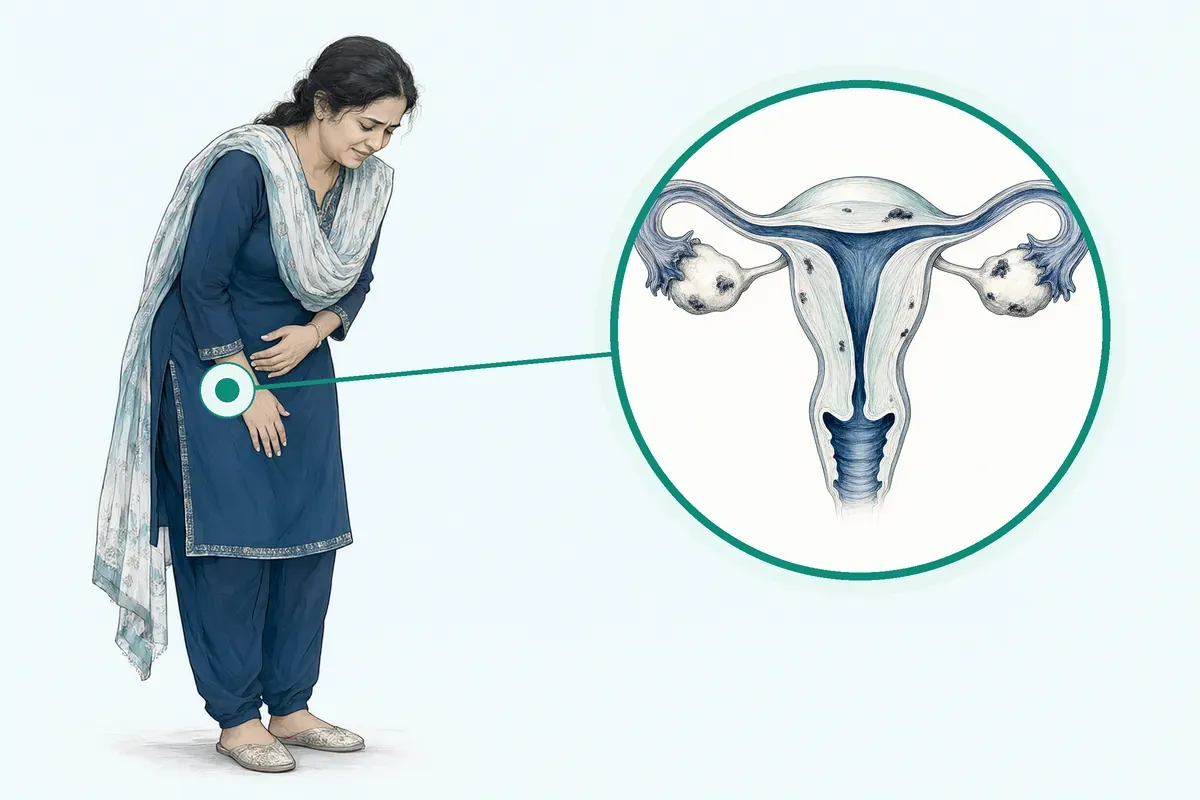
Endometriosis causes tissue like the uterine lining to grow outside the uterus. It often brings severe period pain, pain during sex, and trouble getting pregnant. Many women wait years for a diagnosis while the pain affects their daily routine.
-
Severe period pain
Cramps that keep you from work or school and do not improve with usual painkillers.
-
Pain during intimacy
Deep pain during or after sex that strains your relationship and wellbeing.
-
Bowel or bladder issues
Painful bowel movements or urination, especially during your period.
-
Difficulty conceiving
Trying to get pregnant without success, often linked to hidden endometrial tissue.
-
Long wait for answers
Years of visits and scans without a clear explanation for your symptoms.
Endometriosis affects 5-10% of women of reproductive age globally.
Why Jaipur Hospital
You worry that the pain will never be taken seriously, that surgery means weeks off work you cannot afford, or that the cost will stretch your family budget.
Your care plan
Your first steps with us
- 1 Call or visit OPD for a gynaecology consultation.
- 2 Complete scans and blood tests in our lab and imaging centre.
- 3 Review options with your surgeon and receive a cost estimate.
- 4 Have surgery or start medical therapy, then attend follow-up visits.
How the operation is done
Under general anaesthesia, the surgeon makes small incisions in the abdomen. A camera and instruments are inserted to find and remove endometrial lesions, cysts, and adhesions. The procedure usually takes one to three hours with a hospital stay of one to two nights.
-
Diagnostic laparoscopy
A small camera inserted through the navel to confirm endometriosis by directly viewing the pelvis; tissue samples are sent for lab confirmation.
-
Excision surgery
Deep infiltrating lesions, ovarian cysts, and adhesions are carefully cut out to restore normal anatomy and relieve pain.
-
Hormonal suppression
GnRH agonists, dienogest, or combined pills suppress ovarian function to shrink lesions and control pain without surgery.
-
Mirena IUS insertion
A levonorgestrel-releasing intrauterine system placed in the uterus to thin the lining and reduce pain for up to five years.
Why patients trust us
- 1991 Serving Jaipur for 35 years
- NABH Accredited hospital
- 3 Obstetrics and Gynaecology consultants
- 24×7 Emergency, ICU and ambulance
- 25 Cashless schemes and insurers
What research shows about treatment outcomes
-
about 9 in 10
Sensitivity of laparoscopic visualisation for detecting endometriosis was 90.1% in a study of 96 women.
-
about 2 in 10
Approximately 20% of patients who undergo endometriosis surgery do not respond and need further medical treatment.
-
two weeks for most
Most patients return to normal routines in about two weeks after laparoscopic surgery; advanced cases may need six weeks or longer.
If it is left untreated
Without treatment, endometriosis can lead to worsening chronic pelvic pain, formation of adhesions that bind organs together, and progressive difficulty conceiving. It is associated with a 50% increase in the risk of epithelial ovarian cancer.
Life after treatment
Most women find their pain becomes manageable and their daily routine returns to normal within a few weeks.
-
Manageable periods
Period pain usually becomes mild enough to handle with simple painkillers or hormonal medication.
-
Return to work
Most people resume desk work within two weeks; heavy lifting may need four to six weeks.
-
Better fertility chances
Surgery can improve natural pregnancy rates in many cases, though IVF may still be needed.
-
Ongoing support
Follow-up visits and hormonal options help keep symptoms under control long term.
Frequently asked questions
Questions patients ask about endometriosis and pelvic pain
Which problems are assessed under endometriosis and pelvic pain?
In short
At Jaipur Hospital, the endometriosis and pelvic pain service assesses chronic pelvic pain, painful periods, pain during intercourse, bowel and bladder symptoms linked to the menstrual cycle, and infertility related to endometriosis. The team evaluates superficial peritoneal disease, ovarian endometriomas, and deep infiltrating endometriosis affecting the bowel, bladder, or ureters.
In detail
Endometriosis is defined as endometrial-like tissue outside the uterus and is now considered a systemic inflammatory disease. Common symptoms include dysmenorrhoea, deep dyspareunia, dyschezia, and dysuria. The condition affects 5-10% of women of reproductive age globally.
Diagnosis relies on a structured process combining patient history, clinical examination, and imaging such as ultrasound or MRI for ovarian endometriomas and deep nodular disease. Definitive diagnosis requires surgical visualisation with histological verification.
A common belief
Many people think endometriosis is only about painful periods.
What actually happens
In reality, it is a systemic inflammatory disease that can affect multiple organs and cause a wide range of symptoms beyond menstrual cramps.
Your next step at Jaipur Hospital
Your first step is a detailed consultation where the gynaecologist reviews your symptom diary, past treatments, and imaging reports. Based on this, the team plans further tests or discusses medical and surgical options.
How will the doctor decide which tests I need for endometriosis and pelvic pain?
In short
At Jaipur Hospital, the gynaecologist selects tests based on your symptom pattern, examination findings, and fertility goals. A transvaginal ultrasound is usually the first imaging test to look for ovarian endometriomas and deep infiltrating disease. MRI may be added for surgical planning if deep disease involving the bowel or bladder is suspected. Blood tests such as CA-125 are sometimes used but are not diagnostic alone.
In detail
Guidelines state that ovarian endometriomas and deep nodular disease can be detected through ultrasonography and MRI. Diagnosis should follow a structured process of history, examination, and imaging. Exploratory laparoscopy is no longer recommended solely for diagnosis. Definitive diagnosis requires surgical visualisation with histological confirmation.
The choice of imaging depends on whether the findings will change management, such as planning excision surgery versus continuing medical therapy.
A common belief
A common belief is that a blood test or scan can confirm endometriosis.
What actually happens
In reality, CA-125 is not diagnostic, and ultrasound misses superficial disease. Definitive diagnosis still needs laparoscopy with histology.
Your next step at Jaipur Hospital
The doctor will explain why each test is ordered and what it can or cannot show. Ultrasound is typically done in the same visit at the in-house radiology department. MRI, if needed, is scheduled within a few days. Results are reviewed at a follow-up visit to finalise the care plan.
How soon should I expect improvement after endometriosis treatment?
In short
Improvement timing depends on the treatment chosen. After laparoscopic surgery at Jaipur Hospital, most patients feel better within two to four weeks, though advanced cases may need six weeks or more. Hormonal therapy usually takes a few menstrual cycles to show full effect on pain.
In detail
Surgical recovery follows a typical pattern: you go home after one to two nights, rest for the first week, and gradually resume light activity. Evidence shows most people return to desk work by two weeks, while physically demanding jobs may need longer.
Pain scores often drop in the first month, but endometriosis can recur if ovaries are not suppressed. Medical treatments such as combined pills, dienogest, GnRH agonists or Mirena IUS work by suppressing ovulation and menstruation; noticeable pain relief often appears after two to three cycles. Your surgeon will set realistic expectations based on disease severity.
A common belief
A common belief is that surgery fixes pain instantly, but healing takes time and pain can return without hormonal suppression.
What actually happens
Medicines also need patience before they work fully.
Your next step at Jaipur Hospital
Plan for at least two weeks off work after surgery, longer if your job is physical. Keep follow-up appointments to monitor pain and discuss ongoing suppression if needed. To get a personalised recovery timeline, book a consultation at Jaipur Hospital.
Can endometriosis be present even if an ultrasound is normal?
In short
Yes, endometriosis can be present even when a pelvic ultrasound at Jaipur Hospital appears normal. Superficial peritoneal deposits and some deep infiltrating lesions are often too small to see on ultrasound. A normal scan does not rule out the disease, and your symptoms and clinical examination remain important.
In detail
Evidence shows that ovarian endometriomas and deep nodular disease can be detected by ultrasonography and MRI, but superficial implants are frequently missed. Diagnosis is reliably established only through surgical visualisation with histological verification.
Guidelines now recommend a structured process combining patient interview, clinical examination and imaging, rather than relying on scans alone.
In studies, laparoscopic visualisation had a sensitivity of ninety percent but a specificity of only forty percent, meaning a normal look at laparoscopy can still miss disease confirmed by histology.
Your next step at Jaipur Hospital
If your ultrasound is normal but you have typical symptoms such as painful periods, deep pain during intercourse or cyclical bowel or bladder symptoms, discuss further evaluation with your gynaecologist. The next step may be an MRI or a diagnostic laparoscopy.
How can I decide whether to seek advice about endometriosis care?
In short
You should seek advice if you have pelvic pain during periods, pain during intercourse, pain with bowel or bladder movements, or difficulty getting pregnant. At Jaipur Hospital, our gynaecology team evaluates these symptoms with a structured clinical assessment and imaging.
In detail
Endometriosis affects roughly 5 to 10 percent of women of reproductive age. Common symptoms include dysmenorrhoea, deep dyspareunia, dyschezia and dysuria. Many women experience a long diagnostic delay because symptoms overlap with other conditions.
Guidelines recommend a step-wise approach: detailed history, clinical examination, and transvaginal ultrasound or MRI to detect endometriomas and deep infiltrating disease. Definitive diagnosis requires laparoscopic visualisation with histology.
Early evaluation helps start appropriate medical therapy or plan surgery if needed, and can reduce the impact on quality of life and fertility.
A common belief
Many women think severe period pain is normal and delay care for years.
What actually happens
Evidence shows a long diagnostic delay is common. Over-the-counter painkillers may mask symptoms but do not treat the underlying inflammation. Early assessment with ultrasound or MRI can find endometriomas and deep disease before they progress.
Your next step at Jaipur Hospital
If these symptoms sound familiar, do not wait for them to worsen. A consultation includes a symptom review, examination and imaging if indicated. You will receive a clear plan for medical management or further investigation.
How could endometriosis or its treatment affect future pregnancy?
In short
Endometriosis itself can reduce fertility, and surgery may improve natural pregnancy chances in many cases. At Jaipur Hospital, your surgeon will discuss how excision of lesions and endometriomas can help, while also explaining that ovarian surgery carries a small risk to ovarian reserve. Medical suppression does not improve fertility but controls pain until you are ready to conceive.
In detail
Evidence shows endometriosis is a common cause of infertility. Surgery to remove deep infiltrating disease and endometriomas is considered fertility enhancing, though the benefit on reproductive performance is moderate. Assisted reproductive technologies such as IVF are frequently used to overcome infertility linked to endometriosis.
Guidelines advise careful consideration of whether to offer IVF before surgery. After surgery, recurrence of pain or disease is possible, so ongoing management may be needed during pregnancy planning.
A common belief
A common belief is that surgery always fixes fertility.
What actually happens
In reality, the improvement is moderate, and ovarian surgery can slightly reduce egg reserve. Guidelines recommend individualising the choice between surgery and IVF based on age, disease severity and ovarian reserve.
Your next step at Jaipur Hospital
If you are planning pregnancy, a joint discussion with your gynaecologist and fertility team at Jaipur Hospital helps weigh surgery, medical therapy, or IVF.
Which symptoms should prompt me to see a specialist for endometriosis and pelvic pain?
In short
You should see a specialist at Jaipur Hospital if you have chronic pelvic pain lasting six months or more, severe period pain that disrupts daily life, pain during or after intercourse, pain with bowel movements or urination during periods, heavy or irregular menstrual bleeding, or difficulty getting pregnant. These symptoms suggest possible endometriosis.
In detail
The most frequently reported symptoms are dysmenorrhoea, deep dyspareunia, dyschezia, and dysuria. Studies show abdominal and pelvic pain in 41.7%, menstrual bleeding concerns in 34.4%, dysmenorrhoea in 29.2%, and infertility in 8.3% of women presenting for evaluation. Endometriosis is associated with pelvic pain and infertility.
There is often a long diagnostic delay after symptom onset. Early specialist review can reduce this delay and start appropriate management sooner.
A common belief
Women often dismiss severe period pain as normal.
What actually happens
However, pain that disrupts your life is not normal and may indicate endometriosis, which affects 5-10% of reproductive-age women and has a long average diagnostic delay.
Your next step at Jaipur Hospital
Keep a symptom diary for at least two to three cycles noting pain scores, bleeding pattern, and impact on work or sleep. Bring this diary and any previous ultrasound or MRI reports to your appointment. The gynaecologist will then decide on examination and imaging.
How will the results change my care plan for endometriosis and pelvic pain?
In short
At Jaipur Hospital, test results directly shape your care plan. If ultrasound or MRI shows an endometrioma larger than 3 to 4 cm or deep infiltrating nodules, surgical excision may be recommended, especially if you have pain not controlled by medication or if you are planning pregnancy. If imaging is normal but symptoms persist, diagnostic laparoscopy may be discussed. Medical therapy remains first-line for pain without immediate pregnancy plans.
In detail
Guidelines recommend medical treatment as first-line for pelvic pain when pregnancy is not immediately desired. Surgery is considered if conservative treatments fail to provide sufficient relief, for large or painful endometriomas, or to improve fertility. In infertility, the team weighs assisted reproduction against surgery first.
Laparoscopic excision addresses superficial, ovarian, and deep disease. Hormonal options include GnRH agonists, dienogest, combined pills, or Mirena IUS for long-term suppression.
A common belief
Patients often expect surgery after a positive scan.
What actually happens
However, guidelines stress medical therapy first for pain unless there are large cysts, deep disease, or fertility goals where surgery adds benefit.
Your next step at Jaipur Hospital
After results are available, the gynaecologist reviews them with you in a follow-up visit, usually within one week. Together you decide on medical management, Mirena insertion, or scheduling laparoscopy. The typical hospital stay for surgery is one to two nights with recovery in two to four weeks.
What should I do if endometriosis symptoms persist or worsen after treatment?
In short
If pain or other endometriosis symptoms continue or get worse after treatment at Jaipur Hospital, contact your gynaecologist promptly. After surgery, warning signs include fever, heavy bleeding, severe abdominal pain or difficulty passing urine or stool. On medical therapy, new or worsening pain, unusual bleeding or side effects should be reported. Early review helps adjust the plan.
In detail
Evidence indicates that laparoscopy is relatively safe but complications such as bleeding, infection or organ injury can occur. Patients are advised to call their healthcare provider if they notice specific post-operative symptoms.
For medical treatment, progestins and combined pills fail to control symptoms in about a third of women globally, and GnRH antagonists may be tried next. Recurrence of endometriosis is common; pain can return if lesions were not completely excised or if ovarian suppression stops. A structured reassessment includes history, examination and possibly repeat imaging.
Your next step at Jaipur Hospital
Keep the hospital's contact numbers handy. Attend all scheduled follow-ups even if you feel well. If symptoms escalate outside clinic hours, visit the 24-hour emergency department at Jaipur Hospital.
How are endometriosis and adenomyosis different?
In short
Endometriosis is endometrial-like tissue growing outside the uterus, while adenomyosis is the same tissue growing within the muscular wall of the uterus. Both can cause pain and heavy bleeding, but they are distinct conditions that may coexist. At Jaipur Hospital, our gynaecologists evaluate each separately.
In detail
Endometriosis lesions occur on pelvic organs, peritoneum, ovaries or deep structures. Adenomyosis stays inside the uterine wall, making the uterus enlarged and tender. Symptoms overlap: dysmenorrhoea, deep dyspareunia, heavy menstrual bleeding and infertility.
Ultrasound or MRI can suggest adenomyosis by showing a thickened junctional zone, while endometriosis diagnosis often needs laparoscopy for superficial disease. Medical treatment with hormonal suppression, GnRH agonists, dienogest or Mirena IUS helps both conditions by suppressing ovulation and menstruation.
Surgery for endometriosis excises external lesions; adenomyosis may need uterine-sparing procedures or hysterectomy if severe and childbearing is complete. The two conditions are managed together when they occur in the same patient.
A common belief
They are often confused because symptoms overlap.
What actually happens
Treating one without recognising the other can leave pain unresolved. Imaging and laparoscopy help tell them apart.
Your next step at Jaipur Hospital
If you have severe period pain, heavy bleeding or infertility, ask your gynaecologist to assess for both conditions. Imaging and clinical examination guide the plan. To get a clear diagnosis and tailored treatment, book a consultation at Jaipur Hospital.
FAQ library
Questions and answers about endometriosis and pelvic pain
When you contact us
Get your personalised care plan
Contact Jaipur Hospital for a gynaecology consultation, in-house tests, a clear explanation of your options, and a cost estimate before you decide.
- A consultation with a gynaecologist in the OPD
- Your scans and reports reviewed, with tests done in-house if you need them (laboratory, X-ray and imaging)
- Your options explained in plain words, including whether you need surgery at all
- A cost estimate before you decide
- Help with cashless treatment under RGHS, MAA Yojana, CGHS and empanelled insurers and TPAs
- Follow-up visits after your treatment
Overview
Endometriosis and Pelvic Pain: what to know
What Endometriosis and Pelvic Pain Is
Endometriosis is a chronic inflammatory disease where tissue similar to the lining of the uterus grows outside the uterine cavity. This tissue responds to hormonal changes each month, causing inflammation, scarring, and pain. It is now considered a systemic disease rather than one limited to the pelvis. The condition affects roughly 5 to 10 percent of women of reproductive age worldwide.
Retrograde menstruation, where menstrual blood flows backward through the fallopian tubes into the pelvic cavity, is regarded as an important origin of these deposits. Other factors include a favourable endocrine and metabolic environment, changes in cell behaviour, and altered immunity and inflammatory responses in genetically susceptible women. Hormones produced by the ovaries stimulate the growth of this tissue.
Symptoms of Endometriosis and Pelvic Pain and Warning Signs
- Sudden severe abdominal or pelvic pain
- Heavy vaginal bleeding
- Fever with pelvic pain
- Unable to pass urine or stool
The most frequently reported symptoms are:
- Painful periods (dysmenorrhoea)
- Deep pain during intercourse (dyspareunia)
- Painful bowel movements (dyschezia)
- Painful urination (dysuria)
Many women also experience chronic abdominal and pelvic pain, heavy or irregular menstrual bleeding, and difficulty getting pregnant. Endometriosis can affect metabolism in the liver and fat tissue, lead to body-wide inflammation, and alter gene expression in the brain, which causes pain sensitisation and mood disorders. Not every woman with endometriosis has pain.
Seek urgent care the same day if you have sudden, severe abdominal or pelvic pain that does not settle, heavy vaginal bleeding that soaks a pad in an hour, fever with pelvic pain, or inability to pass urine or stool. These may signal a complication such as a ruptured cyst, infection, or bowel obstruction.
Causes and Who Is at Higher Risk
- Family history
- First-degree relative with endometriosis
- Early periods
- Started periods at an early age
- Short cycles
- Short menstrual cycles
- Heavy or long periods
- Heavy or long periods
- Never given birth
- Have never given birth
The exact cause is not fully known. Retrograde menstruation is regarded as an important origin, but other factors are involved, including a favourable endocrine and metabolic environment, epithelial-mesenchymal transition, and altered immunity and inflammatory responses in genetically susceptible women. Hormones produced by the ovaries stimulate the disease, which is why treatments often aim to suppress ovarian activity.
Risk is higher in women who have a first-degree relative with endometriosis, those who started periods at an early age, have short menstrual cycles, heavy or long periods, or have never given birth. Conditions that block normal menstrual flow may also increase risk. The mean age at diagnosis in one clinical series was around 40 years.
How Endometriosis and Pelvic Pain Is Diagnosed
- 90.1 percent Sensitivity
- 81.0 percent Positive predictive value
- 40.0 percent Specificity
- 74.0 percent Histopathology confirmation
Diagnosis follows a structured process that combines your symptom history, a clinical examination, and imaging. Ovarian endometriomas and deep nodular disease can often be detected through ultrasonography and MRI. However, diagnosis is reliably established only through surgical visualisation with histological verification of the lesions.
In one study, laparoscopic visualisation had a sensitivity of 90.1 percent and a positive predictive value of 81.0 percent, but specificity was lower at 40.0 percent. Histopathology confirmed the diagnosis in 74.0 percent of women. There is often a long delay between the onset of symptoms and a confirmed diagnosis.
Non-Surgical Treatment Options and When Surgery Is Advised for Endometriosis and Pelvic Pain
Medical treatment is the first-line option for pelvic pain when there is no immediate desire for pregnancy. Options include combined oral contraceptive pills, progestins such as dienogest, and the levonorgestrel intrauterine system (Mirena IUS) for long-term relief. Gonadotropin-releasing hormone (GnRH) agonists or oral GnRH antagonists may be used when first-line medications do not provide enough relief. Medical therapy suppresses symptoms but does not remove the lesions. Pain can also be managed with cyclooxygenase inhibitors.
Surgery is typically advised when conservative treatments have not given sufficient relief, when imaging shows endometriomas that are large or causing pain, or when deep infiltrating endometriosis is present. Women diagnosed with endometriosis who are struggling to conceive may be advised to have surgery to remove tissue and improve pregnancy chances. Surgery is not performed during pregnancy.
Active pelvic or abdominal infection is a reason to postpone surgery until the infection is treated. The surgical approach is usually laparoscopic excision of peritoneal implants, deep nodules, and ovarian cysts. Laparoscopy involves small incisions and generally results in fewer complications, less bleeding, and faster recovery compared to open surgery.
Preparing for endometriosis surgery
Do
- Tell surgeon about all regular medicines
- Bring medicines, insurance cards, scan reports
Your surgeon will ask you to have a few tests before the operation. These usually include blood tests, a urine test and sometimes a chest X-ray or ECG to check your heart and lungs. If you take any regular medicines, tell your surgeon and the anaesthetist. This includes blood thinners, hormonal pills, painkillers or supplements.
They will tell you which ones to stop and when. You must not eat or drink anything for at least six hours before the surgery. On the day of admission, wear loose, comfortable clothes. Bring your regular medicines in their original packets, your insurance or scheme cards, and any recent scan reports. An attendant can stay with you in the room after the operation.
How endometriosis surgery is done
- General anaesthesia given You are asleep during the operation
- Laparoscope and instruments inserted Camera and tools go through the cuts
The operation is done under general anaesthesia. The surgeon makes a few small cuts in the abdomen, usually near the navel and lower down. A thin tube with a camera, called a laparoscope, goes through one cut. Special instruments go through the others. The surgeon looks at the pelvic organs to find endometriosis tissue.
What happens next depends on what is found and what you have discussed with your surgeon. In diagnostic laparoscopy, the surgeon only looks and may take a tiny piece of tissue for the lab. This confirms the diagnosis. In excision surgery, the surgeon cuts out deep infiltrating lesions, cysts on the ovaries (endometriomas) and any scar tissue.
The aim is to remove the disease and restore normal anatomy as far as possible. The operation usually takes one to three hours. Your surgeon will explain which approach suits you before you sign the consent form.
Risks and possible complications of endometriosis surgery
- Bleeding
- During or after the operation
- Infection
- Of the wounds or inside the abdomen
- Organ injury
- Bowel, bladder, ureters or blood vessels
- Fluid collection
- May need drainage
Laparoscopy is a common operation and serious problems are uncommon. In studies, laparoscopic surgery results in fewer surgical complications such as bleeding, infection and possible injuries to other abdominal organs compared to open surgery. Even so, every operation carries some risk.
Possible complications include:
- Bleeding during or after the operation
- Infection of the wounds or inside the abdomen
- Injury to the bowel, bladder, ureters or blood vessels
These injuries are rare but may need another operation to repair. Some women develop a collection of fluid or blood that needs drainage. There is also a small risk from the anaesthetic.
After surgery, you should call the hospital if you have a fever, increasing abdominal pain, heavy vaginal bleeding, swelling or redness around the cuts, or difficulty passing urine or stool.
Recovery and aftercare after endometriosis surgery
- Hospital stay One to two nights
- Walking Same day or next morning
- Desk job return About two weeks
- Heavy work return Four weeks or more
- Advanced disease Six weeks or longer
Most women stay in hospital for one to two nights. You will be encouraged to get out of bed and walk a little on the same day or the next morning. This helps prevent blood clots and gets your bowels moving.
You will have some pain at the cut sites and sometimes shoulder tip pain from the gas used during the operation. Pain relief is given regularly. You can eat and drink once you feel ready. Before you go home, the team will explain how to care for the wounds, when you can shower, and what medicines to take.
In the first two weeks, rest at home and avoid heavy lifting, strenuous exercise and sexual intercourse. Most people with desk jobs can return to work in about two weeks. If your work involves heavy physical activity, you may need four weeks or more. People with advanced disease may need six weeks or longer to recover fully.
Results of endometriosis surgery: pain relief and recurrence
Surgery aims to reduce pain and, for some women, improve the chance of natural pregnancy. In studies, many women get good pain relief after excision of lesions. However, endometriosis can grow back. About 20 percent of patients who undergo surgery do not respond and need further medical treatment.
Of those who do respond, pain may return over time, especially if the disease was not completely removed or if the ovaries are not suppressed afterwards. Surgery is associated with high recurrence rates in studies. For infertility, surgery can improve the chance of getting pregnant naturally in many cases, but the benefit on reproductive performance is described as moderate.
Assisted reproductive technologies such as IVF are a valid alternative or next step for some women. Your surgeon will discuss what result you can reasonably expect based on the type and extent of disease found during the operation.
Cost and insurance for endometriosis surgery in Jaipur
The typical price range for laparoscopic endometriosis surgery in India is sixty thousand to one lakh eighty thousand rupees. The final cost depends on the complexity of the surgery, the length of stay, the type of room you choose, and whether any additional procedures are needed. Jaipur Hospital is a NABH-accredited multispeciality hospital.
It accepts patients under:
- RGHS
- MAA Yojana
- CGHS
- A panel of private insurers and TPAs
If you are covered under one of these schemes, bring your card and any pre-authorisation letter at admission. The hospital has an in-house pharmacy and diagnostic laboratory. You can ask for an estimate before admission.