

Obstetrics and Gynaecology · Jaipur Hospital
Ovarian and Adnexal Conditions in Jaipur
Pelvic pain or a cyst found on scan — we assess, explain options and plan your care.
- Serving Jaipur since 1991 (35 years)
- NABH accredited
- 24×7 emergency & ICU
- Cashless: RGHS, MAA Yojana, CGHS + 22 insurers
- Operation time
- 1 to 2 hours
- Anaesthesia
- General anaesthesia
- Recovery
- 1 to 3 weeks
- Price
- ₹45,000 to ₹1,50,000typical range in India; ask us for an estimate
Cysts, pain and uncertainty
A cyst or mass on your ovary can cause pain, worry about fertility and fear of cancer
Many cysts are harmless and disappear on their own. Some grow, twist or bleed, causing sudden severe pain. Others need checks to rule out cancer. You may not know which one you have.
-
Sudden severe pain
Twisting of the ovary cuts off blood flow and needs emergency surgery to save the ovary.
-
Cysts that persist
Large or complex cysts that do not resolve may need removal to relieve symptoms.
-
Fertility concerns
Surgery aims to preserve ovarian tissue, but some conditions can affect future pregnancy.
-
Cancer worry
Solid or post-menopausal masses need prompt evaluation and lab testing of removed tissue.
Adnexal torsion is a gynaecological surgical emergency where prompt diagnosis helps preserve the ovary.
Why Jaipur Hospital
You are in pain, scared about what the scan means, and worried about time off work and the cost of surgery.
Your care plan
Your first steps with us
- 1 Call or visit OPD for gynaecology consultation
- 2 Complete scans and blood tests in-house
- 3 Discuss options and receive a cost estimate
- 4 Have surgery or monitoring with follow-up visits
How the operation is done
Surgery is usually under general anaesthesia and takes one to two hours. Most procedures are laparoscopic with small cuts; open surgery is used for very large or suspicious masses. Hospital stay is typically one to two nights.
-
Laparoscopic cystectomy
Removes the cyst through small cuts while preserving healthy ovarian tissue.
-
Oophorectomy
Removes the whole ovary for complex or suspicious masses; tissue is sent for lab testing.
-
Detorsion surgery
Emergency untwisting of the ovary to restore blood flow, often with cyst removal.
-
Ultrasound monitoring
Serial scans for simple functional cysts to check if they resolve without surgery.
Why patients trust us
- 1991 Serving Jaipur for 35 years
- NABH Accredited hospital
- 3 Obstetrics and Gynaecology consultants
- 24×7 Emergency, ICU and ambulance
- 25 Cashless schemes and insurers
What research shows about this treatment
-
About 95 in 100 removals are laparoscopic
Large studies show most ovarian cyst removals use keyhole surgery with smaller cuts.
-
10 to 15 percent of cysts grow back
After removal, a small proportion of patients develop new cysts over time.
-
Recovery in two to three weeks
Most patients return to normal activities within weeks after laparoscopic surgery.
If it is left untreated
Untreated torsion can lead to loss of the ovary, peritonitis or death. Delayed diagnosis of suspicious masses may allow cancer to spread. Some cysts rupture or bleed, causing severe pain and infection risk.
Life after treatment
Most people recover fully and return to normal routines. Fertility is often preserved when possible.
-
Pain relief
Most people feel better within days as the cyst or twisted ovary is treated.
-
Return to routine
Usually back to light activities within two weeks and normal activities within three weeks.
-
Fertility preserved
If one ovary is removed, the other usually maintains normal hormone and egg production.
-
Clear pathology report
Removed tissue is tested; results guide any further care needed.



Frequently asked questions
Questions patients ask about ovarian and adnexal conditions
Which problems are assessed under ovarian and adnexal conditions?
In short
Ovarian and adnexal conditions assessed at Jaipur Hospital include functional cysts, endometriomas, dermoid cysts, cystadenomas, and adnexal torsion. The service also evaluates solid or complex adnexal masses that may need further investigation. Your surgeon will review your symptoms, imaging, and medical history to determine the nature of the condition.
In detail
Assessment begins with a clinical history and pelvic examination, followed by ultrasound with Doppler analysis to characterise the mass. Evidence shows that imaging features such as a massive oedematous ovary, peripherally displaced follicles, or a lead mass suggest adnexal torsion.
For complex cysts, MRI may be used to improve diagnostic accuracy. CA-125 measurement is considered less reliable than imaging for benign versus malignant differentiation.
The surgical team correlates these findings with your age, menopausal status, and symptom pattern to decide whether observation, medical management, or surgery is appropriate.
A common belief
Many people think every ovarian cyst needs surgery.
What actually happens
In fact, most simple cysts disappear on their own within a few months without treatment. The key is proper imaging and clinical correlation to avoid unnecessary procedures.
Your next step at Jaipur Hospital
You will typically have an ultrasound scan during or soon after the first visit. If the cyst appears simple and asymptomatic, a follow-up scan in a few weeks or months may be arranged. For persistent, symptomatic, or suspicious masses, your surgeon will discuss surgical options and timelines.
How will the doctor decide which tests I need for ovarian and adnexal conditions?
In short
The doctor at Jaipur Hospital selects tests based on your age, menopausal status, symptom pattern, and the cyst appearance on initial ultrasound. A transvaginal ultrasound with Doppler is the first-line investigation for most women.
In detail
Evidence shows that simple ultrasonography is often as sensitive and specific as colour Doppler for adnexal mass assessment. Established morphological scoring systems have equivalent diagnostic competence. If the cyst is complex, solid, or larger than 10 centimetres, MRI may be recommended for better characterisation.
CT and PET are less preferred. CA-125 is considered less reliable than imaging for distinguishing benign from malignant masses. For suspected torsion, clinical judgment combined with ultrasound findings such as an oedematous ovary or absent flow guides urgent surgery.
A common belief
Many patients expect a CA-125 blood test immediately.
What actually happens
Evidence shows CA-125 is less reliable than imaging for benign versus malignant differentiation. MRI is reserved for complex or solid masses where ultrasound is inconclusive.
Your next step at Jaipur Hospital
You will usually have the ultrasound during the same visit. If MRI or blood tests are needed, they are scheduled within a few days. The surgeon will review all results and discuss the next steps within a week.
How soon should I expect improvement after ovarian cyst treatment?
In short
After ovarian cyst treatment at Jaipur Hospital, improvement depends on the type of procedure. For laparoscopic cystectomy or detorsion, pain usually improves within a few days and most people resume light activities within two to three weeks. Open surgery takes longer, often up to twelve weeks for full recovery. Your surgeon will give a personalised timeline at discharge.
In detail
Evidence shows that after laparoscopy, patients often go home the same day or next day. Tummy pain and shoulder tip pain from gas settle in a few days with prescribed pain relief.
Most return to desk work within a week and vigorous exercise by two weeks. After laparotomy, hospital stay is one to two nights, pain lasts longer, and heavy lifting is restricted for six weeks. New cysts can form later, so follow-up scans may be advised.
Hormonal function and fertility are usually preserved if ovarian tissue is saved. If an ovary is removed, the remaining ovary maintains hormone production and ovulation.
A common belief
People often expect instant recovery.
What actually happens
Even keyhole surgery needs days for the internal healing and gas pain to settle. Open surgery is a bigger cut and needs weeks of rest. Pushing too early risks hernia or wound problems.
Your next step at Jaipur Hospital
You will receive discharge instructions covering wound care, pain medication, activity limits, and warning signs like fever, heavy bleeding, or smelly discharge. A follow-up appointment is scheduled within two weeks. Keep your attendant informed of the care plan.
Could an ovarian cyst resolve without surgery?
In short
Yes, an ovarian cyst can resolve without surgery. At Jaipur Hospital, many simple functional cysts disappear on their own within a few months. Evidence supports a policy of watchful waiting with repeat ultrasound scans for asymptomatic cysts that appear benign on imaging. Surgery is reserved for cysts that persist, grow, cause symptoms, or look suspicious.
In detail
Studies show most ovarian cysts are functional and related to the menstrual cycle. They often rupture or regress spontaneously.
If you have not reached menopause and the cyst is small, thin-walled, and fluid-filled on ultrasound, your gynaecologist may recommend a follow-up scan in six to twelve weeks. Hormonal contraception may be offered to prevent new cysts but does not shrink existing ones.
Post-menopausal cysts are monitored more closely with scans and CA-125 blood tests every four months for a year due to a slightly higher cancer risk. Torsion, large size over ten centimetres, solid components, or persistent pain are triggers for surgical referral.
A common belief
Many women assume a cyst always needs removal.
What actually happens
Evidence shows the opposite: the majority are harmless and self-limiting. Surgery has risks, so it is used only when the cyst is large, painful, persistent, or looks abnormal.
Your next step at Jaipur Hospital
You will have serial ultrasounds at the radiology department. Bring previous reports for comparison. If the cyst disappears, no further treatment is needed. If it persists or changes, your surgeon will discuss options.
How can I decide whether to seek advice about ovarian cyst surgery?
In short
You should seek advice about ovarian cyst surgery at Jaipur Hospital if the cyst is larger than 10 centimetres, persists after several menstrual cycles, causes significant pain or pressure, appears complex on ultrasound, or develops after menopause. Your surgeon weighs size, symptoms, imaging features, fertility plans, and cancer risk before recommending an operation.
In detail
Guidelines suggest surgical removal for cysts exceeding 10 centimetres, for postmenopausal cysts, or for masses that grow or look suspicious on imaging. Watchful waiting with repeat ultrasound is standard for simple, asymptomatic cysts under 5 centimetres in premenopausal women.
Surgery may be laparoscopic or open depending on size and suspicion of malignancy. Laparoscopic cystectomy preserves ovarian tissue and offers lower recurrence than drainage or ablation for endometriomas.
The procedure takes one to two hours under general anaesthesia with a typical stay of one to two nights. Recovery ranges from one to three weeks for keyhole surgery and up to twelve weeks for open surgery. New cysts can form later in about ten to fifteen percent of cases.
A common belief
Many women wait too long hoping the cyst vanishes, but postmenopausal cysts and large complex masses rarely resolve alone.
What actually happens
Early review prevents emergencies like torsion.
Your next step at Jaipur Hospital
If you have pelvic pain, a known cyst that has not resolved, or a family history of ovarian cancer, attend the gynaecology OPD at Jaipur Hospital. The team will review your scans, discuss options, and give you a personalised estimate.
How could ovarian cyst treatment affect future pregnancy?
In short
Ovarian cyst treatment at Jaipur Hospital aims to preserve fertility whenever possible. Laparoscopic cystectomy removes the cyst while keeping healthy ovarian tissue. If one ovary is removed, the other usually maintains normal hormone production and ovulation. Fertility is rarely affected by the surgery itself, though the underlying condition such as endometriosis may influence conception.
In detail
Evidence shows laparoscopic cystectomy provides better pregnancy rates and lower recurrence than drainage or ablation for endometriomas. Removing a cyst does not reduce the chance of pregnancy, but the disease causing the cyst can.
If both ovaries must be removed before menopause, early menopause occurs and natural conception is no longer possible. In postmenopausal women, both ovaries may be removed because they no longer release eggs. Detorsion surgery for torsion preserves the ovary in most cases when performed promptly.
New cysts can develop later in about ten to fifteen percent of women after surgery. Weight loss may occur if a very large cyst is removed, but small cysts do not change weight.
A common belief
Many women blame the operation for infertility, but studies show the underlying condition like endometriosis is the main factor.
What actually happens
Removing the cyst often improves pregnancy chances compared to leaving it.
Your next step at Jaipur Hospital
Discuss your fertility plans with the gynaecology team at Jaipur Hospital before any procedure. They will explain the likely impact based on your cyst type, age, and ovarian reserve.
Which symptoms should prompt me to see a specialist?
In short
You should see a specialist at Jaipur Hospital if you have persistent pelvic pain, a feeling of fullness or bloating in the lower abdomen, irregular or painful periods, pain during intercourse, urinary frequency or difficulty emptying the bladder, or a palpable lump in the lower abdomen. These symptoms may indicate an ovarian cyst, endometrioma or other adnexal mass that needs evaluation.
In detail
Many ovarian cysts are asymptomatic and found incidentally on scans. When symptoms occur, they often result from the cyst pressing on nearby organs, stretching the ovarian capsule, or leaking fluid that irritates the peritoneum. Endometriomas cause cyclical pain due to inflammatory fluid within the cyst.
Evidence shows that symptom severity does not always match cyst size; a small endometrioma can cause severe pain while a large functional cyst may be silent.
A specialist uses your symptom pattern, menstrual history and imaging to distinguish between simple functional cysts, endometriomas, complex masses and torsion.
Your next step at Jaipur Hospital
If you notice any of these symptoms, book an OPD appointment at Jaipur Hospital. The gynaecologist will take a detailed history, perform a pelvic examination and usually order a transvaginal or abdominal ultrasound.
Blood tests such as CA-125 may be requested if the mass looks complex. Most initial work-ups are completed within a few days.
How will the results change my care plan?
In short
Test results at Jaipur Hospital directly shape whether you continue observation, start medication, or proceed to surgery. A simple cyst that shrinks or disappears on repeat ultrasound needs no further treatment. A persistent, growing or complex mass, a solid component, or a raised tumour marker in a postmenopausal woman usually leads to surgical removal. Torsion confirmed on imaging or clinically requires emergency detorsion.
In detail
Evidence supports a stepwise approach. Watchful waiting is recommended for asymptomatic simple cysts; if the cyst persists or grows, surgery is considered. For endometriomas, laparoscopic cystectomy gives lower recurrence and better pregnancy rates than drainage or ablation.
If imaging suggests malignancy, the plan shifts to staging with CT or MRI and possible laparotomy with frozen section. The surgeon aims to preserve ovarian tissue in premenopausal women unless both ovaries must be removed. Histopathology of the removed tissue gives the final diagnosis and guides any further treatment such as chemotherapy referral.
Your next step at Jaipur Hospital
Once results are available, the gynaecologist will discuss them with you in person or by phone.
If surgery is advised, the team explains the procedure, typical hospital stay of one to two nights, recovery of one to three weeks, and the cost range of ₹45,000 to ₹1,50,000. You can then schedule the operation at a convenient date.
What should I do if symptoms persist or worsen after ovarian cyst treatment?
In short
If symptoms persist or worsen after ovarian cyst treatment at Jaipur Hospital, contact the hospital immediately. Warning signs include heavy vaginal bleeding, severe abdominal pain or swelling, high fever, or dark and smelly vaginal discharge. These may indicate infection, bleeding, or other complications that need prompt assessment.
In detail
Evidence advises that a fever after surgery requires calling a doctor. Severe pain that is not relieved by prescribed medication, increasing abdominal distension, or inability to pass urine or flatus should be reported without delay.
The 24×7 emergency department at Jaipur Hospital is equipped to evaluate post-operative complications. If you had laparoscopic surgery, shoulder tip pain from residual gas is common for a day or two but should not worsen.
Persistent nausea, vomiting, or signs of wound infection like spreading redness or pus also need review. Do not wait for the scheduled follow-up if you are concerned; early intervention prevents serious sequelae.
A common belief
Some patients think post-op pain is normal and wait too long.
What actually happens
Fever or worsening pain is not normal. Infection or internal bleeding can escalate quickly. The 24-hour emergency team at Jaipur Hospital can assess you straight away.
Your next step at Jaipur Hospital
Keep the emergency numbers 0141-2551500 and +91-7414-001-001 handy. Your attendant should know where the nearest emergency department is. Bring your discharge summary and medication list if you return to hospital.
What features on a scan make an ovarian cyst more concerning?
In short
Features on a scan that make an ovarian cyst more concerning include solid components, thick or irregular walls, internal septations, papillary projections, and increased blood flow on Doppler. A large size, especially over ten centimetres, and free fluid in the pelvis also raise concern. At Jaipur Hospital, these findings prompt further evaluation and often surgical referral.
In detail
Evidence shows that simple cysts with thin walls, no solid parts, and no internal flow are usually benign. Complex cysts with solid areas, thick septations greater than three millimetres, or irregular inner surfaces have a higher risk of malignancy.
Doppler ultrasound assesses blood flow patterns; high-velocity, low-resistance flow in solid areas is suspicious. MRI and CT may be used for further characterisation. CA-125 blood test is less reliable alone but adds information in post-menopausal women.
A massive oedematous ovary displaced to the midline with peripherally displaced follicles suggests torsion, which is an emergency. The gynaecology team uses established morphological scoring systems to standardise assessment.
A common belief
A simple fluid-filled cyst with a thin wall is almost always benign.
What actually happens
The concerning features are complexity: solid tissue, thick divisions, and chaotic blood vessels. These patterns help the team decide between watchful waiting and surgery.
Your next step at Jaipur Hospital
Your radiologist will describe the cyst using standard terminology. The surgeon correlates imaging with your symptoms, age, and menopausal status. If features are worrying, a laparoscopic excision with frozen section or open surgery may be advised. Bring all prior imaging to your appointment.
FAQ library
Questions and answers about ovarian and adnexal conditions
When you contact us
Get your assessment and plan
Contact Jaipur Hospital for a gynaecology consultation, in-house tests, clear options and a cost estimate before you decide.
- A consultation with a gynaecologist in the OPD
- Your scans and reports reviewed, with tests done in-house if you need them (laboratory, X-ray and imaging)
- Your options explained in plain words, including whether you need surgery at all
- A cost estimate before you decide
- Help with cashless treatment under RGHS, MAA Yojana, CGHS and empanelled insurers and TPAs
- Follow-up visits after your treatment
Overview
Ovarian and Adnexal Conditions: what to know
What ovarian and adnexal conditions are and how they happen
- Functional cyst
- Fluid-filled sac from normal cycle, often goes away on its own
- Adnexal mass
- Growth near uterus involving ovary, tube or surrounding tissue
- Endometrioma
- Cyst from endometriosis with iron-rich fluid that harms ovarian tissue
- Adnexal torsion
- Ovary or tube twists on blood supply, needs emergency surgery
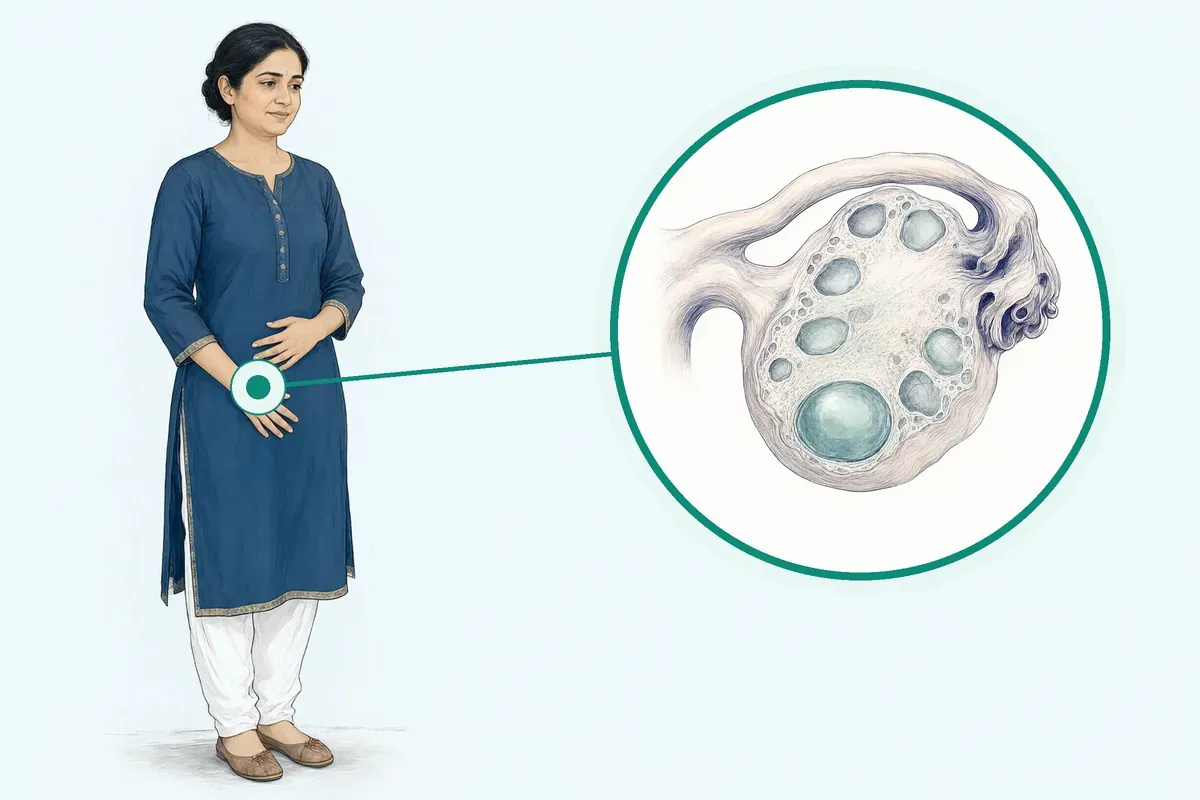
An ovarian cyst is a fluid-filled sac that forms on or inside an ovary. Most cysts are functional, meaning they appear as part of the normal menstrual cycle and disappear on their own within a few months without treatment. An adnexal mass is a growth near the uterus that may involve the ovary, fallopian tube, or surrounding tissue.
Some masses are simple cysts, while others are solid or partly solid and need further checks to rule out cancer.
Endometriomas are cysts caused by endometriosis. They contain fluid with high levels of iron, inflammatory molecules, and enzymes that can damage the nearby ovarian tissue. This damage is not just from the cyst stretching the ovary; the fluid itself changes the cells and reduces the number of healthy follicles in the surrounding cortex.
Adnexal torsion happens when the ovary or fallopian tube twists on its blood supply. This cuts off blood flow and is a surgical emergency. It most often affects women before menopause. A cyst or other mass can act as a lead weight that makes twisting more likely.
Symptoms of ovarian and adnexal conditions and warning signs that need urgent care the same day
- Sudden severe pelvic pain
- Nausea and vomiting with pain
- Fever with pelvic pain
Many ovarian cysts cause no symptoms and are found during a routine scan. When symptoms occur, they may include pelvic pain, bloating, a feeling of fullness, or changes in periods.
Ovarian torsion causes sudden, severe lower abdominal or pelvic pain, often with nausea and vomiting. The abdomen may be very tender to touch. Symptoms can look different in young girls or pregnant women.
Go to the emergency department the same day if you have:
- Sudden, severe lower abdominal or pelvic pain
- Persistent nausea and vomiting with the pain
- Fever along with pelvic pain
These signs can mean the ovary has twisted and its blood supply is cut off. Delay can lead to loss of the ovary, infection spreading in the abdomen (peritonitis), or even death.
After any procedure, contact your doctor if you notice heavy bleeding, severe pain or swelling in the abdomen, high temperature, or dark or smelly vaginal discharge, as these may indicate infection.
Causes of ovarian and adnexal conditions and who is at higher risk
- Functional cysts
- Follicle does not release egg or shrink after release
- Endometriomas
- Womb-like tissue grows on ovary and bleeds each cycle
- Torsion risk
- Enlarged ovary from cyst or mass makes twisting more likely
- Post-menopause
- Any cyst taken more seriously due to slightly higher cancer risk
Functional cysts form when a follicle does not release an egg or does not shrink after releasing one. Endometriomas form when tissue similar to the womb lining grows on the ovary and bleeds with each cycle. Other conditions such as endometriosis or polycystic ovary syndrome (PCOS) can make cysts more likely.
Torsion is more likely when an ovary is enlarged by a cyst or mass. It happens most often in women of reproductive age.
After menopause, any ovarian cyst is taken more seriously because the risk of ovarian cancer is slightly higher. Guidelines suggest ultrasound scans and blood tests every four months for a year if a cyst is found after menopause. Surgery is also normally advised if there is any concern that a cyst could be cancerous or become cancerous.
Your surgeon will consider the cyst size, your symptoms, your plans for pregnancy, your medical history, and your cancer risk when deciding on treatment.
How ovarian and adnexal conditions are diagnosed: examination and tests
Diagnosis starts with a clinical assessment and is usually confirmed with an ultrasound scan. A transvaginal or abdominal ultrasound shows the size, shape, and internal structure of the cyst or mass. Doppler ultrasound checks blood flow, but normal flow does not rule out torsion; it can be seen in up to 60 percent of torsion cases. Three-dimensional ultrasound has higher sensitivity and specificity than two-dimensional ultrasound.
If the ultrasound is unclear, an MRI or CT scan may be used. MRI appears to perform the most suitable, though results are not statistically different from CT. PET scans perform less well. Established morphological scoring systems used by radiologists have respectable sensitivity and specificity for telling benign from suspicious masses.
Explicit scoring systems did not perform as well as other diagnostic methods. Colour Doppler assessment was neither as sensitive nor as specific as simple ultrasonography.
A blood test for CA-125 may be ordered, but it is less reliable than imaging for assessing an adnexal mass. If a solid or partly solid cyst is found, tissue may be sent to the laboratory during surgery to check for cancer cells. Clinical judgment remains central; imaging supports but does not replace it.
Imaging has an important role in identifying torsion and speeding up definitive treatment. Characteristic imaging features of torsion include a large, swollen ovary moved to the midline, follicles displaced to the edge like a string of pearls, a lead mass, free fluid or inflammatory changes around the ovary, and the uterus pulled toward the affected side. Absence of internal flow or enhancement suggests ovarian infarction.
Treatment options without surgery for ovarian and adnexal conditions and when surgery is advised
- Watchful waiting Repeat scan in weeks or months
- Laparoscopy preferred Less pain, quicker recovery
- Emergency detorsion for torsion Untwist to restore blood flow
For simple, asymptomatic functional cysts, a policy of watchful waiting is usually recommended. This means no immediate treatment, but a repeat ultrasound scan after a few weeks or months to see if the cyst has gone. If it disappears, no further tests or treatment are usually needed.
Surgery may be recommended if the cyst is large, persists, or causes symptoms. A common threshold is a cyst larger than 10 centimetres. Surgery is also advised if a cyst grows after menopause. The type of surgery depends on factors such as the size of the cyst and how it looks on ultrasound.
Laparoscopy (keyhole surgery) is preferred for most cysts because it causes less pain and has a quicker recovery. Small cuts are made in the abdomen, gas is used to create space, and a camera and instruments remove the cyst.
If the cyst is very large or there is concern for cancer, an open laparotomy with a larger cut may be needed. In laparotomy, the whole cyst and ovary may be removed and sent for testing.
For endometriomas, laparoscopic cystectomy (removing the cyst wall) gives better outcomes than drainage or burning the cyst lining, with lower recurrence of symptoms and cysts, and better pregnancy rates. For torsion, the definitive treatment is emergency surgical detorsion (untwisting). Even if the ovary looks dark or necrotic, detorsion is still performed because the tissue often recovers.
Any associated cyst is usually removed at the same time. Prompt diagnosis helps preserve the ovary. Recurrence rates are higher with detorsion alone or with only cyst aspiration.
If you have not been through menopause, the surgeon will try to preserve as much ovarian tissue as possible. Often only the cyst is removed, leaving both ovaries intact, so fertility is unaffected. If one ovary must be removed, the other continues to release hormones and eggs; fertility may be slightly reduced but pregnancy is still possible.
Occasionally both ovaries may need removal even before menopause, which triggers early menopause. After menopause, both ovaries may be removed because they no longer produce eggs. New cysts can appear after surgery. The condition causing the cyst (such as endometriosis) may make it harder to get pregnant, but the surgery itself does not reduce fertility. Removing a large cyst may reduce weight and bloating; removing a small cyst is unlikely to change weight.
Preparing for ovarian and adnexal surgery at Jaipur Hospital
Before your operation, our surgical team will arrange a pre-admission check. This usually includes blood tests, a urine test, and an ECG to make sure you are fit for general anaesthesia. You will also have a repeat ultrasound scan to confirm the size and appearance of the cyst or mass. If you take regular medicines, bring the list with you.
Your surgeon will tell you which ones to stop before surgery, especially blood thinners or hormone tablets. You must not eat or drink for at least six hours before the procedure.
Pack a small bag with:
- Comfortable clothes
- Your usual toiletries
- Any medicines you are currently taking
- An attendant to stay with you overnight
Jaipur Hospital provides a 24-hour diagnostic laboratory and in-house pharmacy on site, so any last-minute tests or medicines can be done without leaving the building.
How ovarian and adnexal surgery is done at Jaipur Hospital
Keyhole surgery
- Laparoscopic cystectomy
Whole ovary removal
- Oophorectomy
Emergency untwisting
- Detorsion surgery
The operation is performed under general anaesthesia, so you will be asleep and feel no pain during the procedure. The technique your surgeon chooses depends on the size of the cyst, how it looks on the scan, whether you have been through the menopause, and your plans for pregnancy. The main options are:
- Laparoscopic cystectomy: The surgeon makes a few small cuts in the tummy, inserts a thin telescope (laparoscope) and removes the cyst while preserving the healthy ovarian tissue. This is the most common approach; studies show about 95 percent of ovarian cyst removals are done this way.
- Oophorectomy: If the mass is complex, very large, or looks suspicious, the whole ovary may need to be removed. The tissue is sent to the laboratory to check for cancer.
- Detorsion surgery: For a twisted ovary, the surgeon untwists the adnexa to restore blood flow as an emergency procedure. Any associated cyst may be removed at the same time.
On the day of surgery, you will be taken to one of our modular operation theatres. The operation usually takes one to two hours. After the cyst or ovary is removed, the cuts are closed with dissolvable stitches or staples.
You will then go to the recovery room where the team monitors your blood pressure, heart rate and other vital signs.
Risks and possible complications of ovarian and adnexal surgery
Most patients do not experience complications after ovarian cyst removal. However, every operation carries some risks. Common issues include discomfort or pain in the tummy for a few days after surgery. Your provider will discuss options for pain relief with you.
A small scar of five to 12 millimetres is typical after laparoscopic surgery; open surgery leaves a longer incision at the bikini line.
Less common but serious complications can include infection, which may show as:
- Heavy bleeding
- Severe pain or swelling in the abdomen
- High temperature (fever)
- Dark or smelly vaginal discharge
If a fever develops after surgery, you should call the hospital. Damage to the ovary or fallopian tube during surgery is rare but may affect your ability to get pregnant. Delay in treating a twisted ovary can lead to loss of the ovary, peritonitis, or even death. Endometriomas can cause changes in the surrounding ovarian tissue that reduce follicular density. Your surgeon will explain the risks that apply to your situation before you sign the consent form.
Recovery and aftercare after ovarian and adnexal surgery
After laparoscopic surgery, many people go home on the same day or the next day. You will need an attendant to drive you home. After open surgery, a hospital stay of one or two nights is usual. You will feel pain in your tummy, which should improve in a few days.
In the first weeks:
- After laparoscopic surgery, most patients return to normal activities within two to three weeks. Vigorous exercise like running can resume within two weeks.
- After open surgery, avoid heavy lifting and strenuous activity for six weeks. Light activities around the house can restart after about two weeks. Full recovery may take up to 12 weeks.
Call Jaipur Hospital or visit our 24×7 emergency department if you notice heavy bleeding, severe pain or swelling in your abdomen, a high temperature (fever), or dark or smelly vaginal discharge. These symptoms may indicate an infection. Our in-house pharmacy and diagnostic laboratory are available round the clock for any follow-up tests or medicines you may need.
Results and recurrence after ovarian and adnexal surgery
The benefit of surgery is that your surgeon removes a cyst that may be painful or harmful. Studies show the benefits of removing an ovarian cyst outweigh the risks of surgery. For endometriomas, laparoscopic cystectomy gives better outcomes than drainage or ablation, with lower recurrence of symptoms and better pregnancy rates.
If you have not been through the menopause, your surgeon will try to preserve as much of your reproductive system as possible. It is often possible to remove just the cyst and leave both ovaries intact, so fertility is unaffected. If one ovary is removed, the remaining ovary still releases hormones and eggs as usual.
Fertility should not be affected, although you may find it slightly harder to get pregnant. Occasionally both ovaries may need to be removed, which triggers early menopause. After menopause, both ovaries may be removed because they no longer produce eggs.
Having ovarian cyst surgery does not affect your chances of getting pregnant, but the condition that caused the cyst (such as endometriosis) may make it harder to conceive. New cysts can appear after surgery. Studies show only 10 to 15 percent of ovarian cysts grow back after removal.
If you had a large cyst removed, you may feel lighter and less bloated; removing a small cyst is unlikely to change your weight.
Cost and insurance for ovarian and adnexal surgery in Jaipur
- ₹45,000 to ₹1,50,000 Overall range in India
- ₹65,000 to ₹70,000 Laparoscopic average
- ₹30,000 to ₹55,000 Open surgery range
The typical price range for ovarian and adnexal surgery in India is ₹45,000 to ₹1,50,000. The final cost depends on the type of procedure (laparoscopic or open), the complexity of the case, the length of hospital stay, and whether additional tests or histology are needed. Laparoscopic ovarian cyst treatment in India averages around ₹65,000 to ₹70,000. Open surgery (laparotomy) may cost approximately ₹30,000 to ₹55,000.
Jaipur Hospital is empanelled under RGHS, MAA Yojana, CGHS, and a panel of private insurers and TPAs. If you are covered under any of these schemes, bring your scheme card and photo ID at admission. Our billing team can help you understand what your policy covers and what you may need to pay out of pocket.
The hospital has an in-house pharmacy and diagnostic laboratory, so medicines and tests are billed directly. For a personalised estimate, please contact the hospital using the numbers on your appointment letter.