
Orthopaedics · Jaipur Hospital
Shoulder Replacement in Jaipur
Shoulder pain limits daily tasks; Jaipur Hospital offers assessment and a clear plan
- Serving Jaipur since 1991 (35 years)
- NABH accredited
- 24×7 emergency & ICU
- Cashless: MAA Yojana + 32 insurers
- Operation time
- 2 to 3 hours
- Anaesthesia
- General anaesthesia with interscalene block
- Recovery
- Overhead motion in 4 to 6 months
- Price
- ₹2,50,000 to ₹4,50,000typical range in India; ask us for an estimate
Shoulder pain stops you
Pain and stiffness make simple movements hard
Arthritis or a bad fracture wears the joint surfaces. Lifting, dressing or sleeping become difficult. Medicines and exercises may no longer help.
-
Arthritis pain
Osteoarthritis or rheumatoid arthritis damages the whole joint, causing deep ache and loss of motion.
-
Rotator cuff tear arthropathy
A massive, irreparable tendon tear leads to joint destruction and inability to lift the arm.
-
Complex fracture
A severe break of the upper arm bone near the shoulder that cannot be fixed with plates alone.
-
Failed non-surgical care
Pain persists despite medicines, injections and physiotherapy over several months.
Most people who need a shoulder replacement have shoulder arthritis, usually osteoarthritis or rheumatoid arthritis.
Why Jaipur Hospital
You worry that constant pain will keep you from work, caring for family, or sleeping through the night.
Your care plan
Your first steps with us
- 1 Call or visit OPD for surgeon consultation
- 2 Complete advised tests in our lab and X-ray
- 3 Review implant options and receive a cost estimate
- 4 Undergo surgery and guided rehabilitation at home
How the operation is done
The surgeon replaces the damaged ball and socket with metal and plastic components under general anaesthesia with an interscalene block. The procedure usually takes two to three hours.
-
Anatomic total shoulder
Replicates the normal ball-and-socket anatomy; used when the rotator cuff tendons are intact.
-
Reverse total shoulder
Switches the ball and socket positions; used for rotator cuff tear arthropathy or complex fractures.
-
Stemless humeral component
Fixes the humeral side without a long stem, preserving bone for possible future revision.
-
Short-stem anatomic
Uses a short metaphyseal stem on the humerus, allowing easier revision if needed later.
Why patients trust us
- 1991 Serving Jaipur for 35 years
- NABH Accredited hospital
- 4 Orthopaedics consultants
- 24×7 Emergency, ICU and ambulance
- 33 Cashless schemes and insurers
What research shows about this treatment
-
About 9 in 10 revised implants can be conserved or replaced
In a series of revised reverse shoulder arthroplasties, 90% of cases achieved a functional shoulder, though results were lower than primary surgery.
-
Symptomatic glenoid loosening occurs at 1.2% per year
Long-term registry data show a low annual rate of loosening that causes symptoms and needs attention.
-
Surgical revision rate is 0.8% per year
Pooled data indicate fewer than one revision per 100 implant-years, reflecting durability of modern designs.
If it is left untreated
Without surgery, pain and stiffness usually worsen. The joint may deform further, making later reconstruction harder. Daily tasks such as dressing, cooking and hygiene become increasingly difficult.
Life after treatment
Most people regain useful motion and have much less pain within months, allowing return to light daily activities.
-
Less pain
Most patients report significantly better pain relief within a few weeks after surgery.
-
Better daily function
Dressing, eating and light household work usually become easier by three months.
-
Gradual strength return
Overhead motion and strength typically improve over four to six months with regular exercises.
-
Long-lasting implant
Shoulder replacements usually last about 10 to 20 years with sensible activity modification.
Meet the team
Your orthopaedics doctors
Explore our orthopaedic hospital in Jaipur: every treatment, the doctors and what to expect at your visit.
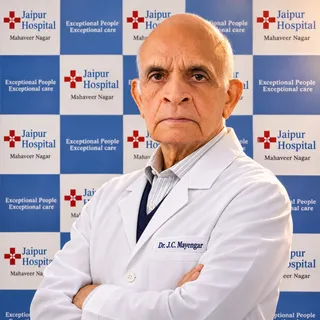

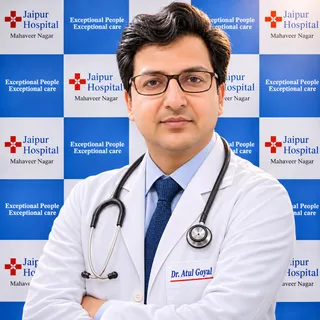
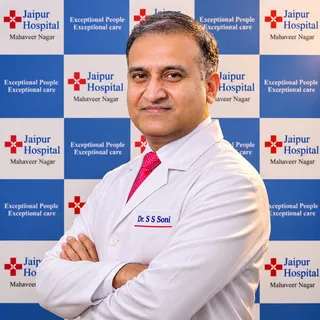
Frequently asked questions
Questions patients ask about shoulder replacement
What is total shoulder replacement?
In short
Total shoulder replacement is an operation that replaces the damaged ball and socket of your shoulder joint with an artificial joint made of metal and plastic. At Jaipur Hospital, the surgical team performs this procedure for severe arthritis or fracture when other treatments no longer help. The operation usually takes two to three hours under general anaesthesia with an interscalene block.
In detail
The surgeon removes the worn head of the humerus and the damaged glenoid socket, then fits a metal ball on a stem into the upper arm and a plastic cup into the shoulder blade.
An anatomic replacement copies your natural anatomy, while a reverse replacement switches the ball and socket and is used when the rotator cuff is torn beyond repair. Stemless or short-stem humeral components preserve more bone and may make future revision easier.
In studies, reverse total shoulder arthroplasty gave better pain relief, higher Constant and Oxford scores, and greater forward elevation than hemiarthroplasty or plate fixation for complex fractures.
A common belief
Some people think only the ball is replaced.
What actually happens
That is a hemiarthroplasty, used less often. A total replacement changes both surfaces. A reverse replacement swaps the ball and socket positions and is chosen when the rotator cuff is badly torn. Studies show reverse designs give better pain relief and movement for those patients.
Your next step at Jaipur Hospital
You will stay in hospital for two to four nights. A sling is worn for four to six weeks, and physiotherapy progresses from passive to active movement over several months. Overhead motion typically returns in four to six months. The usual cost range in India is ₹2,50,000 to ₹4,50,000.
Which specialist should I see for a shoulder replacement problem?
In short
You should see an orthopaedic surgeon who specialises in shoulder and upper limb surgery. At Jaipur Hospital, the orthopaedics department includes surgeons who focus on shoulder arthroplasty for arthritis, rotator cuff arthropathy, and complex fractures. They work with anaesthetists, physiotherapists and the critical care team for the operation and recovery.
In detail
Shoulder replacement is a specialised joint replacement. The surgeon decides whether an anatomic total shoulder, a reverse total shoulder, or a stemless or short-stem humeral component is appropriate based on the condition of the rotator cuff, bone quality, and the type of arthritis or fracture.
Patients with complex acute proximal humeral fractures are often referred to a tertiary centre. The surgical team at Jaipur Hospital performs these procedures in modular operation theatres with 24×7 critical care backup.
A common belief
A general orthopaedic surgeon may treat many joints, but shoulder replacement requires specific experience with anatomic and reverse designs, stemless options, and complex fracture cases.
What actually happens
The surgeon also coordinates with anaesthesia for the interscalene block and with physiotherapy for the months of rehabilitation that follow.
Your next step at Jaipur Hospital
Ask your general physician for a referral to the orthopaedics department at Jaipur Hospital, or contact the hospital directly. Bring any previous X-rays, MRI reports, and a list of medicines. The surgeon will examine your shoulder, review the imaging, and discuss whether surgery is indicated.
What treatment options are available for my shoulder arthritis or fracture?
In short
Jaipur Hospital offers both anatomic and reverse total shoulder replacement for arthritis or fracture. The surgical team may use a stemless humeral component or a short-stem anatomic implant depending on bone quality and the pattern of damage. A partial replacement (hemiarthroplasty) is considered when only the ball is worn.
In detail
Anatomic total shoulder replacement replicates the normal ball-and-socket anatomy and is used when the rotator cuff is intact.
Reverse total shoulder replacement changes the mechanics so the deltoid muscle powers the arm; it is chosen for rotator cuff tear arthropathy or complex fractures where the cuff cannot be repaired. Stemless and short-stem humeral components preserve bone and may make future revision easier.
The decision rests on imaging, the condition of the rotator cuff, bone stock and your functional demands.
In studies, reverse arthroplasty gave higher Constant and Oxford scores and better forward elevation than hemiarthroplasty for fracture, while anatomic replacement provides reliable pain relief for primary osteoarthritis with an intact cuff.
A common belief
Many people think one implant fits all.
What actually happens
In reality the surgeon matches the implant to your rotator cuff status, bone quality and fracture pattern. Reverse designs work better when the cuff is torn; anatomic designs need a healthy cuff.
Your next step at Jaipur Hospital
Your surgeon will review X-rays and, if needed, a CT scan done at an imaging centre, then discuss which implant type fits your shoulder. Pre-operative assessment includes blood tests, anaesthesia review and dental clearance if required.
Surgery takes two to three hours under general anaesthesia with an interscalene block, and the usual stay is two to four nights.
What can I safely do at home to manage shoulder arthritis or fracture symptoms?
In short
At home you can manage shoulder symptoms with gentle pendular exercises, heat or cold packs, activity pacing and over-the-counter anti-inflammatory medication if your doctor agrees. Jaipur Hospital recommends avoiding overhead lifting, repetitive reaching and sleeping on the affected side. A pillow under the arm while sitting can reduce strain.
In detail
Pendular exercises (Codman exercises) maintain passive motion without loading the joint. Heat before movement eases stiffness; cold after activity reduces inflammation. Modify tasks: use a long-handled reacher, wear front-opening shirts, and keep frequently used items at waist level.
For fracture in a sling, follow the surgeon's specific immobilisation instructions; do not remove the sling for dressing unless cleared. Maintain cardiovascular fitness with stationary cycling or walking. Good sleep hygiene and weight control reduce systemic inflammation.
Physiotherapy-guided home programmes have been shown to preserve range of motion better than unsupervised exercise. Stop any movement that causes sharp pain or increases night pain.
A common belief
People often try aggressive stretching or heavy resistance bands, thinking more is better.
What actually happens
That irritates the joint and can worsen inflammation. Gentle, frequent motion within a comfortable range is safer and more effective.
Your next step at Jaipur Hospital
Set a daily routine: 10 minutes of pendular exercises morning and evening, ice after activity, and a weekly review of pain and function. If pain worsens or new weakness appears, contact the hospital.
Can you put your arm behind your back after reverse total shoulder replacement?
In short
Reverse total shoulder replacement changes the joint mechanics so internal rotation behind the back is often limited. At Jaipur Hospital, most patients regain enough motion for toileting and basic dressing, but reaching the opposite shoulder blade or high back fastening may remain difficult. The surgeon will explain the expected range for your specific case.
In detail
In a reverse prosthesis the ball is fixed to the socket and the cup to the humerus. This design stabilises the joint when the rotator cuff is torn, but it shortens the internal rotation arc.
Studies report active external rotation stays unchanged while forward elevation and abduction improve significantly. Internal rotation behind the back depends on subscapularis integrity, component positioning and soft-tissue balance.
Rehabilitation focuses on forward elevation, abduction and external rotation; forced internal rotation stretching is usually avoided to protect the prosthesis from dislocation. Functional tasks such as perineal care and low back tucking are practised with occupational therapy adaptations if needed.
A common belief
Patients expect full motion like a normal shoulder.
What actually happens
The reverse prosthesis trades internal rotation for stability and overhead lift. Forcing the hand up the back can dislocate the implant, so therapy focuses on forward and outward movement instead.
Your next step at Jaipur Hospital
Discuss your daily activities that need behind-the-back motion at the pre-operative visit. The therapist will teach adaptive techniques and safe limits.
How will total shoulder replacement treatment affect my walking, movement, or independence?
In short
Total shoulder replacement at Jaipur Hospital does not directly affect walking or leg movement. Independence improves as shoulder pain decreases and arm function returns for dressing, cooking, and hygiene. A sling temporarily limits one-handed tasks for 4 to 6 weeks.
In detail
The surgery targets shoulder pain and stiffness. Evidence shows most patients have much less pain and better daily function after recovery. Walking is unaffected, though you may use a walker briefly if balance is a concern while wearing the sling.
During the first 4 to 6 weeks, the operated arm is in a sling, so you need help or adaptive techniques for bathing, dressing, and meals. Physiotherapy progresses from passive to active motion, then strengthening.
By 3 months most people feel much more functional; overhead strength may improve up to a year. Long term, the artificial joint lasts about 10 to 20 years if heavy repetitive loads are avoided.
A common belief
People worry about losing mobility.
What actually happens
In fact, the leg function is unchanged. The temporary limit is the sling: you will need help with bathing, dressing, and cooking early on. By 3 months most daily tasks become easier than before surgery.
Your next step at Jaipur Hospital
Arrange an attendant for the first 1 to 2 weeks at home. Practice one-handed dressing before surgery. Home exercises start as advised by your therapist. Follow-up visits monitor progress.
Which symptoms or changes should prompt me to seek medical advice for shoulder replacement?
In short
You should seek medical advice when shoulder pain and loss of function become severe and medicines or other treatments no longer relieve the pain. At Jaipur Hospital, the orthopaedic team sees patients who have deep aching pain in the shoulder, pain that disturbs sleep, stiffness that limits dressing or reaching overhead, and a grinding sensation with movement. These symptoms suggest advanced joint damage.
In detail
The most common problems leading to shoulder replacement are pain and loss of function due to arthritis and rotator cuff dysfunction or tearing. Osteoarthritis and rheumatoid arthritis are the usual arthritis types. Avascular necrosis can also destroy the joint.
When non-surgical measures such as activity modification, physiotherapy, and pain medication no longer control symptoms, a surgeon may recommend joint replacement. The decision is based on how much the symptoms interfere with your daily life and sleep.
A common belief
Many people wait until they cannot move the arm at all.
What actually happens
Earlier evaluation allows the surgeon to plan surgery before the bone wears down further, which can make the operation more straightforward.
Your next step at Jaipur Hospital
If you have persistent shoulder pain that limits your routine activities or wakes you at night, schedule an OPD visit. The surgeon will take a history, examine the shoulder, and order X-rays to assess the joint. Bring any previous imaging or treatment records. To book a consultation at Jaipur Hospital, call 0141-2551500 or 7414 001 001.
What will the doctor ask and check at the first visit for shoulder replacement?
In short
At the first visit, the surgeon will ask about your pain, stiffness, weakness, how long symptoms have lasted, what treatments you have tried, and how the shoulder affects your daily activities and sleep. At Jaipur Hospital, the orthopaedic specialist will also ask about previous injuries, surgeries, medical conditions, and medicines you take.
In detail
The surgeon examines the shoulder for range of motion, strength, stability, and tenderness. They check whether the pain comes from the joint or the neck. X-rays are reviewed to see bone damage, joint space narrowing, bone spurs, and the position of the humeral head.
If the rotator cuff status is unclear, an MRI or ultrasound may be advised. The surgeon explains the types of replacement — anatomic, reverse, stemless or short-stem — and which may suit your pattern of damage.
They also discuss the typical hospital stay of two to four nights, the sling period of four to six weeks, and the four to six months needed for overhead motion.
A common belief
Some patients expect an immediate surgery date.
What actually happens
The first visit is for assessment and planning. The surgeon must confirm the diagnosis, check the rotator cuff, and decide which implant design fits your anatomy. They also explain the recovery timeline and the need for physiotherapy. Dental health is reviewed because infections can spread to the new joint.
Your next step at Jaipur Hospital
Bring all previous imaging, a list of medicines, and details of any allergies. If you have dental work planned, the surgeon may suggest completing it before surgery to reduce infection risk. You will receive guidance on pre-operative tests and fasting.
Can shoulder arthritis or fracture improve without a procedure or operation?
In short
Shoulder arthritis is a progressive condition and does not reverse on its own. Non-surgical measures such as activity modification, physiotherapy, and medication can reduce symptoms for a time. For a fracture, the bone may heal without surgery if the fragments are stable and well aligned, but displaced or complex fractures often need fixation or replacement to restore function.
In detail
In early arthritis, pain and stiffness may be managed with exercises that maintain range of motion, anti-inflammatory medicines, and avoiding heavy overhead loads. These steps do not stop the joint surface from wearing further.
When the cartilage is severely worn or the rotator cuff is torn beyond repair, non-surgical care no longer provides adequate relief. For fractures, the surgeon assesses fragment position on X-ray. Stable, non-displaced fractures can be treated in a sling with early motion.
Displaced multi-part fractures, especially in older patients with poor bone quality, have a high risk of malunion or non-union without surgery.
Evidence shows reverse total shoulder arthroplasty offers an acceptable surgical option for complex acute proximal humeral fractures when non-operative treatment is unlikely to give a functional result.
A common belief
People often hope rest alone will fix a worn joint.
What actually happens
It helps pain temporarily, but the surface damage continues. For complex fractures, leaving the bone out of place usually leads to stiffness and poor function.
Your next step at Jaipur Hospital
If you have tried physiotherapy and medicines for several months without lasting relief, or if your fracture X-ray shows displacement, the surgeon will discuss whether surgery is the next step. Attend an OPD visit at Jaipur Hospital for a fresh assessment and imaging review.
Are there foods, activities, or habits I should change for shoulder arthritis or fracture?
In short
For shoulder arthritis or fracture, stop smoking as it impairs bone and soft tissue healing. Maintain a healthy weight to reduce joint load. Eat a balanced diet with adequate protein, calcium, and vitamin D for bone health. Avoid heavy lifting, repetitive overhead activities, and contact sports that stress the shoulder. Complete any major dental work before planned surgery to lower infection risk.
In detail
Smoking reduces blood flow and increases the risk of wound complications, infection, and non-union in fractures. Evidence shows infections can spread from the mouth to the artificial joint, so dental health matters.
A diet rich in dairy, leafy greens, legumes, and fortified foods supports bone quality. If you take steroid medication, discuss bone protection with your doctor.
Modify daily tasks: use a step stool instead of reaching overhead, carry loads close to the body, and use two hands for heavy items. After surgery, the surgeon may advise avoiding heavy lifting and repetitive activities long-term to prolong implant life.
Swimming is encouraged after wound healing and surgeon approval. Walking and light yard work maintain general fitness without overloading the shoulder.
A common belief
People focus on supplements.
What actually happens
The biggest modifiable risk is smoking, which doubles complication rates. Dental health is the overlooked infection source.
Your next step at Jaipur Hospital
If you smoke, ask your GP about cessation support before surgery. Schedule a dental check-up. Discuss activity modifications with the occupational therapist.
FAQ library
Questions and answers about shoulder replacement
When you contact us
Get a clear plan for your shoulder
Contact Jaipur Hospital for an OPD consultation, scan review, cost estimate and help with cashless schemes.
- A consultation with an orthopaedic surgeon in the OPD
- Your scans and reports reviewed, with tests done in-house if you need them (laboratory, X-ray and imaging)
- Your options explained in plain words, including whether you need surgery at all
- A cost estimate before you decide
- Help with cashless treatment under MAA Yojana, various government health care schemes and empanelled insurers and TPAs
- Follow-up visits after your treatment
Overview
Shoulder Replacement: what to know
What shoulder replacement is and how the joint is affected
Shoulder replacement surgery is a joint replacement (arthroplasty) for your shoulder. Your shoulder is where your upper arm bone (humerus) connects to your shoulder blade (scapula). It is a ball and socket joint. The ball-shaped top (head) of your humerus fits into the cup-shaped socket in your scapula (glenoid).
In this operation a surgeon replaces the bones and connective tissue in your natural shoulder joint with an artificial joint (a prosthesis). Prosthetic shoulders are made of metal and plastic. Your surgeon will replace the ball at the end of your humerus and the socket in your scapula it fits into.
In shoulder replacement surgery, surgeons replace the ends of the damaged humerus (upper arm bone) and usually the scapula (shoulder bone). The top end of the upper arm bone is shaped like a ball. Muscles and ligaments hold this ball against a cup-shaped part of the shoulder bone.
Surgeons usually replace the top of the upper arm bone with a metal ball. The metal piece is inserted into your upper arm bone. If the cup-shaped surface of your shoulder bone that cradles your upper arm bone is also damaged, the surgeon will smooth it. Then they cap it with a plastic or metal and plastic piece.
In some cases, surgeons will do a reverse shoulder replacement. In this procedure, the surgeon removes the damaged bone and smooths the ends. Then they attach the metal ball portion of the implant to the socket bone. The cup-shaped piece is then inserted into the upper arm bone, where the patient's ball joint used to be. In this implant, the positions of the metal ball joint and the socket implant are reversed.
Symptoms of shoulder arthritis and when to seek urgent care
- Sudden severe pain after fall
- Visible deformity
- Rapid swelling
- Numbness or tingling
- Fever with redness and warmth
The most common problems leading to shoulder replacement are pain and loss of function due to arthritis and rotator cuff dysfunction or tearing. Most people who need a shoulder replacement have shoulder arthritis, usually osteoarthritis or rheumatoid arthritis.
That is because most people who have arthritis or another issue that is severe enough to need a shoulder replacement experience damage to the whole shoulder.
You may feel deep aching pain in the shoulder that worsens with activity and improves with rest. Stiffness can make it hard to reach overhead, behind your back, or across your body. You might hear or feel grinding, clicking, or catching when you move the arm.
Weakness and loss of motion can make daily tasks such as dressing, combing hair, or lifting objects difficult. Pain at night that disturbs sleep is common.
Warning signs that need urgent care the same day include sudden severe pain with inability to move the arm after a fall or injury, visible deformity of the shoulder, swelling that appears rapidly, numbness or tingling in the arm or hand, or fever with redness and warmth around the joint. These may indicate a fracture, dislocation, infection, or nerve injury that requires immediate assessment.
Causes of shoulder joint damage and who is at higher risk
- Osteoarthritis
- Wear-and-tear arthritis
- Rheumatoid arthritis
- Inflammatory arthritis
- Post-traumatic arthritis
- After fracture or dislocation
- Rotator cuff tear arthropathy
- Joint damage from massive tendon tears
- Avascular necrosis
- Loss of blood supply to bone
The main causes of shoulder joint damage leading to replacement are osteoarthritis, rheumatoid arthritis, post-traumatic arthritis after a fracture or dislocation, rotator cuff tear arthropathy, and avascular necrosis (loss of blood supply to the bone).
A severe rotator cuff tear or a health condition like avascular necrosis that affects your ability to use your shoulder may also lead to a recommendation for surgery.
People at higher risk include:
- Those with long-standing shoulder arthritis that has not responded to non-surgical treatment
- Older adults with complex fractures of the upper humerus
- Patients with massive irreparable rotator cuff tears
- Those with inflammatory arthritis such as rheumatoid arthritis
A younger or more active person is more likely than an older or less active person to have an artificial shoulder joint wear out and need another replacement surgery in the future.
The younger you are when you have the surgery, and the more stress you put on the joint, the more likely it is that you will eventually need a second surgery to replace the first artificial joint.
How shoulder arthritis is diagnosed: examination and tests
- Clinical examination Range of motion, strength, tenderness
- X-rays Joint space, bone spurs, cysts, deformity
- CT or MRI if needed Bone loss, rotator cuff, soft tissue
- Blood tests if needed Inflammatory arthritis or infection
Your doctor will use X-rays to look at the bones and cartilage in your shoulder to see whether they are damaged and to make sure that the pain is not coming from somewhere else. The examination includes checking your range of motion, strength, and areas of tenderness.
The doctor will ask about your symptoms, how long you have had them, and what makes them better or worse.
X-rays show:
- Joint space
- Bone spurs
- Cysts
- Any deformity
In some cases the surgeon may advise a CT scan or MRI to assess bone loss, rotator cuff condition, or soft tissue detail. These scans are done at an imaging centre outside the hospital; the surgical team reviews the images to plan the operation. Blood tests may be ordered if inflammatory arthritis or infection is suspected.
Non-surgical treatment options and when shoulder replacement is advised
Do
- Activity modification
- Physiotherapy
- Pain relief medicines
- Corticosteroid injection
- Heat or cold packs
- Assistive devices
Non-surgical treatments are tried first. These include activity modification, physiotherapy to maintain motion and strengthen the muscles around the shoulder, pain relief with paracetamol or anti-inflammatory medicines, and in some cases a corticosteroid injection into the joint. Heat or cold packs and assistive devices can help with daily tasks.
A healthcare provider might suggest shoulder replacement if non-surgical treatments have not helped manage severe symptoms. Doctors recommend joint replacement surgery when shoulder pain and loss of function become severe and when medicines and other treatments no longer relieve pain.
Shoulder replacement may not be recommended for people who have active infection, severe nerve damage, or medical conditions that make anaesthesia or surgery unsafe. The decision is made after discussion with your surgeon about your symptoms, imaging findings, general health, and goals.
Preparing for shoulder replacement surgery
Do
- Attend pre-operative assessment
- Complete major dental work
- Fast for at least six hours
- Bring regular medicines and allergy list
- Bring loose front-opening clothing
- Bring an attendant
Before your operation, you will attend a pre-operative assessment where our doctors review your medical history and current medicines. Blood tests, an ECG and a chest X-ray are usually done to check your fitness for anaesthesia.
If you take blood-thinning medicines, diabetes tablets or insulin, or any herbal supplements, tell your doctor so the doses can be adjusted or stopped for a short period. Any major dental work should be completed before surgery because infections can spread from the mouth to the new joint.
You will be asked to fast for at least six hours before the operation. Bring your regular medicines, a list of allergies, comfortable loose clothing that opens at the front, and an attendant who can stay with you during the hospital stay.
How shoulder replacement surgery is done
- Anaesthesia and nerve block General anaesthesia with interscalene block
- Incision at front of shoulder Muscles moved aside
- Implant placement Metal and plastic artificial joint
- Wound closure and sling Bandage applied, arm in sling
- Recovery with compression sleeves Helps prevent blood clots
The operation is performed under general anaesthesia combined with an interscalene nerve block that numbs the shoulder and arm. The procedure usually takes two to three hours.
Your surgeon makes an incision at the front of the shoulder, moves the muscles aside, and replaces the damaged ball at the top of the humerus and the socket in the scapula with an artificial joint made of metal and plastic. The choice of implant depends on the condition of your rotator cuff tendons and bone quality.
An anatomic total shoulder replacement replicates the normal ball-and-socket anatomy and is used when the rotator cuff is intact. A reverse total shoulder replacement switches the positions of the ball and socket; it is chosen for rotator cuff tear arthropathy or when the tendons are severely torn.
Stemless or short-stem humeral components are bone-preserving options that may make future revision easier. Your surgeon will discuss which technique suits your shoulder before the operation. On the day of surgery, you are taken to the modular operation theatre, given anaesthesia, and the procedure is carried out.
After the wound is closed, a bandage is applied and your arm is placed in a sling. You will wake up in the recovery area with compression sleeves on your legs to help prevent blood clots.
Risks and possible complications of shoulder replacement
- 6.6% Heterotopic ossification
- 7.3% Revision surgery rate
Shoulder replacement is generally safe, but like any operation it carries risks. Common early issues include nausea or constipation from anaesthesia and pain medicines. Infection can occur at the wound or deep around the implant; you may receive antibiotics for about a day after surgery to reduce this risk.
Infections elsewhere in the body, such as in the mouth, can spread to the artificial joint later. Bleeding or a haematoma may need drainage. Nerve injury, stiffness, or fracture of the humerus during surgery are uncommon. Over time, the plastic socket can wear down or the components may loosen, which can require revision surgery.
In reverse shoulder replacement, the most frequent reasons for revision are instability of the prosthesis, infection, humeral loosening or fracture, and glenoid loosening. Heterotopic ossification (extra bone forming in soft tissue) has been reported in about 6.6% of patients in studies. Revision surgery was necessary in about 7.3% of patients in one large series.
Notching of the scapula was seen in only a small number of reverse shoulder patients in studies. If you notice redness, drainage, or fever after discharge, contact your surgeon promptly.
Recovery and aftercare after shoulder replacement
Most patients stay in hospital for two to four nights. Pain is managed with the nerve block and oral medicines. You may continue blood-thinning medication for several weeks. Your arm will be in a sling for the first four to six weeks. You can usually sit up and get out of bed with help on the day of surgery.
Simple breathing exercises help prevent chest congestion while you are less active. Before you go home, the physiotherapy team will teach you passive motion exercises where the therapist moves your arm for you. You will also receive a home exercise programme to follow daily.
Rehabilitation progresses from passive motion to active motion and then to strengthening, always under the guidance of a trained physiotherapist. The timing of each stage varies with the type of surgery and your healing. Most people feel much more functional by three months. Overhead strength and full recovery can continue to improve up to a year.
Total rehabilitation typically takes several months. You will be seen in the outpatient department at intervals for several months to monitor the replacement. Avoid heavy lifting and repetitive overhead activities to protect the joint. Light activities such as walking, swimming (once the wound is healed and your doctor approves), and golf are encouraged. Let all future health professionals know you have an artificial shoulder so they can care for you appropriately.
Results of shoulder replacement in studies
In studies, shoulder replacement provides significant pain relief and improved function for most patients. Reverse total shoulder arthroplasty has shown better pain scores, higher function scores, and greater forward elevation and abduction compared with hemiarthroplasty or plate fixation for complex fractures. Active external rotation may not improve significantly with a reverse prosthesis.
Clinical scores and range of motion gains have been maintained up to 20 years after surgery in some series. The amount of movement you regain varies widely and depends on your pre-operative stiffness and the condition of the soft tissues around the shoulder.
Revision rates in large registry data are about 0.8% per year, with symptomatic glenoid loosening at 1.2% per year. Shoulder replacements usually last 10 to 20 years. Younger and more active patients are more likely to need a second replacement later.
Outcomes after revision of a reverse prosthesis are generally not as good as after the first operation and depend on the surgeon's experience with these complex cases.
Cost and insurance for shoulder replacement in Jaipur
The typical cost range for a total shoulder replacement in India is ₹2,50,000 to ₹4,50,000. The final amount depends on the type of implant (anatomic, reverse, stemless or short-stem), the length of hospital stay, and any additional investigations or treatments needed. Jaipur Hospital is a NABH-accredited multispeciality hospital established in 1991.
We accept MAA Yojana, various government health care schemes, and a panel of private insurers and TPAs. Our in-house pharmacy, diagnostic laboratory and X-ray facilities are available 24 hours a day. For an estimate specific to your case, please contact the hospital on 0141-2551500, 0141-2554139 or 7414 001 001, or email [email protected]. खर्च, बीमा और संपर्क की जानकारी देखें।