

Sports Injury · Jaipur Hospital
Rotator Cuff Repair in Jaipur
Shoulder pain and weakness? We assess your tear and give a clear treatment plan.
- Serving Jaipur since 1991 (35 years)
- NABH accredited
- 24×7 emergency & ICU
- Cashless: MAA Yojana + 32 insurers
- Operation time
- 1 to 2 hours
- Anaesthesia
- General or regional anaesthesia
- Recovery
- Sling for 4 to 6 weeks, physiotherapy 3 to 6 months
- Price
- ₹80,000 to ₹1,80,000typical range in India; ask us for an estimate
Shoulder pain limits daily life
A torn tendon makes lifting, reaching and sleeping difficult
A rotator cuff tear causes pain when you lift your arm, weakness when you carry things, and aching at night. Simple tasks like dressing or combing hair become hard. The tear does not heal on its own.
-
Pain with movement
Lifting your arm overhead or reaching behind your back causes sharp or aching pain.
-
Weakness in the arm
You cannot hold usual weights or push up from a chair without the shoulder giving way.
-
Sleep disturbed
Lying on the affected side wakes you up; night pain is a common complaint.
-
Tear may enlarge
Without repair, the tendon can retract further and the muscle may turn fatty over time.
Rotator cuff tears affect 40% or more of people aged over 60 years.
Why Jaipur Hospital
You worry that surgery means months off work, a long rehabilitation, and bills you cannot predict.
Your care plan
Your first steps with us
- 1 Call or visit OPD for specialist assessment
- 2 Review scans and decide on surgery type
- 3 Undergo arthroscopic repair with 1 to 2 night stay
- 4 Follow guided physiotherapy for 3 to 6 months
How the operation is done
The surgeon uses a small camera and instruments through keyhole cuts to reattach the torn tendon to bone with suture anchors. The method depends on tear size and tissue quality.
-
Arthroscopic Single-Row Repair
Standard fixation using one row of anchors; often chosen for small to medium tears.
-
Arthroscopic Double-Row Repair
Two rows of anchors restore a broader footprint; used for larger tears where tissue allows.
-
Mini-Open Repair
A small open incision combined with arthroscopy; reserved for massive or revision tears.
-
Superior Capsular Reconstruction
Graft augmentation to bridge the gap when the tendon cannot be repaired directly.
Why patients trust us
- 1991 Serving Jaipur for 35 years
- NABH Accredited hospital
- 1 Sports Injury consultants
- 24×7 Emergency, ICU and ambulance
- 33 Cashless schemes and insurers
What research shows about rotator cuff repair
-
About 78% of repairs intact at follow-up
In a pooled analysis of 861 patients with at least one year follow-up, 78.3% had healed tendons on imaging.
-
Healing drops with larger tears
Healing rates were 66% for small, 68% for medium, 47% for large and 27% for massive tears at 12 months.
-
Double-row shows lower retear for 1 to 3 cm tears
Meta-analysis found significantly lower retear rates with double-row versus single-row for tears sized 1 to 3 cm.
If it is left untreated
Without repair, the tear can enlarge, the muscle may develop fatty infiltration, and shoulder function can decline further, making later surgery less predictable.
Life after treatment
Most people regain useful shoulder motion and strength after completing the rehabilitation programme.
-
Return to daily tasks
Most people can dress, groom and reach overhead shelves again within a few months.
-
Sleep improves
Night pain usually settles as the tendon heals and inflammation reduces.
-
Strength returns gradually
Guided physiotherapy over 3 to 6 months rebuilds power for lifting and sports.
-
Long-term durability
Studies show good long-term results for repaired tendons that heal structurally.
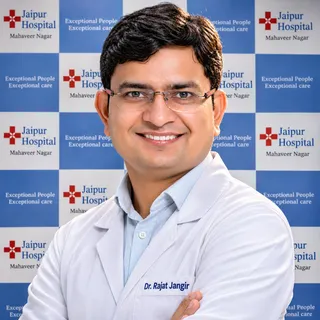
Meet the team
Your sports injury doctors
Explore our sports injury treatment centre in Jaipur: every treatment, the doctors and what to expect at your visit.
Frequently asked questions
Questions patients ask about rotator cuff repair
What does rotator cuff repair involve?
In short
Rotator cuff repair at Jaipur Hospital is an arthroscopic operation to stitch a torn shoulder tendon back to the bone. The surgery takes one to two hours under general or regional anaesthesia. You usually stay one to two nights. A sling is worn for four to six weeks, followed by physiotherapy for three to six months.
In detail
The surgeon inserts a small camera and instruments through tiny cuts around the shoulder. The torn tendon is freed, the bone is prepared, and sutures are passed through the tendon and fixed into the bone with anchors.
Techniques include single-row repair for small to medium tears, double-row repair for larger tears to restore more of the tendon footprint, and mini-open repair for massive or revision tears. For irreparable tears, superior capsular reconstruction uses a graft to bridge the gap.
Evidence shows double-row repair has lower retear rates than single-row for tears of one to three centimetres, though clinical scores are similar between methods.
Healing rates fall as tear size increases: small tears heal in about 66 per cent of cases, large tears in 47 per cent, and massive tears in 27 per cent at twelve months.
A common belief
Many people think the tendon heals quickly once stitched.
What actually happens
In studies, healing rates drop sharply with tear size: small tears heal around 66 per cent, large tears 47 per cent, and massive tears only 27 per cent at one year. Double-row fixation lowers retear risk for medium tears, but final function scores are often similar regardless of technique.
Your next step at Jaipur Hospital
Your surgeon will explain which technique suits your tear size and tissue quality after reviewing your scans. Plan for one to two nights in hospital, a sling for four to six weeks, and regular physiotherapy for three to six months. The typical cost range in India is ₹80,000 to ₹1,80,000; ask us for an estimate.
Which tests and scans do I need before rotator cuff repair?
In short
Before rotator cuff repair at Jaipur Hospital, you need a clinical examination and imaging to confirm the tear size, pattern, and muscle quality. An MRI or ultrasound of the shoulder is standard. X-rays are taken to check bone spurs, arthritis, and acromial shape. Blood tests and a pre-anaesthesia check are done before surgery.
In detail
Imaging defines the tear: small (less than one centimetre), medium (one to three centimetres), large (three to five centimetres), or massive (over five centimetres). MRI or ultrasound also shows retraction, fatty infiltration, and muscle bulk.
Evidence shows these factors predict healing: fatty infiltration and retraction are linked to retears. X-rays assess the acromion type and joint space. Routine pre-operative blood work includes haemoglobin, blood sugar, kidney and liver function, and infection markers.
An ECG and chest X-ray may be needed depending on age and medical history. The anaesthetist reviews these at the pre-anaesthesia check. Jaipur Hospital has in-house X-ray and laboratory; MRI is done at an external imaging centre and the surgeon reviews the images.
A common belief
Patients sometimes think an X-ray alone is enough.
What actually happens
X-rays show bone but not the tendon. MRI or ultrasound is essential to measure tear size, fatty infiltration, and retraction — these directly affect healing probability. Studies show fatty infiltration and retraction are linked to retears. Without this information, the surgeon cannot counsel you accurately on likely outcomes.
Your next step at Jaipur Hospital
Bring any previous shoulder imaging to your consultation. If scans are older than three to six months, a repeat MRI or ultrasound may be needed. The pre-anaesthesia check is usually done a few days before admission. The typical cost range in India is ₹80,000 to ₹1,80,000.
How painful is rotator cuff repair and the early recovery?
In short
Rotator cuff repair at Jaipur Hospital is done under general or regional anaesthesia so you feel no pain during the operation. After surgery the shoulder is sore and swollen. Most patients need regular pain medicine for the first few days. Pain improves steadily over the first two weeks while the arm stays in a sling.
In detail
The operation takes 1 to 2 hours. A nerve block or regional anaesthesia often gives good pain relief for the first 12 to 24 hours. After that, oral painkillers such as paracetamol with an anti-inflammatory or a weak opioid are used.
Studies show early passive motion and immobilisation give similar pain scores at later time points. The sling is worn for 4 to 6 weeks. Physiotherapy starts with gentle assisted movements. Pain usually decreases as swelling goes down and movement returns. Sleeping can be uncomfortable for several weeks; a semi-reclined position helps.
A common belief
Some patients expect no pain at all or fear severe pain for months.
What actually happens
In reality, a nerve block helps the first day, then simple tablets control it. Sleeping upright helps the first few weeks. The team adjusts your medicine if pain is not controlled.
Your next step at Jaipur Hospital
Take pain medicine on schedule for the first 48 hours, then as needed. Keep the sling on day and night except for prescribed exercises. Use ice packs for 15 minutes several times a day. Contact the hospital if pain suddenly worsens or you develop fever.
How long does recovery usually take after rotator cuff repair?
In short
Recovery after rotator cuff repair at Jaipur Hospital takes three to six months for most daily activities and up to twelve months for full strength. The sling is worn for four to six weeks. Physiotherapy starts with passive motion, progresses to active-assisted exercises at six weeks, and strengthening at twelve weeks. Return to heavy work or sport may take six to twelve months.
In detail
Studies show functional scores plateau at six to twelve months, though the Constant score can improve up to twenty-four months. Early passive motion and immobilisation give similar outcomes at later time points.
Healing rates depend on tear size and age: small tears in younger patients heal sixty-five to seventy-eight percent. The rehabilitation protocol is slower for larger tears to protect the repair. The hospital physiotherapy team guides each phase. Driving is usually possible after six to eight weeks when the sling is off and control is adequate.
A common belief
Patients often expect a quick recovery because the incisions are small.
What actually happens
The tendon-to-bone healing takes months regardless of incision size. Rushing rehabilitation increases re-tear risk.
Your next step at Jaipur Hospital
Plan for at least two weeks off desk work and three to six months off heavy labour. Attend physiotherapy two to three times weekly for the first three months. Do home exercises daily as taught. The three-month and six-month reviews at Jaipur Hospital track progress. Book your surgery date early to align rehabilitation with your work and personal calendar.
Can a rotator cuff tear heal with rehabilitation, or is an operation worth considering?
In short
Some rotator cuff tears improve with rehabilitation alone, but many do not heal without surgery. At Jaipur Hospital, the surgeon assesses tear size, tendon quality, your age, activity level and symptoms before advising whether an operation is appropriate. The decision is made together with you after imaging and examination.
In detail
Evidence shows that small tears in older, less active patients often do well with physiotherapy. Larger tears, tears in younger patients, and tears with significant weakness or night pain are less likely to heal without repair.
Studies report that tear size, age, fatty infiltration and retraction all affect healing potential. Rehabilitation cannot reattach a completely torn tendon to bone, but it can improve shoulder mechanics and comfort. Surgery aims to restore the tendon footprint and allow structured rehabilitation to regain strength.
A common belief
A common belief is that all tears eventually heal with exercise.
What actually happens
In fact, a completely torn tendon cannot reattach to bone on its own. Studies show tear size, age, fatty infiltration and retraction determine healing potential. Rehabilitation helps mechanics and comfort, but surgery is needed to restore the tendon footprint when those factors are unfavourable.
Your next step at Jaipur Hospital
The surgeon will review your MRI or ultrasound, examine your shoulder, and discuss your goals. If surgery is advised, it is usually arthroscopic with a one to two night stay. Rehabilitation takes three to six months.
Can I continue any training safely while I recover from rotator cuff repair?
In short
During the first 4 to 6 weeks after rotator cuff repair at Jaipur Hospital, you cannot use the operated arm for any training. You can do lower-body exercises like stationary cycling, walking, or leg machines that do not involve the shoulder. Upper-body training resumes only when your surgeon and physiotherapist clear you, usually after the sling comes off, starting with passive and assisted movements.
In detail
Evidence shows that slower, less aggressive rehabilitation improves healing rates without reducing final range of motion. Early loading of the repair increases the risk of retear.
Studies found retear rates of 26.6 percent at a mean of 23.7 months overall, with higher rates for larger tears and older age. The rehabilitation protocol protects the tendon-to-bone healing. Cardiovascular fitness can be maintained with lower-body work.
Core and leg strength training is safe if the shoulder is not loaded. Any upper-body movement must follow the phased protocol: passive motion first, then active-assisted, then active, then strengthening.
- Studies found retear rates of 26.6 percent at a mean of 23.7 months overall, with higher rates for larger tears and older age.
A common belief
Many athletes try to maintain upper-body fitness with light weights or bands too early.
What actually happens
Evidence shows early loading raises retear risk. Studies report overall retear rates around 27 percent, higher for large tears. Slower rehab actually improves healing without hurting final motion. The safe route: keep the shoulder protected, train legs and core, and let the tendon heal before any upper-body load returns.
Your next step at Jaipur Hospital
Discuss your specific sport and training routine with your surgeon before surgery. Plan lower-body workouts for the first 6 weeks. Expect physiotherapy 3 to 6 months. Return to sport-specific training typically starts around 4 to 6 months, depending on healing.
Why might my doctor recommend rotator cuff repair?
In short
Your doctor may recommend rotator cuff repair at Jaipur Hospital if you have a full-thickness tear that causes persistent pain, weakness, or loss of function despite non-surgical treatment. Surgery aims to reattach the tendon to restore strength and relieve pain, especially when the tear limits daily activities or sleep.
In detail
Rotator cuff tears are common, affecting 40 per cent or more of people over sixty. Not all tears need surgery. The decision depends on tear size, symptom duration, failed physiotherapy, and your functional demands.
Evidence shows clinical improvement averages 72 per cent of the maximum possible after repair. Patient-reported outcomes improve whether or not the tendon heals fully, though intact repairs give better strength.
Risk factors for poor healing include larger tears, older age, fatty infiltration, muscle retraction, smoking, diabetes, osteoporosis, and high cholesterol. Massive tears are an independent predictor of non-healing. Your surgeon weighs these factors against the natural history of the tear, which may enlarge over time.
- Rotator cuff tears are common, affecting 40 per cent or more of people over sixty.
- Evidence shows clinical improvement averages 72 per cent of the maximum possible after repair.
A common belief
A common belief is that all tears must be fixed.
What actually happens
In reality, many tears are managed without surgery. Studies show outcomes improve even if the tendon does not fully heal, but healing rates drop with age and tear size. Massive tears have only a 27 per cent healing rate at one year. Smoking, diabetes, and poor muscle quality also lower success chances.
Your next step at Jaipur Hospital
Bring any previous imaging and a list of treatments tried so far. The surgeon will examine your shoulder, review scans, and discuss whether repair is likely to help your specific situation. The typical cost range in India is ₹80,000 to ₹1,80,000.
How should I prepare in the days before rotator cuff repair?
In short
In the days before rotator cuff repair at Jaipur Hospital, complete all prescribed blood tests, ECG, and chest X-ray. Get the MRI or ultrasound done at an outside imaging centre if not already done. Stop blood-thinning medicines as advised by the surgeon or anaesthetist. Arrange an attendant to stay with you in hospital and help at home after discharge.
In detail
Preparation focuses on anaesthesia safety and postoperative support. Blood tests check haemoglobin, sugar, and clotting. The anaesthetist reviews your medicines and may ask you to stop certain ones a few days before surgery. You need a sling at home, which the hospital provides.
Plan for limited arm use for four to six weeks. Physiotherapy starts after sling weaning and continues for three to six months. Evidence shows slower, less aggressive rehabilitation improves healing without harming final motion. The hospital stay is one to two nights.
A common belief
People often forget to stop blood thinners early enough or assume they can manage alone at home.
What actually happens
You need an attendant for at least the first weeks. The sling limits daily activities like dressing and bathing. Physiotherapy is essential and lasts three to six months. Evidence supports slower rehabilitation for better healing.
Your next step at Jaipur Hospital
Confirm the admission time with the hospital. Fast from midnight before surgery. Wear loose clothing that opens at the front. Bring your medicines, scan reports, and insurance or scheme cards. The attendant should be available for the hospital stay and the first weeks at home. Typical cost is eighty thousand to one lakh eighty thousand rupees.
What are the common side effects and the less common serious complications of rotator cuff repair?
In short
Common side effects after rotator cuff repair at Jaipur Hospital include shoulder stiffness, swelling around the portal sites, bruising down the arm, and temporary numbness near the incisions. Less common serious complications are infection, nerve injury, blood clot in the arm veins, anaesthetic reactions and re-tear of the repaired tendon.
In detail
Studies report a weighted mean re-tear rate of about twenty-seven percent at two years, higher with larger tears, older age, smoking and diabetes. Stiffness affects up to twenty percent but usually resolves with physiotherapy. Infection occurs in less than one percent of arthroscopic cases.
Nerve injury is rare, under one percent. Deep vein thrombosis is uncommon after shoulder surgery but calf pumps and early mobilisation reduce it further. The surgical team uses sterile technique, antibiotic prophylaxis and careful portal placement to minimise risks. You will be told which symptoms need urgent review.
A common belief
Many patients focus only on re-tear rates.
What actually happens
Stiffness is actually more common early on and responds well to guided physiotherapy. Infection and nerve injury are very rare with arthroscopic technique.
Your next step at Jaipur Hospital
Keep the dressing dry and intact for ten to fourteen days. Report fever above 38.5°C, increasing redness, pus, sudden severe pain, numbness of the hand, or calf swelling and pain. Attend all physiotherapy sessions to prevent stiffness. The two-week wound check at Jaipur Hospital catches early problems.
Which symptoms are expected after rotator cuff repair, and which need urgent medical attention?
In short
Expected symptoms after rotator cuff repair at Jaipur Hospital include moderate pain, swelling around the shoulder and down the arm, bruising that may travel to the chest or forearm, stiffness, and numbness near the small scars. These improve over weeks. Urgent symptoms are fever above 38°C, increasing redness or pus at the wounds, sudden severe pain not relieved by medicine, calf swelling or pain, and shortness of breath.
In detail
Pain and swelling peak in the first 72 hours and then decline. Bruising often appears a few days after surgery and spreads down the arm due to gravity. Stiffness is expected because the arm is immobilised in a sling for 4 to 6 weeks.
Numbness around the portal sites is common and usually temporary. Infection signs — spreading redness, warmth, discharge, fever — need same-day review. Deep vein thrombosis shows as calf swelling, pain or warmth; pulmonary embolism causes sudden breathlessness or chest pain. Both are rare but serious. Nerve injury may cause new weakness or numbness in the hand; report it promptly.
A common belief
Patients often panic at bruising on the chest or forearm, but it is just gravity moving blood.
What actually happens
They may ignore calf pain, thinking it is unrelated. Calf pain can be a clot. The team gives you a written list so you know exactly what to watch for.
Your next step at Jaipur Hospital
Take pain medicine regularly for the first 48 hours. Use ice packs. Keep the sling on. Do the prescribed exercises. Call the hospital or go to the emergency department if you develop any urgent symptom.
FAQ library
Questions and answers about rotator cuff repair
When you contact us
Get a clear plan for your shoulder
Contact Jaipur Hospital for a specialist assessment, scan review, cost estimate and insurance help.
- A consultation with a sports injury specialist in the OPD
- Your scans and reports reviewed, with tests done in-house if you need them (laboratory, X-ray and imaging)
- Your options explained in plain words, including whether you need surgery at all
- A cost estimate before you decide
- Help with cashless treatment under MAA Yojana, various government health care schemes and empanelled insurers and TPAs
- Follow-up visits after your treatment
Overview
Rotator Cuff Repair: what to know
What is a rotator cuff tear
- What it is
- Tendon pulls away from bone
- How it happens
- Sudden injury or slow wear
- Types of tear
- Partial or full-thickness
- How common
- 40% or more over age 60
The rotator cuff is a group of four muscles and their tendons that hold the upper arm bone in the shoulder socket and let you lift and rotate your arm. A tear happens when one or more of these tendons pulls away from the bone.
It can occur suddenly from a fall or heavy lift, or it can develop slowly as the tendon wears down with age. Rotator cuff tears are common and rotator cuff repair represents a major health care expense. Tears affect 40% or more of people older than 60 years.
A tear may be partial, where the tendon is damaged but still attached, or full-thickness, where the tendon separates completely from the bone.
Symptoms of a rotator cuff tear and when to seek urgent care
- Sudden severe pain after fall Cannot move arm at all
- Visible deformity or swelling Fever with shoulder pain and redness
Common symptoms include:
- Pain at the top and side of the shoulder that may travel down the arm
- Weakness when lifting or rotating the arm
- A clicking or cracking sensation with movement
Pain often worsens at night, especially when lying on the affected side. Some tears cause no pain at all and are found only on imaging.
You should seek care the same day if you have sudden severe shoulder pain after a fall or injury, cannot move the arm at all, notice visible deformity or swelling, or develop fever with shoulder pain and redness, which may indicate infection.
Causes and who is at higher risk
- Acute tears
- Fall, heavy lift, jerking motion
- Degenerative tears
- Tendon thins with age
- Risk factors for tear and healing
- Age, tear size, smoking, diabetes, more
Tears result from acute injury or gradual wear. Acute tears happen with a fall on an outstretched arm, a sudden heavy lift, or a jerking motion. Degenerative tears develop over time as the tendon thins and its blood supply lessens with age. Many factors, both patient and surgeon related, can influence healing after repair.
Risk factors for a tear and for poorer healing include:
- Increasing age
- Larger tear size
- Greater tendon retraction
- Worse muscle quality with fatty infiltration
- Smoking
- Diabetes
- Osteoporosis
- High cholesterol
Only massive tears were an independent predictor of non-healing after controlling for age. Increasing age also independently reduces healing even after controlling for tear size.
How a rotator cuff tear is diagnosed: examination and tests
- X-rays
- Show bone spurs and arthritis
- Ultrasound and MRI
- Visualise tendon thickness and quality
- CT scan
- Used for bone detail in some cases
- Where scans are done
- At an imaging centre outside the hospital
Your surgeon will ask about your symptoms and examine the shoulder for tenderness, range of motion, and strength. Imaging confirms the tear and guides treatment. X-rays show bone spurs, arthritis, or changes in the joint space but do not show the tendon itself.
Ultrasound and magnetic resonance imaging (MRI) are the main tests that visualise the tendon, its thickness, retraction, and muscle quality. Retears after surgery are diagnosed with MRI, ultrasound, or arthrogram. A CT scan may be used in some cases for bone detail.
The doctor advises and reviews the scan; it is done at an imaging centre outside the hospital because Jaipur Hospital has no CT or MRI scanner.
Non-surgical treatment and when surgery is advised
Do
- Activity modification
- Pain relief tablets
- Physiotherapy programme
Avoid
- Repeated steroid injections
Many people improve with non-surgical care. This includes activity modification, pain relief with paracetamol or anti-inflammatory tablets, and a structured physiotherapy programme to strengthen the remaining cuff muscles and improve shoulder mechanics. A corticosteroid injection may be offered for severe pain but repeated injections can weaken the tendon.
Surgery is usually advised when pain and weakness persist after three to six months of dedicated non-surgical treatment, for acute traumatic tears in younger active people, or for large full-thickness tears with significant weakness. The purpose of surgery is to reattach the tendon to bone.
Patient-reported outcomes generally improve whether or not the repair restores the structural integrity of the rotator cuff. Clinical improvement averaged 72% of the maximum possible improvement in one study. Repair failure rates of 20% to 70% remain a significant clinical challenge.
Your surgeon will discuss the expected benefits and the chance of retear based on your tear size, age, muscle quality, and general health.
Preparing for rotator cuff repair surgery
Do
- Stop smoking several weeks before
- Bring list of all medicines
- Fast for at least six hours
- Pack loose front-opening clothing
- Arrange attendant for first night
Before the operation your surgeon will review your shoulder imaging and ask about any medical conditions such as diabetes, high cholesterol, or osteoporosis, as these can affect tendon healing. If you smoke, you will be advised to stop several weeks before surgery because smoking reduces the chance of the tendon healing to bone.
Bring a list of all medicines you take, especially blood thinners, steroids, or regular painkillers; your doctor will tell you which to pause and when. Routine pre-operative tests usually include blood counts, kidney and liver function, blood sugar, and a chest X-ray or ECG depending on your age and health.
You will be asked to fast for at least six hours before the anaesthetic. Pack loose clothing that opens at the front, your regular medicines, and any imaging reports or CDs. An attendant should plan to stay with you for the first night after discharge.
How rotator cuff repair surgery is done
The operation is performed under general or regional anaesthesia and usually takes one to two hours. Your surgeon will choose the technique based on the size of the tear, the quality of the tendon tissue, and whether this is a first or repeat repair.
Arthroscopic single-row repair uses one row of suture anchors and is the standard option for small to medium tears. Arthroscopic double-row repair adds a second row of anchors to restore more of the tendon footprint and is often used for larger tears; studies show lower retear rates with double-row fixation for tears between one and three centimetres.
Mini-open repair uses a small incision and is typically reserved for massive or revision tears where arthroscopic access is limited. Superior capsular reconstruction uses a graft to bridge the gap when the tendon cannot be repaired directly. On the day of surgery you will be admitted, the anaesthetist will see you, and the operation is done in a modular theatre. Most patients stay one to two nights in hospital.
Risks and possible complications of rotator cuff repair
- about 26 percent Overall retear rate
- about 34 percent Small tears
- about 36 percent Medium tears
- about 53 percent Large tears
- about 73 percent Massive tears
The most common structural complication is that the repaired tendon does not heal to bone or tears again later. In published studies the overall retear rate averages about 26 percent at roughly two years after surgery.
Rates vary with tear size: small tears fail to heal in about 34 percent of cases, medium tears in about 36 percent, large tears in about 53 percent, and massive tears in about 73 percent.
Older age, larger tear size, fatty infiltration of the muscle, greater tendon retraction, smoking, diabetes, high cholesterol, and osteoporosis are all linked to a higher chance of retear. Other risks include infection, stiffness, nerve injury, and anaesthetic complications; these are less frequent. Even when the tendon does not heal, many patients still report meaningful improvement in pain and function. Your surgeon will discuss how these factors apply to your shoulder.
Recovery and aftercare after rotator cuff repair
After surgery your arm will be placed in a sling or abduction brace for four to six weeks to protect the repair. You will be given pain relief tablets and instructions on wound care. Stitches or skin clips are usually removed at ten to fourteen days.
Physiotherapy starts with gentle passive movements guided by a therapist; active-assisted exercises begin after the brace is weaned, typically around four to five weeks. A slower, less aggressive rehabilitation programme is recommended for most full-thickness tears because it improves healing without reducing the final range of motion. Full recovery of strength and function takes three to six months.
Contact the hospital if you develop:
- Increasing pain
- Swelling
- Redness or discharge from the wounds
- Fever
- Sudden loss of movement
- Numbness in the hand
Your attendant should help with daily tasks such as dressing, bathing, and cooking during the first weeks.
Results of rotator cuff repair: how well it works and how often tears come back
In studies, about 78 percent of patients have an intact tendon on imaging at one year or more after repair. Healing rates drop as tears get larger: small tears heal in roughly 66 percent, medium tears in 68 percent, large tears in 47 percent, and massive tears in 27 percent.
Younger patients heal more often; the average age of those with a healed repair was 61 years compared with 64 years for those without healing. Double-row repair shows lower retear rates than single-row for tears of one to three centimetres, though clinical scores such as ASES, Constant, and UCLA are similar between the two methods.
Functional improvement plateaus between six and twelve months, although some strength measures continue to improve up to two years. Patient-reported outcomes improve whether or not the tendon heals completely, but intact repairs are associated with greater strength. Platelet-rich fibrin has not been shown to improve healing or function. Your surgeon will explain what result is realistic for your tear size, age, and tissue quality.
Cost and insurance for rotator cuff repair in Jaipur
The typical price range for arthroscopic rotator cuff repair in India is ₹80,000 to ₹1,80,000.
The final cost depends on:
- The repair technique used (single-row, double-row, mini-open, or graft reconstruction)
- The type of implants and anchors
- The length of hospital stay (usually one to two nights)
- Any additional procedures such as biceps tenodesis or subacromial decompression
Jaipur Hospital is empanelled under MAA Yojana, various government health care schemes, and a panel of private insurers and TPAs; cashless or reimbursement claims can be processed through these schemes. The hospital has an in-house pharmacy and diagnostic laboratory; X-rays are done on site.
CT or MRI scans, if needed for planning or follow-up, are performed at an imaging centre outside the hospital and billed separately. Ask the admissions desk for a detailed estimate based on your insurance coverage and the planned procedure.
