

Physiotherapy · Jaipur Hospital
Rehabilitation Technology in Jaipur
You need more therapy than you can get. We add robotic, VR and sensor-based tools to your plan.
- Serving Jaipur since 1991 (35 years)
- NABH accredited
- 24×7 emergency & ICU
- Cashless: RGHS, MAA Yojana, CGHS + 22 insurers
- Session length
- 30 to 60 minutes per session
- Anaesthesia
- Not needed
- Recovery
- Varies by conditionused as adjunct to conventional therapy
- Price
- ₹1,500 to ₹3,500 per sessiontypical range in India; ask us for an estimate
Not enough therapy
You are not getting the repetition your recovery needs
After a stroke or spinal injury, patients often receive insufficient therapy sessions. High repetition is needed for the brain to relearn movement, but time, travel and therapist availability limit how much you can do.
-
Too few sessions
Conventional therapy often provides less repetition than research shows is necessary for meaningful improvement.
-
Travel is hard
Getting to the centre several times a week is exhausting and sometimes impossible for families.
-
Progress stalls
Without enough practice, walking, balance and arm function stop improving.
-
Falls risk rises
Weakness and poor balance increase the chance of falls and fractures at home.
Patients often receive insufficient rehabilitation therapy after an acquired neurological condition.
Why Jaipur Hospital
You worry that the progress you made in hospital will slip away once you are home and the therapy sessions stop.
Your care plan
Your first steps with us
- 1 Call or visit OPD for a physiotherapy assessment
- 2 Get a plan that adds robotic, VR or sensor sessions to your routine
- 3 Attend 30 to 60 minute outpatient sessions as advised
- 4 Review progress with your therapist and adjust the plan
How the technology fits into your therapy
Technology sessions are added to your regular physiotherapy. Each session lasts 30 to 60 minutes, needs no anaesthesia and is done as an outpatient. Your surgeon or therapist chooses the tools that match your goals.
-
Robotic Gait Training
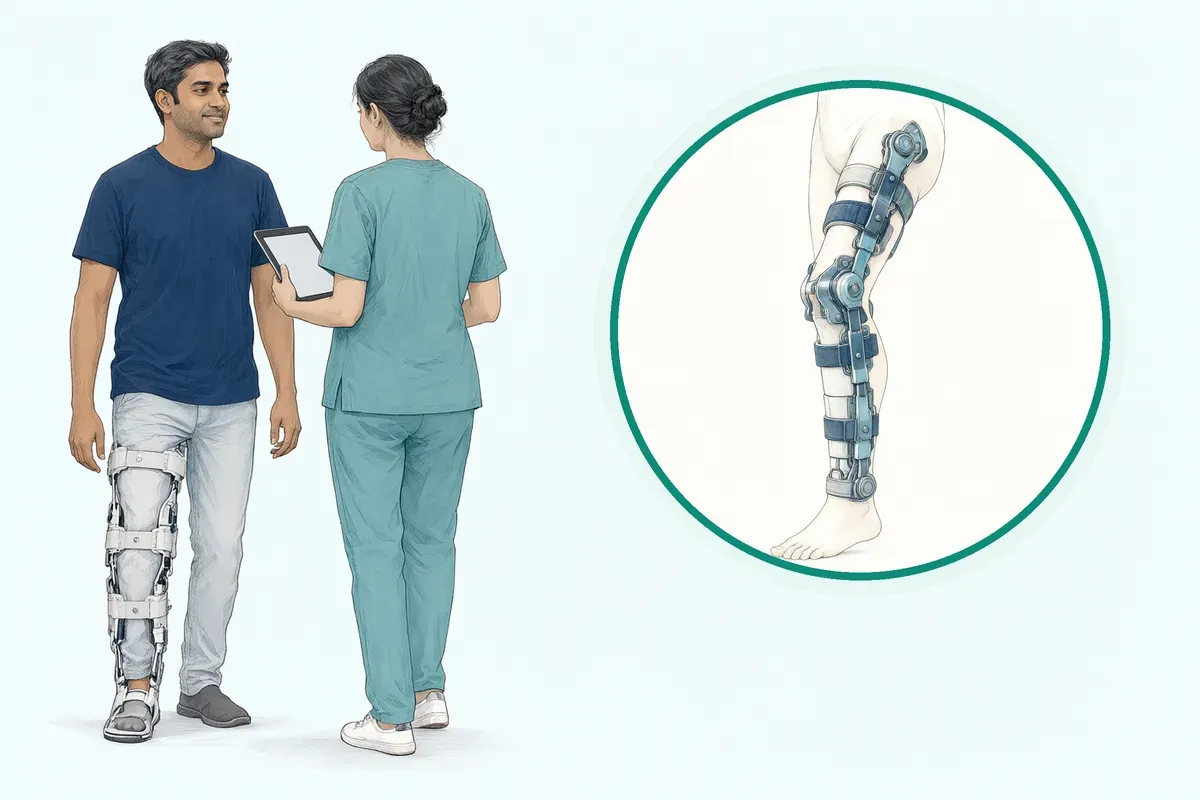
Exoskeleton or end-effector devices help you practise walking patterns with high repetition for stroke or spinal cord injury.
-
Virtual Reality Therapy
Immersive games target balance, upper limb control and cognition in a safe, adjustable environment.
-
Surface EMG Biofeedback
Real-time muscle activation display helps you relearn correct movement patterns during exercises.
-
Functional Electrical Stimulation
FES cycling or walking assistance activates weak muscles to support neurological recovery.
Why patients trust us
- 1991 Serving Jaipur for 35 years
- NABH Accredited hospital
- 1 Physiotherapy consultants
- 24×7 Emergency, ICU and ambulance
- 25 Cashless schemes and insurers
What research shows about these technologies
-
High-quality evidence of benefit on ADL, arm function and strength
A Cochrane systematic review found upper-limb robotics improve activities of daily living, arm function and muscle strength in stroke survivors.
-
Virtual reality improves activities of daily living
VR technologies show benefit on ADLs compared to conventional therapy, with a moderate benefit when therapy dose is not matched.
-
Robotic lower-limb rehab increases odds of independent walking
Robotic gait training raised the chance of walking independently, though walking speed and distance did not change significantly.
If it is left untreated
Without enough repetitive practice, motor recovery can plateau. Residual disability often remains, affecting daily activities and independence. Falls and related fractures become more likely as weakness and poor balance persist.
Life with more therapy hours
Most people find they can do more repetitions in less time, with clearer feedback on every movement.
-
More practice
Technology lets you repeat movements hundreds of times per session, which the brain needs for relearning.
-
Clearer feedback
Sensors and screens show you exactly how your muscles are working, so you can correct errors immediately.
-
Safer balance work
VR and robotic support let you challenge balance without the fear of falling.
-
Easier attendance
Outpatient sessions fit around your routine, so you can keep going week after week.

Frequently asked questions
Questions patients ask about rehabilitation technology
What does rehabilitation technology involve?
In short
Rehabilitation technology at Jaipur Hospital uses robotic gait training, virtual reality therapy, surface EMG biofeedback and functional electrical stimulation to support recovery. These tools are combined with conventional physiotherapy to improve movement, balance and strength. Each session lasts 30 to 60 minutes and is delivered on an outpatient basis.
In detail
Robotic gait training uses exoskeleton or end-effector devices for stroke and spinal cord injury. Virtual reality provides immersive task-specific games for balance, upper limb and cognition. Surface EMG biofeedback shows real-time muscle activation to help motor relearning.
Functional electrical stimulation assists cycling or walking when neurological weakness is present. Evidence shows these technologies can increase therapy intensity and repetition, which are important for neuroplasticity. In studies, robotic upper-limb training improved activities of daily living, arm function and muscle strength.
Virtual reality improved activities of daily living compared with conventional therapy. The benefit over dose-matched conventional therapy is often small, but larger when therapy dose is not matched.
A common belief
People often think these machines replace the therapist.
What actually happens
They do not. They add repetition and feedback that a therapist alone cannot give every minute. Evidence shows the advantage is modest when therapy time is equal, but useful when extra practice is needed.
Your next step at Jaipur Hospital
Your surgeon or physiotherapist will review your condition and decide which technologies suit you. A typical programme starts with an assessment, then regular outpatient sessions. The number of sessions depends on your diagnosis and goals. To learn more, book a consultation at Jaipur Hospital.
What happens during the first session?
In short
The first session at Jaipur Hospital begins with a brief re-check of your goals and safety, then you are introduced to the selected technology such as a robotic gait device, virtual reality headset, EMG biofeedback screen or FES cycling system. The therapist sets parameters, explains feedback and guides you through a few practice trials.
In detail
Before starting, the therapist confirms your diagnosis, precautions and baseline measures. For robotic gait training, you are fitted into the exoskeleton or end-effector and weight support is adjusted. For virtual reality, the headset is calibrated and a simple game is chosen to match your level.
For EMG biofeedback, electrodes are placed on target muscles and you learn to activate them while watching the screen. For FES, electrodes are positioned and stimulation intensity is set to produce a visible contraction without discomfort. The session lasts 30 to 60 minutes.
You may feel fatigue, so rest breaks are given. The therapist records your tolerance, response and any adverse events such as skin irritation or dizziness.
A common belief
Many expect a full workout immediately.
What actually happens
The first session is mainly set-up, safety and learning the feedback. Intensity builds over the next visits as tolerance improves.
Your next step at Jaipur Hospital
After the session, the therapist reviews how you felt and adjusts the plan for the next visit. You will receive a home exercise sheet if appropriate. Sessions are usually scheduled two to three times per week.
How soon should I notice an improvement with rehabilitation technology therapy?
In short
Improvement timelines vary by condition and individual. At Jaipur Hospital, some people notice better muscle activation or reduced stiffness within a few sessions of robotic gait training, virtual reality therapy, biofeedback or electrical stimulation. Functional gains such as walking speed, balance or arm use typically appear after several weeks of regular outpatient sessions.
In detail
Evidence from systematic reviews shows that high-intensity repetitive training with robotic devices and virtual reality can improve activities of daily living, arm function and walking independence, especially when started early after stroke or spinal cord injury.
The benefit over dose-matched conventional therapy is often small to moderate. Studies report that non-ambulatory patients early post-stroke show the greatest gains in walking independence and speed. Upper-limb robotic therapy shows high-quality evidence for improved muscle strength, motor function and activities of daily living.
Virtual reality improves activities of daily living, with a moderate benefit when not dose-controlled. Progress depends on session frequency, severity of impairment, consistency of attendance and carry-over into home exercises.
A common belief
Many expect rapid change, but evidence shows the benefit over conventional therapy is often small to moderate and builds gradually.
What actually happens
Early starters and those who attend consistently tend to see the largest gains.
Your next step at Jaipur Hospital
Sessions last 30 to 60 minutes, usually two to three times a week. Your therapist sets measurable goals at the start and reviews them every one to two weeks. Most programmes run for six to twelve weeks before a formal re-assessment.
What evidence supports rehabilitation technology therapy for my condition?
In short
Evidence varies by condition. For stroke, Cochrane reviews show high-quality evidence that upper-limb robotics improve muscle strength, motor function and daily activities. Lower-limb robotics increase the chance of independent walking. Virtual reality improves daily activities. For other neurological and musculoskeletal conditions, studies report low to moderate effectiveness.
In detail
In studies, telerehabilitation and wearable sensor programmes show comparable results to in-person therapy for osteoarthritis, low-back pain, joint replacement and multiple sclerosis. Robotic gait training combined with virtual reality has improved walking speed and distance in some trials.
However, benefit size is often small and heterogeneity across studies is substantial. The greatest gains are seen in non-ambulatory patients treated early after stroke.
A common belief
Many people assume every high-tech tool is proven for every condition.
What actually happens
Research shows benefit depends on diagnosis, timing and dose. Some combinations have only small trials. We don't overstate the data — we match the technique to what the evidence actually supports for you.
Your next step at Jaipur Hospital
Your surgeon or physiotherapist at Jaipur Hospital will discuss the evidence specific to your diagnosis at the consultation. They will explain what is proven, what is promising, and where gaps remain.
How can I decide whether to seek advice about computerised gait analysis?
In short
You may consider computerised gait analysis at Jaipur Hospital if you have walking difficulty, balance problems, a neurological condition such as stroke or Parkinson's disease, or are recovering from lower limb surgery or injury. Wearable sensors measure spatiotemporal parameters, joint angles, muscle activity and ground reaction forces during walking. The analysis helps your therapist identify specific impairments, track progress and tailor rehabilitation exercises.
In detail
Evidence shows that gait analysis using wearable sensors is an inexpensive, convenient and efficient manner of providing useful information for multiple health-related applications.
Sensors such as accelerometers, gyroscopes, magnetometers, force sensors, goniometers and surface EMG capture kinematics, kinetics and muscle activation patterns across the gait cycle.
These systems can recognise complex gait activities, detect early neurodegenerative changes such as small shuffled steps in Parkinson's disease, and predict fall risk. Quantitative gait assessment is useful for early disease detection, fall prediction and rehabilitation monitoring after injury.
Wearable sensor systems are more flexible and comfortable than camera-based laboratory systems, allowing ambulatory measurement in real-world environments. The data helps therapists design targeted interventions for mobility, balance and activities of daily living.
A common belief
Many people wait until they fall or struggle significantly.
What actually happens
But gait analysis can detect early changes like shuffled steps in Parkinson's or asymmetry after stroke before they become disabling. Wearable sensors are more comfortable than lab cameras and give real-world data. It is not just for elite athletes; it guides everyday rehab.
Your next step at Jaipur Hospital
If you notice changes in your walking pattern, frequent stumbles, reduced walking speed or difficulty with turns and dual-tasking, discuss a referral with your doctor or physiotherapist. The assessment is outpatient, takes 30 to 60 minutes, and typically costs ₹1,500 to ₹3,500 per session.
How will the therapist adapt treatment to my home, work, and activity goals?
In short
At Jaipur Hospital, the therapist adapts rehabilitation technology to your home, work and activity goals by first assessing your current functional level, environment and participation priorities. They then select robotic gait training, virtual reality, EMG biofeedback or functional electrical stimulation to target the specific impairments limiting your desired activities. The programme blends clinic-based technology sessions with home exercises and telerehabilitation options for continuity.
In detail
Evidence supports individual treatment design where technology complements conventional therapy. Virtual reality simulations can be customised to replicate home navigation, kitchen tasks, work-related movements or community mobility challenges.
Robotic gait training parameters such as speed, body-weight support and guidance force are adjusted to progress towards your walking goals. Surface EMG biofeedback targets muscles needed for specific tasks like typing, lifting or stair climbing.
Functional electrical stimulation cycling or walking assistance builds endurance for daily distances. Telerehabilitation platforms allow remote monitoring and exercise progression at home, with studies showing outcomes comparable to in-person therapy for many conditions.
Wearable sensors provide objective data on gait, posture and activity levels in your real environment, enabling the therapist to refine the programme. The therapist also considers your schedule, caregiver support, transport access and fatigue patterns when planning session frequency and home practice.
A common belief
A standard exercise sheet does not account for your shop counter height, stair dimensions or standing endurance.
What actually happens
VR can simulate your shop layout. Robotic gait training adjusts speed and support for your community walking distance. Biofeedback targets the exact muscles for your tasks. Wearable sensors track your real-world activity to refine the plan.
Your next step at Jaipur Hospital
Bring a description of your typical day, home layout, work demands and leisure activities to the first appointment. The therapist will set measurable short-term and long-term goals with you. Sessions are 30 to 60 minutes, outpatient, typically costing ₹1,500 to ₹3,500 per session.
Who is likely to benefit from this therapy?
In short
People with stroke, spinal cord injury, acquired brain injury, multiple sclerosis, Parkinson's disease or other neurological conditions that affect walking, balance, upper limb use or cognition may benefit from rehabilitation technology at Jaipur Hospital. It is also used for musculoskeletal recovery after joint replacement or fracture when extra practice is needed.
In detail
Evidence shows robotic gait training helps non-ambulatory patients early after stroke to walk independently. Virtual reality improves balance and activities of daily living in stroke and brain injury. Surface EMG biofeedback assists motor relearning when muscle activation is poor.
Functional electrical stimulation supports cycling or walking when voluntary control is weak. Studies report that patients who cannot access regular clinic visits due to distance or transport may gain from telerehabilitation options using wearable sensors.
Elderly people with fall risk may use sensor-based monitoring for early detection. The technology is an adjunct, not a replacement, for conventional therapy.
A common belief
A common belief is that only high-tech centres offer this.
What actually happens
Many hospitals now have robotic and virtual reality tools. The key is matching the tool to your specific impairment, not the brand of machine.
Your next step at Jaipur Hospital
Your surgeon or physiotherapist will assess your diagnosis, functional level and goals. If you have a neurological or orthopaedic condition that limits movement, ask about a technology-assisted programme.
How long does a session last?
In short
Each rehabilitation technology session at Jaipur Hospital typically lasts 30 to 60 minutes. The exact duration depends on the technology used, your endurance and the treatment plan set by your therapist.
In detail
Robotic gait training sessions often run 45 to 60 minutes including set-up, walking time and rest breaks. Virtual reality therapy may be 30 to 45 minutes of active game play with short pauses.
Surface EMG biofeedback and functional electrical stimulation sessions are usually 30 to 45 minutes. The therapist monitors fatigue, heart rate and perceived exertion throughout. If you tire quickly, the session may be shorter at first and lengthened as stamina improves. Sessions are outpatient, so you go home the same day.
A common belief
People often think longer is better.
What actually happens
Evidence shows high-intensity repetition within a tolerable window drives neuroplasticity. Pushing past fatigue can reduce quality of movement and increase fall risk.
Your next step at Jaipur Hospital
Plan to arrive 10 minutes early for preparation. Wear loose clothing and flat shoes. The therapist will confirm the session length at each visit based on your progress.
How will progress be measured during rehabilitation technology therapy?
In short
Progress is measured using standardised clinical scales, device-generated data and functional tests at Jaipur Hospital. Your therapist may use the Timed Up and Go test, Ten Metre Walk test, Fugl-Meyer Assessment, Barthel Index or other validated tools depending on your condition. Robotic and wearable sensors also record step count, gait symmetry, joint angles, muscle activation patterns and exercise duration automatically.
In detail
Evidence shows that robotic lower-limb rehabilitation increases the odds of independent walking, and combined virtual reality and robotic therapy can improve walking speed and distance. Upper-limb robotic therapy has high-quality evidence for improved muscle strength, motor function and activities of daily living.
Virtual reality improves activities of daily living. However, studies use many different outcome measures, and impairment-level changes do not always translate into activity-level gains. Your therapist selects measures that match your goals, such as community walking distance, stair climbing or self-care tasks. Data from wearable sensors and device logs supplement clinical observation and help adjust the programme objectively.
A common belief
People often focus only on walking speed, but recovery includes balance, endurance, confidence and participation.
What actually happens
Studies use many different measures, and impairment gains do not always mean better daily function. Your therapist picks measures that match your real-life goals.
Your next step at Jaipur Hospital
Baseline assessment is done at the first visit. Brief checks occur each session. Formal re-assessment is typically at four to six weeks and at programme end. Reports are shared with your referring doctor. Sessions are 30 to 60 minutes, outpatient, two to three times a week.
What improvement is expected beyond a home exercise programme?
In short
Rehabilitation technology at Jaipur Hospital adds robotic gait training, virtual reality therapy, surface EMG biofeedback and functional electrical stimulation to a home exercise programme. These tools provide high-intensity repetitive practice, real-time feedback and task-specific games that are difficult to achieve with unsupervised home exercises alone.
In detail
Evidence shows that robotic technologies can deliver high-intensity repetitive training which encourages motor re-learning and reduces impairment after stroke or spinal cord injury. Virtual reality simulations improve activities of daily living and allow the therapist to adjust environment difficulty to the patient's neurological severity.
Surface EMG biofeedback gives real-time muscle activation visualisation for motor relearning, while functional electrical stimulation assists cycling or walking when neurological weakness limits movement.
Cochrane reviews report that upper-limb robotics improve muscle strength, motor function and activities of daily living, and that virtual reality improves activities of daily living compared with conventional therapy.
Telerehabilitation outcomes are comparable to in-person therapy for many conditions, and wearable sensors enable continuous gait and physiological monitoring that a home programme cannot provide.
A common belief
Many people think a printed home programme is enough.
What actually happens
But studies show robotic devices deliver more repetitions per session, virtual reality adjusts difficulty to your neurological level, and biofeedback shows muscle activation you cannot feel. Telerehabilitation outcomes are comparable to in-person care for many conditions.
Your next step at Jaipur Hospital
Your therapist will assess your goals for home, work and community activities and then design a programme that blends clinic-based technology sessions with your home exercises. Sessions usually last 30 to 60 minutes and are outpatient. The typical price range in India is ₹1,500 to ₹3,500 per session.
FAQ library
Questions and answers about rehabilitation technology
When you contact us
Get your therapy plan reviewed
Contact Jaipur Hospital to have a physiotherapist assess your needs and explain how technology can add to your current programme.
- A consultation with a physiotherapist in the OPD
- Your scans and reports reviewed, with tests done in-house if you need them (laboratory, X-ray and imaging)
- Your options explained in plain words, including whether you need surgery at all
- A cost estimate before you decide
- Help with cashless treatment under RGHS, MAA Yojana, CGHS and empanelled insurers and TPAs
- Follow-up visits after your treatment
Overview
Rehabilitation Technology: what to know
What rehabilitation technology is and how it helps
Rehabilitation technology uses devices such as robotic exoskeletons, virtual reality systems, surface EMG biofeedback and functional electrical stimulation to support recovery after neurological or musculoskeletal conditions. These tools add high-intensity, repetitive practice to conventional therapy so that the brain and muscles can relearn movement patterns.
The equipment is used in the physiotherapy department at Jaipur Hospital as an adjunct to standard exercises; no anaesthesia is needed and each session lasts 30 to 60 minutes on an outpatient basis.
Robotic gait training provides body-weight-supported stepping practice for people with stroke or spinal cord injury. Virtual reality therapy uses immersive, task-specific games to challenge balance, upper-limb coordination and cognition. Surface EMG biofeedback shows real-time muscle activation on a screen so you can see and adjust your effort.
Functional electrical stimulation (FES) delivers timed electrical pulses to weakened muscles during cycling or walking. Your therapist selects the combination that matches your goals and adjusts the difficulty as you improve.
Symptoms and warning signs that need same-day care
- Sudden worsening of weakness
- New numbness
- Slurred speech
- Confusion
- Swollen, painful calf
Common symptoms that lead to a referral for rehabilitation technology include:
- Weakness or paralysis on one side of the body
- Difficulty walking or balancing
- Reduced arm and hand function
- Muscle stiffness or spasticity
- Trouble with coordination or cognition after a neurological event
You may notice shuffled steps, difficulty starting or stopping while walking, or loss of associated arm swing.
Seek care the same day if you develop sudden worsening of weakness, new numbness, slurred speech, confusion, a fall with head injury or suspected fracture, or signs of a blood clot such as a swollen, painful calf.
These symptoms may indicate a new stroke, a fall-related injury or a medical complication that needs urgent evaluation in the emergency department at Jaipur Hospital.
Causes and who is at higher risk
- Acquired neurological injury
- Stroke, brain injury, spinal cord injury
- Progressive disorders
- Multiple sclerosis and Parkinson's disease
The conditions treated with rehabilitation technology are usually caused by acquired neurological injury such as stroke, traumatic brain injury, spinal cord injury, or progressive disorders like multiple sclerosis and Parkinson's disease. Stroke is the most common acquired neurological condition, affecting about 16 million people globally each year.
Higher risk groups include:
- Older adults
- People with hypertension
- Diabetes
- Atrial fibrillation
- High cholesterol
- Smoking history
- A previous stroke or transient ischaemic attack
Falls are more likely with age-related decline in motor control and muscle strength. Patients living in rural areas often travel farther for specialist care and may have worse outcomes for conditions such as diabetes and heart attack. Insufficient therapy dose after a neurological event is a recognised problem.
How the need for rehabilitation technology is assessed
Assessment starts with a detailed history and physical examination by a physiotherapist or rehabilitation physician.
They check:
- Muscle strength
- Tone
- Joint range
- Balance
- Gait pattern
- Coordination
- Sensation
- Cognitive function
Standardised scales may be used to measure walking speed, balance confidence and independence in daily activities.
Wearable sensors such as accelerometers, gyroscopes and inertial measurement units can capture gait kinematics, step count, cycle time and posture during walking. Surface EMG electrodes record muscle activation timing and intensity. Force sensors in insoles or instrumented walkways measure ground reaction forces. Motion capture systems or electromagnetic tracking may be used for three-dimensional joint angles.
These objective data supplement clinical judgement and help set baseline measures. Your doctor may also order imaging (MRI or CT of the brain or spine) and blood tests to define the underlying cause.
Non-surgical treatment options and when surgery is considered
- Rehabilitation technology adds intensity
- Robotic gait, virtual reality, EMG biofeedback, FES
- Cochrane evidence for robotics
- Upper-limb robotics improve daily activities, arm function, strength
Non-surgical management is the mainstay and includes:
- Conventional physiotherapy
- Occupational therapy
- Speech therapy
- Medications for spasticity or neuropathic pain
- Orthoses
- Assistive devices
Rehabilitation technology adds robotic gait training, virtual reality therapy, EMG biofeedback and FES to increase therapy intensity and provide real-time feedback.
Evidence from Cochrane reviews shows high-quality evidence that upper-limb robotics improve activities of daily living, arm function and muscle strength. Robotic lower-limb rehabilitation increases the odds of walking independently, especially in people who were non-ambulatory early after stroke.
Virtual reality improves activities of daily living; the benefit over dose-matched conventional therapy is small but increases when therapy dose is not matched. Combined robotic and virtual reality approaches show mixed results for the upper limb and may improve walking speed and distance in the lower limb based on limited trials.
Telerehabilitation using video conferencing, wearable sensors and home-based platforms can deliver supervised exercise remotely with outcomes comparable to in-person care for many musculoskeletal and neurological conditions. Adverse events are rarely reported and no serious device-related adverse events have been documented in trials.
Surgery is not a treatment for the rehabilitation process itself. Surgical referral may arise for the underlying condition (for example, decompressive craniectomy after large stroke, spinal stabilisation after traumatic spinal injury, or deep brain stimulation for advanced Parkinson's disease) or for complications such as contracture release, tendon transfer, or baclofen pump implantation for severe spasticity. Your treating team will discuss surgical options if they become relevant to your overall care plan.
Preparing for rehabilitation technology sessions
Do
- Wear loose, comfortable clothing
- Bring recent imaging reports
- Bring discharge summaries
- Bring list of medicines
- Bring your assistive device
Rehabilitation technology sessions at Jaipur Hospital are outpatient appointments. You do not need to fast or stop any regular medicines before you come. Wear loose, comfortable clothing and flat shoes that are easy to take off. Bring any recent imaging reports, discharge summaries, or a list of medicines you are taking.
If you use an assistive device such as a walker or stick, bring it with you. Your therapist may ask about pain, fatigue, skin sensation, or any recent falls so they can adjust the plan. Sessions usually last 30 to 60 minutes.
How rehabilitation technology sessions are done
- Check in at physiotherapy department Arrive for your outpatient appointment
- Therapist reviews goals and chooses equipment Equipment matched to your needs
- Therapist guides exercises and adjusts difficulty Response recorded throughout
On the day of your session you will check in at the physiotherapy department. A therapist will review your goals and choose the equipment that matches your needs.
The main options used at Jaipur Hospital are:
- Robotic gait training with an exoskeleton or end-effector device for stroke or spinal cord injury
- Virtual reality therapy with immersive task-specific games for balance, upper limb, or cognition
- Surface EMG biofeedback that shows your muscle activation on a screen in real time
- Functional electrical stimulation (FES) cycling or walking assistance for neurological weakness
Your surgeon or physiotherapist will advise which technique suits you. During the session sensors may be placed on your skin to record movement, muscle activity, or heart rate. The therapist guides you through each exercise, adjusts the difficulty, and records your response. No anaesthesia is needed.
Risks and possible complications of rehabilitation technology
- Generally well tolerated
- No serious device-related adverse events in trials
- Movement restriction
- Some systems limit range of motion at first
- Fall risk in elderly
- Declining motor control increases fall risk
- Minor skin irritation or fatigue
- True frequency not precisely known
Rehabilitation technology is generally well tolerated. In studies of telerehabilitation and wearable sensor systems, no serious trial-related adverse events were reported. Two trials that specifically looked for adverse events found none related to the technology. Some systems can restrict movement within a specific range, which may feel limiting at first.
Elderly people with declining motor control and muscle strength are more vulnerable to falls, and a fall can cause joint injuries, hip fractures, or traumatic brain injury. Therapists supervise every session and adjust the equipment to reduce this risk.
Selective outcome reporting and incomplete data have been noted in some research, so the true frequency of minor skin irritation or fatigue is not precisely known.
Recovery and aftercare after rehabilitation technology sessions
Because no anaesthesia is used, you can leave the hospital as soon as the session ends. You may feel mild muscle soreness or fatigue for a few hours, similar to after a conventional physiotherapy session. Drink water and rest if you feel tired. Your therapist will give you a home exercise plan to practise between visits.
Recovery varies by condition; the technology is used as an adjunct to conventional therapy, so progress depends on the underlying neurological or musculoskeletal problem.
Attend all scheduled sessions and tell your therapist if you notice:
- New pain
- Swelling
- Skin redness under sensor sites
- A sudden change in balance or walking
If you fall at home or feel unsafe, call the hospital on 0141-2551500 or 0141-2554139.
Results of rehabilitation technology in studies
- High-quality evidence of benefit on ADL, arm function, strength Upper-limb robotics
- Increased odds of walking independently Lower-limb robotics
- Improves ADL compared with conventional therapy Virtual reality
- Effective and comparable to standard practice Telerehabilitation
In studies, robotic upper-limb rehabilitation shows high-quality evidence of benefit on activities of daily living, arm function, and arm muscle strength, although the effect size is small and varies between studies. Robotic lower-limb rehabilitation increased the odds of walking independently but did not change walking speed or six-minute walk distance.
Virtual reality rehabilitation improves activities of daily living compared with conventional therapy, but not upper-limb motor function. When robotic technology is combined with virtual reality, some small trials report increased walking speed and distance for lower-limb impairments, while upper-limb studies show mixed results.
Telerehabilitation delivered remotely is effective and comparable to standard practice for musculoskeletal conditions, with standardised mean differences ranging from 0.14 to 1.63 depending on the comparison group. For stroke, multiple sclerosis, and other neurological conditions, telerehabilitation added to usual care is more favourable than usual care alone.
Gait analysis using wearable sensors provides inexpensive, convenient data that helps rehabilitation and diagnosis. Most studies measure impairment-level outcomes; translation to daily-life participation is less certain. The benefit over dose-matched conventional therapy is likely to be small.
Cost and insurance for rehabilitation technology in Jaipur
A typical session costs between ₹1,500 and ₹3,500. The exact amount depends on the type of equipment used, the length of the session, and whether it is combined with conventional physiotherapy. Jaipur Hospital accepts RGHS, MAA Yojana, CGHS, and a panel of private insurers and TPAs.
Check with your insurer whether rehabilitation technology sessions are covered under your policy and whether a pre-authorisation is needed. The hospital can provide the documents your insurer asks for. There is no inpatient stay, so costs are limited to the outpatient session fees and any consumables used during the visit.