

Physiotherapy · Jaipur Hospital
Spine and Back Care in Jaipur
Neck or back pain limiting your day? Get a clear assessment and a guided rehab plan at Jaipur Hospital.
- Serving Jaipur since 1991 (35 years)
- NABH accredited
- 24×7 emergency & ICU
- Cashless: RGHS, MAA Yojana, CGHS + 22 insurers
- Session length
- 40 to 60 minutes per session
- Anaesthesia
- Not needed
- Recovery
- Acute disc: 4 to 8 weeksPost-surgery: 3 to 6 months guided rehab
- Price
- ₹800 to ₹2,500 per sessiontypical range in India; ask us for an estimate
Pain that stops you
Neck or back pain makes simple tasks hard
Pain shoots down your leg or arm. Sitting, standing, or walking becomes difficult. You worry about time off work and whether the pain will return.
-
Leg or arm pain
Nerve pressure causes pain, numbness or weakness that travels away from the spine.
-
Stiff mornings
Getting out of bed takes time. Movement eases it, but the stiffness returns after rest.
-
Fear of surgery
You want to avoid an operation but do not know if exercises alone will help.
-
Work days lost
Pain forces you to take leave. You worry about income and long-term capacity.
-
Recurring episodes
Pain settles, then flares up again with a wrong movement or long sitting.
Lumbar spinal stenosis symptoms worsen with standing or walking and improve with sitting or forward bending.
Why Jaipur Hospital
You are tired of the pain deciding what you can and cannot do each day.
Your care plan
Your first steps with us
- 1 Call or visit OPD for a physiotherapy assessment.
- 2 Get scans and reports reviewed; tests done in-house if needed.
- 3 Start guided sessions 40 to 60 minutes each, usually several per week.
- 4 Continue home exercises and follow-up visits to maintain gains.
how the treatment is done
Physiotherapists assess movement, nerve signs and strength. They choose from established techniques and progress load as you improve. Sessions are 40 to 60 minutes, outpatient or inpatient after surgery.
-
McKenzie Method (MDT)
Mechanical diagnosis to find a directional preference, then repeated exercises to centralise and reduce symptoms.
-
Core Stabilisation
Activation of deep trunk muscles with progressive loading to support the spine during daily tasks.
-
Spinal Mobilisation/Manipulation
Graded joint mobilisations (Grade I-IV) and high-velocity low-amplitude thrust if indicated to restore movement.
-
Traction (Mechanical/Manual)
Decompression force applied to the spine to relieve nerve root pressure in radiculopathy or disc herniation.
Why patients trust us
- 1991 Serving Jaipur for 35 years
- NABH Accredited hospital
- 1 Physiotherapy consultants
- 24×7 Emergency, ICU and ambulance
- 25 Cashless schemes and insurers
what research shows about this treatment
-
about one-third improve without surgery
In a non-operative lumbar stenosis series, roughly one-third of patients reported improvement over up to three years.
-
about 50% report no change
Approximately half of non-operatively followed stenosis patients had no change in symptoms over the same period.
-
10% to 20% worsen
Between one in ten and two in ten non-operative stenosis patients reported worse back pain, leg pain and walking ability.
If it is left untreated
Without guided rehab, acute disc symptoms may persist for months. Stenosis patients often stay the same or worsen; about 10% to 20% report declining walking ability and leg pain over years.
life after treatment
Most people return to daily activities with less pain and better movement. You learn exercises to keep the spine strong.
-
Easier movement
Walking, sitting and bending become less painful and more natural.
-
Return to work
Most people resume usual duties with modified habits and a home exercise routine.
-
Self-management
You know which movements help and which to avoid, reducing future flare-ups.
-
Post-surgery strength
Guided rehab over 3 to 6 months restores function and protects the surgical level.
Frequently asked questions
Questions patients ask about spine and back care
What does spine and back care involve?
In short
Spine and back care at Jaipur Hospital involves specialised physiotherapy for neck pain, low back pain, disc issues, and recovery after spine surgery. The programme uses evidence-informed techniques such as the McKenzie Method, core stabilisation, spinal mobilisation, and traction. Each plan is tailored to your diagnosis and functional goals.
In detail
The therapy targets mechanical causes of pain and movement restriction. McKenzie Method exercises identify directional preferences that reduce disc-related symptoms. Core stabilisation trains deep trunk muscles to support the spine during daily activities.
Spinal mobilisation uses graded passive movements to improve joint mobility and reduce stiffness. Mechanical or manual traction creates decompression for nerve root irritation or disc herniation.
Evidence shows non-surgical management including physiotherapy, activity modification, and multidisciplinary rehabilitation are first-line options for conditions like lumbar disc herniation and spinal stenosis. Systematic reviews note evidence is heterogeneous, so treatment selection relies on clinical reasoning and patient response.
A common belief
Many people think physiotherapy is just generic exercises or massage.
What actually happens
In reality, effective spine care uses mechanical diagnosis to find the specific movements that reduce your symptoms, then builds a progressive programme around that finding.
Your next step at Jaipur Hospital
Your first visit includes a detailed assessment of posture, movement patterns, neurological status, and functional limitations. The physiotherapist will explain the findings and agree a treatment plan with you. Sessions typically last 40 to 60 minutes.
Acute disc problems often need 4 to 8 weeks of guided therapy, while post-surgery rehabilitation usually spans 3 to 6 months.
What happens during the first spine and back care session?
In short
Your first session at Jaipur Hospital lasts 40 to 60 minutes and focuses on a detailed assessment. The physiotherapist reviews your medical history, imaging reports, and surgical notes if applicable. They examine posture, spinal mobility, neurological function, muscle strength, and movement patterns that provoke or relieve your symptoms.
In detail
The assessment follows a structured clinical reasoning process. For disc-related pain, the McKenzie Method uses repeated movements to identify a directional preference that centralises or reduces symptoms. For spinal stenosis, the therapist tests positions of flexion and extension to understand your neurogenic claudication pattern.
Core stabilisation assessment checks deep trunk muscle activation using palpation and functional tests. Spinal mobility is graded using mobilisation techniques. The therapist explains the findings, sets realistic goals, and agrees a treatment plan with you. Education about posture, activity pacing, and home exercises starts immediately. Evidence supports early active management over passive modalities alone.
A common belief
Many patients expect only passive treatments like heat or ultrasound on day one.
What actually happens
Current evidence favours active assessment and exercise from the first visit. Passive modalities alone do not address the mechanical cause of most spine pain.
Your next step at Jaipur Hospital
Wear comfortable clothing that allows movement. Bring any MRI, X-ray, or referral letters. The therapist will outline the expected frequency and duration: acute disc problems typically need 4 to 8 weeks, post-surgery rehab 3 to 6 months. You will receive home exercises to start on day one.
How soon should I notice an improvement?
In short
Most people notice some change in pain or movement within two to four weeks of regular sessions. Acute disc problems often improve in four to eight weeks, while post-surgery rehabilitation takes three to six months of guided rehab. At Jaipur Hospital, your therapist sets realistic goals at your first visit.
In detail
Recovery speed depends on the condition, how long you have had symptoms, and how consistently you do your home exercises. Evidence shows that non-operative care, including physiotherapy, helps many patients avoid surgery, but improvement is gradual.
In studies of lumbar spinal stenosis, about one-third of patients improved over three years without surgery, while half stayed the same. Your therapist tracks pain levels, range of motion, and function scores to show progress even when day-to-day changes feel small.
A common belief
It is common to expect instant relief like a painkiller gives.
What actually happens
Physiotherapy builds strength and changes movement patterns, which takes weeks. Missing home exercises or skipping sessions slows progress more than people realise.
Your next step at Jaipur Hospital
Attend sessions once or twice a week for 40 to 60 minutes each, and do your home programme daily. Your therapist will re-assess you at four weeks and adjust the plan.
If there is no meaningful change by six to eight weeks, your surgeon may review imaging or consider other options.
Do the scan findings explain my spine symptoms?
In short
Scan findings at Jaipur Hospital do not always match your symptoms. Many people have disc bulges, degeneration, or stenosis on imaging but no pain. Conversely, you can have significant pain with only minor changes on a scan. Your surgeon correlates the imaging with your history, examination, and response to physiotherapy to decide what is relevant.
In detail
Evidence shows high rates of anatomic stenosis and disc changes on imaging in older adults who are completely asymptomatic. Clinical guidelines emphasise that imaging alone cannot diagnose the pain source.
The diagnosis is clinical: your symptom pattern, neurological signs, and how you respond to directional exercises like the McKenzie Method. Scans are used to confirm a suspected level before injection or surgery, not to decide treatment on their own.
A common belief
It is common to assume the scan shows the problem.
What actually happens
Research shows scan changes are often incidental. Treating the scan instead of the person can lead to unnecessary procedures.
Your next step at Jaipur Hospital
Bring your scans to your consultation. Your surgeon will explain which findings fit your clinical picture and which are likely incidental. Treatment decisions are based on your whole assessment, not the scan alone.
How can I decide whether to seek advice about lower back pain?
In short
You should seek advice for lower back pain if it persists beyond a few weeks, limits your daily activities, or is accompanied by leg pain, numbness, or weakness at Jaipur Hospital. Guidelines suggest surgery is considered only if sufficiently bothersome symptoms persist despite trials of less invasive interventions. Rapid deterioration is rare, but persistent or worsening symptoms warrant assessment.
In detail
Evidence shows lumbar spinal stenosis and disc herniation often cause pain exacerbated by standing, walking, or lumbar extension, and relieved by forward flexion, sitting, or recumbency.
In studies, approximately one-third of patients with stenosis reported improvement over 3 years without surgery, 50% reported no change, and 10% to 20% worsened. First-line therapy is activity modification, analgesia, and physical therapy. If symptoms remain bothersome despite these measures, a surgical opinion may be appropriate.
A common belief
People often wait too long hoping it will vanish, or rush to surgery too early.
What actually happens
Evidence shows many improve with time and physiotherapy, while surgery is reserved for persistent, bothersome symptoms after conservative care fails.
Your next step at Jaipur Hospital
Start with activity modification and over-the-counter pain relief. If pain continues beyond 4 to 6 weeks, or if you develop leg symptoms, book an assessment. Physiotherapy sessions last 40 to 60 minutes and cost ₹800 to ₹2,500 per session. Acute disc rehabilitation typically takes 4 to 8 weeks.
How will the therapist adapt treatment to my home, work, and activity goals?
In short
The therapist will tailor exercises and advice to fit your home environment, work demands, and activity goals at Jaipur Hospital. Treatment plans use techniques such as McKenzie Method directional exercises, core stabilisation, spinal mobilisation, and traction, progressed according to your functional needs and tolerance. Sessions are 40 to 60 minutes each.
In detail
Rehabilitation focuses on restoring function for daily tasks, work postures, and recreational activities. The therapist assesses your movement patterns, pain triggers, and load tolerance. Exercises are selected and progressed to match your specific goals, whether returning to desk work, manual labour, or sport.
Home exercise programmes are designed to be practical with available space and equipment. Evidence supports structured, goal-oriented physiotherapy for neck pain, low back pain, disc issues, and post-spine surgery recovery.
A common belief
Generic exercise sheets often fail because they ignore your specific demands.
What actually happens
A tailored plan addresses your exact lifting, sitting, or movement patterns, making it easier to stick with and more effective.
Your next step at Jaipur Hospital
Discuss your typical day, work station, and hobbies during the first session. The therapist will give you a home programme with clear instructions and progress checks. Acute disc rehabilitation typically takes 4 to 8 weeks; post-surgery rehab lasts 3 to 6 months. Session cost is ₹800 to ₹2,500.
Who is likely to benefit from spine and back care therapy?
In short
Patients with mechanical neck pain, low back pain, disc herniation with radiculopathy, degenerative disc disease, spinal stenosis, spondylolisthesis, or those recovering from spine surgery can benefit from spine and back care at Jaipur Hospital. The therapy suits adults of any age whose symptoms affect daily function and who are medically stable for active rehabilitation.
In detail
Guidelines recommend non-surgical management including physiotherapy as first-line treatment for symptomatic lumbar disc herniation and degenerative spinal stenosis. Patients with stable degenerative spondylolisthesis and neurogenic claudication often improve with structured exercise and manual therapy.
Post-operative patients benefit from early mobilisation, core activation, and progressive loading to restore function and prevent deconditioning. Evidence shows surgery is elective and considered only when symptoms persist despite conservative trials.
Physiotherapy helps those with waxing and waning symptoms, neurogenic claudication worsened by standing or walking, and radicular pain relieved by flexion. Even patients with imaging findings but mild symptoms can benefit from education and preventive strategies.
A common belief
A common belief is that only post-surgery patients need physiotherapy.
What actually happens
In fact, guidelines recommend physiotherapy as first-line treatment for disc herniation and stenosis before surgery is considered. Early intervention often prevents the need for surgery altogether.
Your next step at Jaipur Hospital
Your surgeon or physician will advise if physiotherapy is appropriate for your specific condition. An initial assessment at Jaipur Hospital determines your suitability and sets realistic goals. Acute disc episodes typically need 4 to 8 weeks of therapy. Post-surgical rehabilitation usually continues for 3 to 6 months.
How long does a spine and back care session last?
In short
Each spine and back care session at Jaipur Hospital typically lasts 40 to 60 minutes. The exact duration depends on your condition, the techniques used, and your stage of rehabilitation. Acute disc episodes and early post-surgical sessions may be shorter initially, progressing to the full duration as tolerance improves.
In detail
Session length allows time for reassessment, manual therapy, supervised exercise progression, and education. A typical session includes brief re-evaluation of symptoms since the last visit, spinal mobilisation or traction if indicated, core stabilisation drills with progressive loading, McKenzie directional exercises, and functional training.
The physiotherapist adjusts intensity based on your response. Evidence shows structured, supervised exercise sessions yield better adherence and outcomes than unsupervised home programmes alone. The 40 to 60 minute window ensures adequate dosage of therapeutic exercise while monitoring for fatigue or symptom aggravation. Post-operative protocols often start with shorter, more frequent sessions in the inpatient setting before transitioning to outpatient care.
A common belief
Some clinics offer only 15 to 20 minute slots.
What actually happens
Shorter sessions often mean less supervised exercise progression and less time for the therapist to adjust your technique, which can slow recovery.
Your next step at Jaipur Hospital
Plan for about an hour per visit including changing time. Most patients attend two to three times per week initially, reducing frequency as they improve. Acute disc problems usually need 4 to 8 weeks of therapy. Post-surgical rehabilitation typically spans 3 to 6 months.
How will progress be measured during spine physiotherapy?
In short
Progress in spine physiotherapy at Jaipur Hospital is measured using standardised tools such as the Oswestry Disability Index for functional limitation, a numerical pain rating scale for symptom intensity, range of motion testing, strength assessment of core and limb muscles, and your ability to perform daily tasks like walking, sitting, and lifting.
In detail
These measures are recorded at the first session and repeated at regular intervals, usually every two to four weeks.
The Oswestry Disability Index scores range from zero to one hundred, with higher scores meaning more disability; a change of ten points or more is considered clinically important.
Pain scores, movement quality, and functional goals such as returning to work or sport guide decisions about continuing, modifying, or advancing the programme. Evidence from clinical guidelines supports using validated outcome tools to ensure treatment is effective and to communicate progress with your surgeon.
A common belief
Relying only on how you feel that day can be misleading.
What actually happens
Standardised tools show real trends and help your surgeon decide if the plan needs to change.
Your next step at Jaipur Hospital
You will receive a summary of your scores at each review. If improvement stalls, your physiotherapist discusses options with you and your surgeon. Consistent attendance and honest reporting of symptoms give the clearest picture.
Which symptoms suggest pressure on the spinal cord or urgent nerve damage during spine physiotherapy?
In short
At Jaipur Hospital, symptoms that suggest spinal cord pressure or urgent nerve damage include loss of bladder or bowel control, numbness in the saddle area between the legs, progressive weakness in both legs, difficulty walking or frequent falls, loss of fine hand coordination, and severe shooting pain in both arms or legs with neck movement.
In detail
These are red-flag signs of cauda equina syndrome or myelopathy. They require same-day medical assessment and often urgent imaging. Physiotherapy is paused until the surgeon clears you.
Evidence shows that rapid deterioration is rare but when it occurs, surgery is considered if sufficiently bothersome symptoms persist despite less invasive interventions. The guideline notes that lumbar spinal stenosis is a clinical syndrome of pain in the buttocks or lower extremities.
A common belief
People often dismiss saddle numbness or mild leg weakness as part of their usual problem, but these are signs of cord or cauda equina compression.
What actually happens
Waiting can lead to lasting loss of function.
Your next step at Jaipur Hospital
If you notice any of these signs, go to the emergency department or call the hospital immediately. Do not wait for your next physiotherapy session. The surgeon will decide on urgent MRI and possible decompression.
FAQ library
Questions and answers about spine and back care
When you contact us
Start your rehab plan today
Contact Jaipur Hospital for a physiotherapy assessment, in-house tests if needed, a clear explanation of options, a cost estimate and cashless scheme help.
- A consultation with a physiotherapist in the OPD
- Your scans and reports reviewed, with tests done in-house if you need them (laboratory, X-ray and imaging)
- Your options explained in plain words, including whether you need surgery at all
- A cost estimate before you decide
- Help with cashless treatment under RGHS, MAA Yojana, CGHS and empanelled insurers and TPAs
- Follow-up visits after your treatment
Overview
Spine and Back Care: what to know
What Spine and Back Care Treats
- Vertebrae and discs
- Bones stacked with soft cushions between
- Nerve compression
- Disc bulge or narrowing presses nerves
- Symptoms from pressure
- Pain, numbness, weakness in arms or legs
Spine and Back Care at Jaipur Hospital covers specialised physiotherapy for:
- Neck pain
- Low back pain
- Disc issues
- Recovery after spine surgery
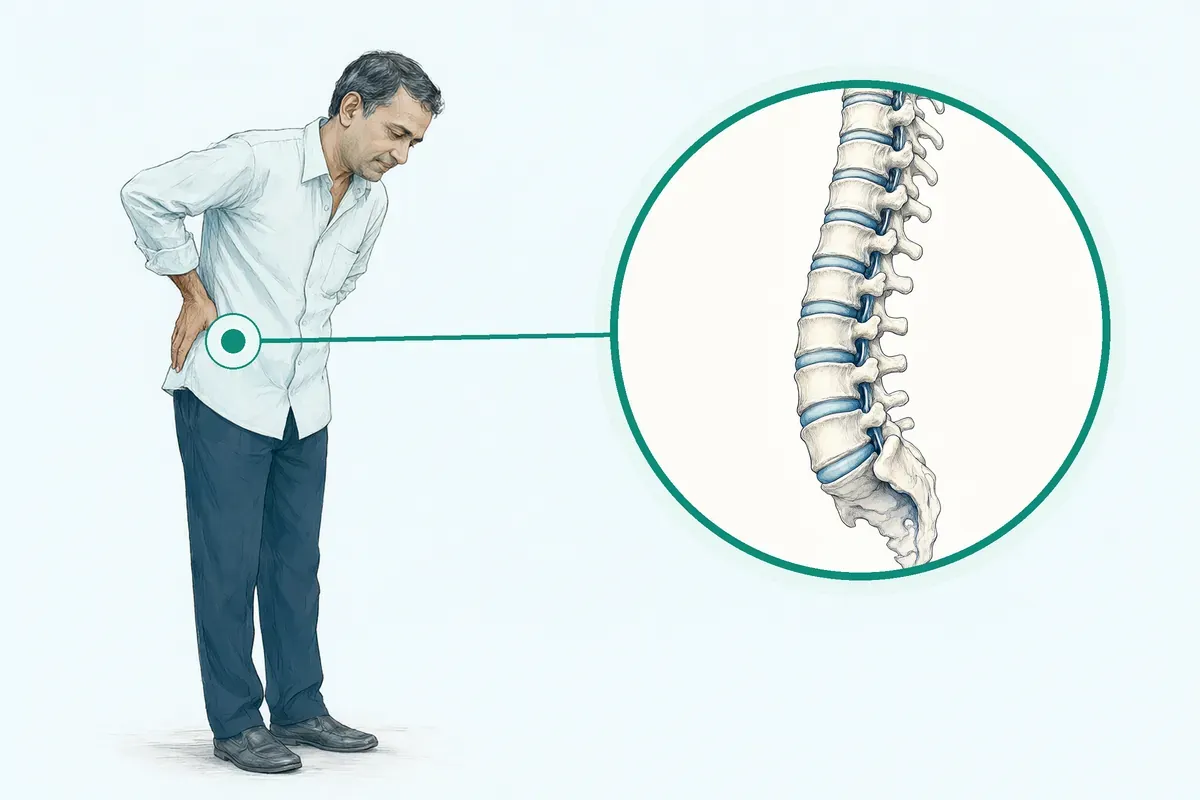
The spine is made of bones called vertebrae stacked one on top of another, with soft discs between them that act as cushions. Nerves run through the spinal canal and branch out between the vertebrae. When a disc bulges or wears down, or when the spaces in the spine narrow, the nerves can get pressed.
This pressure causes pain, numbness, or weakness that may travel into the arms or legs. The condition often develops slowly over years, but it can also start after a sudden strain or injury. In many people, imaging shows changes in the spine that cause no symptoms at all.
Our physiotherapy team works with you to reduce nerve irritation, improve movement, and build strength so you can return to daily activities.
Symptoms and Warning Signs That Need Urgent Care
- Loss of bladder or bowel control
- Numbness in groin or inner thighs
- Sudden severe leg or foot weakness
- Fever with back pain
Common symptoms include pain in the neck or lower back that may spread to the:
- Shoulder
- Arm
- Buttock
- Leg
You may feel numbness, tingling, or weakness in the limbs. With lumbar spinal stenosis, pain in the buttocks or legs often gets worse when you stand or walk and feels better when you sit, bend forward, or lie down. Some people notice heaviness in the legs or a reduced walking distance. These symptoms can wax and wane over time.
Warning signs that need medical attention the same day include loss of bladder or bowel control, numbness in the groin or inner thighs (saddle area), sudden severe weakness in a leg or foot, or fever with back pain. These may point to serious nerve compression or infection and should not wait for a routine appointment.
Causes and Who Is at Higher Risk
- Age-related wear
- Discs lose water, joints enlarge, ligaments thicken
- Lifestyle factors
- Heavy lifting, sitting, posture, smoking, weight
- Congenital narrowing
- Some are born with a narrower spinal canal
Disc problems and spinal stenosis usually result from age-related wear and tear. The discs lose water and height, the joints enlarge, and ligaments thicken, which narrows the space for nerves.
Repetitive heavy lifting, prolonged sitting, poor posture, smoking, and being overweight can speed up this process.:
- Repetitive heavy lifting
- Prolonged sitting
- Poor posture
- Smoking
- Being overweight
Some people are born with a narrower spinal canal. Lumbar spinal stenosis is the most common reason for spine surgery in adults over 65. Clinical care is complicated because many older adults have narrowing on scans but no symptoms, and there is no single standard for diagnosis.
Having imaging changes alone does not mean you need treatment; the decision depends on how much the symptoms bother you and limit your life.
How Spine and Back Conditions Are Diagnosed
Diagnosis starts with a detailed history and physical examination. Your doctor will ask where the pain goes, what makes it better or worse, and how it affects walking, sleep, and daily tasks.
The examination checks nerve function:
- Strength
- Sensation
- Reflexes in the arms and legs
Imaging such as MRI or CT is used when the findings match your symptoms and when the results could change the plan. Because anatomic stenosis is common on scans in people without symptoms, imaging alone does not confirm the diagnosis. Guidelines recommend that imaging and treatment decisions be based on the combination of symptoms, examination, and scan findings together.
At Jaipur Hospital, our orthopaedic and neurosurgery consultants review the images with the physiotherapy team so that the rehabilitation plan targets the right level and cause.
Non-Surgical Treatment Options and When Surgery Is Advised
- about one-third Improved
- about half Stayed the same
- 10 to 20 percent Got worse
First-line therapy is activity modification, pain relief medicines such as NSAIDs, and physical therapy. Non-surgical management also includes spinal injections and multidisciplinary rehabilitation. Evidence reviews show that the quality of studies is often limited and no single non-surgical treatment can be strongly recommended over another.
In studies of lumbar spinal stenosis without surgery, about one-third of patients improved, about half stayed the same, and 10 to 20 percent got worse over up to three years. A randomised trial found decompressive laminectomy improved disability scores more than non-operative therapy, though the average difference was smaller than the minimum clinically important difference.
Surgery is almost always elective and considered only when sufficiently bothersome symptoms persist despite trials of less invasive interventions. Surgical candidates are carefully selected based on imaging-confirmed pathology that matches the clinical picture. For disc herniation with radiculopathy, surgery can give greater improvement in pain and function than non-operative care in carefully selected patients.
For stenosis with spondylolisthesis, the added benefit of fusion over decompression alone remains unclear. At Jaipur Hospital, your surgeon and physiotherapist will discuss the expected recovery timeline: acute disc issues typically need 4 to 8 weeks of guided physiotherapy, while post-surgery rehabilitation usually runs 3 to 6 months.
Sessions last 40 to 60 minutes and cost typically ranges from ₹800 to ₹2,500 per session depending on the techniques used. Treatment is outpatient, though post-operative rehabilitation may start during an inpatient stay.
Your first visit and tests for Spine and Back Care
At your first visit, your physiotherapist will ask about your pain, when it started, what makes it better or worse, and how it affects your daily activities. They will also ask about any previous spine surgery, imaging reports, and medicines you are taking.
Please bring any:
- MRI, CT, or X-ray films
- Your doctor's referral note
- A list of current medicines
The therapist will check your posture, range of movement, muscle strength, reflexes, and nerve signs. They may also assess how you walk, sit, and lift. This examination helps the team decide which treatment approach suits you and whether you need any further tests before starting therapy.
How Spine and Back Care treatment works
- McKenzie Method
- Repeated movements to centralise symptoms
- Core stabilisation
- Activates deep trunk muscles, progresses to functional loading
- Spinal mobilisation
- Graded passive movements to improve joint mobility
- Traction
- Mechanical or manual to decompress nerve root
Treatment is planned around your diagnosis and goals. Your therapist will explain the options and choose techniques that match your condition. Sessions usually last 40 to 60 minutes. The number of sessions depends on your progress. Common approaches include the McKenzie Method, which uses repeated movements to find a directional preference that reduces pain and centralises symptoms.
Core stabilisation training activates deep trunk muscles and progresses to functional loading. Spinal mobilisation uses graded passive movements to improve joint mobility; high-velocity low-amplitude manipulation may be used if indicated. Mechanical or manual traction can decompress the nerve root in radiculopathy or disc herniation. Your therapist will also teach you exercises to do at home, posture advice, and activity pacing. If your symptoms do not improve with conservative care, your doctor may discuss a surgical referral.
Risks and possible complications of Spine and Back Care physiotherapy
Physiotherapy for spine conditions is generally safe. Some people feel temporary soreness or a brief increase in symptoms after a session, which usually settles within a day. Serious adverse events are rare. The evidence on non-surgical treatments is heterogeneous and often of limited quality, and no single approach has been shown to be clearly superior.
If you have had recent spine surgery, the surgical risks such as infection, blood loss, or nerve injury are related to the operation itself, not to the rehabilitation.
In studies comparing fusion with decompression alone, fusion was associated with:
- More blood loss
- Longer hospital stays
- Higher complication rates
Your therapist will monitor your response and adjust the programme if needed.
Recovery and aftercare for Spine and Back Care
- Acute disc problem Guided physiotherapy typically 4 to 8 weeks
- After spine surgery Structured rehabilitation usually 3 to 6 months
- First few days of therapy May feel muscle fatigue or mild soreness
Recovery time varies with the condition. For an acute disc problem, guided physiotherapy typically lasts 4 to 8 weeks. After spine surgery, a structured rehabilitation programme usually continues for 3 to 6 months. In the first few days after starting therapy, you may feel muscle fatigue or mild soreness.
Your therapist will give you a home exercise plan and advice on positions to adopt or avoid. Attend all scheduled sessions and follow the home programme daily. Gradually increase activity as guided.
If you develop new or worsening weakness, numbness in the saddle area, loss of bladder or bowel control, or severe pain that does not settle with rest, contact the hospital immediately. For post-surgical patients, follow the surgeon's wound care and activity restrictions alongside physiotherapy.
Results of Spine and Back Care treatment
- about one-third Improve without surgery
- about half Report no change
- 10 to 20 percent Worsen
In studies, outcomes for non-surgical care vary. For lumbar spinal stenosis, about one-third of patients improve over time without surgery, about half report no change, and 10 to 20 percent worsen. Surgery can give greater improvement in carefully selected patients who do not improve with conservative treatment.
In randomised trials, decompression alone was not inferior to decompression with fusion for disability scores at two years. Long-term follow-up shows little degradation of outcomes in either operative or non-operative groups from four to eight years. For disc herniation with radiculopathy, surgery provides faster relief of leg pain and disability, but non-operative outcomes can be similar at longer follow-up.
Your physiotherapist will track your progress using standard measures such as the Oswestry Disability Index and adjust the plan if goals are not being met.
Cost and insurance for Spine and Back Care at Jaipur Hospital
A typical physiotherapy session costs between ₹800 and ₹2,500. The exact amount depends on the techniques used, the duration of the session, and whether any specialised equipment is needed.
The hospital accepts patients under:
- RGHS
- MAA Yojana
- CGHS
- A panel of private insurers and TPAs
Coverage for physiotherapy varies by scheme and policy; please check with your insurer or the hospital's insurance desk for details of what is included. If you are paying out of pocket, ask for an estimate based on your treatment plan.