
Plastic Surgery · Jaipur Hospital
Hair Transplant in Jaipur
Thinning hair affects confidence. We assess your pattern, explain options and give a clear plan.
- Serving Jaipur since 1991 (35 years)
- NABH accredited
- 24×7 emergency & ICU
- Cashless: RGHS, MAA Yojana, CGHS + 32 insurers
- Operation time
- 6 to 8 hours
- Anaesthesia
- Local anaesthesia with sedation
- Recovery
- Grafts settle in 10 to 14 days
- Price
- ₹40,000 to ₹1,50,000 per sessiontypical range in India; ask us for an estimate
Hair loss changes how you feel
Thinning hair and receding hairline
Pattern baldness progresses slowly. You may notice more scalp showing, a receding hairline or a widening part. It can affect self-esteem and how you feel in social or work settings.
-
Receding hairline
Frontal hair moves back, temples deepen, forehead looks larger.
-
Thinning crown
Hair becomes sparse on top, scalp visible under light.
-
Widening part
Part line broadens, volume drops, styling covers less.
-
Donor area worry
Concern whether back and sides have enough healthy grafts.
Androgenetic alopecia is the most frequent cause of hair loss.
Why Jaipur Hospital
You worry that thinning hair makes you look older than you feel and that treatment will be expensive or leave visible marks.
Your care plan
Your first steps with us
- 1 Call or visit OPD for surgeon consultation
- 2 Scalp assessment, trichoscopy and medical review
- 3 Undergo day-care FUE procedure under local anaesthesia
- 4 Follow post-op care and attend scheduled reviews
How the operation is done
Individual follicular units are taken from the donor area and placed into thinning zones under local anaesthesia with sedation. The procedure usually takes 6 to 8 hours. Grafts settle in 10 to 14 days.
-
FUE (Follicular Unit Extraction)
Individual grafts removed with a micro punch, no linear scar, small round scars hidden by surrounding hair.
-
DHI (Direct Hair Implantation)
Choi pen implanter places grafts directly without pre-made channels, may reduce handling time.
-
Sapphire FUE
Sapphire blades create smaller incisions for implantation, may allow denser packing.
-
Body Hair Transplant
Beard or chest hair used as donor source when scalp donor is limited, texture differs from scalp hair.
Why patients trust us
- 1991 Serving Jaipur for 35 years
- NABH Accredited hospital
- 1 Plastic Surgery consultants
- 24×7 Emergency, ICU and ambulance
- 35 Cashless schemes and insurers
What research shows about FUE outcomes
-
Grafts settle in 10 to 14 days
Studies note the transplanted grafts establish in the recipient area within two weeks.
-
New growth noticeable after a few months
Transplanted hair typically sheds in 2 to 3 weeks, with new growth visible a few months later.
-
Small scars usually concealed by existing hair
FUE leaves tiny round scars in the donor area that are typically hidden by surrounding hair.
If it is left untreated
Without treatment, pattern baldness usually progresses. The bald area expands, donor hair may become insufficient for later surgery, and the impact on self-image and confidence can increase.
Life after treatment
Most people see a natural-looking hairline and improved density as grafts grow over several months.
-
Natural hairline
Grafts placed at correct angle and density mimic your original growth pattern.
-
Improved coverage
Thinning zones show more scalp coverage once grafts mature.
-
Short hair possible
Donor area heals with tiny scars usually hidden, allowing shorter hairstyles.
-
Confidence returns
Feeling comfortable in photos, at work and in social settings without hiding hair.
Meet the team
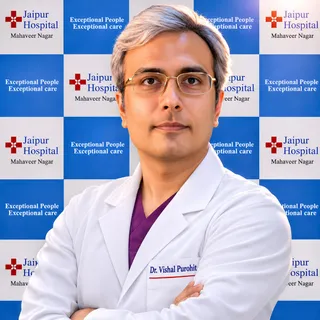
Your plastic surgery doctors
Explore our plastic surgery hospital in Jaipur: every treatment, the doctors and what to expect at your visit.
Frequently asked questions
Questions patients ask about hair transplant
What does FUE hair transplant involve?
In short
FUE hair transplant at Jaipur Hospital involves removing individual hair follicles from the back or sides of your scalp and placing them into bald or thinning areas. The procedure uses local anaesthesia with sedation and typically takes six to eight hours. You usually go home the same day or stay one night. The grafts settle in ten to fourteen days.
In detail
The surgeon uses a small punch tool, usually 0.8 to 1.1 millimetres in diameter, to extract follicular units one by one from the donor area. This avoids the linear scar seen with strip surgery.
The harvested grafts are kept in a chilled holding solution to maintain viability before they are implanted into tiny recipient sites made in the bald area. Techniques such as DHI or Sapphire FUE may be used depending on your case.
Body hair from the beard or chest can serve as an additional donor source if scalp hair is limited. The procedure is minimally invasive and performed under local anaesthesia with sedation.
A common belief
Many people think a strip of skin is cut out, but FUE avoids that linear scar.
What actually happens
The small round scars are hidden by your existing hair. The grafts are kept in a special cold solution so they stay healthy until implantation.
Your next step at Jaipur Hospital
After surgery you will receive instructions on washing, sleeping position, and activity limits for the first two weeks. The transplanted hairs usually shed within two to three weeks, and new growth becomes noticeable after a few months.
Most people see significant growth by six to nine months. A consultation at Jaipur Hospital will let your surgeon assess your donor area, discuss the technique suited to you, and give a personalised estimate.
Which tests and scans do I need before FUE hair transplant?
In short
Before FUE hair transplant at Jaipur Hospital, you usually need basic pre-operative blood tests. These include a complete blood count, blood sugar, bleeding and clotting time, and screening for hepatitis B, hepatitis C, and HIV. The surgeon may also request a chest X-ray and ECG if you are over forty or have medical conditions. No special scans of the scalp are routinely required.
In detail
The blood tests check that you are fit for a six to eight hour procedure under local anaesthesia with sedation. They rule out anaemia, infection risk, and bleeding disorders that could affect healing.
If you take blood thinners or have a history of keloid scarring, inform the surgeon during the consultation. For female patients, the surgeon may ask for hormonal tests such as thyroid function, ferritin, and androgen levels to identify treatable causes of hair loss before surgery.
Dermoscopy of the donor and recipient areas is performed clinically to assess follicular density and scalp health. No MRI, CT, or ultrasound of the scalp is needed for standard FUE.
A common belief
No special scalp scans like MRI or ultrasound are needed.
What actually happens
The surgeon examines your donor and recipient areas with a dermoscope during the consultation. Women may need extra hormone tests to rule out thyroid or iron deficiency before surgery. All tests are done in our in-house lab.
Your next step at Jaipur Hospital
All tests can be done at the in-house diagnostic laboratory at Jaipur Hospital. Results are typically available within a few hours. Once cleared, the surgery can be scheduled.
What are the common side effects and the less common serious complications of a hair transplant?
In short
Common side effects after a hair transplant at Jaipur Hospital include swelling of the forehead or eyelids, crusting and scabbing on the scalp, temporary numbness, itching, and shedding of the transplanted hairs within 2 to 3 weeks. Less common but serious complications can include infection, bleeding, poor graft survival, visible scarring in the donor area, and an unnatural hairline if planning is inadequate.
In detail
Swelling typically peaks around day 3 and resolves in a week. Crusting forms around each graft and falls off by day 10 to 14 as the grafts settle. Shock loss — temporary shedding of existing native hairs — can occur but usually regrows.
Evidence notes that FUE leaves small round scars that may be hypopigmented or slightly larger than the punch size. Buried grafts and donor‑area thinning with repeated sessions are recognised risks. Infection and significant bleeding are rare when sterile technique and careful haemostasis are followed. Graft survival depends on graft handling, storage solution, and surgical skill.
A common belief
Patients often worry the new hairs will never grow or that they will be left with a large scar.
What actually happens
FUE avoids a linear strip scar, but tiny dot scars remain. Good technique and aftercare keep serious complications rare.
Your next step at Jaipur Hospital
Follow the post‑operative care sheet: gentle washing from day 3, no picking at crusts, sleep with head elevated, avoid strenuous activity for 2 weeks. Report any spreading redness, pus, increasing pain, fever, or sudden heavy bleeding at once. Most side effects resolve without intervention.
How long does recovery usually take after a hair transplant?
In short
Recovery after a hair transplant at Jaipur Hospital is usually measured in phases. The grafts settle in 10 to 14 days, after which crusts have fallen off and the scalp looks near normal. You can return to desk work in 2 to 3 days. Strenuous exercise and contact sports should wait 2 to 3 weeks. Full hair growth takes 6 to 12 months as the transplanted hairs go through a natural shedding and regrowth cycle.
In detail
Protocol states grafts settle in 10 to 14 days. Evidence shows transplanted hair typically falls out within 2 to 3 weeks, with new growth noticeable a few months later. Most people see about 60% of new hair growth after 6 to 9 months.
Swelling peaks at day 3 and resolves in a week. Numbness or altered sensation in the donor or recipient area may persist for several weeks but usually resolves spontaneously. The tiny donor‑area punch wounds heal with minimal scarring that is concealed by existing hair. You will be given a detailed timeline sheet at discharge.
- Most people see about 60% of new hair growth after 6 to 9 months.
A common belief
Many people expect instant results.
What actually happens
The reality is a waiting period: the transplanted hairs fall out, then slowly come back thicker over several months.
Your next step at Jaipur Hospital
Plan for 2 to 3 days off work if your job is sedentary. Avoid bending, heavy lifting, sweating, and direct sun on the scalp for 2 weeks. Sleep with your head elevated for the first 5 nights.
Attend the scheduled follow‑up at day 10 to 14 for a wound check. Final density and appearance are judged at 9 to 12 months.
How is the decision about starting dialysis made?
In short
The decision to start dialysis at Jaipur Hospital is made by a nephrologist based on your kidney function tests, symptoms, and overall health. It is not determined by a single number. Common triggers include a glomerular filtration rate (GFR) consistently below 15 mL/min, severe fluid overload not controlled by diuretics, persistent nausea or vomiting from uraemia, refractory hyperkalaemia, pericarditis, or encephalopathy. The nephrology team discusses the timing, modality options, and vascular access planning with you and your family.
In detail
Dialysis initiation follows established clinical guidelines. Blood tests (serum creatinine, urea, electrolytes, bicarbonate, haemoglobin) and urine output are reviewed serially. Symptom burden — fatigue, breathlessness, itching, poor appetite, cognitive change — weighs heavily.
The team also evaluates nutritional status, cardiac function, and vascular access suitability (arteriovenous fistula, graft, or catheter). If you choose peritoneal dialysis, catheter insertion is scheduled electively. For haemodialysis, an arteriovenous fistula is created weeks to months ahead to allow maturation.
The hospital’s 24×7 dialysis unit and intensive care unit support urgent starts when needed. Multidisciplinary input from dietitians, counsellors, and vascular surgeons is routine.
A common belief
Patients often think dialysis starts at a fixed creatinine level.
What actually happens
In practice, the choice balances lab trends, how you feel, and preparation time for safe access.
Your next step at Jaipur Hospital
If your GFR is falling below 30 mL/min, ask your doctor for a nephrology referral. Early referral allows time for access creation and modality education. Attend the pre‑dialysis clinic at Jaipur Hospital for blood work, access assessment, and counselling. Bring a list of medicines and an attendant. The team will give you a written plan and timeline.
How will appearance, function, and realistic expectations be discussed?
In short
During the consultation, the surgeon examines your hair loss pattern, donor area, and scalp laxity. You discuss the hairline design, density goals, and what the procedure can achieve. Jaipur Hospital ensures you understand the likely outcome before surgery.
In detail
The surgeon marks the proposed hairline with your input, considering age, facial proportions, and future loss. Graft numbers are estimated based on donor supply and recipient size.
You learn that transplanted hair sheds at two to three weeks, regrows at three to four months, and matures by twelve to eighteen months. Density depends on grafts available; one session may not give full coverage if bald area is large.
Scars in the donor area are small dots hidden by surrounding hair. The surgeon explains that medical therapy like minoxidil or finasteride may continue to protect native hair. No promise of a specific look is made; results vary by healing, graft survival, and curl characteristics.
A common belief
Many clinics show ideal results without explaining limits.
What actually happens
Here, you learn that density depends on donor supply, native hair may keep thinning, and one session may not cover a large bald area.
Your next step at Jaipur Hospital
You receive a written summary of the plan, estimated graft count, and postoperative care steps. A cooling-off period is encouraged before booking.
Why might my doctor recommend FUE hair transplant?
In short
Your doctor may recommend FUE hair transplant at Jaipur Hospital if you have male or female pattern baldness with a stable hair loss pattern, a good donor area at the back of the scalp, and realistic expectations. It is also considered for facial hair restoration, scar camouflage, or stable vitiligo patches with leucotrichia. Medical therapy is usually tried first.
In detail
Androgenetic alopecia is the most common cause of hair loss. When medical treatment such as minoxidil or finasteride has not given adequate results and the hair loss has stabilised, surgical restoration becomes an option.
FUE avoids a linear donor scar, allows you to wear your hair short, and causes less post-operative discomfort than strip surgery. It can also restore eyebrows, beard, moustache, or eyelashes, and camouflage scars from trauma, burns, or previous surgery.
In stable vitiligo, follicular units transfer melanocyte stem cells that may repigment patches. The decision depends on your age, Norwood or Ludwig grade, donor density, and general health.
A common belief
Some people expect surgery to be the first step, but guidelines say medical treatment comes first.
What actually happens
Also, FUE is not advised while hair loss is still progressing rapidly, because the transplanted hair could be lost later.
Your next step at Jaipur Hospital
If you have tried medical treatment without success and your hair loss has been stable for at least a year, a consultation at Jaipur Hospital will help determine whether FUE is appropriate.
The surgeon will examine your donor area, discuss the number of grafts you may need, and explain the typical price range of forty thousand to one lakh fifty thousand rupees per session.
How should I prepare in the days before FUE hair transplant?
In short
In the days before FUE hair transplant at Jaipur Hospital, stop smoking and alcohol at least one week prior, as they impair healing. Avoid aspirin, ibuprofen, vitamin E, and herbal supplements that increase bleeding risk. Wash your hair with a mild shampoo on the morning of surgery. Do not apply oil, gel, or styling products. Wear a loose, front-button shirt to avoid touching the transplanted area when changing.
In detail
The surgeon will review your regular medicines during the consultation. Blood thinners may need to be paused with your physician's approval. If you take finasteride or minoxidil, continue them unless told otherwise.
Arrange for an attendant to accompany you and drive you home, as sedation is used. The procedure takes six to eight hours, so eat a light breakfast unless fasting is advised. Keep your scalp clean and free of any infections, cuts, or sunburn. Inform the team if you develop a fever, cold, or skin rash before the scheduled date.
A common belief
Do not oil or style your hair on the day.
What actually happens
Continue your regular hair medicines like minoxidil or finasteride unless the surgeon says to stop. Bring an attendant because you will have sedation. If you get a fever or scalp infection before the date, call us to reschedule.
Your next step at Jaipur Hospital
On the day of surgery, arrive at the admitted time with your test reports and ID. The nursing team will prepare the donor area by trimming or shaving a section at the back of the scalp.
What factors could make a hair transplant riskier for me?
In short
Several factors can increase the risk of a hair transplant at Jaipur Hospital. These include young age with rapidly progressing hair loss, advanced baldness with a limited donor area, active scalp disease such as alopecia areata or lichen planopilaris, uncontrolled medical conditions like diabetes or hypertension, smoking, and a tendency to form keloid or hypertrophic scars. Your surgeon will assess each of these at the consultation.
In detail
Evidence advises caution in patients under 25 with evolving alopecia and in Norwood grade VI or VII with poor donor density. Active autoimmune or inflammatory conditions can destroy newly implanted grafts. Dermoscopic signs of reduced blood supply or thickened collagen make graft survival harder.
Smoking impairs wound healing and graft take. Uncontrolled systemic disease raises anaesthetic and infection risk. A history of poor scarring or keloids may lead to visible donor‑area marks. The surgical team reviews your medical history, scalp examination, and dermoscopy before recommending surgery.
A common belief
Some patients assume anyone can have a transplant at any time.
What actually happens
In reality, operating on an unstable condition or a poor donor area often leads to disappointment or complications.
Your next step at Jaipur Hospital
Be ready to share your full medical history, current medications, and any previous scalp treatments. If you smoke, stopping at least 2 weeks before and after surgery improves outcomes. Chronic conditions should be well controlled. The surgeon may advise medical therapy first or delay surgery until the disease is quiescent.
Which symptoms are expected after a hair transplant, and which need urgent medical attention?
In short
Expected symptoms after a hair transplant at Jaipur Hospital include mild to moderate swelling of the forehead or eyelids (peaking day 3), crusting and scabbing on graft sites, itching, temporary numbness or tingling, and shedding of the transplanted shafts within 2 to 3 weeks. Urgent signs are spreading redness, increasing pain not relieved by prescribed medicine, pus or foul‑smelling discharge, fever above 38°C, heavy bleeding that does not stop with gentle pressure, or sudden loss of sensation over a large area.
In detail
Swelling, crusting, itching and numbness are normal inflammatory and healing responses (protocol; e219). Shock loss of native hairs may also occur but usually regrows. Evidence notes that grafts shed at 2 to 3 weeks and new growth appears months later.
Infection is rare but presents with spreading erythema, warmth, purulent discharge and fever. Haematoma presents as tense swelling with throbbing pain. Necrosis of grafts appears as dusky, non‑blanching skin. Any of these require immediate review. The surgical team provides a 24‑hour contact number for post‑operative concerns.
A common belief
Patients sometimes panic over shedding at week 2, which is expected, but ignore a low‑grade fever that could mean infection.
What actually happens
Knowing the difference saves time and protects your result.
Your next step at Jaipur Hospital
Take all prescribed antibiotics and analgesics as directed. Begin gentle washing from day 3 as taught. Do not pick crusts. Sleep with head elevated.
If you notice any urgent symptom, call the hospital emergency line or visit the 24×7 emergency department at Jaipur Hospital without delay. Routine follow‑up is at day 10 to 14.
FAQ library
Questions and answers about hair transplant
When you contact us
Get your assessment and plan
Contact Jaipur Hospital for a consultation with our plastic surgeon, a clear explanation of options and a cost estimate before you decide.
- A consultation with a plastic surgeon in the OPD
- Your scans and reports reviewed, with tests done in-house if you need them (laboratory, X-ray and imaging)
- Your options explained in plain words, including whether you need surgery at all
- A cost estimate before you decide
- Help with cashless treatment under RGHS, MAA Yojana, CGHS and empanelled insurers and TPAs
- Follow-up visits after your treatment
Overview
Hair Transplant: what to know
What hair loss is and how it happens
- Pattern baldness
- Hormones shrink follicles over time
- Alopecia areata
- Immune system attacks hair follicles
Hair loss means you lose more hair than grows back. The most frequent cause is androgenetic alopecia, often called male or female pattern baldness. Hair follicles on the scalp follow a cycle of growth, rest and shedding. In pattern baldness, hormones shorten the growth phase and shrink the follicles until they produce only fine, short hairs or stop altogether.
The hair at the back and sides of the scalp (the occipital area) is genetically different and usually keeps growing for life. This principle is called donor dominance.
Alopecia areata is an autoimmune condition where the body's own immune cells attack the hair follicle. The immune privilege of the follicle collapses, leading to patchy loss. Trauma from chemicals, heat or pulling can also destroy follicles. Scarring alopecias permanently damage the follicle stem cells so hair cannot regrow. Vitiligo can affect hair-bearing skin, turning hair white (leucotrichia).
Symptoms and warning signs that need urgent care the same day
- Sudden hair loss with fever
- Scalp pain, redness, swelling or pus
The main symptom is thinning hair or bald patches. You may notice a receding hairline, thinning at the crown, or a widening part. In alopecia areata, smooth round patches appear suddenly. Scarring alopecias can cause itching, burning or pain before the hair falls out. Loss of hair can affect self-esteem and emotional well-being.
Most hair loss is not a medical emergency. Seek care the same day if you have sudden hair loss with fever, scalp pain, redness, swelling, or pus, as these may signal an infection or an inflammatory flare that needs prompt treatment.
Causes and who is at higher risk
- Family history
- Close relatives with pattern baldness
- Age
- By age 50 many have some thinning
- Autoimmune disease
- Alopecia areata, thyroid disease, vitiligo
- Nutritional deficiency
- Especially iron deficiency
Androgenetic alopecia is driven by genetics and hormones. If close relatives have pattern baldness, your risk is higher. Age increases the chance: by age 50, many men and women have some degree of thinning.
Autoimmune conditions such as alopecia areata, thyroid disease, or vitiligo can cause hair loss. Physical or chemical trauma, burns, and radiation damage follicles. Tight hairstyles that pull on the hair lead to traction alopecia. Certain medicines, severe stress, nutritional deficiencies (especially iron), and hormonal changes such as pregnancy or menopause can trigger shedding.
Young patients with early, evolving alopecia should exercise caution before considering surgery. Patients with advanced baldness (Norwood grade VI or VII) and poor donor density also need careful assessment. Active or unstable alopecia areata is not suitable for transplant because the immune attack may destroy the new grafts.
How hair loss is diagnosed: examination and tests
- Dermoscopy
- Shows follicular openings and inflammation
- Pull test
- Checks how easily hairs come out
- Blood tests
- Haemoglobin, ferritin, thyroid, vitamin D
- Scalp biopsy
- Confirms diagnosis in unclear cases
Your surgeon will ask about the pattern and speed of hair loss, family history, medicines, and general health. The scalp is examined under good light. Dermoscopy (a handheld magnifier with light) shows follicular openings, hair thickness, and signs of inflammation such as exclamation-mark hairs or loss of openings. This helps separate scarring from non-scarring alopecia.
A pull test checks how easily hairs come out. Blood tests may include haemoglobin, ferritin, thyroid function, and vitamin D to find treatable causes. In unclear cases, a small scalp biopsy under local anaesthesia confirms the diagnosis by showing fibrosis, inflammatory cells, or empty follicular tracts. For transplant planning, the donor area is assessed for density, hair calibre, and scalp laxity.
Non-surgical treatments and when a hair transplant is advised
First-line management is medical therapy. For androgenetic alopecia, topical minoxidil and oral finasteride (for men) can slow loss and regrow some hair. Low-level light therapy devices are also used. In alopecia areata, corticosteroids (topical, intralesional, or oral) and other immunosuppressants aim to calm the immune attack. Treating underlying thyroid disease, iron deficiency, or stopping traction hairstyles can allow recovery.
A hair transplant is considered when medical treatment has failed or is not enough, the loss is stable and not rapidly progressive, and you have a good donor area. Typical criteria include Norwood grade 3 or above in men. If you are under 25, transplant is usually delayed until the pattern is established, unless baldness is extensive.
Women are considered only after adequate medical trial and proper investigation of the cause. In scarring alopecias, the disease must be quiescent with no active inflammation on clinical and histopathological examination. For facial hair restoration (beard, moustache, eyebrows), the same principles apply: stable disease, adequate donor hair, and realistic expectations. Your surgeon will advise whether FUE, DHI, Sapphire FUE or body hair transplant suits your pattern and donor supply.
Preparing for hair transplant surgery
Do
- Stop smoking before and after
- Wear a loose front-button shirt
- Bring regular medicines and insurance card
Your surgeon will review your medical history and examine your scalp to confirm the pattern and stage of hair loss. The most frequent cause is androgenetic alopecia. You will be asked about any medicines you take, especially blood thinners, and about allergies to anaesthesia. Routine blood tests and a fitness check are usually done before the day of surgery.
If you smoke, you will be advised to stop for a period before and after the procedure because smoking can impair healing. On the day of surgery you should wear a loose, front-button shirt so you do not have to pull anything over your head.
Fasting instructions will be given by the anaesthesia team; typically you may have a light meal up to six hours before the procedure and clear fluids up to two hours before. Bring any regular medicines you take, your insurance or scheme card, and an attendant who can stay with you and take you home afterwards.
How hair transplant surgery is done
The procedure is performed under local anaesthesia with sedation. Your surgeon will discuss which technique suits you. Follicular Unit Extraction (FUE) removes individual grafts with a small punch, leaving no linear scar. Direct Hair Implantation (DHI) uses a Choi pen to place grafts without creating channels first. Sapphire FUE uses sapphire blades for smaller incisions.
Body Hair Transplant uses beard or chest hair when scalp donor hair is limited. On the day, the donor area is prepared and numbed. Grafts are harvested one by one and kept in a chilled holding solution to preserve viability. The recipient sites are then made and grafts are placed at the correct angle and density.
The operation typically takes six to eight hours depending on the number of grafts. You will be monitored for a short period and then discharged the same day or after an overnight stay.
Risks and possible complications of hair transplant
- Tiny round donor scars
- May be lighter or darker than skin
- Graft transection
- Follicle damaged during extraction
- Donor area thinning
- With repeated sessions
- Active disease flare
- Surgery can trigger new lesions
FUE avoids the linear scar of strip surgery but leaves tiny round scars in the donor area. These scars can be hypopigmented or hyperpigmented and may be slightly larger than the punch size. Graft transection during extraction can make a follicle unusable. Buried grafts may occur. With repeated sessions the donor area can thin and become noticeable.
There is a risk of harvesting hairs that are not long-term and may be lost later. In conditions such as lichen planopilaris, surgery can trigger new lesions if the disease is still active. Graft survival rates in studies have shown no significant difference between FUE and strip techniques.
Your surgeon will assess your donor area, skin type and the stability of your hair loss to minimise these risks.
Recovery and aftercare after hair transplant
Grafts usually settle in ten to fourteen days. The transplanted hair typically falls out within two to three weeks after surgery; this is expected. New growth becomes noticeable a few months later. Most people see about sixty percent of new hair growth after six to nine months.
You will be given instructions on how to wash the scalp gently, when to resume normal activities, and which medicines to apply or take for swelling or discomfort. Avoid strenuous exercise, direct sun exposure, and scratching the treated areas for the first few weeks. Sleep with your head elevated for the first few nights.
Contact the hospital if you develop increasing pain, spreading redness, pus, fever, or sudden swelling. Follow-up visits are scheduled to check healing and graft growth.
Results of hair transplant: what studies show
Hair transplantation has been successfully used to correct androgenetic alopecia, cleft lip scars, post-burn or surgical scars, and vitiligo. In experienced hands FUE can yield excellent results. Studies report a high level of patient satisfaction and safety. In one study of eyebrow alopecia areata, eighty percent hair growth was achieved at twenty-four months.
Facial hair restoration over beard and eyebrow areas is effective with a very high satisfaction rate. The transplanted hair retains the characteristics of the donor area and continues to grow. Some grafts may not survive and fall out. Long-term results depend on the stability of your underlying hair loss and the quality of the donor area. Medical therapy is often continued after surgery to preserve existing hair.
Cost and insurance for hair transplant in Jaipur
The typical price range for a session in India is ₹40,000 to ₹1,50,000. The final cost depends on the number of grafts needed, the technique chosen, and whether body hair is used. FUE tends to be more expensive than strip surgery. Jaipur Hospital is a NABH-accredited multispeciality hospital established in February 1991.
It accepts:
- RGHS
- MAA Yojana
- CGHS
- A panel of private insurers and TPAs
The hospital has modular operation theatres, a 24×7 emergency department, in-house pharmacy and diagnostic laboratory. For an estimate, contact the hospital on 0141-2551500, 0141-2554139, or 7414 001 001, or email [email protected].