

Plastic Surgery · Jaipur Hospital
Hair Restoration in Jaipur
Noticing a receding hairline or thinning crown? Our surgical team offers an evaluation and a clear medical plan to address your hair loss.
- Serving Jaipur since 1991 (35 years)
- NABH accredited
- 24×7 emergency & ICU
- Cashless: RGHS, MAA Yojana, CGHS + 22 insurers
- Procedure time
- 4 to 8 hours
- Anaesthesia
- Local anaesthesia with sedation
- Recovery
- Back to desk work in 2 to 5 days, grafts shed at 2 to 4 weeks, growth at 3 to 6 months
- Price
- ₹40,000 to ₹1,50,000typical range in India; ask us for an estimate
Dealing with hair thinning
Hair loss can feel frustrating and isolating
Thinning hair or a receding hairline often affects everyday confidence. Many people try untested remedies before speaking with a doctor about clinical options.
-
Receding hairline
Gradual loss of hair at the forehead and temples that changes your facial profile.
-
Thinning at the crown
A wider parting or noticeable patch of scalp visible under bright lights.
-
Diffuse thinning in women
Gradual reduction in overall hair thickness while the frontal hairline remains in place.
-
Emotional distress
Worry about appearance that affects social life, work, and personal interactions.
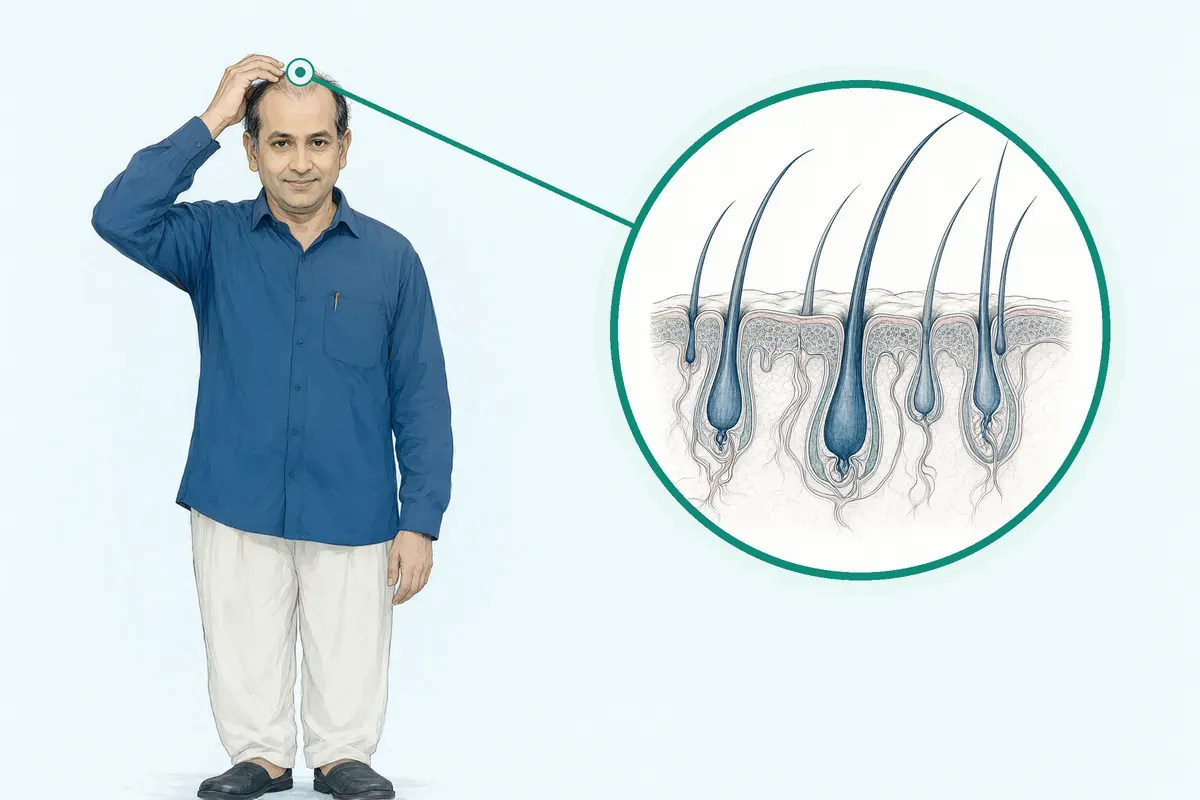
Androgenetic alopecia is primarily mediated by 5-alpha-reductase and dihydrotestosterone (DHT), which causes hair follicles to undergo miniaturisation and shortening of growth cycles.
Why Jaipur Hospital
You may worry about the procedure taking long hours, taking days off work, or facing unexpected costs.
Your care plan
Your first steps with us
- 1 Consult your surgeon in the OPD for an examination.
- 2 Review your scalp assessment and discuss surgical or medical options.
- 3 Undergo your daycare procedure under local anaesthesia with sedation.
- 4 Return for scheduled follow-up visits as your hair recovers.
How hair restoration treatments work
Hair restoration involves surgical transplantation of healthy hair follicles or medical therapies. Your surgeon will discuss which approach suits your scalp condition.
-
FUE (Follicular Unit Extraction)
Individual hair grafts are extracted directly from the donor area, leaving no linear scar.
-
FUT (Follicular Unit Transplantation)
A single strip of donor tissue is harvested, allowing higher graft numbers in one session.
-
DHI (Direct Hair Implantation)
An implanter pen places hair grafts directly into the scalp without pre-made slits.
-
Medical Therapy
Non-surgical options such as Minoxidil, Finasteride, or PRP support maintenance and hair density.
Why patients trust us
- 1991 Serving Jaipur for 35 years
- NABH Accredited hospital
- 1 Plastic Surgery consultants
- 24×7 Emergency, ICU and ambulance
- 25 Cashless schemes and insurers
Clinical findings on hair restoration treatments
-
84%
Of studies analysed reported a positive effect of platelet-rich plasma treatment for androgenetic alopecia.
-
5 to 19%
Of patients in studies reported erectile dysfunction as a potential side effect of oral finasteride.
-
80% of men
And half of women are affected by androgenetic alopecia by age 70.
If it is left untreated
Untreated androgenetic alopecia involves gradual follicular miniaturisation, which converts terminal hairs into thinner vellus hairs over time. This can impact your quality of life and cause ongoing distress with family and peers.
What to expect during recovery
Recovery from hair restoration follows a gradual timeline. Most people follow standard post-procedure steps to support healthy healing.
-
Return to desk work
Most patients typically return to desk work within 2 to 5 days after treatment.
-
Temporary shedding phase
Transplanted grafts typically shed between 2 and 4 weeks as follicles settle.
-
Gradual hair growth
New hair growth typically begins to appear between 3 and 6 months.
Frequently asked questions
Questions patients ask about hair restoration
Which problems are assessed under hair restoration?
In short
Hair restoration at Jaipur Hospital assesses androgenetic alopecia, the most common form of hair loss. This includes male pattern baldness with a receding frontal hairline and female pattern hair loss with diffuse thinning while the frontal hairline is retained. The surgical team also evaluates scalp defects from injury or previous surgery and checks donor hair availability on the scalp or body.
In detail
Androgenetic alopecia is an autosomal dominant condition where terminal hairs gradually convert into finer vellus hairs under the influence of dihydrotestosterone. Diagnosis is usually clinical, supported by trichoscopy showing follicular miniaturisation.
The surgeon examines the scalp quality, grades the baldness pattern, and measures donor density to calculate how many grafts are needed. If scalp donor hair is insufficient, beard or chest hair may be considered as alternative sources.
Medical therapy with minoxidil, finasteride, or PRP is also assessed for patients who are not ready for surgery or as an adjunct to transplant.
A common belief
Many people think hair restoration is only for advanced baldness.
What actually happens
In fact, early assessment helps preserve existing hair with medical therapy and plans surgery only when needed.
Your next step at Jaipur Hospital
You can book a consultation at Jaipur Hospital for a clinical examination and trichoscopy. The surgeon will grade your hair loss, discuss donor availability, and outline a plan that may include medical therapy, surgical transplant, or both. Bring any previous treatment records. The visit takes about 30 minutes and helps set realistic expectations for graft numbers and timeline.
How will the doctor decide which tests I need?
In short
The doctor at Jaipur Hospital decides tests after a clinical history and scalp examination. Most androgenetic alopecia diagnoses are clinical, confirmed by trichoscopy showing follicular miniaturisation. Blood tests like haemoglobin, ferritin, thyroid function, and hormonal profile are ordered only if the pattern is atypical, if you are a woman with signs of hyperandrogenism, or if medical therapy like finasteride is planned.
In detail
Guidelines recommend a targeted approach. Routine screening in classic male pattern baldness is not necessary. In women, polycystic ovary syndrome, thyroid disorders, and iron deficiency are common contributors, so a hormonal panel, TSH, and ferritin are often checked.
If finasteride or dutasteride is considered, baseline liver function and PSA may be advised. A scalp biopsy is reserved for scarring alopecia or diagnostic uncertainty. The surgeon also checks vitals, blood pressure, and blood sugar to assess fitness for any surgical procedure.
A common belief
Many clinics order a full panel for everyone.
What actually happens
Evidence shows routine tests in classic male pattern baldness add cost without changing management. A focused approach saves time and money.
Your next step at Jaipur Hospital
At your OPD visit, the surgeon will examine your scalp with a dermatoscope and ask about menstrual history, medications, and family history. Tests, if any, are done at the in-house laboratory. Results are usually available the same day. The surgeon then finalises whether you need medical therapy, PRP, or a transplant plan.
How soon should I expect improvement after the chosen treatment?
In short
Timelines differ by treatment at Jaipur Hospital. Medical therapy with minoxidil or finasteride shows visible reduction in shedding by 3 to 4 months and density improvement by 6 to 12 months. PRP effects appear around 3 to 6 months after the third session. After transplant, grafts shed at 2 to 4 weeks, new growth starts at 3 to 4 months, and cosmetic density is seen at 6 to 12 months.
In detail
Finasteride and minoxidil require continuous use; studies show stabilisation at 1 year and further improvement up to 5 years. Dutasteride shows hair count improvement at 12 to 24 weeks in trials.
PRP protocols typically use three monthly injections; significant increases in anagen hairs and terminal density are reported at 6 months. Transplanted follicles enter a resting phase, shed, then regrow. The hairline matures over 12 to 18 months. Native hair behind the transplant continues to thin without medical maintenance, so combined therapy is standard.
A common belief
Patients often expect instant results after transplant.
What actually happens
The shed phase at 2 to 4 weeks is normal and temporary. Stopping medicines early because 'nothing happened at 6 weeks' wastes the treatment.
Your next step at Jaipur Hospital
You will be reviewed at 1 month, 3 months, and 6 months after starting any therapy. For transplant, the first wash is at day 3, suture removal (if FUT) at day 10, and follow-ups at 1, 3, 6, and 12 months. Bring photos for comparison.
What is causing my hair loss, and is it still progressing?
In short
The most common cause is androgenetic alopecia, a hereditary condition where dihydrotestosterone shrinks hair follicles over time. In men it shows as a receding hairline and vertex thinning. In women it appears as diffuse thinning with frontal hairline retention. At Jaipur Hospital, your surgeon will confirm the diagnosis clinically and assess whether loss is active.
In detail
Evidence defines androgenetic alopecia as an autosomal dominant condition with gradual conversion of terminal hairs into vellus hairs. It affects at least 80 percent of men and half of women by age 70. Progression varies; early onset links to more severe patterns.
Risk factors include high body mass index, metabolic syndrome, and hormonal changes such as menopause. Diagnosis is usually clinical, supported by trichoscopy showing follicular miniaturisation.
Your surgeon will evaluate pattern, donor density, and family history to estimate future progression, which guides whether medical therapy, transplant, or both are appropriate.
- It affects at least 80 percent of men and half of women by age 70.
A common belief
People blame stress, shampoo, or hats.
What actually happens
Those can worsen shedding but are not the root cause. The condition progresses at different speeds. Without treatment, miniaturisation continues. A clinical check with trichoscopy tells you where you stand.
Your next step at Jaipur Hospital
A clinical examination and trichoscopy at the OPD will clarify the cause and activity of your hair loss. Bring any past treatment records. The surgeon will explain the likely course and options.
How can I decide whether to seek advice about FUE hair transplant?
In short
Consider seeking advice if hair loss affects your confidence, medical therapy has not given desired density, or you want a long-term restoration of the hairline. At Jaipur Hospital, a consultation clarifies whether FUE suits your donor area, pattern, and expectations without any obligation to proceed.
In detail
Evidence shows surgical transplantation is an option when medical treatment fails. FUE leaves no linear scar, which many prefer for short hairstyles. Suitability depends on donor density, scalp laxity, and general health. The surgeon checks vitals, scalp quality, and future loss progression.
If donor hair is limited, FUT or body hair may be discussed. Outcomes vary; studies report high variation in density and coverage. Medical therapy is usually continued after transplant to protect native hair. A consultation provides a realistic graft estimate, timeline, and cost range. It also screens for conditions like uncontrolled diabetes or scalp inflammation that would delay surgery.
A common belief
People wait until the bald area is too large for good coverage.
What actually happens
Others expect FUE to work like a magic eraser. It moves hair; it does not create new follicles. Donor supply limits what is possible. Early advice gives more options.
Your next step at Jaipur Hospital
If you are unsure, book an OPD visit for trichoscopy and donor assessment. Bring photos from the past two to three years. The surgeon will explain options, including non-surgical ones. There is no pressure to book surgery.
How will appearance, function, and realistic expectations be discussed?
In short
At Jaipur Hospital, the surgeon discusses appearance, function, and realistic expectations during the consultation by examining your scalp, reviewing your medical history, and using visual aids to show what hair restoration can achieve for your specific pattern of loss.
In detail
The consultation covers the natural limits of donor supply, the maximum density achievable, and the timeline for graft shedding and regrowth.
The surgeon explains that transplanted hair follows the growth cycle of the donor area, so it grows permanently but sheds initially at 2 to 4 weeks. New growth appears at 3 to 6 months, with full maturity at 12 to 18 months.
For medical therapy, the doctor outlines the need for ongoing use to maintain benefit. For PRP or GFC, the expected improvement in hair calibre and density is described based on study data showing increased anagen hairs and terminal hair density at six months.
The surgeon also discusses scar visibility for FUT, the tiny dot scars of FUE, and the pigment fading of scalp micropigmentation. Photographs of similar cases may be shown to illustrate typical outcomes. The discussion ensures you understand what is possible, what requires maintenance, and what the procedure cannot do.
A common belief
Many patients expect instant thick hair.
What actually happens
In reality, grafts shed first, then grow slowly over months. Medical therapy and PRP need ongoing sessions. The doctor makes sure you understand the timeline and maintenance before you decide.
Your next step at Jaipur Hospital
After the consultation, you receive a written summary of the recommended plan, the typical cost range of ₹40,000 to ₹1,50,000 for surgical procedures, and a timeline for follow-up. You can ask questions at any stage.
Which symptoms should prompt me to see a specialist?
In short
You should see a specialist at Jaipur Hospital if you notice a receding frontal hairline, widening of the part, diffuse thinning on the crown, or increased daily hair shedding beyond 100 strands. Early-onset baldness before age 30, a family history of pattern hair loss, or scalp visibility in bright light are also reasons to seek evaluation.
In detail
Androgenetic alopecia presents as progressive miniaturisation of hair follicles driven by dihydrotestosterone. Men typically develop a characteristic receding hairline and vertex thinning, while women retain the frontal hairline but lose density behind it.
The condition can affect quality of life and cause emotional distress, especially in women. Associated risk factors include high body mass index, metabolic syndrome, and early coronary artery disease. A clinical examination with trichoscopy confirms follicular miniaturisation and rules out other causes like telogen effluvium or alopecia areata.
A common belief
People often wait until the bald patch is large.
What actually happens
Early review lets us start minoxidil, finasteride, or PRP to slow the process and preserve donor hair for any future transplant.
Your next step at Jaipur Hospital
Schedule an OPD visit at Jaipur Hospital for a scalp examination and trichoscopy. The surgeon will grade the pattern, check donor density, and discuss medical or surgical options. Early consultation allows medical therapy to stabilise loss before it advances. No special preparation is needed; wash your hair normally and avoid styling products on the day of the visit.
How will the results change my care plan?
In short
At Jaipur Hospital, test results and clinical findings directly shape your care plan. If trichoscopy confirms androgenetic alopecia with adequate donor hair, the surgeon may offer FUE, FUT, or DHI transplantation. If donor hair is insufficient, body hair transplantation or medical therapy may be recommended. Abnormal blood results may delay surgery until optimised. The plan is always individualised.
In detail
The care plan depends on several factors. The grade and pattern of hair loss determine the number of grafts needed; typically 3000 grafts cover the frontal and crown area.
Scalp quality and donor density decide between FUE (no linear scar) or FUT (higher graft yield in one session). DHI uses an implanter pen for direct placement. Medical therapy with minoxidil, finasteride, or PRP is often combined with surgery or used alone for early stages.
Finasteride is not approved for women. PRP shows positive effects in studies without major side effects. Your overall health, blood parameters, and expectations guide the final recommendation.
Your next step at Jaipur Hospital
After assessment, the surgeon explains which technique suits you, the expected timeline, and costs. Surgery takes 4 to 8 hours as daycare. Recovery to desk work is 2 to 5 days. Grafts shed at 2 to 4 weeks; growth appears at 3 to 6 months. Medical therapy needs long-term use.
What should I do if symptoms persist or worsen after hair restoration treatment?
In short
If you notice increased pain, swelling, bleeding, or signs of infection after hair restoration at Jaipur Hospital, contact your surgeon promptly. Some discomfort, oedema, and itching are common in the first few days. Grafts normally shed at two to four weeks, which is expected and not a complication.
In detail
Evidence shows pain, bleeding, oedema, and pruritis are associated with hair transplantation, while serious adverse reactions are not typically detected. Persistent or worsening symptoms such as spreading redness, pus, fever, or sudden severe pain may indicate infection or haematoma.
Medical therapy side effects like minoxidil-related tachycardia or finasteride-related sexual dysfunction also need review. Your surgeon will assess whether the change is part of normal healing or requires intervention such as antibiotics, drainage, or medication adjustment.
A common belief
People often mistake normal graft shedding for failure, or ignore early infection signs thinking it is just healing.
What actually happens
Medical therapy side effects like heart rate changes or sexual dysfunction also need a doctor's review, not self-management.
Your next step at Jaipur Hospital
Do not wait if symptoms feel unusual or escalate. Call the hospital on the numbers provided at discharge or visit the 24-hour emergency department. Keep the transplant area clean, avoid scratching, and follow all post-operative instructions. An early review prevents small issues from becoming larger problems.
Can medicines help before considering a hair transplant?
In short
Yes, medical therapy can slow or partially reverse hair loss and is often tried before surgery. At Jaipur Hospital, options include topical minoxidil, oral finasteride for men, and platelet-rich plasma (PRP) injections. These treatments may stabilise loss and improve density, reducing the number of grafts needed later.
In detail
Evidence shows topical minoxidil is a first-line FDA-approved treatment for male and female pattern loss. Oral finasteride inhibits the 5-alpha-reductase enzyme, blocking DHT conversion, and long-term use up to five years shows significant hair growth and stabilisation.
Finasteride is not approved for women due to pregnancy risks. PRP has shown positive effects on androgenetic alopecia without major side effects in studies, with significant improvement in anagen hairs and terminal hair density at six months.
Oral minoxidil at low doses and spironolactone for women are also used off-label. The surgeon selects medicines based on your pattern, gender, and medical history. Medical therapy is usually continued indefinitely to maintain benefit.
A common belief
Some patients want surgery immediately, but medicines can preserve existing hair and reduce the grafts needed.
What actually happens
Finasteride has sexual side effects in a minority, and minoxidil can cause initial shedding. The surgeon weighs risks and benefits for you.
Your next step at Jaipur Hospital
Start with a consultation to assess suitability and discuss side effects. Medicines take three to six months to show effect. If response is inadequate, a transplant can be planned.
FAQ library
Questions and answers about hair restoration
When you contact us
Request a hair restoration assessment today
Contact Jaipur Hospital to schedule an OPD consultation with our surgical team and review your options.
- A consultation with a plastic surgeon in the OPD
- Your scans and reports reviewed, with tests done in-house if you need them (laboratory, X-ray and imaging)
- Your options explained in plain words, including whether you need surgery at all
- A cost estimate before you decide
- Help with cashless treatment under RGHS, MAA Yojana, CGHS and empanelled insurers and TPAs
- Follow-up visits after your treatment
Overview
Hair Restoration: what to know
What is pattern hair loss and hair restoration
- at least 80% Men by age 70
- half Women by age 70
Pattern hair loss, known medically as androgenetic alopecia, is a common condition that affects both men and women. It affects at least 80% of men and half of women by age 70. The condition is autosomal dominant. It involves a gradual conversion where thicker terminal hairs turn into finer intermediate and vellus hairs.
Inside the body, this change is driven by an enzyme called 5-alpha-reductase and a hormone called dihydrotestosterone, also called DHT. These cause hair follicles to undergo miniaturisation and shorten the natural growing cycles of your hair. Hair transplantation and medical care are treatment options available to address this form of hair loss.
At Jaipur Hospital, hair restoration covers surgical hair transplant and medical treatments for pattern baldness. When surgical care is chosen, the procedure time is usually 4 to 8 hours under local anaesthesia with sedation. It is typically handled as a daycare procedure, meaning you do not have to stay overnight at the hospital.
Symptoms of hair loss and warning signs
- Sudden patchy hair loss
- Severe scalp pain
- Active bleeding
- Unexpected skin swelling
In men, pattern hair loss typically shows as a receding frontal hairline. In women, it usually presents as diffuse hair thinning across the top of the head between the frontal scalp and vertex, while the frontal hairline is typically retained. This thinning makes the scalp more visible.
Losing hair can cause emotional distress and impact your daily quality of life. Men who experience premature loss of hair often express deep concern to their peers and family. In clinical studies, the psychological impact in women was found to be even more devastating than in men.
Normal pattern hair loss develops gradually over months or years. If you notice sudden patchy hair loss, severe scalp pain, active bleeding, or unexpected skin swelling, visit our OPD or our 24x7 emergency department for an evaluation.
Causes of pattern hair loss and who is at higher risk
- Hormonal changes
- More common in women during menopause
- High body mass index
- Linked to severe pattern hair loss
- Early-onset hair loss
- Associated with heart disease and metabolic syndrome
- Severe COVID-19
- Linked to hair loss termed the Gabrin sign
The primary cause of pattern baldness is the sensitivity of hair roots to dihydrotestosterone, or DHT, created with the help of 5-alpha-reductase. This process shrinks the hair roots until they produce very fine hairs.
Hormonal changes play a clear role. The condition is particularly more common among women undergoing menopause.
Body weight and general metabolic health are also linked to severe forms of the condition. In clinical studies, individuals with a high body mass index had higher rates of severe pattern hair loss. Early-onset hair loss has shown a strong association with severe coronary artery disease and metabolic syndrome. Studies have also linked it to severe cases of COVID-19, which researchers termed the Gabrin sign.
How pattern hair loss is diagnosed: examination and tests
The diagnosis of androgenetic alopecia is usually clinical. When you visit the OPD at Jaipur Hospital, your surgeon or dermatologist examines the scalp directly to observe the thinning pattern.
A microscopic look reveals follicular miniaturisation, which is the histological footprint of this condition. In clinical practice and trials, doctors perform phototrichogram assessments to measure hair density and thickness directly.
Before considering surgical hair restoration, the surgical team examines your general health and scalp quality. Your surgeon checks vitals such as blood pressure and blood sugar levels in our diagnostic laboratory. A patient's overall well-being plays an essential role in determining procedure outcomes.
If the scalp has insufficient donor hair at the back of the head, grafts can sometimes be taken from other body areas, such as chest or beard hair.
Non-surgical treatment options and when hair transplant surgery is advised
Follicular Unit Extraction (FUE)
- Individual grafts extracted one by one
Follicular Unit Transplantation (FUT)
- Strip of donor tissue harvested
Direct Hair Implantation (DHI)
- Implanter pen places hair directly
Non-surgical treatments can maintain existing hair and act as an adjunct to surgery. Current FDA-approved therapies for androgenetic alopecia include topical minoxidil, oral finasteride, and low-level light therapy. Finasteride and minoxidil are well-known, effective treatment methods. In studies, platelet-rich plasma, or PRP, has also shown positive effects on pattern hair loss without major side effects.
Topical minoxidil was approved in 1988 as a first-line treatment for men with mild-to-moderate hair loss, and is one of the approved options for both male and female pattern hair loss. Oral finasteride blocks the conversion of testosterone to DHT by inhibiting the Type II 5-alpha-reductase enzyme.
It is available in 1 mg and 5 mg tablets, with the lower dose indicated for male pattern baldness. It is not approved for use in women due to the risk of birth defects in a male foetus.
Long-term study data up to 5 years showed hair growth and stabilisation with finasteride, though it must be continued indefinitely to preserve salvaged hair.
Possible side effects of oral finasteride include:
- Orthostatic hypotension in about 9% of patients
- Dizziness in 7%
- Erectile dysfunction in 5% to 19%
- Ejaculatory dysfunction in 1% to 7%
- Decreased libido in 2% to 10%
Other medical choices studied include oral dutasteride, which blocks both type 1 and type 2 enzymes. In a study of 399 patients, dutasteride blocked 98.4% of DHT compared to about 70% with finasteride. For women, spironolactone is the most commonly used antiandrogen.
Light therapy using wavelengths of 630, 650, and 660 nm has also shown improvements in hair diameter during clinical trials.
Surgical hair transplantation is typically advised when non-surgical treatments do not provide adequate improvement or when noticeable bald areas require new coverage. Surgical options include:
- Follicular Unit Extraction (FUE): Individual grafts are extracted one by one, leaving no linear scar.
- Follicular Unit Transplantation (FUT): A strip of donor tissue is harvested, offering a higher graft yield in one session.
- Direct Hair Implantation (DHI): An implanter pen places hair directly without pre-made slits.
- Medical Therapy: Non-surgical maintenance using minoxidil, finasteride, or PRP as an adjunct.
Your surgeon will advise which approach suits your scalp. Every graft comprises 2 to 3 follicles with 1 to 3 hairs each. The typical cost in India ranges from ₹40,000 to ₹1,50,000, depending on the number of grafts required and the number of sessions. Ask us for an estimate based on your examination.
Preparing for hair restoration surgery at Jaipur Hospital
Do
- Bring list of all ongoing medicines
- Wear front-opening clothing on procedure day
Before hair restoration surgery, your surgeon checks your general health, vital signs such as blood pressure and blood sugar, and the quality of your scalp. These checks help our surgical team assess your overall well-being and decide the number of sessions required for your procedure.
Your surgeon also examines your donor area to see if you have sufficient healthy hair on your scalp. If your scalp donor hair is not enough, your surgeon may plan to take grafts from other body areas, such as your beard or chest.
Bring a list of all your ongoing medicines to your OPD consultation. Discuss every tablet, oil, or supplement with your surgeon before your procedure date. Do not alter or stop any medication on your own.
If your surgeon asks for routine blood tests, an ECG, or chest X-ray, you can complete these at our in-house 24-hour diagnostic laboratory and imaging facility.
On the day of your procedure, wear comfortable clothing that opens in the front with buttons or a zip, so you do not need to pull cloth over your head. Have an adult attendant come with you to Jaipur Hospital to assist you when you return home after your daycare procedure.
How hair transplant surgery is done on the day
Hair restoration surgery at Jaipur Hospital is typically performed as a daycare procedure. You do not need an overnight hospital stay. The procedure typically takes 4 to 8 hours to complete. Our surgical team usually uses local anaesthesia with sedation, so your scalp remains numb and you stay relaxed throughout the day.
Every hair graft contains 2 to 3 follicles, and each follicle holds 1 to 3 hairs. To cover bald areas, your surgeon can discuss several surgical and medical options with you:
- Follicular Unit Extraction (FUE): Your surgeon extracts individual follicular units one by one from your donor area, leaving no linear scar.
- Follicular Unit Transplantation (FUT): Your surgeon removes a single strip of hair-bearing skin from the donor area using an elliptical incision, followed by stitches, which offers a higher yield of grafts in a single sitting.
- Direct Hair Implantation (DHI): Your surgeon places hair grafts directly into the thinning area using a specialised implanter pen without creating pre-made incisions or slits.
- Medical therapy: Your surgeon may advise non-surgical options like minoxidil, finasteride, or platelet-rich plasma (PRP) alongside or following surgery to help preserve existing hair.
Your surgeon will advise which surgical technique suits your scalp characteristics, hair texture, and stage of hair loss. Surgical hair restoration is an option when hair loss persists despite medical treatments. In FUT, if you require between 500 and 2,500 grafts, our surgical team may complete the transplant in a single session.
In studies, 3,000 grafts are typically enough to treat the frontal scalp and crown area. People with severe baldness or thin, silky hair often require a higher total number of grafts.
Risks and possible side effects of hair restoration treatments
- about 9% Orthostatic hypotension
- 7% Dizziness
- 5% to 19% Erectile dysfunction
- 1% to 7% Ejaculatory dysfunction
- 2% to 10% Decreased libido
Surgical hair restoration involves known surgical side effects. In clinical studies, patients undergoing hair transplantation have experienced pain, bleeding, swelling (oedema), and scalp itching (pruritis). In these studies, researchers detected no serious adverse reactions.
Medical therapies used for hair restoration can also cause side effects in some people. In clinical trials of oral finasteride, reported side effects include orthostatic low blood pressure in about 9% of patients, dizziness in 7%, erectile dysfunction in 5% to 19%, ejaculatory problems in 1% to 7%, and reduced sexual desire in 2% to 10%.
These effects may or may not decrease over time. In one retrospective study of 71 men who had sexual side effects from daily finasteride, symptoms persisted 3 months after stopping the medicine, and about 89% continued to report symptoms when re-interviewed at 14 months. In another study of 79 men, symptoms persisted for close to 4 years.
In a trial of over 400 men taking 1 mg daily, 0.8% developed persistent erectile dysfunction after a median of 4 years following discontinuation, with use for at least 7 months being the main predictor.
In a large placebo-controlled trial, sexual symptoms were reported to persist more often in the placebo group than in those taking a 5 mg daily dose.
Studies show mixed findings on finasteride and male fertility. Some research noted temporary drops in sperm count, while other trials showed no alteration with 1 mg daily. In studies where sperm concentration dropped, improvement was typically observed 3 to 4 months after stopping the drug.
In a multicenter trial, sperm count and movement decreased at 6 months of finasteride treatment, but improved to non-statistically significant differences after 1 year of continuous use. Oral finasteride is not approved for women and carries a strict warning during pregnancy because it can cause developmental harm to male unborn babies.
Oral dutasteride has reported side effects of reduced sexual drive, erectile dysfunction, and ejaculatory problems. In one study of oral dutasteride, side effects were noted in about 30% of participants, and all were reported as tolerable. When dutasteride was injected directly into the scalp, researchers observed no significant changes in circulating male hormone levels.
Oral minoxidil can cause increased heart rate, weight gain, excess body hair growth (hypertrichosis), and leg swelling. In a study of 1,404 subjects taking oral minoxidil, excess hair growth occurred in about 15% of patients, and systemic side effects occurred in 1.7%. Rare adverse events documented with oral minoxidil include fluid around the heart, heart failure, and allergic reactions.
Side effects from oral minoxidil are typically related to the dose and resolve upon stopping the tablet. Platelet-rich plasma (PRP) therapy has shown positive effects in clinical reviews without major side effects.
Recovery and aftercare following hair transplant surgery
- Return to desk work 2 to 5 days after surgery
- Transplanted hair sheds 2 to 4 weeks after procedure
- New hair growth begins 3 to 6 months after procedure
Hair restoration surgery at Jaipur Hospital is typically performed on a daycare basis, allowing you to return home the same day with your attendant. Patients can usually return to desk work within 2 to 5 days after surgery.
In the first week, you must protect the transplanted area from direct rubbing, bumping, scratching, or dust. Our surgical team will explain how to wash your scalp gently and how to care for your donor stitches or extraction sites. You can get your prescribed aftercare lotions or cleansers directly from our in-house 24-hour chemist.
Between 2 to 4 weeks after the procedure, the transplanted hair grafts typically shed. This shedding is an expected part of the normal hair recovery cycle. New hair growth typically begins to appear between 3 to 6 months after the procedure.
Jaipur Hospital provides a 24-hour emergency department and ambulance service.
You should contact our hospital team immediately or visit our emergency department if you experience:
- Active bleeding that does not stop with light pressure
- Severe pain not relieved by your prescribed medicine
- Sudden scalp redness
- Warmth
- Discharge
- Sudden facial swelling
Results and long-term hair growth in clinical studies
Outcomes after hair restoration vary from person to person. Clinical reviews document high variation in results among patient groups following follicular unit hair transplantation.
Long-term maintenance often requires continuing supportive medical care. In studies of oral finasteride, patients taking the tablet continuously for up to 5 years showed hair growth and stabilisation of hair loss. Research indicates finasteride must be continued indefinitely to preserve hairs saved by the treatment.
In a 3-year study of over 3,000 men taking finasteride, 11.1% had significant regrowth, 36.5% experienced moderate growth, and 39.5% showed a slight increase. In clinical studies, finasteride was more effective at treating hair loss at the crown (vertex) than at the frontal hairline.
Oral dutasteride has also been studied in clinical trials. In a study of 399 patients, dutasteride blocked 98.4% of dihydrotestosterone (DHT), compared to about 70% blocked by finasteride. In a trial of 416 men aged 21 to 45 years, dutasteride produced better hair count outcomes over 12 to 24 weeks than finasteride.
In another trial using 5 mg daily dutasteride, 43% of patients achieved excellent improvement at 24 weeks. For women with pattern hair loss, a trial assessing spironolactone 200 mg daily showed that 44% of subjects had hair regrowth, 44% had stable hair density, and 12% had reduced hair density.
Platelet-rich plasma (PRP) therapy has also been examined across clinical trials. In a systematic review of 12 clinical trials, 84% of studies reported positive results for hair loss, with half showing statistically significant improvements on objective tests, while 17% found it ineffective.
In one trial where patients received 3 PRP sessions spaced 1 month apart, significant improvements in terminal hair density and actively growing hairs were measured at 6 months compared to baseline. Low-level light therapy (LLLT) evaluated over 24 weeks also showed statistically greater improvements in hair diameter than sham devices on investigator assessment.
Cost of hair restoration and insurance coverage in Jaipur
Hair restoration at Jaipur Hospital typically costs between ₹40,000 and ₹1,50,000. This is the typical price range in India. You can consult our surgical team in the OPD for an individual estimate based on your scalp evaluation.
The overall price of your procedure depends on several clinical factors. In India, the number of grafts required to cover the thinning area is a major factor that determines total cost. In studies, the cost of one graft typically lies between ₹37 and ₹45.
For larger procedures, such as a 5,000-graft hair transplant, the reported cost in India ranges from approximately ₹85,000 to ₹1,50,000. If your hair loss requires multiple surgical sessions, the total treatment cost increases accordingly.
Hair transplant surgery is classified as a cosmetic procedure and is not covered by standard health insurance policies. Jaipur Hospital is a private, NABH-accredited multispeciality hospital established in February 1991. For other hospital medical treatments, our facility works with government schemes including RGHS, MAA Yojana, and CGHS, alongside a panel of private insurers and Third Party Administrators (TPAs).
You can speak with our hospital administration team during your OPD visit to understand billing details for your hair restoration procedure.