

Plastic Surgery · Jaipur Hospital
Non Surgical Aesthetics in Jaipur
Notice lines or volume loss on your face? Our team provides an assessment and a clear plan.
- Serving Jaipur since 1991 (35 years)
- NABH accredited
- 24×7 emergency & ICU
- Cashless: RGHS, MAA Yojana, CGHS + 22 insurers
- Session length
- 15 to 60 minutes per session
- Anaesthesia
- Topical anaesthesia or Not needed
- Recovery
- Minimalback to work same or next day
- Price
- ₹5,000 to ₹80,000 per session/packagetypical range in India; ask us for an estimate
Changes in facial volume and lines
My face looks tired and lines are deepening
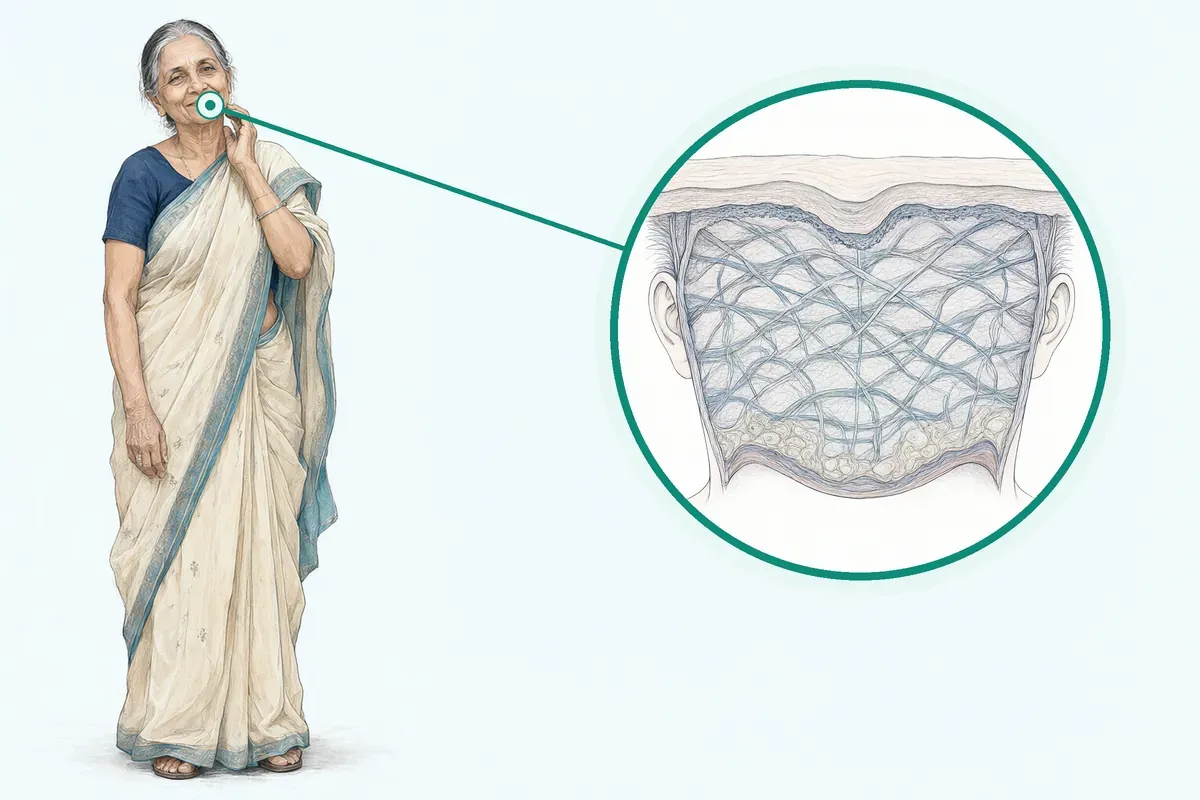
Facial changes happen as skin loses collagen and underlying tissues shift over time.
-
Loss of collagen
Decreased collagen leads to loose skin and reduced volume over time.
-
Dynamic lines
Muscle movements can create persistent lines across the forehead or around eyes.
-
Hollows and folds
Volume loss can cause sunken cheeks, thin lips, or deeper folds.
Decreased amounts of collagen in your skin cause skin laxity and loss of volume.
Why Jaipur Hospital
You may worry about pain, unnatural looks, or taking days off from work.
Your care plan
Your first steps with us
- 1 Book an OPD consultation with our surgical team.
- 2 Discuss treatment options and get an estimate.
- 3 Undergo your outpatient procedure with topical anaesthesia.
- 4 Resume daily work with scheduled follow-up visits.
How non-surgical treatments are evaluated and performed
Treatments are outpatient procedures taking 15 to 60 minutes per session.
-
Botulinum Toxin (Botox/Dysport)
Your surgeon will discuss this option for dynamic wrinkles like forehead lines, crow's feet, and frown lines.
-
Hyaluronic Acid Fillers
Your surgeon will discuss this option for volume loss in the cheeks, lips, and nasolabial folds.
-
Fractional CO2 / Erbium Laser
Your surgeon will discuss this resurfacing option for scars, enlarged pores, and skin texture.
-
RF Microneedling / HIFU
Your surgeon will discuss this option for skin tightening and collagen stimulation.
Why patients trust us
- 1991 Serving Jaipur for 35 years
- NABH Accredited hospital
- 1 Plastic Surgery consultants
- 24×7 Emergency, ICU and ambulance
- 25 Cashless schemes and insurers
What research shows about non-surgical facial treatments
-
within 1 week
Studies show most cases of trauma-related swelling after filler injections dissipate within one week.
-
2–3 days
Transient swelling after properly administered filler injections typically resolves within two to three days in clinical reports.
-
3-12 months
Tiny vessels appearing after dermal filler trauma usually fade within three to twelve months without further treatment.
If it is left untreated
As ageing progresses, facial skin becomes thinner, loses elasticity, and continues to sag as structural tissue changes.
What to expect after treatment
Recovery is typically minimal, allowing most people to return to work quickly.
-
Return to normal activity
Most people return to routine activities the same day or the next day.
-
Gradual settling
Mild initial swelling or redness typically settles over a few days.
-
Regular check-ins
Follow-up visits ensure your skin is healing as expected.
Frequently asked questions
Questions patients ask about non surgical aesthetics
Which problems are assessed under non surgical aesthetics?
In short
Non surgical aesthetics at Jaipur Hospital addresses facial ageing signs such as dynamic wrinkles, volume loss, skin laxity, uneven texture, acne scars, and enlarged pores. The service covers treatments for forehead lines, crow's feet, frown lines, hollow cheeks, thin lips, nasolabial folds, and sagging skin. Each concern is evaluated to match the most suitable energy device or injectable option.
In detail
Facial ageing results from a combination of soft tissue and bony changes, with bone loss in specific areas contributing significantly to ageing features. Dynamic wrinkles form from repeated muscle movement and are treated with botulinum toxin.
Volume loss in cheeks, lips, and nasolabial folds is restored using hyaluronic acid fillers that retain moisture. Skin texture, scars, and pores improve with fractional CO2 or Erbium laser resurfacing. Skin tightening and collagen stimulation are achieved through RF microneedling or HIFU. Decreased collagen causes skin laxity and volume loss.
Your next step at Jaipur Hospital
Your first step is a consultation where the surgeon examines your face, discusses goals, and reviews medical history. A customised plan may combine several techniques. Sessions last 15 to 60 minutes with minimal recovery. Typical price range is ₹5,000 to ₹80,000 per session or package.
How will the doctor decide which tests I need?
In short
For non surgical aesthetics at Jaipur Hospital, routine laboratory tests are not usually required before treatment. The surgeon decides on any tests based on your medical history, medications, and planned procedure. If you have a bleeding disorder, take anticoagulants, or have a history of herpes simplex, relevant blood work or antiviral prophylaxis may be advised before injectable or laser sessions.
In detail
Most aesthetic treatments are minimally invasive and do not mandate pre-procedure investigations. However, patients on anticoagulants or supplements that increase bleeding risk may need medication adjustment. A history of frequent herpes recurrences warrants prophylactic antiviral therapy.
Skin type assessment using Fitzpatrick classification guides laser settings to minimise hyperpigmentation risk. The surgeon evaluates these factors clinically; no standard test panel exists for healthy individuals seeking cosmetic rejuvenation.
A common belief
Many assume a full check-up is mandatory, but for healthy adults the clinical assessment is sufficient.
What actually happens
Tests are targeted, not routine, saving you time and cost.
Your next step at Jaipur Hospital
Bring a complete medication list and disclose any medical conditions at the consultation. The surgeon will advise if specific tests are needed for your safety. Most patients proceed without investigations. Sessions last 15 to 60 minutes with minimal downtime.
How soon should I expect improvement after non-surgical aesthetic treatment?
In short
Improvement timing depends on the specific non-surgical aesthetic treatment you receive at Jaipur Hospital. Botulinum toxin typically shows effects within a few days, with full results by two weeks. Hyaluronic acid fillers give immediate volume, though initial swelling may obscure the final look for a few days. Energy-based treatments like fractional laser or RF microneedling produce gradual improvement over weeks as collagen rebuilds.
In detail
Evidence indicates botulinum toxin blocks neurotransmitter release, reducing muscle activity over days. Fillers provide instant volumisation, but HA's hydrophilic nature causes temporary swelling that resolves in 2 to 3 days. Laser and RF microneedling rely on neocollagenesis, which takes weeks to months.
Studies note results are seen right away for fillers and last months to years depending on product and area. Individual variation exists; your surgeon will explain the expected timeline for your plan.
A common belief
A common belief is that all aesthetic treatments work instantly.
What actually happens
Only fillers give immediate volume. Botox needs time to relax muscles. Energy devices work by stimulating your body's own collagen, which takes weeks. Expecting instant final results from every modality leads to unnecessary worry.
Your next step at Jaipur Hospital
After treatment at Jaipur Hospital, you may resume normal activities the same or next day. For botulinum toxin, avoid rubbing the area for 24 hours. For fillers, cold compresses help reduce swelling. Laser treatments may require sun protection and gentle skincare for a week. Follow-up is usually scheduled at two weeks.
Are my expectations realistic for my anatomy and health for non-surgical aesthetic treatment?
In short
Realistic expectations for non-surgical aesthetic treatment at Jaipur Hospital depend on your facial anatomy, skin quality, age, and health. These treatments soften wrinkles, restore volume, and improve texture but do not replicate surgical lifting or stop ageing. Your surgeon will assess bone structure, soft tissue support, and skin elasticity to explain what is achievable. Results vary between individuals.
In detail
Evidence shows facial ageing involves skeletal resorption (maxilla, orbital rims, pyriform aperture) and soft tissue changes. Fillers replace lost volume but cannot reposition ligaments or tighten significant skin laxity. Botulinum toxin treats dynamic lines only, not static etched lines.
Energy devices improve texture and stimulate collagen but have limits in severe laxity. Overfilling can cause unnatural contours, lumpiness, or vascular compromise. Patients with autoimmune conditions, active infections, or on anticoagulants may have higher risks. A thorough consultation aligns goals with what is safely possible.
A common belief
Social media often shows dramatic before-and-afters that set unrealistic standards.
What actually happens
Overfilling creates a puffy, unnatural look. Botox does not fix deep static lines or sagging skin. Lasers cannot tighten severe jowls. Understanding the limits prevents disappointment.
Your next step at Jaipur Hospital
At your consultation at Jaipur Hospital, the surgeon will examine your face, review medical history, and discuss realistic outcomes. Photographs may be taken for planning. You will receive a personalised plan with expected results, limitations, and costs (₹5,000 to ₹80,000 per session or package).
How can I decide whether to seek advice about botulinum toxin treatment?
In short
You may consider botulinum toxin if you have dynamic wrinkles such as forehead lines, crow's feet or frown lines that appear when you move your face. Jaipur Hospital offers a consultation to assess whether this treatment matches your concerns and medical history.
In detail
Botulinum toxin works by temporarily relaxing the muscles that cause dynamic wrinkles. Evidence shows it reduces wrinkles by paralysing the underlying muscles.
A typical session lasts 15 to 60 minutes with topical anaesthesia or none needed, and recovery is minimal so you can return to work the same or next day. The treatment is outpatient and suited for adults who want a non-surgical option for expression lines.
A common belief
Creams and serums cannot reach the muscle layer that causes these lines.
What actually happens
Botulinum toxin works at the source, but it is temporary and needs repeat sessions every few months.
Your next step at Jaipur Hospital
If you notice wrinkles that deepen with facial movement and want a temporary improvement, book a consultation at Jaipur Hospital. The surgeon will examine your facial anatomy, discuss realistic outcomes, and explain the typical price range of ₹5,000 to ₹80,000 per session or package. You can then decide whether to proceed.
How will appearance, function, and realistic expectations be discussed?
In short
At Jaipur Hospital, the consultation begins with a detailed discussion of your concerns, a physical examination of the treatment area, and a review of your medical history. The surgeon explains what the chosen non-surgical treatment can and cannot achieve, using before-and-after photos of similar cases where appropriate. This conversation sets realistic expectations for appearance changes and any functional impact.
In detail
Evidence shows that choosing the right treatment requires guidance from an experienced clinician with thorough understanding of facial anatomy. The surgeon assesses your facial structure, skin quality, and the specific ageing changes — whether dynamic wrinkles, volume loss, or skin laxity.
They explain the typical duration of results: botulinum toxin lasts several months, hyaluronic acid fillers from six months to over two years, and energy-based treatments vary by modality. Potential side effects such as bruising, swelling, or temporary asymmetry are discussed openly.
The surgeon also reviews any medications that may increase bleeding risk. You are encouraged to ask questions and share your goals so the plan aligns with what is safely achievable.
A common belief
Patients often hope one treatment fixes all ageing signs.
What actually happens
In reality, dynamic wrinkles need toxin, volume loss needs fillers, and skin laxity may need energy devices or threads. Combining treatments gives better harmony than over-treating one area.
Your next step at Jaipur Hospital
After the discussion, you receive a personalised treatment plan with the recommended procedure, number of sessions, recovery timeline, and the typical cost range of ₹5,000 to ₹80,000 per session or package. You can take time to consider before booking. To start this conversation, schedule a consultation at Jaipur Hospital by calling the hospital.
Which symptoms should prompt me to see a specialist?
In short
You should see a specialist at Jaipur Hospital if you notice deepening forehead lines, crow's feet, frown lines, hollowing under the eyes or cheeks, thinning lips, prominent nasolabial folds, sagging jawline, rough skin texture, acne scars, or enlarged pores that bother you. These visible changes often reflect underlying collagen loss and volume shifts that non surgical treatments can improve.
In detail
Ageing reduces collagen, causing skin laxity and volume loss. Bone resorption in the midface and pyriform area weakens structural support. Dynamic wrinkles appear from repeated muscle contractions. Volume loss in cheeks and lips results from fat pad descent and bone changes.
Skin becomes thinner and loses elasticity. These changes develop gradually; early assessment allows a wider range of minimally invasive options before changes become severe.
Your next step at Jaipur Hospital
Schedule a consultation when these signs affect your confidence or when you want preventive care. The surgeon will evaluate skin quality, facial proportions, and medical history. Most treatments are outpatient with same-day return to work. Typical cost range is ₹5,000 to ₹80,000 per session.
How will the results change my care plan for non surgical aesthetics?
In short
The results of your assessment at Jaipur Hospital directly shape your care plan by matching each concern to the most appropriate technique. Dynamic wrinkles guide botulinum toxin placement. Volume deficits determine filler type and volume. Skin texture issues select laser or radiofrequency settings. The plan may combine several methods in a staged approach for a balanced outcome.
In detail
Your surgeon analyses the depth and cause of each sign. Deep static lines may need filler plus toxin. Hollow cheeks require deeper structural filler while fine lines need a softer product. Scar depth chooses between fractional ablative and non ablative laser.
Skin laxity grades the intensity of radiofrequency microneedling or HIFU. The plan also considers your downtime tolerance, budget and maintenance preferences. Follow up intervals are set to review effect and adjust volumes.
A common belief
A one size fits all approach often leads to overfilled or frozen looks.
What actually happens
A customised plan respects your natural anatomy and ageing pattern.
Your next step at Jaipur Hospital
You will receive a written summary of the proposed sessions, expected timeline and cost range of ₹5,000 to ₹80,000 per session or package. Most treatments are outpatient with same day return to work. Adjustments are made at review visits.
What should I do if symptoms persist or worsen after non-surgical aesthetic treatment?
In short
If you experience persistent or worsening symptoms after a non-surgical aesthetic treatment at Jaipur Hospital, contact the hospital promptly. Common early effects like mild swelling, bruising, or redness usually resolve within a few days. However, increasing pain, spreading redness, fever, vision changes, or asymmetric swelling may indicate infection, vascular compromise, or delayed hypersensitivity and need urgent assessment.
In detail
Evidence lists several complications that require attention. Infection may present as dark red erythema with burning 2 to 3 days post-procedure. Vascular occlusion can cause a reticular pattern of red or purple discoloration within 1 to 3 days and is an emergency.
Delayed hypersensitivity reactions show induration, erythema, and oedema days to months later and do not respond to antihistamines. Malar oedema after tear trough filler can last months. Hyaluronidase is used to dissolve HA fillers if needed. The treating team at Jaipur Hospital is equipped to evaluate and manage these events.
A common belief
People often wait to see if things improve on their own.
What actually happens
With vascular occlusion or infection, delay can lead to tissue loss or scarring. Delayed hypersensitivity can also mimic infection but needs different treatment. Knowing the warning signs helps you act fast.
Your next step at Jaipur Hospital
Do not massage the area if infection or vascular compromise is suspected. Keep your head elevated and apply cold compresses for bruising or swelling. If you notice vision changes, one-sided weakness, or severe pain, seek immediate medical help. Jaipur Hospital provides 24×7 emergency care.
What qualifications and experience should I look for in the treating surgeon for non-surgical aesthetic treatment?
In short
Look for a surgeon with formal training in facial anatomy and injection techniques, preferably a specialist in plastic surgery, dermatology, or a related field with dedicated aesthetic experience. At Jaipur Hospital, our surgical team includes qualified specialists who perform these procedures regularly. Ask about their training, years of practice with injectables and energy devices, and how they manage complications.
In detail
Evidence emphasises that choosing the right physician is key to safe, natural results. Deep knowledge of facial vascular anatomy reduces the risk of vascular occlusion, blindness, and nerve injury.
Proper technique — such as using cannulas, slow injection, low volumes, and correct plane placement — minimises bruising, lumpiness, and migration. Experience with different filler rheologies and laser settings allows tailored treatment for skin type and concern.
The ability to recognise and treat complications like delayed hypersensitivity, infection, or malar oedema promptly is critical. Jaipur Hospital follows strict sterility and safety protocols.
A common belief
Many people assume any doctor with a medical degree can inject fillers safely.
What actually happens
But facial anatomy is complex; injecting into a blood vessel can cause blindness or skin necrosis. Weekend courses do not replace years of surgical training. Complication management requires experience, not just a certificate.
Your next step at Jaipur Hospital
During your consultation at Jaipur Hospital, ask the surgeon about their specific training in aesthetic medicine, the number of similar procedures they have performed, and their approach to safety. Verify their registration with the appropriate medical council. The hospital is NABH-accredited, ensuring quality standards.
FAQ library
Questions and answers about non surgical aesthetics
When you contact us
Consult our team at Jaipur Hospital
Contact our OPD to schedule an assessment for non-surgical aesthetic care.
- A consultation with a plastic surgeon in the OPD
- Your scans and reports reviewed, with tests done in-house if you need them (laboratory, X-ray and imaging)
- Your options explained in plain words, including whether you need surgery at all
- A cost estimate before you decide
- Help with cashless treatment under RGHS, MAA Yojana, CGHS and empanelled insurers and TPAs
- Follow-up visits after your treatment
Overview
Non Surgical Aesthetics: what to know
What is facial volume loss and wrinkling in non surgical aesthetics
- Collagen loss
- Skin becomes loose, thin, and less stretchy
- Bone loss
- Facial bones shrink and change shape
- Hyaluronic acid fillers
- Gel-like substance that holds moisture
As your body grows older, it naturally begins to lose collagen, which is a structural substance present throughout your skin, muscles, bones, and connective tissues. Less collagen leads to skin laxity, meaning the skin becomes loose, loses its firmness, and begins to thin out. Over time, the skin loses its natural stretch and starts to sag.
At the same time, the bones of your face undergo ongoing changes and bone loss in specific areas, which reduces the underlying support for your soft tissues.
Non surgical aesthetics includes medical treatments such as injectables and skin procedures that restore lost volume and smooth wrinkles without an operation. Dermal fillers are soft, gel-like substances placed just under the skin using a fine needle. Most fillers contain hyaluronic acid, a substance that occurs naturally in human tissue and holds moisture to keep skin hydrated.
In non surgical aesthetics, botulinum toxin is also used to relax muscles that cause dynamic wrinkles when you frown or smile. In the United States alone, more than 3 million people receive dermal fillers each year.
Symptoms of facial ageing and warning signs that need urgent care
- Sudden vision problems
- Weakness or numbness on one side
- Rapid swelling or breathing difficulty
Ageing in the face brings distinct changes to both the surface skin and the underlying shapes.
You may notice:
- Deepening skin folds
- Dynamic lines across the forehead
- Crow's feet near the eyes
- Hollows under the lower eyelids
The area around the lower jaw can develop hollow notches called prejowl concavities, which make jowls look more pronounced. In some people, the corners of the nose recede and the upper lip loses its fullness.
After aesthetic injections, mild skin redness, minor swelling, and small bruises are common and usually settle within 2 to 3 days. However, certain warning signs need urgent medical attention the same day:
- Sudden problems with your eyesight or vision
- Weakness, numbness, discomfort, or pain on one side of your body
- Skin showing a mottled purple or red web-like pattern within 1 to 3 days, which can indicate poor blood supply
- Swelling that spreads rapidly across the face or makes breathing difficult
- Active bleeding, sudden severe pain, or severe hives
- A burning sensation with dark red, spreading skin redness and swelling within 2 to 3 days, which suggests an infection
- Small blisters or crusts around the mouth after a tingling feeling
Causes of facial changes and who is at higher risk of complications
- Bone changes
- Upper jaw angle drops about 10 degrees by age 60
- Medical conditions
- HIV, AIDS, and their medicines can cause marked facial thinness
- Skin tone
- Darker skin (Fitzpatrick IV-VI) more prone to dark patches after needles
- Blood thinners
- Aspirin, warfarin, NSAIDs, vitamin E, fish oil raise bruising risk
Facial ageing comes from a natural mix of changes in your bones and your soft tissues. In the midface, the upper jaw bone resorbs faster than the cheekbone. In studies comparing people younger than 30 years with those older than 60 years, the angle of the upper jaw decreased by about 10 degrees.
The eye socket widens as bone recedes around its edges. The opening of the nasal bone also enlarges as bone recedes over time. In addition, medical conditions such as HIV and AIDS, along with certain medicines prescribed for them, can cause marked facial thinness. People with naturally smaller chins can develop jowls at an earlier age due to less bony support.
Certain people face higher risks when receiving non surgical aesthetics. Patients who have a history of cold sores can experience a flare-up of the herpes virus after injections near the mouth. People with a skin condition called rosacea run a higher risk of prolonged redness.
Darker skin tones, classified as Fitzpatrick skin types IV to VI, have a higher tendency to develop dark patches, known as postinflammatory hyperpigmentation, after needle punctures or skin irritation. Taking medicines that thin the blood, such as aspirin, warfarin, non-steroidal painkillers, or supplements like vitamin E and fish oil, increases the chance of bleeding and bruising under the skin.
Buying unverified products from internet sellers carries severe dangers, as such bottles can contain contaminated substances like hair gel that cause cell death and deep infection.
How facial volume loss is evaluated before non surgical aesthetics
Your evaluation takes place in an outpatient consultation room at Jaipur Hospital.
Your surgeon will review:
- Your medical history
- Any medicines you take
- Previous cosmetic procedures
If you have a history of frequent cold sores around your lips, your surgeon will discuss preventive antiviral medicine before any injection is planned. Choosing the right procedure requires an experienced specialist who has extensive knowledge of facial anatomy and tissue planes.
During the examination, your surgeon carefully checks your skin thickness, facial bone structure, symmetry, and areas of volume loss. Your surgeon will evaluate whether your wrinkles appear only with movement, such as forehead lines, or whether they remain when your face rests. Your surgeon may take photographs and make temporary pen markings on your face to map injection points.
Your surgeon will discuss realistic expectations, the limits of what injectables can achieve, and the common side effects you might see during recovery.
Treatment options in non surgical aesthetics and when surgery is advised
Botulinum toxin
- Dynamic wrinkles
Hyaluronic acid fillers
- Volume loss in cheeks, lips, folds
Laser and energy devices
- Skin texture and tightening
Non surgical aesthetics offers several established methods to refresh the face without incisions. For dynamic lines such as frown lines and crow's feet, botulinum toxin relaxes the underlying muscle. A typical single syringe contains 100 units of botulinum toxin, and small areas may need 5 to 10 units.
For volume loss in the cheeks, lips, or folds beside the nose, hyaluronic acid fillers add shape under the skin. Hyaluronic acid fillers typically last from six months to more than two years, depending on their formula and placement, before your body absorbs them.
Other non surgical options include:
- Fractional CO2 or erbium laser for skin texture
- Radiofrequency microneedling
- High-intensity focused ultrasound for tightening skin layers
Your surgeon will advise which treatment suits your facial anatomy and goals. Sessions typically take 15 to 60 minutes and do not require a hospital stay. Skin numbing cream is usually applied, or local numbing is already mixed into the filler.
Non surgical aesthetics in India typically costs between ₹5,000 and ₹80,000 per session or package, depending on the products used, the number of units, and the areas treated. When facial skin laxity is extensive or skeletal changes cause deep sagging, injectables alone can look unnatural or heavy.
In such situations, your surgeon may advise surgical procedures, such as autologous fat grafting using your own body fat or structural surgical lifting, which require operating theatre care and longer recovery times.
Preparing for non surgical aesthetics procedures
Before your non surgical aesthetics procedure at Jaipur Hospital, you will have a consultation with your healthcare provider. A medical professional will evaluate your areas of concern, discuss your goals, and explain what to expect before, during, and after the treatment. Your healthcare provider will review different product options, discuss risks and benefits, and help you set realistic expectations.
It is important to discuss all medicines and health conditions with your healthcare provider. In studies, factors influencing bruising include age, general physical condition, vascular health, and existing conditions like liver disorders. If you take blood-thinning medicines, anticoagulants, aspirin, warfarin, nonsteroidal anti-inflammatory drugs, vitamin E, or fish oil, these can increase the risk of bleeding and bruising.
In clinical recommendations, taking steps such as stopping blood-thinning medications one week or several days prior to the procedure helps minimise bruising. If you have a history of frequent herpes recurrences around the mouth, your provider may consider preventive antiviral treatment.
Non surgical aesthetics treatments are usually conducted in the outpatient department or doctor's office, so overnight hospital admission is not needed. Fasting is typically not required for these office-based procedures. You may bring your previous medical records and a list of all current prescriptions to your OPD visit. An attendant may accompany you for support.
How non surgical aesthetics procedures are done on the day
- Skin cleaned and marked Provider cleans skin and may mark treatment sites
- Photos taken for records Clinical photographs are taken
- Numbing applied Anaesthetic cream or lidocaine in filler
- Injections given Thin needle or blunt cannula used
On the day of your treatment, your healthcare provider cleans your skin and may mark treatment sites with a pen or marker. They may also take photographs of your face for clinical documentation. To ensure comfort, your healthcare provider may apply an anaesthetic cream or lotion to numb the area.
Anaesthesia is typically topical or not needed, and most hyaluronic acid fillers come premixed with lidocaine to ease discomfort during the injection. Sessions typically take 15 to 60 minutes.
Several treatment options exist in non surgical aesthetics, and your surgeon will advise which suits you:
- Botulinum Toxin (Botox/Dysport): Used for dynamic wrinkles such as forehead lines, crow's feet, and frown lines. The doctor uses a thin needle to inject small amounts into targeted facial muscles without surgical cuts.
- Hyaluronic Acid Fillers: Soft, gel-like substances injected just under the skin or deep near the bone to address volume loss in areas like the cheeks, lips, and nasolabial folds.
- Fractional CO2 / Erbium Laser: Resurfacing treatments aimed at scars, pores, and skin texture.
- RF Microneedling / HIFU: Energy-based procedures designed for skin tightening and collagen stimulation.
During injectable procedures, the doctor uses a thin needle or a blunt cannula to inject small amounts of product under the skin. The needle may cause a mild pinch or sting, but most people do not experience substantial pain. In studies, using blunt cannulas, limiting entry points, injecting slowly, and applying firm compression help reduce tissue trauma and bruising. After the injection, your provider cleans the skin again.
Risks and possible complications of non surgical aesthetics
- Common early reactions
- Mild bruising, swelling, redness settle in 2 to 3 days
- Contour irregularity
- Unevenness, lumps, asymmetry, or product migration from overfilling
- Tyndall effect
- Bluish tint under skin from shallow filler placement
- Prolonged under-eye swelling
- Malar oedema lasting months in some patients
As with any cosmetic procedure that breaks the surface of the skin, non surgical aesthetics procedures carry risks of side effects, though serious complications are rare. Mild bruising, swelling, and transient redness are normal early reactions. Short-term swelling typically settles within 2 to 3 days, and post-traumatic swelling dissipates within 1 week in most cases.
Contour irregularity is the most common complication observed with volumising hyaluronic acid fillers in clinical studies. This includes unevenness, asymmetry, lumps, or product migration, which can occur from overfilling or muscle movement. Overcorrection or shallow placement of particulate fillers can cause a bluish appearance under the skin known as the Tyndall effect.
If an excessive volume of filler is placed in the delicate under-eye area, prolonged swelling known as malar oedema can occur. In a retrospective study of 51 patients who received hyaluronic acid gel in the infraorbital hollows, 12 patients experienced prolonged swelling lasting an average of 5.4 months.
Allergic responses and delayed hypersensitivity reactions can develop days to weeks later, showing:
- Redness
- Firm swelling
- Tenderness
In rare instances, bacterial, fungal, or viral infections occur, presenting with redness, warmth, or pus, which may require oral or intravenous antibiotics and drainage if an abscess forms. Inadvertent injection into blood vessels or tissue compression can impede circulation, leading to skin necrosis or, extremely rarely, vision problems and blindness.
Recovery and aftercare for non surgical aesthetics
- Same day or next day Return to desk work and daily activities
- First 24 to 48 hours Avoid vigorous exercise and heavy activity
- While bruising persists Stay out of direct sun
Recovery after non surgical aesthetics procedures is typically minimal, allowing most people to return to regular desk work and daily activities on the same day or the next day. Your healthcare provider may apply a cold compress or give you an ice pack to help ease swelling and pain.
Keeping your head elevated during the procedure and for the first 24 hours can also help limit swelling and bruising.
During the first 24 to 48 hours, your healthcare provider may advise you to take a break from vigorous exercise and heavy physical activity. It is recommended to stay out of the direct sun while bruising persists.
The treated area should not be aggressively massaged or pressed unless specifically instructed by our surgical team, as excessive manipulation can displace filler or worsen swelling. Vitamin K cream may be applied to support the clearance of skin bruising.
You should contact Jaipur Hospital immediately if you develop:
- Worsening pain
- Spreading redness
- Unusual bleeding
- Burning sensation with uneven swelling
If you experience any problems with your eyesight, changes in vision, or weakness and pain on one side of your face or body, seek immediate emergency medical care.
Results and clinical outcomes of non surgical aesthetics
In clinical studies, many patients notice visible changes right away after receiving dermal filler injections. How long the improvements last varies depending on the product used, the injection technique, and the facial area treated. Because every person's anatomy and tissue metabolism are different, individual outcomes vary.
Hyaluronic acid fillers are gradually broken down by natural enzymes and free radicals in the body. In clinical practice, hyaluronic acid fillers can last from 6 months to over 1 year, and some products work for more than 2 years before being absorbed. For botulinum toxin, the treatment relaxes targeted muscles to reduce the look of dynamic wrinkles.
In studies, botulinum toxin effects depend on dosage, and its paralytic activity wears off over time as nerve terminals recover.
Because non surgical aesthetics treatments do not stop the natural ageing process, repeat treatments are generally needed to maintain facial volume and wrinkle reduction. If subtle irregularities appear 1 to 2 weeks after treatment as initial swelling subsides, your healthcare provider can evaluate them during a follow-up visit.
For hyaluronic acid fillers, an enzyme called hyaluronidase can be injected if a patient requires the filler to be dissolved due to lumps, unevenness, or adverse events.
Cost and insurance in Jaipur for non surgical aesthetics
At Jaipur Hospital, non surgical aesthetics treatments typically range from ₹5,000 to ₹80,000 per session or package. The total cost varies based on several clinical factors, including the specific procedure chosen, the brand and formulation of injectable used, the number of syringes or units required, and the size of the facial area being addressed.
In India, botulinum toxin typically costs between ₹400 and ₹500 per unit, with the overall cost of a botox procedure ranging between ₹7,000 and ₹21,000, and an average cost of ₹14,000.
Specific areas require different unit quantities: for example,:
- Treating crow's feet typically requires 24 to 30 units and costs ₹8,000 to ₹10,000
- Forehead lines require 8 to 10 units and cost ₹2,800 to ₹4,000
- Glabella lines require 12 units and cost ₹4,000
- Bunny lines require 4 to 8 units and cost ₹1,500 to ₹3,000
- A gummy smile requires 2 to 6 units and costs ₹5,000
- Treating upper face wrinkles or the jawline requires 50 to 60 units and costs ₹17,000 to ₹20,000
Elective cosmetic treatments are generally not covered by standard health insurance policies. However, Jaipur Hospital is empaneled with government health schemes such as RGHS, MAA Yojana, and CGHS, alongside a panel of private insurers and Third Party Administrators (TPAs) for medically indicated admissions and procedures covered under those plans. You can visit our OPD consultation to discuss your treatment goals and ask us for an estimate.