

Sports Injury · Jaipur Hospital
AC Joint Injury Surgery in Jaipur
Shoulder separation pain and weakness; Jaipur Hospital offers clear assessment and a treatment plan.
- Serving Jaipur since 1991 (35 years)
- NABH accredited
- 24×7 emergency & ICU
- Cashless: MAA Yojana + 32 insurers
- Operation time
- 1 to 1.5 hours
- Anaesthesia
- General or regional anaesthesia
- Recovery
- Sling 4 to 6 weeks, contact sports 4 to 6 months
- Price
- ₹80,000 to ₹1,80,000typical range in India; ask us for an estimate
Shoulder separation limits daily life
A fall leaves your shoulder painful, weak and visibly uneven
A direct blow or fall onto the shoulder can tear the ligaments that hold the collarbone to the shoulder blade. The joint may sit higher than normal, causing pain with overhead movement and a visible bump.
-
Pain with overhead use
Lifting the arm above shoulder height becomes painful and weak.
-
Visible bump on top
The collarbone sits higher than the other side and does not settle.
-
Sleep disturbed
Lying on the affected shoulder is uncomfortable or impossible.
-
Work and sport paused
Manual tasks and contact sports must be avoided while the joint is unstable.
AC joint injuries account for 40% of shoulder injuries following trauma.
Why Jaipur Hospital
You worry the bump will stay, the pain will not settle, and time off work or sport will stretch longer than you can afford.
Your care plan
Your first steps with us
- 1 Call or visit OPD for specialist assessment
- 2 Review scans and decide if surgery is needed
- 3 Admit for operation and one to two nights stay
- 4 Follow sling and physiotherapy plan for four to six months
How the operation is done
Surgery restores the collarbone to its normal position and reconstructs the torn ligaments using sutures, buttons or a graft. The procedure takes one to 1.5 hours under general or regional anaesthesia.
-
Arthroscopic AC Joint Fixation
Keyhole surgery using a suture-button device to hold the collarbone down while ligaments heal.
-
Open Reduction Internal Fixation
A small incision to place a metal plate or hook plate across the joint for stability.
-
Coracoclavicular Ligament Reconstruction
A tendon graft from your own tissue or a donor rebuilds the torn ligaments in chronic cases.
-
Distal Clavicle Excision
Removing the end of the collarbone for late arthritis or when earlier fixation has failed.
Why patients trust us
- 1991 Serving Jaipur for 35 years
- NABH Accredited hospital
- 1 Sports Injury consultants
- 24×7 Emergency, ICU and ambulance
- 33 Cashless schemes and insurers
What research shows about this treatment
-
4 to 6 months to unrestricted activity
Most patients in studies returned to full activity including contact sport between four and six months after surgical reconstruction.
-
Significant pain reduction
Studies report visual analogue pain scores dropping from a preoperative mean of 5 to 8 down to 0.5 to 1 at follow-up.
-
Revision rate around 10%
In one series 10 out of 54 patients needed revision surgery, five due to early wound healing problems.
If it is left untreated
Without surgery for high-grade separations the collarbone usually remains displaced, which can lead to ongoing pain, weakness overhead and early arthritis from joint surface wear.
Life after treatment
Most people regain shoulder strength and return to work and sport within six months, though full confidence can take longer.
-
Overhead movement returns
Most people lift and reach overhead without the previous pain or catching.
-
Sleep improves
Lying on the operated side becomes comfortable once the sling is discarded.
-
Sport and work resume
Desk work often resumes in weeks; contact sport clearance usually comes at six months.
-
Bump reduces
The visible prominence decreases as the joint heals in a reduced position.
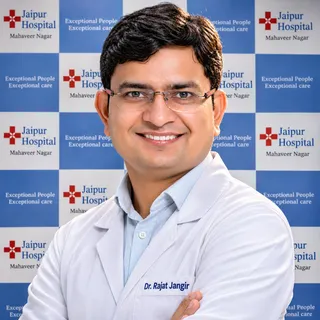
Meet the team
Your sports injury doctors
Explore our sports injury treatment centre in Jaipur: every treatment, the doctors and what to expect at your visit.
Frequently asked questions
Questions patients ask about ac joint injury surgery
What does AC joint injury surgery involve?
In short
AC joint injury surgery at Jaipur Hospital stabilises the acromioclavicular joint after a separation. The operation takes one to one and a half hours under general or regional anaesthesia. Surgeons use arthroscopic or open techniques to reconstruct the torn coracoclavicular ligaments with suture-button devices, plates, or tendon grafts. You usually stay one to two nights.
In detail
The surgeon chooses the technique based on the injury grade and timing. Arthroscopic fixation with a TightRope or suture-button device is common for acute injuries. Open reduction with a hook plate or anatomical plate may be used when bone quality or soft tissue requires it.
For chronic cases, coracoclavicular ligament reconstruction with an autograft or allograft restores stability. Distal clavicle excision is reserved for late arthritis or failed fixation. Studies show both suture-button and tendon constructs give similar biomechanical strength and clinical outcomes.
Horizontal stability improves when additional augmentation is added. Complication rates vary; hook plates and K-wires have higher rates, while suture-button and anatomic reconstructions show lower loss of reduction.
A common belief
Many people think the bump on top of the shoulder is just cosmetic.
What actually happens
In higher-grade injuries the ligaments are completely torn, so the collarbone stays out of place and the shoulder can remain weak or painful without surgical stabilisation.
Your next step at Jaipur Hospital
After surgery you wear a sling for four to six weeks. Gentle pendulum exercises start early. Supervised range of motion begins at six weeks, strengthening at three months, and contact sports at four to six months.
Most people drive by six weeks and return to desk work sooner. The surgical team will give you a detailed rehabilitation plan.
Which tests and scans do I need before AC joint injury surgery?
In short
Before AC joint injury surgery at Jaipur Hospital you need weight-bearing X-rays of both shoulders to grade the injury on the Rockwood scale. An MRI is often added to assess the coracoclavicular ligaments, rotator cuff, and labrum. Routine pre-operative blood work, ECG, and chest X-ray are done for anaesthesia safety. The hospital has in-house X-ray and laboratory; MRI is performed at an outside imaging centre and the surgeon reviews the report.
In detail
Standard radiographs include anteroposterior, axial, and Zanca views. Holding a weight in the affected hand during the X-ray makes the displacement more obvious, which helps separate grade 3A from 3B.
MRI is not mandatory for every case but is useful in chronic injuries or when associated soft tissue pathology is suspected. The European evidence notes that MRI aids treatment planning in severe dislocations.
Blood tests typically cover haemoglobin, coagulation profile, blood sugar, renal and liver function, and infectious markers. ECG and chest X-ray screen for cardiac or pulmonary conditions that could affect anaesthesia. All imaging and lab results are reviewed by the anaesthesia and surgical teams before the operation.
A common belief
A plain X-ray without weight can underestimate the displacement.
What actually happens
Holding a weight during the X-ray shows the true gap between the collarbone and acromion, which changes the grade and the treatment plan.
Your next step at Jaipur Hospital
Arrange the MRI at a centre of your choice a few days before the surgical review. Bring the films and reports to the pre-operative appointment. The anaesthetist will go through your blood work and ECG. If you take blood thinners or diabetes medicines, the team will give specific stopping instructions.
How painful is AC joint injury surgery and the early recovery?
In short
You will have discomfort after AC joint injury surgery, and the surgical team at Jaipur Hospital manages it with regular medication. The operation takes one to one and a half hours under general or regional anaesthesia, so you feel nothing during the procedure itself.
In detail
After surgery the shoulder is swollen and the incision site is sore. Most patients need prescribed pain relief for the first week, then reduce the dose as the ache lessens.
A sling protects the repair for four to six weeks, and you may remove it for gentle elbow, wrist and finger exercises three times a day. Ice packs help control swelling in the early days.
A common belief
Many people expect the pain to be severe for weeks, but most find it manageable with tablets and ice.
What actually happens
The sling stays on for four to six weeks to protect the repair, and you start gentle hand exercises almost straight away.
Your next step at Jaipur Hospital
Expect to stay one to two nights in hospital. You can usually shower with the waterproof dressing after the first week. Driving is not recommended while the sling is on, typically about four weeks.
Desk work may resume in two to three weeks; heavy duties take twelve to fourteen weeks. Contact sports need six months and a surgeon's clearance.
How long does recovery usually take after AC joint injury surgery?
In short
Recovery after AC joint injury surgery at Jaipur Hospital is staged. You wear a sling for four to six weeks. Desk work often resumes within two to three weeks. Light manual tasks start around eight to ten weeks. Heavy duties and overhead lifting usually wait until twelve to fourteen weeks. Contact sports and unrestricted activity are generally cleared at four to six months, after reassessment of strength and control. Most patients drive at about six weeks once the sling is off and arm control is safe.
In detail
Studies report functional scores (CMS) improving from preoperative means of 31.8 to 99.5, 57.7 to 96.6, and 62.3 to 94.5 across different series. Pain scores (VAS) drop from 5.1 to 0.7 and from 7.9 to 0.7 at twelve months.
Biomechanical testing shows constructs are stable immediately, but biologic healing of ligaments and scar tissue takes months. Grade 1 injuries without surgery settle in two to three weeks; grade 2 takes six weeks to three months.
Surgical recovery is longer because the reconstruction must be protected while biology catches up. Consistent supervised physiotherapy is the single factor within your control that most shortens the timeline.
A common belief
People often confuse wound healing with full recovery.
What actually happens
The incision looks fine at two weeks, but the ligaments inside need months. Rushing back to the gym or sport before four months is a common reason repairs stretch or fail.
Your next step at Jaipur Hospital
Phase one (weeks 1–6): sling full-time, pendulum exercises only, grip and wrist movements. Phase two (weeks 6–12): sling weaned, supervised range-of-motion, scapular strengthening. Phase three (months 3–4): progressive strengthening, gym work without overhead press.
Phase four (months 4–6): overhead pressing, contact sport drills, full clearance after reassessment. Lower-body exercise can continue throughout. Return to driving when you can control the wheel safely with both hands.
Which structures are injured in an AC joint injury and how severe is the damage?
In short
An AC joint injury damages the ligaments that hold the collarbone to the shoulder blade. The acromioclavicular ligaments and the stronger coracoclavicular ligaments can be stretched, partially torn or completely ruptured. Jaipur Hospital uses the Rockwood classification to grade the injury from type I to type VI based on X-ray findings.
In detail
The acromioclavicular joint is a planar diarthrodial articulation between the clavicle and the acromion. It is stabilised by the AC ligaments and the coracoclavicular ligaments, which attach the clavicle to the front of the scapula.
Direct trauma such as a fall onto the shoulder tears these ligaments. The Rockwood system categorises the injury by the direction and degree of displacement seen on radiographs. Type I is a sprain of the AC ligament with the joint in place.
Type II tears the AC ligament and sprains the CC ligaments. Types III to VI involve complete tears of both ligament sets with increasing displacement of the clavicle. Type III is further divided into stable (3A) and unstable (3B) patterns. MRI is often used to assess soft tissue damage in severe dislocations and helps plan treatment.
A common belief
Many people think a visible bump means the joint is dislocated like a ball-and-socket shoulder.
What actually happens
An AC separation is different; the main shoulder joint stays intact while the collarbone rides up because its ligament anchors are torn.
Your next step at Jaipur Hospital
Your surgeon will examine the shoulder, review X-rays and may order an MRI to define the grade. The grade decides whether non-surgical care or surgery is appropriate.
Can I continue any training safely while I recover from AC joint injury surgery?
In short
Yes. Lower body training such as stationary cycling, leg press and bodyweight leg exercises can usually continue early while the arm is in a sling. Upper body training is restricted for the first three months. Jaipur Hospital encourages safe cardiovascular and lower body work to maintain fitness without loading the healing shoulder.
In detail
During the first six weeks the sling protects the reconstruction. You may remove the sling three times a day for active elbow flexion and extension exercises. Simple movement of wrist and fingers is encouraged.
Grip strength can be maintained by squeezing a ball, sponge or putty starting almost immediately after surgery. Lower body work is usually permitted early. Upper body work returns gradually from around three months.
Overhead pressing is the last movement restored, generally between four and six months, because it loads the reconstruction most directly. The most important thing to avoid is placing too much strain on the newly operated shoulder.
Do not over-exert even with non-weight-bearing movements such as extended reaching or rotating the shoulder. Consistent supervised physical therapy shortens recovery more than any other variable.
Patients who follow the phased programme return to full activity sooner than those who push too early or do nothing.
A common belief
A common mistake is stopping all exercise and losing cardiovascular fitness.
What actually happens
Another is sneaking in light upper body work too soon. Both delay recovery. The safe path is structured lower body work plus the prescribed shoulder protocol.
Your next step at Jaipur Hospital
Your physiotherapist will prescribe specific lower body and core exercises that keep the shoulder safe. Upper body progression is guided by clinical healing.
Why might my doctor recommend AC joint injury surgery?
In short
A doctor at Jaipur Hospital may recommend AC joint injury surgery when the separation is severe, the shoulder remains unstable, or non-surgical treatment has not relieved pain and weakness. High-grade injuries (Rockwood type IV, V or VI) usually need surgical stabilisation. Type III injuries that are unstable (type IIIB) or cause persistent symptoms are also considered for surgery.
In detail
The decision is based on the Rockwood classification seen on X-rays and sometimes MRI. Types I and II are generally treated without surgery.
Types IV to VI involve complete ligament tears and significant displacement, so the clavicle cannot heal in the correct position on its own. For type III, the surgeon checks whether the joint is stable (IIIA) or unstable (IIIB).
Unstable type III, ongoing pain, weakness overhead, or a deformity that limits function are reasons to operate.
Evidence shows that most grade I, II and III injuries do not need surgery, but when the deformity is unacceptable or the shoulder collapses, reconstruction gives better functional results. The surgeon also considers your activity level, occupation and whether the injury is acute or chronic.
A common belief
A common belief is that all AC joint bumps need fixing.
What actually happens
In fact, most grade I, II and even many grade III injuries heal well with a sling and therapy. Surgery is reserved for cases where the joint is truly unstable or symptoms do not settle.
Your next step at Jaipur Hospital
If you have a visible bump, pain with overhead activities, or weakness that does not improve with a sling and physiotherapy, see the orthopaedic team. They will grade the injury, discuss the expected recovery with and without surgery, and help you decide.
How should I prepare in the days before AC joint injury surgery?
In short
In the days before AC joint injury surgery at Jaipur Hospital, stop smoking if you can because nicotine slows wound healing. Arrange for an attendant to stay with you during the one to two night admission. Prepare loose button-up shirts that go on easily over the sling. Fill any prescribed pre-operative medications. Confirm the fasting time with the anaesthesia team. Keep the shoulder skin clean and free of cuts or infections.
In detail
Evidence shows smoking impairs tissue healing and increases complication risk. The surgical team will advise stopping nicotine products at least a few weeks before if possible.
You will need someone to drive you home and help with daily tasks while your arm is in a sling for four to six weeks. Practice sleeping with a tri-pillow arrangement to support the back and shoulders. Stock easy-to-prepare meals.
If you take blood thinners, diabetes medicines, or herbal supplements, the anaesthetist will give exact stopping schedules usually discussed at the pre-anaesthesia check. Avoid any skin irritation, sunburn, or cuts over the shoulder area as that can delay the operation.
The hospital provides a waterproof dressing after surgery so you can shower, but you cannot soak in a bath until the wound heals.
A common belief
Many patients forget that the sling makes dressing and washing hard.
What actually happens
Practising one-handed dressing and setting up pillows for sleep before surgery makes the first weeks much easier.
Your next step at Jaipur Hospital
Complete the pre-anaesthesia assessment a few days before the operation. Bring all investigation reports and your regular medicines list. The nursing team will confirm admission time and fasting instructions.
Plan for four to six weeks of sling use, with driving allowed around six weeks once you have control of the operated arm.
What are the common side effects and the less common serious complications of AC joint injury surgery?
In short
Common side effects after AC joint injury surgery at Jaipur Hospital include swelling, bruising around the shoulder and chest, temporary stiffness, and a small scar. A visible bump at the joint often remains but usually becomes less noticeable. Less common serious complications include infection, loss of fixation, clavicle or coracoid fracture, nerve injury, and persistent pain or arthritis.
In detail
Studies report that suture-button constructs can fail by suture rupture, button pull-out, or clavicle fracture through the drill hole. Hook plates and K-wires have higher complication rates. Allograft reconstructions show higher loss of reduction and revision rates, especially without suture-tape augmentation.
Infection rates are low but possible. Some patients develop calcification of the coracoclavicular ligament, degenerative changes, or clavicular osteolysis around implants. Stiffness or frozen shoulder can occur if rehabilitation is delayed.
A common belief
Many people think the bump disappears completely.
What actually happens
Evidence shows it often remains to some degree. Also, hook plates and allografts without extra suture support have higher failure and revision rates. The surgeon chooses the technique to lower these risks for your injury pattern.
Your next step at Jaipur Hospital
The surgical team monitors for infection, wound healing, and fixation stability at follow-up visits. You will wear a sling for four to six weeks and start gentle motion early to prevent stiffness. Contact sports are avoided for four to six months. Report fever, increasing redness, sudden severe pain, or numbness in the hand immediately.
Which symptoms are expected after AC joint injury surgery, and which need urgent medical attention?
In short
Expected symptoms after AC joint injury surgery at Jaipur Hospital include moderate pain for the first week, swelling and bruising around the shoulder and upper chest, stiffness, and a visible bump at the joint that may persist. Some aching during rehabilitation is normal as tissues remodel. Urgent signs are fever above 38°C, increasing redness or discharge from the wound, sudden severe pain not relieved by medication, numbness or cold fingers, and inability to move the fingers.
In detail
Pain is managed with scheduled analgesics for the first week, then as needed. Ice packs reduce swelling. Bruising may track down the arm. Stiffness improves with guided pendulum and range-of-motion exercises. A persistent bump is common, especially in higher-grade injuries.
Evidence shows that loss of reduction presents as increasing deformity or weakness overhead. Infection occurs in a small percentage and needs early antibiotics. Nerve injury is rare but causes numbness or weakness in the hand.
A common belief
Patients often wait too long with a fever or wound change, thinking it is part of healing.
What actually happens
Early infection is easier to treat. Also, a sudden increase in deformity or weakness overhead can mean the fixation has loosened. Both need same-day review.
Your next step at Jaipur Hospital
Take pain medication on time for the first five to seven days. Use ice packs three to four times daily. Keep the sling on except for prescribed exercises. Contact the hospital immediately if you develop fever, wound discharge, sudden severe pain, or hand numbness. The surgical team reviews the wound at one week.
FAQ library
Questions and answers about ac joint injury surgery
When you contact us
Get a clear plan for your shoulder
Contact Jaipur Hospital to have your scans reviewed, understand your options and receive a cost estimate before you decide.
- A consultation with a sports injury specialist in the OPD
- Your scans and reports reviewed, with tests done in-house if you need them (laboratory, X-ray and imaging)
- Your options explained in plain words, including whether you need surgery at all
- A cost estimate before you decide
- Help with cashless treatment under MAA Yojana, various government health care schemes and empanelled insurers and TPAs
- Follow-up visits after your treatment
Overview
AC Joint Injury Surgery: what to know
What is an AC joint injury
- What it is
- Collarbone meets shoulder blade
- How it is graded
- Rockwood type I to VI
- How common
- 40% of shoulder trauma
The acromioclavicular joint, often called the AC joint, is the small joint at the top of the shoulder where the collarbone meets the highest point of the shoulder blade.
It is a planar joint that connects the arm to the axial skeleton and is stabilised by strong coracoclavicular ligaments that run from the collarbone to the front of the shoulder blade. An AC joint injury, also known as a shoulder separation, happens when a fall or direct blow tears or stretches these ligaments.
It does not involve the main ball-and-socket joint of the shoulder. The Rockwood classification grades the injury from type I, a mild sprain with the joint still in place, to type VI, a severe dislocation with complete ligament detachment. In type III injuries the joint is visibly displaced; these are further divided into stable (3A) and unstable (3B) patterns.
AC joint injuries account for about 40 percent of shoulder injuries after trauma and for 9 percent of injuries in collision sports such as football, hockey and lacrosse.
Symptoms and warning signs that need urgent care
- Numb or cold fingers
- Marked arm weakness
- Severe shoulder deformity
- Pain not settling with simple measures
Symptoms vary with the grade of injury.
Common signs include:
- Pain at the top of the shoulder
- Swelling
- Bruising
- A visible bump or step deformity where the collarbone sits higher than normal
- Weakness or pain when lifting the arm overhead or across the body
In grade I and II injuries the bump may be subtle; in grade III and above the collarbone prominence is obvious and usually remains permanently without surgical reconstruction.
Warning signs that should be assessed the same day include numb or cold fingers, marked weakness of the arm muscles, a severe deformity of the shoulder, or pain that does not settle with simple measures. These features suggest a high-grade dislocation (type IV–VI) or associated nerve or vascular injury and warrant immediate evaluation in an emergency department.
Causes and who is at higher risk
- Main mechanism
- Direct fall on outside of shoulder
- Who is affected most
- Young adult males in contact sports
- Modifiable risk
- Smoking slows wound healing
The most common mechanism is a direct fall onto the outside of the shoulder with enough force to tear the ligaments.
Typical examples are:
- A rugby or football player landing hard on the shoulder
- A cyclist falling onto the point of the shoulder
- A similar impact in a road traffic accident
The injury is seen most often in young adult males who take part in contact or high-speed sports. Degenerative changes in the joint can also lead to chronic AC joint pain and instability in older adults. The single largest factor influencing recovery time is the injury grade; each higher grade adds meaningfully to the timeline.
Chronic reconstructions tend to heal more slowly than acute repairs. Smoking slows wound healing and is a modifiable risk factor for poorer outcomes.
How an AC joint injury is diagnosed
Diagnosis begins with a detailed history and physical examination. The doctor will ask about the mechanism of injury, review symptoms and examine the shoulder for tenderness, swelling and deformity. A weight-bearing test — holding a weight in the hand — may be used to make the collarbone prominence more obvious. Imaging is essential for grading.
Standard X-rays of both shoulders, often taken while holding a weight, allow comparison and classification using the Rockwood system.:
- Standard X-rays of both shoulders
- Often taken while holding a weight
- Allow comparison and classification using the Rockwood system
In severe dislocations an MRI may be advised to assess soft-tissue damage and help plan treatment. After examination and imaging the doctor may refer you to an orthopaedic surgeon who will confirm the grade and discuss whether surgery is indicated.
Non-surgical treatment and when surgery is advised
Most grade I and II injuries, and many stable grade III (3A) injuries, are managed without surgery.
Non-surgical care typically involves:
- A shoulder sling for immobilisation
- Ice
- Analgesia such as non-steroidal anti-inflammatory medication
- A structured physiotherapy programme to restore range of motion and strength
Pendulum stretches and wall-climbing exercises are started early, followed by muscle-strengthening exercises such as scapular squeezes once pain allows. Many patients regain full function without surgery, although a cosmetic bump may persist. Surgery is generally advised for type IV, V and VI injuries, for unstable type IIIB injuries, and when non-surgical treatment fails to relieve pain or restore function.
The decision also considers the patient's activity demands; a desk worker may tolerate a stable deformity that a contact athlete cannot. Your surgeon will explain the grade of your injury and the options that fit your situation.
Preparing for AC Joint Injury Surgery
Do
- Bring regular medicines and insurance cards
- Wear loose front-opening clothing
Before your operation your surgeon will review your shoulder X-rays and any MRI you have had. The doctor will ask about medicines you take regularly, especially blood thinners, anti-inflammatory drugs, or supplements that can affect bleeding. You may be asked to stop some of these a few days before surgery.
Routine blood tests, an ECG and a chest X-ray are usually done as part of the pre-operative check. If you have other medical conditions such as diabetes or high blood pressure, your physician will make sure they are well controlled.
You will be told when to stop eating and drinking, usually from midnight on the night before the operation. Wear loose clothing that opens at the front so it is easy to put on over a sling afterwards.
Bring:
- Your regular medicines
- Your insurance or scheme cards
- Any imaging films or reports
An attendant should plan to stay with you in the hospital and take you home on discharge.
How AC Joint Injury Surgery Is Done
The operation is performed under general or regional anaesthesia and usually takes one to one and a half hours. Your surgeon will choose the technique that fits your injury pattern, whether the injury is fresh or chronic, and the quality of your ligaments. The main options are:
- Arthroscopic AC joint fixation using a suture-button device such as a TightRope to hold the collarbone in place while the ligaments heal.
- Open reduction and internal fixation with a hook plate or an anatomical plate that is fixed to the collarbone and acromion.
- Coracoclavicular ligament reconstruction using a tendon graft taken from your own body (autograft) or from a donor (allograft), usually for chronic injuries where the native ligaments cannot be repaired.
- Distal clavicle excision, removing a small piece of the end of the collarbone, which may be done for late arthritis or if a previous fixation has failed.
On the day of surgery you will be admitted, changed into a theatre gown, and taken to the operating theatre. After anaesthesia the surgeon makes the necessary incisions, reduces the joint to its normal position, and secures it with the chosen implant or graft. The wounds are closed and a supportive sling is applied before you wake up.
You will spend about an hour in the recovery room until your pain is controlled and your condition is stable, then you are moved to a ward for an overnight stay. Most patients stay one to two nights.
Risks and Possible Complications of AC Joint Injury Surgery
- Loss of reduction
- Collarbone moves out of position again
- Fixation pull-out or suture cut-through
- Implant pulls out or cuts through bone
- Fracture through drill holes
- Clavicle or coracoid fracture
- Wound infection
- Surgical site infection
- Persistent pain or stiffness
- Ongoing symptoms after surgery
As with any shoulder operation there are risks.
In studies, complications have included:
- Loss of reduction where the collarbone moves out of position again
- Fixation pull-out or suture cutting through the bone
- Fracture of the clavicle or coracoid through the drill holes
- Wound infection
- Persistent pain or stiffness
Hook plates and K-wires have been associated with higher complication rates in published series. Allograft reconstructions without suture-tape augmentation have shown higher loss-of-reduction and revision rates. The modified Weaver-Dunn technique has been reported to have one of the highest unplanned reoperation rates. Some patients develop degenerative changes or calcification of the reconstructed ligament over time.
A bump or cosmetic deformity may remain even after successful surgery, and a small number of people continue to have aching with overhead activities. Your surgeon will discuss which risks apply most to your injury type and the chosen technique.
Recovery and Aftercare After AC Joint Injury Surgery
You will wear a sling continuously for the first four to six weeks to protect the reconstruction. In the first week you may remove the sling three times a day for gentle elbow, wrist and hand exercises. Pendulum exercises for the shoulder usually start early. Pain is managed with tablets; ice packs help in the first few days.
The waterproof dressing stays on until the first wound check at about one week. You can shower with the dressing on but should not soak in a bath until the wound is fully healed.
From weeks two to six you begin supervised range-of-motion exercises. The sling is usually discontinued around six weeks, once the arm can be controlled safely. Most people are driving by six weeks and back to desk work sooner. Light manual tasks are possible around eight to ten weeks, heavy duties around twelve to fourteen weeks.
Strengthening of the shoulder and scapular muscles progresses from three to four months. Overhead pressing and contact sports are the last to return, generally not before four to six months, and only after your surgeon confirms excellent strength and coordinated control. Consistent supervised physiotherapy is the factor that most reliably shortens the timeline.
Call the hospital if you develop:
- Increasing pain
- Redness or discharge from the wound
- Fever
- Numbness or colour change in the hand
- If the shoulder suddenly feels unstable
Results of AC Joint Injury Surgery
- 62.3 to 94.5 Constant-Murley Score improvement
- 57.7 to 96.6 Professional athletes Constant-Murley Score
- 45.7 to 90.8 Non-professionals Constant-Murley Score
- Below 1 at one year Pain score (visual analogue scale)
In clinical studies, functional scores such as the Constant-Murley Score have improved markedly after reconstruction. One large series reported a preoperative mean of 62.3 rising to 94.5 postoperatively. Another showed professional athletes improving from 57.7 to 96.6 and non-professionals from 45.7 to 90.8.
Pain scores on a visual analogue scale typically fell from means of 5 to 8 preoperatively to below 1 at one year. Biomechanical testing of suture-button and tendon-graft constructs shows similar stability and load-to-failure strength. Both early and delayed surgical interventions for high-grade dislocations can give equivalent outcomes when appropriate techniques are used.
Autograft and allograft reconstructions have shown comparable clinical results in published series. A small percentage of patients need revision surgery, often for early wound healing problems or loss of reduction. Most people regain full function, although some cosmetic prominence may persist.
Return to pre-injury sport and work levels is common, but manual labourers and high-demand athletes may take longer and a few do not return to the same heavy duties.
Cost and Insurance for AC Joint Injury Surgery in Jaipur
The typical price range for AC joint stabilisation surgery in India is ₹80,000 to ₹1,80,000.
The final cost depends on:
- The technique used (arthroscopic fixation, plate fixation, or ligament reconstruction with graft)
- The type of implant or graft
- The length of hospital stay (usually one to two nights)
- Any additional investigations or physiotherapy sessions
Jaipur Hospital is empanelled under MAA Yojana, various government health care schemes and a panel of private insurers and TPAs. If you are covered under one of these schemes, bring your scheme card and any pre-authorisation letter. The hospital’s insurance desk can help verify coverage and estimate your out-of-pocket amount.
For an estimate specific to your case, contact the hospital on 0141-2551500, 0141-2554139 or 7414 001 001, or email [email protected].
