

Sports Injury · Jaipur Hospital
Achilles Tendon Repair in Jaipur
Torn Achilles tendon? We assess your injury and give a clear treatment plan.
- Serving Jaipur since 1991 (35 years)
- NABH accredited
- 24×7 emergency & ICU
- Cashless: MAA Yojana + 32 insurers
- Operation time
- 60 to 90 minutes
- Anaesthesia
- Spinal or General anaesthesia
- Recovery
- Weight bearing at 6 to 8 weeks, return to sports in 6 to 9 months
- Price
- ₹80,000 to ₹2,00,000typical range in India; ask us for an estimate
Torn tendon stops you moving
A torn Achilles tendon makes walking and pushing off impossible
You may hear a snap, feel a sudden pain in the back of the ankle, and find you cannot stand on tiptoe. A gap may be felt in the tendon.
-
Sudden snap or pop
Often happens during sport or a sudden push-off; you may feel like being kicked in the ankle.
-
Cannot push off toes
Walking becomes difficult; you cannot rise on the ball of the foot on the injured side.
-
Swelling and bruising
The back of the ankle swells and may bruise within hours of the injury.
-
Gap in the tendon
A palpable dent or soft spot appears where the tendon should be firm.
Acute Achilles tendon rupture is one of the most common tendon injuries in adults.
Why Jaipur Hospital
We know you are worried about months off work, the cost of surgery, and whether your ankle will ever feel strong again.
Your care plan
Your first steps with us
- 1 Call or visit OPD for specialist assessment
- 2 Get scans reviewed and a clear treatment plan
- 3 Have surgery with spinal or general anaesthesia
- 4 Follow guided rehab to regain strength and return to activity
How the operation is done
Surgery reconnects the torn tendon ends. The method depends on whether the tear is fresh or old and the size of any gap. Operation takes 60 to 90 minutes under spinal or general anaesthesia with a 1 to 2 night stay.
-
Open Repair (Krackow Technique)
Standard strong suture repair through a posterior incision; often used for acute tears and high-demand patients.
-
Minimally Invasive (PARS)
Smaller incisions with lower wound complication risk; suitable for many acute mid-substance ruptures.
-
V-Y Advancement / Turndown Flap
Used for chronic ruptures with a tendon gap larger than 3 cm to lengthen and reattach the tendon.
-
FHL Tendon Transfer
Augments the repair using the flexor hallucis longus tendon for severe chronic tendinopathy with poor tissue quality.
Why patients trust us
- 1991 Serving Jaipur for 35 years
- NABH Accredited hospital
- 1 Sports Injury consultants
- 24×7 Emergency, ICU and ambulance
- 33 Cashless schemes and insurers
What research shows about this treatment
-
2-5% re-rupture rate after surgical repair
Studies report a low re-rupture rate with surgery compared to higher rates with non-operative care.
-
3-4% infection or wound problem rate
Surgical repair carries a small risk of wound complications, similar between open and minimally invasive techniques.
-
42% of patients developed DVT during immobilisation
In a cohort of 181 patients, deep vein thrombosis was common in the first weeks after surgery and linked to poorer long-term outcomes.
If it is left untreated
Without treatment, a complete rupture often heals in a lengthened position, leading to weak push-off, a limp, and difficulty with stairs or sport. Re-rupture risk is higher with non-operative care.
Life after treatment
Most people regain the ability to walk, climb stairs and return to light sport after completing rehabilitation.
-
Walk without a limp
Most people walk around the house without crutches by week 6 and regain a near-normal gait over several months.
-
Return to daily activities
Desk work often resumes in 1 to 2 weeks; heavy manual work may take 3 to 6 months depending on healing.
-
Play sport again
Many return to recreational sport by 6 to 9 months after passing strength and hop tests guided by physiotherapy.
-
Strong calf and ankle
Guided exercises rebuild calf size and ankle control, reducing the chance of future tendon problems.
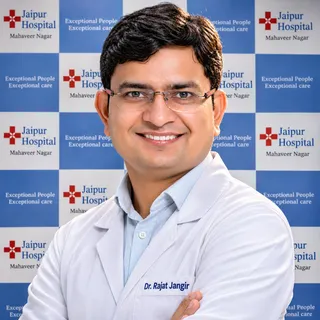
Meet the team
Your sports injury doctors
Explore our sports injury treatment centre in Jaipur: every treatment, the doctors and what to expect at your visit.
Frequently asked questions
Questions patients ask about achilles tendon repair
What does Achilles tendon repair involve?
In short
Achilles tendon repair at Jaipur Hospital reconnects the torn ends of the tendon so you can use your foot normally again. The operation takes 60 to 90 minutes under spinal or general anaesthesia. You usually stay in hospital for one to two nights. The surgeon chooses either an open repair with a posterior incision or a minimally invasive technique with smaller cuts, depending on the tear pattern and timing.
In detail
In open repair the surgeon uses a strong Krackow suture through a single incision at the back of the leg. Minimally invasive repair (PARS) uses several smaller incisions and special instruments to pass sutures, which lowers the risk of wound complications.
For chronic ruptures with a gap larger than three centimetres the surgeon may use a V-Y advancement or a flexor hallucis longus tendon transfer to bridge the defect.
Studies show both open and minimally invasive methods give similar strength and re-rupture rates, while minimally invasive surgery tends to have fewer wound problems. The team does not use robotic or computer-navigated systems for this surgery.
A common belief
Many people think only a large open cut is used.
What actually happens
In fact the surgeon may choose a minimally invasive approach with several small cuts, which reduces wound complications. For old tears with a gap, a tendon transfer or advancement may be needed instead of a simple stitch.
Your next step at Jaipur Hospital
After surgery you wear a cast or boot for six to twelve weeks, initially with the foot pointed downwards. Weight bearing usually starts at six to eight weeks, and return to sport takes six to nine months. You will need regular physiotherapy and follow-up visits.
Which tests and scans do I need before Achilles tendon repair?
In short
Before Achilles tendon repair at Jaipur Hospital you will have a physical examination including the Thompson squeeze test and Matles test. Ultrasound is the first imaging test; it gives a fast, cost-effective view of tendon continuity and gap size. MRI is ordered only for equivocal cases, complex partial tears, or detailed pre-operative mapping. Routine blood tests and a pre-anaesthesia check are also done.
In detail
The Thompson test is positive if no passive plantarflexion occurs when the calf is squeezed. The Matles test is positive if the foot falls into neutral or dorsiflexion instead of slight plantarflexion when the knee is bent to 90 degrees.
Ultrasound confirms the tear and measures the gap, which helps the surgeon choose between open repair, minimally invasive repair, or a more complex reconstruction for gaps over 3 cm. MRI provides detailed soft-tissue mapping when ultrasound is inconclusive or for chronic tendinopathy planning.
A common belief
Some people expect an MRI straight away.
What actually happens
In practice ultrasound is fast, cheaper, and usually enough. MRI is kept for difficult cases or when the surgeon needs a detailed map before a complex reconstruction. The MRI itself is done at an outside centre; our team reviews the images.
Your next step at Jaipur Hospital
All tests can be arranged through our in-house diagnostic laboratory and radiology department (X-ray only; MRI is done at an outside imaging centre and the results are reviewed by our team). The surgeon will explain the findings and the surgical plan.
How painful is Achilles tendon repair and the early recovery?
In short
Achilles tendon repair at Jaipur Hospital is done under spinal or general anaesthesia, so you feel no pain during the operation. After surgery, the lower leg and ankle are swollen and sore for several days. Your surgeon prescribes pain medicine to keep discomfort manageable while the tendon begins to heal.
In detail
The operation takes 60 to 90 minutes. In open repair, a single posterior incision is made; in minimally invasive (PARS) repair, several smaller cuts are used. Both techniques aim for a strong suture repair. Evidence shows wound complication rates are similar between the techniques.
Early pain comes from swelling and the incision. You will feel tired for several days and may have numbness around the cut on the back of your leg. Bruising around the ankle and shin is also common. Regular icing, elevation and the prescribed analgesics usually control the pain well.
A common belief
Many people expect severe, lasting pain, but with regular icing, elevation and the prescribed tablets, most patients find the discomfort manageable.
What actually happens
Open and minimally invasive repairs have similar wound‑complication rates, so the choice of technique does not change the pain profile much.
Your next step at Jaipur Hospital
Expect to stay in hospital for one to two nights. You will wear a cast or walking boot for six to twelve weeks, initially with the foot pointed downward. Weight bearing usually starts after a few weeks as your surgeon advises.
Keep the leg raised above heart level and ice the area for 10 to 20 minutes every one to two hours for the first three days. Take pain medicine as directed.
How long does recovery usually take after Achilles tendon repair?
In short
After Achilles tendon repair at Jaipur Hospital, you will wear a cast or walking boot for six to twelve weeks. Weight bearing typically starts at six to eight weeks. Return to sports usually takes six to nine months. Desk‑based work may resume in one to two weeks; jobs that require standing take six to eight weeks; heavy physical work may need three to six months.
In detail
Rehabilitation follows a phased protocol. Phase 1 protects the repair, controls pain below 3 out of 10 at rest, and reduces swelling by about 30 percent.
Phase 2 progresses weight bearing from toe‑touch at week two to 90 to 100 percent in the boot by week six in a neutral position.
Phase 3 requires standing on the injured leg for ten seconds without wobble, pain 2 out of 10 or less with full weight, and dorsiflexion within ten degrees of the other side.
The Alfredson heel‑raise programme (three sets of 15 repetitions, twice daily) for at least six months is proven to lower tendinopathy risk. Studies show gait symmetry improves gradually, and tendon elongation can occur regardless of treatment.
- Phase 1 protects the repair, controls pain below 3 out of 10 at rest, and reduces swelling by about 30 percent.
A common belief
A common mistake is thinking the tendon is healed when the boot comes off.
What actually happens
In reality, the tendon continues to remodel for many months. Early weight‑bearing protocols are safe, but pushing too hard too soon can stretch the repair. The Alfredson heel‑raise programme for six months is a key part of preventing future tendinopathy, not just an optional extra.
Your next step at Jaipur Hospital
You can shower 24 to 48 hours after surgery if the wound is covered. Keep the leg elevated and ice it regularly for the first three days. Use crutches or a knee scooter until your surgeon allows full weight bearing.
Driving is usually possible at four to six weeks once you are off prescription pain medicine and can control the foot. Attend all follow‑up appointments.
Can an Achilles tendon rupture heal with rehabilitation, or is an operation worth considering?
In short
An Achilles tendon rupture can heal with either rehabilitation or an operation. The choice depends on the tear type, your age, activity level and overall health. Jaipur Hospital offers both pathways and the surgical team will explain which suits you after examining the scan and your goals.
In detail
Evidence shows that non-surgical functional rehabilitation carries an 8 to 12 percent re-rupture rate while surgical repair carries a 2 to 5 percent re-rupture rate and a 3 to 4 percent wound problem rate.
Surgery is typically chosen by athletes under 40, manual labourers or anyone needing maximal push-off strength. Non-surgical treatment is typically chosen by patients over 60, smokers, those with diabetes or vascular disease, and the risk-averse.
Modern early-mobilisation protocols narrow the re-rupture gap between the two options. Your surgeon will discuss the trade-offs so you can decide.
A common belief
Many people think surgery is always stronger, but early-mobilisation rehab now gives similar results for many patients.
What actually happens
The right choice depends on your age, sport, and health, not just the tear.
Your next step at Jaipur Hospital
You will need a boot or cast for 6 to 12 weeks whichever route you take. Weight-bearing usually starts at toe-touch around week 2 and builds to full weight by week 6. Return to sport takes 6 to 9 months after surgery.
Can I continue any training safely while I recover from Achilles tendon repair?
In short
You can maintain upper-body and core fitness while recovering from Achilles tendon repair, but lower-leg loading follows a strict timeline. Non-weight-bearing cardio such as swimming (once the wound is healed) or a hand-cycle may be allowed after the first few weeks. Jaipur Hospital guides you on what is safe at each stage.
In detail
For the first two weeks you are non-weight-bearing with crutches. Toe-touch weight-bearing begins around week 2 and builds to full weight by week 6 in the boot.
During this protected phase you can do seated upper-body weights, core work, and single-leg exercises for the uninjured side. Once the boot comes off and you have full weight-bearing clearance, stationary cycling with low resistance and pool walking can start.
Running, jumping, and heavy lower-body loads wait until strength and hop-test benchmarks are met, usually after 4 to 6 months. The Alfredson protocol (3 sets of 15 heel raises twice daily) for at least six months is proven to reduce tendinopathy risk later.
A common belief
Many patients either stop all exercise or push the leg too soon.
What actually happens
Both hurt recovery. The tendon needs protected loading, not zero load or full load. A structured plan keeps you fit without risking a re-rupture.
Your next step at Jaipur Hospital
Your physiotherapist will give you a weekly programme that protects the healing tendon while keeping the rest of you fit. Return-to-sport testing includes single-leg hop distance, triple hop symmetry, plantarflexion strength, and heel-raise endurance.
Why might my doctor recommend Achilles tendon repair?
In short
Your doctor at Jaipur Hospital may recommend Achilles tendon repair if you are an active person who needs strong push-off strength, such as an athlete under 40 or a manual worker. Surgery lowers the re-rupture rate to about 2 to 5 percent compared with 8 to 12 percent with non-surgical treatment. It also allows earlier weight bearing and rehabilitation.
In detail
Evidence shows surgical repair reduces the risk of re-rupture and restores plantar flexor strength better than cast immobilisation alone. A recent multicentre trial found non-operative treatment had a tenfold higher re-rupture rate.
Surgery is typically chosen by younger, active patients and those whose work or sport demands maximal calf power.
Non-surgical treatment is usually preferred for patients over 60, smokers, people with diabetes or vascular disease, and those who wish to avoid surgical risks such as wound infection, which occurs in about 3 to 4 percent of surgical cases.
A common belief
A boot alone avoids surgical wounds and infection, which happen in about 3 to 4 percent of operations.
What actually happens
For older adults, smokers, or people with diabetes or vascular problems, the non-surgical route is often safer overall. The choice depends on your age, health, and how much push-off strength you need.
Your next step at Jaipur Hospital
The surgeon will assess your age, activity level, medical history and the type of tear. Acute ruptures with a palpable gap (Grade 5) or near-complete tears (Grade 4) often need surgery. Chronic ruptures with a gap over 3 cm may require more complex reconstruction.
How should I prepare in the days before Achilles tendon repair?
In short
In the days before Achilles tendon repair at Jaipur Hospital you should stop smoking or vaping because tobacco slows healing. Arrange for an attendant to stay with you during the one to two night hospital stay and to help at home afterwards. Keep the skin on your lower leg clean and free of cuts or infection. Follow any specific advice from the anaesthetist about your regular medicines.
In detail
Smoking and nicotine products impair wound healing and increase complication rates. The anaesthetist will review your medicines at the pre-anaesthesia check-up and tell you which to continue or pause. You may be asked to stop blood thinners or certain supplements a few days before surgery.
Prepare your home by placing frequently used items within reach, setting up a sleeping area on the ground floor if possible, and arranging crutches or a knee scooter. The hospital provides a walking boot after surgery, but you can bring your own crutches if you prefer.
A common belief
People often forget that smoking delays tendon healing significantly.
What actually happens
Also, many do not realise they will need non-weight-bearing aids like crutches or a knee scooter immediately after surgery, so arranging these beforehand avoids last-minute stress.
Your next step at Jaipur Hospital
Complete any pending blood tests or ECG at least two days before admission. Confirm your fasting time with the nursing staff the evening before. Reach the hospital on the admission time given.
What are the common side effects and the less common serious complications of Achilles tendon repair?
In short
Common side effects after Achilles tendon repair at Jaipur Hospital include swelling, bruising around the ankle and shin, numbness near the incision, and tiredness for several days. Less common but serious complications are wound infection, deep vein thrombosis, re‑rupture of the tendon, and suture‑anchor problems such as pull‑out or persistent heel pain.
In detail
Studies report a surgical re‑rupture rate of 2 to 5 percent and a wound‑problem or infection rate of 3 to 4 percent. Deep infection can occur, sometimes linked to suture material allergy.
DVT was found in 42 percent of screened patients at two or six weeks after surgery in one cohort, and it is associated with poorer long‑term outcomes. Sural nerve injury and skin adhesion were not seen in the compared groups.
Suture‑anchor pull‑out from the calcaneus and knot slippage have been reported with certain percutaneous techniques. Non‑surgical functional rehab carries a higher re‑rupture rate of 8 to 12 percent.
- DVT was found in 42 percent of screened patients at two or six weeks after surgery in one cohort, and it is associated with poorer long‑term outcomes.
A common belief
People often think infection is the main risk, but studies show blood clots occur in a large minority of patients and can affect long‑term strength.
What actually happens
Re‑rupture after surgery is 2 to 5 percent, while non‑surgical treatment has an 8 to 12 percent re‑rupture rate. Suture‑anchor complications are specific to certain techniques.
Your next step at Jaipur Hospital
Watch for increasing pain, warmth, redness, red streaks, pus, fever, calf pain or swelling, a cool or pale foot, tingling or numbness in the toes, bleeding through the bandage, or the cast feeling too tight. Any of these need urgent medical attention. You will have follow‑up visits to check the wound and start rehabilitation.
Which symptoms are expected after Achilles tendon repair, and which need urgent medical attention?
In short
After Achilles tendon repair at Jaipur Hospital you can expect tiredness for several days, swelling and bruising around the ankle and shin, and numbness near the incision. These are normal. Urgent symptoms include increasing pain not relieved by medicine, redness, warmth, pus or red streaks from the wound, fever, calf pain or swelling, a cold or pale foot, tingling or numbness in the toes, chest pain, shortness of breath or coughing up blood.
In detail
Normal postoperative symptoms reflect the surgical trauma and immobilisation. Swelling and bruising often track down to the foot. Numbness around the scar is common because small skin nerves are cut. Warning signs of infection are rising pain, spreading redness, warmth, pus, red streaks and fever.
Deep vein thrombosis shows as calf pain, swelling, colour change or a cool pale foot. Pulmonary embolism presents with sudden chest pain, breathlessness or coughing blood. A tight cast causing worsening pain, numbness or colour change needs immediate loosening. Re-rupture may feel like a sudden snap or loss of push-off strength.
A common belief
Patients often wait too long with a swollen painful calf, thinking it is just post-op swelling.
What actually happens
A blood clot can travel to the lungs and become life-threatening. Any sudden calf pain or breathing trouble needs immediate care.
Your next step at Jaipur Hospital
Keep the leg raised above heart level for the first three days. Use ice packs for ten to twenty minutes every one to two hours while awake. Take all prescribed medicines including blood thinners. Do not remove the cast or boot unless told.
If any urgent symptom appears, go to the emergency department at once. Keep follow-up appointments so the team can check healing.
FAQ library
Questions and answers about achilles tendon repair
When you contact us
Get a clear plan for your Achilles repair
Contact Jaipur Hospital for a specialist assessment, scan review, cost estimate and help with cashless insurance.
- A consultation with a sports injury specialist in the OPD
- Your scans and reports reviewed, with tests done in-house if you need them (laboratory, X-ray and imaging)
- Your options explained in plain words, including whether you need surgery at all
- A cost estimate before you decide
- Help with cashless treatment under MAA Yojana, various government health care schemes and empanelled insurers and TPAs
- Follow-up visits after your treatment
Overview
Achilles Tendon Repair: what to know
What Achilles tendon rupture is and how it happens
- Location
- Back of the ankle, calf to heel
- Function
- Lets you push off when moving
- Healing
- Poor blood supply limits self-repair
The Achilles tendon is the strong cord at the back of your ankle that connects the calf muscles to the heel bone. It lets you push off when you walk, run or jump. A rupture means the tendon has torn, either part way or all the way through. It is one of the most common tendon injuries in adults.
The tendon has a limited blood supply and a complex structure, so it does not heal well on its own after a complete tear.
A sudden force — like pushing off hard in a sport, landing from a jump, or stepping into a hole — can overload the tendon and cause it to snap. People often describe a sharp snap or a feeling like being kicked in the back of the leg.
The tear can be acute, happening within days of the injury, or chronic, when a tear was missed or not treated and the tendon ends have pulled apart and scarred over weeks or months.
Symptoms of Achilles tendon rupture and warning signs that need urgent care
- Chest pain or breathing trouble Shortness of breath, coughing up blood
- Blood clot signs Calf pain, swelling, colour change
- Infection signs Redness, warmth, pus, fever
- Nerve or circulation change Numbness, cool or pale foot
- Wound problems Bleeding, loose stitches, opening
Common symptoms include a sudden snap or pop at the back of the ankle, pain and swelling near the heel, and difficulty pointing the foot downward or pushing off when walking. You may notice a gap you can feel where the tendon should be.
The Thompson squeeze test is positive when squeezing the calf does not make the foot move downward. The Matles test is positive when the foot falls into a neutral or upward position instead of pointing slightly downward with the knee bent.
After surgery, it is normal to feel tired for several days, have swelling in the lower leg and ankle, bruising around the ankle and shin, and some numbness near the incision.
Contact a doctor or go to the emergency department the same day if you notice any of the following:
- Chest pain, shortness of breath, or coughing up blood
- Fainting or loss of consciousness
- Pain that does not improve with pain medicine
- Tingling, weakness or numbness in the foot or toes
- The foot becoming cool, pale or changing colour
- The cast or splint feeling too tight
- Nausea or vomiting with inability to keep fluids down
- Loose stitches or the incision opening
- Bleeding through the bandage
- Pain in the calf, back of the knee, thigh or groin
- Swelling in the leg or groin
- A reddish, purplish or dark brown colour change on the leg or groin
- Signs of a blood clot such as calf pain or swelling
- Signs of infection such as increased pain, swelling, warmth, redness, red streaks, pus, or fever
Causes and who is at higher risk of Achilles tendon rupture
- Athletes and labourers
- Need maximal push-off strength
- Medical factors
- Age, smoking, diabetes, vascular disease
- Medicines
- Fluoroquinolones and steroid injections
- DVT during immobilisation
- Linked to poorer long-term function
The tendon transmits large forces from the calf muscles to the heel and has a relatively poor blood supply, which limits its ability to repair itself. A sudden, forceful stretch of the tendon — common in sports that involve sprinting, jumping or quick direction changes — is the usual cause. Fluoroquinolone antibiotics and corticosteroid injections near the tendon can weaken it and raise the risk of rupture.
People at higher risk include recreational and competitive athletes, especially those under 40, and manual labourers who need maximal push-off strength.
Older age, smoking, diabetes and vascular disease increase the chance of a tear and also make healing slower.:
- Older age
- Smoking
- Diabetes
- Vascular disease
Patients who have a deep vein thrombosis (DVT) during the period of immobilisation tend to have worse long-term function, including lower heel-rise work capacity and lower Achilles Tendon Total Rupture Scores at three years. Calf muscle wasting (hypotrophy) is another independent risk factor for poorer outcomes at three years.
How Achilles tendon rupture is diagnosed: examination and tests
- Bedside tests Thompson squeeze and Matles tests
- Ultrasound first Fast, cost-effective, measures gap
- MRI if needed For unclear ultrasound or complex tears
- X-ray for bone injury Does not show the tendon itself
The doctor will ask how the injury happened and examine the ankle. The Thompson squeeze test and the Matles test are standard bedside checks for a complete tear. A gap in the tendon can often be felt.
Ultrasound is a fast, cost-effective way to see whether the tendon is intact and to measure the gap size. MRI is used when the ultrasound is unclear, for complex partial tears, or for detailed pre-operative planning. X-rays may be taken to rule out a bone injury, but they do not show the tendon itself.
Jaipur Hospital has an in-house X-ray facility; MRI and CT scans are done at an outside imaging centre and the results are reviewed by your surgeon.
Non-surgical treatment for Achilles tendon rupture and when surgery is advised
Non-surgical (conservative) treatment starts with RICE:
- Rest with no weight bearing and crutches
- Ice for 15 to 20 minutes every two hours with a thin towel barrier
- Compression with an elastic wrap from toes to mid-calf
- Elevation
A posterior splint or boot set at 20 to 30 degrees of plantarflexion holds the tendon ends together. Many non-operative programmes allow toe-touch weight bearing (about 10 percent of body weight) from day three if the boot stays locked.
Pain is managed with ibuprofen 400 to 600 mg every six hours with food (maximum 2,400 mg per day) or paracetamol 500 to 1,000 mg every six hours (maximum 3,000 mg per day if no liver disease).
Surgery is typically chosen by athletes under 40, manual labourers, or anyone who needs maximal push-off strength. Non-surgical treatment is often preferred by patients over 60, smokers, those with diabetes or vascular disease, and people who wish to avoid surgical risks.
Surgical repair carries a 2 to 5 percent re-rupture rate and a 3 to 4 percent wound problem or infection rate. Non-surgical functional rehabilitation carries an 8 to 12 percent re-rupture rate. A recent multicentre trial showed the non-operative group had a tenfold increase in re-rupture compared with surgical groups.
Modern early-mobilisation protocols have narrowed the gap in re-rupture rates between surgical and non-surgical care. Your surgeon will discuss which option fits your activity level, health and preferences.
Preparing for Achilles Tendon Repair
Do
- Bring medicine list Include blood thinners and supplements
- Stop eating and drinking At least six hours before operation
- Stop smoking weeks before Helps wound healing, lowers complications
- Arrange attendant Stay in hospital and take you home
- Pack loose clothes Fit over bulky dressing or boot
Your surgeon will explain the operation and ask about your general health. Bring a list of every medicine you take, including blood thinners, aspirin, and any supplements. The anaesthetist will review your medical history and may order blood tests, an ECG, or a chest X-ray before the day of surgery.
These tests are done in our in-house laboratory and radiology department. You will be asked to stop eating and drinking for at least six hours before the operation; clear fluids may be allowed up to two hours before if the anaesthetist agrees.
If you smoke or use tobacco, stopping several weeks before surgery helps wound healing and lowers the risk of complications. Pack comfortable clothes that fit over a bulky dressing or boot, and arrange for an attendant to stay with you in the hospital and take you home afterwards. Our team will confirm the admission time and the consent form on the day before surgery.
How Achilles Tendon Repair Is Done
- Anaesthesia and time Spinal or general, 60 to 90 minutes
- Open repair (Krackow) Single incision, sutures woven through tendon
- Minimally invasive (PARS) Smaller cuts, instruments pass sutures
- Chronic rupture options V-Y advancement, turndown flap, FHL transfer
- After repair Dressing, splint or boot, foot pointed down
The operation takes 60 to 90 minutes under spinal or general anaesthesia. Your surgeon will choose the technique that fits the tear pattern and the time since injury. In open repair (Krackow technique), a single incision is made at the back of the ankle and strong sutures are woven through the tendon ends to pull them together.
In minimally invasive repair (PARS), several smaller cuts are used and instruments are passed through them to place the sutures; this approach is designed to lower the chance of wound problems.
For chronic ruptures where the tendon ends have pulled apart and a gap larger than three centimetres remains, a V-Y advancement or turndown flap may be used to lengthen the tendon and close the gap. In severe chronic tendinopathy, the flexor hallucis longus (FHL) tendon can be transferred to reinforce the repair. Your surgeon will discuss which option suits you.
After the repair, the incisions are closed, a sterile dressing is applied, and the ankle is placed in a plaster splint or boot with the foot pointing downwards to protect the healing tendon. You usually stay in hospital for one to two nights.
Risks and Possible Complications of Achilles Tendon Repair
- 2 to 5 percent Re-rupture
- 3 to 4 percent Superficial wound infection
- 42 percent at two or six weeks DVT on screening ultrasound
- Lower strength and scores at three years DVT linked to poorer outcomes
All operations carry some risk. In studies, surgical repair has a re-rupture rate of about 2 to 5 percent. Wound problems such as superficial infection occur in roughly 3 to 4 percent of cases; most settle with antibiotics. Deep infection is less common but may need a further operation to wash out the wound.
One study noted a deep infection linked to an allergy to non-absorbable suture material. Nerve injury causing numbness or pain along the outer foot (sural nerve) has been reported with percutaneous techniques, though other studies found no sural nerve injuries in either open or minimally invasive groups.
Tendon elongation, where the repaired tendon stretches slightly longer than the other side, can happen with any method and may affect push-off strength. A blood clot in the leg (deep vein thrombosis) occurs in a significant number of patients during immobilisation; in one large cohort, 42 percent had a clot detected on screening ultrasound at two or six weeks.
Having a clot is linked to poorer long-term strength and patient-reported scores at three years. Suture anchor pull-out or knot slippage has been seen in laboratory testing of certain anchor-based systems.
Your surgical team takes steps to minimise these risks: antibiotics at the time of surgery, careful surgical technique, early mobilisation when appropriate, and blood-thinning medication or compression stockings for clot prevention.
Recovery and Aftercare After Achilles Tendon Repair
You will wake up with your leg in a splint or boot holding the foot pointed downwards. Keep the leg raised on a pillow above heart level as much as possible for the first few days to reduce swelling. Ice packs applied for 10 to 20 minutes every one to two hours while awake also help swelling.
You will use crutches or a knee scooter and must not put weight on the operated leg until your surgeon allows it. Pain medicine will be prescribed; take it as directed and tell the team if it upsets your stomach.
The dressing stays clean and dry; you may shower after 24 to 48 hours if the wound is covered with a waterproof sheet. Stitches or clips are usually removed at the first follow-up visit around two weeks.
Weight-bearing typically begins at toe-touch (about 10 percent of body weight) at week two and increases gradually; most patients walk in the boot without crutches by week six.
A structured physiotherapy programme starts early with gentle range-of-motion exercises and progresses to strengthening; the Alfredson heel-raise protocol (three sets of 15 repetitions, twice daily) for at least six months is shown to reduce tendinopathy risk.
Driving is usually possible once you are out of the boot, off strong painkillers, and can control the pedals safely, often around four to six weeks. Desk work may resume in one to two weeks; jobs that require standing take six to eight weeks; heavy manual work may need three to six months.
Contact the hospital straight away if you notice increasing pain, redness, warmth, pus, red streaks, fever, a tight or loose cast, calf pain or swelling, shortness of breath, or chest pain.
Results of Achilles Tendon Repair
In studies, surgical repair lowers the re-rupture rate compared with non-operative treatment; non-surgical functional rehabilitation carries an 8 to 12 percent re-rupture rate, while surgery carries a 2 to 5 percent rate. Early functional rehabilitation with weight-bearing after minimally invasive surgery gives better early functional scores at three months, though at six months the results are similar to traditional rehabilitation.
Open techniques are biomechanically stronger and allow earlier mobilisation while maintaining complication rates similar to minimally invasive methods. Regardless of the technique, minimising tendon gapping and elongation is critical for a good outcome.
At three years, patients who did not have a deep vein thrombosis during immobilisation had better heel-rise work symmetry (78 percent vs 68 percent) and higher Achilles Tendon Total Rupture Scores (median 93 vs 88).
Performance benchmarks for return to sport include single-leg hop distance at least 90 percent of the other side, triple hop symmetry at least 90 percent, plantarflexion strength deficit no more than 10 percent, 25 continuous single-leg heel raises with minimal pain, and Y-Balance test difference within four centimetres.
Most people regain full use of the leg and ankle over several months; how quickly depends on following the rehabilitation programme and how well the tendon heals.
Cost and Insurance for Achilles Tendon Repair in Jaipur
The typical price range for Achilles tendon repair in India is ₹80,000 to ₹2,00,000. The final cost depends on the type of anaesthesia, the surgical technique used, whether implants or suture anchors are needed, the length of hospital stay (usually one to two nights), and any additional investigations or physiotherapy sessions.
Jaipur Hospital is empanelled under MAA Yojana, various government health care schemes, and a panel of private insurers and TPAs; cashless or reimbursement claims can be processed through these schemes. Our admissions team can check your policy coverage and explain the expected out-of-pocket amount before admission.
The hospital has a 24-hour pharmacy, laboratory, and X-ray on site; CT, MRI, and DEXA scans are arranged at external imaging centres when required.
