

Sports Injury · Jaipur Hospital
PCL Reconstruction in Jaipur
Knee giving way after injury? We assess, explain options and give a clear plan.
- Serving Jaipur since 1991 (35 years)
- NABH accredited
- 24×7 emergency & ICU
- Cashless: MAA Yojana + 32 insurers
- Operation time
- 1.5 to 2.5 hours
- Anaesthesia
- Spinal or General anaesthesia
- Recovery
- Return to sports in 9 to 12 months
- Price
- ₹1,80,000 to ₹3,50,000typical range in India; ask us for an estimate
Knee feels unstable
Your knee gives way or feels loose after an injury
A PCL tear often happens when the bent knee hits a dashboard or the ground. You may feel unsteady on stairs, have swelling that comes and goes, or find it hard to trust the knee when you run or turn.
-
Unsteady on stairs
The knee may buckle when you go down steps or slopes.
-
Swelling returns
Effusion appears after activity and settles with rest.
-
Hard to run or turn
Cutting, pivoting or sprinting feels unsafe.
-
Ache deep in the knee
A dull pain behind the knee that worsens with load.
The PCL is the strongest ligament in the knee and provides primary stabilisation for posterior tibial translation.
Why Jaipur Hospital
You worry that the knee will give way at work or on the field, and you do not want a long layoff without knowing the cost upfront.
Your care plan
Your first steps with us
- 1 Call or visit OPD for specialist assessment
- 2 Review scans and decide if surgery is needed
- 3 Have arthroscopic reconstruction with chosen graft
- 4 Follow structured rehab to return to sport
How the operation is done
Arthroscopic PCL reconstruction replaces the torn ligament with a graft. The surgeon makes tunnels in the femur and tibia (or uses an open inlay) and fixes the graft with screws or buttons. Operation takes 1.5 to 2.5 hours under spinal or general anaesthesia.
-
Single-bundle reconstruction
Reconstructs the anterolateral bundle using a transtibial tunnel; standard approach for many isolated tears.
-
Double-bundle reconstruction
Restores both anterolateral and posteromedial bundles anatomically; may improve stability at high flexion.
-
Tibial inlay technique
Open posterior approach places graft directly into the tibial footprint, avoiding a tibial tunnel.
-
Allograft Achilles tendon
Donor tendon used as graft; avoids harvest-site morbidity but may show slightly more laxity than autograft.
Why patients trust us
- 1991 Serving Jaipur for 35 years
- NABH Accredited hospital
- 1 Sports Injury consultants
- 24×7 Emergency, ICU and ambulance
- 33 Cashless schemes and insurers
What research shows about PCL reconstruction
-
Return to pre-injury sport in about 6 in 10 patients
In a comparative study, 58% of transtibial and 63% of tibial inlay patients returned to their previous sport level.
-
Side-to-side laxity improved to around 4 mm
Both transtibial and tibial inlay groups reduced posterior laxity from ~10 mm pre-op to ~4 mm at final follow-up.
-
Graft failure rate below 1 in 400
Only one revision was reported across 445 PCL reconstructions in a systematic review (0.2%).
If it is left untreated
Without treatment, a complete PCL tear can lead to ongoing instability, early wear of the kneecap and inner knee compartments, and a higher chance of osteoarthritis over time.
Life after treatment
Most people regain a stable knee for daily work and light sport after completing the full rehab programme.
-
Stable on stairs
Walking up and down steps usually feels secure by 4 to 6 months.
-
Return to jogging
Straight-line running typically starts around 6 months with guidance.
-
Back to sport
Cutting and pivoting sports often resume between 9 and 12 months.
-
Less swelling
Effusion after activity usually settles as strength returns.
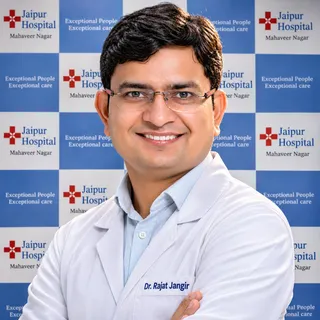
Meet the team
Your sports injury doctors
Explore our sports injury treatment centre in Jaipur: every treatment, the doctors and what to expect at your visit.
Frequently asked questions
Questions patients ask about pcl reconstruction
What does PCL reconstruction involve?
In short
PCL reconstruction at Jaipur Hospital replaces the torn posterior cruciate ligament with a graft. The operation takes 1.5 to 2.5 hours under spinal or general anaesthesia. You usually stay in hospital for 2 to 3 nights. The surgeon uses arthroscopic keyhole techniques, either single-bundle or double-bundle, and may choose a tibial inlay approach depending on your knee.
In detail
The PCL is the strongest ligament in the knee and controls backward movement of the tibia. Reconstruction restores this stability. Evidence shows both single-bundle and double-bundle techniques improve knee function and reduce posterior laxity.
Double-bundle reconstruction restores stability across a wider range of flexion, while single-bundle is the standard anterolateral bundle technique. Graft choices include autografts such as hamstring or patellar tendon, and allografts such as Achilles tendon. Studies report similar patient-reported outcomes and functional scores for both graft types, with no significant difference in revision rates.
A common belief
Many people think one technique fits all, but the surgeon may choose single-bundle, double-bundle, or a tibial inlay approach depending on your knee anatomy and stability needs.
What actually happens
Graft options include your own hamstring or patellar tendon, or a donor Achilles tendon. Studies show both autografts and allografts give similar functional results.
Your next step at Jaipur Hospital
After surgery, you begin a structured rehabilitation programme focused on quadriceps strengthening, range of motion, and proprioception. Return to sports typically takes 9 to 12 months. The typical cost range in India is ₹1,80,000 to ₹3,50,000. Your surgeon will discuss the exact technique and graft suited to you at the consultation.
Which tests and scans do I need before PCL reconstruction?
In short
Before PCL reconstruction at Jaipur Hospital you will need a clinical examination, plain X-rays of both knees, and an MRI scan. The MRI is done at an imaging centre outside the hospital because we do not have an MRI scanner. The surgeon reviews the images to confirm the tear grade, check for other ligament injuries, and assess cartilage condition. Blood tests and a pre-anaesthesia check-up are also routine.
In detail
Standing weight-bearing X-rays show joint space and alignment. Stress X-rays with a Telos device or KT-1000 arthrometer may be used to quantify posterior translation. MRI is the standard for visualising the PCL bundles, menisci, and articular cartilage.
Evidence highlights that accurate tibial tunnel placement relies on understanding the native insertion anatomy, which the MRI helps define. The surgeon also screens for concomitant injuries such as posterolateral corner damage, which would change the surgical plan. All imaging results are reviewed at the pre-operative visit.
A common belief
Patients sometimes assume the hospital does the MRI on site.
What actually happens
Jaipur Hospital has X-ray but no CT or MRI scanner, so the scan is done externally and the images are brought back for the surgeon to review.
Your next step at Jaipur Hospital
Arrange the MRI at a convenient imaging centre and bring the films and report to your pre-operative appointment. Blood work can be done at our in-house laboratory. The anaesthesia team will see you for a fitness assessment.
How painful is PCL reconstruction surgery and the early recovery?
In short
PCL reconstruction at Jaipur Hospital is performed under spinal or general anaesthesia, so you feel no pain during the operation. After surgery, discomfort is managed with a planned pain-relief programme that includes regular medication and ice therapy. Most patients describe the first few days as moderately sore rather than severe.
In detail
The operation takes 1.5 to 2.5 hours. Anaesthesia blocks sensation completely during surgery. Once the anaesthetic wears off, the surgical team starts a multimodal analgesia plan that typically combines paracetamol, an anti-inflammatory drug and a short course of opioid tablets for breakthrough pain.
Cold packs and leg elevation help control swelling, which is the main driver of early discomfort. Evidence from rehabilitation guidelines shows that early quadriceps activation and controlled movement reduce stiffness and lower pain scores over the first two weeks. You will use crutches and a knee brace for protected weight-bearing, which also limits strain on the healing graft.
A common belief
Many people expect severe, uncontrolled pain after knee ligament surgery.
What actually happens
In reality, a structured medication schedule and early movement keep pain manageable for most patients, and strong opioids are usually needed for only a few days.
Your next step at Jaipur Hospital
Expect the strongest soreness in the first 48 to 72 hours, then a steady improvement. Take prescribed medicines on schedule, not only when pain spikes. Keep the leg elevated above heart level when resting. The physiotherapy team will guide gentle range-of-motion exercises from day one. Most patients switch to oral tablets only by the time of discharge, usually after two to three nights.
How long does recovery usually take after PCL reconstruction?
In short
Recovery after PCL reconstruction at Jaipur Hospital is a phased process. You stay in hospital for two to three nights. Crutches and a brace are used for several weeks. Return to desk work is possible around four to six weeks. Full return to sports typically takes nine to twelve months, guided by strength and stability milestones.
In detail
The first two weeks focus on wound healing, swelling control and regaining full extension. Protected weight-bearing progresses as the graft heals into the bone tunnels.
Evidence from rehabilitation guidelines stresses quadriceps strengthening throughout, with plyometrics and sport-specific drills introduced only after adequate strength and proprioception return. Studies report mean follow-up periods of 45 to 148 months, showing that patients continue to improve well beyond the first year.
Residual mild laxity under 10 mm occurs in about 25 percent of patients but often does not affect function. Osteoarthritis changes appear in roughly 30 percent at long-term follow-up, similar between techniques. The timeline varies with age, graft choice, associated injuries and how consistently you follow the physiotherapy programme.
- Residual mild laxity under 10 mm occurs in about 25 percent of patients but often does not affect function.
- Osteoarthritis changes appear in roughly 30 percent at long-term follow-up, similar between techniques.
A common belief
People often think the knee is ready once the wound heals.
What actually happens
The graft needs months to turn into a living ligament, and pushing sport too early is the most common cause of re-injury or persistent laxity.
Your next step at Jaipur Hospital
Plan for at least two weeks off your feet for home recovery, then a gradual return to daily activities. Attend all physiotherapy sessions; they are the main driver of a good outcome.
Do not rush running, cutting or pivoting sports before the surgeon clears you, usually after nine months at the earliest. Regular clinic reviews track graft healing and joint stability.
Can a PCL injury heal with rehabilitation, or is PCL reconstruction worth considering?
In short
Some PCL injuries can heal with a structured rehabilitation programme, especially when posterior knee translation is up to 10 mm. At Jaipur Hospital, the orthopaedic team assesses your knee stability and symptoms before advising whether non‑operative care or arthroscopic PCL reconstruction is appropriate.
In detail
Evidence shows that isolated PCL tears with less than 10 mm posterior translation often respond well to conservative management, including quadriceps strengthening and proprioception training.
Surgery is usually considered when rehabilitation of at least three months fails to restore functional stability, or when the injury is combined with other ligament damage. The decision depends on clinical examination, imaging findings, and your activity demands.
A common belief
Many people assume every ligament tear needs surgery.
What actually happens
In reality, isolated PCL tears often do well with non‑operative care if the knee remains functionally stable. The choice depends on your examination, imaging, and activity goals, not on the tear grade alone.
Your next step at Jaipur Hospital
Your surgeon will examine knee laxity, review imaging, and discuss your sport and work goals. If non‑operative care is chosen, a supervised physiotherapy programme begins immediately. If reconstruction is advised, the typical hospital stay is two to three nights.
Can I continue any training safely while I recover from PCL reconstruction?
In short
Yes, you can continue modified training during recovery from PCL reconstruction at Jaipur Hospital. Upper-body exercises, core work, and non-weight-bearing cardiovascular activities (such as swimming with a pull buoy or upper-body ergometer) are usually safe once wounds heal. Lower-body loading follows a strict phased protocol guided by your physiotherapist.
In detail
Rehabilitation emphasises restoring function while mitigating swelling and pain. Early phases protect the graft with restricted weight-bearing and brace use. As healing progresses, you add stationary cycling, then progressive resistance for the quadriceps and hamstrings. Studies stress quadriceps strengthening throughout recovery.
Plyometrics and sport-specific drills come only after strength and neuromuscular milestones are met. The surgeon and physiotherapist define what is safe at each stage based on your graft healing and clinical exam.
A common belief
Many patients either stop everything or push too hard on the leg.
What actually happens
Both are wrong. Complete rest loses fitness; uncontrolled loading risks the graft. The safe middle ground is a structured cross-training plan approved by your surgeon and physio.
Your next step at Jaipur Hospital
Discuss your current training routine at the consultation. The team will design a cross-training plan that maintains fitness without compromising the graft. You will receive clear guidelines on what to do and avoid each week.
Why might my doctor recommend PCL reconstruction?
In short
Your doctor at Jaipur Hospital may recommend PCL reconstruction if you have a complete tear with persistent instability after trying non-operative treatment. Surgery is considered when the knee gives way during daily activities or sport, or when posterior translation exceeds 10 mm on examination. The aim is to restore stability and protect the joint from long-term wear.
In detail
The PCL is the strongest ligament in the knee and controls backward movement of the tibia. High-energy trauma such as a dashboard injury or a fall on a bent knee typically causes the tear.
Evidence shows that isolated PCL injuries with up to 10 mm of posterior translation can be managed conservatively with structured rehabilitation. However, patients who fail three months of rehabilitation with ongoing functional disability and instability are candidates for surgery.
Studies report that both single-bundle and double-bundle reconstructions improve stability and patient-reported scores, with double-bundle offering better control at higher flexion angles.
A common belief
A common belief is that every PCL tear needs surgery.
What actually happens
Evidence shows many isolated tears do well with bracing and quadriceps strengthening alone. Surgery is reserved for those who still have giving-way episodes or marked laxity after at least three months of dedicated rehab.
Your next step at Jaipur Hospital
If your knee feels unstable despite completing a supervised physiotherapy programme, the surgeon will assess laxity with clinical tests and possibly a stress X-ray. A decision for surgery is made jointly after reviewing your activity goals.
How should I prepare in the days before PCL reconstruction?
In short
In the days before PCL reconstruction at Jaipur Hospital, stop smoking, keep the skin clean, and do the pre-hab exercises your physiotherapist gives you. Arrange an attendant for the two to three night stay. Complete all blood tests and the anaesthesia review. Confirm the MRI films are ready for the surgeon.
In detail
Evidence highlights quadriceps strength and range of motion before surgery as predictors of better recovery. Pre-hab reduces swelling and improves muscle control. Stop blood thinners, herbal supplements, and NSAIDs as advised by the anaesthetist — usually five to seven days before.
Wash the leg with antiseptic soap the night before. Fast from midnight for a morning operation. The hospital provides a pre-admission checklist at the OPD visit.
A common belief
Many patients rest completely before surgery.
What actually happens
Evidence shows pre-hab — active quad work and swelling control — leads to faster recovery. The surgeon will give you a specific exercise sheet.
Your next step at Jaipur Hospital
Reach the admission desk on the scheduled morning with your attendant, ID, insurance papers, and investigation reports. The nursing team will verify consent and mark the surgical site.
What are the common side effects and the less common serious complications of PCL reconstruction?
In short
Common side effects after PCL reconstruction at Jaipur Hospital include swelling, bruising around the knee and thigh, temporary numbness near the incision sites, and stiffness that improves with physiotherapy. Serious complications are uncommon; studies report a graft failure rate of about 0.2 percent and low rates of infection or deep vein thrombosis.
In detail
Swelling and bruising are expected because the surgery involves tunnels in the tibia and femur and a posterior approach in some techniques. Numbness over the front of the knee can occur from small skin nerves being divided; it usually fades over months.
Stiffness is addressed by early guided motion. Evidence from large series shows no difference in anterior knee pain or revision rates between single-bundle and double-bundle methods.
The tibial inlay technique tends to have slightly more perioperative complications than the transtibial technique, so the surgeon will discuss which approach suits your anatomy. Graft failure is rare; one revision in 445 procedures was reported in a pooled analysis. Infection and blood clot rates remain low with standard prophylaxis.
A common belief
Patients often worry that the graft will tear or the knee will stay unstable.
What actually happens
Data from hundreds of cases show that modern techniques and careful rehabilitation keep major complication rates very low.
Your next step at Jaipur Hospital
Apply ice packs regularly for the first two weeks and keep the leg elevated. Perform the prescribed range-of-motion exercises to prevent stiffness. Watch for increasing redness, warmth, wound discharge, fever, or calf pain and swelling; report these immediately. Attend all follow-up appointments so the team can check graft healing and joint stability.
Which symptoms are expected after PCL reconstruction and which need urgent medical attention?
In short
Expected symptoms after PCL reconstruction at Jaipur Hospital include moderate pain, swelling around the knee and thigh, bruising that may track down the leg, stiffness especially in the morning, and numbness over the front of the knee. These improve steadily with elevation, ice and exercises.
In detail
Pain that is not controlled by prescribed medication, swelling that suddenly increases or makes the calf tight and tender, redness or heat spreading from the wounds, any discharge or foul smell, fever above 38.5°C, and sudden inability to bear weight or move the knee are warning signs.
They may indicate infection, deep vein thrombosis, graft disruption or compartment syndrome. Evidence shows graft failure is rare (about 0.2 percent) but usually presents as giving way or renewed instability after a fall. Infection and blood clots are also uncommon but require immediate treatment.
Numbness over the shin or foot, colour change or coldness of the foot suggests vascular or nerve injury and needs urgent review.
- Evidence shows graft failure is rare (about 0.2 percent) but usually presents as giving way or renewed instability after a fall.
A common belief
Patients often dismiss calf pain as just soreness, but a tight, tender calf can be a blood clot.
What actually happens
Similarly, a fever after the first 48 hours is not normal and should be checked the same day.
Your next step at Jaipur Hospital
Take pain medicine on schedule for the first week, then as needed. Ice the knee 15 minutes every two to three hours while awake. Keep the leg elevated above heart level. Do the prescribed ankle pumps and quadriceps sets hourly.
If any red-flag symptom appears, call the hospital emergency line or go to the nearest emergency department without waiting for the next clinic visit.
FAQ library
Questions and answers about pcl reconstruction
When you contact us
Get a clear plan and cost estimate
Contact Jaipur Hospital for an OPD consultation with a sports injury specialist, scan review, honest advice on whether you need surgery, a cost estimate and help with cashless schemes.
- A consultation with a sports injury specialist in the OPD
- Your scans and reports reviewed, with tests done in-house if you need them (laboratory, X-ray and imaging)
- Your options explained in plain words, including whether you need surgery at all
- A cost estimate before you decide
- Help with cashless treatment under MAA Yojana, various government health care schemes and empanelled insurers and TPAs
- Follow-up visits after your treatment
Overview
PCL Reconstruction: what to know
What is a PCL injury
- What the PCL does
- Stops the shin bone moving too far back
- Two bundles
- Anterolateral and posteromedial
- How it tears
- High force on a bent knee
The posterior cruciate ligament (PCL) is the strongest ligament in the knee joint and provides primary stabilisation for posterior tibial translation over the femur. It largely consists of two bundles: the anterolateral (AL) and posteromedial (PM) bundles.
A PCL injury happens when a high-energy force pushes the upper shin bone backwards while the knee is bent, such as in a dashboard impact during a road accident or a fall on a flexed knee.
PCL tears can be partial or complete. In studies, sport-specific PCL injuries account for about 1 to 4 percent of knee ligament injuries.
At Jaipur Hospital, our orthopaedics and sports injury team evaluates each injury to decide whether the knee is stable enough for non-operative care or whether reconstruction is needed to restore stability.
Symptoms of a PCL tear and when to seek urgent care
- Cannot bear weight Leg gives way completely
- Knee looks deformed Visible change in shape
- Foot numb or tingling Possible nerve injury
- Foot cold or pale Possible blood vessel injury
- Swelling in minutes May mean bleeding in the joint
Common symptoms include:
- Pain at the back of the knee
- Swelling that appears within hours
- A feeling of instability or the knee giving way
- Difficulty walking or bearing weight
Some people notice a limp or stiffness, especially when going downstairs or squatting. A lump that causes no pain is not typical of an acute PCL tear.
Seek care the same day if you have:
- Inability to put weight on the leg
- Visible deformity of the knee
- Numbness or tingling in the foot
- Cold or pale foot
- Severe swelling that develops within minutes
These signs may indicate a combined ligament injury, vascular injury, or fracture that needs immediate attention. At Jaipur Hospital, the 24×7 emergency department can assess and stabilise such injuries straight away.
Causes and who is at higher risk
- Dashboard impact
- Knee hits dashboard in a crash
- Fall on bent knee
- Common in contact sports
- Direct blow to shin
- Force from front to back
- Women affected too
- About 28 percent in one series
The PCL is typically injured by a high-energy trauma directed posteriorly to the proximal tibia with the flexed knee.
Common mechanisms include:
- Dashboard injuries in motor vehicle collisions
- Falls onto a bent knee during sports
- Direct blows to the front of the shin
People at higher risk include athletes in contact sports such as football, rugby, and kabaddi, as well as riders and drivers in road traffic. Men and women are both affected; in one large series, about 28 percent of patients undergoing reconstruction were women.
Isolated PCL injuries are less common than combined injuries. When other ligaments, the meniscus, or cartilage are also damaged, the knee is more likely to be unstable and may need surgical reconstruction.
How a PCL injury is diagnosed: examination and tests
- Posterior sag test
- Checks for backward sag of tibia
- Posterior drawer test
- At 90 degrees flexion
- KT-1000 arthrometer
- Measures side-to-side translation
- X-ray in-house
- Available 24 hours
- MRI outside
- Done at imaging centre
Diagnosis starts with a clinical examination. The surgeon checks for posterior sag, performs the posterior drawer test at 90 degrees of flexion, and may use a KT-1000 arthrometer to measure side-to-side translation.
X-rays are taken to rule out fractures and avulsion injuries. At Jaipur Hospital, X-ray is available in-house 24 hours a day.
The hospital does not have a CT or MRI scanner; if an MRI is needed to assess the PCL, meniscus, cartilage, or other ligaments, your surgeon will advise it and review the images once they are done at an imaging centre outside the hospital.
Outcome scores such as the Lysholm score, Tegner activity score, and IKDC score are used to grade functional disability and track progress.
Grade I and II injuries (up to 10 mm posterior translation) may be managed conservatively. Grade III injuries (more than 10 mm) with persistent instability after rehabilitation are usually considered for surgery.
Non-surgical treatment and when surgery is advised
- Conservative first
- For grade I and II tears
- Rehab focus
- Motion, strength, proprioception
- Surgery if rehab fails
- After at least three months
- Surgery indications
- Grade III laxity, combined injuries
PCL injuries can be treated conservatively with a structured rehabilitation programme, especially for isolated grade I and II tears. The focus is on restoring range of motion, quadriceps strength, proprioception, and controlling swelling and pain. Return-to-play timelines depend on the patient's sport and level of play.
Surgery is advised when non-operative management for at least three months fails to resolve functional disability and instability. Indications include persistent grade III laxity (posterior translation greater than 10 mm), combined ligament injuries, and symptomatic instability that limits daily activities or sport.
At Jaipur Hospital, the decision for PCL reconstruction is made after a thorough assessment by your surgeon, considering your age, activity level, associated injuries, and response to rehabilitation. The operation is performed arthroscopically under spinal or general anaesthesia and typically takes 1.5 to 2.5 hours, with a hospital stay of 2 to 3 nights.
Preparing for PCL reconstruction
Do
- Pre-anaesthesia check-up History, medicines, allergies reviewed
- Blood tests, chest X-ray, ECG Routine investigations
- Stop blood thinners as told Doctor gives exact timing
- Fast for six hours No food or drink before surgery
- Bring medicines and loose clothes Also crutches if you use them
- Attendant stays 2 to 3 nights Plan for family member
Before the operation you will attend a pre-anaesthesia check-up. The anaesthetist reviews your medical history, current medicines and any allergies. Blood tests, a chest X-ray and an ECG are routine. If you take blood-thinning medicines, your doctor will tell you when to stop them. You must not eat or drink for at least six hours before the scheduled time.
Bring your regular medicines, comfortable loose clothing, and a pair of crutches if you already use them. An attendant should plan to stay with you for the 2 to 3 nights you will be in hospital.
How PCL reconstruction is done
The operation is performed under spinal or general anaesthesia and usually takes 1.5 to 2.5 hours. Your surgeon will discuss which technique suits your knee.
The common options are single-bundle reconstruction, which restores the anterolateral bundle; double-bundle reconstruction, which aims to restore both the anterolateral and posteromedial bundles; the tibial inlay technique, which uses an open posterior approach and avoids a tibial tunnel; and the choice of graft, where an allograft Achilles tendon is frequently used.
Arthroscopic portals are used for the single-bundle and double-bundle methods, while the tibial inlay technique requires a separate posterior incision. The surgeon fixes the graft in tunnels drilled in the femur and tibia, or in a bony trough for the inlay method.
On the day of surgery you are admitted in the morning, taken to the modular operation theatre, and moved to the ward after a short stay in the recovery area.
Risks and possible complications of PCL reconstruction
All operations carry some risk. In studies, no patients experienced graft failure. One revision was reported in 445 procedures, which is about 0.2%. Rates of anterior knee pain and revision surgery were not different between the main techniques.
The tibial inlay technique has been associated with more perioperative complications than the transtibial technique, and surgeons should inform patients of this risk.
Other possible complications include:
- Infection
- Stiffness
- Nerve or blood vessel injury
- Residual laxity
Your surgical team will discuss the risks that apply to your situation.
Recovery and aftercare after PCL reconstruction
- Hospital stay 2 to 3 nights
- Brace and crutches from day one Weight-bearing as advised
- Physiotherapy starts inpatient Continues as outpatient
- Return to sports Typically 9 to 12 months
You will stay in hospital for 2 to 3 nights. Pain is managed with regular medication. A knee brace and crutches are used from day one; weight-bearing instructions depend on the technique used and any additional procedures. Physiotherapy starts while you are an inpatient and continues as an outpatient programme.
The primary focus of rehabilitation is to restore range of motion, strength and proprioception while controlling swelling and pain. Quadriceps strengthening is emphasised throughout the recovery process. Plyometric and sport-specific exercises are added later, guided by your desired sport and level of play. Return to sports typically takes 9 to 12 months.
Contact the hospital if you develop increasing pain, redness or discharge from the wounds, fever, sudden swelling in the calf, or if the knee feels unstable.
Results of PCL reconstruction
In studies, both single-bundle and double-bundle reconstructions improve patient-reported scores and knee stability. Lysholm scores reached 88 to 90 points in one trial. Tegner activity scores improved to between 6 and 7. Side-to-side posterior translation decreased to around 2 to 4 mm. The double-bundle technique showed significantly better posterior stability in that study.
In another series comparing transtibial and tibial inlay techniques, both groups improved from preoperative Lysholm scores in the 50s to similar final scores, and about 60% of patients returned to their pre-injury sport. Residual mild to moderate laxity (less than 10 mm) was seen in approximately 25% of patients across studies.
Degenerative changes on X-ray occurred in roughly 30% of knees at long-term follow-up, with similar rates between techniques. Allograft and autograft reconstructions both produced satisfactory clinical and functional results, although instrumented laxity was slightly higher with gamma-irradiated allografts.
No clinical trial has shown a clear difference in functional scores, laxity, patient satisfaction or radiographs between single-bundle and double-bundle reconstructions at a minimum of two years.
Cost and insurance for PCL reconstruction in Jaipur
The typical price range for PCL reconstruction in India is ₹1,80,000 to ₹3,50,000. The final cost depends on the choice of graft (autograft or allograft), the surgical technique (single-bundle, double-bundle or tibial inlay), the type of implants used, the length of stay, and any additional procedures needed.
Jaipur Hospital is empanelled under MAA Yojana, various government health care schemes and a panel of private insurers and TPAs. The hospital has a 24×7 emergency department, in-house pharmacy, in-house diagnostic laboratory and X-ray, modular operation theatres and an ICU.
For an estimate specific to your case, please contact the hospital on 0141-2551500, 0141-2554139 or 7414 001 001, or email [email protected].
