
Techniques in depth · Knee Replacement
Partial versus total knee replacement: how surgeons choose
Your doctor will explain which option fits your knee.
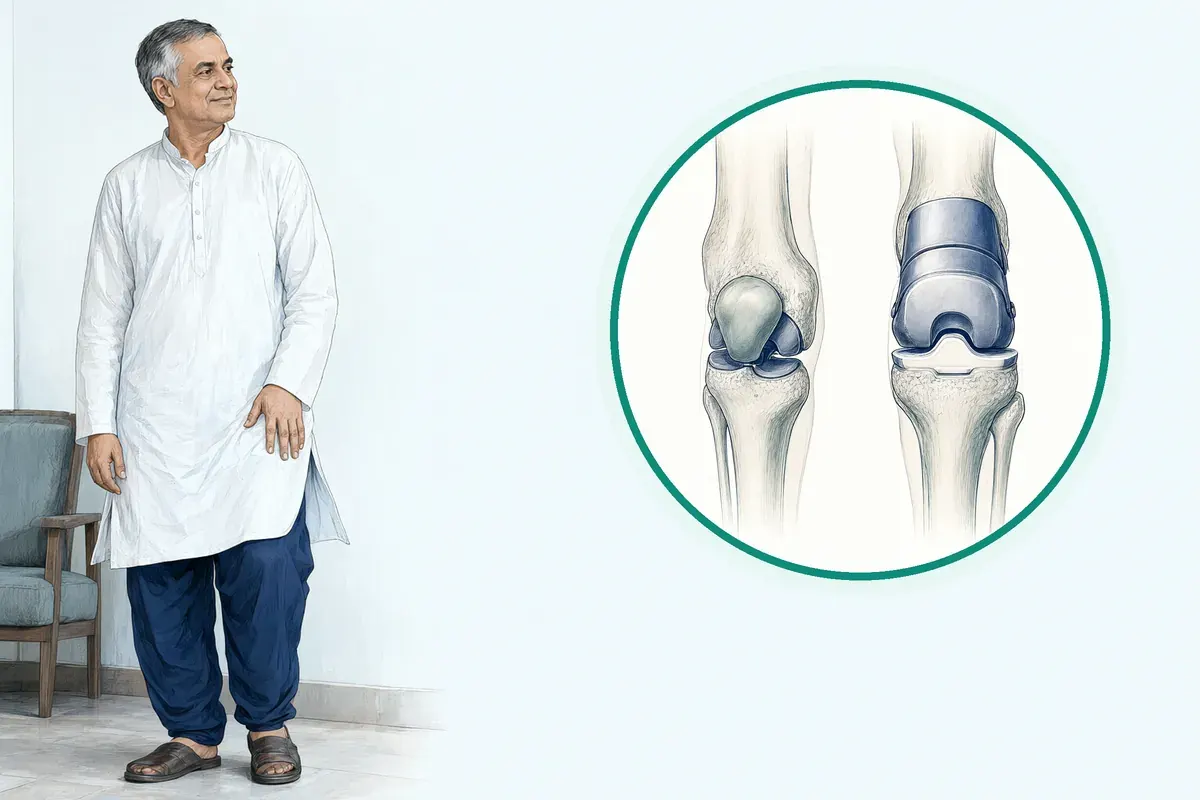
How the knee feels after each operation
Studies report that a partial replacement may bend better and feel more like a normal knee than a total replacement. Most people get good pain relief and improved movement with either operation, but an artificial knee never feels exactly the same as a natural one. Your surgeon will explain what you can expect for your own knee.
Recovery time and hospital stay
Recovery after a partial knee replacement is usually faster. A total knee replacement typically needs a hospital stay of three to five nights. You will walk with an aid in one to two days and return to desk work in four to six weeks.
Full recovery for either operation can take up to a year, though most usual activities resume by six weeks. Your own health, age and home support affect the exact timeline.
Risk of needing another operation later
A partial knee replacement keeps the healthy parts of your knee, but arthritis can develop in those other compartments over time. If that happens, you may need a second operation to change the partial replacement to a total knee replacement. Studies show that many partial knee replacements last 10 years or longer.
A revision operation is usually more complex and recovery can take longer than after the first surgery. Your surgeon will discuss how your age, activity level and the pattern of arthritis affect this risk.
Infection, blood clots and other risks
- Older age
- Increases complication chance
- Overweight
- Increases complication chance
- Smoking
- Increases complication chance
- Diabetes
- Increases complication chance
- Heart or lung disease
- Increases complication chance
Some complications, such as wear or loosening of the implant without infection, may lead to another operation.
People who are older, overweight, smoke, or have diabetes, heart or lung disease have a higher chance of complications.:
- Older
- Overweight
- Smoke
- Diabetes
- Heart or lung disease
Your surgeon will explain which risks apply most to you.
Kneeling, sitting cross-legged and daily activities
Do
- Kneel safely
- Resume usual activities
Avoid
- Expect full bend for kneeling
After a partial knee replacement, the knee may bend better and feel more like a normal knee than after a total replacement. However, an artificial knee never feels exactly the same as a natural one. You are safe to kneel on the new knee, but many people do not have enough bend to kneel comfortably and choose not to.
Most people resume their usual activities by six weeks, though full recovery can take up to a year. Your doctor will guide you on which movements are safe for your new knee.
Questions to ask your surgeon
Ask your surgeon which compartments of your knee are affected and whether your ligaments are intact. Find out why they recommend a total or partial replacement for you. Ask about the expected life of the implant and the chance of needing revision surgery later.
Discuss the typical recovery timeline, when you can walk without aids, and when you can return to work or driving. Ask about the specific risks that apply to your health, such as infection or blood clots. Check whether kneeling or sitting cross-legged is a realistic goal for you. Finally, ask what non-surgical options you have tried and whether any remain.