

Physiotherapy · Jaipur Hospital
Chest Physiotherapy in Jaipur
When chest congestion makes breathing difficult, our specialist team provides an assessment and a clear plan to help clear your lungs.
- Serving Jaipur since 1991 (35 years)
- NABH accredited
- 24×7 emergency & ICU
- Cashless: MAA Yojana + 32 insurers
- Session length
- 30 to 45 minutes per session
- Anaesthesia
- Not needed
- Recovery
- Immediate relief, repeated as needed
- Price
- ₹800 to ₹2,000 per sessiontypical range in India; ask us for an estimate
Struggling to clear chest secretions
When coughing does not clear your chest
After an operation or during a lung illness, sputum can collect in the airways. Coughing may feel weak or painful, making it hard to breathe easily and rest.
-
Sticky mucus in airways
Secretions stay trapped in the chest, causing persistent heaviness and shallow breathing.
-
Difficulty coughing after surgery
Post-surgical discomfort makes it hard to take deep breaths or cough forcefully enough.
-
Shortness of breath
Congestion limits airflow, leaving you feeling tired after minimal physical movement.
Airway clearance techniques are classified as either proximal for cough augmentation or peripheral for secretion mobilisation.
Why Jaipur Hospital
Struggling to catch your breath while worrying about hospital stays and daily costs can feel exhausting.
Your care plan
Your first steps with us
- 1 Consult a specialist physiotherapist in our OPD
- 2 Review your chest reports and medical history
- 3 Learn tailored airway clearance techniques with guidance
- 4 Practise guided breathing exercises for recovery at home
Insurance and schemes
How cashless works
Cashless treatment under MAA Yojana and with 32 insurers.
-
Tell us when you book
Say you are insured or have a scheme card, and send a photo of the card on WhatsApp so our insurance desk can check it in advance.
-
We get the approval
Once your doctor advises admission, the insurance desk sends the pre-authorisation request to your insurer or TPA; for planned surgery, approval can come before you are admitted.
-
Settled at discharge
The approved amount is settled between the insurer and the hospital; you pay only what the policy does not cover.
Techniques for airway clearance
Sessions typically take 30 to 45 minutes without anaesthesia, as an outpatient or inpatient. Your physiotherapist will discuss which options suit your breathing pattern.
-
Percussion and Vibration
Manual clapping on the chest wall helps loosen thick secretions inside the airways.
-
Postural Drainage
Gravity-assisted body positions encourage mucus to drain from specific lung segments.
-
Active Cycle of Breathing Technique
Structured breathing exercises mobilise secretions from lower airways to facilitate coughing.
Why patients trust us
- 1991 Serving Jaipur for 35 years
- NABH Accredited hospital
- 1 Physiotherapy consultants
- 24×7 Emergency, ICU and ambulance
- 32 Cashless insurers, plus MAA Yojana
Clinical findings on chest physiotherapy
-
0.55
In clinical studies, physiotherapy significantly reduced postoperative pulmonary complications with a risk ratio of 0.55.
-
RR 0.62
A meta-analysis found a decrease in pulmonary infection with a risk ratio of 0.62.
-
RR 0.40
A systematic review identified a decrease in lung injury development with a risk ratio of 0.40.
If it is left untreated
Untreated mucus pooling in the lungs can lead to complications such as chest infections or collapse of lung segments, which may prolong hospital stay.
Breathing after structured care
With guided chest therapy, most people notice immediate relief as trapped secretions clear.
-
Easier lung clearance
Most patients learn simple breathing patterns that make clearing mucus less tiring.
-
Steadier breathing
Airways usually stay clearer, supporting better airflow during daily activities.
-
Supported recovery
Attendants and patients usually gain confidence managing home breathing exercises.
Meet the team
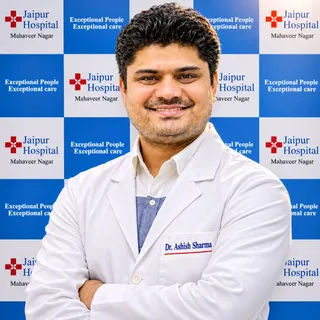
Your physiotherapy doctors
Explore our physiotherapy centre in Jaipur: every treatment, the doctors and what to expect at your visit.
Frequently asked questions
Questions patients ask about chest physiotherapy
What does chest physiotherapy involve?
In short
Chest physiotherapy at Jaipur Hospital uses hands-on techniques to help clear mucus from your lungs. The therapist applies percussion and vibration to loosen secretions, guides you into positions that let gravity drain specific lung segments, and teaches the Active Cycle of Breathing Technique to move sputum toward the larger airways where you can cough it out.
In detail
The three core techniques work together. Percussion and vibration use rhythmic clapping on the chest wall to shake mucus loose from the airway walls. Postural drainage places you in tilted positions so gravity pulls secretions from the outer lung segments toward the centre.
The Active Cycle of Breathing Technique combines breathing control, deep breaths and forced expiratory movements to shift mucus upward. Evidence reviews show these methods can be adapted for different conditions and that physiotherapy reduces postoperative pulmonary complications with moderate certainty.
A common belief
People often think it is just deep breathing.
What actually happens
The hands-on percussion and specific positioning are what move thick secretions that breathing alone cannot shift.
Your next step at Jaipur Hospital
Your surgeon or pulmonologist will decide if chest physiotherapy suits your condition. Sessions last 30 to 45 minutes and may be done as an outpatient or during a hospital stay. The typical cost in India is ₹800 to ₹2,000 per session; ask us for an estimate.
What happens during the first chest physiotherapy session?
In short
The first session at Jaipur Hospital starts with the assessment described above, then moves into treatment. The therapist positions you for postural drainage — often lying on your back, side, or stomach with the head lowered — and applies percussion and vibration over the target lung segments. They then guide you through the active cycle of breathing technique: relaxed breathing, deep breaths, and a huff or cough to clear the loosened mucus.
In detail
Each technique is explained before it is done. The therapist watches your oxygen saturation, comfort, and fatigue throughout. If you are an inpatient, the session may be at the bedside; outpatients attend the physiotherapy department.
Evidence reviews show that combining peripheral secretion mobilisation with proximal cough augmentation clears mucus more effectively than either alone. The therapist adjusts force, duration, and positions based on your response and how much sputum you produce.
A common belief
Many people think it is just breathing exercises.
What actually happens
The hands-on percussion and specific gravity-assisted positions are what actually move mucus from deep in the lungs.
Your next step at Jaipur Hospital
The session lasts 30 to 45 minutes. You may feel tired or cough more afterwards — this is expected. The therapist will advise on home breathing exercises and the next appointment. Typical cost in India is ₹800 to ₹2,000 per session.
How soon should I notice an improvement with chest physiotherapy?
In short
Many people feel their chest is looser and cough more productively after the first few sessions of chest physiotherapy at Jaipur Hospital. Measurable changes in sputum volume, breathlessness on exertion or exercise tolerance usually appear within one to two weeks of regular sessions. The exact timing depends on the underlying lung condition, how much secretion is present and your overall fitness.
In detail
Airway clearance techniques mobilise peripheral secretions toward the central airways and are recommended for specific clinical situations. In surgical patients, physiotherapy reduced postoperative pulmonary complications. Preoperative exercise training improved peak oxygen uptake and maximal inspiratory pressure and shortened hospital stay. Those gains build over days to weeks. Daily practice reinforces the effect; missing sessions slows it.
A common belief
Some expect instant heal.
What actually happens
The techniques move mucus step by step. Skipping days or doing the wrong intensity delays the benefit. Consistency matters more than force.
Your next step at Jaipur Hospital
Track how much sputum you clear, how far you can walk before stopping, and how many pillows you need at night. Share that log with your physiotherapist at each visit. If there is no change after two weeks of daily practice, the plan will be reviewed.
How will breathing, exercise capacity, and oxygen needs be assessed during chest physiotherapy?
In short
At Jaipur Hospital, the physiotherapist assesses breathing, exercise capacity, and oxygen needs at the first visit and at regular intervals. Baseline measurements guide the choice and intensity of airway clearance techniques.
In detail
The assessment includes resting respiratory rate, oxygen saturation on room air, and heart rate. A six-minute walk test or shuttle walk test measures functional exercise capacity and shows how far you can walk before breathlessness limits you.
Spirometry or peak flow may be reviewed if recent results are available. The therapist also uses the modified Borg scale to rate perceived breathlessness and fatigue during activity.
Evidence from preoperative exercise studies shows that peak oxygen uptake and maximal inspiratory pressure improve with training, and that physiotherapy reduces postoperative pulmonary complications with a risk ratio of 0.55. These objective measures help the team set realistic goals and progress the programme safely.
A common belief
Some clinics only ask how you feel.
What actually happens
Without objective walk distance and saturation data, the programme can be too easy or too hard, which delays recovery or risks overexertion.
Your next step at Jaipur Hospital
Wear comfortable clothes and flat shoes for the assessment. Bring any recent pulmonary function test or sleep study reports. The first session takes 30 to 45 minutes and includes the baseline tests. Follow-up reassessments are done weekly or after any change in your condition.
How will the therapist adapt chest physiotherapy treatment to my home, work, and activity goals?
In short
At Jaipur Hospital, the physiotherapist tailors the chest physiotherapy programme to fit your home layout, work schedule, and activity goals. The plan includes clinic sessions and a home routine you can do independently.
In detail
The therapist asks about your bedroom space for postural drainage positions, your typical work hours, and the physical demands of your job.
If you sit at a desk, the home plan emphasises active cycle of breathing technique and seated percussion that can be done during breaks. If your work involves lifting, the therapist adds inspiratory muscle training and teaches pacing strategies.
Evidence shows physiotherapy reduces postoperative pulmonary complications with moderate certainty, and that preoperative exercise training improves functional capacity. The home plan uses simple equipment such as pillows for positioning and a timer for breathing cycles, so no special devices are needed.
A common belief
Generic leaflets assume a spare room and a 9-to-5 day.
What actually happens
Without adapting positions and timing to your real environment, most people stop doing the exercises within a week.
Your next step at Jaipur Hospital
Bring photos of your bedroom and a note of your shift times to the first visit. The therapist will write a weekly schedule with clinic visits and daily home sessions. Sessions last 30 to 45 minutes.
Who is likely to benefit from chest physiotherapy?
In short
Chest physiotherapy at Jaipur Hospital helps people who have trouble clearing mucus from their lungs. This includes patients with chronic lung conditions such as bronchiectasis, cystic fibrosis, or chronic obstructive pulmonary disease, as well as those recovering from chest or abdominal surgery where pain or immobility makes deep breathing and coughing difficult.
In detail
When mucus builds up in the airways, it blocks airflow and raises the risk of infection.
The techniques used here — percussion, vibration, postural drainage, and active cycle of breathing — are designed to mobilise secretions from the peripheral airways and move them to the central airways where they can be expelled.
Evidence reviews classify these as peripheral secretion mobilisation and proximal cough augmentation methods and show they reduce postoperative pulmonary complications. Preoperative exercise training has also been linked to fewer lung complications and shorter hospital stays.
A common belief
Many assume it is only for long-term lung disease.
What actually happens
In reality, it is also standard after major surgery to prevent pneumonia and collapse of lung segments.
Your next step at Jaipur Hospital
Your doctor or surgeon will advise if chest physiotherapy is appropriate for you. Sessions are 30 to 45 minutes and may be outpatient or inpatient. Typical cost in India is ₹800 to ₹2,000 per session.
How long does a chest physiotherapy session last?
In short
A chest physiotherapy session at Jaipur Hospital usually lasts 30 to 45 minutes. This time covers the therapist's hands-on techniques, the positioning for postural drainage, coaching the breathing cycle, and a short rest period while your oxygen saturation and comfort are monitored.
In detail
The 30 to 45 minute window allows enough repetition of percussion and vibration over each targeted lung segment, usually three to five minutes per segment, plus the time needed to settle into each drainage position and complete several cycles of the breathing technique.
Evidence reviews note that airway clearance techniques are adapted for specific contexts, so the exact duration within this range depends on how many lung segments need treatment and how well you tolerate the positions. Shorter sessions may be used for frail patients or those early after surgery.
A common belief
People sometimes think it is a quick five-minute add-on.
What actually happens
Effective secretion clearance needs several minutes per lung segment and time to teach you the breathing cycle properly.
Your next step at Jaipur Hospital
Sessions can be daily during an inpatient stay or two to three times a week as an outpatient. Typical charges in India are ₹800 to ₹2,000 per session; ask us for an estimate.
How will progress be measured during chest physiotherapy?
In short
Progress at Jaipur Hospital is tracked with objective measures: the volume and character of sputum you expectorate, your respiratory rate and oxygen saturation at rest and after exercise, the distance you cover on a six-minute walk test, maximal inspiratory pressure using a handheld manometer, and the number of pillow you need to sleep comfortably. Your physiotherapist records these at each session.
In detail
Evidence recommends objective measurements of efficacy for proximal airway clearance techniques. In studies, physiotherapy lowered postoperative pulmonary complications and preoperative training raised peak oxygen uptake and maximal inspiratory pressure.
Those same metrics — sputum volume, walk distance, inspiratory pressure, oxygen saturation — are used here to show whether the therapy is working. Subjective scores like the Borg breathlessness scale are added for daily tracking.
A common belief
People often go by feel alone.
What actually happens
Feelings vary day to day. The numbers show the real trend and tell the team when to change the plan.
Your next step at Jaipur Hospital
You will repeat the walk test and pressure check every one to two weeks while you are on the programme. Sputum volume is noted daily in your diary. The team reviews the trends at each OPD visit and adjusts the technique, frequency or intensity. If the numbers plateau, a pulmonology review is arranged.
Which breathing or airway-clearance techniques are suitable for me during chest physiotherapy?
In short
At Jaipur Hospital the physiotherapist selects chest physiotherapy techniques after assessing your lung condition, secretion volume, strength and any other health issues. The main options are percussion and vibration to loosen secretions, postural drainage using gravity to drain specific lung segments, and active cycle of breathing technique exercises to mobilise and clear sputum. The choice is individualised for you.
In detail
If you have thick, sticky secretions and good tolerance, manual percussion and vibration may be used. When secretions pool in lower lobes, postural drainage positions help gravity move them toward the larger airways.
If you tire easily or have rib or spine problems, the therapist may favour active cycle of breathing technique, which uses controlled breathing, huffing and relaxation without heavy manual force.
Evidence classifies these as proximal or peripheral airway clearance methods and shows physiotherapy reduces postoperative pulmonary complications. The therapist explains each method and watches your response before continuing.
A common belief
People often think one technique fits all.
What actually happens
Actually, heavy clapping can hurt fragile ribs, and some positions worsen reflux or breathlessness, so the method must match your body.
Your next step at Jaipur Hospital
You will try the chosen technique during a 30 to 45 minute session. The therapist teaches you the correct hand positions or breathing pattern so you can practise at home. Adjustments are made at each visit.
What should I do if I am unsure whether I am doing a chest physiotherapy exercise correctly?
In short
At Jaipur Hospital, if you are unsure about any chest physiotherapy exercise, stop and contact the physiotherapy department. The therapist will review your technique by video call or at the next clinic visit.
In detail
Incorrect postural drainage angles or forced expiration can reduce sputum clearance or cause dizziness and rib discomfort. The therapist gives you a printed sheet with diagrams and key checkpoints for each technique.
During clinic sessions, the therapist watches you perform the full cycle and corrects hand placement, breathing rhythm, and position.
Evidence supports objective measurement of efficacy for proximal airway clearance techniques, so the therapist may use a peak flow meter or sputum volume chart to confirm the home technique is working.
You are encouraged to record a short phone video of your home session and send it for feedback between visits.
A common belief
Many people keep guessing and develop habits that miss the target lung segments or strain the ribs.
What actually happens
A quick video review prevents weeks of wasted effort.
Your next step at Jaipur Hospital
Keep the printed guide and the therapist's phone number handy. If you feel unusual pain, sudden breathlessness, or see blood in sputum, stop immediately and call the hospital. Sessions last 30 to 45 minutes.
FAQ library
Questions and answers about chest physiotherapy
When you contact us
Plan your chest physiotherapy assessment
Speak with our team to arrange an evaluation in our OPD and discuss your care plan.
- A consultation with a physiotherapist in the OPD
- Your scans and reports reviewed, with tests done in-house if you need them (laboratory, X-ray and imaging)
- Your options explained in plain words, including whether you need surgery at all
- A cost estimate before you decide
- Help with cashless treatment under MAA Yojana and empanelled insurers and TPAs
- Follow-up visits after your treatment
Overview
Chest Physiotherapy: what to know
What is chest physiotherapy and how it works
Peripheral
- Peripheral techniques Mobilise secretions deeper inside lungs
Proximal
- Proximal techniques Augment cough to bring loosened mucus out
Chest physiotherapy is a set of physical methods designed to help clear sputum and secretions from your lungs and airways. Mucus can collect inside the breathing passages during illness, nerve weakness, or after an operation. When secretions stay trapped in the airways, breathing becomes harder and the chance of a chest infection rises.
Airway clearance techniques are broadly classified into two main types: peripheral techniques that mobilise secretions deeper inside the lungs, and proximal techniques that augment your cough to bring the loosened mucus out. These techniques can be adapted or modified to suit specific medical contexts, including for patients who have neuromuscular disorders.
At Jaipur Hospital, chest physiotherapy is typically carried out as an outpatient service in our physiotherapy department or at the bedside during an inpatient stay. Sessions usually last between 30 to 45 minutes, require no anaesthesia, and provide immediate relief that can be repeated as needed.
Common methods include manual percussion and vibration where clapping helps loosen secretions, postural drainage where gravity helps drain specific lung segments, and the active cycle of breathing technique where specialised breathing exercises move and clear sputum. Your specialist physiotherapist advises which method suits your situation.
Symptoms of airway secretions and urgent warning signs
- Sudden severe breathlessness
- Bluish colour around lips Or around fingernails
- Confusion
- Chest tightness
- Coughing up blood
- High fever with chills
When secretions build up in your lungs, you may experience difficulty breathing, a persistent wet cough, or a feeling of heaviness and rattling in your chest. You might notice that coughing fails to bring up thick sputum, leaving you feeling short of breath during routine activities. Fatigue and reduced stamina are also common when your breathing muscles work harder to clear the passages.
Some symptoms can develop without pain, such as quiet shallow breathing or a gradual decrease in your daily activity. You should never ignore changes in your breathing pattern.
Seek immediate emergency care at our 24×7 emergency department if you notice urgent red flags.
These include:
- Sudden severe breathlessness
- A bluish colour around your lips or fingernails
- Confusion
- Chest tightness
- Coughing up blood
- A high fever with chills
In an emergency, an attendant can accompany you directly to the hospital or call our 24×7 ambulance service.
Causes of lung secretion build-up and who is at higher risk
- Major surgery
- Natural clearance mechanisms become impaired
- Prolonged bed rest
- Leads to secretions accumulating in lungs
- Neuromuscular disorders
- Weaken muscles needed to produce effective cough
Secretions accumulate when the natural clearance mechanisms of the respiratory tract become impaired. This frequently occurs after major surgery, during prolonged bed rest, or alongside neuromuscular disorders that weaken the muscles needed to produce an effective cough.
People recovering from surgery face a higher risk of postoperative pulmonary complications. In clinical studies, patients who did not receive pulmonary rehabilitation had an independent risk factor for experiencing higher-grade postoperative pulmonary complications. Patients who have underlying lung conditions, reduced baseline physical fitness, or nerve and muscle disorders are also at greater risk.
In studies, clinical trial data shows that preoperative exercise training helps build lung stamina, resulting in increased peak oxygen uptake and higher maximal inspiratory pressure before an operation takes place. This protective training was associated with a lower incidence of postoperative pulmonary complications in clinical trials.
How lung conditions are assessed and diagnosed
Your assessment begins with a thorough clinical examination by our pulmonology and physiotherapy specialists. The doctor listens to your breath sounds using a stethoscope to identify areas of congestion, wheezing, or reduced air entry. They also evaluate your breathing rate, oxygen saturation, and how strongly you are able to cough.
Objective measurements of efficacy are reviewed by clinicians, specifically for proximal airway clearance techniques. Your doctor may evaluate published evidence from randomised controlled trials, case series, and retrospective reviews to guide recommendations on when and how each technique should be applied.
Diagnostic tests may be advised to assess the condition of your lungs. Jaipur Hospital has an in-house diagnostic laboratory and imaging facility providing X-ray and ECG services. If your specialist advises advanced imaging such as a CT or MRI scan, this is done at an imaging centre outside the hospital, and our medical team reviews the scans once completed.
Chest physiotherapy treatment options and when surgery is advised
Chest physiotherapy is entirely non-surgical. Common clearance options include percussion and vibration, postural drainage, and the active cycle of breathing technique. In clinical research, moderate certainty evidence showed that physiotherapy significantly reduced postoperative pulmonary complications, with a risk ratio of 0.55. Clinical studies have also shown that structured respiratory interventions can shorten a patient's overall hospital length of stay.
For a session in India, the typical cost ranges from ₹800 to ₹2,000 per session, depending on the number of sessions and whether care is provided in an outpatient clinic or an inpatient room; ask us for an estimate. Cashless treatment is supported under MAA Yojana as well as our empanelled private insurers and TPAs.
Surgery is not a treatment for clearing mucus, but operations performed for other underlying conditions can place demands on your lungs. When surgery is necessary, your surgical team plans protective intraoperative ventilation and preoperative exercise to safeguard your breathing. Following surgery, chest physiotherapy is resumed to keep airways clear and support your recovery.
Your first visit and tests for chest physiotherapy
- Check medical history Doctor checks your breathing pattern and symptoms
- Review reports Doctor reviews your chest X-ray and tests
- Advise treatment plan Our doctors advise which plan suits you
When you come to Jaipur Hospital for chest physiotherapy, you meet our doctors and our specialist physiotherapy team in the OPD or in the ward. The doctor checks your medical history, your breathing pattern, and how easily you clear sputum. If you had an operation or have a long-term lung problem, the team reviews your symptoms and your current medicines. You do not need to fast for this visit.
Please bring your hospital file, discharge summary if you were recently discharged, and past test records. The doctor reviews your chest X-ray and laboratory reports. If specialised imaging such as a CT scan is required, our doctors advise the scan, it is done at an imaging centre outside the hospital, and our team reviews the report. Anaesthesia is not needed for chest physiotherapy sessions.
Airway clearance techniques are classified as either proximal to assist cough or peripheral to mobilise secretions. The review systematically reports the evidence base for airway clearance techniques in both adults and children with neuromuscular disorders. The review highlights how airway clearance techniques may be adapted or modified for specific contexts.
The review recommends when and how each technique should be applied. Our doctors will advise which plan suits your condition.
How treatment works and techniques used
Chest physiotherapy provides airway clearance techniques for lung conditions and post-surgery care. Treatment takes place as an outpatient visit or during an inpatient hospital stay. A single session usually lasts 30 to 45 minutes. You wear loose, comfortable clothing, and your attendant may stay with you during the session.
Several techniques may be used depending on your health needs:
- Percussion and Vibration: Manual clapping on the chest wall to loosen secretions in the airways.
- Postural Drainage: Gravity-assisted positioning to drain mucus from specific lung segments.
- Active Cycle of Breathing Technique: Controlled breathing exercises designed to mobilise and clear sputum from the chest.
Your doctor will advise which technique suits you. The therapist guides your breathing and monitors your comfort. Treatment offers immediate relief and is repeated as needed throughout your recovery.
Risks and possible complications
- 8 Articles evaluated in meta-analysis
- 1669 Patients in ventilation meta-analysis
- 0.40 Risk ratio for lung injury
- 6.8% Rescue ventilation in driving pressure
Chest physiotherapy is a non-invasive physical therapy and anaesthesia is not needed. However, general lung complications can happen after surgery or during acute respiratory illness, and medical research studies track these issues closely.
In studies of patients undergoing surgery, postoperative pulmonary complications can develop. In a multivariate analysis, not receiving pulmonary rehabilitation was an independent risk factor for postoperative pulmonary complications greater than CDC grade II. In one group of surgical patients, more postoperative pulmonary complications were detected in the propofol anaesthesia group than in the sevoflurane group.
In that study, first-year mortality was significantly higher in the propofol group than in the sevoflurane group. Expression of lung and systemic pro-inflammatory cytokines was greater in the propofol group than in the sevoflurane group, and pulmonary and systemic IL-10 release was less in the propofol group.
Ventilation methods used during surgery also influence lung complications. A meta-analysis of 8 articles with 1669 patients evaluated mechanical ventilation practices. In that meta-analysis, ventilating patients with higher levels of PEEP, with or without recruitment manoeuvres, showed a decrease in lung injury development and a decrease in pulmonary infection.
The decrease in lung injury showed a risk ratio of 0.40 with a 95% confidence interval of 0.22 to 0.70 and a number needed to treat of 37. The decrease in pulmonary infection showed a risk ratio of 0.62 with a 95% confidence interval of 0.40 to 0.96 and a number needed to treat of 33. Meta-analysis also showed a decrease in lung injury development in patients receiving intraoperative mechanical ventilation with lower tidal volumes.
In another study of 1170 patients in a modified intention-to-treat analysis, the mean driving pressure was 7.1 cm H2O in the driving pressure group compared to 9.2 cm H2O in the protective ventilation group.
The mean driving pressure was 7.1 cm H2O in the driving pressure group, with a mean difference of -2.1 cm H2O and a 95% confidence interval of -2.4 to -1.9 cm H2O. The median inter-quartile range was 21.5 (14.5 to 30.4) versus 19.5 (13.5 to 29.1) kPa.
In that trial, the need for rescue ventilation was less frequent at 6.8% in the driving pressure group compared to 10.8% in the control group.
Recovery and aftercare: first days and weeks
Do
- Deep breathing cycles Continue doing breathing cycles as demonstrated
- Drink warm water Helps keep your secretions thin
- Collect medicines Collect prescribed medicines from chemist
Recovery after a chest physiotherapy session brings immediate relief, as cleared sputum helps ease breathing effort. The sessions are repeated as needed based on your progress. In the first days, you may feel mild muscle tiredness around the chest or shoulders as you practice active coughing and breathing cycles.
Over the first weeks, our specialist physiotherapy team teaches you self-care exercises that you can practice at home. Continue doing your deep breathing cycles as demonstrated. Drink adequate warm water to help keep secretions thin, and collect any prescribed medicines from the chemist.
If you are an inpatient, therapy continues by your bedside until discharge. Your attendant can observe the sessions to understand how to assist with positioning at home. Contact Jaipur Hospital or visit our 24x7 emergency department if you experience sudden breathlessness, chest pain, high fever, or blood in your sputum.
Results: how well chest physiotherapy works in studies
Medical studies demonstrate clear benefits of physical therapy and exercise training for lung function and recovery from surgery. Evidence from systematic reviews includes randomised controlled trials, case series, and retrospective reviews of practice. The review provides recommendations for objective measurements of efficacy, specifically for proximal airway clearance techniques.
In clinical research, physiotherapy significantly reduced postoperative pulmonary complications with a risk ratio of 0.55. Moderate certainty evidence showed benefit for physiotherapy in reducing postoperative pulmonary complications. Trial sequential analysis confirmed sufficient cumulative evidence for physiotherapy.
Preoperative exercise training also produces positive lung outcomes in study groups. In trials, preoperative exercise training was associated with a lower incidence of postoperative pulmonary complications. Trial Sequential Analysis confirmed the effectiveness of preoperative exercise training. Patients in preoperative exercise training groups showed increased peak oxygen uptake and higher maximal inspiratory pressure.
Hospital length of stay was shortened in the intervention group receiving respiratory therapy. In post-surgical assessments, the CDC grade in the pulmonary rehabilitation group was significantly lower than that in the non-rehabilitation group. The UPSS score in the pulmonary rehabilitation group was also significantly lower than that in the non-rehabilitation group at postoperative day 1. In these studies, no difference was found in postoperative mortality between groups.
Cost and insurance in Jaipur
The cost of chest physiotherapy typically ranges from ₹800 to ₹2,000 per session in India. The overall cost depends on whether therapy is given as an outpatient service in the OPD or during an inpatient hospital stay, the total number of sessions needed, and whether additional breathing exercises or suctioning are required. You can ask us for an estimate based on your treatment plan.
Jaipur Hospital is NABH-accredited and in service since 1991. For cashless treatment, the hospital accepts MAA Yojana, along with a panel of private insurers and TPAs. Please check with our desk to verify your coverage before your planned sessions.
