

Plastic Surgery · Jaipur Hospital
Facial Trauma Surgery in Jaipur
My face is swollen and eating hurts. We check your scans, explain your options and give you a clear plan.
- Serving Jaipur since 1991 (35 years)
- NABH accredited
- 24×7 emergency & ICU
- Cashless: RGHS, MAA Yojana, CGHS + 22 insurers
- Operation time
- 1 to 3 hours
- Anaesthesia
- General anaesthesia
- Recovery
- Soft diet 4 to 6 weeksswelling resolves in 2 to 4 weeks
- Price
- ₹50,000 to ₹2,00,000typical range in India; ask us for an estimate
Your face was injured. Now what?
It hurts to eat, talk and look in the mirror
You were in an accident or a fall. Your jaw, cheek or eye socket may be broken. The swelling makes it hard to eat, speak or sleep, and you may worry about how your face will look. You do not know if you need surgery or what it will cost.
-
Swelling and pain
Your face swells after the injury and eating or speaking can hurt. Swelling usually settles over some days.
-
Not knowing what is broken
A jaw, cheekbone, eye socket or nose injury can look alike. You need scans and an assessment to know what is damaged.
-
Worry about time off work
You may need time away from work, and the length depends on your injury and the kind of work you do.
-
Cost uncertainty
You may not know what treatment will cost. We give you an estimate before you decide, so you can plan.
Facial trauma repair is surgery to fix an injury to the face or jaw.
Why Jaipur Hospital
You may be lying awake worrying about the swelling, the missed work and the bill, and whether your face will look the same.
Your care plan
Your first steps with us
- 1 Call us or walk in to the OPD.
- 2 Have your scans reviewed, with tests done in-house if needed.
- 3 Hear your options and whether surgery is needed.
- 4 Get a cost estimate, then plan surgery and follow-up.
How the operation is done
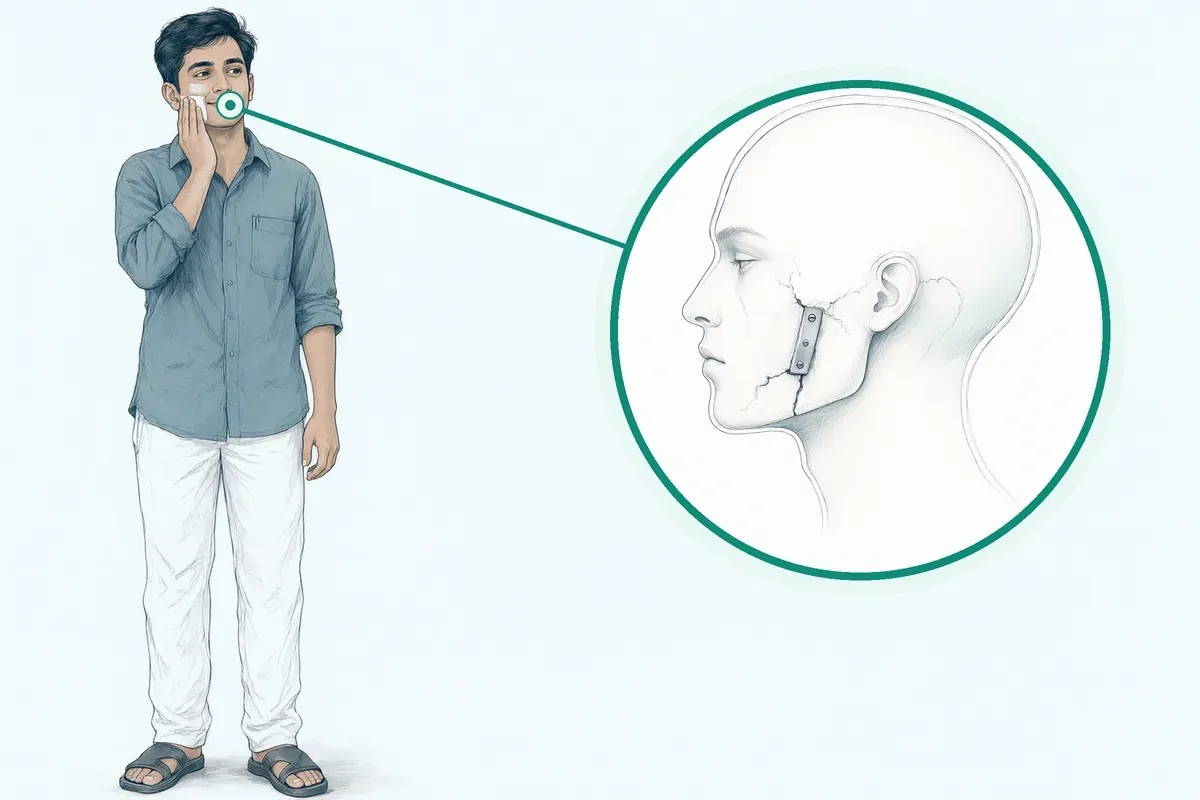
If you need surgery, it is usually done under general anaesthesia and takes 1 to 3 hours. Your surgeon makes a plan for your fracture type. Small plates, screws or implants hold the bone in place while it heals. You usually stay 2 to 5 nights.
-
ORIF Mandible / Maxilla Fractures
Miniplate fixation through an intraoral or extraoral approach. Your surgeon will discuss whether this option suits your fracture.
-
Zygomaticomaxillary Complex (ZMC) Fixation
Three-point fixation for cheekbone fractures. Your surgeon will discuss the approach and what it involves for you.
-
Orbital Floor Reconstruction
Titanium mesh or porous polyethylene implants to support the floor of the eye socket. Your surgeon will discuss which option fits your case.
-
Nasal Bone Reduction / Septorhinoplasty
Closed reduction for an acute nasal injury, or open surgery later if needed. Your surgeon will discuss timing and choices with you.
Why patients trust us
- 1991 Serving Jaipur for 35 years
- NABH Accredited hospital
- 1 Plastic Surgery consultants
- 24×7 Emergency, ICU and ambulance
- 25 Cashless schemes and insurers
What studies report about facial fracture treatment
-
half
In one study, half of the patients recovered their functions within 20 days after treatment.
-
8.9%
In one study, five complications occurred among the patients treated, which was 8.9% of the total.
-
1 to 2 weeks
A patient guide says you may be able to return to work in this time, depending on your injury and job.
If it is left untreated
If a facial fracture is not checked, the bone may heal in a poor position. Your face may look different than it did before the injury, and sometimes more surgery is needed later. A surgeon can assess the injury and explain your options.
Life after treatment
Most people heal over a few months. Swelling and bruising settle first, and eating gets easier as your jaw heals. You will have follow-up visits, and your surgeon will check how you are healing.
-
Swelling settles
Most people see swelling go down over the first week or two as they rest and use cold packs as advised.
-
Eating gets easier
Most people start on a soft diet and move to normal food as the jaw heals, usually over 4 to 6 weeks.
-
Back to your routine
Many people return to work within 1 to 2 weeks, depending on their injury and the type of work they do.
-
Follow-up support
You come back for check-ups so your surgeon can see how the bone is healing and answer your questions.
Frequently asked questions
Questions patients ask about facial trauma surgery
Which problems are assessed under facial trauma surgery?
In short
Facial trauma surgery at Jaipur Hospital assesses fractures of the jaw, cheekbone, eye socket and nose along with related soft tissue injuries. The surgical team evaluates bone alignment, bite relationship, eye movement and nerve function to plan the right repair.
In detail
Assessment begins with a clinical examination of swelling, bruising, step deformities and mouth opening. Imaging such as CT scans shows the exact fracture pattern in three dimensions. The surgeon checks for malocclusion, double vision, numbness in the cheek or lip, and breathing difficulty.
Evidence from studies on mandibular fractures shows that radiographic union rates reach 98 percent when fixation is accurate.
The technique chosen depends on the fracture site: miniplate fixation for jaw fractures, three point fixation for cheekbone fractures, titanium mesh or porous polyethylene for orbital floor reconstruction, and closed or open reduction for nasal bones. Each approach aims to restore anatomy and function.
- Evidence from studies on mandibular fractures shows that radiographic union rates reach 98 percent when fixation is accurate.
Your next step at Jaipur Hospital
You will need a clinical review and imaging before any plan is made. The surgeon will explain the findings and the likely operation time of one to three hours under general anaesthesia. Hospital stay is usually two to five nights. A soft diet is required for four to six weeks.
How will the doctor decide which tests I need?
In short
At Jaipur Hospital, the surgeon decides tests based on the mechanism of injury, clinical findings and the facial regions involved. A CT scan of the face with fine cuts and three-dimensional reconstruction is standard for suspected fractures. Additional tests may include cervical spine imaging, ophthalmology review or angiography if vascular injury is suspected.
In detail
The decision follows a structured assessment. History tells the force and direction of impact. Examination checks each facial third for step deformity, mobility, sensory change, ocular motility and occlusion.
If the mandible is tender or the bite is off, a CT mandible or panoramic radiograph may be added. Midface tenderness or cheek flattening prompts a CT maxillofacial with coronal and sagittal reformats.
Orbital symptoms need fine-cut orbital CT and often an ophthalmology opinion for visual acuity and fields. Cervical spine imaging is considered with any high-energy mechanism or neck tenderness. Vascular studies are ordered if there is an expanding haematoma, pulsatile bleeding or a bruit. The in-house radiology department provides these studies rapidly so the operative plan can be finalised without delay.
A common belief
Some patients expect a full-body scan.
What actually happens
That adds radiation and delay without benefit. The surgeon targets imaging to the zones at risk. A normal eye exam avoids an unnecessary ophthalmology referral. Targeted testing is faster and safer.
Your next step at Jaipur Hospital
Expect a focused clinical examination first. The surgeon will then order the specific imaging needed for your injury pattern. Most patients need only a dedicated facial CT. Results are usually available the same day.
How soon should I expect improvement after facial trauma surgery?
In short
After facial trauma surgery at Jaipur Hospital, initial swelling starts to reduce within 5 to 7 days and bruising fades by 10 to 14 days. Functional recovery varies by fracture site: zygomatic-orbital-nasal complex injuries average 11 days for functional recovery, while maxillary-mandibular complex injuries average 21 days. Full bony healing and return to normal diet take 4 to 6 weeks.
In detail
Recovery timelines come from clinical observation and study data. Evidence shows half of patients recover function within 20 days after fixation. The zygomatic-orbital-malar-nasal complex has a shorter average recovery of 11 days compared to 21 days for the maxillary-mandibular complex.
Mandibular injuries are associated with nearly twice the recovery time of maxillary lesions. Swelling typically resolves in 2 to 4 weeks per protocol. A soft diet is maintained for 4 to 6 weeks to protect the fixation.
Numbness or altered sensation from nerve injury may persist longer. The surgeon monitors healing with clinical examination and occasional imaging.
Pulsed electromagnetic field therapy has been studied as an adjunct showing increased bone density and faster recovery at 28 days, but this is not standard protocol.
A common belief
Patients often expect to eat normally within days.
What actually happens
The bone needs 4 to 6 weeks of protected loading. Rushing the diet risks plate loosening or malunion. Numbness in the lip or cheek can last months even after the bone heals.
Your next step at Jaipur Hospital
Plan for 2 to 5 nights in hospital. Keep the surgical site clean and follow the soft diet strictly for 4 to 6 weeks. Use ice packs for 10 to 20 minutes, three times daily, for the first few days.
Attend all follow-up appointments for suture removal and bite check. If your jaw is wired, carry wire cutters at all times. Contact the hospital if swelling increases after the first week, you develop fever, or have difficulty breathing.
How can I decide whether to seek advice about facial fracture fixation?
In short
Seek advice about facial fracture fixation if you have had a facial injury with visible deformity, difficulty opening your mouth, a change in your bite, double vision, numbness in the cheek or lip, or persistent nasal obstruction. Jaipur Hospital provides emergency and OPD assessment with CT imaging to determine if open reduction and internal fixation is indicated.
In detail
The decision rests on functional impairment and displacement. Evidence defines facial trauma repair as surgery to fix injury to the face or jaw.
Indications include malocclusion from mandibular fractures, restricted mouth opening from zygomatic fractures, enophthalmos or diplopia from orbital floor fractures, and nasal deformity with airway obstruction. Studies show that displaced fractures treated non-operatively can lead to malunion, chronic pain, and asymmetry.
The surgical team evaluates CT scans for fracture displacement, comminution, and soft tissue entrapment. Techniques include miniplate fixation for jaws, three-point fixation for cheekbones, titanium mesh or porous polyethylene for orbital floors, and closed or open nasal reduction. Early consultation within the first two weeks allows easier reduction before fibrous union forms.
A common belief
Many people wait weeks hoping the swelling hides a fracture.
What actually happens
But early fixation within 10 to 14 days is technically easier and gives better results. Delayed treatment often needs more complex surgery like osteotomy or bone grafting.
Your next step at Jaipur Hospital
Do not wait for the swelling to fully settle if you have functional symptoms. Attend the emergency department or book an OPD appointment. Bring any previous X-rays or CT scans. The surgeon will examine your bite, eye movements, facial symmetry, and nerve function. If fixation is advised, surgery is usually scheduled within a few days.
Is emergency facial trauma surgery covered by medical insurance in Jaipur?
In short
Emergency facial trauma surgery is generally covered by health insurance policies in India, including government schemes and private plans. Jaipur Hospital is empaneled under RGHS, MAA Yojana, CGHS, and a panel of private insurers and TPAs.
In detail
Most health insurance policies cover emergency procedures required after accidents or trauma. Coverage depends on the specific policy terms, sum insured, network status of the hospital, and whether pre-authorisation is obtained.
Government schemes such as RGHS, MAA Yojana, and CGHS cover eligible beneficiaries for emergency surgeries at empaneled hospitals. Private insurers and TPAs also provide coverage as per the policy schedule.
Jaipur Hospital is a NABH-accredited multispeciality hospital and is on the panel of these schemes and insurers.
The typical price range for facial trauma surgery in India is ₹50,000 to ₹2,00,000, but the final bill depends on the fracture complexity, implants used, and length of stay. The hospital's insurance desk assists with pre-authorisation and cashless claims where applicable.
Patients should carry their insurance card, policy document, and any accident-related paperwork (such as an FIR or MLC) for smoother processing.
A common belief
People often assume they must pay everything upfront.
What actually happens
In reality, most policies cover emergency trauma surgery. The key is to have your insurance card and accident documents ready so the hospital can start cashless authorisation quickly.
Your next step at Jaipur Hospital
Bring your insurance card, policy details, and any accident report (FIR or MLC) when you arrive at the emergency department. The hospital's insurance desk will verify coverage and initiate pre-authorisation. For planned follow-up procedures, check with your insurer on network benefits and any sub-limits.
How will appearance, function, and realistic expectations be discussed?
In short
At Jaipur Hospital, the surgeon discusses appearance, function and realistic expectations during the pre-operative consultation using your clinical findings and CT images. The conversation covers the planned surgical approach, expected symmetry, bite alignment, eye movement, and the likely timeline for swelling to resolve.
In detail
Facial trauma surgery aims to restore both form and function. The surgical team explains the technique chosen for your fracture pattern, such as miniplate fixation for the jaw, three-point fixation for the cheekbone, or orbital floor reconstruction with titanium mesh or porous polyethylene.
Evidence shows that open reduction and internal fixation achieves radiographic union in the majority of cases. The surgeon outlines what can be improved, such as facial contour and occlusion, and what limitations may remain, including subtle asymmetry, scar visibility, or persistent numbness.
Recovery involves a soft diet for four to six weeks and swelling that typically settles over two to four weeks. In some cases, a secondary revision procedure may be considered later to refine the result.
A common belief
Patients sometimes expect a perfect cosmetic result immediately, but swelling lasts weeks and minor asymmetry can persist.
What actually happens
The team is honest about what surgery can and cannot achieve.
Your next step at Jaipur Hospital
Bring any previous imaging or referral notes to the OPD. The surgeon will show you the fracture on the scans, describe the fixation plan, and answer questions about scars, diet, and return to work. A second opinion is welcome.
Which symptoms should prompt me to see a specialist?
In short
You should see a specialist at Jaipur Hospital if you have facial swelling, bruising, pain, difficulty opening your mouth, misaligned teeth, double vision, numbness in the cheek or lip, nasal obstruction or bleeding that does not stop. These symptoms suggest a fracture or soft-tissue injury that needs evaluation.
In detail
Facial trauma can involve bone and soft tissue in ways that are not obvious. Swelling and bruising are common after any impact, but persistent swelling beyond a few days may indicate a deeper haematoma or fracture.
Difficulty opening the mouth or a change in how your teeth meet often points to a mandible or maxilla fracture. Double vision or pain on eye movement can mean an orbital floor fracture with muscle entrapment.
Numbness over the cheek or upper lip suggests infraorbital nerve injury from a zygomatic fracture. Nasal bleeding that continues or a new nasal deformity may need reduction. Early specialist review allows imaging and a decision on whether surgery is required within the optimal window.
A common belief
Many people wait for the swelling to go down first.
What actually happens
But a normal bite today can shift tomorrow as swelling changes. Numbness may feel minor but signals nerve injury. Early review prevents missed fractures.
Your next step at Jaipur Hospital
Do not wait for symptoms to worsen. Attend the emergency department or OPD for clinical examination and CT scanning. The surgeon will advise on timing of any operation, which is usually done within one to two weeks of injury.
How will the results change my care plan?
In short
At Jaipur Hospital, imaging results determine whether a fracture needs open reduction and internal fixation, closed reduction, or observation. Displacement, comminution, occlusion disturbance, orbital volume change and nerve involvement guide the decision. The surgeon matches the fixation technique to the fracture pattern and your functional needs.
In detail
CT findings directly shape the operative plan. A minimally displaced mandibular angle fracture with normal occlusion may be managed with maxillomandibular fixation and soft diet alone. A displaced subcondylar fracture with malocclusion usually needs open reduction via intraoral or retromandibular approach with miniplate fixation.
Zygomaticomaxillary complex fractures with orbital rim step-off or enophthalmos typically require three-point fixation. Orbital floor fractures with muscle entrapment or enophthalmos greater than two millimetres are reconstructed with titanium mesh or porous polyethylene.
Nasal fractures with septal deviation and airway obstruction may need closed reduction acutely or open septorhinoplasty later. The surgeon also considers timing: early surgery within two weeks is easier before fibrous union forms. Your general health, age and preferences are discussed before finalising the plan.
A common belief
Patients often think every fracture needs a plate.
What actually happens
Many non-displaced fractures heal well with just maxillomandibular fixation and diet modification. Over-treating adds scars and hardware risk. The plan fits the fracture, not a fixed protocol.
Your next step at Jaipur Hospital
After imaging, the surgeon will explain which fractures need fixation and which can be watched. You will discuss the approach, expected hospital stay of two to five nights, and the soft diet period of four to six weeks.
What should I do if symptoms persist or worsen after facial trauma surgery?
In short
Contact Jaipur Hospital immediately if you develop increasing pain not relieved by prescribed medication, bleeding from the incision or mouth, signs of infection such as fever, redness, warmth, pus, or red streaks, loose stitches or an open wound, difficulty breathing, talking, or swallowing, or calf pain suggesting a blood clot. These require urgent assessment.
In detail
Post-operative complications, while not universal, are documented in surgical literature. Complication rates in facial fracture fixation studies range from approximately 7% to 13% for specific issues like infection, malunion, or nerve injury. Deep infection, hardware exposure, and malocclusion are known risks.
The healthy.kaiserpermanente.org guidelines list specific red flags: uncontrolled pain, wound dehiscence, active bleeding, infection signs, fever, neurovascular changes, and venous thromboembolism symptoms. Early re-intervention for infection or hardware failure improves outcomes. Persistent numbness or malocclusion beyond the expected healing window also warrants review. The surgeon will examine the wound, check occlusion, and may order imaging to assess bone position and hardware integrity.
A common belief
Some patients think mild swelling or numbness lasting weeks is an emergency.
What actually happens
Swelling peaks at 48 hours and slowly improves. Numbness from nerve stretching often takes months. The red flags are new or worsening symptoms: fresh bleeding, rising fever, or sudden loss of function.
Your next step at Jaipur Hospital
Keep the emergency numbers accessible. Do not wait for the next scheduled appointment if you notice any warning sign. If your jaw is wired shut, always carry wire cutters and know how to use them.
For wound concerns, attend the emergency department or call the hospital. For persistent numbness or bite changes after 6 weeks, request an OPD review.
How can I decide whether to seek advice about nasal bone fracture reduction?
In short
Seek advice about nasal bone fracture reduction if you have had a nasal injury with persistent blockage, visible deviation of the nose, ongoing nosebleeds, or pain that does not settle. At Jaipur Hospital, the surgeon will assess whether closed reduction is suitable in the acute phase or if open septorhinoplasty is needed later.
In detail
Nasal bone reduction or septorhinoplasty is performed for displaced nasal fractures. Closed reduction is typically done early, while open surgery may be required if the fracture is old or complex. The surgeon evaluates the nasal septum, airway, and external shape.
Early assessment within the first two weeks allows simpler management. The procedure is usually under general anaesthesia and may be combined with other facial fracture fixation.
A common belief
Many people wait months hoping the nose will straighten itself.
What actually happens
Early reduction within two weeks is simpler and often avoids the need for more extensive surgery later.
Your next step at Jaipur Hospital
If your nose looks crooked or you cannot breathe through it after an injury, attend the emergency department or book an OPD visit promptly. Bring any prior imaging. The surgeon will explain the options, typical recovery, and costs.
FAQ library
Questions and answers about facial trauma surgery
When you contact us
What you get when you call us
Call us or visit the OPD and we will review your injury, explain your choices and help you plan the next step.
- A consultation with a plastic surgeon in the OPD
- Your scans and reports reviewed, with tests done in-house if you need them (laboratory, X-ray and imaging)
- Your options explained in plain words, including whether you need surgery at all
- A cost estimate before you decide
- Help with cashless treatment under RGHS, MAA Yojana, CGHS and empanelled insurers and TPAs
- Follow-up visits after your treatment
Overview
Facial Trauma Surgery: what to know
What Is Facial Trauma Surgery?
- 1 to 3 hours Operation time
- 2 to 5 nights Hospital stay
- ₹50,000 to ₹2,00,000 Cost range in India
Facial trauma surgery repairs an injury to the face or jaw. The face has soft tissue and bone, and an injury can damage both. Surgery may be done to stop bleeding, repair damaged tissue, or fix broken bones.
Open reduction and internal fixation, or ORIF, is the name for an operation that puts broken bone pieces back in place and holds them with small plates and screws. This surgery is done by a maxillofacial surgeon.
It can involve:
- Lower jaw
- Upper jaw
- Cheekbone
- Eye socket
- Nose
At Jaipur Hospital, the operation usually takes 1 to 3 hours and is done under general anaesthesia. A hospital stay of 2 to 5 nights is typical.
Healing takes time. It will probably take a few months for you to heal after surgery. In one study, lower jaw injuries took almost twice as long to recover as upper jaw injuries. Not every facial injury needs an operation. Your surgeon will examine you and explain the choices.
The typical range for this surgery in India is ₹50,000 to ₹2,00,000. The cost depends on the type of fracture, the implants used and how long you stay in hospital. Ask us for an estimate.
Facial Trauma Symptoms and Warning Signs That Need Same-Day Care
- Pain not better after medicine
- Incision bleeds or opens
- Signs of infection
- Red streaks, pus or fever
- Calf, knee, thigh or groin pain
A facial injury can cause pain, swelling and bruising. It may be hard to eat at first. If the lower jaw is broken, chewing can be a problem. You may not be able to open your mouth fully. Your face may look different from before the injury. Sometimes more surgery is needed later to bring the shape closer to how it was before the injury.
After surgery, swelling may take 5 to 7 days to go down, and bruising may take 10 to 14 days to fade. Putting ice or a cold pack on your face for 10 to 20 minutes at a time, 3 or more times a day, may help.
Contact your surgeon or come to our 24×7 emergency department the same day if:
- You have pain that does not get better after you take pain medicine.
- Your incision bleeds, or your stitches come loose or the incision opens.
-
You see signs of infection, such as:
- More pain
- Swelling
- Warmth
- Redness
- You have red streaks, pus or a fever.
- Your mouth is bleeding, or you have trouble talking or swallowing.
- You have pain in your calf, behind your knee, in your thigh or groin.
Causes of Facial Fractures and Who May Need More Care
- Half recover function
- Within 20 days in one study
- Age and sex not linked
- No statistical evidence found
Facial trauma is an injury to the face or jaw. The injury can damage soft tissue, break bone or cause bleeding.
The type of fracture and the cause of the injury can affect how long recovery takes. One study looked at this link but did not find statistical evidence for it. The same study looked at age and sex and also found no statistical evidence.
Some fractures need more time and follow-up. A lower jaw fracture is linked with chewing problems, and lower jaw injuries can take longer to recover than upper jaw injuries. Some patients with a lower jaw fracture need to stay in hospital for closed reduction treatment.
Facial injuries can make eating and talking difficult for a time. In one study of facial trauma, half of the patients recovered their function within 20 days. Recovery time varies from person to person.
How Facial Trauma Is Diagnosed
Your surgeon will examine your face and jaw and ask how the injury happened.
The examination checks:
- How wide you can open your mouth
- How well you chew
- Whether you have numbness
Chewing problems are common with lower jaw fractures.
Imaging helps show which bone is broken. In studies, a direct digital panoramic machine was used to assess the bone. Jaipur Hospital has in-house imaging and radiology, X-ray, a 24-hour laboratory, and an in-house diagnostic laboratory.
The results help your surgeon see which bone is involved, whether the broken pieces have moved, and whether the eye socket or nose is affected. Your surgeon will use this information to plan your treatment.
Sometimes a facial injury needs treatment before a full plan is made, for example when there is bleeding or a wound that needs care. Our team will tell you what is needed and why.
Facial Fracture Treatment Without Surgery and When Surgery Is Advised
Not every facial fracture needs surgery. Some broken jaws are treated with closed reduction, where the bone is set without an open operation. The jaw may be held with wires or a device, called maxillomandibular fixation. In one study, this device was removed at week 4. You will usually be asked to take a soft diet for 4 to 6 weeks.
Surgery may be done to stop bleeding, repair damaged tissue or fix a broken bone. Your surgeon will advise if an operation is right for you. During open reduction and internal fixation, small plates and screws hold the bone. Screw sizes used in one study were 1.5 mm, 2.0 mm and 2.4 mm. Stitches close the surgical wounds, and they are usually removed about a week after surgery.
The main techniques are:
- ORIF of the lower or upper jaw, using miniplates placed through the mouth or through a small cut outside.
- ZMC fixation, using 3-point fixation for cheekbone fractures.
- Orbital floor reconstruction, using a titanium mesh or a porous polyethylene implant.
- Nasal bone reduction, using closed reduction for a fresh injury or an open procedure later if needed.
Your surgeon will advise which option suits your fracture. Studies comparing two types of miniplate for lower jaw fractures found no major difference in outcome, and both worked equally well. Another study found no statistically significant difference in complication rates between the plate groups.
Swelling usually settles in 2 to 4 weeks. If your jaw is wired shut, keep wire cutters with you at all times in case you throw up. Your doctor will show you how to use them. When you can return to work depends on your injury and the type of work you do. Some people may be able to go back in 1 to 2 weeks.
Preparing for Facial Trauma Surgery at Jaipur Hospital
Do
- Tell surgeon about all medicines
- Arrange someone to take you home
- Follow fasting time before anaesthesia
Facial trauma surgery is done to repair an injury to the face or jaw. Before the operation, your surgeon will usually review your scans and your general health. You may have imaging such as a digital panoramic X-ray to check the bone.
Tell your surgeon about every medicine you take, including:
- Blood thinners
- Diabetes medicines
- Herbal products
Do not stop any medicine on your own. Your surgeon will tell you if anything needs to change before surgery. Tell your surgeon about allergies and any past operations. Arrange for someone to take you home after discharge.
The hospital will tell you when to stop eating and drinking before general anaesthesia. Follow that time carefully. Bring your identity proof, scheme or insurance card, earlier scans, and a list of your medicines. Loose, front-opening clothes are easier to manage. You may want a family member or attendant with you for help with papers.
The hospital has an in-house diagnostic laboratory and imaging / radiology. Ask us for an estimate before admission. Ask your surgeon any questions you have before the operation.
How Facial Trauma Surgery Is Done
- General anaesthesia given You will be asleep during the operation
- Surgeon plans approach from scans Based on bones involved
Facial trauma surgery may be done to stop bleeding, repair damaged tissue, or fix broken bones. The operation is usually done under general anaesthesia. You will be asleep during the operation. It takes about 1 to 3 hours. You will usually stay in hospital for 2 to 5 nights. Your surgeon will plan the approach after reviewing your scans and the bones involved.
There are several common ways to repair facial fractures. Your surgeon will advise which one suits your injury.
- ORIF for jaw fractures: The surgeon puts the broken parts of the jaw back in place and holds them with small plates and screws. This is called open reduction and internal fixation. The approach may be through the mouth or through a cut on the face. The plates and screws hold the bone while it heals.
- Cheekbone fixation: For a cheekbone fracture, the surgeon may use three-point fixation to hold the bone in position.
- Orbital floor repair: If the bone under the eye is broken, the surgeon may rebuild the floor with a titanium mesh or a porous polyethylene implant.
- Nasal bone treatment: A fresh nasal fracture may be treated with closed reduction. If the shape or breathing needs more work later, an open procedure such as septorhinoplasty may be considered.
Our surgical team will close the wounds with stitches. On the day, the anaesthesia team will check you before surgery. After the operation, you will be watched in the recovery area before you go back to your room. Your surgeon will tell you what was done and what to expect.
Risks and Complications of Facial Trauma Surgery
- 8.9% Overall complications
- 7.14% Conventional miniplate group
- No Difference not significant
All surgery has some risks. In one study of mandibular fracture repair with miniplates, five complications occurred, which was 8.9% of the total. The rate was 7.14% in one plate group and 10.71% in the other. The difference between the groups was not statistically significant. These figures come from one study and may not apply to every fracture.
One study compared 28 fracture sites treated with a 3-dimensional miniplate and 28 with a conventional miniplate.
Possible problems include:
- Infection
- Bleeding
- Loose stitches
- A wound that opens
A blood clot in the leg is another possible problem. Some people need more surgery later to improve the shape of the face. Your face may look different from before the injury.
The studies used for this page do not give one complication rate for every type of facial fracture. Your surgeon will discuss the risks that apply to your injury. Ask about the signs to watch for and when to get help.
Recovery After Facial Trauma Surgery
- Hospital stay 2 to 5 nights
- Swelling settles 2 to 4 weeks
- Bruising fades 10 to 14 days
- Soft diet 4 to 6 weeks
- Return to work 1 to 2 weeks for some
- Full healing A few months
After surgery, you will usually stay in hospital for 2 to 5 nights. Swelling usually resolves in 2 to 4 weeks. Bruising may take 10 to 14 days to fade. Cold packs can help: put ice or a cold pack on your face or jaw for 10 to 20 minutes at a time, 3 or more times a day.
You will usually need a soft diet for 4 to 6 weeks. It may be hard to eat at first. Follow the diet your surgeon gives you. Keep the wound clean and dry, and follow the instructions your surgical team gives you. Stitches may be removed about a week after surgery.
If your jaw is wired shut, keep wire cutters with you at all times in case you throw up. Your doctor will show you how to use them.
Healing will probably take a few months. When you can return to work depends on your injury and the type of work you do. Some people can go back to work in 1 to 2 weeks. Keep the follow-up OPD visits your surgeon gives you. Arrange for someone to help you at home for the first few days.
Call the hospital now if you have pain that does not get better after pain medicine, loose stitches or an incision that opens, or bleeding from the incision.
Also call for signs of infection such as:
- More pain
- Swelling
- Warmth
- Redness
Call if you have red streaks from the wound, pus draining from it, or a fever. Get help if you have symptoms of a blood clot in your leg, trouble talking or swallowing, or bleeding from your mouth.
Results of Facial Trauma Surgery in Studies
The operation is done to fix the injured face or jaw. In a study of mandibular fractures, researchers found no major difference in treatment outcome between two plate systems. Both were equally effective. Another study found no significant difference in complication rates between a 3-dimensional miniplate and a conventional miniplate.
In one study, half of the patients got back their normal function within 20 days. The average recovery time was 11 days for injuries around the cheekbone, eye socket, and nose, and 21 days for injuries of the upper and lower jaw.
Another study found that injuries to the lower jaw took almost twice as long to recover as injuries to the upper jaw.
Some people need another operation later to improve the shape of the face. The studies used for this page do not give one rate for how often this happens. These results come from groups of patients. They cannot tell you what will happen in your case. Your surgeon will explain what is known about your type of fracture.
Cost and Insurance for Facial Trauma Surgery in Jaipur
The typical range for facial trauma surgery in India is ₹50,000 to ₹2,00,000. Ask us for an estimate. The final cost depends on the type of fracture, the bones involved, the implants used, and the length of your stay. A stay of 2 to 5 nights is usual. More complex injuries can change the bill. The range is a guide and not a fixed price.
Jaipur Hospital is a NABH-accredited multispeciality hospital, privately run. It was established in February 1991.
We work with:
- RGHS
- MAA Yojana
- CGHS
- A panel of private insurers and TPAs
Please ask us about your scheme or policy before admission. Ask whether your scheme or policy will cover the planned surgery. Coverage depends on your policy and scheme rules. Keep your card and documents ready.