

Pulmonology · Jaipur Hospital
Interventional Pulmonology in Jaipur
Breathing problems need clear answers. We assess, explain and plan your next steps.
- Serving Jaipur since 1991 (35 years)
- NABH accredited
- 24×7 emergency & ICU
- Cashless: RGHS, MAA Yojana, CGHS + 22 insurers
- Procedure time
- 30 to 90 minutes (diagnostic)60 to 120 minutes (therapeutic)
- Anaesthesia
- Conscious sedation or General anaesthesia
- Recovery
- Observation 2 to 4 hours post-procedure, resume activities next day
- Price
- ₹25,000 to ₹1,50,000typical range in India; ask us for an estimate
Unexplained breathing trouble
You have a shadow on your scan or a cough that will not go away, and you need to know why.
A CT scan shows a spot or enlarged nodes. You may be coughing blood or feeling short of breath. Waiting for a diagnosis is stressful and delays treatment.
-
Scan shows a spot or nodes
A shadow on X-ray or CT needs tissue sampling to confirm the cause.
-
Persistent cough or blood
Cough lasting weeks or blood in sputum needs airway inspection.
-
Breathing getting worse
Narrowed airways from tumour or scarring make daily activity hard.
-
Previous tests were unclear
Earlier biopsies did not give an answer; a targeted approach is needed.
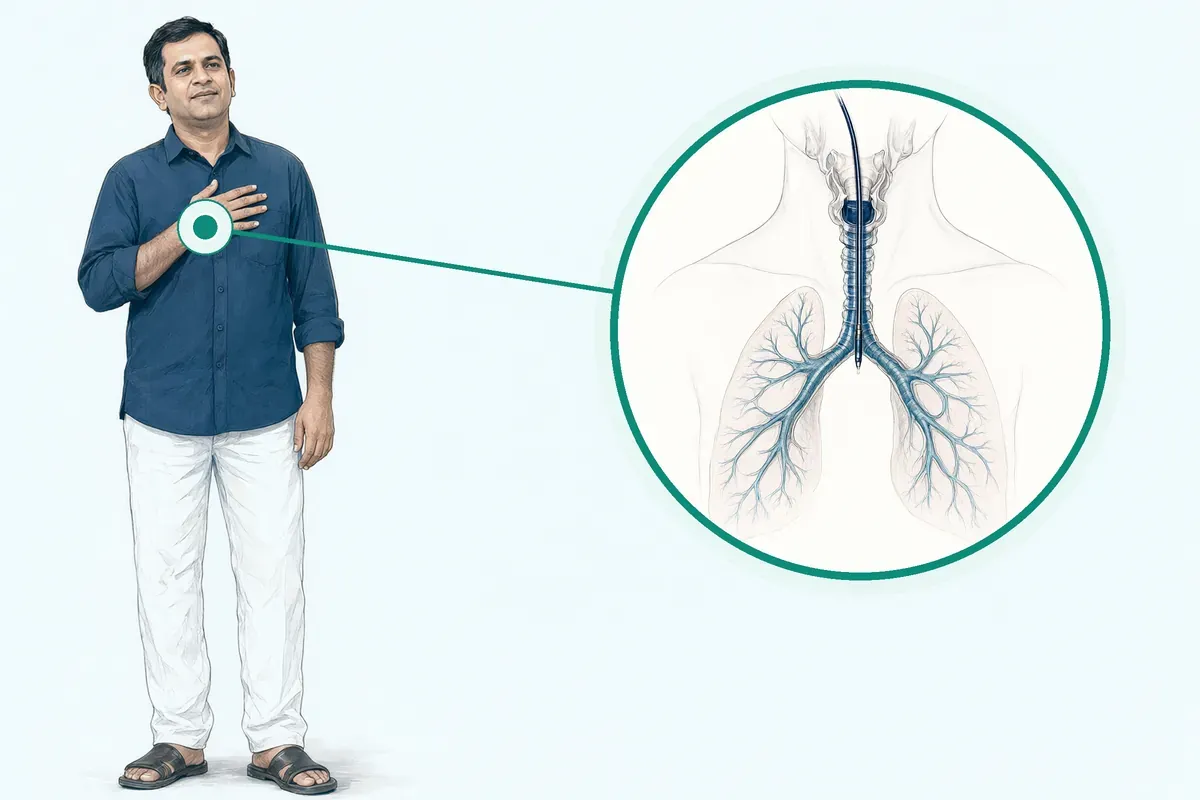
EBUS-TBNA is a minimally invasive technique for diagnosis of mediastinal lymphadenopathy.
Why Jaipur Hospital
You worry that the test will hurt, that you will miss work, or that the cost will stretch your family budget.
Your care plan
Your first steps with us
- 1 Call or visit OPD for pulmonologist consultation
- 2 Review scans and plan the procedure
- 3 Undergo bronchoscopy or EBUS with sedation
- 4 Recover under observation and go home next day
How the procedure is done
A thin flexible tube with a camera and ultrasound is passed through the nose or mouth into the airways. The doctor sees the lungs and nearby nodes on a screen and takes samples or places a stent. You receive sedation or general anaesthesia and are monitored afterwards.
-
Flexible Bronchoscopy with Biopsy
Endobronchial and transbronchial sampling for lesions seen inside the airways.
-
EBUS-TBNA (Endobronchial Ultrasound)
Real-time ultrasound-guided needle aspiration of mediastinal and hilar lymph nodes.
-
Airway Stent Placement
Silicone or metallic stents placed to open narrowed airways from tumour or scarring.
-
Therapeutic Bronchoscopy
Foreign body removal, tumour debulking or argon plasma coagulation for bleeding.
Why patients trust us
- 1991 Serving Jaipur for 35 years
- NABH Accredited hospital
- 1 Pulmonology consultants
- 24×7 Emergency, ICU and ambulance
- 25 Cashless schemes and insurers
What research shows about this treatment
-
1 to 2 weeks
Most patients receive biopsy results within one to two weeks after the procedure.
-
2.8% overall complication rate
In a large study the overall complication rate was 2.8 percent, mostly minor events.
-
70.6% diagnostic yield for peripheral lesions
Radial EBUS diagnosed peripheral lung lesions in about 71 percent of cases in a meta-analysis.
If it is left untreated
Without a tissue diagnosis, cancer or infection cannot be confirmed and the right treatment cannot start. Delayed diagnosis of airway obstruction can lead to worsening breathlessness and respiratory failure.
Life after the procedure
Most people go home the same day or the next morning and return to normal activity within a day.
-
Clear diagnosis
You and your doctor know the exact cause and can plan targeted treatment.
-
Easier breathing
Stenting or tumour debulking usually relieves airway blockage quickly.
-
Quick recovery
Sore throat or hoarseness settles in a day or two; you resume routine work.
-
Ongoing support
Follow-up visits and in-house tests keep your care on track.
Frequently asked questions
Questions patients ask about interventional pulmonology
Which problems are assessed under interventional pulmonology?
In short
Interventional pulmonology at Jaipur Hospital assesses airway and lung conditions that need minimally invasive diagnosis or treatment. Our team evaluates central airway obstruction, mediastinal and hilar lymphadenopathy, peripheral lung nodules, pleural disease, and persistent infections. We also manage malignant and benign airway stenosis, foreign bodies, and haemoptysis that require endoscopic intervention.
In detail
The specialty uses flexible bronchoscopy, endobronchial ultrasound (EBUS-TBNA), radial EBUS, and therapeutic bronchoscopy to reach lesions beyond the range of standard imaging.
Evidence shows EBUS-TBNA provides real-time guided sampling of mediastinal nodes with a pooled diagnostic accuracy of 79 percent and a sensitivity of 92 percent in lung cancer staging.
Radial EBUS achieves a diagnostic yield of 70.6 percent for peripheral lesions, especially those larger than two centimetres or with a bronchus sign on CT. Therapeutic techniques include argon plasma coagulation, tumour debulking, and silicone or metallic stent placement for airway patency.
- Radial EBUS achieves a diagnostic yield of 70.6 percent for peripheral lesions, especially those larger than two centimetres or with a bronchus sign on CT.
A common belief
Many people think bronchoscopy is only for looking inside the airways.
What actually happens
In fact, modern interventional pulmonology also samples tissue under ultrasound guidance, removes tumours, places stents, and treats bleeding — all through the same thin tube.
Your next step at Jaipur Hospital
Your pulmonologist will review imaging, pulmonary function, and clinical history before recommending a procedure. Most diagnostic bronchoscopies take 30 to 90 minutes under conscious sedation or general anaesthesia, with two to four hours of observation.
Daycare discharge is common; complex stenting may need one to two nights. The typical cost range in India is ₹25,000 to ₹1,50,000.
How will the doctor decide which tests I need?
In short
The doctor at Jaipur Hospital decides tests based on your symptoms, CT or PET-CT findings, and the location of the abnormality. Central lesions or enlarged mediastinal nodes usually need EBUS-TBNA for real-time guided sampling. Peripheral nodules may require radial EBUS or navigational bronchoscopy. The choice also considers your fitness for sedation and bleeding risk.
In detail
Evidence supports a structured algorithm: EBUS-TBNA is the first-line test for mediastinal staging in suspected lung cancer and for sarcoidosis, with a sensitivity of 92 percent and diagnostic accuracy of 95 percent.
For peripheral lesions larger than two centimetres or with a bronchus sign, radial EBUS yields 70.6 percent diagnostic success. If EBUS cannot reach a target node, EUS-FNA is an alternative.
The multidisciplinary team reviews imaging together to minimise unnecessary tests — studies show upfront EBUS reduces PET scans by 23 percent and avoidable thoracotomies. Your pulmonologist will also assess pulmonary function and coagulation before confirming the plan.
- For peripheral lesions larger than two centimetres or with a bronchus sign, radial EBUS yields 70.6 percent diagnostic success.
- The multidisciplinary team reviews imaging together to minimise unnecessary tests — studies show upfront EBUS reduces PET scans by 23 percent and avoidable thoracotomies.
A common belief
Patients sometimes assume every lung nodule gets the same test.
What actually happens
In fact, guidelines and evidence show a clear algorithm: EBUS-TBNA first for mediastinal staging, radial EBUS for outer lesions, and EUS-FNA if EBUS cannot reach a node. This targeted approach avoids unnecessary scans and surgeries.
Your next step at Jaipur Hospital
You will receive a clear explanation of the recommended test, why it is chosen, and any alternatives. Preparation includes fasting, medication review, and arranging an attendant for discharge. The procedure typically takes 30 to 120 minutes with two to four hours of observation. The typical cost range in India is ₹25,000 to ₹1,50,000.
How soon should I expect improvement after an interventional pulmonology procedure?
In short
After a diagnostic bronchoscopy or EBUS at Jaipur Hospital, you usually feel back to normal by the next day once the sedation wears off. If you had therapeutic bronchoscopy, stent placement, or tumour debulking, breathlessness often improves within a few days as the airway opens. A sore throat, hoarseness, or small streaks of blood in sputum may last 1 to 2 days and then settle.
In detail
Recovery data shows most patients are observed for 2 to 4 hours and discharged the same day. Conscious sedation or general anaesthesia wears off over a few hours; you must not drive, drink alcohol, or operate machinery for 24 hours.
In studies, minor complications such as transient fever or cough occurred in under 3 percent of cases. Pneumothorax is rare but would require a chest drain and admission.
If a stent was placed, the full benefit on airflow may be assessed at a follow-up bronchoscopy within a few weeks.
A common belief
People expect instant heal, but the airway needs time to settle after stenting or debulking.
What actually happens
A sore throat from the scope is normal for a day or two and does not mean something went wrong.
Your next step at Jaipur Hospital
Rest for the remainder of the procedure day and resume light activities the next morning. Take any prescribed throat lozenges or simple analgesia as advised. Restart blood thinners only when your doctor confirms it is safe, usually the next day.
Contact the hospital if you develop increasing breathlessness, chest pain, fever, or cough up more than a spoonful of blood.
Why is an interventional pulmonology procedure needed rather than imaging alone?
In short
Imaging such as CT or PET-CT shows the size, shape, and metabolic activity of a lesion or lymph node, but it cannot confirm the diagnosis. At Jaipur Hospital, interventional pulmonology procedures like EBUS-TBNA or bronchoscopy with biopsy provide tissue proof — distinguishing cancer from infection, sarcoidosis, or benign disease — and allow molecular testing for targeted therapy. Imaging alone cannot guide treatment decisions with certainty.
In detail
Evidence demonstrates EBUS-TBNA sensitivity of 92 percent and diagnostic accuracy of 95 percent in trials, significantly higher than imaging-based assumptions. In a randomised study, upfront EBUS-TBNA reduced median time to treatment decision from 29 days to 14 days and avoided unnecessary PET scans and thoracotomies.
Radial EBUS achieves a 70.6 percent diagnostic yield for peripheral lesions, especially those over 2 cm or with a bronchus sign. Tissue samples also enable EGFR, KRAS, ALK, and other molecular analyses that imaging cannot provide, which are essential for personalised lung cancer therapy.
- Radial EBUS achieves a 70.6 percent diagnostic yield for peripheral lesions, especially those over 2 cm or with a bronchus sign.
A common belief
Treating on imaging alone risks wrong therapy — giving chemotherapy for an infection or missing a treatable mutation.
What actually happens
Studies show EBUS cuts time to correct treatment by half and avoids unnecessary surgery.
Your next step at Jaipur Hospital
Your multidisciplinary team will review your scans and recommend the least invasive procedure that yields a definitive diagnosis. Preparation includes fasting, blood tests, and pausing blood thinners as advised. The procedure typically takes 30 to 90 minutes with 2 to 4 hours observation.
How can I decide whether to seek advice about flexible bronchoscopy and bronchoalveolar lavage?
In short
At Jaipur Hospital, flexible bronchoscopy with bronchoalveolar lavage (BAL) is usually advised when imaging shows an unexplained shadow, persistent cough, or suspected infection that has not responded to standard treatment. Your surgeon will review your CT scan, blood tests, and symptoms to decide if the procedure can give a clear diagnosis or guide therapy.
In detail
Flexible bronchoscopy lets the pulmonologist look directly at the airways and collect fluid from the deep lung using saline wash (BAL). This fluid is tested for bacteria, fungi, tuberculosis, cancer cells, and inflammatory markers.
Evidence shows BAL increases diagnostic yield for infections, interstitial lung disease, and some malignancies compared with sputum samples alone. The procedure takes 30 to 90 minutes under conscious sedation or general anaesthesia. You will need to fast beforehand and stop blood thinners as advised.
Recovery is typically a few hours of observation before discharge the same day. The decision depends on whether less invasive tests like sputum culture or blood work have already provided an answer.
A common belief
Some patients wait too long hoping symptoms will settle, while others ask for the test before simpler investigations like sputum tests or blood work are done.
What actually happens
The right timing avoids unnecessary procedures and catches treatable conditions early.
Your next step at Jaipur Hospital
If you have a cough lasting more than three weeks, unexplained fever, weight loss, or an abnormal chest X-ray or CT that your doctor cannot explain, ask for a referral to our interventional pulmonology OPD. Bring your imaging and previous reports.
The surgeon will explain whether bronchoscopy with BAL is the next step. You can book a consultation at Jaipur Hospital to discuss your case.
Which changes in breathing, chest symptoms, or oxygen levels need urgent help after interventional pulmonology procedures?
In short
At Jaipur Hospital, you should seek urgent medical help if you develop sudden shortness of breath, chest pain that does not settle, fever above 38 degrees Celsius, or cough up more than a few streaks of blood after bronchoscopy, EBUS, or airway stenting. A drop in oxygen saturation below 94 percent at rest also needs immediate assessment.
In detail
Evidence shows that pneumothorax (collapsed lung) can occur rarely after transbronchial procedures; it presents with sudden breathlessness and sharp chest pain. Mediastinitis (infection in the central chest) causes fever, central chest discomfort, and feeling unwell, usually within a few days.
Minor blood-streaked sputum for 24 to 48 hours is common after biopsy, but frank bleeding or clots are not. Oxygen desaturation may signal airway oedema, bleeding, or pneumothorax. The nursing team monitors you for two to four hours after the procedure before discharge.
You are advised not to drive, drink alcohol, or operate machinery for 24 hours after sedation. An attendant should stay with you overnight.
A common belief
Patients often think a sore throat or a little blood in the spit is an emergency.
What actually happens
Those are normal for a day or two. The red flags are new breathlessness, unrelenting pain, high fever, or heavy bleeding — these can mean a collapsed lung or infection that needs immediate treatment.
Your next step at Jaipur Hospital
If any of these warning signs appear, go to the nearest emergency department or call our 24-hour emergency line. Do not wait for the next OPD appointment. Bring your procedure summary sheet.
The team will assess you with a chest X-ray, oxygen check, and blood tests as needed. You can book a follow-up consultation at Jaipur Hospital once the acute issue is resolved.
Which symptoms should prompt me to see a specialist?
In short
You should see a specialist at Jaipur Hospital if you have a cough lasting more than three weeks, coughing up blood, unexplained breathlessness, recurrent chest infections, hoarseness that does not settle, or abnormal shadows on a chest X-ray or CT scan. Persistent wheeze, stridor, or difficulty swallowing may also indicate airway involvement needing endoscopic evaluation.
In detail
These symptoms often reflect central airway lesions, mediastinal lymphadenopathy, or peripheral nodules that standard imaging cannot fully characterise.
EBUS-TBNA is the preferred first test for mediastinal staging in suspected lung cancer and for diagnosing sarcoidosis, with a diagnostic yield of 48 to 93 percent across studies.
Radial EBUS improves yield for peripheral lesions, particularly those larger than two centimetres or showing a bronchus sign.
Early specialist review allows timely tissue diagnosis, which evidence shows can reduce the median time to treatment decision from 29 days to 14 days when EBUS is used upfront.
A common belief
People often wait hoping a cough will clear on its own.
What actually happens
But if it persists beyond three weeks or comes with blood, weight loss, or voice change, it may signal a lesion that needs tissue diagnosis — and early bronchoscopy can shorten the path to treatment by weeks.
Your next step at Jaipur Hospital
At your first visit, the pulmonologist will take a detailed history, review prior imaging, and may order pulmonary function tests or blood work before scheduling a bronchoscopy. Procedures are usually done under conscious sedation with two to four hours of recovery. Most patients go home the same day. The typical cost range in India is ₹25,000 to ₹1,50,000.
How will the results change my care plan?
In short
Results from bronchoscopy or EBUS at Jaipur Hospital directly guide the next steps: a confirmed diagnosis of cancer, infection, sarcoidosis, or benign disease determines whether you need oncology referral, anti-tubercular therapy, immunosuppression, or airway stenting. Staging results from EBUS-TBNA decide if surgery, chemoradiation, or palliative care is appropriate.
In detail
Evidence shows EBUS-TBNA staging accuracy of 95 percent allows the multidisciplinary team to make treatment decisions without further invasive tests in most cases. In trials, upfront EBUS reduced the median time to treatment decision from 29 to 14 days and cut avoidable thoracotomies.
Molecular analysis (EGFR, KRAS, ALK) on EBUS samples further personalises targeted therapy for lung cancer. For benign stenosis, biopsy confirms the cause and stent type is chosen accordingly. If results are negative but suspicion remains, the team may recommend repeat sampling, CT-guided biopsy, or surgical mediastinoscopy.
- Evidence shows EBUS-TBNA staging accuracy of 95 percent allows the multidisciplinary team to make treatment decisions without further invasive tests in most cases.
A common belief
Many people think a biopsy just says yes or no. In reality, EBUS samples allow molecular testing for EGFR, KRAS, and ALK mutations, which directly select the right targeted therapy.
What actually happens
Accurate staging also prevents unnecessary surgery — evidence shows upfront EBUS cuts avoidable thoracotomies.
Your next step at Jaipur Hospital
Results are usually available within one to two weeks. The pulmonologist will discuss them with you and the multidisciplinary team, then outline a clear plan — whether it is starting treatment, further tests, or surveillance. Bring an attendant to the results visit for support.
What should I do if symptoms persist or worsen after an interventional pulmonology procedure?
In short
If you develop increasing breathlessness, chest pain, fever, or cough up more than a small amount of blood after a bronchoscopy, EBUS, or stent procedure at Jaipur Hospital, seek medical attention immediately. A nurse will give you a discharge summary with a 24-hour contact number. For urgent concerns outside hospital hours, go to the nearest emergency department and inform them you had an airway procedure.
In detail
Evidence lists warning signs that need prompt evaluation: sudden shortness of breath may indicate pneumothorax, which occurs rarely but requires a chest drain; fever with central chest pain may suggest mediastinitis needing intravenous antibiotics; persistent or increasing blood in sputum beyond a day or two should be reported.
A sore throat, hoarseness, or blood-streaked sputum for 24 to 48 hours is expected and usually self-limiting. If you are on home oxygen, you may need a higher flow temporarily; your team will guide you.
A common belief
Patients often wait too long thinking it is just a sore throat.
What actually happens
Pneumothorax and mediastinitis are rare but serious; early treatment prevents a longer admission.
Your next step at Jaipur Hospital
Keep the discharge instructions handy. Do not restart blood thinners until your doctor confirms. Avoid driving, alcohol, and heavy machinery for 24 hours after sedation. If any symptom feels worse than described in your discharge advice, call the hospital or attend A&E without delay.
Will tissue or fluid samples be taken during an interventional pulmonology procedure?
In short
Yes, tissue or fluid samples are routinely taken during diagnostic bronchoscopy, EBUS-TBNA, and radial EBUS at Jaipur Hospital. The bronchoscope allows direct vision and ultrasound guidance to target abnormal areas, and needles, brushes, or forceps collect cells for cytology, histology, microbiology, and molecular testing. Therapeutic procedures such as stent placement may also include biopsies if indicated.
In detail
Evidence confirms that during EBUS-TBNA, a 21 or 22 gauge needle aspirates lymph nodes under real-time ultrasound vision, with at least three passes typically made for optimal yield. Rapid on-site evaluation (ROSE) may be used to confirm adequacy.
Transbronchial biopsies, endobronchial biopsies, and bronchial brushings or lavage fluid are collected during flexible bronchoscopy. Samples are sent for malignant cell detection, TB PCR, fungal culture, and molecular markers such as EGFR, KRAS, and ALK. The type and number of samples depend on the lesion location and clinical question.
A common belief
Some patients think the camera only looks.
What actually happens
In fact, sampling is the main purpose — without it, you only have pictures, not a diagnosis or molecular profile.
Your next step at Jaipur Hospital
Your doctor will explain which samples are planned before you sign consent. Results are usually available within 1 to 2 weeks; molecular panels may take longer. You will be contacted by the team to discuss findings and next steps. If you have not heard back after two weeks, call the hospital.
FAQ library
Questions and answers about interventional pulmonology
When you contact us
Get your assessment and plan
Contact Jaipur Hospital for a pulmonologist consultation, in-house tests, a plain-word explanation of options, a cost estimate and help with cashless schemes.
- A consultation with a pulmonologist (chest physician) in the OPD
- Your scans and reports reviewed, with tests done in-house if you need them (laboratory, X-ray and imaging)
- Your options explained in plain words, including whether you need surgery at all
- A cost estimate before you decide
- Help with cashless treatment under RGHS, MAA Yojana, CGHS and empanelled insurers and TPAs
- Follow-up visits after your treatment
Overview
Interventional Pulmonology: what to know
What interventional pulmonology is and how it helps
- Thin tube with camera Passed through mouth or nose into airways
- Ultrasound probe option Shows lymph nodes outside the airway walls
- Tools passed through tube Biopsy needle, brush, stent or coagulation device
- Same-day discharge usual Complex stenting may need overnight stay
Interventional pulmonology uses a thin, flexible tube called a bronchoscope to look inside your airways and lungs. The tube carries a tiny camera and, in some procedures, an ultrasound probe that lets your doctor see structures outside the airway walls such as lymph nodes.
Through the same tube the doctor can:
- Take tissue samples (biopsies)
- Remove blockages
- Place a small tube called a stent to keep an airway open
The procedures are done in the endoscopy unit or a procedure room. You usually go home the same day, though complex stenting may need an overnight stay.
Symptoms and warning signs that need urgent care
- More breathless
- Fever
- Chest pain
Common reasons your doctor may refer you for these procedures include:
- A cough that does not go away
- Coughing up blood
- Shortness of breath
- Wheezing
- An abnormal shadow seen on a chest X-ray or CT scan
After a bronchoscopy or EBUS you may have a sore throat, hoarse voice, or see a small amount of blood in your spit for a day or two.
Contact your doctor or go to the emergency department the same day if you become more breathless, develop a fever, have chest pain, or cough up a lot of blood that does not stop.
Causes and who is at higher risk
Airway narrowing or abnormal areas in the lung can be caused by:
- Infections such as tuberculosis
- Long-standing inflammation
- Tumours (both cancerous and non-cancerous)
- Scarring from previous illness or treatment
People with a history of smoking, exposure to dust or fumes, or a family history of lung disease are at higher risk of developing lesions that need investigation. Patients who are on blood-thinning medicines or have bleeding disorders need special preparation because of the risk of bleeding during biopsy.
How it is diagnosed: examination and tests
Your pulmonologist will first review your symptoms, examine your chest, and look at any previous imaging such as a chest X-ray or CT scan. If an abnormal area or enlarged lymph nodes are seen, you may be advised to have a flexible bronchoscopy with biopsy, an EBUS-TBNA, or a radial EBUS for lesions in the outer parts of the lung.
During EBUS-TBNA the doctor passes a needle through the bronchoscope under real-time ultrasound guidance to take samples from lymph nodes or masses next to the airway.
The samples are sent to the laboratory for testing, which can include checks for:
- Cancer
- Infection such as tuberculosis
- Inflammatory conditions like sarcoidosis
Results are usually available within one to two weeks.
Non-surgical treatment options and when surgery is considered
Many airway problems can be managed without open surgery.
Therapeutic bronchoscopy can:
- Remove a foreign body
- Clear thick mucus
- Debulk a tumour that is blocking the airway using tools such as argon plasma coagulation
If the airway is narrowed, a silicone or metallic stent can be placed through the bronchoscope to keep it open. These procedures are done under conscious sedation or general anaesthesia and typically take 30 to 120 minutes.
Surgery such as thoracotomy or video-assisted thoracic surgery may be advised when the lesion cannot be reached safely with a bronchoscope, when a large portion of lung needs to be removed, or when a stent cannot relieve the blockage. Your surgeon will discuss which approach suits your condition.
Preparing for interventional pulmonology procedures
Do
- Tell doctor about blood-thinning medicines
- Follow fasting instructions in appointment letter
Before your bronchoscopy or EBUS, the team at Jaipur Hospital will ask about your health and any medicines you take. You may need blood tests to check your blood levels and how well your blood clots. Tell your doctor if you are taking medicines that change how your blood clots, such as warfarin or heparin.
Your doctor will tell you if you need to stop these or any other medicines for a while before the test. You cannot eat or drink for some time before the procedure. The exact fasting time may differ, so check your appointment letter. If this is a problem, for example if you have diabetes, contact the department in advance.
On the day, bring your regular medicines, your insurance or scheme cards, and an attendant who can stay with you and take you home afterwards.
How interventional pulmonology procedures are done
- Numbing and sedation Local anaesthetic spray or gel, then sedation or general anaesthetic
- Bronchoscope passed Through mouth or nose into airways; images watched on screen
- Samples or treatment done Biopsies, stent, debulking or coagulation as needed
- Recovery monitoring Cannula removed, doctor explains findings
At Jaipur Hospital, interventional pulmonology covers:
- Flexible bronchoscopy with biopsy
- EBUS-TBNA for lymph node sampling
- Airway stent placement for narrowing of the airway
- Therapeutic bronchoscopy for foreign body removal, tumour debulking or argon plasma coagulation
Your surgeon will advise which technique suits your condition. On the day, you will lie on a couch in the endoscopy unit. A nurse will check your blood pressure, heart rate, breathing rate, oxygen level and weight. You will sign a consent form after the procedure is explained.
You may change into a hospital gown and remove false teeth if you have them. You may have the test sitting upright or lying down. A mouthguard or nose guard is placed. Oxygen may be given through a small tube in your nostril, and a clip on your finger will monitor your oxygen and heart rate.
The doctor numbs your nose and throat with a local anaesthetic spray or gel. You will receive sedation through a cannula in your vein to help you relax and feel sleepy, or a general anaesthetic so you are asleep. The bronchoscope is passed through your mouth or nose into your airways.
This can feel uncomfortable but does not last long and should not hurt because of the numbing medicine. You can breathe normally. The doctor watches the images on a screen. For EBUS, an ultrasound probe on the scope creates pictures of the lungs and structures outside the airway walls, such as lymph nodes.
The doctor can see abnormal areas and take tissue samples (biopsies) with a needle, brush or liquid wash. They may also take photographs. The procedure takes 30 to 90 minutes for diagnostic work and 60 to 120 minutes for therapeutic work.
After the test, the cannula is removed and the doctor will tell you how it went and if biopsies were taken.
Risks and possible complications of interventional pulmonology
Interventional pulmonology procedures are generally safe. In studies, the overall complication rate was about 2.8%. Minor complications were reported in only five out of 553 patients. Common temporary effects include a sore throat, hoarse voice or cough for a day or two. You might see a small amount of blood in your spit after the test.
This is normal and should go away within a few hours or days. Let your doctor or nurse know if it does not go away. You may feel like you cannot swallow, but you can. Rarely, air or gas can collect around the lung and make it collapse (pneumothorax).
In one study, one patient in each group had a pneumothorax from a CT-guided biopsy; one needed a chest drain and hospital admission. Contact your doctor or go to the emergency department if you become short of breath. A tube may be put into the chest to remove the air. Inflammation or infection of the central chest (mediastinitis) can happen.
Symptoms include pain or discomfort in the centre of your chest. Contact your healthcare team or go to the emergency department if you have this. You would need hospital admission for intravenous antibiotics. Seek medical attention right away if you have signs of infection such as fever, or if your phlegm changes colour, or you feel more breathless.
If you are in pain, contact your provider right away. Let your provider know if side effects do not go away within a few days or if you are coughing up a lot of blood. Contact your provider if you have any questions or unexpected side effects.
Recovery and aftercare after interventional pulmonology
After the procedure, you will feel sleepy. A nurse will monitor you in the recovery area until you are fully awake and recovered. You will not be able to eat or drink until the local anaesthetic wears off, usually an hour or two. This is because your throat is too numb to swallow safely at first.
The healthcare team will watch you until you are breathing and swallowing well. You usually go home the same day. Observation typically lasts 2 to 4 hours; complex stenting may need an overnight stay or two nights. Someone should collect you from the hospital and stay with you overnight if you had sedation or anaesthetic.
For 24 hours after sedation or anaesthetic, you should not drive, drink alcohol or operate heavy machinery. Take things easy for a day or so. You might have a sore throat or hoarse voice for a couple of days. If you take blood thinners, your doctor or nurse will tell you when to restart them, usually the next day.
You can resume normal activities the next day. Call the hospital if you develop fever, increasing breathlessness, chest pain, or if you cough up more than a small amount of blood.
Results and effectiveness of interventional pulmonology procedures
- 70.6% overall Radial EBUS yield for peripheral lesions
- 92% EBUS-TBNA sensitivity for mediastinal staging
- 79% Pooled diagnostic accuracy across studies
EBUS-TBNA is a minimally invasive technique for diagnosis of mediastinal lymphadenopathy and lung lesions. In studies, the diagnostic yield of radial EBUS for peripheral lesions was 70.6% overall. The yield was significantly higher for lesions larger than 2 cm, for malignant lesions, and when a bronchus sign was seen on CT scan.
Yield was also higher when the probe was within the lesion rather than next to it. For mediastinal staging, EBUS-TBNA sensitivity was 92% and diagnostic accuracy 95% in one trial. Pooled diagnostic accuracy across studies was 79%. EBUS-TBNA had a better yield than conventional TBNA (48.4% vs 30 of 62) and better than endobronchial biopsy (36.3%).
In sarcoidosis, EBUS-TBNA had the highest individual diagnostic yield. Molecular analysis such as EGFR, KRAS and ALK testing can routinely be done on samples obtained by EBUS-TBNA. Routine upfront use of EBUS-TBNA in the diagnostic pathway reduced the median time to treatment decision from 29 days to 14 days in one trial.
For non-small-cell lung cancer, the time to treatment decision was 15 days with initial EBUS-TBNA compared with 30 days with conventional workup. Fewer PET scans and avoidable thoracotomies were needed in the EBUS group. You should get your results within 1 or 2 weeks. Waiting can make you anxious; ask your doctor or nurse how long it will take.
Contact the doctor who arranged the test if you have not heard after a couple of weeks. You may have contact details for a specialist nurse. It may help to talk to a close friend or relative and have them go with you for the results. Your provider will explain the results and next steps.
Cost and insurance for interventional pulmonology in Jaipur
The typical price range for interventional pulmonology procedures in India is ₹25,000 to ₹1,50,000.
The final cost depends on:
- The type of procedure (diagnostic or therapeutic)
- The technique used (bronchoscopy, EBUS, stenting)
- The choice of sedation or general anaesthesia
- Whether biopsies or molecular tests are needed
- The length of hospital stay (daycare, one night or two nights for complex stenting)
Ask Jaipur Hospital for an estimate based on your case. Jaipur Hospital is a NABH-accredited multispeciality hospital established in February 1991.
It accepts:
- RGHS
- MAA Yojana
- CGHS
- A panel of private insurers and TPAs
The hospital has a 24×7 emergency department, in-house pharmacy, diagnostic laboratory and imaging, modular operation theatres and intensive care. For billing and scheme-related questions, contact the hospital on 0141-2551500, 0141-2554139 or +91-7414-001-001, or email [email protected].