

Sports Injury · Jaipur Hospital
Bone Stress and Overuse Injuries in Jaipur
Shin pain that stops you training? We assess the cause and give you a clear recovery plan.
- Serving Jaipur since 1991 (35 years)
- NABH accredited
- 24×7 emergency & ICU
- Cashless: RGHS, MAA Yojana, CGHS + 22 insurers
- Treatment length
- 6 weeks to 6 months modified loading
- Anaesthesia
- Not needed (non-operative mostly)
- Recovery
- Graded return to sport over 2 to 6 months
- Price
- ₹3,000 to ₹1,00,000typical range in India; ask us for an estimate
Pain that returns with every run
Your shin or foot hurts when you train, eases with rest, then comes back
Bone stress injuries start as a dull ache along the shin or foot. The pain appears during activity, fades when you stop, and returns each time you load the bone. Without the right load plan, the reaction can progress to a fracture.
-
Diffuse shin pain
Ache along the inner tibia border that worsens with running or jumping.
-
Focal bone tenderness
Sharp pain at one spot on the bone, sometimes with mild swelling.
-
Pain after sudden load increase
Symptoms often follow a rapid rise in mileage, intensity or new surfaces.
-
Recurring injuries
Prior bone stress injury raises the risk of another one significantly.
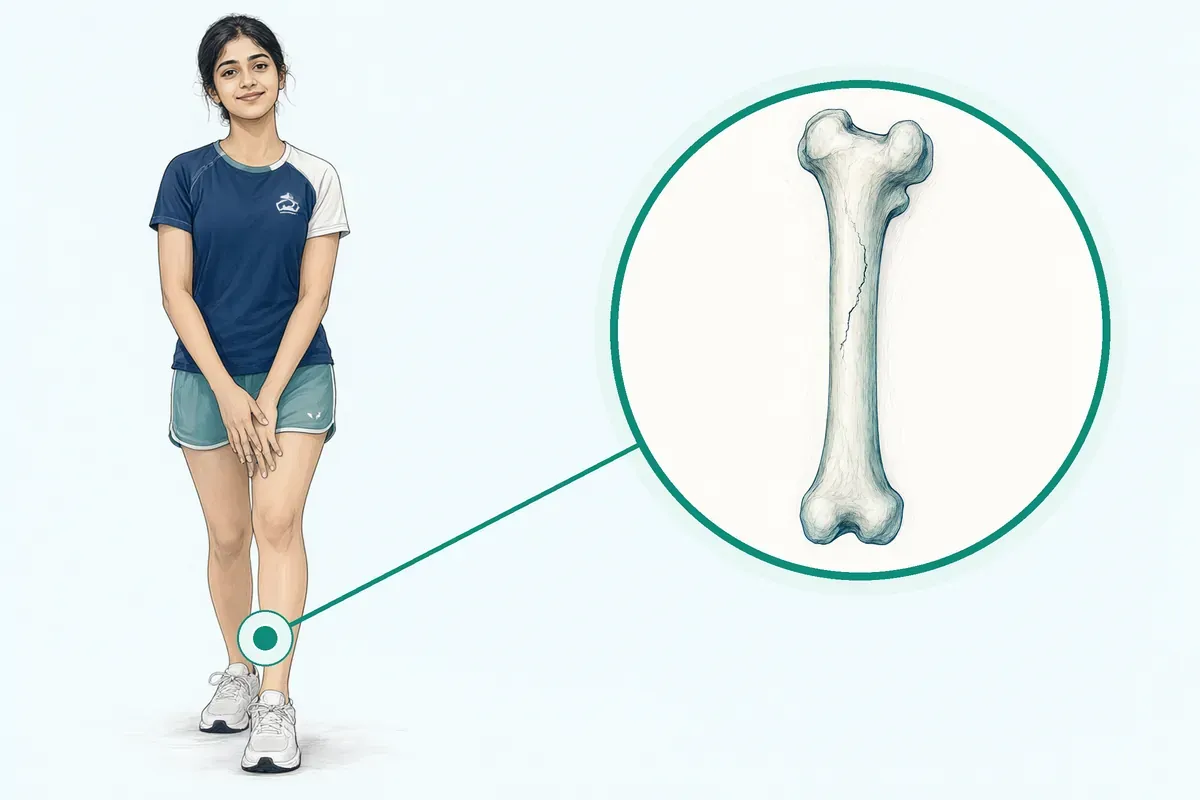
Stress fractures result from abnormal repetitive loading on normal bone leading to microdamage.
Why Jaipur Hospital
You worry that the pain will force you to give up the sport you love or that you will lose fitness while waiting to heal.
Your care plan
Your first steps with us
- 1 Book an OPD consultation with our sports injury team
- 2 Get examined and imaged in-house the same day
- 3 Start your graded loading plan with physiotherapy guidance
- 4 Return to running step by step with regular check-ins
How we assess and treat bone stress injuries
We confirm the diagnosis with clinical exam and MRI, identify biomechanical and nutritional drivers, then prescribe a progressive loading plan. Surgery is considered only for high-risk fractures that do not heal.
-
Activity Modification & Offloading
Moon boot or crutches reduce load while bone heals; training volume is adjusted, not stopped completely.
-
Biomechanical & Nutritional Assessment
Gait analysis, DEXA scan, vitamin D and calcium levels, and RED-S screening to find root causes.
-
Shockwave Therapy (ESWT)
Used for stubborn tibial stress syndrome or delayed healing when rest alone has not worked.
-
Surgical Fixation (High-risk fractures)
Intramedullary nailing or plating for femoral neck, tibial or navicular fractures at risk of non-union.
Why patients trust us
- 1991 Serving Jaipur for 35 years
- NABH Accredited hospital
- 1 Sports Injury consultants
- 24×7 Emergency, ICU and ambulance
- 25 Cashless schemes and insurers
What studies show about bone stress injury patterns
-
5% to 35% of runners affected
Medial tibial stress syndrome is common in runners, military personnel and dancers.
-
6 to 7 times higher recurrence
Prior bone stress injury increases recurrence risk sixfold in females and sevenfold in males.
-
4.5 times higher injury rate with low energy availability
Runners with amenorrhea or low testosterone had 4.5-fold higher bone injury rates.
If it is left untreated
Untreated high-risk stress fractures can progress to complete fracture, non-union or delayed union, requiring surgery and a much longer time away from sport.
Life after your recovery plan
Most people return to their chosen activity with a stronger understanding of load management and nutrition.
-
Run without dread
Most people rebuild mileage gradually and complete their usual training sessions.
-
Know your limits
You learn the warning signs and how to adjust load before pain returns.
-
Stronger foundation
Addressing biomechanics and nutrition often leaves you more resilient than before.
-
Stay in the game
Regular check-ins help you keep training through niggles without a full stop.
Frequently asked questions
Questions patients ask about bone stress and overuse injuries
Which problems are assessed under bone stress and overuse injuries?
In short
Jaipur Hospital assesses stress fractures, shin splints, and bone stress reactions under bone stress and overuse injuries. These conditions result from repetitive loading on normal bone leading to microdamage. The service covers diagnosis and graded return to activity for injuries commonly seen in runners, dancers, and military personnel.
In detail
Evidence shows stress fractures occur after a sudden increase in physical activity and are common with load-bearing activities. Medial tibial stress syndrome (MTSS), also called shin splints or tibial stress syndrome, presents as diffuse pain along the posteromedial tibia.
Tibial bone stress injuries are classified by grade; the first three grades are stress reactions, and a visible fracture line makes it a grade 4 stress fracture. The posteromedial tibial shaft is the most common low-risk site in runners. High-risk sites such as the anterior tibial cortex may require surgery or prolonged non-weight bearing.
A common belief
Many people think shin splints are just muscle soreness, but evidence shows it is a painful bone stress reaction.
What actually happens
High-risk stress fractures like the anterior tibial cortex need very different care than low-risk posteromedial tibial injuries.
Your next step at Jaipur Hospital
If you have activity-related leg pain, book a consultation at Jaipur Hospital. The orthopaedic and sports injury team will take a detailed history, examine you, and advise on imaging if needed. Typical treatment length is 6 weeks to 6 months of modified loading. A graded return to sport over 2 to 6 months is planned based on your injury grade and location.
How will the doctor decide which tests I need for a bone stress injury?
In short
The surgeon at Jaipur Hospital selects tests based on your history, examination findings, and the suspected grade and location of the injury. Clinical assessment comes first. If a stress fracture is suspected, MRI is the preferred imaging to confirm and grade it. X-ray may be used initially but is often normal early on. Blood tests check for nutritional and hormonal contributors.
In detail
Evidence states the diagnosis remains clinical, but imaging studies such as plain radiographs and bone scans are usually sufficient, although MRI is useful in borderline cases to rule out more significant pathology. No biological test is useful for diagnosis.
Plain radiographs are normal in early stage disease. MRI is the preferred imaging to confirm stress fracture. The surgeon also considers risk factors: female sex, previous injury, low energy availability, vitamin D deficiency, and biomechanical overload. These guide whether DEXA, vitamin D, calcium, or hormonal panels are needed.
A common belief
Many patients expect an X-ray to rule out a fracture, but plain films miss early stress reactions.
What actually happens
MRI shows bone oedema and fracture lines before they appear on X-ray. Blood tests are not for diagnosis but to find treatable drivers like low vitamin D or relative energy deficiency.
Your next step at Jaipur Hospital
Expect a clinical examination followed by a targeted imaging request. MRI is typically arranged for suspected stress fractures. Blood work may include vitamin D, calcium, and markers of energy availability. The results shape the offloading method and return to sport timeline.
How soon should I expect improvement after the chosen treatment for a bone stress injury?
In short
Improvement timing varies by injury grade and site. At Jaipur Hospital, low-risk tibial stress reactions often settle within weeks of offloading. High-risk fractures or delayed unions take longer. Pain reduction usually precedes full bone healing seen on MRI. A graded return to running starts only after clinical and imaging clearance.
In detail
Evidence shows recovery times in medial tibial stress syndrome tend to be long. Tibial bone stress injuries have a high recurrence rate. Prior injury increases recurrence sixfold in females and sevenfold in males.
Return-to-run decisions must be purposeful and based on defined criteria, not just pain absence. The 10% loading rule is not generalisable to all runners. Gait retraining can reduce load rates significantly when adhered to.
- The 10% loading rule is not generalisable to all runners.
A common belief
Many runners restart too early because pain drops.
What actually happens
But bone needs load to remodel, and jumping back causes recurrence. Studies show prior injury multiplies recurrence risk. Gait retraining helps but takes weeks to stick.
Your next step at Jaipur Hospital
Expect modified loading for 6 weeks to 6 months. Graded return to sport spans 2 to 6 months. Your physiotherapist guides load progression. If symptoms persist or worsen, review is needed.
Could a stress injury be present even if an early X-ray is normal?
In short
At Jaipur Hospital, yes, a stress injury can be present with a normal early X-ray. Plain radiographs are normal in early stage disease because bone changes take weeks to appear. MRI is used to confirm the diagnosis when X-rays are negative but symptoms suggest a stress injury.
In detail
Evidence shows that plain radiographs are normal in early stage disease. MRI is the preferred imaging to confirm stress fracture and grade the injury. Bone scans are also used but MRI gives better detail of soft tissue and bone marrow oedema.
No biological test is useful for diagnosis. Clinical evaluation based on history and examination guides the decision to image. Early MRI detection allows earlier offloading and prevents progression to a complete fracture.
A common belief
Many patients are told 'nothing is broken' after a normal X-ray and keep training.
What actually happens
This turns a stress reaction into a full fracture. Early MRI changes management from months of modified loading to weeks.
Your next step at Jaipur Hospital
If you have activity-related pain along the tibia or other risk sites and your X-ray is normal, ask your surgeon about MRI. Early diagnosis shortens the overall recovery.
How can I decide whether to seek advice about stress fracture management?
In short
You should seek advice at Jaipur Hospital if you have activity-related pain that does not settle with a few days of relative rest, especially if the pain is localised over a bone and worsens with loading. Night pain, pain at rest or a sudden increase in training volume before symptoms started are additional reasons to book an assessment. Early evaluation prevents a stress reaction from becoming a complete fracture.
In detail
Stress fractures result from abnormal repetitive loading on normal bone and often follow a sudden increase in physical activity. Plain radiographs are normal in early stage disease so a clinical examination and often MRI are needed to confirm the diagnosis.
High-risk sites such as the femoral neck, anterior tibial cortex or navicular carry a higher complication risk and may require surgical fixation. Female sex, previous injury, low energy availability and biomechanical factors like navicular drop increase risk.
A surgeon can grade the injury, assess risk factors and start a graded return-to-sport plan that typically spans two to six months.
A common belief
Many runners try to run through the pain hoping it will disappear.
What actually happens
Evidence shows early imaging and offloading prevent a stress reaction from turning into a complete fracture that may need surgery. Waiting usually makes the recovery longer.
Your next step at Jaipur Hospital
If your pain matches this pattern, do not wait for it to become severe. Call Jaipur Hospital on 0141-2551500 or 0141-2554139 to book an orthopaedic consultation. The surgeon will examine you, arrange imaging if needed and outline a management plan the same day.
Can I continue any training safely while I recover from a bone stress injury?
In short
Yes, at Jaipur Hospital your surgeon will prescribe a modified loading programme that keeps you moving without overloading the healing bone. Non-impact cardiovascular exercise such as swimming, deep-water running or stationary cycling is usually started early. Strength training for uninvolved limbs and core is encouraged. The specific activities and intensity depend on the injury site, grade and your symptoms.
In detail
Treatment always involves rest from the provocative load and analgesics if needed. However, complete immobilisation is rarely required for low-risk injuries. Activity modification and offloading using a moon boot, crutches or altered training load is a standard technique.
Biomechanical and nutritional assessment including gait analysis, DEXA, vitamin D, calcium and RED-S screening addresses the root causes. Graded return to sport over two to six months follows a criteria-based progression. The 10 percent rule of graduated loading is not generalisable to all runners. Your surgeon will individualise the plan based on injury severity and your experience.
- The 10 percent rule of graduated loading is not generalisable to all runners.
A common belief
Many people think they must stop all exercise.
What actually happens
Evidence shows total rest can weaken bone and muscle. A criteria-based graded return maintains fitness and promotes bone adaptation. The 10 percent weekly increase rule does not fit everyone. Your plan is individualised.
Your next step at Jaipur Hospital
Expect a written modified training plan at your first visit. It will be reviewed every two to four weeks. Typical modified loading lasts six weeks to six months.
Which symptoms should prompt me to see a specialist?
In short
You should see a specialist at Jaipur Hospital if you have mechanical pain in the lower limbs that worsens with activity and eases with rest. Typical signs include focused tenderness over a bone, diffuse ache along the inner shin border, or swelling that appears after training. Pain that persists despite a few days of reduced loading also warrants review.
In detail
Evidence describes stress fracture pain as mechanical, appearing mostly in the lower limbs, with clinical findings of focused pain and sometimes swelling. Medial tibial stress syndrome presents as diffuse pain along the posteromedial border of the tibia, activity related and often bilateral.
Symptoms typically start after a sudden increase in physical activity. Risk factors such as female sex, previous running injury, higher BMI, and navicular drop increase the likelihood of these conditions. Early specialist review helps confirm the grade of injury and prevents progression to a complete fracture or chronic symptoms.
A common belief
Runners often dismiss shin pain as normal soreness, but diffuse pain along the posteromedial tibia is a classic sign of medial tibial stress syndrome.
What actually happens
Focused tenderness suggests a stress reaction or fracture. Waiting until pain occurs at rest or at night means the injury has advanced.
Your next step at Jaipur Hospital
At your consultation, the surgeon will ask about your training history, load changes, and any menstrual or hormonal irregularities. A physical examination will locate the tender area. Imaging may be ordered to distinguish a stress reaction from a stress fracture. A graded return plan will be outlined.
How will the results change my care plan?
In short
Test results at Jaipur Hospital directly guide whether you need offloading, activity modification, shockwave therapy, or surgical referral. A confirmed stress fracture grade and location determine the loading plan. Low-risk injuries follow a graded return to sport over 2 to 6 months. High-risk fractures may need non-weight bearing or surgery. Nutritional deficits trigger supplementation.
In detail
Evidence shows tibial bone stress injuries are classified by grade and risk of location. The first three grades are stress reactions; a visible fracture line is a grade 4 stress fracture. Low-risk posteromedial tibial injuries typically heal with modified loading.
High-risk anterior tibial cortex, femoral neck, or navicular fractures may require surgical fixation or prolonged non-weight bearing and have a longer return-to-run timeline. MRI confirms the grade. DEXA and blood results guide vitamin D, calcium, and energy availability correction. RED-S screening addresses hormonal factors.
Gait retraining evidence shows increasing step rate by 7.5% reduces vertical load rates by about 18% and hip adduction, which informs rehabilitation.
A common belief
A common belief is that all stress fractures just need rest.
What actually happens
But evidence shows high-risk sites like the anterior tibia or femoral neck often need surgery or months of non-weight bearing. Also, the 10% weekly load increase rule is not generalisable to all runners. Your plan must be individualised to your injury grade and biomechanics.
Your next step at Jaipur Hospital
Your care plan is individualised based on injury grade, site, and contributing factors. Treatment length ranges from 6 weeks to 6 months of modified loading. The return-to-run process is purposeful and criteria-based, not a fixed 10% rule.
What should I do if symptoms persist or worsen during treatment for a bone stress injury?
In short
If pain increases, swelling appears, or you cannot progress through the loading stages, contact Jaipur Hospital promptly. Your surgeon will reassess clinically and may order repeat imaging to check for fracture progression, non-union, or a missed high-risk pattern.
In detail
Evidence shows that high-risk injuries involving the anterior tibial cortex may require surgical fixation or prolonged non-weight bearing and have a higher complication risk. Persistent symptoms despite modified loading can indicate delayed union or non-union.
In such cases, options include dynamisation of an intramedullary nail, exchange nailing, bone grafting, or adjunctive low-intensity pulsed ultrasound. Shockwave therapy is another option for recalcitrant tibial stress syndrome. Early re-evaluation prevents a minor setback from becoming a complete fracture.
A common belief
A common mistake is to keep running through discomfort.
What actually happens
Bone stress injuries can silently worsen; anterior tibial cortex fractures are notorious for non-union. Early imaging and plan adjustment prevent a longer layoff or surgery.
Your next step at Jaipur Hospital
Do not push through worsening pain. Attend the next available OPD slot for examination and imaging review. The team will adjust offloading, investigate nutritional or hormonal contributors, and discuss further interventions if needed.
Do I need assessment of training load, nutrition, hormones, or bone health for a bone stress injury?
In short
At Jaipur Hospital, yes, a comprehensive assessment of training load, nutrition, hormones, and bone health is standard for bone stress injuries. This includes gait analysis, DEXA scan for bone density, Vitamin D and calcium levels, and screening for Relative Energy Deficiency in Sport. These factors drive healing and prevent recurrence.
In detail
Evidence shows that low energy availability, or Relative Energy Deficiency in Sport, is an intrinsic risk factor affecting both females and males.
Amenorrhea and low testosterone were found in 37 percent and 40 percent of elite female and male distance runners, resulting in 4.5-fold higher bone injury rates. The most proven risk factors are hyperpronation, female sex, and previous injury.
Increased BMI, navicular drop, and hip external rotation range are also risk factors. Enhancing adaptive bone formation is a promising target for prevention. Nutritional and hormonal correction supports bone remodelling during the six-week to six-month modified loading period.
A common belief
Runners often focus only on shoes or mileage.
What actually happens
But studies show low energy availability and hormonal disruption raise bone injury risk 4.5 times. Fixing the load without fixing the fuel leaves the bone weak.
Your next step at Jaipur Hospital
Your surgeon will order blood tests, DEXA, and gait analysis as needed. A sports nutritionist and endocrinologist may be involved. Correcting deficits shortens healing and lowers recurrence risk.
FAQ library
Questions and answers about bone stress and overuse injuries
When you contact us
Get your assessment and plan
Contact Jaipur Hospital to book your sports injury OPD visit and start a clear path back to training.
- A consultation with a sports injury specialist in the OPD
- Your scans and reports reviewed, with tests done in-house if you need them (laboratory, X-ray and imaging)
- Your options explained in plain words, including whether you need surgery at all
- A cost estimate before you decide
- Help with cashless treatment under RGHS, MAA Yojana, CGHS and empanelled insurers and TPAs
- Follow-up visits after your treatment
Overview
Bone Stress and Overuse Injuries: what to know
What bone stress and overuse injuries are and how they happen
- Grade 4
- Visible fracture line
- Common site
- Posteromedial tibial shaft
Bone stress and overuse injuries cover a range of conditions from early bone stress reactions to clear stress fractures. They appear mostly in the lower limbs. Medial tibial stress syndrome (MTSS), often called shin splints, is a benign though painful condition common in running athletes. It presents as diffuse pain along the posteromedial border of the tibia.
A stress fracture results from abnormal and repetitive loading on normal bone that leads to microdamage and then fracture. They occur after a sudden increase in physical activity. In response to novel repetitive loading, increased bone remodeling may serve to replace fatigue-damaged bone while at the same time creating temporary porosity. Tibial bone stress injuries are common among long-distance runners.
These injuries can be classified based on grade of injury as well as risk of location. For most classification systems, the first three grades are considered stress reactions, and when there is a visible fracture line, the injury is considered a stress fracture, typically classified as grade 4.
In the tibia, the most common location especially among runners is the posteromedial tibial shaft, which is considered a low-risk injury.
Symptoms and warning signs that need urgent care the same day
- Sudden severe pain
- Inability to bear weight
- Visible deformity
Patients complain of mechanical pain. Clinical findings include focused pain and sometimes swelling. MTSS presents as diffuse pain along the posteromedial border of the tibia. The definition of MTSS includes three characteristics: pain along the posteromedial border of the tibia, diffuse pain, and pain that is activity related.
Common names for this problem include shin splints, soleus syndrome, tibial stress syndrome, and periostitis. High-risk injuries involving the anterior tibial cortex may require surgical fixation or prolonged non-weight bearing, have a higher complication risk, and will require a longer timeline for returning to running.
If you have sudden severe pain, inability to bear weight, or visible deformity, attend the emergency department the same day.
Causes and who is at higher risk for bone stress injuries
- 5% to 35% MTSS in runners
- 4% to 35% MTSS in military and dancers
- sixfold Recurrence in females
- sevenfold Recurrence in males
The exact cause of MTSS is unknown. Previous theories included an inflammatory response of the periosteum or periosteal traction reaction. More recent evidence suggests a painful stress reaction of bone. Stress fractures result from abnormal and repetitive loading on normal bone that lead to microdamage and then fracture. They occur after sudden increase in physical activity.
The most proven risk factors are:
- Hyperpronation of the foot
- Female sex
- History of previous MTSS
Women are at higher risk than men. Female sex is a risk factor for the development of MTSS with an odds ratio of 2.35. Increased weight is a risk factor for the development of MTSS. Higher navicular drop is a risk factor for the development of MTSS. Previous running injury is a risk factor for the development of MTSS.
Greater hip external rotation with the hip in flexion is a risk factor for the development of MTSS. Increased BMI is a risk factor for MTSS. Navicular drop is a risk factor for MTSS. Ankle plantarflexion range of motion is a risk factor for MTSS. Hip external rotation range of motion is a risk factor for MTSS.
Low energy availability, or more specifically Relative Energy Deficiency in Sport (REDs), is an intrinsic risk factor. REDs expands on the Female Athlete Triad and recognises that both females and males can be affected. It is important to acknowledge and address mechanical loading issues, and other contributing factors including biomechanical, nutritional and hormonal factors, particularly in females.
Amenorrhea and low testosterone, indicating chronic energy conservation, were found in 37% and 40% of elite female and male distance runners, respectively. Amenorrhea and low testosterone resulted in 4.5-fold higher rates of bone injuries than in runners with normal menstruation or testosterone levels. MTSS affects 5% to 35% of runners.
MTSS is prevalent among military personnel, runners, and dancers, showing an incidence of 4% to 35%. Tibial bone stress injuries have a high recurrence rate. Prior BSI has been shown to increase the recurrence rate sixfold in females and sevenfold in males.
How bone stress injuries are diagnosed: examination and tests
- History and examination Detailed history and physical check
- Imaging X-ray, bone scan or MRI
- Grading Clinical assessment and imaging grade the injury
Patient evaluation is based on meticulous history taking and physical examination. Even though the diagnosis remains clinical, imaging studies, such as plain radiographs and bone scans are usually sufficient, although MRI is useful in borderline cases to rule out more significant pathology. No biological test is useful for diagnosis. Plain radiographs are normal in early stage disease.
MRI is the reference standard to confirm stress fracture. At Jaipur Hospital, our orthopaedic and sports injury team uses clinical assessment and imaging to grade the injury and guide your recovery plan.
Non-surgical treatment options for bone stress injuries and when surgery is advised
Do
- Biomechanical and nutritional assessment
- Shockwave therapy (ESWT)
Avoid
- NSAIDs
- Unproven therapies
Treatments of stress fracture always involve rest and analgesics. Non-steroidal anti-inflammatory should be used cautiously because they may inhibit callus formation. Activity modification and offloading with a moon boot, crutches, or altered training load is the first step. Biomechanical and nutritional assessment including gait analysis, DEXA, vitamin D and calcium levels, and RED-S screening helps address underlying causes.
Shockwave therapy (ESWT) has shortened the duration of symptoms in recalcitrant tibial stress syndrome or delayed union. Extracorporeal shockwave may be a new approach for stress fractures not healing with rest. ESWT appears to have the most promise among examined treatments.
Iontophoresis, phonophoresis, ice massage, ultrasound therapy, periosteal pecking and extracorporeal shockwave therapy (ESWT) could be effective in treating MTSS when compared with control. Low-energy laser treatment, stretching and strengthening exercises, sports compression stockings, lower leg braces and pulsed electromagnetic fields have not been proven to be effective in treating MTSS.
None of the studies are sufficiently free from methodological bias to recommend any of the treatments investigated. Shock-absorbing insoles have reduced MTSS rates in military personnel. Prevention programmes do not seem to influence the rate of MTSS. Retrainers increased step rate by 8.6%, reducing instantaneous vertical load rate, average vertical load rate, peak hip adduction, and eccentric knee joint work.
Alterations in gait were maintained at 30 days. Surgery is rarely indicated but has shown some promising results in patients who have not responded to all conservative options. Surgical treatment is often needed in high risk stress fracture of delayed healing, non-union or complete fracture.
High-risk fractures such as femoral neck, tibial, or navicular fractures may need surgical fixation with intramedullary nailing or plating. Displaced, unstable, intra-articular, or open fractures require surgical reduction and internal or external fixation to restore anatomy, prevent malunion, and permit early joint mobilisation. Intramedullary nailing is the fixation standard for diaphyseal fractures of the femur, tibia and humerus.
Locking plate fixation is used for periarticular and metaphyseal fractures. Following a tibial BSI, a critical component of complete rehabilitation is the successful return to running. The decision on when to start the return to running process should be purposeful and based on defined criteria.
The return-to-run process needs to be individualised, and based on multiple factors including the severity of injury and experience of the runner. While widely cited, the 10% rule of graduated loading is not generalisable to all runners. Recovery times in MTSS tend to be long. At Jaipur Hospital, your surgeon will advise which option suits you.
Treatment length is typically 6 weeks to 6 months of modified loading. Recovery involves a graded return to sport over 2 to 6 months. Most care is outpatient based. The typical price range in India is ₹3,000 to ₹1,00,000; ask us for an estimate.
Your first visit and tests for bone stress and overuse injuries
Do
- Previous imaging
- List of current medications
- Weekly training load details
At your first visit, your doctor will take a detailed history of your training, recent changes in activity, footwear, and any previous injuries. They will ask about menstrual history, diet, and symptoms of low energy availability, as these are recognised risk factors for bone stress injuries.
A physical examination will check for focal tenderness, swelling, and biomechanical factors such as navicular drop, hip rotation range, and ankle plantarflexion. You should bring any previous imaging, a list of current medications, and details of your typical weekly training load.
Imaging is often needed because plain radiographs are normal in early-stage disease. MRI is the reference standard to confirm a stress fracture and to grade the injury.
Your doctor may also order blood tests for vitamin D, calcium, and hormonal profile, and a DEXA scan to assess bone density, especially if there are features of Relative Energy Deficiency in Sport (RED-S). Gait analysis may be arranged to identify loading patterns that contribute to the injury.
How treatment works for bone stress and overuse injuries
- Modified loading 6 weeks to 6 months
- Graded return to sport 2 to 6 months
Treatment is almost always non-operative and based on modified loading. Your doctor will advise a period of relative rest or offloading using a moon boot or crutches, depending on the site and grade of injury. The typical treatment length is 6 weeks to 6 months of modified loading, with a graded return to sport over 2 to 6 months.
Biomechanical and nutritional assessment is a core part of care. This includes gait retraining, correction of hyperpronation, and addressing vitamin D or calcium deficiency. In studies, increasing step rate by about 7.5 to 8.6 percent reduced vertical load rates and hip adduction, and these changes were maintained at one month.
For recalcitrant medial tibial stress syndrome or delayed union, extracorporeal shockwave therapy (ESWT) may be offered. Evidence shows ESWT can shorten the duration of symptoms and appears to have the most promise among physical therapies for this condition. Non-steroidal anti-inflammatory drugs should be used cautiously because they may inhibit callus formation.
If the injury is a high-risk stress fracture — such as the femoral neck, anterior tibial cortex, or navicular — and it fails to heal with non-operative care, your surgeon may recommend surgical fixation with intramedullary nailing or plating. This is a referral option discussed when conservative measures have not led to healing. Non-operative management with cast immobilisation remains appropriate for undisplaced or minimally displaced fractures with acceptable alignment.
Risks and possible complications of bone stress and overuse injuries
The main risk with non-operative treatment is that the bone does not heal, leading to delayed union or non-union. High-risk injuries involving the anterior tibial cortex have a higher complication risk and may require surgical fixation or prolonged non-weight bearing. In studies, no treatment has been shown to be clearly superior, and many trials carry a high risk of bias.
If surgery becomes necessary, the general risks include infection, implant-related irritation, and the usual risks of anaesthesia. Surgical treatment is often needed in high-risk stress fractures with delayed healing, non-union, or complete fracture. Displaced, unstable, intra-articular, or open fractures require surgical reduction and fixation to restore anatomy and prevent malunion. Open fractures receive emergency irrigation and surgical debridement within 6 hours.
Recovery and aftercare for bone stress and overuse injuries
Recovery is outpatient-based. In the first days, you will focus on pain control, offloading as advised, and starting any prescribed nutritional supplements. Your doctor will give you clear criteria for when you can begin weight-bearing and progress to the next stage.
The return-to-run process is individualised and based on multiple factors including the severity of injury and your running experience. The widely cited 10 percent rule of graduated loading is not generalisable to all runners. You will typically follow a structured, graded programme supervised by the physiotherapy team, with regular review of symptoms and, if needed, repeat imaging.
You should contact the hospital if pain worsens or does not improve with the prescribed offloading, if you develop new swelling or night pain, or if you have any concerns about your progress. Recovery times in medial tibial stress syndrome tend to be long, and tibial bone stress injuries have a high recurrence rate.
Results for bone stress and overuse injuries
Most low-risk tibial stress injuries heal with modified loading and biomechanical correction. In studies, gait retraining reduced loading parameters and the changes were maintained at 30 days. Shockwave therapy has shortened the duration of symptoms in recalcitrant cases. However, none of the studies are sufficiently free from methodological bias to recommend any single treatment as clearly superior.
Recurrence is common. Prior bone stress injury increases the recurrence rate sixfold in females and sevenfold in males. Amenorrhea and low testosterone, indicating chronic energy conservation, were found in 37 percent and 40 percent of elite female and male distance runners respectively, and were associated with 4.5-fold higher rates of bone injuries. Addressing energy availability, biomechanics, and bone health is therefore essential to reduce the chance of the problem coming back.
Cost and insurance for bone stress and overuse injuries in Jaipur
The typical price range for diagnosis and treatment in India is ₹3,000 to ₹1,00,000. The final cost depends on the number of imaging studies (MRI, DEXA), whether shockwave therapy sessions are needed, the duration of physiotherapy and gait retraining, and whether surgical fixation becomes necessary. Outpatient-based care keeps costs at the lower end; surgery and implants raise the cost.
Jaipur Hospital is a NABH-accredited multispeciality hospital established in February 1991. We accept patients under RGHS, MAA Yojana, CGHS, and a panel of private insurers and TPAs. The hospital has in-house diagnostic laboratory and imaging, 24-hour laboratory, X-ray and ECG, modular operation theatres, and a physiotherapy department on site. For an estimate specific to your case, please ask at the billing counter or during your consultation.