

Sports Injury · Jaipur Hospital
Elbow and Wrist Sports Injuries in Jaipur
Elbow or wrist pain stopping your sport or work. We assess, explain options, and give you a clear plan.
- Serving Jaipur since 1991 (35 years)
- NABH accredited
- 24×7 emergency & ICU
- Cashless: RGHS, MAA Yojana, CGHS + 22 insurers
- Treatment length
- Varies by condition
- Anaesthesia
- Local or regional as needed
- Recovery
- 2 to 12 weeks depending on severity
- Price
- ₹5,000 to ₹1,50,000typical range in India; ask us for an estimate
Pain that stops you
Elbow or wrist pain that won't go away
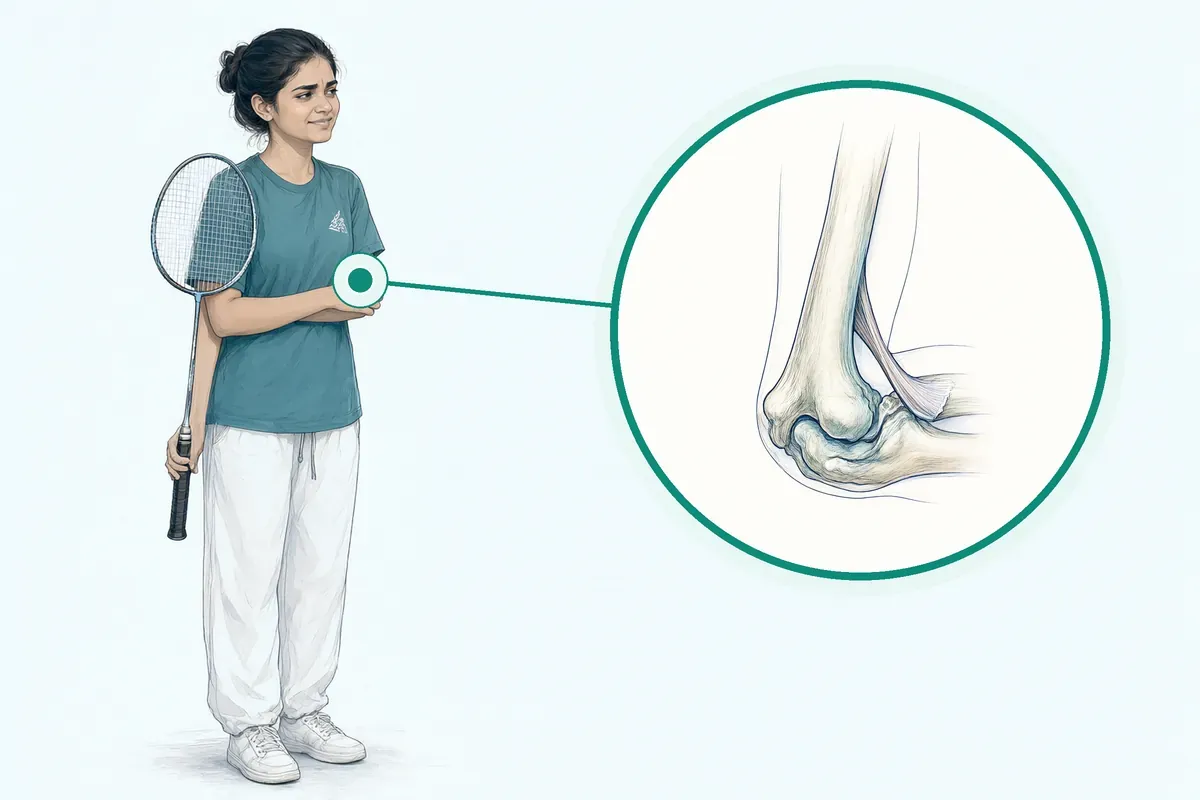
Pain on the outside or inside of the elbow, or the ulnar side of the wrist, often comes from overuse or a sudden twist. It makes gripping, lifting, or typing difficult. Rest helps briefly, but the pain returns when you resume activity.
-
Tennis elbow
Pain on the outer elbow from repeated wrist extension. Common in racquet sports, typing, and manual work.
-
Golfer's elbow
Pain on the inner elbow from repeated wrist flexion and gripping. Affects golfers, weightlifters, and labourers.
-
Wrist sprain
Ligament stretch or tear from a fall on an outstretched hand. Causes swelling, bruising, and instability.
-
TFCC tear
Tear of the triangular fibrocartilage complex on the ulnar side of the wrist. Causes clicking, pain on rotation, and weak grip.
Lateral epicondylitis affects 1 to 3 percent of the population and is usually self-limiting over 12 to 18 months.
Why Jaipur Hospital
You worry the pain will keep you off the court, away from work, or make simple tasks like lifting a cup feel impossible.
Your care plan
Your first steps with us
- 1 Call or visit OPD for specialist consultation
- 2 Get scans and tests done in-house
- 3 Review options and receive a cost estimate
- 4 Start treatment and attend follow-up visits
How treatment is planned
Your surgeon examines the joint, reviews imaging, and discusses which option fits your condition and goals. Most cases start with non-operative care.
-
Physiotherapy & Bracing
First-line for tendinopathy and mild ligament sprains. Load management, eccentric exercises, and a counterforce brace reduce tendon strain.
-
PRP Injection
Platelet-rich plasma injected into the tendon for chronic tennis or golfer's elbow. Uses your own blood components to support healing.
-
Arthroscopic Debridement/Release
Keyhole surgery for refractory cases or loose bodies. Small incisions allow camera and instrument access to clean or release the tendon.
-
TFCC Repair
Arthroscopic or open repair for unstable wrist injuries. The surgeon reattaches or debrides the torn fibrocartilage and ligaments.
Why patients trust us
- 1991 Serving Jaipur for 35 years
- NABH Accredited hospital
- 1 Sports Injury consultants
- 24×7 Emergency, ICU and ambulance
- 25 Cashless schemes and insurers
What studies show about these treatments
-
90 percent recover within one year
Most lateral epicondylitis cases are self-limiting and resolve with simple measures within 12 months.
-
Glucocorticoid better at 1 month only
Corticosteroid injection gives short-term pain relief at 4 weeks but no advantage over placebo beyond 8 weeks.
-
Most regain function by 12 weeks post-surgery
After TFCC repair surgery, the majority of patients regain full wrist function within 12 weeks.
If it is left untreated
Untreated severe TFCC tears can lead to a weak or unstable wrist. Chronic tendinopathy may cause progressive tendon weakening and recurrent pain with activity.
Life after treatment
Most people return to their sport, work, and daily tasks with a stable joint and manageable symptoms.
-
Return to sport
Gradual return to racquet sports, golf, or gym once strength and pain control are adequate.
-
Work without pain
Typing, lifting, and manual tasks become comfortable again with proper ergonomics and conditioning.
-
Stable wrist
Clicking and giving-way sensations resolve as the TFCC heals or is repaired.
-
Confidence in movement
You trust your elbow and wrist again because you understand the condition and the plan.
Frequently asked questions
Questions patients ask about elbow and wrist sports injuries
Which problems are assessed under elbow and wrist sports injuries?
In short
Jaipur Hospital assesses elbow and wrist sports injuries including tennis elbow, golfer's elbow, wrist sprains and triangular fibrocartilage complex tears. These conditions affect tendons, ligaments and cartilage from repetitive strain or sudden impact. The orthopaedic team evaluates each problem to plan suitable care.
In detail
Tennis elbow involves degenerative changes in the extensor carpi radialis brevis tendon from overuse of wrist extensors. Golfer's elbow affects the medial epicondyle tendons. Wrist sprains stretch or tear ligaments.
TFCC tears damage the fibrocartilage disc, dorsal and palmar ligaments and ulnocarpal ligaments that stabilise the distal radioulnar joint. Evidence shows these conditions result from repetitive activities such as tennis, typing or manual work, or from falls and twisting injuries.
Age-related tissue wear also contributes to TFCC tears. The hospital's sports injury department examines the mechanism of injury and the structures involved.
Your next step at Jaipur Hospital
You can book a consultation at Jaipur Hospital for a detailed assessment. The surgeon will review your activity history, examine the joint and may order imaging. Most patients start with non-operative measures. If symptoms persist, further options are discussed.
How will the doctor decide which tests I need for elbow and wrist sports injuries?
In short
The doctor at Jaipur Hospital selects tests based on your history, examination findings and the suspected diagnosis. X-rays are usually first to rule out fracture or arthritis. MRI is preferred for soft tissue detail such as TFCC tears or tendon degeneration. Ultrasound may assess tendon thickness and neovascularisation.
In detail
Clinical reasoning guides test choice. For tennis elbow, the diagnosis is often clinical; imaging confirms tendon changes or excludes other pathology. For TFCC tears, MRI with or without arthrogram visualises the fibrocartilage disc, ligaments and associated injuries.
Evidence shows ultrasonography can evaluate common extensor origin tears, oedema, cortical erosion and tendon thickness. The surgeon considers cost, availability and diagnostic yield. In acute trauma, X-ray is mandatory. In chronic cases with mechanical symptoms, MRI helps plan arthroscopic treatment. The surgeon explains why each test is needed and what it will show.
Your next step at Jaipur Hospital
Tests are arranged through the in-house radiology department. Results are typically available within 24 to 48 hours. A follow-up visit reviews the images and confirms the treatment plan. Ask the surgeon about any test concerns.
How soon should I expect improvement after treatment for an elbow or wrist sports injury?
In short
Recovery time varies by condition and treatment at Jaipur Hospital. Non-operative care such as physiotherapy and bracing typically shows gradual improvement over six to twelve weeks. After arthroscopic surgery, most people regain full wrist function within twelve weeks, while tennis elbow symptoms may take longer to settle completely.
In detail
Studies indicate that lateral epicondylitis has a self-limiting course of 12 to 18 months, with 90% of patients recovering within one year even without treatment. Glucocorticoid injection provides short-term pain reduction at one month but no long-term advantage beyond eight weeks.
Platelet-rich plasma and autologous blood injections are statistically superior to placebo, yet neither was superior to saline at the primary three-month endpoint in randomised trials. For TFCC tears, most people regain full function within 12 weeks of surgery.
Physiotherapy programmes that include eccentric exercise report decreased pain and improved grip strength from baseline, with the majority of consistent findings supporting eccentric exercise as part of a multimodal programme.
- Studies indicate that lateral epicondylitis has a self-limiting course of 12 to 18 months, with 90% of patients recovering within one year even without treatment.
A common belief
A cortisone shot feels great at one month but the benefit fades by eight weeks.
What actually happens
PRP beats placebo but not always saline at three months. The real driver is a structured eccentric exercise programme, not a single injection.
Your next step at Jaipur Hospital
Expect a phased return: initial pain control in weeks one to four, progressive strengthening in weeks four to eight, and sport-specific drills after eight to twelve weeks. Your physiotherapist will adjust load based on symptoms.
Can this injury heal with rehabilitation, or is an operation worth considering?
In short
At Jaipur Hospital, many elbow and wrist sports injuries heal with rehabilitation alone. Tennis elbow and golfer's elbow are usually self-limiting, with 90% of patients recovering within one year without surgery. Minor TFCC tears may also heal on their own. An operation is considered when symptoms remain severe or persistent after six months of non-operative care, or when there is wrist instability.
In detail
Evidence shows that non-invasive treatment methods such as bracing, physical therapy and extracorporeal shockwave therapy do not appear to provide definitive benefit regarding pain relief in every case, yet most patients are well-managed with non-operative treatment and activity modification.
For lateral epicondylitis, glucocorticoid injection gives short-term pain reduction at one month but no long-term advantage beyond eight weeks. PRP and autologous blood injections were statistically superior to placebo. Surgical procedures have been recommended for refractory symptoms.
For TFCC tears, surgical treatment is advocated if conservative management fails or if there is frank instability of the distal radio-ulnar joint. Arthroscopic debridement, release or TFCC repair are options for refractory cases.
A common belief
Patients often want a quick surgical fix, but studies show steroid shots fade by two months and surgery carries risks like tendon thinning or recurrence.
What actually happens
Patience with a structured rehab programme avoids unnecessary operations.
Your next step at Jaipur Hospital
Your surgeon will review your imaging, symptom duration and response to previous therapy before advising on surgery. If an operation is recommended, it is typically daycare or one night stay with recovery of two to twelve weeks.
How can I decide whether to seek advice about tennis elbow treatment?
In short
You should seek advice at Jaipur Hospital if lateral elbow pain persists beyond a few weeks of rest, limits your grip strength, or interferes with daily tasks like lifting a cup or typing. Tennis elbow is usually self-limiting over twelve to eighteen months, but early assessment can shorten disability and guide appropriate therapy.
In detail
Lateral epicondylitis affects one to three percent of the population and involves degenerative tendinosis of the extensor carpi radialis brevis. Overuse from racquet sports, manual work, or repetitive typing drives microtears and failed healing.
Studies show ninety percent recover within a year with simple measures, but persistent pain, night pain, or weakness warrants evaluation.
A clinical exam includes palpation of the lateral epicondyle, resisted wrist extension testing, and possibly ultrasound or MRI to assess tendon thickness, tears, or cortical erosion. If symptoms exceed six weeks despite activity modification and NSAIDs, structured physiotherapy with eccentric exercises is indicated.
Injection options such as PRP or corticosteroid may be considered for chronic cases. Surgical debridement or release is reserved for refractory symptoms after six months of failed conservative care.
A common belief
Many people wait months hoping it will vanish.
What actually happens
While ninety percent settle within a year, untreated tendinosis can thicken and tear, making later treatment harder. Early physiotherapy and load management prevent chronic disability.
Your next step at Jaipur Hospital
If your elbow pain has not improved with two to three weeks of rest, ice, and over-the-counter pain relief, book a consultation at Jaipur Hospital.
The orthopaedic team will confirm the diagnosis, grade severity, and outline a stepwise treatment plan tailored to your occupation and sport.
Can I continue any training safely while I recover from an elbow or wrist sports injury?
In short
At Jaipur Hospital, modified training is usually encouraged during recovery from elbow or wrist sports injuries. Complete rest is rarely advised because tendons and ligaments need controlled load to heal. Your surgeon and physiotherapist will design a programme that maintains cardiovascular fitness and strength in uninjured areas while protecting the healing tissue.
In detail
Evidence supports activity modification rather than complete abstinence. For tennis or golfer's elbow, you can continue lower-body conditioning, core work, and cardiovascular exercise such as stationary cycling or running. Upper-body exercises that avoid painful wrist extension, flexion, or gripping are permitted.
For TFCC tears, you avoid weight-bearing through the wrist, forced rotation, and heavy gripping. Isometric exercises for the forearm musculature begin early. Progressive loading follows a criteria-based protocol: pain during exercise stays below a tolerable threshold and settles quickly afterwards.
The team uses pain-monitoring models to advance from isometrics to slow heavy resistance, then to sport-specific drills. This approach prevents deconditioning and promotes collagen alignment in the healing tendon or ligament.
A common belief
Stopping all exercise causes stiffness, muscle loss, and slower tendon healing.
What actually happens
Controlled loading actually stimulates repair. The mistake is pushing through sharp pain — that delays recovery.
Your next step at Jaipur Hospital
At your first visit, the team will give you a written list of permitted and restricted exercises. You will review progress every two to three weeks.
Which symptoms should prompt me to see a specialist for elbow and wrist sports injuries?
In short
You should see a specialist at Jaipur Hospital if you have persistent lateral elbow pain, medial elbow pain, ulnar-sided wrist pain, clicking, weakness or instability during gripping or forearm rotation. Pain that limits daily activities or sport warrants evaluation. Night pain or swelling also needs review.
In detail
Lateral epicondylitis typically causes pain over the lateral epicondyle worsened by wrist extension. Medial epicondylitis produces medial elbow pain with wrist flexion. TFCC tears present as vague ulnar-sided wrist pain particularly during forearm rotation, with possible clicking or instability.
Evidence indicates chronic or degenerative TFCC tears may not cause symptoms, while acute tears cause pain, swelling and reduced grip strength. Shoulder and neck pain can accompany altered upper limb biomechanics.
If simple measures such as rest and activity modification do not relieve symptoms within a few weeks, specialist assessment helps confirm the diagnosis and prevent chronic disability.
Your next step at Jaipur Hospital
Schedule a consultation at Jaipur Hospital if symptoms persist beyond two weeks of rest. The surgeon will take a history, examine range of motion and strength, and may order X-rays or MRI. Early evaluation guides appropriate treatment.
How will the results change my care plan for elbow and wrist sports injuries?
In short
Test results at Jaipur Hospital directly shape your care plan. Normal imaging with classic clinical findings supports non-operative treatment. MRI showing a TFCC tear with instability may lead to arthroscopic repair. Tendon degeneration without tear usually continues with physiotherapy. The surgeon matches treatment to the structural findings.
In detail
Evidence indicates most lateral epicondylitis cases are self-limiting and managed with activity modification, bracing and physiotherapy. If imaging shows a full-thickness tendon tear or significant cortical erosion, surgical debridement or release may be considered.
For TFCC tears, the Palmer classification guides management: stable peripheral tears may heal with immobilisation, while unstable central tears or those with distal radioulnar joint instability often need arthroscopic repair or debridement. Degenerative TFCC changes with ulnar impaction may require ulnar shortening. The surgeon discusses how each finding alters the options, expected recovery and whether surgery is indicated.
Your next step at Jaipur Hospital
After results are reviewed, the surgeon outlines the recommended pathway, timelines and any restrictions. You can ask about alternatives and costs. A physiotherapy referral is made if appropriate.
What should I do if symptoms persist or worsen after treatment for an elbow or wrist sports injury?
In short
If pain, swelling or instability increase or do not improve after six weeks of prescribed therapy, contact Jaipur Hospital promptly. Your surgeon may repeat clinical examination, order updated imaging such as MRI or ultrasound, and discuss escalation from physiotherapy to injection or from injection to arthroscopic surgery.
In detail
Evidence shows that leaving a severe TFCC tear untreated can lead to a weak or unstable wrist. In corticosteroid-treated tennis elbow, symptom recurrence involved 46.7% of patients at six months. Botulinum toxin can cause temporary finger extension weakness.
Corticosteroid injection is associated with increased tendon thinning and cortical erosion at the lateral epicondyle over time. If conservative management fails to provide relief, surgical treatment is advocated.
The choice of operative treatment is guided by the type and extent of injury, and arthroscopic management can be instituted successfully in most conditions affecting the TFCC.
- In corticosteroid-treated tennis elbow, symptom recurrence involved 46.7% of patients at six months.
A common belief
Ignoring worsening signs risks chronic instability in the wrist or tendon degeneration in the elbow.
What actually happens
Steroid shots can thin the tendon and erode bone if repeated. Botulinum toxin may weaken finger extension temporarily. Early escalation prevents long-term loss of function.
Your next step at Jaipur Hospital
Do not wait beyond your scheduled review if symptoms worsen. Call the OPD at Jaipur Hospital to bring forward your appointment. Bring your current medication list and any new imaging.
The team will reassess the treatment ladder — activity modification, bracing, injection, or surgery — and agree on the next step within the typical price range of ₹5,000 to ₹1,50,000.
Does the scan show a partial tear, complete tear, or wear-related change in my elbow or wrist?
In short
Imaging such as MRI or ultrasound at Jaipur Hospital can distinguish a partial tear, complete tear, or degenerative wear in the tendon or TFCC. Your surgeon will explain the exact finding and whether it correlates with your symptoms, because some degenerative changes are asymptomatic and do not require treatment.
In detail
Evidence shows that ultrasonography evaluates tear at the common extensor origin, oedema, cortical erosion, probe-induced tenderness, and tendon thickness. Histopathological studies of the extensor carpi radialis brevis in long-standing lateral epicondylitis have shown necrosis as well as signs of fibre degeneration.
For the TFCC, both traumatic and degenerative insults produce specific injury patterns presenting as vague ulnar-sided wrist pain particularly during forearm rotation. Chronic or degenerative TFCC tears often do not cause pain or other symptoms.
Acute tears from a fall, twist or fracture typically cause immediate symptoms. The TFCC comprises the fibrocartilaginous disc, dorsal and palmar ligaments, ulnocarpal ligaments, a meniscal homologue, and the subsheath of the extensor carpi ulnaris. Imaging helps classify the tear pattern, which guides whether debridement, repair, or ulnar unloading procedures are appropriate.
A common belief
A complete tear on MRI does not always mean surgery — some stable TFCC tears function well with rehab.
What actually happens
Conversely, a partial tear with instability may need repair. The clinical exam, not the scan alone, drives the decision.
Your next step at Jaipur Hospital
Bring any previous scans to your consultation. If new imaging is needed, the in-house radiology department provides MRI and ultrasound same day. Your surgeon will review the images with you, label the tear grade, and link it to your treatment options.
FAQ library
Questions and answers about elbow and wrist sports injuries
When you contact us
Get your assessment and plan
Contact Jaipur Hospital for a sports injury consultation, in-house tests, clear options, a cost estimate, and cashless insurance help.
- A consultation with a sports injury specialist in the OPD
- Your scans and reports reviewed, with tests done in-house if you need them (laboratory, X-ray and imaging)
- Your options explained in plain words, including whether you need surgery at all
- A cost estimate before you decide
- Help with cashless treatment under RGHS, MAA Yojana, CGHS and empanelled insurers and TPAs
- Follow-up visits after your treatment
Overview
Elbow and Wrist Sports Injuries: what to know
What is an elbow or wrist sports injury
Tennis elbow
- Outer elbow tendon
Golfer's elbow
- Inner elbow tendon
Wrist sprain
- Wrist ligaments
TFCC tear
- Ulnar wrist cartilage
Elbow and wrist sports injuries are conditions that affect the tendons, ligaments and cartilage around these joints. Tennis elbow, also called lateral epicondylitis, is the most common elbow problem. It affects the extensor carpi radialis brevis tendon on the outer side of the elbow. The condition is a tendinosis, a degenerative change in the tendon, rather than an acute inflammation.
Golfer's elbow affects the tendons on the inner side of the elbow. Wrist sprains involve the ligaments that hold the wrist bones together. A TFCC tear is an injury to the triangular fibrocartilage complex, a structure made of ligaments, tendons and cartilage on the ulnar side of the wrist that stabilises the joint and acts as a shock absorber.
These injuries usually develop from repeated stress. When a tendon is loaded beyond its tolerance, microtears occur. Multiple microtears lead to degenerative changes known as tendinosis. The tendon has a poor blood supply and sustained muscle contractions can cause local ischaemia. Repetitive activity also raises tissue temperature, which can cause hyperthermic injury at the tendon-bone junction.
In the wrist, a TFCC tear can happen from a fall on an outstretched hand, a twisting force or a fracture. The TFCC also wears down with age, making tears more common in older adults.
Symptoms and warning signs that need urgent care the same day
Tennis elbow typically causes pain on the outer elbow that worsens with gripping or lifting. Golfer's elbow causes similar pain on the inner elbow. Wrist sprains and TFCC tears produce ulnar-sided wrist pain, often vague, that increases with forearm rotation or weight-bearing through the hand. Some degenerative TFCC tears cause no symptoms at all. An acute TFCC tear may bring sudden pain, swelling, clicking or a feeling of instability in the wrist.
Seek care on the same day if you have:
- Sudden severe pain after a fall or twist
- Visible deformity of the wrist or elbow
- Inability to move the wrist or fingers
- Numbness or tingling in the hand or fingers
- Signs of infection such as redness, warmth and fever
Causes and who is at higher risk
- Overuse of wrist extensors
- Repetitive gripping, typing or sport loads the tendon
- Underuse weakens the tendon
- Avoiding use makes the tendon weaker
- TFCC tears from trauma or age
- Fall, twist, fracture or tissue wear with age
- Smoking and obesity raise risk
- Significant risk factors for tendinopathy
Overuse of the wrist extensor or supinator muscles is the main cause of tennis elbow. Any activity that involves repetitive use of these muscles — tennis, playing an instrument, typing, manual work — can lead to tendinosis. The extensor carpi radialis brevis is most often affected, but other extensors can be involved.
Underuse of a painful tendon weakens it further and raises the risk of injury. Shearing forces at the tendon-bone junction can form fibrocartilage that weakens the attachment.
TFCC tears result from trauma such as a fall, twist or fracture, or from age-related tissue breakdown. The condition is most common between 35 and 55 years of age. Smoking and obesity are significant risk factors for tendinopathy.
How elbow and wrist sports injuries are diagnosed: examination and tests
- Medical history and pain details
- Physical examination
- Imaging tests if needed
Your doctor will ask about your medical history, how and when the pain started, and what activities make it worse. A physical examination follows. The doctor presses on specific areas to locate tenderness, checks range of motion and tests strength. For tennis elbow, resisted wrist extension with the elbow straight typically reproduces the pain. For TFCC injuries, the doctor may rotate the forearm and load the ulnar side of the wrist.
Imaging may be recommended. X-rays show fractures or bony changes. Ultrasound can assess tendon thickness, tears at the common extensor origin, oedema and cortical erosion. MRI provides detailed views of soft tissues including the TFCC, ligaments and cartilage. These tests help confirm the diagnosis and guide treatment planning.
Non-surgical treatment options for elbow and wrist sports injuries and when surgery is advised
Most patients are managed without surgery.
First-line treatment includes:
- Activity modification to avoid movements that aggravate pain
- Rest from sports or gym exercises that stress the wrist
- Temporary splint or cast immobilisation
Non-steroidal anti-inflammatory medication is used for pain relief. Physiotherapy with eccentric exercises is a core part of rehabilitation; studies show that including eccentric exercise in a multimodal programme improves pain, function and grip strength. Bracing with a counterforce strap can offload the tendon.
Corticosteroid injection may give short-term pain relief at one month, but the benefit does not last beyond eight weeks. Repeated corticosteroid injections can cause tendon thinning and cortical erosion at the lateral epicondyle. Platelet-rich plasma (PRP) injection uses your own blood components to stimulate healing.
In studies, PRP was statistically superior to placebo, though not consistently superior to corticosteroid or saline at three months. Botulinum toxin injection can cause temporary finger extension weakness. Prolotherapy and autologous blood injection have shown benefit over placebo in some trials.
A minor TFCC tear may heal on its own with conservative care. Simple treatments such as rest and physical therapy are often enough. Surgery is considered when conservative measures fail to provide relief, or when there is frank instability of the distal radioulnar joint or unstable fractures at presentation.
Operative options include arthroscopic debridement, repair of the TFCC, or ulnar shortening procedures for degenerative tears. Arthroscopic management is successful in most TFCC conditions. Your surgeon will advise which technique suits your injury.
Preparing for Elbow and Wrist Sports Injuries Surgery
Do
- Tell doctor all medicines
- Fast for six hours
- Wear loose clothing
- Bring insurance and reports
- Bring an attendant
Before surgery, your surgeon will review your medical history and current medicines. You may need blood tests, an X-ray or an MRI to confirm the plan. Tell your doctor about every tablet you take, including blood thinners, diabetes drugs and supplements. Some medicines are stopped a few days before the operation; your surgeon will give you a clear list.
You will usually fast for six hours before the procedure, which means no food or drink after midnight for a morning slot. Wear loose clothing that fits over a bulky dressing or splint. Bring your insurance cards, any imaging films or reports, and a list of your medicines. An attendant should come with you to help after discharge and to listen to the post-operative instructions.
How Elbow and Wrist Sports Injuries Surgery Is Done
Tennis or golfer's elbow
- Arthroscopic debridement or release
Unstable TFCC tear
- Arthroscopic or open ligament repair
The operation depends on the condition and how severe it is. For tennis elbow or golfer's elbow that has not improved with months of non-surgical care, arthroscopic debridement or release is an option. The surgeon makes two or three small cuts around the elbow, inserts a camera and instruments, and removes damaged tendon tissue or loose bodies.
For a TFCC tear that makes the wrist unstable, the surgeon may repair the ligament arthroscopically or through a small open incision. The choice of technique is guided by the type and extent of the injury. Anaesthesia is usually local or regional, so you stay awake but the arm is numb. The procedure typically takes 30 to 90 minutes.
After the cuts are closed, a dressing and a splint or brace are applied. Most patients go home the same day; some stay one night if the surgery was more extensive.
Risks and Possible Complications of Elbow and Wrist Sports Injuries Surgery
- Infection
- Possible but uncommon
- Nerve irritation
- Possible but uncommon
- Stiffness
- Possible but uncommon
- Persistent pain
- Possible but uncommon
- Corticosteroid injection risks
- Tendon thinning and cortical erosion
- Botulinum toxin risk
- Temporary finger extension weakness
All surgery carries some risk. With arthroscopic elbow surgery, studies report that corticosteroid injections given during treatment can lead to thinning of the common extensor tendon and cortical erosion at the lateral epicondyle in some patients. Botulinum toxin injections, which are sometimes used for tennis elbow, can cause temporary weakness of finger extension.
Infection, nerve irritation, stiffness and persistent pain are possible but uncommon.:
- Infection
- Nerve irritation
- Stiffness
- Persistent pain
For TFCC repair, leaving a severe tear untreated can lead to a weak or unstable wrist. The surgical risks include infection, injury to nearby nerves or tendons, stiffness and the chance that the repair does not heal fully. Your surgeon will discuss the risks that apply to your specific procedure and health.
Recovery and Aftercare After Elbow and Wrist Sports Injuries Surgery
- First few days Hand raised above heart; dressing clean and dry
- 10 to 14 days Stitches or skin clips removed
- Two to three weeks Light daily activities often resume
- Six to twelve weeks Heavier lifting and sport may resume
After surgery, your arm will be in a splint or brace. You will get pain tablets to take at home. Keep the hand raised above heart level for the first few days to reduce swelling. The dressing must stay clean and dry; you will be told when you can remove it or get it wet.
Stitches or skin clips are usually removed at 10 to 14 days. Physiotherapy starts early for wrist procedures to prevent stiffness, and a bit later for elbow tendinopathy release. Your therapist will guide you through range-of-motion and strengthening exercises. Light daily activities can often resume within two to three weeks.
Heavier lifting and sport may take six to twelve weeks depending on the procedure and how well the tissues heal. Call the hospital if you notice increasing pain, redness, warmth, discharge from the wounds, fever, numbness that is new or worsening, or if the fingers become pale or cold.
Results of Elbow and Wrist Sports Injuries Surgery
In studies, most patients with tennis elbow improve with non-operative treatment and activity modification over 12 to 18 months. For those who need surgery, pain scores, function scores and grip strength typically improve significantly by six months. One large trial found that about 47 percent of patients who received corticosteroid injections had a recurrence of symptoms at six months.
Platelet-rich plasma and autologous blood injections were statistically superior to placebo in reducing pain. For TFCC tears, simple treatments such as rest and physical therapy are often enough to heal a minor tear. After surgical repair, most people regain full function within 12 weeks.
The exact outcome depends on the severity of the injury, how long it has been present, and how closely the rehabilitation plan is followed.
Cost and Insurance for Elbow and Wrist Sports Injuries Treatment in Jaipur
The typical price range for treatment in India is ₹5,000 to ₹1,50,000. The final cost depends on whether you need only injections and physiotherapy or arthroscopic surgery, the type of implant or suture used, the length of hospital stay, and the room category.
Arthroscopic surgery costs in India generally range from ₹80,000 to ₹1,30,000 depending on the joint, the complexity of the procedure and the severity of the condition. Jaipur Hospital is empanelled under RGHS, MAA Yojana, CGHS and a panel of private insurers and TPAs. If you have a policy, the hospital's insurance desk can help verify coverage and process the claim. Ask the billing office for an estimate before admission.