

Sports Injury · Jaipur Hospital
Tennis Elbow Treatment in Jaipur
Elbow pain when gripping or lifting? We assess and plan your care.
- Serving Jaipur since 1991 (35 years)
- NABH accredited
- 24×7 emergency & ICU
- Cashless: MAA Yojana + 32 insurers
- Treatment length
- Consultation 15 minsurgery 30 to 45 min
- Anaesthesia
- Local or regional anaesthesia for surgery
- Recovery
- Physio 6 to 12 weekspost-op 8 to 12 weeks
- Price
- ₹2,000 to ₹5,000 (consultation)₹50,000 to ₹1,00,000 (surgery)typical range in India; ask us for an estimate
Elbow pain limits daily tasks
Pain on the outside of the elbow that flares with use
The tendon that extends the wrist degenerates from repeated strain. Pain appears when you grip a cup, turn a door handle or lift a bag. It can disturb sleep and make work difficult.
-
Pain with gripping
Lifting a kettle, shaking hands or using a screwdriver triggers sharp pain at the outer elbow.
-
Weak grip strength
Forearm muscles tire quickly; you may drop light objects or struggle to open jars.
-
Stiffness in the morning
The elbow feels tight after rest and takes time to loosen with movement.
-
Pain spreading down the forearm
Discomfort can travel along the top of the forearm toward the wrist.
The condition involves degenerative change in the extensor carpi radialis brevis tendon from chronic microtrauma.
Why Jaipur Hospital
You worry the pain will keep you from work, sport or simply carrying your child without a wince.
Your care plan
Your first steps with us
- 1 Call or visit OPD for an assessment
- 2 Review scans and decide on a plan
- 3 Start physiotherapy or schedule daycare surgery
- 4 Complete guided rehabilitation at home
how the operation is done
Surgery is daycare under local or regional anaesthesia. The surgeon removes degenerative tendon tissue and may release or repair the tendon. The procedure takes 30 to 45 minutes.
-
Physiotherapy & Eccentric Loading
First-line programme of progressive strengthening and stretching exercises for the wrist extensors.
-
Arthroscopic Debridement
Keyhole surgery to visualise the joint, remove damaged tendon tissue and stimulate healing.
-
Open ECRB Release
Open release of the extensor carpi radialis brevis tendon for cases not improving with other measures.
Why patients trust us
- 1991 Serving Jaipur for 35 years
- NABH Accredited hospital
- 1 Sports Injury consultants
- 24×7 Emergency, ICU and ambulance
- 33 Cashless schemes and insurers
what research shows about this treatment
-
70% to 90% improve without surgery within one year
Non-operative care including rest, bracing, physiotherapy and NSAIDs leads to symptomatic resolution in most patients.
-
symptoms resolve in 9 out of 10 people with or without surgery
Long-term follow-up shows similar return to normal activities whether patients have surgery or not.
-
infectious complications slightly higher with open release
Complication risk is similar across techniques, though open releases may carry a marginally higher infection risk.
If it is left untreated
Without treatment the tendon can degenerate further, leading to persistent weakness, longer rehabilitation and a higher chance of needing surgery later.
life after treatment
Most people return to daily tasks within weeks and to sports by 4 to 6 months with guided rehab.
-
Grip strength returns
Most people regain the ability to lift, carry and twist without sharp pain.
-
Sleep improves
Night pain usually settles as the tendon heals and loading tolerance builds.
-
Work and sport resume
Return to manual work in 3 to 12 weeks; sports typically by 4 to 6 months.
-
Self-management skills
You learn exercises and activity modifications to keep the elbow healthy long term.
Meet the team
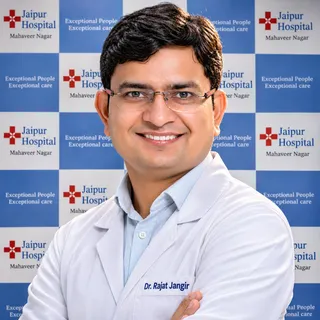
Your sports injury doctors
Explore our sports injury treatment centre in Jaipur: every treatment, the doctors and what to expect at your visit.
Frequently asked questions
Questions patients ask about tennis elbow treatment
What is tennis elbow treatment?
In short
Tennis elbow treatment at Jaipur Hospital focuses on reducing pain and restoring strength in the affected arm. The condition involves degenerative changes in the tendon on the outer elbow. Most people improve with non-surgical care including physiotherapy, bracing and activity modification. Surgery is considered only when symptoms persist despite months of conservative management.
In detail
Treatment begins with rest from aggravating activities and a structured physiotherapy programme using eccentric loading exercises to strengthen the tendon. A counterforce brace may reduce strain during daily tasks. Non-steroidal anti-inflammatory medicines help with pain.
Corticosteroid injections are sometimes used but studies show they may not alter the natural history and can be harmful to the tendon long term. Shock wave therapy and other modalities have conflicting evidence.
If symptoms do not resolve after 6 to 12 months of consistent non-operative care, surgical options include arthroscopic debridement or open release of the extensor carpi radialis brevis tendon. Both techniques aim to remove degenerative tissue and stimulate healing.
The choice depends on the surgeon's assessment. Recovery after surgery involves a supervised physiotherapy programme lasting 8 to 12 weeks.
A common belief
Many believe a steroid injection will fix it quickly but evidence shows it may not change the long-term course and can weaken the tendon.
What actually happens
Surgery is only for cases that do not improve after 6 to 12 months of proper non-surgical care.
Your next step at Jaipur Hospital
You can start with an OPD consultation at Jaipur Hospital where the surgeon will examine your elbow and discuss a plan. Non-surgical treatment usually continues for several months before surgery is considered. Physiotherapy sessions are available in-house.
If surgery is needed it is a daycare procedure under local or regional anaesthesia. Typical consultation cost is ₹2,000 to ₹5,000 and surgery ranges from ₹50,000 to ₹1,00,000. Book an appointment to have your elbow assessed and a personalised plan made. खर्च, बीमा और संपर्क की जानकारी देखें।
Which specialist should I see for tennis elbow?
In short
You should see an orthopaedic surgeon for tennis elbow at Jaipur Hospital. The Orthopaedics department manages both non-surgical and surgical treatment of lateral epicondylitis. The surgeon will assess your elbow, guide physiotherapy and decide if surgery is needed after a trial of conservative care. A sports injury specialist may also be involved for athletes.
In detail
Orthopaedic surgeons are trained in the diagnosis and management of tendon disorders of the elbow. The diagnosis is typically clear from the patient interview and physical examination alone. Imaging and other diagnostic tests are usually unnecessary.
The surgeon will prescribe a home exercise programme including strengthening and stretching exercises and may recommend a counterforce brace.
If symptoms are refractory to 6 to 12 months of conservative therapy the surgeon performs either arthroscopic debridement or open release of the extensor carpi radialis brevis tendon. The hospital has modular operation theatres and a physiotherapy department for post-operative rehabilitation. The surgeon works with the physiotherapy team to plan your exercise programme.
Your next step at Jaipur Hospital
Book an OPD appointment in the Orthopaedics department at Jaipur Hospital. The consultation takes about 15 minutes. Bring any previous records or X-rays. The surgeon will examine you and outline a treatment plan. Typical consultation cost is ₹2,000 to ₹5,000.
If surgery is later required it is a daycare procedure costing ₹50,000 to ₹1,00,000. Book your consultation to start the right care pathway. खर्च, बीमा और संपर्क की जानकारी देखें।
What treatment options are available for tennis elbow?
In short
Treatment options at Jaipur Hospital start with non-surgical care: activity modification, counterforce bracing, a structured physiotherapy programme with eccentric loading exercises and pain management with non-steroidal anti-inflammatory medicines. If symptoms persist after 6 to 12 months surgery is offered as arthroscopic debridement or open release of the extensor carpi radialis brevis tendon. Surgery is a daycare procedure under local or regional anaesthesia.
In detail
First-line treatment is physiotherapy with eccentric strengthening and stretching which addresses the tendon degeneration. A counterforce brace reduces tendon load during activities. NSAIDs help with pain.
Corticosteroid injections are sometimes used for short-term relief but studies show they do not alter the natural history and may harm the tendon long term. Shock wave therapy has conflicting evidence. Acupuncture may provide symptom relief but evidence is limited.
Kinesiotaping with exercises has shown better pain reduction than exercises alone in studies. Surgical intervention is indicated for recalcitrant cases refractory to 6 to 12 months of conservative therapy. Arthroscopic debridement offers enhanced visualisation, faster rehabilitation and reduced morbidity.
Open release is used for refractory cases. Both aim to excise degenerative tissue and stimulate healing. Post-operative physiotherapy continues for 8 to 12 weeks. The surgeon will discuss which option suits your situation.
A common belief
Many expect a quick fix with an injection but evidence shows it does not change the tendon's natural course.
What actually happens
Surgery is a last resort and most people never need it if they stick with the exercise programme.
Your next step at Jaipur Hospital
Begin with an OPD consultation where the surgeon will assess your elbow and start a non-surgical plan. Physiotherapy sessions are available at the hospital. If surgery is later needed it takes 30 to 45 minutes and you go home the same day.
Typical consultation cost is ₹2,000 to ₹5,000 and surgery ranges from ₹50,000 to ₹1,00,000. Book an appointment to discuss the full range of options for your case. खर्च, बीमा और संपर्क की जानकारी देखें।
What can I safely do at home to manage tennis elbow symptoms?
In short
You can safely manage symptoms at home with rest from the aggravating activity, ice, a counterforce brace and a home exercise programme of stretching and strengthening. At Jaipur Hospital, the physiotherapy team teaches you eccentric loading exercises that target the extensor carpi radialis brevis tendon. Applying ice for 10 to 20 minutes every 1 to 2 hours for the first few days helps reduce pain. Keep the elbow elevated above heart level when sitting or lying down.
In detail
Evidence supports a structured home exercise programme including eccentric strengthening and stretching. Kinesiotaping plus exercises has been shown to be more effective than sham taping or exercises alone in improving pain and arm disability.
A long rest from the activity that caused the problem allows the small tears in the tendon to heal. Stopping or changing activities that irritate the tendon is part of treatment.
Using wrist and elbow splints and wearing a special counterforce brace offloads the tendon during daily tasks. Over-the-counter pain medicines may be used as directed by your doctor. Ultrasound therapy and TENS are sometimes used in a physiotherapy setting but evidence for them is limited.
A common belief
Complete rest alone is not enough; the tendon needs controlled loading to heal.
What actually happens
Taping plus exercises works better than exercises alone. Pain medicines and ultrasound give only temporary relief and do not fix the tendon.
Your next step at Jaipur Hospital
Start gently and stop if pain increases. Most people feel better in a few weeks, but tendon healing may take 6 to 12 months. Continue the exercises as often and as long as your physiotherapist advises.
If symptoms do not improve after 6 to 8 weeks of consistent home care, contact your doctor to review the plan.
Which structures are injured and how severe is the damage in tennis elbow?
In short
Tennis elbow, or lateral epicondylitis, involves degenerative changes in the extensor carpi radialis brevis tendon at its origin on the lateral epicondyle. The condition is caused by chronic microtrauma from repetitive wrist extension and forearm rotation. Severity ranges from tendinopathy with microtears to partial or full-thickness tears, which your surgeon at Jaipur Hospital will grade after clinical examination and, if needed, imaging.
In detail
The pathophysiology is primarily tendinosis — collagen disorganisation, vascular hyperplasia and mucoid degeneration — rather than acute inflammation. Clinically it manifests as lateral elbow pain worsened by resisted wrist dorsiflexion and forearm pronation-supination, with focal tenderness at the ECRB origin.
Some patients develop diminished grip strength from progressive forearm muscle weakness.
Imaging such as ultrasound or MRI, performed at an outside centre and reviewed by our team, can show tendon thickening, intra-substance tears or calcifications, but the diagnosis is typically clear from interview and examination alone.
The surgeon correlates imaging findings with your symptoms and functional loss to decide whether non-operative care or a procedure is appropriate.
A common belief
Many people think tennis elbow is just inflammation, but studies show it is a degenerative tendinopathy.
What actually happens
Imaging helps, but the diagnosis is mainly clinical.
Your next step at Jaipur Hospital
At your consultation the surgeon will examine your elbow, test grip strength and review any scans you already have. If further imaging is advised, the team will guide you to a centre and then discuss the findings with you.
Can I continue any training safely while I recover from tennis elbow?
In short
You can usually maintain cardiovascular fitness and train uninvolved body parts while protecting the elbow. At Jaipur Hospital the physiotherapist will prescribe specific modifications such as using a neutral grip, avoiding resisted wrist extension and limiting forearm rotation under load. Pain during or after an exercise is the guide to stop or reduce that movement.
In detail
Evidence shows that continuing the aggravating activity prolongs rehabilitation. However, complete immobilisation leads to stiffness and muscle atrophy. The programme progresses from isometric holds to slow eccentric loading and finally to sport-specific drills. A counterforce brace may allow light skill work once acute pain settles. The therapist monitors grip strength and pain scores weekly to advance you safely.
A common belief
Stopping everything causes stiffness and weakness.
What actually happens
The key is not rest alone but graded loading that stimulates tendon repair. A therapist will tell you exactly which movements to pause and which to progress.
Your next step at Jaipur Hospital
Discuss your current routine with the therapist at your first visit. You will receive a written list of permitted exercises and clear pain-monitoring rules. Book a consultation at Jaipur Hospital to get a safe training plan that keeps you moving without harming the tendon. खर्च, बीमा और संपर्क की जानकारी देखें।
Which symptoms or changes should prompt me to seek medical advice for tennis elbow?
In short
You should seek medical advice at Jaipur Hospital if you have pain on the outer elbow that worsens with gripping, lifting or twisting the forearm. Tenderness over the lateral epicondyle, weakness when shaking hands or holding a cup, and pain that disturbs sleep are common reasons to consult. If self-care with rest and over-the-counter medicines does not improve symptoms in a few weeks, an assessment is appropriate.
In detail
The condition typically presents as lateral elbow pain made worse by resisted wrist extension and forearm rotation. Focal tenderness at the extensor carpi radialis brevis origin is a key sign.
Some people experience diminished grip strength that interferes with daily tasks like opening jars or using tools. Pain may radiate down the forearm.
If the pain follows a specific injury or is accompanied by swelling, redness, fever or inability to move the elbow, urgent evaluation is needed to rule out other problems. Numbness or tingling in the hand suggests possible nerve involvement and should be checked promptly. The diagnosis is usually clear from the history and physical examination alone without complex tests.
A common belief
People often wait months hoping it will go away on its own but early physiotherapy gives better long-term results.
What actually happens
Numbness or tingling in the hand is not typical for tennis elbow and needs a different evaluation.
Your next step at Jaipur Hospital
Visit the Orthopaedics OPD at Jaipur Hospital for a 15-minute consultation. The surgeon will examine your elbow, check grip strength and review your activities. Bring any previous X-rays if you have them. Early assessment helps start physiotherapy sooner which can shorten the overall recovery.
Typical consultation cost is ₹2,000 to ₹5,000. Book an appointment to have your symptoms evaluated. खर्च, बीमा और संपर्क की जानकारी देखें।
What will the doctor ask and check at the first visit for tennis elbow?
In short
At the first visit to Jaipur Hospital the surgeon will ask about your symptoms, when they started, which activities make them worse and your work or sports routine. They will examine your elbow for tenderness over the lateral epicondyle, test resisted wrist and finger extension, check grip strength and assess elbow range of motion. The consultation lasts about 15 minutes.
In detail
The diagnosis is typically clear from the interview and physical examination alone. The surgeon will ask about the location and nature of the pain, any specific injury or gradual onset, and how it affects daily tasks.
They will palpate the lateral epicondyle and the extensor carpi radialis brevis origin for focal tenderness. Resisted wrist dorsiflexion and middle finger extension tests confirm the diagnosis. Grip strength may be measured.
The surgeon will also check for signs of nerve compression or other elbow pathology. Imaging such as X-ray is only ordered if the presentation is atypical or to rule out arthritis.
MRI or ultrasound is rarely needed and would be done at an imaging centre outside the hospital. The surgeon will explain the condition and discuss a treatment plan including activity modification, bracing and physiotherapy.
A common belief
Many expect an MRI or X-ray straight away but imaging is only needed if the story or examination suggests something else.
What actually happens
The clinical test is reliable and saves time and cost.
Your next step at Jaipur Hospital
Wear clothing that allows easy access to your elbow and forearm. Bring a list of your current medicines and any previous investigation reports. The surgeon will give you a home exercise programme to start immediately. Physiotherapy sessions can be scheduled at the hospital.
Typical consultation cost is ₹2,000 to ₹5,000. Book an appointment for your initial assessment. खर्च, बीमा और संपर्क की जानकारी देखें।
Can tennis elbow improve without a procedure or operation?
In short
Yes, tennis elbow often improves without surgery. At Jaipur Hospital, the surgical team sees that most patients recover with non-operative care. Studies show that 70% to 90% of people achieve symptomatic resolution within one year using rest, bracing, physiotherapy and anti-inflammatory medicines. The natural history of the disorder is spontaneous resolution, although it can last for more than one year.
In detail
The condition is caused by degenerative changes in the extensor carpi radialis brevis tendon from repetitive wrist extension and forearm rotation. Because it is a self-limiting enthesopathy, the tendon can heal with time and load management.
Evidence indicates that no treatment has been proven to alter the natural history of the condition. Corticosteroid injections may give short-term pain relief but at mid-term follow-up pain can be worse than placebo, and they do not change the long-term outcome. Physiotherapy with eccentric loading remains the first-line approach to strengthen the tendon while symptoms settle.
A common belief
Steroid shots may help for a few weeks but can leave you worse at three to six months.
What actually happens
No treatment has been proven to change the natural course of the condition; the tendon simply needs time and the right loading to heal.
Your next step at Jaipur Hospital
You can start with activity modification, a counterforce brace and a home exercise programme of stretching and strengthening. Most people feel better in a few weeks, but full tendon healing may take 6 to 12 months.
If symptoms do not improve after 6 to 12 months of consistent conservative therapy, the surgeon may discuss surgical options.
Are there foods, activities, or habits I should change for tennis elbow?
In short
No specific diet has been proven to alter tennis elbow. The main changes are activity-related: avoid repeated wrist extension, forearm rotation and gripping with the palm down. Adjust your racquet grip size and string tension if you play tennis. At work, an ergonomic assessment can reduce tendon load. Smoking impairs tendon healing, so quitting helps recovery.
In detail
The condition is driven by chronic microtrauma from repetitive wrist extension and forearm rotation. Evidence shows that continuing the harmful activity lengthens rehabilitation. A sports trainer can advise on racquet and technique changes. An ergonomic specialist, occupational therapist or physiotherapist can modify your workstation.
There is no strong evidence for supplements or special foods. Weight control and good protein intake support general tissue health but are not disease-specific treatments.
A common belief
Patients often ask about supplements or anti-inflammatory foods.
What actually happens
Studies do not show they change the condition. The mechanical load on the tendon is what matters most.
Your next step at Jaipur Hospital
Identify the tasks that provoke pain and modify them. Use a counterforce brace during those tasks. If you play racquet sports, have your equipment checked. If your job involves repetitive forearm work, request an ergonomic review. Stop smoking if you smoke.
FAQ library
Questions and answers about tennis elbow treatment
When you contact us
Get a clear plan for your elbow
Contact Jaipur Hospital for an OPD assessment, cost estimate and help with cashless insurance.
- A consultation with a sports injury specialist in the OPD
- Your scans and reports reviewed, with tests done in-house if you need them (laboratory, X-ray and imaging)
- Your options explained in plain words, including whether you need surgery at all
- A cost estimate before you decide
- Help with cashless treatment under MAA Yojana, various government health care schemes and empanelled insurers and TPAs
- Follow-up visits after your treatment
Overview
Tennis Elbow Treatment: what to know
What Tennis Elbow Is and How It Happens
- 1 to 3 in every 100 People affected
- Most people Natural recovery
Tennis elbow, or lateral epicondylitis, is a common condition that causes pain on the outer side of the elbow. It affects about 1 to 3 people in every 100. The problem is not a simple inflammation. It is a degenerative change in the extensor carpi radialis brevis (ECRB) tendon, which attaches to the lateral epicondyle of the humerus.
Repetitive wrist extension and forearm rotation create chronic microtrauma in this tendon. Over time, the tendon structure breaks down, causing pain and weakness. The condition often arises in middle-aged adults. It can last for more than a year if left untreated, but the natural history is spontaneous resolution in most people.
Symptoms of Tennis Elbow and Warning Signs for Urgent Care
- Obvious deformity or cannot move elbow Go to hospital the same day
- Signs of infection Redness, warmth, swelling, fever
The main symptom is pain and tenderness over the lateral epicondyle and the back of the forearm. Pain gets worse when you resist wrist dorsiflexion or twist the forearm (pronation-supination). Gripping objects becomes painful and weak. Some people notice a drop in grip strength that makes daily tasks difficult. Daily activities such as lifting a cup, turning a doorknob, or shaking hands can trigger the pain.
Warning signs that need medical attention the same day:
- Sudden severe pain after a fall or direct blow to the elbow
- Obvious deformity or inability to move the elbow
- Numbness or tingling in the hand or fingers
- Signs of infection: increasing redness, warmth, swelling, or fever
- Pain that does not improve with rest and over-the-counter medicine
After any procedure, contact your doctor if you notice increased pain, swelling, warmth, redness, red streaks from the wound, pus, fever, bleeding that soaks the bandage, a cool or pale hand, more tingling or weakness, stitches coming loose, or if you are not getting better as expected.
Causes and Who Is at Higher Risk
- Repetitive wrist and forearm movements
- Racquet sports, tools, typing, mouse use
- Age
- Most common in middle age
- Poor technique or wrong equipment
- Large grip, tight strings, sudden activity increase
- Smoking and metabolic conditions
- May affect tendon health
The condition is caused by chronic microtrauma from repetitive wrist extension and forearm rotation. This overloads the ECRB tendon where it attaches to the bone. Any activity that repeats these movements can start the process.
Common examples include:
- Racquet sports
- Manual work with tools
- Typing
- Using a mouse for long periods
Age is a factor; it is most common in middle age. Poor technique in sport, wrong equipment (such as a racquet grip that is too large or strings that are too tight), and sudden increases in activity level raise the risk. Smoking and certain metabolic conditions may also affect tendon health.
The condition is not limited to tennis players; it gets its name because the backhand stroke in tennis stresses the same tendon.
How Tennis Elbow Is Diagnosed: Examination and Tests
The diagnosis is usually clear from your history and a physical examination alone. Your doctor will ask about your symptoms, activities, and any previous injuries. They will press on the lateral epicondyle to check for tenderness and test resisted wrist extension and middle finger extension to reproduce the pain. Imaging and other diagnostic tests are usually unnecessary.
An X-ray may be ordered if the doctor suspects a bone problem, arthritis, or a loose body. Ultrasound or MRI can show tendon changes but are not needed for routine diagnosis. At Jaipur Hospital, X-ray is available on site. CT and MRI scans are done at an imaging centre outside the hospital; your surgeon advises and reviews the scan. There is no DEXA scanner at the hospital.
Non-Surgical Treatment Options for Tennis Elbow and When Surgery Is Advised
Most people improve without surgery. Non-operative management including rest, bracing, physiotherapy, NSAIDs, and corticosteroid injections achieves symptomatic resolution in 70 to 90 percent of patients within one year. Treatment works well when it starts early. A period of rest from the aggravating activity allows small tendon tears to heal. Ice and over-the-counter pain medicines help reduce pain.
Stopping or changing activities that irritate the tendon is essential. A counterforce brace worn on the forearm can offload the tendon. Wrist and elbow splints may be used for short periods.
Physiotherapy with eccentric loading exercises is the first-line treatment. A home programme of strengthening and stretching is standard. Kinesiotaping combined with exercises has been shown to improve pain and disability more than exercises alone or sham taping. Ultrasound therapy may help the tendon heal and reduce pain. Transcutaneous electrical nerve stimulation (TENS) is sometimes used in a physiotherapy setting.
Acupuncture may provide symptom relief, but strong evidence is lacking. Extracorporeal shock wave therapy has conflicting results; some studies report improvement, others find no benefit over placebo. A nitric oxide patch applied to the elbow may speed recovery.
Corticosteroid injections are sometimes used when pain persists after 6 to 8 weeks of rest and rehab. They may relieve pain for a short time. However, at short-term follow-up, corticosteroid injection improved pain, but at later follow-up it was associated with pain worse than placebo. At 6 months, there is no difference in pain intensity between corticosteroid injection and placebo.
The weight of evidence suggests corticosteroid injections are neither meaningfully palliative nor disease-modifying. These steroid shots may be harmful to the tendon.
Surgery is a last resort if other treatment is not helpful after 6 to 12 months. Surgical intervention is indicated for recalcitrant cases refractory to conservative therapy, with the primary objective of excising degenerative tendon tissue and stimulating neoangiogenesis. The goal of surgery is that you can do your activities with less pain.
In 3 to 6 months after surgery, the pain should go away and you should have good movement in your elbow. In as many as 9 out of 10 people who have tennis elbow, symptoms go away and they return to normal activities whether they have surgery or not. Surgical options include arthroscopic debridement and open ECRB release.
Arthroscopic methods offer enhanced visualisation, accelerated rehabilitation, and reduced perioperative morbidity. RF-based microtenotomy is a surgical option with reliable functional restoration and shorter operation time. The necessity of tendon repair with suture anchors during arthroscopy remains contentious, with limited data showing clinical superiority over debridement alone. Functional outcomes of open and arthroscopic releases may be superior to percutaneous release.
Patients may report less pain with arthroscopic and percutaneous techniques. The risk of complications is similar regardless of technique, though infectious complications may be slightly higher with open releases. A subset of patients may experience diminished grip strength and persistent functional deficits, possibly from iatrogenic detachment of the ECRB tendon during debridement. Your surgeon will advise which technique suits you.
Preparing for tennis elbow surgery
Your surgeon will explain the procedure and ask about any medicines you take regularly, especially blood thinners, aspirin, or anti-inflammatory drugs. You may be advised to stop some of these a few days before surgery. Routine blood tests and a basic health check are usually done to confirm you are fit for anaesthesia.
You will be asked not to eat or drink for at least six hours before the operation. Wear loose clothing with sleeves that can be rolled up past the elbow. Bring an attendant who can stay with you and take you home afterwards, as the surgery is done as a daycare procedure under local or regional anaesthesia. The hospital provides a gown and any dressings you will need.
How tennis elbow surgery is done
The operation takes 30 to 45 minutes. Your surgeon will discuss which technique suits your tendon condition and your daily demands.
The main options are arthroscopic debridement, where a small camera and instruments are inserted through tiny cuts to remove damaged tendon tissue, and open ECRB release, where a slightly larger cut is made on the outer elbow to release the extensor carpi radialis brevis tendon from the bone. Both aim to excise degenerative tissue and stimulate healing.
The choice depends on the extent of tendon damage, whether there are loose bodies or joint changes seen during assessment, and your surgeon's judgement. On the day, you will be taken to the modular operation theatre, given local or regional anaesthesia so the arm is numb, and the procedure is carried out.
The wounds are closed with stitches or tape and a bandage is applied. You will recover in the daycare area until the anaesthesia wears off and you are comfortable enough to go home.
Risks and possible complications of tennis elbow surgery
- Wound infection
- Uncommon; pain, swelling, warmth, redness, pus, fever
- Nerve injury
- Tingling, numbness, or weakness in hand or forearm
- Diminished grip strength
- May relate to tendon detachment during debridement
- Stiffness or persistent pain
- Can occur after surgery
All surgery carries some risk. Infection at the wound site is uncommon but possible; signs include increasing pain, swelling, warmth, redness, red streaks, pus, or fever. Nerve injury can cause tingling, numbness, or weakness in the hand or forearm. Some patients report diminished grip strength after debridement, which may relate to tendon detachment during the procedure.
Stiffness or persistent pain can occur. Bleeding that soaks the bandage, a cool or pale hand, or the incision opening up are reasons to seek help promptly. The risk of infectious complications may be slightly higher with open releases compared with arthroscopic techniques. Your surgeon will discuss these risks in the context of your health and the chosen technique.
Recovery and aftercare after tennis elbow surgery
After surgery your arm will be bandaged and may be placed in a splint or cast. You will probably need help with two-handed tasks for about two weeks. Stitches are usually removed in 7 to 10 days. You may shower after 24 to 48 hours if your doctor agrees, keeping the bandage dry with a plastic cover.
Do not soak the arm in a bath for the first two weeks. Ice packs for 10 to 20 minutes every one to two hours for the first three days help with swelling; keep the arm raised above heart level when resting. A rehabilitation programme of stretching and strengthening exercises starts as advised by your surgeon and physiotherapist.
Exercises may be painful at first. You will work with the physiotherapy team at the hospital and then continue the programme at home. Most people return to daily activities in 2 to 6 weeks, to work in 3 to 12 weeks depending on the job, and to sports in 4 to 6 months.
A brace may be needed for work or sports that stress the elbow. Take pain medicines as prescribed; if they upset your stomach, take them after meals or ask for an alternative. Complete any antibiotic course given.
Call the hospital if you have severe pain not relieved by medicine, signs of infection, bleeding that soaks the bandage, a cool or pale hand, increasing tingling or weakness, vomiting, or if you are not improving as expected.
Results of tennis elbow surgery
In studies, both open and arthroscopic release show functional improvement at two years, with better grip strength and lower pain scores compared with preoperative levels. Arthroscopic and percutaneous techniques may be associated with less early postoperative pain.
Nonoperative management including rest, bracing, physiotherapy, NSAIDs and corticosteroid injections achieves symptomatic resolution in 70% to 90% of patients within one year, so surgery is considered only after 6 to 12 months of conservative treatment without adequate relief. The natural history of the condition is spontaneous resolution, though it can last more than a year.
In as many as 9 out of 10 people, symptoms go away and they return to normal activities whether they have surgery or not. The goal of surgery is to allow you to do your activities with less pain; in 3 to 6 months the pain should go away and you should have good elbow movement. Recurrence is possible if the same repetitive loads continue without modification of technique or equipment.
Cost and insurance for tennis elbow treatment in Jaipur
- ₹2,000 to ₹5,000 Consultation
- ₹50,000 to ₹1,00,000 Daycare surgery
- MAA Yojana, various government health care schemes, private insurers Insurance panels
A consultation typically costs ₹2,000 to ₹5,000. Surgery as a daycare procedure typically costs ₹50,000 to ₹1,00,000. The final amount depends on the technique used, the type of anaesthesia, any implants or suture anchors required, the length of stay if an overnight admission becomes necessary, and whether you have other health conditions that need monitoring.
Jaipur Hospital is empanelled under MAA Yojana, various government health care schemes and a panel of private insurers and TPAs. Cashless or reimbursement claims can be processed through the hospital's insurance desk. The in-house pharmacy and diagnostic laboratory (X-ray; CT and MRI are done at an outside imaging centre) are available for any preoperative tests or postoperative medicines. Ask the billing office for an estimate based on your planned procedure and insurance coverage.
