

Sports Injury · Jaipur Hospital
Meniscus Tear Surgery in Jaipur
Knee locking, swelling or giving way? Get a clear assessment and a simple plan.
- Serving Jaipur since 1991 (35 years)
- NABH accredited
- 24×7 emergency & ICU
- Cashless: MAA Yojana + 32 insurers
- Operation time
- 45 to 90 minutes
- Anaesthesia
- Spinal anaesthesia
- Recovery
- Repair: 3 to 6 monthsMeniscectomy: 4 to 6 weeks
- Price
- ₹70,000 to ₹1,80,000typical range in India; ask us for an estimate
Knee catches, swells or gives way
A torn meniscus can make the knee feel unstable, painful or stuck
The meniscus is a C-shaped cushion in the knee. A tear can cause catching, locking, swelling or a feeling the knee will give way. It often happens during a twisting movement.
-
Catching or locking
The knee may get stuck in one position or click painfully when you move it.
-
Swelling after activity
Fluid builds up in the joint, often hours after walking or standing.
-
Giving way
The knee buckles without warning, making stairs or uneven ground feel unsafe.
-
Pain with twisting
Sharp pain when you turn on the planted foot, especially squatting or kneeling.
Meniscal tears are the most common knee injury, affecting about 66 per 100,000 people each year.
Why Jaipur Hospital
You worry the knee will give way on the stairs, that swelling will keep you off your feet, or that time off work will stretch longer than you can afford.
Your care plan
Your first steps with us
- 1 Call or visit OPD for a specialist consultation
- 2 Bring scans; we arrange X-ray or lab tests if needed
- 3 Review repair or meniscectomy options with your surgeon
- 4 Schedule surgery and begin guided physiotherapy after discharge
How the operation is done
Surgery is arthroscopic, using small incisions and a camera. The surgeon either stitches the tear or trims the damaged part. Spinal anaesthesia is typical. The procedure usually takes 45 to 90 minutes. Daycare or one-night stay is common.
-
All-inside meniscus repair
Sutures or anchors placed through small portals; often used for posterior horn tears. Your surgeon will discuss if it fits your tear.
-
Inside-out meniscus repair
Sutures passed from inside the joint out through a small incision; used for certain posterior horn patterns. Your surgeon will discuss if it fits your tear.
-
Outside-in meniscus repair
Sutures passed from outside the knee into the tear; used for anterior horn tears. Your surgeon will discuss if it fits your tear.
-
Partial meniscectomy
The torn fragment is trimmed to a stable rim; recovery is usually faster than repair. Your surgeon will discuss if it fits your tear.
Why patients trust us
- 1991 Serving Jaipur for 35 years
- NABH Accredited hospital
- 1 Sports Injury consultants
- 24×7 Emergency, ICU and ambulance
- 33 Cashless schemes and insurers
What research shows about this treatment
-
Meniscectomy recovery around six weeks; repair up to three months
Meniscectomies usually take around six weeks to recover. Meniscus repairs take longer because the meniscus must heal inside the knee.
-
Healing rated complete in 62% of repairs at second look
In a series of 137 patients assessed by MRI or repeat arthroscopy, healing was complete in 62%, partial in 34%, failed in 3%.
-
Higher osteoarthritis risk at five years after meniscectomy
At five years, 72% of meniscectomy patients had radiographic osteoarthritis progression versus 60% after placebo surgery.
If it is left untreated
Without treatment, a tear that causes locking or giving way can lead to repeated swelling, muscle wasting and reduced walking distance. Degenerative tears with advanced arthritis may not improve with arthroscopy and can progress to joint replacement sooner.
Life after treatment
Most people return to daily activities and light sport after rehabilitation. Recovery time depends on whether the meniscus was repaired or trimmed.
-
Walk without giving way
Most people regain stable weight-bearing and can manage stairs and uneven ground.
-
Less swelling after activity
Joint effusion usually settles as the knee recovers and muscles strengthen.
-
Return to light sport
Many resume jogging, cycling or recreational games after guided physiotherapy.
-
Longer timeline for repair
Repair needs protected weight-bearing and brace use for weeks; meniscectomy is quicker.
Meet the team
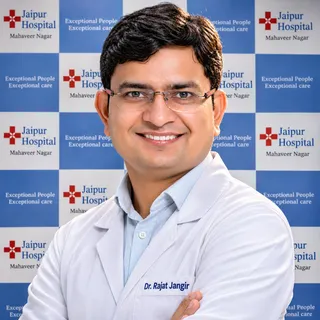
Your sports injury doctors
Explore our sports injury treatment centre in Jaipur: every treatment, the doctors and what to expect at your visit.
Frequently asked questions
Questions patients ask about meniscus tear surgery
What does meniscus repair involve?
In short
Meniscus repair at Jaipur Hospital is an arthroscopic operation that stitches the torn cartilage back together. The surgeon uses small incisions and special devices or sutures to hold the tear edges so the tissue can heal. The operation usually takes 45 to 90 minutes under spinal anaesthesia.
In detail
The surgeon chooses the technique based on where the tear lies. All-inside repair uses devices placed through tiny portals and is often used for posterior horn tears.
Inside-out repair uses sutures passed from inside the joint to the outside and is a common choice for tears in the posterior horn. Outside-in repair is used for anterior horn tears. In studies, these techniques show similar healing and complication rates.
The decision to repair rather than trim is made during the arthroscopy when the surgeon sees the tear pattern, blood supply and tissue quality. Repair preserves the meniscus and may protect the knee from early wear, but it needs a longer protected recovery.
A common belief
Many people think every tear gets trimmed.
What actually happens
In fact, if the tear is in a zone with blood supply and the tissue is healthy, the surgeon will repair it to keep your own meniscus. Repair needs a longer recovery with a brace and crutches, but it may delay arthritis.
Your next step at Jaipur Hospital
You will meet the orthopaedic team for a clinical examination and a review of your MRI. The surgeon explains which repair method fits your tear and what the rehabilitation timeline looks like. Most patients stay one night or go home the same day. Physiotherapy starts soon after surgery with a brace and limited bending for about six weeks.
Which tests and scans do I need before meniscus repair surgery?
In short
Before meniscus repair at Jaipur Hospital you will need a recent MRI of the knee to confirm the tear pattern and location, and standing weight-bearing X-rays of the knee to check for osteoarthritis. Routine blood tests and an ECG are also required for anaesthesia fitness.
In detail
The MRI shows the tear configuration — vertical, horizontal, complex, bucket-handle — and whether it lies in the red-red, red-white or white-white zone, which guides the repair decision.
Weight-bearing X-rays (AP, lateral and skyline views) reveal joint space narrowing and osteophytes; advanced arthritis makes arthroscopy less beneficial. Blood work typically includes haemoglobin, blood group, kidney and liver function, clotting profile and infectious markers. An ECG screens for heart rhythm issues.
If you have other medical conditions, the anaesthetist may ask for additional clearance. The hospital does not have a CT or MRI scanner; the MRI is done at an outside imaging centre and the surgeon reviews the images and report.
A common belief
Patients sometimes think the hospital does the MRI on site.
What actually happens
Jaipur Hospital has X-ray and lab facilities but no MRI or CT scanner; the MRI is done at an external centre and the surgeon reviews the images. Make sure you get weight-bearing X-rays, not lying-down films, because they show the true joint space.
Your next step at Jaipur Hospital
Arrange the MRI and X-rays before your surgical consultation so the surgeon can review them at the first visit. Blood tests and ECG can be done at the hospital's in-house laboratory. The anaesthetist will see you at the pre-anaesthesia check-up.
How painful is meniscus repair surgery and the early recovery?
In short
Meniscus repair at Jaipur Hospital is done under spinal anaesthesia, so you feel no pain during the operation. After surgery you will have moderate pain and swelling for the first few days, which is managed with a combination of prescribed pain tablets, ice, elevation and a knee brace. Most patients find the pain decreases steadily over the first two weeks.
In detail
The spinal block wears off after a few hours; the nursing team starts oral pain relief before the numbness fully goes. A typical regimen includes a scheduled paracetamol and an NSAID if your kidneys and stomach allow, plus a stronger tablet for breakthrough pain.
Ice packs applied for 15 to 20 minutes every few hours help control swelling. The brace keeps the knee in a safe range of motion and reduces strain on the repair.
You will use crutches and put only partial weight on the leg for about six weeks. Pain at night is common in the first week; taking the evening dose on time helps. The surgical wounds are small and usually heal without much discomfort. If pain suddenly worsens, the calf becomes swollen or you develop a fever, contact the hospital immediately.
A common belief
Some people expect either no pain or severe agony.
What actually happens
The reality is a manageable middle ground: you will need regular painkillers for the first week, especially at night, but it is not the kind of pain that cannot be controlled. The brace and crutches feel awkward at first, not painful.
Your next step at Jaipur Hospital
Fill the pain prescription before discharge so you have tablets at home. Keep the leg elevated above heart level when resting. Follow the physiotherapist's guidance on brace settings and weight-bearing progression. The first follow-up is usually at two weeks for wound check and brace adjustment.
How long does recovery usually take after meniscus tear surgery?
In short
Recovery time after meniscus tear surgery at Jaipur Hospital depends on the procedure. After a partial meniscectomy, most people return to daily activities in 4 to 6 weeks. After a meniscal repair, full recovery takes 3 to 6 months because the meniscus must heal biologically.
In detail
Evidence shows that meniscectomy patients can often bear weight immediately and walk without crutches within days, resuming light activity by 2 to 4 weeks and sport by 6 weeks.
Repair patients wear a hinged brace locked at 0 to 90 degrees for about 6 weeks, use crutches for several weeks, and progress to full range of motion and strengthening thereafter.
Healing rates vary by tear zone: red-red and red-white zones heal better than white-white zones. Age, smoking and adherence to physiotherapy also affect the timeline. Both procedures improve clinical scores, but repair better preserves knee biomechanics long term.
A common belief
People often expect the same recovery for both.
What actually happens
In fact, after a repair you wear a brace and use crutches for six weeks, while after a trim you walk almost straight away. The trade-off is that a repair protects the joint longer, whereas a trim raises arthritis risk over time.
Your next step at Jaipur Hospital
Your physiotherapy plan starts within days of surgery. You will receive a written protocol with weight-bearing limits, brace settings and exercise milestones. Return to driving and work depends on the operated leg and your job demands.
The surgeon reviews progress at 2 weeks, 6 weeks and 3 months. For a recovery timeline tailored to your tear and procedure, book a consultation at Jaipur Hospital.
Can a meniscus tear heal with rehabilitation, or is an operation worth considering?
In short
Many meniscus tears, especially degenerative tears without locking, can improve with a structured rehabilitation programme and may not need surgery. At Jaipur Hospital, the surgeon first assesses tear type, symptoms, knee arthritis and your activity level before recommending an operation.
In detail
Evidence from randomised trials shows that for degenerative tears without mechanical locking, a 12-week supervised exercise programme often matches arthroscopic partial meniscectomy in pain and function at 2 years. Conservative care includes analgesics, physiotherapy and sometimes a steroid injection.
Surgery is considered when symptoms such as locking, giving way, or persistent pain and swelling do not settle after a reasonable trial of non-operative treatment, usually 3 months.
Traumatic tears in younger patients, bucket-handle tears causing locking, and tears in the vascular red zone are more often repaired. The decision is made arthroscopically in some cases: the surgeon may plan a repair but convert to a trim if the tissue quality is poor.
A common belief
Many people assume every tear on an MRI needs fixing.
What actually happens
Trials show that for wear-and-tear tears in middle-aged knees, structured physio matches surgery at two years. The surgeon decides based on tear type, mechanical symptoms, arthritis and your goals, not the scan alone.
Your next step at Jaipur Hospital
Your surgeon will review your MRI, examine your knee, and discuss whether a trial of physiotherapy is appropriate or if early surgery is indicated. A written plan with milestones and a review date is provided. To find out which path fits your tear, book a consultation at Jaipur Hospital.
Can I continue any training safely while I recover?
In short
You can continue selected training during recovery if it respects the loading and range-of-motion limits for your procedure. At Jaipur Hospital the physiotherapy team designs a cross-training programme that maintains cardiovascular fitness and proximal strength without stressing the healing meniscus. The options differ between repair and meniscectomy.
In detail
After partial meniscectomy you may start stationary cycling with no resistance and upper-body ergometry within days, progressing to swimming and light jogging by two to four weeks if swelling and range allow.
After meniscal repair the brace and weight-bearing restrictions usually limit you to upper-body work, core exercises, and non-weight-bearing cycling for the first six weeks. Blood-flow restriction training for the quadriceps may be used early to limit atrophy while protecting the repair.
Running, jumping, and cutting are introduced only after strength and hop milestones are met. The surgeon and physiotherapist review and adjust the programme at each visit.
A common belief
A common error is stopping all exercise, which causes deconditioning, or pushing running too early, which can damage the repair.
What actually happens
Evidence supports structured cross-training that loads the hip and core while respecting knee restrictions.
Your next step at Jaipur Hospital
Bring your current training schedule to the pre-operative visit so the team can modify it safely. You will receive a weekly plan with permitted exercises, intensity limits, and progression criteria. Typical hospital stay is daycare or one night.
Why might my doctor recommend meniscus repair surgery?
In short
Your doctor may recommend meniscus repair at Jaipur Hospital when the tear is in a zone with good blood supply, the tissue is healthy enough to heal, and your symptoms such as locking, giving way or persistent pain have not settled with physiotherapy and medicines. Repair is preferred over removal when the meniscus can be saved.
In detail
Evidence shows that preserving the meniscus helps maintain knee biomechanics and may reduce the risk of early osteoarthritis compared with removing the torn piece. Repair is usually offered for vertical longitudinal tears in the red-red or red-white zones, especially in younger patients.
If the tear is complex, degenerative or in the white zone with poor blood supply, the surgeon may trim the damaged part instead. The final decision is often made during the arthroscopy when the surgeon sees the tear directly. Your age, activity level, smoking status and any other knee injuries also influence the recommendation.
A common belief
A common belief is that surgery always means a quick trim and fast return.
What actually happens
Repair takes longer — you will use crutches and a brace for weeks — but studies show repaired menisci preserve knee mechanics better and may lower arthritis risk compared with removal.
Your next step at Jaipur Hospital
The surgeon will review your MRI, examine your knee and discuss your daily demands. If repair is possible, you will need a brace and crutches for about six weeks and a guided physiotherapy programme for three to six months. If trimming is needed, recovery is shorter, around four to six weeks.
How should I prepare in the days before meniscus repair surgery?
In short
In the days before meniscus repair at Jaipur Hospital, stop smoking if you can, keep doing any gentle exercises your physiotherapist gave you, arrange an attendant to stay with you overnight, and follow the specific medication instructions given at your pre-anaesthesia check-up.
In detail
Smoking reduces blood flow to the healing meniscus and increases complication rates, so stopping even a few weeks before helps. Continue simple quadriceps and range-of-motion exercises to maintain muscle tone.
Buy or borrow a pair of elbow crutches and a knee brace if the surgeon has prescribed them; you will need them immediately after surgery. Prepare loose clothing that fits over a bulky dressing. Confirm your hospital admission time and fasting instructions.
If you take blood thinners, diabetes medicines or herbal supplements, the anaesthetist will tell you exactly when to pause or adjust them. Keep the skin around the knee clean and free of cuts or infections.
A common belief
A common mistake is stopping all exercise and waiting passively.
What actually happens
Keeping the thigh muscles active before surgery makes post-operative rehabilitation easier. Another mistake is forgetting to arrange crutches; you will need them from day one after a repair.
Your next step at Jaipur Hospital
Complete any pending blood tests or ECG at the hospital lab. Pack your regular medicines, the MRI films and report, X-rays, insurance cards and a photo ID. The attendant should be ready to help you with crutches and personal care for the first 24 hours.
What are the common side effects and the less common serious complications of meniscus tear surgery?
In short
After meniscus tear surgery at Jaipur Hospital, common side effects include pain, swelling and stiffness around the knee for several weeks. You may also feel numbness near the small incision sites. These usually improve with physiotherapy and prescribed pain relief.
In detail
Evidence shows that both repair and partial meniscectomy carry typical surgical risks such as infection, bleeding or a blood clot in the leg (deep vein thrombosis). Stiffness or persistent swelling can occur if rehabilitation is not followed.
Serious but less common complications include nerve or blood vessel injury, compartment syndrome, or a re-tear of the meniscus. Having a partial meniscectomy is associated with a slightly increased risk of developing knee osteoarthritis over the longer term compared with a successful repair.
Your surgical team will discuss the specific risks that apply to your tear pattern and general health before you consent.
A common belief
People often think the surgery itself is the main risk.
What actually happens
In fact, serious problems like infection, blood clots or nerve injury are rare. A partial meniscectomy does raise the chance of knee arthritis later on, while a repair aims to protect the joint longer.
Your next step at Jaipur Hospital
You will receive written instructions on wound care, signs of infection and when to seek urgent help. Swelling that suddenly increases, calf pain, shortness of breath, fever above 38°C, or wound discharge should be reported immediately. A follow-up appointment is usually scheduled within two weeks. To discuss your personal risk profile, book a consultation at Jaipur Hospital.
Which symptoms are expected after meniscus tear surgery, and which need urgent medical attention?
In short
After meniscus tear surgery at Jaipur Hospital, expected symptoms include moderate pain, swelling around the knee, bruising that may track down the leg, and stiffness for several weeks. You may feel clicking or a sensation of fluid moving in the joint. These improve steadily with elevation, ice and physiotherapy.
In detail
Evidence-based guidance lists symptoms that need urgent review: sudden increase in swelling or pain not relieved by prescribed medication, calf pain or tenderness (possible deep vein thrombosis), shortness of breath or chest pain (possible pulmonary embolism), fever above 38°C, increasing redness or discharge from the wounds, numbness or colour change in the foot, or inability to bear weight as instructed.
Locking that returns after a repair may suggest a re-tear. The surgical team gives you a written list and a contact number for the ward or on-call doctor before you leave.
A common belief
Patients often wait too long with warning signs.
What actually happens
Sudden calf pain, shortness of breath, fever, wound discharge, or a foot that turns cold or numb need immediate attention. A locked knee after a repair could mean a re-tear. The team gives you a written checklist before you go home.
Your next step at Jaipur Hospital
Keep the leg elevated above heart level when resting for the first few days. Take pain medication on schedule, not only when pain is severe. Do not remove the dressing until the nurse or surgeon advises.
If any urgent symptom appears, go to the nearest emergency department or call the hospital's 24-hour line. To receive the full postoperative instruction sheet, book a consultation at Jaipur Hospital.
FAQ library
Questions and answers about meniscus tear surgery
When you contact us
Get a clear plan for your knee
Contact Jaipur Hospital for a specialist consultation, scan review, cost estimate and help with cashless insurance.
- A consultation with a sports injury specialist in the OPD
- Your scans and reports reviewed, with tests done in-house if you need them (laboratory, X-ray and imaging)
- Your options explained in plain words, including whether you need surgery at all
- A cost estimate before you decide
- Help with cashless treatment under MAA Yojana, various government health care schemes and empanelled insurers and TPAs
- Follow-up visits after your treatment
Overview
Meniscus Tear Surgery: what to know
What a meniscus tear is and how it happens
- Meniscus
- C-shaped cartilage cushion in the knee
- Two per knee
- Each knee has two menisci
- How it tears
- Twisting with foot planted on the ground
- Traumatic tear
- Sudden force in sport or accident
- Degenerative tear
- Cartilage wears down and tears with minimal stress
- Common site
- Posterior horn at the back of the meniscus
The meniscus is a C-shaped piece of cartilage that sits between your thigh bone and shin bone. Each knee has two menisci. They act as cushions and help the joint move smoothly. A meniscus tear is a rip in this cartilage. It is the most common knee injury, affecting about 66 in every 100,000 people each year.
Tears usually happen when you twist your knee while your foot stays planted on the ground. This can happen during sports, a sudden turn, or even when standing up from a squat. The tear can be traumatic, from a sudden force, or degenerative, where the cartilage wears down over time and tears with minimal stress.
Degenerative tears are more common as you get older. The posterior horn, the back part of the meniscus, is the most frequent site for tears.
Symptoms of a meniscus tear and warning signs that need urgent care
- Knee locks completely Cannot straighten the knee
- Very swollen, red, hot with fever Possible infection in the joint
A torn meniscus can make your knee feel unstable, as if it might buckle or give way. You may have pain and swelling. The knee can lock up or get stuck in one position. Some people feel a catching or clicking sensation. In studies, about 46 to 49 percent of patients reported catching or locking before surgery.
These mechanical symptoms — locking, catching, giving way — are the main reasons people seek surgery. If your knee locks completely and you cannot straighten it, or if the knee is very swollen, red and hot with fever, go to the emergency department the same day. These can mean a displaced fragment blocking the joint or an infection.
Causes and who is at higher risk of a meniscus tear
- Typical cause
- Twisting with a fixed foot
- Traumatic tears
- Younger people during sport or accidents
- Degenerative tears
- After age 35 as cartilage becomes less elastic
- Men affected more
- About 80 percent of tears are seen in men
- Red zone
- Outer third with blood supply can heal
- White zone
- Inner two-thirds with poor blood supply
Twisting movements with a fixed foot are the typical cause. Traumatic tears happen in younger people during sport or accidents. Degenerative tears appear more often after age 35 as the cartilage becomes less elastic. Men are affected more often than women; about 80 percent of tears are seen in men.
Smoking and older age are linked with poorer healing after treatment. The blood supply of the meniscus matters. The outer third (red zone) has a blood supply and can heal. The inner two-thirds (white zone) has poor blood supply, so tears there are less likely to heal on their own or after repair.
If you have advanced knee osteoarthritis, arthroscopic surgery for a meniscus tear is not usually advised because results are poor and joint replacement may be needed soon after.
How a meniscus tear is diagnosed: examination and tests
- Clinical examination
- Tenderness, swelling, locking, clicking
- MRI
- Main test to confirm tear and show pattern
- X-ray
- Checks for osteoarthritis or bone problems
- Kellgren-Lawrence scale
- Grades osteoarthritis 0 to 4 on X-ray
- OARSI atlas
- Grades joint space narrowing and osteophytes 0 to 3
- Questionnaires
- Lysholm score and WOMET measure daily impact
Your surgeon will ask about your symptoms and examine your knee. They check for tenderness along the joint line, swelling, and whether the knee locks or clicks on certain movements. Magnetic resonance imaging (MRI) is the main test to confirm a tear and show its pattern and location.
X-rays do not show the meniscus but are used to check for osteoarthritis or bone problems. The Kellgren-Lawrence scale grades osteoarthritis on X-ray from 0 to 4. The OARSI atlas grades joint space narrowing and osteophytes from 0 to 3. In some studies, patients with isolated meniscal tears and no or mild osteoarthritis on X-ray were selected for treatment comparison.
Your surgeon will also use questionnaires such as the Lysholm knee score or the Western Ontario Meniscal Evaluation Tool (WOMET) to measure how the knee affects your daily life, sports and emotions.
Treatment options without surgery and when surgery is advised for a meniscus tear
Nonoperative management is the first-line treatment for many meniscus tears. It includes pain relief medicines, structured physiotherapy, and sometimes steroid injections. In randomised trials, a 12-week supervised exercise programme gave similar improvements in pain and function to arthroscopic partial meniscectomy for degenerative tears without locking. Exercise therapy also improved quadriceps strength more than surgery in one trial.
Anxiety and depression scores improved more with exercise than with surgery. If symptoms do not resolve after a proper trial of conservative care, surgery can be considered. Surgery is usually advised for high-grade tears, for mechanical symptoms like locking or giving way that limit daily life, or when non-surgical treatment has not helped.
The decision between repair and trimming (partial meniscectomy) depends on the tear pattern, location, your age, and the quality of the tissue. Repair is preferred when feasible because it preserves the meniscus and protects the joint long term. Meniscectomy is chosen for severe, complex, or degenerative tears that cannot heal. In some cases, the final choice is made during the arthroscopy itself.
Preparing for meniscus tear surgery
Do
- Blood tests, ECG, chest X-ray
- Tell doctor all medicines
- Stop blood thinners if told
- Wear loose clothing
- Bring medicines, insurance cards, attendant
Your surgeon will review your MRI and ask about your symptoms, any previous knee injuries, and your general health. Blood tests, an ECG and a chest X-ray are usually done a few days before the operation to check you are fit for anaesthesia.
Tell your doctor about every medicine you take, especially:
- Blood thinners
- Diabetes tablets or insulin
- Any supplements
You may be asked to stop blood thinners a few days before surgery; your doctor will give you a clear plan. Do not eat or drink anything for at least six hours before the operation. Wear loose clothing that fits over a bulky knee bandage.
Bring your regular medicines, your insurance or scheme cards, and an attendant who can stay with you and take you home. If you smoke, try to stop at least two weeks before surgery; smoking slows meniscus healing and increases the risk of complications.
How meniscus tear surgery is done
- Spinal anaesthesia Awake but numb from waist down
- Small cuts and camera Two or three 1 cm cuts for arthroscope
- Inspect tear and decide Check location, pattern, tissue quality
- Repair if red zone and healthy All-inside, inside-out or outside-in techniques
- Trim if white zone or complex Partial meniscectomy with punch and shaver
- Microfracture if needed Small holes in bone to bring healing cells
The operation is performed under spinal anaesthesia. You are awake but numb from the waist down. The surgeon makes two or three small cuts (about 1 cm each) around the knee and inserts a thin camera (arthroscope) and instruments. The surgeon inspects the tear, its location, pattern and the quality of the meniscus tissue.
The decision to repair or trim is often made at this point, inside the joint. If the tear is in the red zone (good blood supply), is a clean vertical or bucket-handle tear, and the tissue is healthy, the surgeon will usually repair it.
Repair techniques include:
- All-inside (devices such as Fast-Fix)
- Inside-out (sutures passed through small incisions at the back of the knee)
- Outside-in (for tears at the front of the meniscus)
If the tear is in the white zone (poor blood supply), is frayed, degenerative or complex, the surgeon will usually do a partial meniscectomy: the torn fragment is trimmed away with a punch and a motorised shaver, leaving a stable rim of healthy meniscus.
Microfracture (small holes in the bone) may be added during a repair to bring healing cells into the area. The operation takes 45 to 90 minutes. The small cuts are closed with stitches or adhesive strips and a bulky bandage is applied. You go to the recovery room until the spinal anaesthesia wears off. Most patients go home the same day; some stay one night.
Risks and possible complications of meniscus tear surgery
- Common early issues
- Swelling, bruising, stiffness
- Joint infection
- About 1 in 200 to 300 arthroscopies
- Blood clot (DVT)
- Uncommon but possible
- Repair may not heal
- Complete healing in about 60% of root repairs
- Osteoarthritis risk after meniscectomy
- Slightly increased over following years
All operations carry some risk. Common early issues include swelling, bruising and stiffness around the knee. Infection in the joint occurs in about 1 in 200 to 300 arthroscopies; you will be given antibiotics at the time of surgery to lower this risk.
A blood clot in the leg (deep vein thrombosis) is uncommon after knee arthroscopy but can happen; you will be encouraged to move your ankles and walk as soon as you can, and some patients receive a short course of blood-thinning injections. Nerve or blood vessel injury is rare.
After a repair, the meniscus may not heal; studies report complete healing in about 60% of root repairs and similar rates for other repairs, with partial healing in about one third and failure in a small percentage. If the repair does not heal, a second operation to trim the tear may be needed.
After a partial meniscectomy, there is a slightly increased risk of developing knee osteoarthritis over the following years compared with a repair that heals. Persistent pain, mechanical symptoms (catching, locking) or a new tear can occur with either procedure.
Call your surgeon straight away if you develop:
- Increasing redness, warmth or discharge from the wounds
- A fever above 38°C
- Sudden severe pain not relieved by your tablets
- Calf swelling or tenderness
- Shortness of breath
Recovery and aftercare after meniscus tear surgery
First days: You will use crutches. After a partial meniscectomy you can usually put weight on the leg straight away as comfort allows. After a repair you will be told to keep weight off the operated leg (non-weight-bearing or touch-down weight-bearing) for about six weeks, often with a brace locked at 0 to 90 degrees of bend.
Pain is managed with a combination of prescription tablets, paracetamol and anti-inflammatory tablets if they are safe for you. Keep the leg raised on pillows when sitting or lying down. The bulky bandage is reduced to a light dressing after 48 hours; keep the wounds dry until the stitches or strips are removed at 10 to 14 days.
First weeks: Physiotherapy starts within a few days. After meniscectomy the goal is to regain full movement and strength; most people walk without crutches by two to three weeks and return to light activity by four to six weeks.
After a repair the brace stays on for six weeks with movement limited to 0 to 90 degrees; full movement and strengthening follow. You will need crutches for at least six weeks. Light activity without support may start around three months; return to sport or heavy work is usually four to six months after a repair.
When to call the hospital: increasing wound redness, heat or discharge; fever above 38°C; sudden severe pain; calf swelling or pain; shortness of breath; or if the knee locks in a new position and you cannot straighten it.
Results of meniscus tear surgery in studies
In studies of patients with isolated meniscal tears, both repair and partial meniscectomy improve knee scores compared with no surgery. At medium-term follow-up (around 30 months) the Lysholm score rose from about 52 before surgery to about 86 after surgery. Repair shows better preservation of knee biomechanics and lower rates of early cartilage wear than meniscectomy.
In patients under 45 years, repair outcomes are superior to meniscectomy. In patients over 40, some studies find similar outcomes between repair and meniscectomy at five years, meaning age alone should not rule out repair.
Healing of the repaired meniscus is seen in about 60% of root repairs on second-look arthroscopy or MRI, with partial healing in about 34% and failure in about 3%.
For degenerative tears without locking, randomised trials have found that a structured 12-week exercise programme often matches the results of arthroscopic partial meniscectomy at two years, and sham (placebo) surgery gives similar outcomes to real meniscectomy. Mechanical symptoms such as catching or locking improve more reliably with meniscectomy than with exercise alone.
Meniscectomy is associated with a slightly higher rate of radiographic osteoarthritis progression at five years (about 72% versus 60% in placebo surgery). Smoking and older age are linked with poorer outcomes after repair.
Cost and insurance for meniscus tear surgery in Jaipur
The typical price range for arthroscopic meniscus repair or partial meniscectomy in India is ₹70,000 to ₹1,80,000. The final cost depends on whether a repair or meniscectomy is done, the type of implants or sutures used, the length of hospital stay (daycare or one night), and any additional procedures such as microfracture.
Jaipur Hospital is empanelled under:
- Various government health care schemes
- MAA Yojana
- A panel of private insurers and TPAs
If you are covered by one of these schemes, the hospital will help you with the pre-authorisation paperwork. For self-pay patients, ask the admissions desk for an estimate before admission. The estimate will include the operation, anaesthesia, implants, ward stay, medicines and physiotherapy during the stay. Outpatient physiotherapy after discharge is billed separately.
The in-house pharmacy and diagnostic laboratory are available 24 hours. For appointments or scheme queries, call 0141-2551500, 0141-2554139 or 7414 001 001, or email [email protected].
