

Sports Injury · Jaipur Hospital
Regenerative Sports Medicine in Jaipur
Nagging joint pain slowing you down? Get a clear assessment and a step-by-step plan at Jaipur Hospital.
- Serving Jaipur since 1991 (35 years)
- NABH accredited
- 24×7 emergency & ICU
- Cashless: RGHS, MAA Yojana, CGHS + 22 insurers
- Procedure time
- 30 to 60 minutes
- Anaesthesia
- Local anaesthesia
- Recovery
- Resumes light activity in 1 to 2 weeks
- Price
- ₹15,000 to ₹1,50,000typical range in India; ask us for an estimate
Pain that will not settle
You have done the exercises and taken the tablets, but the ache remains
Chronic tendon, ligament or cartilage injuries can limit daily activity and sport. When conservative care stalls, you need a honest review of biologic options.
-
Tendon pain persists
Tendinopathy in the elbow, shoulder, knee or ankle that flares with load.
-
Ligament laxity
Partial tears or sprains that leave the joint feeling unstable.
-
Early cartilage wear
Joint stiffness and swelling from early osteoarthritis changes.
-
Failed conservative care
Physiotherapy, NSAIDs and corticosteroid shots have not given lasting relief.
PRP injection may be a good alternative treatment in the management of tendon, ligament, muscle, and/or cartilage injury.
Why Jaipur Hospital
You worry that ongoing pain will force you to give up the sport or daily walks that keep you healthy.
Your care plan
Your first steps with us
- 1 Call or visit OPD for a sports injury consultation
- 2 Get scans and blood tests done in-house
- 3 Review biologic options and receive a cost estimate
- 4 Have the day-care procedure and start guided rehab
How the procedure is done
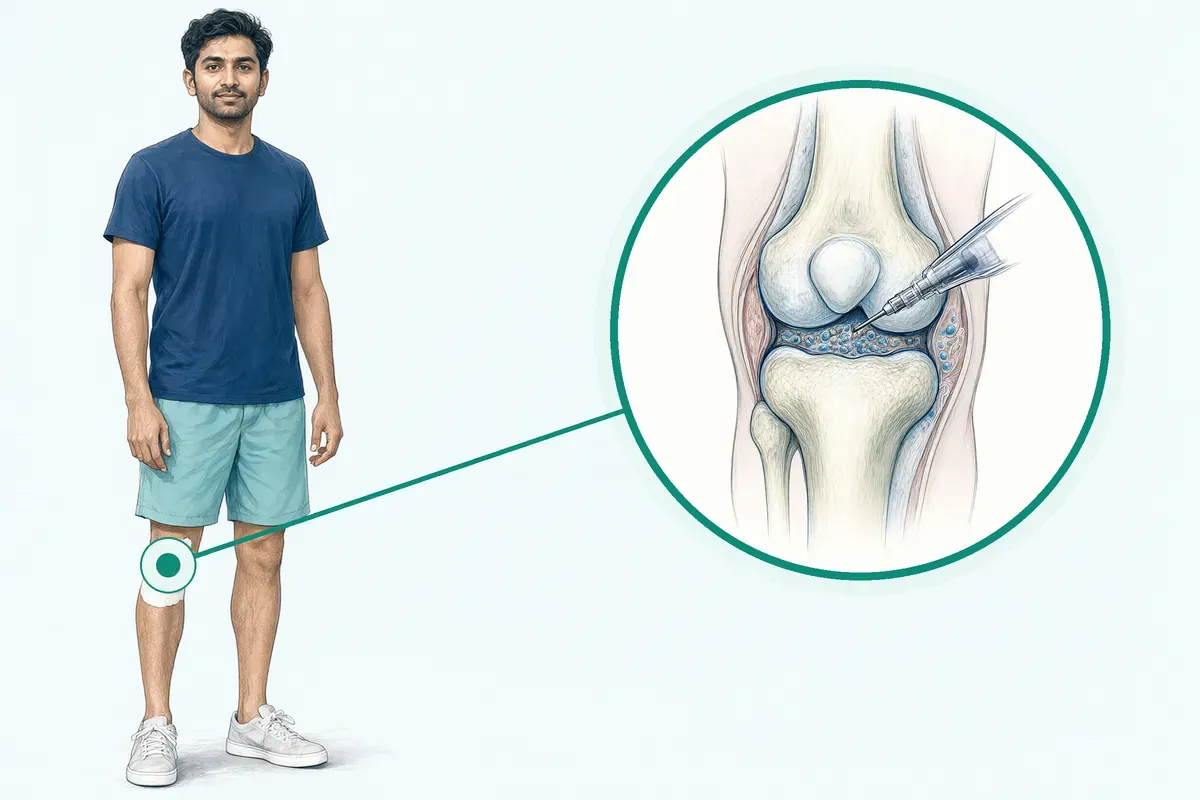
A small blood or tissue sample is processed to concentrate healing cells, then injected into the injured area under ultrasound guidance using local anaesthesia. The visit usually takes 30 to 60 minutes and you go home the same day.
-
Platelet-Rich Plasma (PRP)
Autologous growth factor injection for tendinopathy and early arthritis.
-
Bone Marrow Aspirate Concentrate (BMAC)
Mesenchymal stem cells from iliac crest for cartilage defects.
-
Adipose-Derived Stem Cells
Fat-derived stromal vascular fraction for joint regeneration.
-
Prolotherapy
Dextrose injection to stimulate ligament and tendon healing.
Why patients trust us
- 1991 Serving Jaipur for 35 years
- NABH Accredited hospital
- 1 Sports Injury consultants
- 24×7 Emergency, ICU and ambulance
- 25 Cashless schemes and insurers
What research shows about biologic therapies
-
Pain scores dropped from 7.3 to 2.4
Athletes with chronic sports injuries reported significant pain reduction after PRP injections.
-
About 73% needed only one injection
In a study of athletes, most acute injuries resolved with a single PRP session.
-
Effects may last six months to a year or longer
Symptom improvement from PRP can continue for several months after treatment.
If it is left untreated
Without treatment, chronic tendon and ligament injuries can lead to progressive weakness, reduced joint stability and early joint degeneration, making future repair more difficult.
Life after treatment
Most people return to light activity within one to two weeks and see gradual improvement over months with guided physiotherapy.
-
Return to daily routine
Light activities usually resume in one to two weeks after the day-care procedure.
-
Gradual strength gains
Pain and function typically improve over several months with a structured rehab plan.
-
Avoid or delay surgery
Biologic therapy can be a minimally invasive alternative when conservative care has failed.
Frequently asked questions
Questions patients ask about regenerative sports medicine
Which problems are assessed under regenerative sports medicine?
In short
Regenerative sports medicine at Jaipur Hospital assesses tendon, ligament, muscle and cartilage injuries that have not healed with standard care. Common conditions include chronic tendinopathy, partial ligament tears, early osteoarthritis and cartilage defects. The service also evaluates persistent joint pain and sports-related soft tissue injuries that limit daily activity or training.
In detail
Evidence shows platelet-rich plasma (PRP) may be a good alternative for tendon, ligament, muscle and cartilage injury. PRP can also be used with surgery to enhance healing.
Bone marrow aspirate concentrate (BMAC) provides mesenchymal stem cells for cartilage defects, while adipose-derived stem cells and prolotherapy offer additional biologic options. These therapies are typically recommended when physical therapy, anti-inflammatory medicines or corticosteroid injections have failed to give adequate relief.
Your next step at Jaipur Hospital
Your surgeon will review your imaging, examine the joint and discuss how long symptoms have lasted. If conservative measures have been tried for several weeks without improvement, a biologic injection may be offered. The procedure takes 30 to 60 minutes under local anaesthesia as day care.
How will the doctor decide which tests I need?
In short
The doctor at Jaipur Hospital selects tests based on your injury type, symptom duration and previous imaging. For tendon or ligament problems, ultrasound or MRI shows tear size and tissue quality. For cartilage or arthritis, weight-bearing X-rays and MRI assess joint space and defect depth. Blood tests check platelet count, clotting profile and inflammatory markers before any biologic injection.
In detail
Blood tests may be required to assess platelet levels and overall health before PRP. Patients with blood disorders such as thrombocytopenia or clotting disorders may not be ideal candidates. Imaging guides the choice between PRP, BMAC, adipose-derived stem cells or prolotherapy.
Ultrasound guidance during injection improves accuracy. The surgeon correlates clinical findings with imaging to decide if the pathology is suitable for biologic augmentation or if surgical referral is needed.
A common belief
Patients sometimes assume they need every scan.
What actually happens
The surgeon orders only what changes the decision: imaging to confirm the lesion and bloods to ensure safety. Unnecessary tests add cost and delay.
Your next step at Jaipur Hospital
Bring any recent scans and blood reports to avoid repeat testing. New imaging, if needed, is arranged in-house. Results are usually available within 24 to 48 hours. The surgeon then finalises the treatment plan.
How soon should I expect improvement after regenerative sports medicine treatment?
In short
After regenerative sports medicine treatment at Jaipur Hospital, some patients report pain improvement in four to six weeks, sometimes sooner, with continued improvement for up to a year. The effects may last six months to a year or longer depending on your condition. Your surgeon will give you a realistic timeline at the consultation.
In detail
Evidence indicates that PRP injections can ease pain and encourage healing in tissues that are slow to recover. In studies, athletes with sports injuries saw significant pain score reductions after treatment.
However, results vary between individuals, and healthcare providers cannot predict with certainty that the therapy will work for every patient. Some people may need more than one injection to achieve the desired outcome.
Swelling and pain at the injection site are common for a day or two as the healing process begins. It can take a few weeks to feel initial results and several months for tissues to fully heal.
A common belief
It is not an instant fix.
What actually happens
Early swelling and soreness are normal signs of inflammation starting the repair process. Results differ from person to person, and a second injection is sometimes needed.
Your next step at Jaipur Hospital
You should plan for a gradual return to activity, with light activity usually resuming in one to two weeks. Follow your surgeon's instructions on activity progression and any recommended physiotherapy. If symptoms do not improve within the expected window, a follow-up visit will help decide the next steps.
What evidence supports regenerative sports medicine treatment for my specific condition?
In short
At Jaipur Hospital, our surgical team uses treatments backed by clinical studies for tendinopathy, ligament injuries and early arthritis. PRP and stem cell therapies have shown pain reduction and functional improvement in peer-reviewed research.
In detail
Studies report significant drops in VAS pain scores after PRP for sports injuries, with 73% of athletes needing only one injection. For cartilage defects, BMAC has demonstrated defect fill and improved knee scores at 29 months. PRP is also used alongside surgery to enhance healing.
However, preparation methods vary and results differ between patients, so your surgeon will discuss the evidence relevant to your diagnosis.
- Studies report significant drops in VAS pain scores after PRP for sports injuries, with 73% of athletes needing only one injection.
A common belief
Not every preparation is the same, and not every patient responds.
What actually happens
The evidence supports use in specific conditions, not as a universal heal.
Your next step at Jaipur Hospital
Ask your surgeon to explain the data for your exact condition during the consultation.
How can I decide whether to seek advice about PRP for tendinopathy?
In short
You may consider seeking advice about PRP for tendinopathy at Jaipur Hospital when conservative measures such as physiotherapy, activity modification, and anti-inflammatory medication have not given adequate relief. PRP is an autologous biologic injection that delivers concentrated platelets and growth factors to the injured tendon. It is usually offered after other non-surgical options have been tried.
In detail
Evidence indicates PRP can be a useful adjunct therapy for tendon, ligament, muscle, and cartilage injuries. It may promote a longer-lasting recovery than some other treatments, with some patients reporting pain improvement in four to six weeks and continued improvement for up to a year.
However, results vary between individuals, and healthcare providers cannot predict with certainty that PRP will work for every patient. Certain conditions such as blood disorders, active infection, cancer, pregnancy, or use of blood thinners may make you unsuitable. The surgeon will review your health history and imaging to decide if PRP is appropriate.
A common belief
PRP is not a heal and does not work for everyone.
What actually happens
Studies show mixed results, and some patients see no benefit. It is usually an add-on treatment, not a replacement for rehabilitation. Certain medical conditions also rule it out.
Your next step at Jaipur Hospital
If your tendon pain persists despite a structured rehabilitation programme, schedule a consultation. The surgeon will assess the tendon structure on ultrasound or MRI, discuss the likely benefits and limitations, and outline the expected recovery timeline.
Can I continue any training safely while I recover from regenerative sports medicine treatment?
In short
After regenerative sports medicine treatment at Jaipur Hospital, you will usually need to rest the treated area for a short period. The procedure stimulates a healing response that causes temporary swelling and pain, similar to a new injury. Light activity can often resume in one to two weeks, but the exact training allowed depends on the tissue treated, the biologic used, and your surgeon's protocol.
In detail
Evidence shows PRP treatment typically causes swelling and pain for a day or two because it initiates inflammation, which is the start of healing. It can take a few weeks to feel initial results and several months for tissues to fully heal.
Athletes with acute, lower-grade injuries returned to sport earlier than those with chronic injuries needing multiple injections. Your surgeon and physiotherapist will design a graded loading programme that protects the healing tissue while maintaining cardiovascular fitness and strength elsewhere.
A common belief
Many athletes think they can push through the soreness.
What actually happens
The injection creates a controlled inflammatory response; loading it too early can disrupt the healing. Studies show acute injuries heal faster than chronic ones, so timelines differ.
Your next step at Jaipur Hospital
Do not return to full training until cleared by your surgeon. You will receive specific post-procedure instructions on weight-bearing, range of motion, and progressive loading. Follow-up visits will assess healing before advancing activity.
Which symptoms should prompt me to see a specialist?
In short
See a specialist at Jaipur Hospital if you have joint or tendon pain lasting more than three months despite rest, physiotherapy and anti-inflammatory medication. Swelling that returns with activity, stiffness that limits daily movement, a catching or giving-way sensation in the joint, or pain that wakes you at night are also reasons to seek evaluation for regenerative options.
In detail
Studies show athletes with symptom duration averaging 2.8 months received PRP injections after conservative management failed. Persistent pain scores before treatment averaged 7.25 on a visual analogue scale, indicating significant functional limitation.
The procedure is typically recommended when other conservative treatments such as physical therapy, anti-inflammatory medications or corticosteroid injections have failed to provide adequate relief.
Ongoing inflammation, mechanical symptoms like locking, or inability to return to sport or work suggest the natural healing process has stalled and biologic augmentation may be considered.
A common belief
Patients often wait too long, hoping rest alone will work.
What actually happens
Evidence shows the average symptom duration before PRP was nearly three months. Early assessment prevents further joint damage and keeps more treatment options open.
Your next step at Jaipur Hospital
Bring any recent X-rays or MRI scans to your first visit. The surgeon will examine you, review imaging and decide if PRP, BMAC, adipose-derived stem cells or prolotherapy is appropriate. Most consultations last 20 to 30 minutes.
How will the results change my care plan?
In short
Test results at Jaipur Hospital directly shape whether you proceed with a biologic injection, need a different biologic, or require surgery. Normal platelets and clear imaging of a chronic tendon tear or cartilage defect support PRP or BMAC. Low platelet count, active infection, or a full-thickness tear with retraction may shift the plan to surgical repair or medical optimisation first.
In detail
If blood tests reveal thrombocytopenia or a clotting disorder, PRP may not be suitable. Active infection in the treatment area postpones any injection until resolved. Imaging showing advanced osteoarthritis with bone-on-bone contact may favour joint replacement over biologics.
Conversely, a focal cartilage defect with healthy surrounding cartilage supports BMAC or adipose-derived stem cells. The surgeon matches the biologic to the pathology: PRP for tendinopathy and early arthritis, BMAC for cartilage defects, adipose-derived cells for joint regeneration, prolotherapy for ligament laxity.
A common belief
Patients often think one abnormal value stops everything.
What actually happens
In reality, the surgeon adjusts: treat the infection first, correct anaemia, or choose a different biologic. The goal is matching the right therapy to your specific pathology.
Your next step at Jaipur Hospital
After results are reviewed, the surgeon explains the recommended option, number of sessions likely needed and expected recovery timeline. Most biologic procedures are day care, 30 to 60 minutes under local anaesthesia. Light activity resumes in one to two weeks.
What should I do if symptoms persist or worsen after regenerative sports medicine treatment?
In short
If your symptoms persist or worsen after regenerative sports medicine treatment at Jaipur Hospital, you should contact your surgeon promptly for a follow-up assessment. The surgical team will evaluate your progress, check for any complications, and decide if further treatment or a different approach is needed. Do not ignore increasing pain, swelling, or new symptoms.
In detail
Evidence shows that while PRP injections are minimally invasive and rarely cause side effects, the most common issues are discomfort, pain, or stiffness at the injection site, which usually settle in a day or two.
There is a remote chance of contamination if blood is not kept sterile during preparation. Some patients may need additional PRP treatments or a combination with other therapies such as physiotherapy. In studies, a proportion of athletes required multiple injections, especially for chronic injuries. Your surgeon will monitor your response and adjust the plan accordingly.
A common belief
Mild soreness for a day or two is normal, but increasing pain, swelling, or fever are not.
What actually happens
Some conditions need more than one injection, and a few patients do not respond at all. Early review helps avoid delays.
Your next step at Jaipur Hospital
Keep a record of your symptoms and any changes in function. Attend all scheduled follow-up appointments. If you experience severe pain, signs of infection, or sudden loss of function, seek medical attention immediately. The team at Jaipur Hospital will guide you on activity modification, pain management, and whether further sessions are appropriate.
Is regenerative sports medicine treatment established, off-label, or investigational?
In short
Regenerative sports medicine treatments such as PRP, BMAC, adipose-derived stem cells, and prolotherapy are established clinical options offered at Jaipur Hospital for certain orthopaedic conditions. They are widely used in sports medicine practice globally. However, specific applications may be considered off-label depending on the condition and regulatory guidelines. Your surgeon will clarify the status for your indication.
In detail
PRP is prepared from your own blood and has been used for years to treat tendon, muscle, and ligament injuries. It is generally regarded as an orthobiologic adjunct therapy. BMAC and adipose-derived stem cell therapies involve harvesting and concentrating your own cells.
While clinical trials have shown promising results for cartilage defects and osteonecrosis, standardised protocols are still evolving. There is no single universal preparation method, and healthcare providers are still determining the most suitable ways to use these biologics for different conditions. The treatments are performed under local anaesthesia as day-care procedures following current safety standards.
A common belief
People often assume these are fully standardised like a drug.
What actually happens
In reality, preparation methods differ, and not every indication has high-level trial data. Your surgeon will be transparent about the evidence level for your case.
Your next step at Jaipur Hospital
At your consultation, the surgical team will explain which therapies have the strongest evidence for your problem and whether any are considered investigational for that use. They will also discuss risks, costs, and alternatives. Jaipur Hospital provides these therapies within a structured clinical framework.
FAQ library
Questions and answers about regenerative sports medicine
When you contact us
Get your personalised plan
Contact Jaipur Hospital for a sports injury consultation, in-house scans, a clear explanation of options and a cost estimate before you decide.
- A consultation with a sports injury specialist in the OPD
- Your scans and reports reviewed, with tests done in-house if you need them (laboratory, X-ray and imaging)
- Your options explained in plain words, including whether you need surgery at all
- A cost estimate before you decide
- Help with cashless treatment under RGHS, MAA Yojana, CGHS and empanelled insurers and TPAs
- Follow-up visits after your treatment
Overview
Regenerative Sports Medicine: what to know
What regenerative sports medicine treats
PRP
- Source Your own blood, spun in a centrifuge
BMAC
- Source Mesenchymal stem cells from hip bone
Adipose-derived stem cells
- Source Stromal vascular fraction from fat tissue
Prolotherapy
- Source Dextrose solution injected into ligament or tendon
Regenerative sports medicine uses biologic therapies to help tendons, ligaments and cartilage heal.
The treatments include:
- Platelet-rich plasma (PRP)
- Bone marrow aspirate concentrate (BMAC)
- Adipose-derived stem cells
- Prolotherapy
These therapies are considered when an injury has not improved with rest, physiotherapy or medication.
PRP is made from your own blood. A sample is spun in a centrifuge to concentrate the platelets, which carry growth factors and cytokines that signal the body to repair tissue.
BMAC uses mesenchymal stem cells taken from the iliac crest (hip bone). These cells can become bone, cartilage or fat cells and release proteins that support healing.
Adipose-derived stem cells come from a small amount of fat tissue. They are processed to obtain a stromal vascular fraction that is injected into the joint or tendon.
Prolotherapy uses a dextrose solution injected into the painful ligament or tendon to stimulate a healing response.
The procedures are done as day care under local anaesthesia and usually take 30 to 60 minutes. You go home the same day.
Symptoms and when to seek urgent care
- Cannot put weight on the limb
- Joint looks deformed
- Rapid swelling within minutes
- Fever with a hot, red joint
Common symptoms that lead people to consider regenerative therapy are:
- Persistent pain in a tendon or joint
- Stiffness that is worse in the morning
- Swelling that comes and goes with activity
- A feeling of weakness or giving way
These symptoms often follow a sports injury or develop over months from overuse.
Seek medical attention the same day if you have sudden severe pain after a fall or twist, cannot put weight on the limb, the joint looks deformed, there is rapid swelling within minutes, or you have fever with a hot, red joint. These signs may mean a fracture, complete tendon rupture or infection that needs immediate treatment.
Causes and who is at higher risk
- Obesity and diabetes
- May heal more slowly
- Smoking
- Impairs blood flow to tendons
- Blood disorders
- Can make PRP unsuitable
- Age
- Reduces natural healing capacity
Tendon, ligament and cartilage injuries happen from a single traumatic event or from repetitive load over time. Sports that involve jumping, pivoting or throwing place high stress on these structures. Age reduces the natural healing capacity of tendons and cartilage.
People with obesity, diabetes, inflammatory arthritis or a history of corticosteroid injections may heal more slowly. Smoking impairs blood flow to tendons. Certain blood disorders such as thrombocytopenia or clotting problems can make PRP unsuitable.
Active adolescents and adults who want to return to sport or avoid long-term medication are typical candidates.
How the injury is diagnosed
Your surgeon will ask about the mechanism of injury, the pattern of pain, and what treatments you have already tried. A physical examination checks for tenderness, swelling, range of motion and specific tests that stress the tendon or ligament.
Imaging confirms the diagnosis and guides treatment planning. Ultrasound shows tendon structure in real time and can guide the injection. MRI gives detailed pictures of cartilage, ligaments and bone marrow. X-ray rules out fracture or advanced arthritis. Blood tests may be done before PRP to check platelet count and rule out infection or anaemia.
Non-surgical options and when surgery is advised
- First-line conservative care Rest, physiotherapy, short-term medication
- Regenerative therapies PRP, BMAC, adipose cells, prolotherapy
- Surgery For complete tears or advanced arthritis
First-line treatment is usually:
- Rest
- Activity modification
- A structured physiotherapy programme
- Short-term anti-inflammatory medication
Corticosteroid injections can give short-term pain relief but are not repeated often because they may weaken tendon tissue.
If symptoms persist after three to six months of consistent conservative care, regenerative therapies may be offered. PRP is the most common first biologic step. BMAC or adipose-derived cells are considered for larger cartilage defects or when PRP has not helped. Prolotherapy may be used for chronic ligament laxity.
Surgery is advised when there is a complete tendon or ligament tear, a large cartilage flap causing mechanical locking, or advanced joint arthritis with bone-on-bone contact. Your surgeon will discuss whether a biologic injection can be tried before surgery or used alongside surgical repair to enhance healing.
Preparing for regenerative sports medicine treatment
Do
- Stop blood-thinning medicines a week before Aspirin, NSAIDs, fish oil, vitamin E
- Discuss regular medicines with your doctor Make a safe plan together
- Wear comfortable clothing on the day Easy access to the joint or tendon
Before your procedure at Jaipur Hospital, your surgeon will review your medical history and current medicines. You may be asked to stop blood-thinning medications such as aspirin, non-steroidal anti-inflammatory drugs (NSAIDs), and certain supplements like fish oil or vitamin E for at least a week before the appointment.
If you take regular medicines for other conditions, discuss them with your doctor so a safe plan can be made. People with blood disorders such as thrombocytopenia, clotting disorders, active infections in the treatment area, active cancer, or who are pregnant or breastfeeding are generally not suitable candidates.
Chronic skin conditions like psoriasis or eczema in the treatment area may also make the procedure unsuitable. On the day of treatment, wear comfortable clothing that allows easy access to the joint or tendon being treated. Stay well-hydrated and avoid alcohol and smoking for at least 48 hours before the procedure. You may want an attendant to drive you home afterwards, especially if you feel sore.
How regenerative sports medicine treatment is done
- Blood drawn from your arm Typically 10 to 60 ml
- Blood spun in centrifuge About 10 to 15 minutes
- Concentrated PRP injected Often using ultrasound guidance
At Jaipur Hospital the procedure is performed as day care under local anaesthesia and usually takes 30 to 60 minutes. The exact technique depends on your injury and your surgeon's advice. For Platelet-Rich Plasma (PRP), a small amount of blood (typically 10 to 60 ml) is drawn from your arm.
The blood is spun in a centrifuge for about 10 to 15 minutes to separate the platelet-rich plasma from red blood cells and other components. The concentrated PRP, which contains three to ten times the normal platelet count, is then injected into the injured tendon, ligament or joint, often using ultrasound guidance.
For Bone Marrow Aspirate Concentrate (BMAC), marrow is taken from the iliac crest, concentrated, and injected into the cartilage defect. Adipose-derived stem cells are harvested from fat tissue, processed to obtain the stromal vascular fraction, and injected into the joint. Prolotherapy uses a dextrose solution injected into the painful ligament or tendon to stimulate healing.
Your surgeon will explain which option suits your condition. After the injection you are monitored briefly and given post-procedure instructions before going home.
Risks and possible complications of regenerative sports medicine treatment
- Common effects
- Discomfort, pain or stiffness for a day or two
- Remote chance
- Contamination if blood not kept sterile
- Stem cell therapy risks
- Immune rejection and small malignant transformation risk
- Serious adverse events
- About 6.7% in one trial within 30 days
PRP injections are minimally invasive and rarely cause side effects. The most common effects are discomfort, pain or stiffness at the injection site, which usually last a day or two. Swelling and pain are signs that the healing process has started. There is a remote chance of contamination if the blood is not kept sterile during preparation.
Some people feel more discomfort than expected. Because the material comes from your own body, rejection or disease transmission is not a concern. For stem cell therapies using cultured mesenchymal stem cells, studies have reported immune rejection of allogeneic donor cells and a small risk of malignant transformation with long-term culture.
In one trial, serious adverse events such as heart failure occurred in about 6.7% of patients within 30 days. Your surgeon will discuss the specific risks that apply to the technique chosen for you.
Recovery and aftercare after regenerative sports medicine treatment
You can usually resume light activity within 1 to 2 weeks. The entire visit takes less than an hour. You may need to rest for the first day or two. Ice application and simple pain relief may be advised. Avoid NSAIDs for a period after the injection because they can impair platelet function.
Follow your surgeon's guidance on how quickly to return to sports or heavy work to ensure optimal recovery. Initial pain relief or improvement may be felt within a few weeks, but tissues can take several months to fully heal. Some patients need more than one injection to achieve the desired result.
In one study of athletes, about 73% required only a single injection while the rest needed two or more. Contact Jaipur Hospital if you develop increasing pain, swelling, redness, fever, or any other concern after the procedure.
Results of regenerative sports medicine treatment
Studies show that PRP and biologic therapies can improve pain and function in tendon, ligament and cartilage injuries that have not responded to conservative care. In a group of athletes with chronic symptoms, the average pain score (VAS) fell from 7.25 to 2.42 after treatment, a statistically significant change.
Some patients report improvement within four to six weeks, with continued gains for up to a year. The effects of a PRP injection may last six months to a year or longer, depending on the condition. However, results vary: while some people experience clear benefit, others do not, and doctors cannot predict with certainty who will respond.
PRP is considered a useful adjunct therapy, not a standalone heal. It is often combined with physiotherapy or other treatments. For cartilage defects treated with bone marrow concentrate, studies have shown defect fill and symptom improvement at 12 to 24 months. Knee scores such as IKDC and KOOS have improved markedly in small case series. Your surgeon will set realistic expectations based on your specific injury.
Cost and insurance for regenerative sports medicine treatment in Jaipur
The typical price range for regenerative sports medicine procedures in India is ₹15,000 to ₹1,50,000. The exact cost depends on the technique used (PRP, BMAC, adipose-derived cells or prolotherapy), the number of sessions needed, the treatment area, and any imaging guidance required. PRP therapy alone in India often ranges from ₹15,000 to ₹30,000 per session.
Biologic treatments are relatively expensive because they are prepared from your own blood or tissue and cannot be mass-produced. If you have a chronic condition, you will need to weigh the cost of repeated treatments against the benefit you experience.
Jaipur Hospital accepts patients under:
- RGHS
- MAA Yojana
- CGHS
- A panel of private insurers and TPAs
Check with your scheme or insurer whether regenerative therapies are covered, as many plans treat them as investigational. The hospital can provide an estimate after your consultation.