

Sports Injury · Jaipur Hospital
Shoulder Instability and Labral Injuries in Jaipur
Recurrent shoulder dislocation or catching? Get a clear diagnosis and a simple plan at Jaipur Hospital.
- Serving Jaipur since 1991 (35 years)
- NABH accredited
- 24×7 emergency & ICU
- Cashless: RGHS, MAA Yojana, CGHS + 22 insurers
- Operation time
- 1 to 2 hours
- Anaesthesia
- General anaesthesia with interscalene block
- Recovery
- Return to contact sports in 6 months
- Price
- ₹1,50,000 to ₹3,00,000typical range in India; ask us for an estimate
Shoulder keeps giving way
Your shoulder feels unstable or catches
Repeated dislocations, a catching sensation, or pain when you reach overhead can stop you from playing sport, lifting at work, or sleeping on that side. Each episode can damage the joint further.
-
Repeated dislocations
The shoulder pops out with minor movement or even during sleep.
-
Catching or clicking
A mechanical click or clunk when you move the arm overhead.
-
Pain with activity
Deep ache during throwing, lifting or pushing movements.
-
Fear of movement
You avoid certain positions because the shoulder feels unsafe.
-
Failed rehab
Physiotherapy has not stopped the instability after several months.
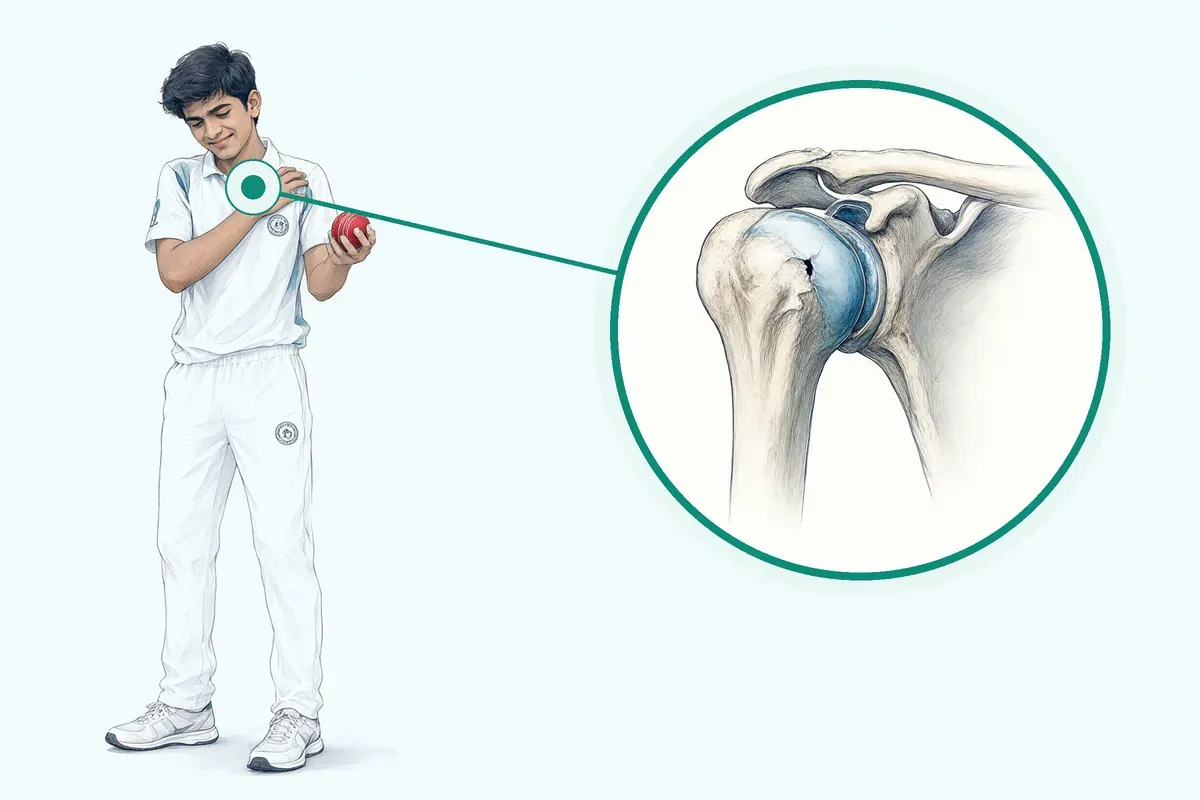
Glenoid bone loss is typically associated with the Hill-Sachs lesion in patients with recurrent anterior shoulder instability.
Why Jaipur Hospital
You worry that the next dislocation will happen at work or on the field and mean more time off and another surgery.
Your care plan
Your first steps with us
- 1 Book an OPD consultation with a sports injury specialist
- 2 Get imaging and lab tests done in-house
- 3 Undergo arthroscopic stabilisation or repair
- 4 Complete guided physiotherapy and return to activity
How the operation is done
Surgery is usually arthroscopic under general anaesthesia with an interscalene block, takes one to two hours, and needs one night in hospital.
-
Arthroscopic Bankart Repair
Suture anchors reattach the torn anteroinferior labrum to the glenoid rim.
-
SLAP Repair
Anchors fix the superior labrum anterior-to-posterior tear.
-
Latarjet Procedure
Coracoid bone transfer addresses significant glenoid bone loss.
-
Remplissage
Infraspinatus tenodesis fills an engaging Hill-Sachs defect.
Why patients trust us
- 1991 Serving Jaipur for 35 years
- NABH Accredited hospital
- 1 Sports Injury consultants
- 24×7 Emergency, ICU and ambulance
- 25 Cashless schemes and insurers
What research shows about this treatment
-
About 9 in 10 return to sport after arthroscopic Bankart
The rate of return to sport was 97.5% after arthroscopic Bankart repair in pooled studies.
-
Recurrence around 8% after surgical stabilisation
The overall recurrent instability rate was 8.5% across surgical procedures at long-term follow-up.
-
Residual pain reported in about 36% at long follow-up
Residual shoulder pain was reported in 35.7% of patients at a mean 16.6-year follow-up.
If it is left untreated
Without treatment, repeated dislocations can increase glenoid bone loss and Hill-Sachs lesions, making future repair more complex and raising the risk of early arthritis.
Life after treatment
Most people regain a stable shoulder and return to sport or work within six months with guided rehabilitation.
-
Stable shoulder
Most people no longer feel the shoulder slipping or catching during daily tasks.
-
Return to sport
Usually back to contact sports around six months after surgery.
-
Less pain
Pain scores typically drop significantly after healing.
-
Confident movement
You can reach, lift and sleep without fear of the joint giving way.
Frequently asked questions
Questions patients ask about shoulder instability and labral injuries
Which problems are assessed under shoulder instability and labral injuries?
In short
Shoulder instability and labral injuries cover recurrent dislocation, Bankart tears, SLAP tears, Hill-Sachs lesions and glenoid bone loss. Jaipur Hospital evaluates each pattern with clinical examination and imaging to decide the right treatment path.
In detail
The evidence shows that glenoid bone loss is typically associated with Hill-Sachs lesions in recurrent anterior instability and that the injury is often bipolar. Other pathology such as Bankart tears, labral or capsular injuries must be identified.
The incidence of these lesions approaches 100 percent in persons with recurrent anterior shoulder instability. Identification of concomitant glenoid bone loss is essential to optimise clinical outcome.
Surgical options include arthroscopic Bankart repair, SLAP repair, Latarjet procedure for significant glenoid bone loss and remplissage for engaging Hill-Sachs lesions.
- The incidence of these lesions approaches 100 percent in persons with recurrent anterior shoulder instability.
A common belief
Many people think a dislocation is just a dislocation.
What actually happens
In reality the joint often has a bipolar injury with both a Hill-Sachs defect on the humeral head and bone loss on the glenoid. Missing the bone loss leads to higher recurrence after simple repair.
Your next step at Jaipur Hospital
Your surgeon will take a detailed history, examine your shoulder for apprehension and instability signs, and order X-rays or MRI scans to assess the extent of injury. This usually happens at the first OPD visit. After reviewing the images, the surgeon explains which pattern you have and discusses the options.
How will the doctor decide which tests I need for shoulder instability?
In short
The surgeon chooses tests based on your history of dislocations, examination findings of instability and apprehension, and the suspected pattern of injury. Jaipur Hospital follows a stepwise approach starting with X-rays and often adding MRI or CT.
In detail
Treatment is dictated by subjective and objective findings of shoulder instability and radiographic findings. Pre-operative tests usually include imaging studies such as X-rays or MRI scans to assess the extent of the injury and plan the surgery.
X-rays show bony Bankart fragments, glenoid bone loss and Hill-Sachs lesions. MRI evaluates labral tears, capsular injury and SLAP lesions. CT with 3D reconstruction quantifies glenoid bone loss precisely when the Latarjet procedure is considered. Blood tests check for underlying health issues and cardiac evaluation may be needed for patients with heart history.
A common belief
Some patients expect only an X-ray.
What actually happens
Soft tissue injuries like Bankart or SLAP tears need MRI. If bone loss is seen, a CT with 3D reconstruction is required to plan a Latarjet. The surgeon selects each test to answer a specific surgical question.
Your next step at Jaipur Hospital
At your first visit the surgeon examines the shoulder, reviews any previous films and orders the appropriate scans. Results are typically available within a few days. The surgeon then explains the injury pattern and discusses treatment options.
How soon should I expect improvement after shoulder instability surgery?
In short
After shoulder instability surgery at Jaipur Hospital, most patients notice less pain and better stability within the first six weeks. The arm is protected in a sling for about four to six weeks. Gentle motion begins early, but strength and confidence return gradually over several months.
In detail
Evidence shows that forward elevation reaches about 120 degrees by the sixth week and returns to normal by the twelfth week. External rotation at ninety degrees abduction improves from thirty degrees at nine weeks to near normal by six months.
In studies, the mean VAS pain score dropped from 4.9 before surgery to 1.9 after surgery, and the mean ASES score rose from 56.4 to 91.8. Patients with combined Bankart and SLAP lesions regain motion more slowly than those with isolated Bankart tears.
The typical hospital stay is one night, and the operation takes one to two hours under general anaesthesia with an interscalene block.
A common belief
Many expect a quick fix, but the shoulder heals in phases.
What actually happens
Early protection prevents re-tear, and pushing too hard too soon can delay return to sport.
Your next step at Jaipur Hospital
You will wear a sling for four to six weeks and start supervised physiotherapy soon after discharge. Light daily activities are usually possible by six weeks. Return to contact sports is typically expected at six months. Your surgeon will guide the exact timeline based on your repair type and healing.
Can a shoulder labral injury heal with rehabilitation, or is an operation worth considering?
In short
At Jaipur Hospital, the decision depends on the type of lesion, your age, activity level, and how many dislocations you have had. Small bony defects and non-engaging Hill-Sachs lesions may stay stable with focused rehabilitation alone. However, recurrent dislocations, failed physiotherapy, or significant glenoid bone loss usually make arthroscopic stabilisation the preferred option to restore stability.
In detail
Evidence shows nonsurgical management is acceptable for small defects where the joint remains stable during desired activities. Arthroscopic Bankart repair gives a seven-fold lower recurrence rate than conservative care and a higher return-to-play rate.
Patients with more than ten dislocations, those who fail a comprehensive rehabilitation programme, and younger active individuals are typical surgical candidates. The presence of glenoid bone loss, engaging Hill-Sachs lesions, or combined Bankart-SLAP tears shifts the balance toward surgery, sometimes with Latarjet or remplissage.
Your next step at Jaipur Hospital
Your surgeon will review imaging, examine stability, and discuss your sport and work goals. A trial of supervised physiotherapy for three to six months is reasonable for first-time or low-demand cases. If instability persists, surgery is planned with the technique matched to your pathology.
How can I decide whether to seek advice about shoulder arthroscopy for instability?
In short
You should consider seeking advice at Jaipur Hospital if you have had multiple dislocations, feel your shoulder giving way during daily activities, or have completed a full rehabilitation programme without lasting improvement. Younger, active patients and athletes often benefit from earlier surgical evaluation.
In detail
Evidence indicates that patients with recurrent dislocations, particularly those occurring with minimal trauma, are prime candidates for surgery. Failure of conservative treatment, including physical therapy and activity modification, also warrants surgical assessment.
Age and activity level matter: younger, active individuals, especially athletes, may benefit more from arthroscopic stabilisation. In studies, arthroscopic Bankart repair resulted in a seven-fold lower recurrence rate than conservative management and a higher rate of return to play. The choice of technique depends on your specific condition, the presence of bone loss, and the surgeon's expertise.
A common belief
Some believe surgery is only for severe cases, but evidence shows early stabilisation in active patients lowers recurrence seven-fold compared to physio alone.
What actually happens
Waiting longer can increase bone loss and make repair harder.
Your next step at Jaipur Hospital
If your shoulder remains unstable despite rehabilitation, or if you avoid activities you enjoy because of fear of dislocation, arrange a consultation. Your surgeon will review imaging, examine your shoulder, and discuss whether arthroscopy is appropriate for you.
Can I continue any training safely while I recover from shoulder instability surgery?
In short
Yes, you can continue modified training during recovery at Jaipur Hospital, but only within the limits set by your surgical team and physiotherapist. Early phases protect the repair with immobilisation and passive motion; lower-body and core exercises that avoid shoulder loading are usually permitted.
In detail
Evidence shows forward elevation reaches 120 degrees by week six and normal by week twelve. External rotation at 90 degrees abduction recovers to near normal by six months. Combined Bankart and SLAP repairs regain motion more slowly.
During the first six weeks, the shoulder is typically in a sling with only guided passive exercises. From weeks six to twelve, active-assisted and active range of motion begin. Strengthening starts after twelve weeks.
Cardiovascular fitness can be maintained with stationary cycling, treadmill walking or running once balance and pain allow, provided the shoulder is not jarred. Sport-specific drills are introduced only after full range and symmetric strength are confirmed.
A common belief
Many athletes try to maintain upper-body strength too soon.
What actually happens
Evidence shows the repair is vulnerable until at least twelve weeks; premature loading risks anchor pull-out or recurrent instability. A structured plan protects the repair while preserving fitness.
Your next step at Jaipur Hospital
Discuss a safe cross-training plan with your physiotherapist at each follow-up. Do not resume throwing, contact, or overhead loading until cleared.
Which symptoms should prompt me to see a specialist?
In short
See a specialist if your shoulder has dislocated more than once, feels loose or slips during daily activities, catches or clicks painfully, or if pain and weakness stop you from sport or work. Jaipur Hospital sees many patients with these mechanical symptoms.
In detail
Recurrent shoulder dislocations, particularly if they occur with minimal trauma, are a prime indicator for surgical evaluation. Failure of a comprehensive rehabilitation programme including physical therapy and activity modification without significant improvement also warrants specialist review.
Younger active individuals and athletes often benefit from earlier assessment. The evidence notes that all patients in one series had greater than ten experiences of shoulder dislocation before surgery, highlighting how recurrent instability progresses. Persistent shoulder pain that interferes with daily life is another key symptom.
A common belief
Patients often wait until they have had ten or more dislocations before seeking help.
What actually happens
Each episode can increase bone loss and make later surgery more complex. Early specialist review after the second dislocation or failed physiotherapy can preserve the joint.
Your next step at Jaipur Hospital
If you recognise these symptoms, book an OPD appointment. The surgeon will examine your shoulder, check range of motion and stability, and usually order an MRI or CT to quantify bone loss. Early assessment helps prevent further joint damage.
How will the test results change my care plan for shoulder instability?
In short
Imaging results define the injury pattern — labral tear type, bone loss amount, Hill-Sachs size — and directly determine whether arthroscopic repair, Latarjet or remplissage is recommended. Jaipur Hospital uses these findings to match the procedure to your pathology.
In detail
Identification of concomitant glenoid bone loss is essential to optimise clinical outcome. The choice of technique depends on various factors including the surgeon's expertise, the patient's specific condition and the presence of additional injuries.
A small Bankart tear without bone loss may be treated with arthroscopic Bankart repair. Significant glenoid bone loss shifts the plan to Latarjet procedure. An engaging Hill-Sachs lesion may need remplissage added to the repair.
Combined Bankart and SLAP lesions are repaired together with suture anchors. The evidence shows that treatment is dictated by subjective and objective findings and radiographic findings.
A common belief
Patients often assume all instability gets the same keyhole repair.
What actually happens
In reality, glenoid bone loss over a critical threshold makes simple Bankart repair fail. The surgeon measures bone loss on CT and chooses Latarjet when needed. Hill-Sachs engagement adds remplissage. Each finding changes the operation.
Your next step at Jaipur Hospital
After scans are done, the surgeon reviews them with you, measures bone loss percentages and Hill-Sachs engagement, and explains which procedure fits your anatomy. This discussion usually happens at a follow-up visit within a week.
What should I do if symptoms persist or worsen after shoulder stabilisation surgery?
In short
At Jaipur Hospital, you should contact your surgical team promptly if pain increases, swelling appears, fever develops, or the shoulder feels unstable again after arthroscopic stabilisation. Early reporting allows the team to check for infection, anchor loosening, or recurrent dislocation before they become serious. Do not wait for the next scheduled visit if something feels wrong.
In detail
Studies report a recurrent instability rate of about 8.5 percent and a revision rate of 3.7 percent after surgical stabilisation. Residual pain occurs in roughly 35.7 percent of patients at long-term follow-up, and daily pain in 4.8 percent.
Arthritic changes appear in 38.2 percent over sixteen years. These numbers mean that while most patients do well, a minority experience ongoing or new symptoms that need assessment. The arthroscopic technique carries a learning curve, and outcomes relate to surgeon experience and the specific lesion pattern treated.
- Arthritic changes appear in 38.2 percent over sixteen years.
Your next step at Jaipur Hospital
Keep the emergency numbers for Jaipur Hospital handy: 0141-2551500 and +91-7414-001-001. If the wound becomes red, hot, or discharges, or if you feel the shoulder slip out of joint, attend the 24-hour emergency department. Bring any imaging or notes from outside providers. The team will examine you, possibly order repeat MRI or X-ray, and decide on further treatment.
Does the scan show a partial tear, complete tear, or wear-related change in the shoulder labrum?
In short
An MRI or MR arthrogram can show whether you have a partial tear, complete tear, or degenerative change in the labrum. It also reveals associated injuries such as a Bankart lesion, SLAP tear, Hill-Sachs defect, or glenoid bone loss. Your surgeon at Jaipur Hospital will review the images with you and explain what they mean for treatment.
In detail
The Hill-Sachs lesion is an osseous defect of the humeral head, typically associated with anterior instability. Glenoid bone loss is often paired with a Hill-Sachs lesion, creating a bipolar injury. The incidence of these lesions approaches one hundred percent in recurrent anterior instability.
Identifying concomitant glenoid bone loss is essential to optimise clinical outcome. Pre-operative imaging studies — X-rays or MRI scans — are standard to assess the extent of injury and plan the surgery. The scan also helps decide between arthroscopic Bankart repair, SLAP repair, Latarjet procedure, or remplissage.
A common belief
Patients often focus only on the labrum tear.
What actually happens
But bone loss on the socket or a large Hill-Sachs lesion changes the operation from a simple repair to a Latarjet or remplissage.
Your next step at Jaipur Hospital
Bring any previous scans to your appointment. If new imaging is needed, the hospital has in-house radiology. The surgeon will correlate the scan findings with your history of dislocations, instability episodes, and failed rehab.
FAQ library
Questions and answers about shoulder instability and labral injuries
When you contact us
Get your shoulder assessed
Contact Jaipur Hospital for an OPD consultation, in-house scans, a plain explanation of options, a cost estimate and help with cashless schemes.
- A consultation with a sports injury specialist in the OPD
- Your scans and reports reviewed, with tests done in-house if you need them (laboratory, X-ray and imaging)
- Your options explained in plain words, including whether you need surgery at all
- A cost estimate before you decide
- Help with cashless treatment under RGHS, MAA Yojana, CGHS and empanelled insurers and TPAs
- Follow-up visits after your treatment
Overview
Shoulder Instability and Labral Injuries: what to know
What shoulder instability and labral tears are
Bankart lesion
- Front labrum tear
SLAP tear
- Top labrum tear
Hill-Sachs lesion
- Dent on ball
The shoulder is a ball-and-socket joint. The ball is the top of the upper arm bone (humeral head) and the socket is a shallow cup on the shoulder blade (glenoid). A ring of firm tissue called the labrum deepens the socket and helps keep the ball in place. Ligaments and the joint capsule also hold the joint together.
Shoulder instability means the ball moves too much or slips out of the socket. This can happen as a partial slip (subluxation) or a full dislocation where the ball comes completely out. When the ball dislocates forward, it often tears the labrum off the front of the socket. This tear is called a Bankart lesion.
A SLAP tear is a tear at the top of the labrum where the biceps tendon attaches. A Hill-Sachs lesion is a dent in the back of the ball caused by it hitting the front of the socket during dislocation. In recurrent anterior instability, the Hill-Sachs lesion is typically found together with glenoid bone loss, making it a bipolar injury. In studies, labral tears are found in almost all people with recurrent anterior shoulder instability.
Symptoms of shoulder instability and labral tears, and warning signs needing same-day care
- Shoulder visibly deformed
- Cannot feel fingers or hand
Common symptoms include:
- A feeling that the shoulder may slip out or has slipped out
- Pain with certain movements such as throwing or reaching overhead
- Clicking or catching sensations
- A sense of looseness or weakness
Some people wake at night with pain. Recurrent dislocations often happen with minimal force, such as rolling over in bed or reaching for an object.
Seek care the same day if:
- The shoulder is visibly deformed after an injury and you cannot move the arm.
- The arm or hand becomes numb, cold, or changes colour.
- Pain is severe and not relieved by rest or simple pain medicine.
- You cannot feel your fingers or hand.
These signs may mean the joint is still dislocated or that nerves or blood vessels are injured.
Causes and who is at higher risk for shoulder instability and labral tears
- 82% Male patients in long-term studies
- mid-20s Average age in surgical series
- more than ten Dislocation episodes before surgery
A first dislocation is usually caused by a fall on an outstretched hand, a direct blow, or a forced overhead movement. Once the labrum or ligaments are torn, the shoulder can dislocate again with much less force. Glenoid bone loss can occur with each dislocation episode.
Factors that increase the chance of recurrent instability include:
- Age under 25 at the time of first dislocation.
- Male sex; in long-term studies about 82% of patients were men.
- Participation in contact or overhead sports.
- Presence of a Hill-Sachs lesion or glenoid bone loss.
- A first dislocation before age 20 carries a very high recurrence rate.
- Patients in surgical series had an average age in the mid-20s and had often experienced more than ten dislocation episodes.
How shoulder instability and labral tears are diagnosed: examination and tests
Your surgeon will ask about the number of dislocations, the direction of instability, and how the shoulder affects daily life and sport. Clinical tests check for apprehension, relocation, and signs of laxity. Other pathology such as Bankart tears, labral or capsular injuries must be identified.
Imaging is used to confirm the diagnosis and plan treatment:
- X-rays show bone loss, fractures, or a Hill-Sachs lesion.
- MRI or MR arthrogram shows the labrum, ligaments, and soft tissue tears.
- CT scan with 3D reconstruction is often used to measure the amount of glenoid bone loss precisely.
Identification of concomitant glenoid bone loss is essential to optimise clinical outcome. Treatment is dictated by subjective and objective findings of shoulder instability and radiographic findings.
Non-surgical treatment for shoulder instability and labral tears, and when surgery is advised
Do
- Multiple dislocations with minimal trauma
- Rehab programme has not improved symptoms
Non-surgical management includes a period of immobilisation followed by a focused rehabilitation programme to strengthen the rotator cuff and scapular muscles. This approach is acceptable in cases of small bony defects and non-engaging lesions where the joint remains stable during desired activities. It is often tried first for a first-time dislocation or for patients with low functional demands.
Surgery is usually advised when:
- You have had multiple dislocations, particularly with minimal trauma.
- A comprehensive rehabilitation programme including physical therapy and activity modification has not improved symptoms.
- You are a younger, active individual or athlete who wants to return to sport.
- There is significant glenoid bone loss or an engaging Hill-Sachs lesion.
- Persistent shoulder pain interferes with daily life.
The choice of technique depends on the surgeon's expertise, your specific condition, and any additional injuries. Surgical options include arthroscopic and open techniques.
Preparing for Shoulder Instability Surgery at Jaipur Hospital
Do
- Complete pre-op tests
- Review medicines with doctor
- Stop or reduce smoking
- Follow fasting instructions
Before your operation, your surgeon will ask for a few tests to make sure you are fit for anaesthesia and to plan the repair. These usually include imaging studies such as X-rays or MRI scans to assess the extent of the injury and plan the surgery.
Blood tests are done to check for any underlying health issues that could affect surgery. If you have a history of heart problems, a cardiac evaluation may be necessary.
You will have a medication review with your healthcare provider. Some medicines, especially blood thinners, may need to be adjusted or stopped before surgery to reduce the risk of bleeding. If you smoke, consider quitting or reducing smoking before surgery, as it can impair healing.
Arrange for someone to accompany you on the day of surgery and to assist you during the initial recovery period at home. Follow the fasting instructions given by your surgeon; typically you will be advised not to eat or drink anything after midnight the night before your procedure.
Prepare your home for recovery by clearing pathways, setting up a comfortable resting area, and keeping necessary supplies within reach. On the day of surgery, wear loose-fitting, comfortable clothing that allows easy access to your shoulder. It is normal to feel anxious; relaxation techniques such as deep breathing, meditation, or visualisation can help ease your mind.
How Shoulder Stabilisation and Labral Repair Surgery Is Done
- Admission and anaesthesia General anaesthetic and nerve block given
- Arthroscopic examination Small cuts for camera and tools
- Repair with anchors or bone transfer Labrum fixed or bone graft used
- Closure and sling Stitches, dressing and arm in sling
On the day of surgery, you will be admitted to the ward and prepared for the operation. The anaesthetist will give you a general anaesthetic and an interscalene nerve block to numb the shoulder and arm. The surgical team will make small incisions around the shoulder to insert the arthroscope and instruments.
The surgeon examines the joint, confirms the labral tear and any bone loss, and then performs the chosen repair using suture anchors or bone transfer. The incisions are closed with stitches or steristrips and a dressing is applied. Your arm will be placed in a sling before you wake up in the recovery area.
Risks and Possible Complications of Shoulder Stabilisation Surgery
- 11.9% to 13.8% Overall complications
- 7.5% to 10% Recurrent dislocation
- 3.7% Revision surgery
- 4.8% Residual daily pain
All surgery carries some risk. In studies of shoulder stabilisation procedures, the overall complication rate has been reported around 11.9% to 13.8%. Specific complications can include infection, stiffness, nerve injury, and recurrent instability.
Recurrent dislocation after surgical stabilisation has been reported in about 7.5% to 10% of shoulders in various studies. The revision (re-operation) rate has been reported around 3.7%. Some patients experience residual shoulder pain; in long-term follow-up studies, residual pain was reported in 35.7% of patients, with 4.8% experiencing daily pain. Arthritic changes were seen in 38.2% of patients at long-term follow-up.
After the Latarjet procedure, diminished internal rotation capacity has been noted compared to other techniques. Persistent apprehension (a feeling the shoulder may dislocate) was reported more often after arthroscopic Latarjet (35.7%) than after open Latarjet (10.2%). Donor-site sensory disturbances have been noted with some bone graft techniques.
Your surgical team will discuss the risks that apply to your specific procedure and anatomy. No specific complication and no significant limitation of motion more than 10 degrees was noted in one series at final follow-up.
Recovery and Aftercare After Shoulder Labral Repair
After surgery, you will wear a sling to protect the repair. Pain is managed with regular medication and the interscalene block usually provides good relief for the first 12 to 24 hours. In studies, pain scores (VAS) decreased from a preoperative average of 4.9 to a postoperative average of 1.9.
Range of motion returns gradually. In patients with isolated Bankart lesions, forward elevation reached 120° by the 6th postoperative week and recovered to normal by the 12th week. External rotation at 90° abduction improved from 30° at the 9th week to almost normal by the 6th month. Recovery of normal range of motion is slower in patients with combined Bankart and SLAP lesions.
Physiotherapy starts early with passive movements and progresses to active exercises as the repair heals. You will be given a home exercise programme and outpatient physiotherapy appointments. Return to contact sports is typically around 6 months, but your surgeon will guide you based on your progress and the type of repair.
Call the hospital or your surgeon if you develop:
- Increasing pain not controlled by medication
- Swelling or redness around the wounds
- Fever
- Numbness or tingling in the arm or hand that is new or worsening
- Any sudden popping sensation in the shoulder
Results of Shoulder Instability Surgery: How Well It Works and Recurrence Rates
In studies, surgical stabilisation shows good functional outcomes. Mean ASES scores improved from 56.4 preoperatively to 91.8 postoperatively. Mean Rowe shoulder scores improved from 33.7 to 94.1. In one series, all patients had better than good results, with 6 excellent and 9 good according to the Rowe scoring system.
Recurrent dislocation was not observed until the last follow-up and anterior instability was not noted on examination in that series.
Return to sport rates are high overall. The overall rate of return to play was 84.9% across studies, with 86.1% achieving good or excellent outcomes. After arthroscopic Bankart repair, the rate of return to sport was 97.5%, and the rate of return to pre-injury level was highest at 91.5%. The mean time to return to sport after arthroscopic Bankart was 5.9 months.
After the Latarjet procedure, the overall return to play rate was 88.8%, with 72.6% returning to the same level. The mean time to return to play was 5.8 months. Among collision athletes, 88.2% returned to play and 69.5% to the same level. Among overhead athletes, 90.3% returned to play and 80.6% to the same level.
Arthroscopic Bankart repair resulted in a 7-fold lower recurrence rate than conservative management and a higher rate of return to play than conservative management. The overall recurrent instability rate across surgical procedures was 8.5%.
Both open and arthroscopic Latarjet procedures result in significant improvements in function and outcome scores, with no significant difference in clinical or radiologic outcomes except for internal rotation.
Cost and Insurance for Shoulder Stabilisation Surgery in Jaipur
The typical price range for shoulder stabilisation and labral repair surgery in India is ₹1,50,000 to ₹3,00,000.
The final cost depends on several factors:
- The choice of hospital and its pricing structure
- The city or region (urban centres may have higher costs)
- The type of room you choose (private, semi-private, or general)
- Whether any complications arise during or after surgery that need additional treatment
Ask us for an estimate based on your specific procedure and room preference.
Jaipur Hospital is a NABH-accredited multispeciality hospital established in February 1991.
We accept patients under:
- RGHS
- MAA Yojana
- CGHS
- A panel of private insurers and TPAs
Our facilities include 24×7 emergency and ambulance services, intensive care, in-house pharmacy, diagnostic laboratory and imaging, modular operation theatres, and a dedicated physiotherapy department. The Orthopaedics and Sports Injury departments manage these procedures with support from Anaesthesia and Critical Care.