

Recovery & aftercare · Knee Replacement
Walking aids, stairs and physio after knee replacement
After knee replacement you start walking with a frame, then move to a stick, and finally walk unaided. This guide explains the usual steps, safe stair technique, daily exercises and when to seek help.
- about 6 weeks Typical time to one crutch or stick
- about 12 weeks Typical time to walk unaided
- 3 to 4 times a day Exercise frequency
- 15 to 20 minutes, 3 to 4 times daily Ice pack duration
First days: walker and early movement
- Move frame forward Then step with operated leg
- Do ward exercises Three to four times daily
- Take pain medicine first Use ice after each session
- No pillow under knee Keep leg raised when resting
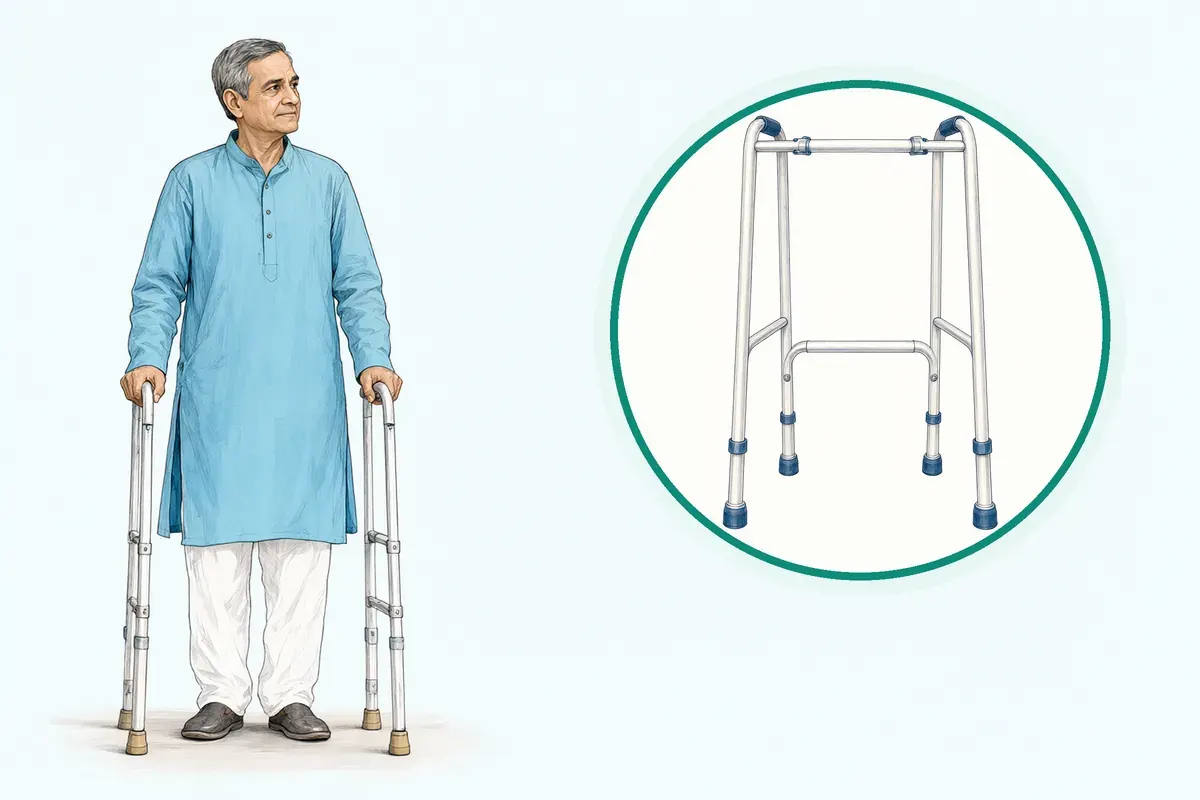
You will start walking with a frame on the day of surgery or the next day, under the supervision of the physiotherapy team. The frame gives you the most stability while your new knee gets used to taking weight.
Move the frame forward first, then step forward with your operated leg, brace that knee, and step through with your other leg. You will also begin exercises on the ward: static quads, end-range extension, seated quads and knee bends, each done 10 times, three to four times a day.
Take your pain medicine before each exercise session and use ice afterwards to keep swelling down. Do not place a pillow under your knee while resting, as this can make it harder to straighten the leg later. Keep your leg raised on a stool or the bed when you are not walking or exercising.
Moving from walker to stick
- When to switch
- Confident, no limp, physio agrees
- Which hand
- Opposite the operated knee
- Typical timing
- Around six weeks after surgery
Most people use a walker or two crutches for the first few weeks. You can progress to one crutch or a walking stick when you feel confident, can walk without a limp, and your physiotherapist agrees you are ready. Hold the single stick in the hand opposite your operated knee.
In studies, many patients reach this stage by about six weeks after surgery, but the exact timing varies. Continue to increase your walking distance a little each day as comfort allows. Do not stop using the aid until your care team reassesses you and says it is safe.
Walking inside the house without support
- NHS minimum wait At least six weeks
- Typical milestone Around 12 weeks after surgery
Walking indoors without any aid usually becomes possible when you have good balance, no limp, and enough strength in your thigh muscles to support your weight. Evidence suggests most people reach this milestone by around 12 weeks after surgery. The NHS advises waiting at least six weeks before trying to walk without an aid, and only if you feel ready.
Your physiotherapist will check your progress and tell you when it is safe to try short distances at home without support. Build up slowly and keep a stick nearby until you are fully confident.
Safe way to use stairs in the first month
- Going up Good leg, operated leg, then aid
- Going down Aid first, operated leg, then good leg
- Keep aid on same step While going up
Use a banister rail whenever you can. Going up: lead with your unoperated leg, then bring your operated leg onto the same step, then bring your crutch or stick up. Going down: place your crutch or stick on the step below first, step down with your operated leg, then follow with your unoperated leg.
Keep your walking aid on the same step you are standing on while going up. Continue this pattern until you feel strong enough to manage stairs normally, which is often around six weeks.
Daily home exercises that matter most
Your physiotherapist will give you a set of exercises to do three to four times a day.
The core movements are:
- Static quads
- End range extension
- Seated quads
- Knee bends
Static quads are done by pulling your foot towards you and pushing your knee down against the bed, holding for five to ten seconds and repeating ten times.
End range extension uses a rolled towel under the ankle; you tighten your thigh to straighten the knee and try to touch the bed with the back of your knee, holding for ten to fifteen seconds for ten repetitions.
Seated quads are done sitting in a chair: pull your toes up, tighten your thigh to straighten the knee slowly, hold for five to ten seconds and repeat ten times. Knee bends are done with your thigh supported on a chair; bend your knee as far as you can, hold for fifteen to twenty seconds and repeat five times.
If your knee struggles to go fully straight, rest your heel on a pillow or stool without support behind the knee for as long as you can tolerate. Take your pain relief before you exercise and apply ice after each session.
Do not put a pillow under your knee in a bent position, as this can make it harder to straighten later.
Managing swelling and a stiff knee after physio
Do
- Raise leg above hip
- Balance cold, pain relief, physio
Avoid
- Avoid long standing
Raise your leg on a stool or on the bed so that your foot is higher than your hip. Apply an ice pack three to four times a day for fifteen to twenty minutes, especially after you finish your exercises. Balance cold treatment with your pain relief and the amount of physio you do in the first couple of weeks. Avoid standing for long periods, as this can make the ankles swell.
When to contact your doctor or physiotherapist
Tell them if pain stops you from doing your exercises or sleeping, even after you have taken your regular pain relief. If you are unsure whether a symptom is normal, it is safer to ask your physiotherapist or doctor than to wait.
