

Anaesthesia and Critical Care · Jaipur Hospital
Non-invasive Ventilation (BiPAP) in Jaipur
Breathing failure or COPD flare-up? We assess, fit BiPAP and monitor you in ICU.
- Serving Jaipur since 1991 (35 years)
- NABH accredited
- 24×7 emergency & ICU
- Cashless: MAA Yojana + 32 insurers
- Treatment length
- Hours to days, intermittent or continuous
- Anaesthesia
- Not needed
- Recovery
- Monitored in ICU or HDU
- Price
- ₹3,000 to ₹8,000 per daytypical range in India; ask us for an estimate
Breathing becomes a struggle
You cannot get enough air and carbon dioxide builds up
Breathlessness worsens, the chest feels tight, wheezing increases and thinking gets fuzzy as carbon dioxide rises.
-
Rising carbon dioxide
Causes confusion, drowsiness and worsening breathlessness.
-
Low oxygen levels
Leaves you exhausted and unable to do usual activities.
-
COPD flare-ups recur
Many patients return to hospital within a month.
-
Mask discomfort
Some people find the tight mask hard to tolerate at first.
A build-up of carbon dioxide in the body is very dangerous and different treatments may be able to help with this.
Why Jaipur Hospital
You worry that sudden breathlessness may leave you unable to speak for yourself or force a tube down your throat.
Your care plan
Your first steps with us
- 1 Call or visit emergency for immediate assessment
- 2 Start BiPAP with mask fitting and pressure titration
- 3 Stay in ICU or HDU with continuous monitoring
- 4 Step down to ward, then home with follow-up plan
Insurance and schemes
How cashless works
Cashless treatment under MAA Yojana and with 32 insurers.
-
Tell us when you book
Say you are insured or have a scheme card, and send a photo of the card on WhatsApp so our insurance desk can check it in advance.
-
We get the approval
Once your doctor advises admission, the insurance desk sends the pre-authorisation request to your insurer or TPA; for planned surgery, approval can come before you are admitted.
-
Settled at discharge
The approved amount is settled between the insurer and the hospital; you pay only what the policy does not cover.
How the operation is done
A mask is fitted, pressures are set and blood gases are checked after 60 to 90 minutes to confirm improvement.
-
BiPAP S/T Mode
Spontaneous or timed backup breaths for COPD patients who need assured ventilation.
-
CPAP Mode
Constant pressure helps push fluid out of the lungs in cardiogenic pulmonary oedema.
-
AVAPS / iVAPS
Volume-assured pressure support adjusts to deliver a target tidal volume.
-
High-Flow Nasal Cannula
Warmed, humidified high-flow oxygen can be an alternative or step-down from BiPAP.
Why patients trust us
- 1991 Serving Jaipur for 35 years
- NABH Accredited hospital
- 1 Anaesthesia and Critical Care consultants
- 24×7 Emergency, ICU and ambulance
- 32 Cashless insurers, plus MAA Yojana
What research shows about this treatment
-
77% improved or stabilised at 10 days
In a COVID-19 ARDS cohort, 77 percent of patients showed improved or stable respiratory condition at 10 days.
-
Median 3 days ICU stay with high-flow
High-flow nasal oxygen patients had a median ICU stay of 3 days versus 4 days with non-invasive ventilation.
-
42.9% adverse effects needing withdrawal
Adverse effects requiring therapy withdrawal occurred in 42.9 percent of non-invasive ventilation patients versus none in the high-flow group.
If it is left untreated
Without support, severe respiratory failure can lead to dangerously high carbon dioxide, worsening acid levels in the blood and a rising risk of death.
Life after treatment
Most people stop non-invasive ventilation within a few days and go home with a plan to prevent the next flare-up.
-
Breathing eases
Oxygen and carbon dioxide levels usually return to your baseline within days.
-
Mask-free days
You spend more time off the machine each day until it is no longer needed.
-
Fewer crises
Optimised inhalers, vaccinations and early action cut the chance of another admission.
-
Home plan ready
If long-term support is needed, we arrange a home device and teach you to use it.
Meet the team
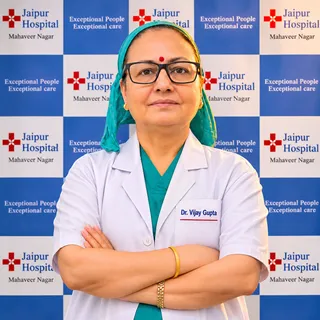
Your anaesthesia and critical care doctors
Explore our anaesthesia and critical care department in Jaipur: every treatment, the doctors and what to expect at your visit.
Frequently asked questions
Questions patients ask about non-invasive ventilation (bipap)
Do I need surgery or a breathing tube for this?
No, BiPAP is non-invasive ventilation that uses a mask instead of a tube placed in the windpipe.
It helps you breathe by delivering air at two pressure levels through a face or nasal mask. Jaipur Hospital provides this treatment in the ICU or HDU for acute respiratory failure and COPD exacerbations. A tube is only considered if BiPAP does not improve your condition.
How long does the treatment take each day?
You may need BiPAP continuously or for several hours a day depending on your breathing.
In the first 24 hours the mask is worn as much as possible with short breaks to eat and drink. Over the next days the time on the machine is reduced as you improve. Jaipur Hospital staff adjust the schedule daily based on your blood gas results.
Will I need anaesthesia or be put to sleep?
No anaesthesia is needed for BiPAP.
You stay awake and breathe on your own while the machine supports each breath. Most patients are fully conscious during treatment. Jaipur Hospital may give a small dose of sedation only if you feel very anxious or panicky with the mask.
Is BiPAP painful or uncomfortable?
BiPAP is not painful but the mask can feel tight or strange at first.
You may get a dry mouth, nasal dryness, stomach bloating or pressure marks on the nose bridge. Jaipur Hospital nurses fit the mask carefully, use a humidifier and adjust straps to improve comfort. Breaks are allowed for meals and to clear phlegm.
How many days will I stay in hospital?
A typical stay is 2 to 7 days for acute respiratory failure or a COPD flare-up.
Most people stop BiPAP after about three days if blood gases improve. Jaipur Hospital monitors you in the ICU or HDU and decides discharge based on daily arterial blood gas tests and how well you breathe off the machine.
When can I go back to work or normal activity?
You can start moving around in bed or sitting in a chair as soon as you feel able, often on day one.
Return to work depends on the underlying illness and how quickly your breathing stabilises. Jaipur Hospital doctors advise on activity level at discharge; many patients need a week or two at home before resuming full duties.
What are the main risks or side effects?
Common issues are mask leaks, skin irritation on the nose bridge, dry mouth, bloating from swallowed air and feeling claustrophobic.
Rare but serious risks include a collapsed lung (pneumothorax), vomiting with aspiration, low blood pressure or irregular heart rhythm. Jaipur Hospital nurses check the mask fit and your vitals frequently to catch problems early.
What does it cost and will insurance cover it?
The typical range in India is ₹3,000 to ₹8,000 per day for the machine, monitoring and consumables.
Jaipur Hospital accepts MAA Yojana and a panel of private insurers and TPAs for cashless care. The final bill depends on the number of days you need support and any medicines or tests required.
What happens if I do not have BiPAP?
Without support, carbon dioxide can build up and oxygen can fall to dangerous levels, leading to severe respiratory failure, confusion, coma or death.
BiPAP gives the lungs a chance to recover while treating the cause. Jaipur Hospital starts treatment promptly when blood gases show you need it to avoid these complications.
When you contact us
Get assessed and a clear plan
Contact Jaipur Hospital for an OPD consultation with our anaesthesia and critical care specialist, a cost estimate and help with cashless admission.
- A consultation with an anaesthesia and critical care specialist in the OPD
- Your scans and reports reviewed, with tests done in-house if you need them (laboratory, X-ray and imaging)
- Your options explained in plain words, including whether you need surgery at all
- A cost estimate before you decide
- Help with cashless treatment under MAA Yojana and empanelled insurers and TPAs
- Follow-up visits after your treatment
Overview
Non-invasive Ventilation (BiPAP): what to know
What is Non-invasive Ventilation (BiPAP) and how it works
- Machine
- Delivers air through a mask
- Two pressures
- Higher when you breathe in, lower when you breathe out
- No tube in windpipe
- Mask only, no invasive tube
- Humidifier
- Warms and moistens the air
Non-invasive Ventilation (BiPAP) is a treatment that helps you breathe when your lungs cannot do the work on their own. A machine delivers air through a mask that fits over your nose, or your nose and mouth. The machine gives a higher pressure when you breathe in and a lower pressure when you breathe out.
This two-level pressure is why it is called BiPAP, short for bilevel positive airway pressure. The mask is held in place with soft straps. No tube is placed into your windpipe.
The machine sits at the bedside. A tube connects the motor to the mask. A heated humidifier may be added to warm and moisten the air. Nursing staff set up the machine, check the mask size, and start the flow. You will hear a loud rush of air at first.
The nurse holds the mask gently so you can get used to the feeling, then secures the straps. The mask should fit snugly around the nose, cheeks and chin without pain.
The treatment supports your lungs while your body heals from the illness that caused the breathing failure. It is used for acute respiratory failure and for flare-ups of chronic obstructive pulmonary disease (COPD).
Most patients stay awake during treatment. Small doses of sedation may be given only if anxiety or panic makes it hard to keep the mask on.
Symptoms and warning signs that need urgent care the same day
- Worse breathlessness More than your usual level
- Confusion or drowsy Cannot stay awake or think clearly
- Blue lips or fingertips Late sign of low oxygen
A build-up of carbon dioxide in the blood causes:
- Breathlessness that is worse than your usual level
- Tightness in the chest
- More wheeze than normal
- "fuzzy" thinking with difficulty concentrating or confusion
Low oxygen levels may make you feel very short of breath, unable to speak in full sentences, drowsy, or cold and clammy. Blue lips or fingertips are a late sign.
If you have a known lung condition and your breathing suddenly gets much worse, or if you become confused or cannot stay awake, call an ambulance or come to the emergency department straight away. These are signs that non-invasive ventilation or other urgent support may be needed.
Causes and who is at higher risk
- COPD flare-up
- Common cause of respiratory failure
- Readmission risk
- 1 in 4 to 1 in 5 readmitted within 30 days
- Other risk factors
- Heart failure, obesity, neuromuscular disease, recent surgery
- Age and multimorbidity
- Over 65 with multiple conditions raises risk
Acute respiratory failure happens when the lungs cannot get enough oxygen into the blood or cannot remove carbon dioxide.
Common causes include:
- A severe flare-up of COPD
- Severe pneumonia
- Cardiogenic pulmonary oedema (fluid in the lungs from heart failure)
- Respiratory failure after surgery or in people with weakened immunity
People at higher risk include those with long-standing COPD, especially if they have had a previous flare-up needing hospital care. Between 1 in 4 and 1 in 5 people admitted with a COPD flare-up are readmitted within 30 days. Other risk factors are heart failure, obesity, neuromuscular disease, and recent chest or abdominal surgery. Age over 65 and multiple long-term conditions also raise the risk.
How it is diagnosed: examination and tests
The doctor checks your breathing rate, oxygen level, heart rate, blood pressure, and level of alertness. They listen to your chest for wheeze, crackles, or reduced air entry.
An arterial blood gas test takes a small sample from the artery at the wrist. It measures oxygen, carbon dioxide, and acidity (pH) in the blood. This is the key test to decide if non-invasive ventilation is needed.
A chest X-ray looks for pneumonia, fluid, air leaks, or other problems that would change the plan. It also checks for reasons not to use non-invasive ventilation.
Blood tests check:
- The blood count
- Kidney and liver function
- Signs of infection
An ECG checks that the heart is not under strain from the lung condition.
If the oxygen level is low, the carbon dioxide level is high, and the blood has become acidic, non-invasive ventilation may be started.
Treatment options without surgery, and when invasive ventilation is advised
BiPAP modes
- S/T mode For COPD flare-ups
- CPAP mode For fluid in lungs from heart failure
- AVAPS or iVAPS Volume-assured pressure support
Alternative
- High-flow nasal cannula Warmed humidified oxygen through nasal prongs
Non-invasive ventilation (BiPAP) is the first choice for many people with acute respiratory failure from a COPD flare-up or cardiogenic pulmonary oedema. The machine can run in spontaneous/timed (S/T) mode for COPD, CPAP mode for fluid in the lungs from heart failure, or volume-assured modes such as AVAPS or iVAPS.
High-flow nasal cannula (HFNC) is an alternative or a step-down from BiPAP. It gives warmed, humidified oxygen at high flow through soft nasal prongs. In studies, high-flow oxygen was not inferior to non-invasive ventilation for preventing reintubation after a breathing tube is removed.
If you do not want or cannot tolerate the mask, very controlled oxygen through a face mask or high-flow nasal oxygen may be considered.
BiPAP is not life support. It does not take over breathing completely like a ventilator with a tube in the windpipe.
If BiPAP does not improve the blood gases after 60 to 90 minutes, or if you become too drowsy, cannot protect your airway, or your condition worsens, the team may advise invasive mechanical ventilation with a tube in the windpipe.
Some people who do not want a breathing tube but want some assistance may choose to stay on BiPAP as a ceiling of care. Others may move from a ventilator to BiPAP as their breathing improves.
Typical hospital stay is 2 to 7 days. Treatment runs from hours to days, either continuously or with breaks. In the first 24 hours the mask is worn as much as possible with short breaks to eat and drink. After that, time off the machine increases each day. Most people stop non-invasive ventilation after three days.
Oxygen level is monitored continuously for at least the first 24 hours. Doctors review you daily. Nurses check the mask fit regularly and help with food and drinks. Early mobilisation is encouraged — getting out of bed as soon as you are able keeps muscles strong and helps recovery.
Common side effects are:
- Mask discomfort
- Claustrophobia
- Nasal dryness
- Skin irritation or pressure sores on the nasal bridge
- Air leaking into the stomach causing bloating or vomiting
- Dry mouth
- Eye or sinus irritation
A humidifier, a different mask type or size, strap adjustment, or a lower pressure setting can help.
If you need BiPAP for more than a few days straight, you must be able to take breaks — either breathing without the machine or using low-flow oxygen through a nasal cannula.
Typical cost in India is ₹3,000 to ₹8,000 per day. The final amount depends on the length of stay, the ICU or HDU bed category, medicines, and investigations. Jaipur Hospital is NABH-accredited and in service since 1991. Cashless care is available under MAA Yojana and our panel of private insurers and TPAs. Ask us for an estimate.
Your first visit and tests for BiPAP treatment
When you arrive with breathing difficulty, your doctor will ask about your symptoms, past lung problems, current medicines and any allergies. You should bring your regular medicines, any recent blood reports, chest X-rays and a list of questions. The doctor examines your breathing rate, oxygen level, heart rate and blood pressure.
An arterial blood gas test from the wrist measures oxygen, carbon dioxide and acidity levels of the blood. A chest X-ray checks for pneumonia, fluid, air leaks or other reasons that would stop the team giving non-invasive ventilation.
Blood tests check:
- Blood count
- Kidney function
- Liver function
- Signs of infection
An ECG checks that the heart is healthy and not under strain from the lung condition. If the oxygen level is low, the carbon dioxide level is high and the blood has become acidic, non-invasive ventilation may be needed. The team explains the treatment, the mask and what to expect, and answers your questions before starting.
How BiPAP treatment works
- Machine at bedside Nursing staff set up the breathing machine next to you
- Mask size checked Right-sized mask is checked before treatment
- Mask attached Mask connected to machine by a long tube
- Start and fit Machine started, nurse holds mask gently, then secures straps
- Pressure adjusted Team adjusts air pressure until settings are correct
BiPAP is a type of noninvasive ventilation that helps you breathe by delivering air through a mask on the face. It uses a lower pressure when you breathe out than when you breathe in. The two pressure levels are called inhalation positive airway pressure (IPAP) and exhalation positive airway pressure (EPAP).
Machine settings can set the timing of the two pressures (timed) or adjust the pressure based on your breathing pattern (automatic). Your surgeon will advise which mode suits you.
Options include:
- BiPAP S/T mode, which gives a spontaneous timed backup breath for COPD
- CPAP mode, which gives the same pressure whether breathing in or out and is used for cardiogenic pulmonary oedema
- AVAPS or iVAPS, which provide volume-assured pressure support
High-flow nasal cannula may be used as an alternative or step-down from non-invasive ventilation. The breathing machine is set up next to you by nursing staff. The right-sized mask is checked before treatment. The mask is attached to the machine by a long tube. The machine is started and a loud sound of rushing air is heard.
The nurse holds the mask gently on your face to allow you to get used to the sensation. The mask is secured with soft straps around the head. It should fit snugly and firmly around the nose, cheeks and chin and should not be painful or uncomfortable.
The team adjusts the pressure of the air flowing into the lungs until settings are correct. Most patients are awake during treatment. Small doses of sedation may be given to help with anxiety or panic. You will not receive the full benefits if you do not use the machine as directed.
It is important not to eat or drink anything while using BiPAP because you might inhale food or liquid into your lungs. Treatment length is hours to days, intermittent or continuous. Recovery is monitored in the ICU or HDU. Hospital stay is typically 2 to 7 days.
Risks and possible complications of BiPAP
Do
- Try a different mask Facial mask may lessen eye or sinus symptoms
- Use humidifier Reduces nasal dryness
- Adjust straps or pressure Can help with leak, skin irritation, stomach bloating
Avoid
- Mask too tight Can cause skin damage, nasal bridge pain or ulcers
- Mask leak Less pressure delivered, eye irritation
BiPAP is usually very safe and has a lower risk of complications such as infection compared with invasive ventilator support or tracheostomy. Most problems involve the face mask. A mask may fit too tightly and cause local skin damage, nasal bridge pain or ulcers. Leaking from the mask can cause less pressure to be delivered and eye irritation.
Mild stomach bloating, dry mouth, trouble clearing phlegm, sinus pain or sinus congestion can occur.:
- Mild stomach bloating
- Dry mouth
- Trouble clearing phlegm
- Sinus pain
- Sinus congestion
Anxiety or claustrophobia may prevent you from keeping the mask on and cooperating with the ventilator. Feeling of claustrophobia is a possible side effect at the start of treatment, which most people get used to quickly. A humidifier may help reduce nasal dryness. Using a facial mask instead of a nasal mask may lessen eye or sinus symptoms.
Headaches could be due to sinus congestion. An antihistamine or nasal steroid spray may be prescribed for these symptoms. If you have a leaky mask, skin irritation or pressure lines, you may need a different size or type of mask. Adjusting the straps around your mask may help. Reducing the pressure setting may prevent stomach bloating.
Pneumothorax (collapsed lung) is a possible side effect where the breathing machine increases air pressure causing lungs to over-expand. Sickness and vomiting can occur where increased pressure forces air into the stomach. Low blood pressure and irregular heart rhythms or pulses are very rare possible side effects. If non-invasive ventilation is unsuccessful, some patients will not survive.
If it is unsuccessful, going to intensive care and potentially being put to sleep and placed on an invasive ventilator may allow time for the body to recover. BiPAP is not life support and does not take over breathing entirely like invasive mechanical ventilation does.
If you need to be on BiPAP for more than a few days straight, you need to be able to take breaks, either breathing without the machine or getting extra oxygen through a small tube under the nose. BiPAP can feel uncomfortable and take some getting used to.
Recovery and aftercare after BiPAP
- Day 1 Mask as much as possible, short food and drink breaks
- Day 2 16 hours including 6 to 8 hours overnight, 1 to 2 hour breaks
- Day 3 12 hours including 6 to 8 hours overnight
The nurse checks very regularly to make sure there are no problems with the mask and helps with food and drinks. Oxygen level is monitored continuously for the first 24 hours at the least. Doctors see you every day to check that the treatment is working well.
In the first 24 hours, the breathing mask must be worn as much as possible but regular breaks to eat and drink are allowed. After the first 24 hours, you spend more time off the breathing machine and can eat and drink as normal. Most people will stop non-invasive ventilation treatment after three days.
On Day 1, non-invasive ventilation is used as much as possible, including overnight when sleeping, with short food and drink breaks. On Day 2, it is used for 16 hours including 6 to 8 hours overnight, usually with 1 to 2 hour breaks in the morning, afternoon and evening.
On Day 3, it is used for 12 hours including 6 to 8 hours overnight. If you are able, you can get out of bed during the first day of treatment. It is advised to get out of bed and start moving around as soon as possible to keep muscles strong and help recovery.
After 60 to 90 minutes on the breathing machine, another arterial blood gas is taken from the wrist. If the blood test shows that oxygen, carbon dioxide and acidity levels are better, the treatment is working and no changes will be made. If things have not improved, the team will make adjustments and check again.
Unless treating sleep apnoea, most people are only on BiPAP until they can breathe well enough on their own again. If your health problem gets better, you may be able to start using less pressure on your BiPAP machine or use the machine less frequently. Work with your healthcare team to get the most suitable treatment.
COPD flare-ups can last days or weeks, even with BiPAP treatment. Call the hospital if you develop new or worsening breathlessness, confusion, fever, or if the mask causes skin breakdown that does not improve with adjustments.
Results of BiPAP treatment in studies
In studies of patients treated outside the ICU with non-invasive ventilation, 37 out of 57 improved and suspended NIV, 7 remained stable, and 13 worsened with 10 deaths and 3 admitted to the ICU. Of ICU-treated patients, 32 out of 43 improved, with 17 taken off the ventilator and discharged to the ward, 1 remained stable, and 10 died.
At 10 days, 77% of patients had improved or stabilised respiratory condition, 61 showed significant clearing of diffuse bilateral opacities on chest X-ray, 15 were discharged, and 23% had worsened respiratory condition with 20% of those dying.
In a 12-month study of home oxygen plus home NIV versus home oxygen alone, the median time to readmission or death was 4.3 months in the home oxygen plus home NIV group versus 1.4 months in the home oxygen alone group.
At 12 months, 16 patients had died in the home oxygen plus home NIV group versus 19 in the home oxygen alone group. The 12-month risk of readmission or death was 63.4% in the home oxygen plus home NIV group versus 80.4% in the home oxygen alone group, an absolute risk reduction of 17.0%.
High-flow conditioned oxygen therapy was not inferior to NIV for preventing reintubation and post-extubation respiratory failure in high-risk adults after extubation. The median time to reintubation was 26.5 hours in the high-flow group and 21.5 hours in the NIV group.
The median post-randomisation ICU length of stay was 3 days in the high-flow group and 4 days in the NIV group. Between 1 in 4 and 1 in 5 people admitted with a flare-up of COPD will be readmitted within 30 days. These results come from groups of patients in studies and may not reflect what happens to any one person.
Cost and insurance for BiPAP in Jaipur
The typical price range in India for BiPAP treatment is ₹3,000 to ₹8,000 per day.
This is not Jaipur Hospital's own price list; the actual cost depends on the number of days you need the machine, whether you stay in the ICU or HDU, the type of mask and humidifier used, medicines, investigations and any other treatments given at the same time. Ask us for an estimate based on your condition.
Jaipur Hospital is NABH-accredited and in service since 1991. For cashless care, the hospital is empanelled under MAA Yojana and a panel of private insurers and TPAs.
The hospital has:
- 24×7 emergency department
- 24×7 ambulance service
- Intensive Care Unit
- In-house pharmacy
- In-house diagnostic laboratory and imaging including X-ray (no CT or MRI scanner, no DEXA machine)
- Canteen with dietary meals
- Preventive health check packages
- 24-hour laboratory, X-ray and ECG
- Modular operation theatres
Departments include Pulmonology, Anaesthesia and Critical Care, General Medicine and others. Contact the hospital on 0141-2551500, 0141-2554139 or 7414 001 001, or email [email protected] for admission and insurance queries.
